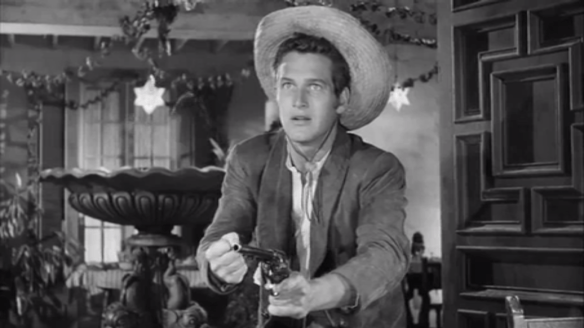
The Left Handed Gun (1958)

left handed gun 1.png

Few figures in the West have the mystique in western lore as Billy the Kid, aside from a few prominent names like Wyatt Earp, Butch Cassidy, Jesse James, etc. Billy Joel even famously penned a tune chronicling the life of the outlaw.

Part of the allure, no doubt, has to do with his youth and the casting of the man as a Robin Hood type anti-hero who only robbed those with excess. Inspired by a teleplay by Gore Vidal (who for the record disliked the picture), television-turned-film-director Arthur Penn makes a conscious decision to focus his story on other facets of the character.

Although slightly older, Paul Newman came into acting about the same time as James Dean and in some respects they were cut out of the same mold. At any rate, they came from a similar school of actors training in the 1950s. Though Newman was no Dean, he does a fine facsimile here. He gives a, at times, disconcerting but overwhelmingly giddy performance as Billy the Kid and somehow his age of 33 doesn’t seem to distract from the part too much. Because he’s still holding onto a decent amount of his boyish charm and good looks.

Leslie Stevens’ script features terse often tiresome colloquial dialogue in a downright peculiarly paced western. However, this is not the main point of interest anyway. For the record, William Bonney (Paul Newman) drifts onto a ranch and is taken on by a trusting cattle rancher John Tunstall (Colin Keith-Johnston). But that same penchant for trust winds up getting him killed in an ambush.

Though he only knew the man for a short period, Billy carries a fierce loyalty and resolves to go after the four men who conspired in killing his boss pulling, his reluctant partners Charlie Bowdre and Tom Folliard into it with him. Allusions to “Through a glass darkly” from Corinthians suggests a bit of the muddled kaleidoscope that the man envisions the world through.

One morning he’s howling with his boys on a wagon heaped with flour, caked in white and the next minute he’s provoking another man to draw on him just so he can blow him away. His old friend, Pat Garrett (John Dehner), has trouble knowing what to do in the face of William’s lighting-hot personality.

The newly minted amnesty in the territory means a temporary peace, instantly obliterated by a moment of stupidity among Billy’s buddies. Though the novels back east have cast him as some fictionalized larger-than-life figure, he’s really nothing like that at all.

His buddies get it and then as the final straw, Pat vows to hunt down his estranged friend, putting on the badge of the local sheriff, after an unwanted blowup at his own wedding. Billy has alienated the one man who will make him pay. First, he brings him in to be hung and then after the kid escapes, Garrett heads out again to finish things off once.  It’s a pitiful character arc and that’s the key.

While it might be overshooting its influence to say that the Left Handed Gun singlehandedly erected a new brand of western, at the very least, it suggested a new age of the West as we knew it. Beyond this, it’s hard not to draw parallels to Penn’s later work in Bonnie and Clyde (1967) which The Left Handed Gun is an obvious precursor to in the depiction of the outsider who uses violence almost indiscriminately.

One scene that leaves an impression involves a blurred image as Billy taunts a deputy from up above, toting a shotgun and blowing him away as he squints through the sunlight. Not only is it composed as a slo-mo killing but as his body lies in the street and people run toward him, instead of screaming, a little girl looks at his solitary boot just sitting there and proceeds to point and laugh. Her mother smacks her but the damage has been done. His death is a joke. There’s no point to it. People fail to react as they have been coached to since the dawning of the cinematic western.

There’s a senselessness to the killing which explodes with an almost haphazard vengeance. In no accordance with reason or morals nor in the end by perceived good or evil. Each bullet is yet another indication of all that is idiosyncratic in the subject matter. Not a hero, not a villain, but a perplexingly near neurotic gunslinger.

Whether it’s to everyone’s taste is another question entirely. It’s more character study than drama and in this close observation, it’s the distillation of a new kind of western hero — the anti-hero, or lack thereof, that is most notable. Today it’s less interesting because we have Peckinpah, Clint Eastwood, and even Butch Cassidy and the Sundance Kid (1969).

But as a picture going against the grain, an artifact from a certain moment in time, there’s still something burning within its frames. Even if it’s not a fully cohesive effort, The Left Handed Gun is not without its flashes of artfulness and intriguing volatility. It began the work of reconstructing the mythos of the West that had been forged in the movies though there was still a great deal more to come. In fact, Arthur Penn would return to western revisioning with Little Big Man (1970) over a decade later.

3/5 Stars

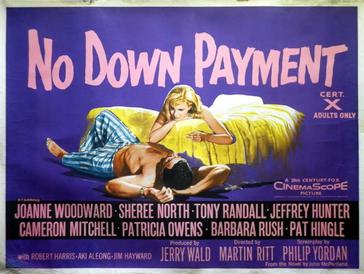
No Down Payment (1957)

No_Down_Payment_-_poster.jpg

When a film seems to materialize in front of you coming out of nowhere and subsequently moves you, it seems worthy to try and champion it to others who might also be pleasantly surprised. But first, I believe an acknowledgment of director Martin Ritt is in order because I’m not sure how much adulation he usually gets amid the myriad of prominent Hollywood workhorses out there.

Though he first started out in the theater and then television during The Red Scare years, Ritt ultimately transitioned to movies with a body of work full of variety that has all but stood the test of time on numerous accounts. Highlights include a six-film collaboration with Paul Newman including the likes of The Long, Hot Summer (1958), Paris Blues (1961), Hud (1963, and Hombre (1967). Other noteworthy successes many will know are The Spy Who Came in From The Cold (1965), Sounder (1972), and Norma Rae (1979).

He is most definitely an adherent to progressive, socially conscious filmmaking that, while never flashy in formalistic aspects, is nevertheless, chock full of depth for its commitment to humanist storytelling. It’s meant to ring true and touch on subjects that pertain to real people and the world-at-large captured through a lens of stark realism. To his credit, Ritt would never claim the title “Auteur” because he himself spent time as an actor and understood how collaborative such an art form is.

That brings us to the picture at hand, No Down Payment, which while being one of his earlier directorial efforts for film, already has his sensibilities in place. There’s nothing flashy about the picture per se but it readily digs into issues that feel uncommon and cutting edge for the very fact that we rarely see them portrayed in the 1950s. This film provides a very special opportunity and I was more than happy to oblige.

To put it succinctly, our story takes place in the residential neighborhood of Sunrise Hills. What we get is a disillusioning portrait of 1950s suburbia specifically in Los Angeles, that beacon of post-war middle-class living, observing the overlapping existence of four couples.

I enjoy how everything seems to be underlined by party chatter, Cowboys and Indians on the television, and groovy rockability — all integral parts of the ubiquitous soundtrack of the suburbs. But there’s also a veneer with two layers. The outward-facing street view with white picket fences and barbeques with the neighbors and then what’s actually going on, either when the doors are closed or when you can’t contain it anymore and rancor slowly asserts itself. Underneath we also soon realize that everybody is afraid of something.

A young couple just moving in is brought into the fold of the community. The husband (Jefferey Hunter) works as an up-and-coming electrical engineer while his pretty wife (Patricia Owens) urges him to get in a more lucrative field like sales so they can grow their social status.

If your image of Tony Randall is a nice guy or a hypochondriac, try on a philandering day drunk car salesman for size. Jerry Flagg constantly has his wife Isabelle (Sheree North) exasperated because he’s always strapped for cash and never dependable, with aspirations that keep him constantly flocking to the next big idea. Of course, he’s never able to see any of them to fruition.

Arguably, the least done up of any of the husbands is Troy (Cameron Mitchell), a war hero and Tennessee native who currently works as a car mechanic but soon hopes to be brought on as the local police chief. In fact, he’s banking on it. His wife, Leola Boone (Joanne Woodward) is intent on it as well since he’s promised they can have a child once he has greater job stability. She’s tried to bury painful memories of the baby she was once forced to give away. They too are plagued by marital bickering and late night alcohol consumption.

Last of all is Herman Kreitzer (prolific TV actor Pat Hingle) and his wife Betty (Barbara Rush). While she takes the children to church on Sunday, he stays at home and washes his car out on the street. Otherwise, there’s little discord in the house as he’s a loving husband and father who runs an appliance store and is a member of the local homeowner’s board.

Ritt’s picture, with yet another script fronted by Philip Yordan and actually written by Ben Maddow, has innumerable topics of interest. However, two that were the most intriguing to me had to do with the Kreitzers. Because it just so happens that Herman’s best employee, a man named Iko (Japanese-American though played by Aki Aleong), requested help in getting his family a home in a predominantly white neighborhood. As is, he currently has a taxing commute to work every day.

And though Herman is a good man, he’s hesitant to get involved knowing full well that housing developments have long been run by de facto laws of segregation. L.A. was like any other area where African-Americans were in places like Watts and Japanese-Americans were concentrated in Little Tokyo and even Boyle Heights for a time. That’s just the way it was. You stayed with your kind.

People wouldn’t like it one bit. Off the top of his head, he knows Troy, who fought in the Pacific, wouldn’t be too keen on a “Japanese” living in the neighborhood. So Herman ultimately brings the conversation to his church-going wife who voices similar apprehension (“Do you think you’re ready to have a Japanese as a neighbor?”). It’s this conversation over the kitchen table that causes him to reconsider. Because you see we already know he’s not a churchgoer and part of the reason we can guess has to do with the hypocrisy that is often so easy to find fault with.

That brings us back to Iko and his family. As Herman sees it, what good is a church if it doesn’t lend a helping hand to someone who needs it. How can you say you’re a “Good Christian” and not do anything to help these people? The issue is hardly resolved then and there but it’s a start. At least, in this case, we get the hint of closure in the end. Other threads aren’t nearly as sanguine.

It’s fitting that we return to an establishing shot of that perfect piece of the suburbs and all our main players are at church the following Sunday. Except for one, it means a long drive in a taxi cab to who knows where. While the others will make a go of trying to preserve their dreams, this lonely individual’s exodus is a reminder of how quickly our aspirations can crumble.

4/5 Stars

God’s Little Acre (1958)

God's little acre 1.png

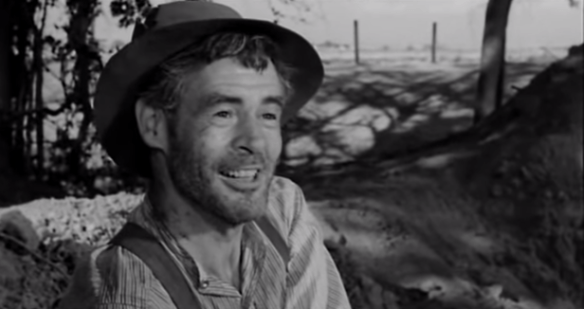
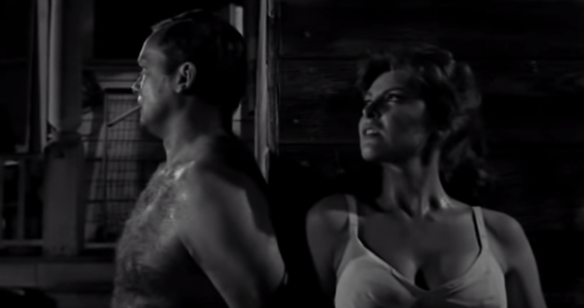
If there was an atypical even offbeat Anthony Mann picture, then God’s Little Acre would probably fit the bill. Based on the wildly popular and vehemently decried Depression-era work of the same name by Erskine Caldwell, it essentially serves as a second outing for much of the cast and crew involved with a picture from the year prior, Men in War (1957).

We have Mann reteamed with his favorite, Robert Ryan, and young Aldo Ray. Then, most prominently, we have cinematographer Ernest Haller and composer Elmer Bernstein returning. Even Phillip Yordan once more fronts for blacklisted Ben Maddow. And yet the actual results are oil and water.

The opening notes of a folksy title ballad sound off, seemingly more at home in a live-action Disney classic than a mainstream drama such as this. In truth, it’s an outmoded brand of melodrama. We just cannot hope to look at the pedigree the same way with its southern gothic and a hint of hillbilly.

That’s right. It’s part Jed Clampett, the other section Tennessee Williams, edgy and sweaty as any 50s film at its height. But what leaves an impression is not only the raciness for the day but the unadulterated playfulness. This is real Georgia down-home entertainment and it benefits from these qualities.

Ty Ty Walden (Ryan) is a slightly scatterbrained matriarch, who resolutely believes that his daddy left behind gold on their property. He’s hellbent on getting him a piece of the wealth and he’s pursued his aspirations by leaving his family acreage dotted with holes.

God's little acre 3.png

He’s dragged his two sons into it too (Jack Lord and Vic Morrow), who are both a bit neurotic in their own right. The jealous Buck is constantly at the throat of his ravishing bride Griselda (Tina Louise in a sweltering debut) believing she still has the hots for their brother-in-law Will Thompson (Aldo Ray), a man married to the eldest Walden gal (Helen Westcott). He’s not altogether wrong but he’s not helping the situation any either. Then there’s Shaw. He just repeats everything his older brother says. They’re not the sharpest tools in the shed. They take after their father.

Meanwhile, their youngest sister, the bodacious southern belle Darlin’ Jill, is quite the looker herself. Buddy Hackett is just about the same as we remember him in all his pictures. That voice. That blubbering. That rotund lovable girth. His character, the aptly named Pluto, comes looking to court Darlin’ Jill who strings him alone as is expected.

Otherwise, the cast also features a criminally underused Rex Ingram as a farmhand and Michael Landon in a thoroughly unique role as an albino. Though only a minor player, he proves a crucial component of the plot since Ty Ty is convinced that albinos have an impeccable radar for gold and he pressgangs the boy to use his remarkable abilities. The beauty is that no one seems to outrightly question such a notion. They just move along like normal. In the meantime, Darlin’ Jill has fun tantalizing her rotund suitor and making eyes at the intriguingly pale Dave Dawson.

The latter half of the story follows lusty looks and passionate clenches as forbidden love is rekindled between Will and Griselda. It seems like just about everyone is being pawed over by everybody else. Tremors are going through the household with Ty Ty putting it upon himself to bring his family together and keep them on amicable terms. It’s not such an easy task with so much dysfunction at hand.

Will’s wife is beside herself as her man gets drunk and has some vague notion of turning the power at the old plant on so work can commence again for all the impoverished locals. But Ty Ty’s also in a scrape for cash and relationships have only deteriorated into fiery hell between Buck and Will — a woman still caught between them.

What are the main takeaways from the picture? It’s a rather incredulous piece that’s provocative and dull and maladjusted all at the same time. Ryan once more shows his capability at ably anchoring an entire film. However, all I could think of was the fact that if God’s Little Acre had been a bit more conventional and garnered a few more accolades for hard-hitting drama, we might be remembering Tina Louise as a cinematic sex symbol instead of a “Movie Star” from Gilligan’s Island. Maybe some movies get buried serendipitously.

3/5 Stars


Men in War (1957)

men in war 1.png

“Tell me the story of the foot soldier and I’ll tell you the story of all wars.”

The date might seem arbitrary but we are told that this story takes place over the course of one day: Sept 6, 1950. Robert Ryan might as well be the stand-in for a Bill Mauldin G.I. as he leads a battalion cut off and deep in enemy territory. He’s got the 5 o’clock shadow and most other prerequisites. There’s a sense that he’s just trying to live through the day and keep his men alive for as long as possible — hopefully to see their way back home or at least to their brethren on the other side of the next hill.

But in order to get there, they must survive a line of snipers, a hailstorm of enemy artillery, and terrain laced with mines. If I had never seen The Steel Helmet (1951), Men in War would easily become one of the most crucial war movies for me. Because it dares to tell a narrative of war that rings fiercely resonant not simply because of cynicism or even pure authenticity. It has to do with a story stripped down to its bare essentials. Men in War is just that. It comes down to the semantics of what you think that actually means. But for the average soldier, it’s a moment by moment struggle to survive. It’s not about heroics at all. Instead, it entails methodical and level-headed action in the face of constant stressors verging on the absurd.

Though Hollywood might have suggested otherwise on various occasions, war was never about the glut of combat. It’s always lean and mean — proving to be disillusioning even to the victors and far more so to those who must stand defeated or draw a truce.

The best way I can find to describe this particular experience is through the influence of negative space. Because Mann’s film, in showing us less manages to evoke the exact inverse, suggesting what is not shown to be as vitally important as what is left in the frame. Far from lowering the tension, it only succeeds in making it all the more unnerving. There’s an ongoing sense of isolation and the enemy is left all but unseen.

Then, in a single moment, we realize they’re as afraid of us as we are of them. Actually, the adversary is only shown on a couple of brief occasions, most visibly with a surrendering Korean Soldier (played by Bonanza support Victor Sen Yung).

Aldo Ray is a soldier at his most cynical and insubordinate. The only thing more exasperating about him for Ryan is the fact that in most cases he’s right and more important still, he’s too ornery to be knocked off. But it’s almost odd how fiercely loyal he is the catatonic colonel (Robert Keith) who made it away from the lines with him.

James Edwards offers another obvious link to Fuller’s Korean War picture while serving up his usual foray in minor though intelligent portrayals of African-American soldiers. Men in War is devastating in how unsentimental and unsensational it is. The scenes with machine guns, flamethrowers, bazooka, and grenades feel palpably real. These are not infallible killing machines. Just men who are doing their best to stay alive and fight another day. Again, it’s about mere survival.

Here we have Mann’s earlier explorations in noir more fully externalized with a sense of psychological torment made visible in an environment of continuous unease. The action is taken outdoors while maintaining what we might call even an intimate interaction with its characters if it weren’t so harrowing. It’s likewise an extension of the director’s Western landscapes, though the palette is muted, it consequently plays a crucial role in shaping the drama as Mann usually takes particular care with his atmosphere.

Phillip Yordan’s involvement, whether the true author or only a frontman, might be slightly up for debate but what’s not is the fact that the script keeps the action clean and unfettered by strains of patriotism or similar endeavors. Elmer Bernstein, best remembered for his western scores of resplendent glory, nevertheless, delivers a piece with the right amount of understatement to compliment such a picture as this.

Again, Men in War is unassuming, even unspectacular, but that’s what makes it all the more deserving of discovery. By going against the grain with a few similarly formidable titles, it gave us a far more mystifying portrait of The Korean War. Because reconciling with that conflict is far from a straightforward task — as it is with most any war.

3.5/5 Stars

Man of the West (1958)

220px-Motw1958The proverbial stranger rides into town looking for a place to wash up and grab a bite to eat. We get the sense he might be sticking around. Except, soon enough, he turns right back around and buys a ticket on the first train out of town. Because he has business to attend to.
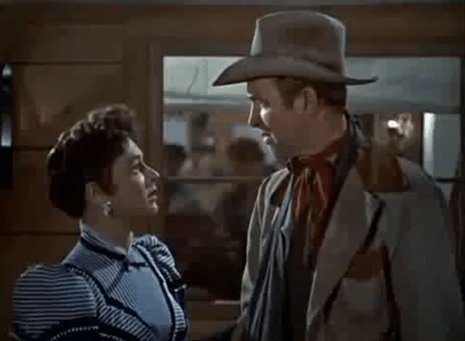
The train gets ambushed but subverts expectations again by evading the bandits in time; one of the outlaws gets winged as the rest ride off to live another day. The only people left are three travelers thrown together by circumstance. We have reformed gunman Link Jones (Gary Cooper), the incessant chatterbox Sam Beasley (Arthur OConnell), and saloon songstress Billie Ellis (Julie London).

They must make it by foot and find some way to subsist off the land. But it’s precisely this predicament that causes our protagonist to fully revisit his past in the most direct way possible.

We get some hint of it the way a man at the train station looks him over and asks if they’ve ever met before. We receive our confirmation when he walks into an old cabin only to be confronted with the same outlaws who held up the train. Their leader, a veteran rogue named Dock Tobin (Lee J. Cobb), walks in and so begins the family reunion.

This used to be the place Jones called home working under his uncle and training to be a killer and a thief. He gave up that life long ago. But now he’s back out of necessity pretending he sought out his uncle purposefully. Meanwhile, the old man bemoans the fact nothing has been the same since Link left.

Lee J. Cobb, God bless him, is poorly cast. He is probably too young in spite of the makeup job. Just as Coop is slightly too old, in the final stages of his illustrious career, to be playing such a character. And yet with those minor qualms aside, their performances in most other aspects could not be better. Because they both remain fine talents who elevate the picture.

The cronies are played by a scruffy gun-crazed Jack Lord with Royal Dano as a mute sidekick, and prolific television actor John Dehner as Link’s cousin who warns him he should have never come back. London is our lone female character and her position is perfectly encapsulated by a single line, “Every man thinks he has the right to put their hands on me. All those lonely people looking for some special thrill.”

The prominence of the mise en scene becomes strikingly evident first in the interiors of the cabin in one particular sequence when a knife is held to Link’s throat as his girl is forced to undress. Then, the outdoor scenes are interspersed with close-ups bursting with color set against the backdrop of the prairie at large with deep blue skies. No more boldly then when Cooper and Lord go at each other’s throats and he returns the favor to the sniveling thug by stripping off his clothes as they both flail around bruised and bloodied.

Dock’s ultimate job to rob the bank in Lassoo is our obvious objective and Link agrees to be the one to ride in first to case the area. But imagine our surprise when the town and its bank turns out to be nothing more than an abandoned outpost with next to nothing to suggest civilization. In our heart of hearts, we knew this was never about a bank robbery or the heist. It’s no mistake the opening attempt is botched and the final outing is a far cry from what was expected. Lassoo is a bank robber’s Mecca that never existed. Maybe in the old days but alas not anymore.

Both these outcomes allow the action to be funneled right back to our characters. Because it is the events in question rousing our hero to act, even if it is against his wishes. To put people in danger and resort to violence become necessary choices. It leads to a resoundingly well-executed shootout on par with the best of the genre, both stylish and jolted with trademark tension from Mann. An obvious precursor to some of Leone’s finest rendered gunfights.

But once more, like The Far Country (1954), the western has been rewritten yet again to dwell in the dirt and the dust of the noonday sun. Violence is only an outcropping of some psychological turmoil that must be dealt with and met with some form of resolution.

What becomes crystal clear with Man of the West is how isolating the frontier is as an entity. Though we start in a big city, aboard trains, and look to end in what’s purported to be a bustling bank town, we are slowly diverted away from those spaces.

The film plays out with a small band of figures caught in interplay fraught with an undercurrent of volatility. The fact there are fewer people only seems to magnify this conflict. Because it is man-to-man they must face each other. There’s little white noise or distraction and Mann has staged everything so it’s clear and boldly laid out before us.

Certainly, if it’s about a handful of characters then at its core is a protagonist who must grapple with something crucial to this entire narrative of regression and decay. Where a man must resort to his old ways — dive back into the hell fury of his past — only to come out on the other side of the maelstrom to prove to himself he is no longer that man. In one sense, it’s playing with fire but it’s also a story that calls for a secondary redemption.

Cooper proves himself in the Town of Good Hope, a town we will never see and a town that acts more like an idea than a tangible place. Lassoo is very much the same — this ghost town that manifests itself as an open-air graveyard — an arena for our climactic showdown. They are points of departure imbued with thematic meaning just as the rundown homestead Jones used to frequent represents a part of his old life. He must throw them off once and for all.

Thus, the final wagon ride off into the wild blue yonder is not just a pretty picture. Yes, Anthony Mann has demonstrated a mastery for capturing the scope of the West here yet again but moreover, his hero is riding back toward the straight and narrow leading to redemption. He has seen the other side and comes back out a man of integrity again.

Whereas High Noon (1952) is a picture easy to admire and enjoy thoroughly straight away, Man of The West is arguably no less brilliant, especially rewarding for those who linger over it. Though strained relations meant James Stewart lost out on working with Anthony Mann again, there’s little doubt Gary Cooper was one of the great western heroes and it’s providential he was furnished this opportunity to ride tall in the saddle once more.

4/5 Stars

The Tin Star (1957)

the tin star 1.png

You can master a gun if you have the knack. Harder to learn men.” ~ Henry Fonda as Morgan Hickman

A veteran bounty hunter rides into town with a corpse slung over the rear of his horse and gets the whole town gawking. They don’t quite fancy this entrance because they’re about law and order in these parts. Paid guns have no place in the western utopia that they have envisioned.

Obviously, no one in town wants to house such a reprobate and he has no place to bed down his horse at the livery stable either. Finally, he finds room and board with the only folks who have enough congeniality to welcome in a man like him. Because in one sense they are ostracized too, living on the outskirts of town as local pariahs. The single mother Nona (Betsy Palmer) gets by doing needlework in the evenings and trying to keep her son out of mischief. He’s half-Indian. Hence the reason no one wants anything to do with them.

But in this man who seems little more than a hardened killer, they find someone genuine and compassionate when you get to know him. Though initially surprised by the boy’s paternity his kindness doesn’t slacken admitting only that many others grow up hating Indians. They are preached as much by their parents and take it to heart so they can’t hardly change their ways. It’s unfortunate.

I’m not sure if I dare use the term “revisionist western” lest viewers get the wrong idea but seeing of all people gun shy Anthony Perkins as sheriff over a town you realize that something is gravely different with the film’s character types — at least this crucial one. His skittish nature is perfectly-suited along with his boyish looks because, as he soon learns, being a sheriff is not only about what you do but how you look doing it. Being smart, working your mind, and projecting a certain image.

At first, Ben Owens (Perkins) is like everyone else. He sees Hickman only at face value. But soon he gathers there is much to glean from this veteran who is handy with a gun and holds a wealth of knowledge. Most impressively he’s lived long enough to talk about it and that means he must be a pretty smart fellow. He’s become well-versed in human nature.

He looks at Owens, a young gun beholden to the duty thrust upon him, and he sees a dead man walking. He’s not going to last long. Hickman knows it. Ben’s girl (Mary Webster) knows it. Perhaps deep down Ben knows it too.

Finally, he asks the bounty hunter to be his mentor and reluctantly Morg agrees to it because his pupil still has his training wheels on as it were. He’s not ready to stand down the town or confront a hulking heavy like the local bad boy named Bogardus (Neville Brand).

One of the film’s finest creations is the local Doctor Joseph McCord (John McIntyre) who not only pulled strings to get Mrs. Mayfield work but he is keen to play matchmaker with two of the fast-growing babies he brought into the world. Indeed he is well-liked by all on every side.

Mann pulls another stunt, not unlike the one in The Far Country (1954) with the Doc making a grand entry with his horse into town to much fanfare on his birthday. It’s one of the film’s most indelible sequences.

A pair of half-breed brothers are also on the lamb and wanted for a couple of crimes. Bogardus gathers a mob of his own to go after them. But begrudgingly following the advice of Morg who has remained hands-off, the Sheriff decides to track them alone.

Morg lingers behind and ultimately ends up being the one who smokes them out without any bloodshed. He delivers the McGaffey Brothers (including Lee Van Cleef) over to the Sheriff so that justice can be implemented first in the jailhouse then in the courtroom.

But that is just the beginning. The final act takes on an uncanny turn toward a High Noon-like allegory. One man faced with a major opposition and yet resisting to back down. But whether or not that motif is McCarthyism incarnate or not, Mann’s handling of the sequence is arresting.

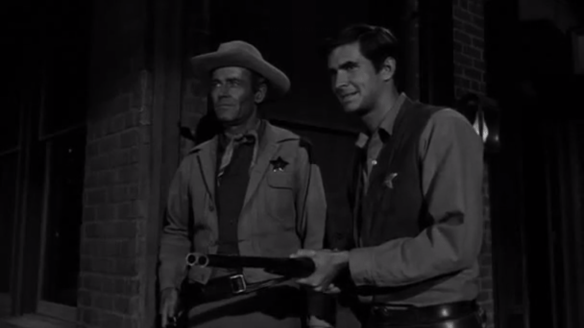
He sets up the action in such a way that we are standing behind Perkins peeking past his solitary frame. He’s unimposing and spindly standing there on the jail steps with his shotgun but he is a better man than me. The question he must grapple with is where the line between a good man and a dead one exists. Sheriffing is a nervewracking business and most men die young in such an occupation. Mann makes us comprehend exactly why that is.

And yet, in the end, it’s all for naught as the picture collapses too easily lacking that typical hard-edged savagery of Mann’s other pictures with James Stewart. While Dudley Nichol’s high-minded script might be quality stuff for a minor picture, it’s not necessarily the script best-suited for Mann.

He was never one for moralizing. In fact, his best films about isolation or outsiders never seemed to make a point of a racial divide or any other societal issues. It felt like they were very much implicit in the story at hand. They never were didactic instead choosing to viscerally speak to us delivering any themes through mere osmosis.

By no means does that downplay the fine chemistry between Henry Fonda or Anthony Perkins both seemingly impeccably cast. However, The Tin Star is a picture that could have been even more resonant.

3.5/5 Stars

The Man From Laramie (1955)

the man from laramie 1.png

The title says it all. James Stewart is the eponymous stranger who rides into town delivering a load of supplies to an isolated outpost called Coronado. But that’s not his main business at hand. He’s searching for someone because he has some personal matters to take care of. In this small regard, Stewart heads a cast of enigmatic characters with hidden agendas and histories we piece together over time.

Within the opening frames what becomes evident immediately are the million dollar skies and cotton candy clouds captured in CinemaScope and vibrant Technicolor by veteran cinematographer Charles Lang.

At the local general store, the stranger meets the demure shopkeeper Barbara Waggoman who welcomes him to town though she seems less than thrilled to receive his goods as she’s intent on closing up her father’s shop since he died. Otherwise, she tips him off to the salt reservoir outside of town so he and his partner Charley (Wallace Ford) can make some more dough. I’ll always hold a soft spot for Cathy O’Donnell since The Best Years of Our Lives (1946) and nothing has changed here. She is as soft-spoken and delightful as ever.

Unwittingly this sets them up with the film’s reoccurring point of conflict. Because they begin mining the resource not knowing it’s technically located on the infamous Barb Ranch run by a ruthless cattle baron (Donald Crisp) and yet he’s nothing compared to his crazed son toting an inferiority complex.

He rides in on them with his band of heavies and proceeds to raze all their wagons and shoot every last mule they have. Talk about overkill for mining salt. It’s a textbook overreaction that’s seemingly uncalled for but it only makes Dave Waggonman’s other behavior more believable.

In town, fisticuffs erupt in the middle of a cattle stall as Lockhart handily takes on his adversaries thanks to the help of a plucky woman named Kate Canady. With it Aline MacMahon makes a crackling entrance as one of the film’s most joyously rousing characters.

The picture continues to be a contentious family affair on the whole. The quiet strength of Donald Crisp resonates as a hard man who you know holds onto some regrets for the empire he has forged. Not least among them the entitled softness of his only son. At the same time, he loves the boy dearly and will do anything to maintain his land holdings.

Arthur Kennedy rarely gets a fair shake as an acting talent but yet again much like Bend of The River, he is a vital component of this particular story. Here he is Vic Hansbro, Alec’s loyalist workhorse and the man trusted to rein in Dave. Though not a blood relation Vic has been with the family for a long time and is planning to marry Barbara. He’s a great deal more rational than Dave but that doesn’t mean he’s not willing to fight for what’s in his best interest whether it’s against Lockhart or his longtime boss. He’s not about to be pushed around.

A single moment seared into our consciousness unfolds after the boy Dave ambushes Lockhart only to get shot in the hand. But he’s not about to take it like a man. Once his cronies are there to back him up he makes his rival pay in one of the most vindictive scenes out of the Mann canon. Jimmy Stewart gets treated to some eye for an eye maliciousness which only makes his personal vendetta smolder.

He’s intent on discovering the man who’s been giving the Apaches repeating rifles. Because he has a personal stake in it as do most everyone else in the story. It gets him in trouble nosing around. On one such occasion, Canady fishes him out of prison for the back alley stabbing of a man (Jack Elam) that he didn’t commit. As recompense, she asks him to finally accept the offer to be foreman of her ranch and he reluctantly agrees.

You see she has long been a thorn in the side of Alec. She’s been one of the few people he hasn’t pushed out of the territory. But maybe it has something to do with their past history together.

The final act brings everything to a stellar apex as Alec catches wind of the missing shipment of rifles and Vic begins to lose his cool as he does everything in his power to protect his boss, harming him in the process. The stage is set for a showdown, Will finally able to make his peace with Apaches also out on the warpath. It exceeds our expectations in typical Mann fashion.

Though regrettably they would never work on another picture together again based on a minor creative disagreement, James Stewart and Anthony Mann left us a stellar body of work including a line of five western pictures that remain a harrowing testament to the genre. If it must be the end, then The Man from Laramie is a fine capstone to go out with.

4/5 Stars

The Far Country (1954)

the far country 1.png

“I don’t need help. I don’t need people. I can take care of me.” ~ James Stewart as Jeff Webster

This Alaskan Northwestern opens and it’s almost like we’ve missed something. Jeff Webster (James Stewart) rides into a town with two men and promptly gives them back their guns and dares them to draw on him. They relent and say they’ll be back for him. To my recollection, we never see them again or if we do it doesn’t matter because for all intent and purposes this little tiff sets up all we need to know about our main character.

James Stewart continues carving out a diverging path for his screen persona thanks in part to the work of Anthony Mann and screenwriter Borden Chase. We are also treated to late period Walter Brennan playing up his future Real McCoys persona constantly yammering away idly about everything. But he’s loyal and if Webster has anything close to a friend in the whole entire world it would be Ben. He’s a good buddy.

Soon the two cattlemen are Skagway bound but this is no Hope & Crosby Road Picture as they look to make bank on their choice beef. Already Webster is a wanted man and he conveniently is given berth to hide from his pursuers. It yields a rather risque character introduction as Jimmy Stewart gets some assistance from a lovely lady (Ruth Roman) who covers for him — hiding under her sheets — spurs and all.

His next biggest faux pas is breaking up a local hanging with his herd of cattle barreling through town past the flimsy scaffolding. As he has unwittingly made a mockery of justice, Webster soon finds himself brought to court. It just so happens that the local purveyor of law and order holds court with his gavel in the local saloon. Devious and rugged-faced Judge Gannon (John McIntyre) is both chief judge and executioner. He has the clout to snatch the stock away from the perpetrator for his minor offense which he proceeds to do right quick.

As an alternative Webster is hired on to ride point for the proprietress of the Skagway Castle. They’ve already been acquainted and Rhonda’s quite the businesswoman as it turns out. She leverages her allegiance with Gannon to set up outposts in the two largest outposts in the territory. Though Webster is no less opportunistic, using this chance to round up his cattle to drive them to Dawson City for a pretty penny.

More than anyone, the plucky and pouting young red-capped Renee gives Stewart a chance to be a tease with his iconic jocularity but he’s always more condescending toward her. He makes it painfully obvious that he’s not going to fall for her nor does he feel the need for any friends.

He’s the epitome of a Lone Wolf character. The stark majesty of the icy backdrop behind him is an impeccable extension of who he is and he seems very much in his element. He’s willing to traverse roads others will not and predicts an avalanche before it hits. All with calculated detachment. He doesn’t make a habit of worrying about others.

But Gannon will not let up and he looks to muscle his way into Dawson as well seeing as he already has a major stake in Skagway. The formerly tame territory gets wilder by the hour. This sanctioned hike in lawlessness calls for a response from the peacekeepers but any of the men subsequently sworn in as Marshall have little leverage against the Judge’s guns. Their best bet is to wait until real law and order comes. Until then Gannon keeps on confiscating their stakes.

The only man who can do anything to stop them isn’t about to make the town’s problems his own. He’s made a habit of not getting involved. But there comes a point where his hand is forced and there’s no way to separate the town’s affairs and his own agenda. He must act.

Jeff rides his steed down the main street for the final showdown which looks more like an ambush. They underestimate him. To his credit, Mann strips away any final notion of the heroic mythos of the frontier with a gunfight that finds itself in the muck and the mire under a porch. True, Dawson City gets their happy ending and a renewed reputation but the film resonates far more for its besmirched brand of tenacity than for any amount of heroism. James Stewart gave up being a stereotypical protagonist years before and it pays heavy dividends once again.

4/5 Stars


The Naked Spur (1953)

the naked spur 1.png

James Stewart carries over his persona from Bend of the River (1952) to continually redefine his career in the post-war years. He is a man under a different name who nevertheless is seething with the same raw fury.

In this regard, there are numerous parallel themes in this subsequent collaboration between Stewart and director Anthony Mann culling the recesses of one man’s mind to showcase his unswerving resentment. There’s not an ounce of amiability in the performance which is almost unheard of.

It winds up being a bit of an open-air paradox with gorgeous Colorado visuals which are nevertheless infused with the tension of a near suffocating chamber piece. Because it proves that such an incongruity is possible. Freedom of movement does not necessarily prohibit continually duress of another nature.

The cast is compact but a mighty group of talent with five individuals that you cannot help but remember. Stewart is the leader in all regards as Howard Kemp who has been tracking Ben Vandergroat for some time now since the other man murdered a Marshall in Kansas.

Millard Mitchell is the crusty prospector, the first man that Kemp runs into, and they form an uneasy partnership with Jesse Tate believing the other man to be a Marshall. It’s true that Kemp is always barking orders at everyone. It continues when a Union soldier helps them scale a rock face and close in on Kemp’s target.

Ralph Meeker always gives the impression that he’s ogling and that distinctive voice that would serve him well as Mike Hammer instantly labels him as a tough customer. His tattered military record suggests something else. He’s not exactly to be trusted as a soldier recently discharged for being “morally unstable,” whatever that means.

Janet Leigh despite her undeniable beauty does well to drop her ingenue image and play a tougher, earthier role as the doting girlfriend of the wanted Marshall-killer. But in her you see much the same conflict as all the other characters. Something is driving them to continue down the road they are traveling. It’s simply a matter of deciphering just what it is.

Arguably most important of all is chortling Robert Ryan as Vandergroat egging Stewart on with continuous catcalls of “Howie” as he commences the mind games that comprise most of the meat of the story. He dispels any misconceptions the other two might have about Kemp. He’s no Marshall and he’s hardly doing this out of the kindness of his heart. There’s a $5,000 reward for the wanted man.

Whether he read his Bible or not, Ben knows enough about human nature and the reality that a house divided against itself cannot stand and he’s looking for any way to pit his captors against each other. Chatting them up constantly and using his girl to try and soften up the other two while scheming here and dropping little remarks there to wheedle under Howard’s skin.

It’s a long stretch of country ahead. Final destination: Abilene, Kansas. He knows as well as they do that a lot can happen in that length of territory. He’s aiming to get himself out from under a hanging tree and so he’s mighty keen to chip away at them as much as possible.

Though he’s very much an instigator, there’s little question that Vandergroat gets some unsolicited help. Anderson’s shady past with a Native American princess means he’s soon caught up in a skirmish with a pack of warriors bent on some form of justice. While initially keeping their noses clean of the whole squabble, there’s finally no recourse but for Kemp and the prospector to get involved. Howard winds up with lead lodged in his leg and he’s hobbling feebly for the rest of the trip.

One must note that the American Indians are utilized solely for their agency to the story. They are not human as our leads are human and that is a shame. Because aside from that major oversight, The Naked Spur is a splendid Western that takes a scenario deeply-rooted in the tradition and yet uses it to more closely still examine the human psyche. Most specifically we see in each character the things that drive them and how men can so easily be weaponized against one another.

Tate immediately gets a renewed hankering for gold when Vandergroat lets him in on a little secret. He happens to be sitting on a gold mine. But only he knows where it is. Then of course, the soldier has a thing for the ladies and is looking to earn some money as much as the next fellow. For Howard, it’s his unbending sense of revenge that he must complete at all costs.

He’s practically dying, plagued by cold sweats and hallucinations but there’s a doggedly resilient quality about him. Proposing cave shoot-outs and fording rivers relentlessly. In a textbook Mann shot of brutality, his anti-hero is getting choked to death rolling around in the dirt only to live to fight another day. That is the ongoing motif that Stewart never allows us to forget for a minute up until the film’s pinnacle.

While not as heralded as a Ford and Wayne type partnership one could argue that Stewart and Mann was a no less important or formative collaboration. The Naked Spur and a slew of other pictures stand as cogent proof.

4/5 Stars

Bend of The River (1952)

Bend_of_the_River_-_1952-_Poster.pngIn Bend of The River, there are glimpses of the man we knew before the war. Joking and smiling with that same face. The affable charm and so on. But it’s also starkly different.

In this picture, James Stewart is on horseback leading a wagon train preoccupied with farming, cattle, ranching, and biscuits. His name is Glyn Mclyntock and this is the life he has crafted for himself.

Of course, when another man comes along to ride with them, a man named Emerson Cole (Arthur Kennedy), they trade glances and instantly know something about the other. Their names precede them as Glyn was once an infamous Missouri border raider and Cole had his own run-ins with the law for similar crimes.

However, no one knows about Mclyntock here and he’s bent on going straight. But with them together we have the perfect case study to test out the theories of one of the leaders of the caravan Jeremy Bailes. He believes a man can never change. “When an apple’s rotten there’s nothing you can do but throw it away or it will spoil the whole barrel.”

But these past sins as they were, give each man a time-tested wisdom about the real West. In one such scenario, they knowingly make talk to a pretty gal about bird calls coming from Orioles indigenous to Canada though they realize at that very moment some Shoshone are circling their camp. They’re ready for them.

The journey continues proving reminiscent of the pilgrims of old and that’s what these pioneers are, pilgrims of the Pacific Northwest. Occupied with grand visions of how they will cultivate the land and help build a prospering life for their families. But there’s also talk of stocking up enough food for the first winter and fears of the impending snows. Supplies haven’t been sent ahead yet nor have they gotten any word from Portland — the town where their supplies were supposed to come from.

It quickly becomes apparent following a return trip that the town has been swept by a frenzy of Gold Fever and things are noticeably different. We are conveniently reminded that it was Man who spoiled the land, tainting it with their many vices including pillaging and killing.

The part of the professional gambler in town — one Trey Hendricks — features Rock Hudson in a growing role as the pretty boy. He hasn’t quite reached true stardom yet but to have him in the picture is another stroke of luck in a project that is positively stacked with talent.

Julie Adams (billed as Julia) plays the main love interest, Laura, who is wounded by an arrow and laid up in the town of Bend only to fall for Cole who quickly took on a position at Trey’s establishment. As Glyn has no rightful claim to her, it looks like the two lovebirds will be married.

Mclyntock hires a group of wage laborers to help him peddle the goods back into the mountains as the riverboat they used before can only get them so far. The most memorable of the lot certainly include Harry Morgan, Royal Dano, and Jack Lambert. What’s more, they have no firm allegiances and their compensation amounts to a meager grubstake.

The uninhibited rage that burns in Stewart’s eyes with insurrection afoot becomes increasingly apparent and he’s about ready to administer a deathblow with one stab of a knife only to be stopped by the shriek of dismay from Laura. It brings him back to his senses but in no way ends his ordeal. Not by a long shot.

When a band of miners in desperate need of provisions is willing to pay an astronomical sum for the goods it all but seals the deal; we have a mutiny on our hands. That’s not altogether surprising; it’s how it goes down that proves a jolt.

But that trademark tension of Anthony Mann just will not leave us be and we find ourselves continually harried to the end of the picture because this mission of mercy is our mission. But again, we are reminded of what man is capable of left to his own devices. Avarice is a deadly beast and it brings out a fellow’s true colors.

Stewart is cast out with no horse and no gun. But he’s relentless in his pursuit. The objective clear and he makes sure his foes know it without a shadow of a doubt.

“You’ll be seeing me. You’ll be seeing me. Every time you bed down for the night, you’ll look back to the darkness and wonder if I’m there. And some night, I will be. You’ll be seeing me!”

First, it’s one man. Then two shots in the night and finally the confrontation that we’ve all been waiting for. Glyn reemerges to take back the supplies aided by Trey, Laura, and Mr. Baile. The bullets fly. The bodies fall into the stream. Horses scamper away. And our two stars have it out for good.

Mann captures it all for the maximum effect, the most striking visuals being contorted faces in the throes of hand-to-hand combat first in a wagon and finally, the bedraggled forms reeling in the depths of the water. It’s so visceral and physical even alarmingly so. But it gets to us.

Is this a western or what? My goodness. The final shots are so Hollywood — the epitome of its Technicolor glories with everyone getting together and evil conquered — but all this cannot quite rub out the images that preceded it. They are blistering with unmistakable antagonism.

Stewart’s performance might seem unprecedented and certainly, it was for all its psychological torment but his characterization is indebted to Arthur Kennedy who draws upon a vitality of his own. Together they make Bend of the River a tale well worth remembering.

4/5 Stars