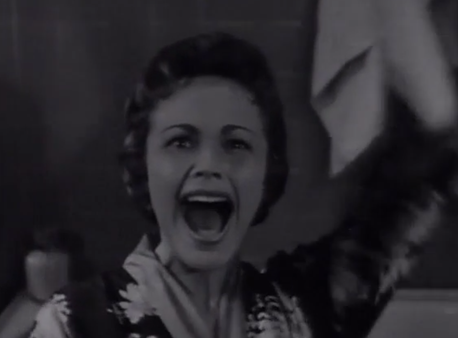
While the City Sleeps (1956)

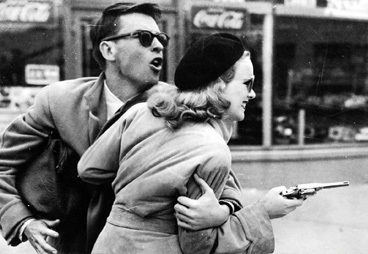
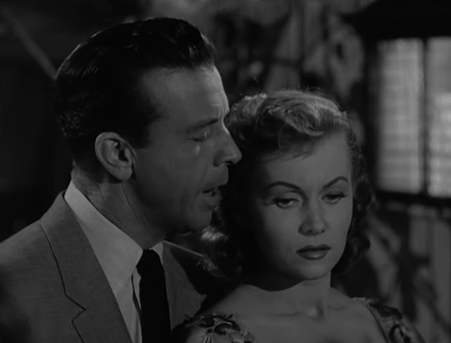
whilethecity1While the City Sleeps has a brilliant cold open followed by a pounding title sequence, courtesy of Fritz Lang, that brings to mind a bit of Diabolique and Psycho. The rest of the film turns into a case to find the wanted lipstick murderer (based on a real killer), but that only holds part of our attention.

When newspaper magnate Mr. Kyne dies suddenly, his begrudging son Walter (Vincent Price) takes over intent on shaking up the status quo and putting his mark on the company. He soon turns three men against each other as they desperately fight for the new position of executive director. The first is veteran newspaper editor John Day Griffith (played by the always memorable character actor Thomas Mitchell). The second candidate is chief of the wire service Mark Loving (George Sanders) who is Griffith’s main competitor. Finally, in the third spot is Harry Kritzer who happens to have a secret ace in the hole. Each of them is tasked with finding out the real scoop about the serial killer, and it turns into a real tooth and claw ordeal. Within the glass cubicles, everything can be seen, but not everything is heard and that’s where the secrets get disclosed.

On the outside looking in, so to speak, is star TV reporter Edward Mobley (Dana Andrew), who agrees to help his friend Griffith by doing a little digging around about the murderer. He gets some tips from a cop friend Lt. Kaufmann (Howard Duff), and Mobley tries to smoke the killer out on air. However, it leads to the potential endangerment of his fiancée Nancy, who also happens to be Loving’s secretary. Loving has his love directed towards a female reporter named Mildred Donner (Ida Lupino), who attempts to needle Mobley for info. At the same time, the killer is on the move once more, with Nancy being an obvious target. Mr. Kritzer’s own romantic entanglements get him in trouble because he is seeing Kyne’s beautiful but detached wife Dorothy (Rhonda Fleming). Mildred finds out about them and they have some talking to do. Mobley also has some making up to do with Nancy after she finds out Mildred came to see him. It’s a big mess.
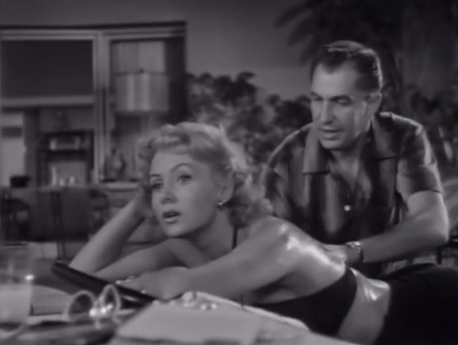
whilethecity3Mobley juggles everything from his love life to the big scoop and they apprehend the killer, but things at Kyne’s don’t wind up exactly the way they expected. Mobley looks to move on from the paper with Nancy, but even he cannot get away that easily.

While the City Sleeps is an underrated tale from Lang that is positively stacked with big names. Its pacing can be deliberate at times, but it is just as much an indictment of journalism as it is a thriller. The office is a web of deception with so many interconnections between these work factions. Those you would normally expect to be scrupulous seem to give up their honor in the face of this new promotion. In a sense, Mobley seems to be outside of this fray and yet he cannot help but get involved in it. It doesn’t help that nothing turns out the way it’s supposed to. Everybody seems to gain something, but nobody really wins the game.

I must say it was great to see Dana Andrews in one of these leading roles again and although their roles were smaller, Ida Lupino and George Sanders still were a deliciously stuffy and corrupt pair. I was never really a fan of Vincent Price due to the roles he normally plays, but I was inclined to like Howard Duff (Lupino’s real-life husband) in his turn as the policemen. It goes without saying that Rhonda Fleming is positively beautiful, but she also cannot be trusted. I guess that applies to about every character in this film. It’s certainly a cynical world out there that Lang paints, where the killer might be caught, but corruption is never fully quelled.

4/5 Stars
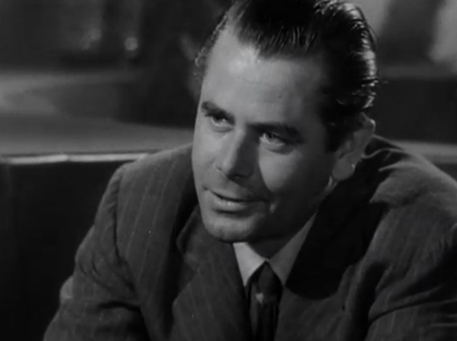
Review: The Big Heat (1953)

bigheat2The Big Heat is not a noir where the darkness comes from the shadowy visuals, but from within its characters themselves. In fact, some of these individuals are so subtle in their corruption that it easily gets overshadowed. Homicide cop Dave Bannion is, rather ironically, the straight-arrow trying to do what is right, and he becomes the most vengeful character in Fritz Lang’s film. It’s a subversion of the typical noir arc because his greatest help ultimately comes from the former femme fatale. That’s not how it’s supposed to happen, but then again a lot of things happen a little differently in The Big Heat.

The film opens and within a second a man has shot himself and left a confession on his desk. The cues tell us that he’s a cop and he’s just committed suicide. His wife comes downstairs strangely composed and shuffles through the pages he has written. She goes to the phone, not to call the police, but she talks to a third party. We quickly forget what’s she’s done, but the fact is Mrs. Duncan represents the corruption that reigns supreme in this film. She’s used a juicy piece of blackmail to receive large payoffs from someone and she’s not the only sellout.

Bannion (Glenn Ford) is a cop by day and a family man at night with a loving wife and a beautiful little girl. By convention, he is supposed to be the moral compass of this film — the emblem of good conquering evil. He takes on the straightforward case of Officer Duncan’s death, but it gets convoluted when a B-girl named Lucy Chapman calls him up to say she knew the deceased, and he would never kill himself. Initially, Bannion takes little heed of this girl, because she is hardly as respectable as Mrs. Duncan, or so society says.

He gets pressure from his superior Wilks to lay off, but Bannion is discontent with loose ends, especially when he receives news that the Chapman girl has been brutally murdered. This can’t all be all coincidence, and he begins sniffing out the truth like a bloodhound. Bannion leads us into the home of this empire of crime literally. He confronts local businessman/crime boss Mike Laganna, who he accuses of involvement in the corruption. Things are beginning to heat up, and they start to infiltrate the sanctity of his home life. The dark recesses of the noir world can never be subdued, and Bannion dives deeper into the labyrinth that is created by his own obsessive vendetta. He has no tolerance for his colleagues who don’t take a stand, in favor of their pensions. He can’t stand tight-lipped locals who give him no help and most of all he hates Laganna’s guts.

bigheat3At the local shady nightclub “The Retreat,” Bannion has his first run-in with the hired thug Vince Stone (Lee Marvin). Afterward Vince’s girl Debby is genuinely impressed by Bannion’s methods, but he will not give her the time of day. He expects her to be the same superficially ditsy dame that we have all seen before. Hardly a femme fatale, but still there is the potential to be deadly. The one character who seems to conform to the stereotype is Stone, and yet he is even more brutal than most, burning girls with cigarette butts and splashing scalding coffee on Debby’s face.

Bannion gets to one of the other hired guns named Larry and both Stone and Laganna decide that something must be done to stop Bannion in his tracks. The obvious target is his little girl, but this time the family life prevails over the noir world. His family and colleagues rally around him and yet Bannion is not done with his obsession.

In fact, it is Debby who actually finishes off Bannion’s work by paying a visit to Mrs. Chapman and then Vince. Bannion arrives soon after to reprimand Vince, but Debby has already done the dirty work. The nightmare is over and everything that is good and right comes to the forefront. Debby proves her allegiance, the criminals are put away, and Bannion gets a new position with the homicide department. But underlying this seemingly happy ending is still a sense of tension. The film ends as Bannion heads out on a new homicide case with the cycle continuing and it seems like he will never be free of it.

The world will continue ripping away the ones he loves. Before he knows it, he will be left with only his personal vengeance to drive his future. Bannion very easily could cross the line between righteousness and corruption. He already almost strangled two characters and was not opposed to slugging it out with others. It’s only a matter of time before he totally blows his cool and collected exterior. It’s a dark assumption, but then again that is a lot of what film-noir is. Fritz Lang seems to get this and that’s what makes his characters here so powerful because he knows that the root of all evil can be in everyone.

4.5/5 Stars

Review: Gun Crazy (1950)

guncrazy2

Bart has an intense obsession with guns. It’s what his life revolves around. It’s the only thing he wants to do as a boy and the only things he seems to think about. It becomes a problem when he breaks a store window, but during the following hearing, his sister and friends vouch for his character. He would never take a human life or kill. That’s not in his nature.

No matter, it is decided Bart should be sent off to a special preparatory school, and he only returns years later as a grown man recently off a stint in the army.  He’s back in his hometown not quite sure what his future plans will be, but his buddies are glad to see him. They shoot some, drink a few beers, and decide to take a jaunt to the carnival for a night of fun.

Their Bart meets the girls of his dreams. There’s a quality to John Dall that makes Bart into a pure victim of his circumstances. He’s quickly infatuated with the gun slinging and sensuous Peggy, who seems to share his one love. A goofy smile is plastered on his face as he faces off against her in an act of skill. He makes her uneasy and ultimately beats her. 

He gets a job with the carnival and spends as much time as he can with her when he’s not shooting guns. They are fed up with their boss and leave the migrant life behind. Marriage is on their radar, and they live it up with the money they have. But Peggy wants more and she wants to keep living the high life. 

She wants to rob a gas station. It’s one little idea that soon blows way out of proportion. They are holding up banks, gas stations, and any place with money that they can lay their hands on. The pair is fugitives with exploits plastered all over the front pages and roadblocks waiting to stop them up. All the while Bart makes Peggy promise not to shoot anything because he still is totally opposed to killing people. 

It seems like things might end peaceably, except once again the gun-toting lovers are nearly flat broke so Peggy coaxes Bart into one last job to end all jobs. For the first time, despite their planning, just enough goes wrong to nearly botch their mission. Bart drives off and Peggy shoots a guard. He’s not the only one. 

 guncrazy1When Bart finds out, after the fact, he realizes they have just stepped up a level with murder stuck on them. The game is winding down and the only place Bart can turn is his hometown where his sister is. For good reason, she cannot stand Bart or Peggy who she sees as poisoning her brother. And it’s true. Bart seems different now, so paralyzed by fear that he even pulls a gun on his old friends.

The last ditch effort of Bart and Peggy is to literally head for the hills. The dragnet is sent out and the hounds are let loose. They hardly have a chance before dropping from exhaustion in a swamp. They’re trapped and a crazed Peggy looks to shoot it out to the death. But for once Bart breaks with her remembering his friends. It doesn’t help him much.

Gun Crazy is a B-film and yet it is easy to forget because the way Joseph H. Lewis constructed this film is so impressive in its economy. One scene that reflects this so beautifully is the long take from the back seat of the car. The camera does not change positioning and so we see a bank job from the outside, and it only helps to build up greater tension.

 We also have enough time to care about certain characters. We have enough time to see Peggy is really no good. Yet with her keen marksmanship, she is a different shade of femme-fatale who is still as deadly as any of her contemporaries. Along with They Live by Night (1948), this is one of the archetypal Bonnie and Clyde-esque films. Thank goodness this film’s title was changed from Deadly is the Female to the more apt Gun Crazy. That it is. 

4/5 Stars

Union Station (1950)

unionstation1Although it features the pairing of William Holden and Nancy Olsen, Union Station certainly is no Sunset Boulevard, but it doesn’t need to be. It’s a modest procedural of 80 minutes, but it has a gritty realism that is rather reminiscent of Pickup on South Street (1953) or The Naked City (1947). This is ironic since it’s hardly believable and yet it still ropes us in. The story goes something like this.

A young woman  (Olsen) says goodbye to a blind friend and later after she boards a train, she sees two suspicious men board the same car as her. At the final destination of Union Station, she goes to lead cop Willie Calhoun (Holden) who uses his network of plainclothesman to investigate and tail the men. As it turns out, the blind girl has been kidnapped and a ransom is put up for her at $100,000. Her father is understandably desperate to get her back and does whatever he is relayed to do. He remains in contact with Calhoun and the Inspector named Donnelly (Barry Fitzgerald) who resolve to get his daughter back and apprehend the perpetrator.

However, the man they are dealing with has been around the block a few times, and he is well acquainted with Union Station. Thus, the station becomes the main point of interest in the film evolving from less of a game of cat and mouse to a chess match. Men are tailed aboard trains, in terminals and everywhere else. When one man leaves another takes his place, eyes are always watching and the beauty of it all is you can never tell who is a policeman and who is not in the veritable mass of humanity. But it goes the other way too.

The ransom is ultimately set to go down at Union Station and just in the nick of time, Calhoun catches a break. All that’s left is to chase down the mastermind, but it’s not so easy as he also has the blind girl Lorna stashed away. Calhoun must race to apprehend the culprit while also getting to Lorna first. It’s a photo finish.

Did I say already that Union Station employs a gritty realism? Well, it does, and it is full of slimy criminal types pitted against no-nonsense cops who are not opposed to using rough methods if necessary. Willie Calhoun is the number one tough guy and he’s relentless in his job as the intense finale suggest. Donnelly is a character blessed with the voice of a Leprechaun thanks to Fitzgerald and believe me that’s a compliment. He’s a personable, mentoring type who is a nice compliment to Holden. Inquisitive Joyce Willecombe is necessary to get the plot rolling and also as the love interests, but Nancy Olsen gives an appeal that reaches farther than that.

Enough said, now take a trip down memory lane to Union Station where you are sure to be lost with the masses in this engaging procedural.

3.5/5 Stars

Review: Rear Window (1954)

Hitchcock_stills_0006_rear-windowWho in their right mind would make a film that takes place in a courtyard? Rear Window has always been fascinating from a technical standpoint, and Alfred Hitchcock is certainly not “The Master of Suspense” for nothing. He uses the confined space of a single Greenwich Village courtyard with an incapacitated individual to truly build the tension to immeasurable heights. The events within the film are often highly bemusing as Hitchcock has a wicked sense of humor, whether Jefferies is trying desperately to scratch that itch or the conversation turns morbid as he tries to eat breakfast.

The script has so many great little moments of back in forth repartee; some supplied by the always dynamic Thelma Ritter who plays the nurse with a lot of advice and opinions about rear window ethics: “We’ve become a race of peeping toms. What people ought to do is get outside their own house and look in for a change. Yes, sir. How’s that for a bit of home-spun philosophy.

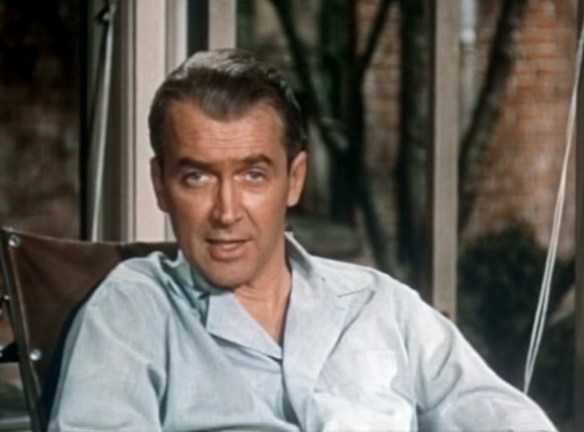
James Stewart is always a pleasure, but this time around he is perhaps at his most constrained as famed photographer L.B. Jefferies, who is laid up in his apartment for weeks on end with a leg in a cast. He got the injury thanks in part to his last big photo shoot where he ran in front of an oncoming race car. With nothing better to do, he spends his idle moments people watching and getting to know his neighbors. That’s one way to put it at least. As an actor, Stewart is stuck and relegated to conveying his whole performance through his gaze and the dialogue he speaks to those few who come in and out to see him. Most of what he’s doing is simply looking across the way and yet it works.

His neighbors are as follows:

There’s Ms. Torso who is an aspiring dancer and always the target of many men. There’s Ms. Lonelyheart who never can find the love she so desires. A washed-up composer spends the entire film trying to figure out his newest project (even getting a visit from Hitchcock himself). There are the newlyweds who hardly ever leave their bedroom because they’re doing something… Then, comes the older couple on the second floor with a cute little dog and the sculptor who lives below.

Most interesting of all is the couple directly across the way from Jefferies’ because that’s where a long-suffering husband and his wife live. All seems normal, to begin with, however, Jefferies begins to have his suspicions thanks to circumstantial evidence and no sign of Mrs. Thorwald. His first thoughts immediately shoot to murder, but it seems highly unlikely. Day and night he continues to watch seeming to get more evidence, only to have his theories crushed, and then gain new hope through more evidence.

James_Stewart_in_Rear_Window_trailerThe interesting part is that as an audience we are fully involved in this story. We see much of the picture from Jefferies’ apartment, because there is no place to go, and so we stay inside the confines of the complex. In this way, Hitchcock creates a lot of Rear Window‘s  plot out of actions occurring and then the reactions that follow. We are constantly being fed a scene and then immediately being shown the gaze of Jefferies. It effectively pulls us into this position of a peeping tom too. Danger keeps on creeping closer and closer as he discovers more and more. The narrative continues to progress methodically from day to night to the next day and the next evening.

In the climactic moments, he finally faces the man who he always looked in at from the outside and yet by the end the roles are reversed with Jefferies space being fully invaded, and yet he can do little to flee, because of his cast. Hitchcock cuts it in such a choppy and chaotic way which breaks with the smooth continuity of the rest of the film, but it works so wonderfully in stark juxtaposition.

This is one of the main appeals of Rear Window because it has this Hitchcockian story of murder, mystery, and suspense. However, I am constantly eager to revisit this story, since there are so many other intricacies that are of interest.

Although the film uses a score by Franz Waxman, the majority of the sounds heard are diegetic and they either are street noises or music wafting around the courtyard from one of the apartments.  Also, there is only one small outlet to the outside world. At times, it becomes fun to survey what is going on whether it is kids playing on the street corner or cars passing back and forth. It builds this sense of realism suggesting that this world that has been created is larger than this one set full of apartment buildings.

Another important element is themes of romance and love. Jefferies comes into the film with issues in his own love life. His girl is the elegant and refined Lisa Fremont (Grace Kelly), who seems perfect, too perfect in his estimation. In his mind, they just don’t seem compatible enough, and he cannot see marrying her. It’s something they have to work through because she truly loves him.

Really every character essentially has a different outlook on love and different struggles, because romance is never an easy thing. Like the lyricist’s song, it is so often fragmented, but in their case, Jefferies and Lisa seem to figure things out just as the song finally gets finished. The moment where you can see it in Jefferies’ face that he is both impressed and worried for Lisa’s safety seems to be the time when things change. He realizes his love for her since she is very dear. He quits his thinking and his analyzing of their relationship, as gut-wrenching emotions take over when she is caught. In a sense, he listens to Stella’s earlier advice: “Look, Mr. Jefferies, I’m not an educated woman, but I can tell you one thing. When a man and a woman see each other and like each other they ought to come together – wham! Like a couple of taxis on Broadway, not sit around analyzing each other like two specimens in a bottle.”

Wendell Corey, in his supporting role as Jefferies’ friend and the police detective, is a man who can be a skeptic and still prove his loyalty as a friend. They can be at odds and still poke fun at each other with mutual affection. It feels real. Raymond Burr as the villainous Lars Thorwald works well too because he is certainly an angry, unfriendly grouch, but he does not seem altogether evil. It shows how easy it is for the lines to be blurred.

rear-window-first-shot-of-gkAbove all, Grace Kelly shines opposite Jimmy Stewart. There’s no one quite like her, so elegant, eloquent, with a touch of playfulness and adventure. She is willing to fight for her man and even go out on a limb for him (ie. breaking into Thorwalds’ apartment). One of the film’s most extraordinary images, out of many, has to be when a shadow covers the face of Stewart as he rests. Then there is a close-up of Kelly, her face slowly descending towards him. It’s hard to forget and for the rest of the film, she attempts to not let him forget her.

It’s not often easy for me to make statements like this, but Rear Window has to be close to my favorite film of all time. Yes, I said it. It never gets old for me, and I pick out new things every time. It’s more than just a mystery thriller. Hitchcock made it a technical marvel that is also steeped in themes of love and ethical questions. The players are the best of the best from James Stewart, to Grace Kelly, to Thelma Ritter, all down the line. It’s at times deliberate, but never boring, completely immersing the viewer into this drama as a firsthand witness. It’s the type of cinema we just don’t get every day because it has everything and it cuts to the core — to the most visceral level. That is the sign of cinematic greatness.

5/5 Stars

Seven Brides for Seven Brothers (1954)

Seven_brides_seven_brothersThe title gives a clear indication of what this Stanley Donen musical will be about, but it does not tell us how we will arrive at that conclusion. It all begins when a woodsman named Adam (Howard Keel) comes to town intent on finding himself a cute and handy bride. That he does in Milly (Jane Powell) and soon enough, in a whirlwind, they are married and heading back to his home. There she is greatly surprised to meet his rambunctious and rough-edged younger brothers. Six to be exact, but you already guessed that.

Once she accepts her new life, it becomes Milly’s mission to straighten them out and find them girls to court. It isn’t easy but soon they learn table manners and proper etiquette before the big barn raising takes place. There the boys make quite the impression and the audience is given quite the show complete with bright colors and inventive-foot-tapping choreography. It’s an understatement to say that the Pontipee brothers are not popular with the locals, and not only is there a barn-raising but some hell-raising as well.

Adam is proud of their showing, but the rest of the lads are lovesick as the long cold winter begins, separating them indefinitely from their girls. With Adam’s encouragement, they decide to do as the Romans and kidnap their sweets, but they fail to think about the consequences. The town’s in an uproar, the girls are frightened, and a man-made avalanche means there is no contact with the outside world for at least 5 months!

Milly is appalled by their actions, especially Adam’s part, and the lads are made to sleep in the barn as she dotes over the scared group of girls. Not liking what he’s seeing, Adam heads off on his own for a while. Spring brings a fresh start as young love flourishes and the boys are forgiven. Milly gives birth to a baby girl, and Adam finally returns home with a new perspective. But what about the town folk you ask? They do come after the  Pontipees, and they don’t like what they see when they ride in. Needless to say, it is a happy ending with each boy getting his girl, thanks to a few shotguns.

With catchy songs, beautiful color cinematography, lively dance numbers, and an amusing premise, this is a very strong MGM musical, even if it is not the best of the lot. That is not saying much because the studio could hardly go wrong with such previous titles as On the Town, An American in Paris, Singin’ in the Rain and The Band Wagon. Seven Brides is a nice addition although I will say it vaguely reminded me of Oklahoma. However, it is different enough to be well worth it. The only question left to ask is, “Are Adam, Benjamin, Caleb, Daniel, “Frank,” and Gideon natural red-heads? I’m not sure I know the answer but I could wager a guess.

4/5 Stars

Cry Danger (1951)

589aa-crydanger2Here is yet another noir gem which would never get made today, much less in a mere 22 days! This directorial debut of Robert Parrish is boosted by an often witty script from William Bowers.

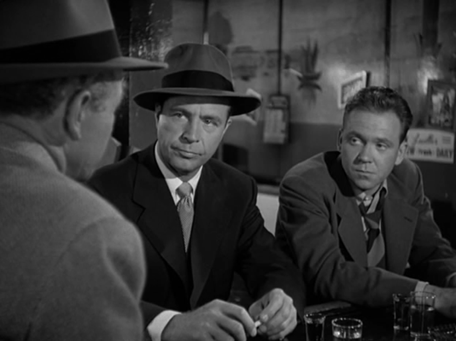
Rocky Mulloy (Dick Powell) is fresh out of prison after a former marine (Richard Erdman) testifies on his behalf though Mulloy already spent five years rotting away in prison. He went in right around the end of the war because of a robbery that he was assumed to be a part of.

Regis Toomey (The Big Sleep, Raw Deal) is Lt. Cobb and he is still skeptical when he is assigned to monitor the newly released man. Richard Erdman is the peg-legged, alcoholic marine who has a penchant for booze and dames. Also, he never actually knew Mulloy before. He just wants some of the loot.

So the two new found chums set up camp in a beat down trailer park of all places, with a music playing proprietor (Jay Adler). It’s not exactly the Ritz, but Delong finds some female company, and it just so happens that Mulloy’s former flame lives there too. Nancy (Rhonda Fleming) is married to Rocky’s pal Danny who is still in the clink. His mission is to prove his innocence, but could it be more harm than good?

Rocky goes to a local mobster named Castro (William Conrad) who left him holding the bag five years ago, and he wants reimbursement for his time. He gets some of it in the form of a horse race which leads to a big payoff.

But as it turns out, the money is hot and Lt. Cobb wants to know where it came from. Rocky obliges but it becomes all too obvious he’s being set up. There was one slip up though, proving Rocky is telling the truth for once, amidst all the lies swirling around. That does not help Delong much and his girl Darlene gets blown sky high. The bullets were obviously meant for Rocky and  Nancy.

Rocky confronts Castro and they play a little game he likes to call Russian Roulette, although it’s very one-sided favoring Rocky. The fearful mobster spills the truth, revealing Danny was actually a part of the plan 5 years ago all the time. Since he took a lighter rap, someone else is holding his share of the payoff. The missing $50,000. Who is keeping it warm for him? You guessed it.

Rocky goes back to the trailer park where Nancy spills all her beautiful guts to him. What she gives is a tempting offer and Mulloy lets her believe it will happen. Off he walks with Lt. Cobb ready to swoop in. Rocky may have gone straight, but it doesn’t mean it makes it any easier. He had to turn on one of the most beautiful girls in the world, courtesy of Rhonda Fleming.

Dick Powell has another laconic performance which nearly matches his turn as Philip Marlowe in Murder, My Sweet. I always love seeing Richard Erdman as a young jokester, because he has gained a following more recently for his work in the television show Community as Leonard. William Conrad will always be the narrator in Rocky and Bullwinkle as well as Cannon. However, his big frame and mustache make for a good criminal type. What can I say about Rhonda Fleming except that she looks stunning in black and white, much less technicolor?

Lt. Gus Cobb: Now, just get it through your heads that the pressure’s on. 
(To Nancy)
Lt. Gus Cobb: I wouldn’t give a nickel for your husband’s chances before that parole board with all this going on.
(To Rocky)
Lt. Gus Cobb: And I wouldn’t give a nickel for your chances with those two apes running around looking for you.
(To Castro)
Lt. Gus Cobb: For you, I just wouldn’t give a nickel.

4/5 Stars

The Crimson Kimono (1959)

crimson kimono 1 shigeta and corbettFrom director Samuel Fuller comes another welcomed addition to his canon. It features the same type of seedy urban landscapes and back alleys of Pick up on South Street (1953) and there are some equally interesting characters like Mac (Anna Lee). It all is underlined by some sleazy jazz music in the vein of Sweet Smell of Success except this one is set in L.A.

The plot line is basic enough following two policemen as they investigate the homicide of a local stripper with a heart of gold and wasted plans for a new show involving kimonos and karate. Their only real lead is a painting and the name that goes with it. That’s where the more interesting part of the story begins.

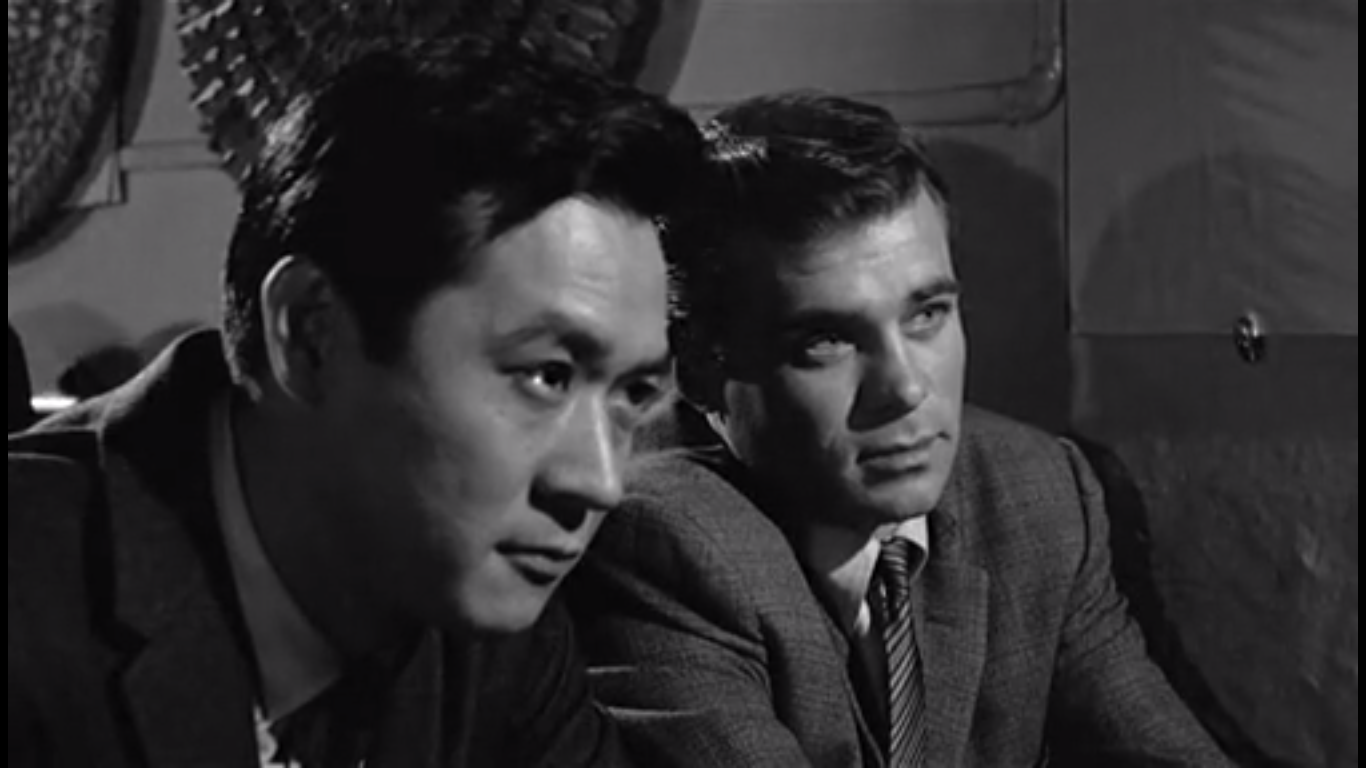
I failed to mention that one of the cops is Caucasian. His name is Detective Sergeant Charlie Bancroft (Glenn Corbett). His partner is Japanese-American or “Nisei,” meaning the second generation. Detective Joe Kojaku (James Shigeta) is his name. The beauty of their relationship, which is one of Fuller’s focuses, is that they are equals who are inseparable ever since landing in a fox hole together in Korea.  Charlie was saved by a pint of Joe’s blood, Charlie practices kendo with Joe in their off hours, and they live together on the side. You cannot get much closer than that.

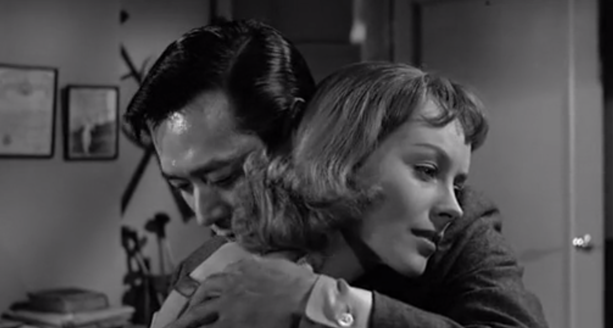
The movement of the plot leads them to Ms. Chris Downes (Victoria Shaw), a pretty young painter who is the only witness who potentially saw the man who shot Sugar Torch. In between looking at journals full of mug shots, she gets to know both Charlie and Joe. Charlie sees himself falling in love with her and like anyone he tells his best friend. Joe is happy for him until the fateful moment when he is alone with Chris. She makes her affection for him quite plain because he’s a pretty great guy, but as a good friend, he doesn’t do anything. It tears him apart and it only hurts them as they plod on with the homicide.

What follows is a painful love triangle embroiled with issues of race, friendship, and misguided notions. It’s jarring because these three are all likable and you want only the best for them, but it cannot be remedied like the murder which ultimately gets wrapped up neatly.

crimson kimono 4 shigeta shawSamuel Fuller always tackles issues of race head on like no other. In fact, he was ahead of his time when no one else would show such relationships, romantic or otherwise, on the silver screen. Beyond whether or not an Asian man and a Caucasian woman romantically involved was accepted back in the 1950s or not, it probably was not what audience cared to see at the movies. To me, now, it’s really interesting, especially to see such non-stereotypical roles all across the board. It’s a breath of fresh air from the Charlie Chans and Mr. Motos.

On another level, Fuller’s camera makes solitary L.A. street corners and the bustling Nisei festival amazingly dynamic. It brings Little Tokyo alive, filling it with genuine people, sights, and sounds. Thank you, Sam Fuller.

It’s like mixing two dabs of paint together. You could never separate them.” ~ Mac on Charlie and Joe

It’s what you think is behind every word and every look.” ~ Chris Downes

4/5 Stars

To Catch a Thief (1955)

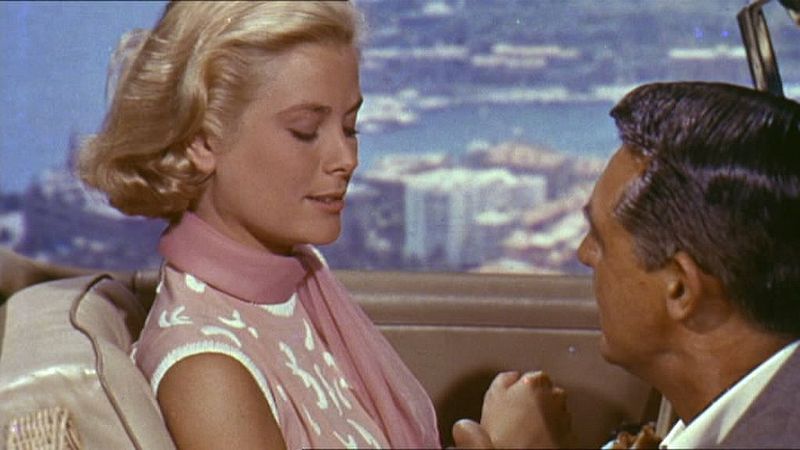
800px-To_Catch_a_Thief3Robert Wagner certainly knows It takes a thief, to catch a thief. The same goes for Cary Grant in this film which has him playing reformed cat burglar John Robie who is suspected for a series of thefts that have struck the French Riviera.

However, he knows he is not the culprit so he must clear his own name by catching the cat himself. The police want to nab him, his old French resistance buddies suspect him, and a beautiful young American woman (Grace Kelly) traveling with her mother is sure he is the cat. With a little help, mixed with some passionate romance, he is able bring some closure and get the girl.

That is all fine and dandy if you wanted a typical romance thriller. However, no one does it as well as Hitch. He somehow wonderfully balances the little bits of humor with his darker moments of suspense.  Jessie Royce Landis helps bring that comedy whether she is putting her cigarette out in some eggs or holding her book upside down as she commits a little white lie.

Hitchcock certainly had better films, but this one is so fun and it has the same glamorous Hollywood look as Hitchcock’s Man Who Knew Too Much (1956) with location shooting and vibrant colors.

Cary Grant and Grace Kelly make quite the pair, perfectly matched with the French Riviera in all its glory. I am convinced that Grace Kelly is and always will be one of my favorite actresses, period. Any era, any genre. Her name sums up her persona, because much like Audrey Hepburn, she has an extraordinary grace in how she carries herself. She can also be quite mischievous as well in her role as Francie. She is sure to set off fireworks.

4/5 Stars

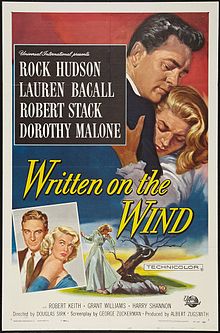
Written on the Wind (1956)

WrittenOnTheWind2Here is a film that wholly personifies an over the top melodrama or soap opera. Douglas Sirk’s film is full of complicated romances, tense relationships, drunkenness, and murder. Yet when the two stars drive away through the gates of the Hadley Estate everything is resolved (at least to a degree).

It seems that Sirk undoubtedly knew how over the top his story is and he reinforces it with his blatantly loud colors, dramatic music, flashy cars, gaudy interiors, and so on. He embraces a style that seems stereo-typically 1950s Hollywood and he makes it work.

Ironically Rock Hudson gives a good performance and Lauren Bacall is okay but the real drama flows from Robert Stack and especially Dorothy Malone. They are the black sheep of the Hadley family and by the end of the film they definitely deserve the moniker. Except there is more to them then that. Kyle is a tragic figure to be sure and despite her sex-crazed ways there still is a bit of sympathy for Marylee.

I cannot wait to see more Sirk because he seems quintessentially 1950s.

4.5/5 Stars