Review: Cool Hand Luke (1967)

cool hand luke.png

While I might not consider it one of the finest films ever produced, Cool Hand Luke features one of the most mythic characters ever conceived for the movies. He’s one of those figures who can seemingly only exist on celluloid. Luke Jackson comes out of a certain turbulent period in American history even as his story remains indelibly timeless.

Paul Newman realized some greats throughout the 1960s from Fast Eddie Felson to Hud and then Butch Cassidy. However, this monumental role is one of his most iconic regardless of all the others that came before and proceeded it. Newman stretches himself to the edge of the frame and then some. It’s difficult to even begin to consider who else might have managed the feat if not him — furnishing both a constant resiliency and the trademark gleam in his eye.

It’s that placid demeanor and vaguely smug attitude which is above all prepossessing. A near relentless self-subjection to suffering and malevolence follows and for the most ridiculously absurd offense. Luke was bored and so he went about town slicing the tops off parking meters while inebriated. For that, he’s given a two-year sentence on a chain gang. For that, he willingly takes on the ills, disdain, and wrath of a whole community of people without hardly batting an eye.

It begins when the “fresh meat” comes to town. They’re jeered by the veterans led by the hulking southern boy Dragline (George Kennedy) and filled out like all the quality prison movies with a bevy of talented character actors. Some fairly prominent names including Dennis Hopper and Richard Davalos as well character parts for Wayne Rogers, Lou Antonio, etc.

The new faces quiver in this foreign environment, among them Ralph Waite and Harry Dean Stanton. Meanwhile, Luke Jackson sports a stellar war record though he left the military with the same rank he had going in. He was just passing time.

There’s a mild disinterest, a silent bravado, and subtle anti-establishment slant to him. He doesn’t flaunt it necessarily but it does come out. The guards and the camp’s proprietor (Strother Martin) are wary of him and the inmates don’t believe he’ll ever come to learn their pecking order.

That’s what’s so appealing about the Luke character. He could care less what other people think. He never has to prove himself. He just does what he wants and as a result, makes himself an idol of the entire chain gang without ever trying to do so.

The script, penned by the story’s original author Donn Pearce as well as Frank Pierson, is adept at creating individual moments and bits of dialogue that are in themselves so distinctive, showcasing a remarkable ability to stand on their own merit. Even now over 50 years later.

“The Night in the Box” monologue might have its imitators but it has no equal, setting up the monotonous drudgery that makes camp life, backbreaking and yet somehow strangely comforting to some men. Strother Martin famously sums up his relationship with the troublesome prisoner as a “failure to communicate” while in another sequence the girl (Joy Harmon) saucily washes her car, tantalizing all the sex-crazed men on the job.

Dragline and Luke have a boxing bout that cements the new man’s reputation as well as a budding friendship with the camp’s resident top dog. He bluffs his way through poker games to earn his iconic nickname, “Sometimes nothing is a real cool hand” Luke grins almost matter-of-factly. Everyone else howls with delight at his exploits.

Next, overtaken by a surge of giddy energy he spurs on his compatriots turning their assignment of tarring a road into a game that captures the imagination of all involved. They are taken by his spirit which never seems to sour. It’s the same temperament that will lead him to eat 50 eggs in under an hour just for the heck of it. Whether he meant to or not the whole cohort feeds off of him, even as some spurn his attempts at individuality — most gravitate toward the man. From thenceforward, outstretched on a table like a Crucifix he is cast as their Christ-like figure.

A flurry of escape attempts is spawned by the news that his mother has died. The outcome was all but inevitable. Still, that doesn’t make it sting less. The conversation shared between the two of them earlier is only one minor scene of dialogue, and yet together Newman and Joan Van Fleet make something impactful out of it. Thus, when Arletty dies, off camera, it has critical implications for the man. For once, he shows some type of emotion; he cares about something.

Luke can be found strumming away at a banjo singing “Plastic Jesus.” Not being able to get away for the funeral he resolves to sing her a dirge of his own. The rest of the film is backed by Lalo Schrifrin’s score laced with a down-home country meandering melody contributed to by an arrangement of guitars, banjos, and harmonicas with more traditional string and brass sections. It’s the soundtrack of Luke’s exploits as he gets some jackrabbit in his blood and looks to jump the coop.

His Fourth of July escape runs the hounds ragged or else he’s “shaking the bush” to take a leak only to scramble off into the underbrush. He’s away long enough to even send the boys a souvenir from the outside featuring him gussied up with two bodacious gals. His smile lights up the page and the picture gives them something to keep their blood pumping; it’s really something to live for.

But multiple times he is brought back to confinement and “the box.” The bosses, having just about enough of his impertinence, subject him to neverending ditch digging and refilling after long days of work. They’re not about to let him forget he’s a prisoner. While his inmates helplessly watch him get worked to death in the camp yard, they sing “Ain’t No Grave” in solidarity with him. Throughout Stanton can be heard belting out Gospel spirituals accompanied by his acoustic guitar.

Director Stuart Rosenberg in his first movie after a career in TV at least ably conveys the pervasively sweaty grime of the day-to-day in such a world. Nothing is clean. Dirt clings to everyone and everything. It permeates every inch of the screen.

However, some of his visual choices come off rather clunky in execution. “The Man With No Eyes” constantly has his reflective sunglasses put on display as metaphor and the choice to end the picture in a clip show gives one last upbeat note but undermines what could have been an uncompromising ending.

Contrast Milos Forman’s One Flew Over The Cuckoo’s Nest (1976) and on an external level, you have nominally similar dramas about a group rallying around one man to stick it to the institution. But there is little comparison between Randle McMurphy and Luke beyond that point just as the endings choose their own alternative resolutions.

As it is, Luke is smiling to the end of his days and Dragline canonizes him as a saint for all posterity. He becomes the vehicle for all their hopes, dreams, and aspirations. He is their Savior but he’s a fallible Christ-figure — never perfect and he never can be perfect — but they put there hope in him nonetheless. After all, he is a natural world shaker to the very last grin.

However, In his final hour, Luke can be found talking to The Man Upstairs in an abandoned church building. It is his version of Gethsemane:

“It’s beginnin’ to look like you got things fixed so I can’t never win out. Inside, outside, all them rules and regulations and bosses. You made me like I am. Just where am I supposed to fit in? Ol’ Man, I gotta tell ya. I started out pretty strong and fast. But it’s beginnin’ to get to me. When does it end?”

Surely the implications are twofold. He maintained a failure to communicate with his fellow man as a perennial outsider turned-savior but the issue extended to his relationship with God too. He is all but alone. He’s an outsider without ever trying to be. That’s simply his God-given temperament. But that can be a wearisome existence and we cannot smile at Cool Hand Luke‘s ending without harboring a residual sense of pessimism as well.

5/5 Stars

The Americanization of Emily (1964)

americanization of emily 1.png

“Don’t show me how profitable it will be to fall in love with you, Charlie. Don’t Americanize me.” – Julie Andrews as Emily

Yes, Kubrick’s film is definitive. Though something inside of me wants to rale against convention and wave the flag for The Americanization of Emily instead, a movie that came out the same year as Dr. Strangelove (1964) and could probably use the acknowledgment. While not technically as renowned — Arthur Hiller is no Stanley Kubrick — this is probably the director’s best work and we do have a script by Paddy Chayefsky, the man famed for penning everything from Marty (1955) to Network (1976).

Our stars are to die for in James Garner and Julie Andrews while in its satirical bleakness, the movie predates the absurdity of Mike Nichol’s Catch-22 (1970) adaptation or Altman’s M*A*S*H (1970). At any rate, it deserves a place in the conversation among the seminal anti-war statements of the 20th century.

Though Chayefsky can get verbose with his quill, it’s all quite eloquent; between the stars and the dilemma they find themselves in, the resonance of The Americanization of Emily cannot be overstated. It starts with of all things a “Dog-Robber,” the pet name and vernacular shorthand used for personal assistants of military big wigs.

Garner always the conman, grifter, or otherwise likable trickster, is seamlessly fit to play Charlie Madison, a rapscallion who is also very good at his line of work. As right-hand man to Rear Admiral Jessup (Melvyn Douglas), Charlie is tasked with laying out the red carpet for his superior, charming and cajoling his way to get the best of the best. That means the finest food and the most charming female company that wartime Britain has to offer.

A couple of the assumed premises of the picture are troubling, starting with the prevalence of what can only be termed “tush slaps” of nearly every female attendant. Nearly everyone seems to enjoy the attention. The second is how the war takes a back seat as does the fact, despite Man being infallible and the reasons for war being muddied, Hitler was seemingly a power that necessitated some counteraction. For that matter, D-Day feels like it’s an open secret among every Tom, Dick, and Harry.

But this is all part of the groundwork which all comes into relief as we begin to visualize the story. Consequently, it doesn’t much feel like a bombed out or rationed Great Britain at any point in time. There’s little need for historical accuracy — the trail of a cynical war comedy with all its biting fury is what’s most importantly on display.

After getting off on the wrong foot, Charlie and his assigned chauffeur Emily (Andrew) joust a bit only to fall into each other’s arms. She brings him over to tea with mother and there he sees the shrine to all the deceased war heroes in their family (a lah Hail the Conquering Hero). Except Charlie sets the record straight on what he thinks of war and how other people go about it. Some might consider him callous but the way he sees it, being brutally honest, in such a case, is the most humane thing to do.

Mrs. Barnham has long been pressing on in life as if her son was still alive. However, Charlie brings the tea conversation to the cold hard facts. In his estimation, it’s the most profane thing in the world to enjoy war. Enjoyment in the same sense that he sees grieving as a sensual thing for a woman — when she can mourn her husband who gave his life so gallantly for his country. He doesn’t see anything noble about needlessly making heroes of our dead, venerating them, instead of allowing them to rest in peace.

When probed about his religious views, he retorts quite blatantly he’s “a practicing coward.” He learned it in Guadalcanal in the midst of buddies dropping all around him. “Wars are the only time a man can be gallant and redeemed. Wars are always fought for goodness, except virtue is so unnatural to us. God save us all from people doing the morally right thing.” These are little nuggets of wisdom he drops.

americanization of emily.png

The complete absurdity of it all comes into focus when his commanding officer cooks up a cockamamie plan to shoot a movie during the storming of Normandy to capture the first dead man on the beach — who will obviously be a sailor — proving to the world that the Navy is just as important as anyone else. They know he’s really flipped when Admiral Jessup dreams up the Tomb for the Unknown Sailor too.

Still, no one has the gumption to disobey so Charlie’s buddy Bus (James Coburn) looks to stall operations as long as possible and yet, in the end, they find themselves hurtling toward Normandy on an utterly pointless suicide mission. Except Bus gets bitten by the patriotic bug too and goes nutty for his duty with Charlie and his lackluster movie crew hoisted onto the LST like stray cargo. They’re going whether they like it or not.

The comedy is solidified for me in the D-Day sequences as Charlie finds himself dumped out in the ocean, flailing around in the cold, half-heartedly trying to hold onto a camera he doesn’t know how to use, probably already decommissioned by sea water. It’s utterly pointless. Here he is amid the chaos with his former friend goading him on only to wing him with a pistol in the process. Charlie’s left for dead but on the bright side, at least he’s positioned himself as the first casualty on the beaches of Normandy — a navy man, no less.

True to form, the images of him are soon plastered all over every magazine back home. He’s been christened a hero and every type of idolatry he would never care to give anyone else is lofted on him. It’s far from done, rolling over on itself one final time.

There must be continuous punchlines to underscore the sheer looniness of it all. Whereas a picture like The Spy Who Came in From the Cold (1965) is bleakly cynical, here James Garner is able to inject his grouchy strain of comedy into the part, aiding the story to its conclusion. But the final zinger goes to Julie Andrews as she is and always will be his equal in the film.

“Honestly, Charlie, your conversion to morality is really quite funny. All this time I’ve been terrified of becoming Americanized, and you, you silly ass, have turned into a bloody Englishman.”

So you see, it might have just as easily been called the Anglification of Charlie. There you have the irony at work again. Somehow it makes sense and it doesn’t at the same time. That’s war in a nutshell.

4/5 Stars

The Chase (1966)

the chase 2.png

Of all the reasons to watch this movie, I felt compelled to as a roundabout reevaluation of Robert Redford’s career as he just recently said The Old Man and The Gun would be his last film. He more recently still, admitted he never should have said he was retiring but for all intent and purposes, he’s winding down, focusing his energies on other endeavors.

The Chase is situated at the beginning of his career and although he’s not quite the star, Redford has an integral part to play. Bubba is a local boy who breaks out of prison. Due to his dashing good looks, they don’t immediately place him as a runaway criminal type but if Paul Newman could do it, I gather Redford could do it too.

If we had to pick one central conceit this would be it, except, on the whole, The Chase proves a meandering epic, purely hit or miss, especially given such a promising cast. It’s as bloated with talent as it is convoluted by so many character arcs, each coming at us from all over the place with varying degrees of interest and importance.

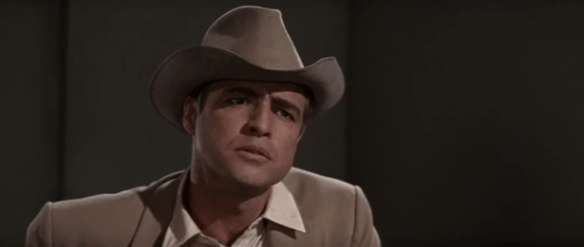
The local sheriff, named Calder (Marlon Brando), lives an honest life with his loving wife (Angie Dickinson). There is talk around town that the lawman is in the coat pocket of prominent banker Val Rogers (E.G. Marshall). Though the accusations seem dubious based on Calder’s simple integrity. However, if it is true,  he wouldn’t be the only one intent on getting on the big man’s good side.

Soon it’s Saturday night and the whole town seems to be having a party. The most coveted one is thrown by Rogers and sure enough, among his guests are the Calders. Though they hardly fit into the upper echelon, they have an open invitation because Val is intent on staying on the incumbent lawman’s good side for what he might be able to do for him.

Meanwhile, an agitated bank employee (Robert Duvall) and his coquettish wife (Janice Rule) put on a shindig for the “normal folks” who never seem to get an invitation from Rogers. The means might be humbler but they similarly get a little tipsy while play fighting, dancing, and openly flirting with anything with a pulse and a pickup line.

Two of the most accomplished adulterers and partakers in sordid gossip-worthy fodder are Emily and Damon, who are quite openly lovey-dovey, given they are both married to other people. It’s telling that the status quo is getting drunk and carousing with other’s spouses.  We hardly bat an eye because the whole town is rampant with this kind of conduct.

Despite being the lead and raking in a hefty fee, Brando spends most of the film moseying around town making house calls or patrolling the streets. In fact, initially, it feels like the most mundane and understated performance from Mr. Brando I can recall. That is until the final act where for once his hand is forced and he has to struggle for his own survival and any semblance of small-town law and order.

The only other moment where he enters such terrain again is in the final moments on the steps of the sheriff’s office; this time to deliver retribution. Because this is a film where everything seems to go awry. If the hothouse dramas of the 50s were a dying breed, The Chase might be the closest thing to a reanimation of the genre, albeit with younger, newer blood.

However, amidst this southern operatic melodrama, helmed by Arthur Penn, The Chase still comes off somewhat dated, maybe due to its evocation of earlier works. It’s as if the picture is trying to push an agenda of social importance for a new decade but simultaneously lacks a compelling framework to work within. The point is made quite clear that African-Americans and Mexican migrant workers are second-class citizens and subsequently mostly forgotten in this story. But there are few interesting conclusions on this front.

Otherwise, for the first half, there’s nothing organic or terribly alive in terms of authenticity. Because while Brando gives a fine turn, admittedly easy to overlook, most everyone else is carried away by the drama. They have nothing to give us that feels truly genuine and the story freely escalates by upping the temperature in the ongoing search for Bubba.

Finally, Redford and Jane Fonda get together, an escaped convict reunited with his long lost wife. Maybe they didn’t know it at the time but it would be the beginning of a meaningful screen partnership which has been forged over 50 years. But before long, even this brief, potentially intimate moment is interrupted by first one party, then two, and before long the whole town has turned their moment into the latest county-wide social event.

The junkyard is the finest attraction as it promises to give them the most wanted fugitive for miles around and they’ve come to be a part of the show. Soon folks are yelling exuberantly, lobbing firecrackers into the heaps of old automobiles as car horns honk in this symphony of tumult. But if this is where the climax begins it actually ends on the steps of the jailhouse in a scene that evokes if not JFK’s assassination then certainly Jack Ruby’s actions the following day. The clouds of misery linger over the frames but that’s not our biggest regret.

I think, no fault of its own, The Chase boasts almost more talent than it knows what to do with. So many actors come together at so many different crossroads of their careers. Of course, Brando is front and center. He and Robert Duvall still had The Godfather and many other classics ahead of them. Redford and Fonda were both young talents. E.G. Marshall had an illustrious career on stage and screen while Miriam Hopkins was in her twilight years in a small role. Angie Dickinson was pretty much in her prime. Even Arthur Penn had pictures with more socially incisive commentary and interesting themes including the cinema-shattering Bonnie and Clyde released the following year.

The bottom line is that in each individual case it’s easy to think of at least a handful of films each of these actors was involved in which were more enthralling than this one. It’s hard to hold a candle to that type of competition and against it, The Chase looks fairly mediocre. True, it’s a rather unfair fulcrum to measure a movie by but in this case, it’s very hard not to. Taking these unfair biases into account, it has something to offer the viewer even if it’s not quite as satiating as one would like.

3/5 Stars

Paris Blues (1961)

paris blues 1.png

I’m the first to admit I’m no jazz connoisseur but I dig it. In this age that we now live in of shuffling and song roulette — where the single has surged passed a cohesive album in terms of singular importance — there has been some small amount of education going on for me.

Awareness of some of the classics is starting to set in. There’s recognition of a few of the heavy hitters like Miles Davis, John Coltrane, Bill Evans, Dave Brubeck, Count Basie, and of course Duke Ellington. When we hear even the briefest interludes of “Take The A Train” we will grab a hold of it. Ellington provided the score for Paris Blues including some of his beloved classics and they couldn’t be more fitting.

Because Martin Ritt’s film is hot when it comes to jazz — you can feel it wafting through the air and giving an added layer of sensuality to the already romantic milieu of the Parisian streets. This is a propitious factor married with the fact the picture also takes its shoot right to the streets of Paris, even filling out the cast with a few native supporting players.

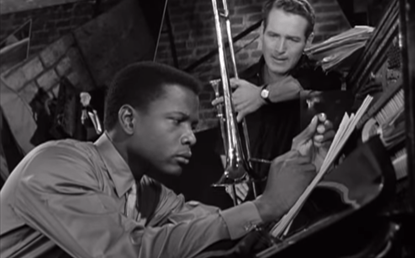
Less than a decade before, we had Roman Holiday (1953) and now we have something that might just do the same for France, except with an extra flavoring of brass and a rhythm section. The cast couldn’t be better with two of Ritt’s former students from their Actor’s Studio days, power couple Paul Newman and Joanne Woodward. Equally compelling is another legendary leading man in Sidney Poitier and Diahann Carroll as beautiful and sophisticated as ever. I admire them all.

paris blues 2.png

However, in translating the source material to the silver screen, you could easily say the story lost most of its clout. Harold Flender’s original novel was about two interracial romances between two vacationing Americans and two expatriate jazz musicians working in Paris. However, this was Hollywood in 1961. Although the script teases the original storyline when Ram Bowen (Newman) comes onto Connie Lampson (Carroll) on an inbound train, it was not meant to be — quickly brushed off for more conventional demarcations.

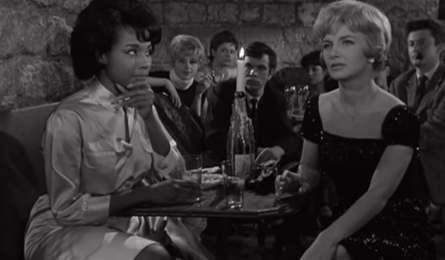
Believing the public was still not ready for such portrayals, the studio got cold feet and smoothed things out by making sure everyone ended up with their “kind.” It’s Lillian Corning (Woodward) who gets starstruck with the trombone player and her friend eventually softens to the handsome saxophonist Eddie Cook (Poitier).

Acknowledging this grievance, the only thing that makes me mildly okay with the change is that the husband and wife duo of Newman and Woodward get paired opposite each other so we see real-life romance partially channeled into the movie. While the four leads look great together and there’s indubitable chemistry, somehow it still feels like something is missing.

paris blues 3.png

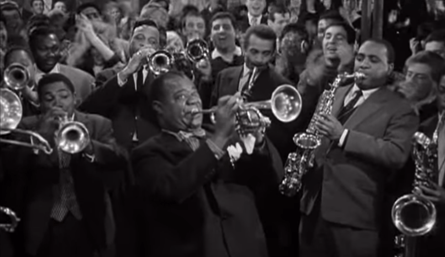
Louis Armstrong leading a parade of brass into the jazz club is a shining moment full of uninhibited synergy that fills up the underground space in the most joyous of fashions. As he always does, Wild Man Moore brings down the house. But the real issue is the lack of pizzazz outside these performances.

The story meanders without creating enough interludes ripe with meaning. They’re either cutesy momentary snapshots of lovebirds in Paris or understated pieces of human drama. Not by any means bad but what the picture might have used were some sustained sequences of action in places where it floundered. Most vividly I can recall the Vespa ride through the streets or even the party which is raided by the local police which helped make Roman Holiday a landmark.

There is nothing so memorable here. Instead, some characters leave on the train they arrived on and others stay behind. Musical aspirations and romance are continuously being weighed. Whether we care that deeply about any of it is up for debate.

Worst of all, these issues are only exasperated by the fact that the story no longer has one of Martin Ritt’s finest attributes, a theme of social importance. Because in a Pre-Civil Rights age, Paris Blues could have been a much more moving statement; instead, it’s a middling love story.

Poitier gets one conversation with Carroll where he candidly vocalizes that in Paris he’s a man or he’s a musician. To borrow someone else’s words, “he’s judged not by the color of his skin but by the content of his character” and even more so by his artistry. It spawns a minor spat but the opportunity to make a statement — a statement without the utterance of words even — was lost before it even began. Perhaps the wasted potential hurts more than anything. Like the musicians at its core, Paris Blues is ultimately a lightweight.

3/5 Stars

Help! (1965)

Helponesheet.jpgWhat can I say? I am one of the proud and the many who loved The Beatles before they loved any other type of music. So when I watch Help! I look for all the best in it because that’s all that I can do.
However, if you are familiar with this follow-up to the frenzy and the success surrounding A Hard Day’s Night (1964), then that picture will feel like a serendipitous accident where everything came together for 90 minutes of magic. Help! is more of what one might actually expect from distributors trying to capitalize on The Beatles fandom before “the fad” ran its course. It’s less inspired and hammered out with what seems like little forethought at all. Because that’s what it was. Except previously a better job was done to fake it.

Though a quality filmmaker, Richard Lester was hampered by time constraints even going so far as to edit his daily footage while he was making the film. The ending results showcase a purposely disjointed narrative with a ludicrous script following a Far Eastern cult’s attempts to swipe Ringo’s prize ring for their human sacrifice. There’s not much more to it than that. It would prove ample fodder for many an episode of The Monkees which made no qualms about being a Beatles knockoff.

The rumor mill even provides accounts that the Fab Four were to have made a western picture with the lads all fighting for the affection of a rancher’s eligible young daughter. Maybe it’s the novelty of an idea never realized but I would have liked to see that picture in lieu of this one. However, we must content ourselves which what we have.

Stacked up against some of its more forgettable contemporary spoofs and scatterbrain comedies, Help! could have done a worse job blending the exoticism of Bond with its attempts at comedy. There are numerous Eastern influences and if anything the film facilitated Harrison’s introduction to the sitar. We even hear a version of “Hard Day’s Night” on the Indian instrument.

Otherwise, the boy’s flat is decked with Tati-like contraptions and coloring that evoke the Frenchmen’s work in Mon Oncle (1958). The lines of disparate gags owe a debt to Peter Sellers (especially The Goon Show) and act as a less inspired precursor to Monty Python’s Flying Circus.

These are the only reference points I can manage and yet this suggests that Help! might have been so much more. Instead, fueled by their new infatuation for marijuana, the boys are in a bit of a garbled haze and it reflects the mess of the film full of flubbed lines and absurd non-sequiturs.

Nevertheless one could argue that much of it feels akin to the world The Beatles were finding themselves adrift in. Their fame had blown up to outrageous proportions that were almost laughable. It would make someone go batty. Perhaps they needed a trip to the Alps and the Bahamas, play acting with tigers and then tanks on the Salsbury Plains. For a few stray moments, they were not a commodity. They could muck about and be themselves.

That gets down to one of the primary takeaways. We still have The Beatles. True, John Lennon later commented that it felt like the boys were sideshow attractions in their own movie. I get the sentiment but I would disagree it in the sense that I’m hardly drawn to any of the other characters. There’s little interest in their antics because I’ve seen countless more inspired takes on the same material.

But we have Richard Lester directing The Beatles’ music so we have something iconic to grab ahold of. It’s not a total loss. What you gain an appreciation for, especially in this effort, is how Lester has almost single-handedly invented the language of the music video whether he meant to or not. At its best that’s what this manic comedy is — an early exhibition in the music video — using spliced together standalone sequences showcasing the boys in various situations most memorably attempting to ski or playing curling.

“Ticket to Ride” in the snow, “I Need You” out in the brisk British air, and “Another Girl” shot in the Bahamas are able to bottle just a little bit of The Beatles because it’s their music that stands the test of time meshed with those playful personas.

While it’s momentarily amusing for flashes of humor and memorable for the unparalleled tunes, in many ways, it pales in comparison to its predecessors.  It lacks the perfect docudrama zaniness of A Hard Day’s Night (1964) and the pure animated invention of Yellow Submarine (1968). Instead, Help! slates itself as an often shallow even dopey picture.  But, I’ll say it again. We still have The Beatles. Surely that is enough for most of us.

3/5 Stars


Pretty Poison (1968)

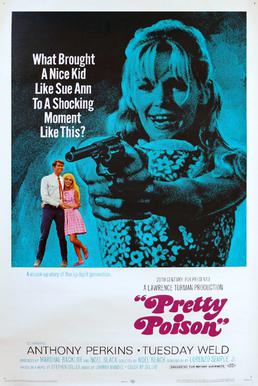
Prettypoison1.jpgBoy. What a week. I met you on Monday, fell in love with you on Tuesday, Wednesday I was unfaithful, Thursday we killed a guy together. How about that for a crazy week, Sue Ann?” – Anthony Perkins as Dennis Pitt
Director Noel Black himself described the story as “a Walter Mitty type who comes up against a teenybopper Lady Macbeth.” It seems like the perfect shorthand to get a line on the characters and the actors more than rise to the challenge.

By all accounts,  Black, a recent UCLA film grad, wasn’t much of a director, at least when it came to working with actors. But he could sure edit a film together. The cutting helps to accentuate this trippy world with the spliced together images of Anthony Perkins’ unstable psyche.

After securing his release from a mental institution, Dennis (Perkins) is continually fixated on all sorts of fantasies — playing games full of cops and robbers and CIA agents. He keeps surveillance on a pretty blonde majorette (Tuesday Weld) drilling nearby and unwittingly meets her at a local hot dog stand. They make contact and his nonchalant cool captures her imagination.

We are always wondering if they actually take each other seriously. But the beauty of the script is how they never seem to question one another. They just go with it. What seems utterly ludicrous to us as an audience is so very believable to them.

It relies on Anthony Perkins being able to pull it off and he gets it spot-on with every line coming out of his mouth with total conviction. He makes us believe he’s serious with every bit of fanciful conspiracy he matter-of-factly dreams up.  At his core is this benign human being. We get a sense he wouldn’t hurt a fly. Of course, watching Psycho (1960) might give us a different inclination. And that’s part of the issue.

Perkins’ performance can never be seen outside of the shadow of his greatest triumph and simultaneously his most constricting role. Because everything he does is informed by the part of Norman Bates. If we were able to remove this distraction, his part in Pretty Poison would feel much the same as Tuesday Weld’s does. Because in films like Friendly Persuasion he was the shy, All-American boy. But conventions are getting subverted left and right.

They both make us start believing in their reality. They rendezvous in “makeout valley” only to get ousted by some cops and Dennis tries to hold down his job at the plant, despite constantly being distracted. He professes that aliens are trying to infiltrate the water supply and then very reluctantly stakes out Sue Ann’s home to spy on the mother’s boyfriend.

They are swimming in the invigorating paranoia of their own little world and the drugged-out love romp they create for themselves. Each reverie-like frame bathed in sunbeams and an ever refracting prism of colors. For these very reasons, Pretty Poison could play as a companion film to The Shooting (1967) – another acid singed genre picture.

But at some point, it begins to turn on its head. Because Dennis is the one we suspect will become dangerous due to his erratic behavior. It seems all too inevitable as his parole officer (John Randolph) continues to warn him. Yet the killer joke of the whole movie is how it plays out for real.

This pretty blonde in the high school honor roll turns out to be a femme fatale sipping Pepsi. What are the chances? A little friendly neighborhood murder is what’s on the docket one evening. She gets an emotional high from her adventures with Dennis only to take them to an even deadlier end. The film is not meant to make conventional sense. It never does.

Instead, it operates in alternate realities, delusions of grandeur mixed with sociopathic behavior. It is an instance of a story having two edges, both the terrifying and darkly funny. If there was ever an obvious precursor to Gone Girl (2014), Pretty Poison seems like an obvious jumping off point.

Unfortunately, it was the casualty of absolutely horrific timing. Not only did it not get the distribution it needed but the year of 1968 was punctuated by the assassinations of both MLK and RFK. A film with such content was probably not on the top of the public’s watch list.

For the actors as well there were unfortunate circumstances. Since it was Perkins’ first highly visible American film since Pyscho (1960), his typecasting was again solidified because the shades of an unhinged Norman Bates type is all people seemed to focus on. Tuesday Weld hated the entire process and considered it one of if not the worst of her performances. Though her rapport with Black might have been nonexistent, somehow an evocative performance of contradictions still comes through to compliment her costar.

It’s easy to see where the roots of a cult following might grab hold of such an idiosyncratic picture as this. It fits into the love-on-the-run canon with the likes of Bonnie Clyde (Weld was offered the lead initially) and then Badlands (1973) but Pretty Poison is an even smaller scale story never breaking out of a small town scope.

Its neuroticism and quirks are incubated in such a way to deliver a tone indicative of late 60s disillusionment within the youth culture. Weld might be the finest example as she along with a select few represented the prim and proper girl-next-door sensibilities of the 1950s. Pretty Poison blows the lid off the past and in its own unassuming way it offers a warped portrait of where the world might be heading. If the right person dusts off this offbeat genre flick, it casts a certain off-the-wall spell to capture the imagination.

3.5/5 Stars

Diary of a Chambermaid (1964)

diary of a chambermaid 64 1.png

Luis Bunuel made a name for himself ever since his early work on Un Chien Andalou (1929) as king of the surrealist filmmakers. That and bashing the bourgeoisie. Some might be surprised in finding that Diary of a Chambermaid, adapted from the eponymous 1900 novel of Octave Mirbeau, is a fairly straightforward narrative for him.

From what I gather, that’s not to say its fully faithful to its source but more so it does not send the narrative hurtling into surrealistic visions like many of his other prominent works. What’s not missing is his typical acerbic wit that belittles the lifestyle of the upper class partially through the eyes of a Chambermaid named Celestine (Jeanne Moreau).

Before it’s begun we already know it’s charted out a diverging course from that which Jean Renoir’s Hollywood effort tread. That goes without question because not simply the directors but the systems that they were working under prove drastically different. Thus, there’s little reason to label this a remake. It’s an entirely different beast.

Furthermore, their leading ladies, the vivacious Paulette Goddard, and the aloof Jeanne Moreau could not be more different muses. The latter dame of France projects even a mild indifference to the hoops she’s put through.

Moreau actually received the part over Silvia Pinal who was intent on being in the picture (even learning French for the role). Bunuel was no doubt happy to have Pinal aboard as well but ultimately the French backing won out.

While he did not get his initially chosen leading lady, Bunuel nevertheless was blessed with one of his other most prolific collaborators the young French screenwriter Jean-Claude Carriere who would go on to work with the director on many of his most prestigious later works.

Celestine, as portrayed here, is not an altogether awful human being — she does show some amount of heart even — but that does not mean she fails to realize the degree of power she has over people.

Yes, she’s only a chambermaid. There’s an elder gentleman who resides in the manor. His adult daughter who oversees much of their affairs. And we have the upstairs-downstairs drama at hand most certainly with gossip being traded. Especially about the Madame’s husband (Michel Piccoli) whose raging libido means he is just about to pronounce his love for anything that moves.

However, in this particular picture, the Monsieur Monteil also has an ongoing feud with the retired army officer next door who is constantly ridiculing him and tossing refuse onto his property. In fact, there are numerous other exemplary moments of wry humor like when a pronounced animal lover annihilates a butterfly at point-blank range his first time using a shotgun. Or the fact that the same man who turns out to be Lord of the manor finds Celestine far too long a name and christens her Marie; that’s what all his past maids went by.

But as Bunuel pictures are accustomed to doing, this one slowly begins to roll out the carpet of perversity masked under refined sophistication. The master has Celestine read to him in the evenings and quite nonchalantly asks to touch her calf. He says she has nothing to fear and otherwise he might be the most charming individual in the home. He’s simply exercising a few whims, after all, he’s advanced in years. He should be given leeway… That’s how the rationalization goes anyway. However, the moment is as cringe-worthy as it is despicable especially in an age where such acts of sexual harassment are finally being brought to the fore and into the light.

Except in a Bunuel picture these proclivities were never really hidden. He tantalizes and nearly taunts you with them. Because this elderly “gentleman” is not the only one. The perpetually vexed husband keeps inquiring if Celestine has settled in because he wants to have a love affair with her. He promises that he’s not a brute though his past history seems to suggest otherwise.

Then, there’s brusque chauffeur Joseph who initially picked her up at the station. He relishes the opportunity of making the goose for dinner suffer because they taste better that way. And he also brandishes callous statements about killing jews after scanning the newspaper headlines. His anti-semitic sentiments are never in question.

The crass behavior doesn’t end there either. The father dies and on the very same day, a darling little girl that Celestine had taken care of is prematurely pulled from the picture as well. Both have dubious shrouds lingering over them. Amid it all, Celestine nearly leaves her post but comes back and the marriage proposals keep on coming from every man. She finally ends up with probably the nicest of the lot. It turns out hurling insults and garbage is almost docile.

Even the priest while not necessarily a wayward figure provides no type of spiritual guidance. He has no wisdom to impart. Instead entreating his parishioners to give to his church. There is no one righteous, not even one.

One of the few moments Bunuel does stray from normal classical filmmaking comes in the final frames. The first time you see it the immediate assumption is your eyes must be playing a trick on you.

But then we see a mass of protesters jump once, then again, and one final time so that they have all disappeared from the screen with each subsequent cut. One final lightning bolt for good measure and the books close on Bunuel’s rueful indictment of the bourgeoisie. It was very much his favorite pastime.

And yet any neat explanation of the film — even if it is more conventional as a narrative — is soon eviscerated by any number of complications. The contradiction in character, political undertones, and even a finale that indubitably has ties to Bunuel’s early career all spring to mind. His picture L`Age d’Or (1930) was decried with a similar protest. There’s no doubt that with each subsequent picture, the director pushed the cinematic boundaries with schemes of visionary ingenuity. Love him or hate him, there is no denying the skill in his craft.

4/5 Stars

The Killers (1964)

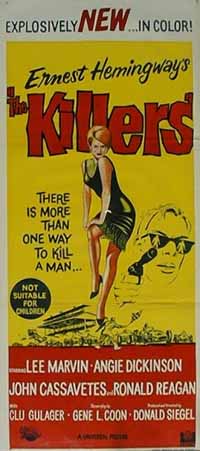
The_Killers_(1964_movie_poster).jpgAfter an opening to rival the original film noir The Killers (1946), though nowhere near as atmospheric, Don Siegel’s The Killers asserts itself as a real rough and tumble operation with surprisingly frank violence. However, it might be expected from such a veteran action director on his way to making Dirty Harry (1971) with Clint Eastwood.
With hitmen (Lee Marvin and Clu Galagher) as the motors for the story, they help maintain a similar flashback structure to the original film taken from Hemingway’s short story, except this time their inquiries are a little more forceful than anything the insurance investigator managed in Robert Siodmak’s film.

Furthermore, to fit better with the cultural moment boxing is traded out for race car driving as our fateful hero in this instance is Johhny North (John Cassavetes) a tragic figure who got caught up in love and wounded in the same instance.

Still, Cassavetes even before he was a director of great repute, he made for a quality acting force because the intensity always seems to burn in his eyes and it serves him well here yet again.

He and his mechanic partner (Claude Akins) are intent on winning a big pile at the racetrack but Johnny gets caught up in a romance with an alluring beauty named Sheila Farr (Angie Dickinson) who can’t get enough of him. But she also happens to be pretty closely connected to an unscrupulous “businessman” who conveniently pays the bills for her. If Johnny knew any better he would get out of there as fast as he could but she’s a knockout who seems to want him and he wants to believe in her sincerity.

Ronald Reagan takes on the uncharacteristically grimy role as the corrupt Jack Browning which interestingly enough would be the actor’s last Hollywood role before switching his sights on politics first as governor of California and then down the road aways as the president of the United States.

Like his predecessor so many years before, The Swede (Burt Lancaster), Johnny (Cassavetes) gets played for a bit of a stooge and as embittered as he is after a faltering racing career, he inserts himself into Jack Browning’s (Reagan) get-rich-quick bank job which is bound to spin out of control. Adding insult to injury Sheila is right there searing through him like she always used to. The imminent results speak for themselves concerning hitmen, dames, and everyone else who could possibly be caught up in the dirty business.

There are isolated moments where the drama gets laid down a little thick and yet for a film that was initially supposed to be a TV movie, this effort really is an enjoyable neo-noir despite being starkly different than its predecessor. In fact, that allows it to stand on its own two feet and even if it’s not nearly as good, Siegel’s film is still quite thrilling. Thankfully this one lives up to its name and it goes out as deadly as it came in which usually bodes well for a crime picture.

Part of that goes down to the acting talent because it feels like there’s no real throwaway role and everyone has something to keep them busy. Lee Marvin has top billing and he takes up a post that feels like it just might be the precursor to the enigmatic crime spree of Point Blank (1967). His performance along with Clu Gulager’s are undoubtedly the coolest bar none and yet they aren’t even in the majority of it.

That privilege goes to Cassavetes and Dickinson who light up the screen and play their character types impeccably. The same might be said for Claude Akins or Norman Fell. The only odd spot is Reagan but then again maybe that might only be my bias since I’m so used to seeing him be presidential.

3.5/5 Stars

Sunday in New York (1963)

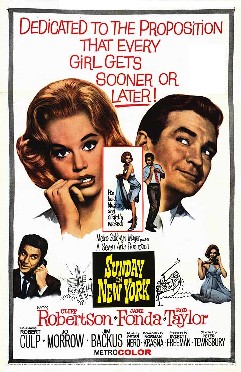
Sunday_ny_moviep.jpgIt would appear that a film like Sunday in New York would never exist today. First, it’s obviously rooted in a stage play and it functions with the kind of moments you might expect out of some of Neil Simon’s works around New York though this particular story was crafted from a play by longtime screenwriter Norman Krasna who wrote many a screwball comedy back in the day.

But this is a film of the 1960s and it looks as such by today’s standards because it’s a chaste sex comedy that is charmingly madcap in its romance and numerous mishaps all while dodging around the social mores of the day. It’s never biting, always palatable, and fairly tame fun given its central themes.

New York becomes a lovely place for a pit stop over the weekend. Numerous people are headed there. First on the list is an airline pilot (Cliff Robertson) who is titillated by the prospect of a whole day alone with his best girl. Of course, being on active call near a busy terminal can be very aggravating for your love life and he and Mona constantly find themselves spending more time on the opposite ends of a telephone than actually together eating bagels and doing whatever else they normally do.

Then there’s Eileen (Jane Fonda), Adam’s little sister who is trying to get over a breakup with her beau. As a young, naive 22-year-old, she’s still trying to figure out the conventions of society and she goes to her big brother for advice on life’s most important questions. He’s someone she can trust about this particular issue.

The fact is she’s still a virgin (Gasp!). He does the brotherly thing and commends her as a respectable man will come along sometime for her. Meanwhile, he conveniently equivocates about what his romantic life looks like.

She does meet a man (Rod Taylor) and there is something between them rather odd at first and then strained by sexual tension and finally complicated by the fact that first her beau (Robert Culp) and then her brother Adam both come back and she must explain the presence of her guest. The film has plenty of comings and goings and while the plot is nothing new and noteworthy the cast makes it work rather well.

Jane Fonda gives a delightfully radiant performance opposite the always personable Rod Taylor with a meet-cute that’s so obviously absurd that it’s easy to laugh it off and simply enjoy it. They get thrown together on public transportation, aboard a bus, but the lady’s jacket gets caught on his coat and they must proceed to exit together. One of those awkward rom-com trifles. The film is full of these cute moments. Little do they know they will be spending a great deal more time with one another on a Sunday in New York.

3.5/5 Stars

Kiss Me, Stupid (1964)

KissMeStupidPosterWhile a less heralded picture, this Billy Wilder film is a minor classic built around a contrived comedic situation. Dean Martin opens playing a parodied version of himself as Dino the boozing, womanizing, but altogether good-natured playboy who makes a short pit stop in the gas station of the small town of Climax, Nevada following his latest Las Vegas circuit.

The beauty of his performance, though it may be exaggerated, there is no sense that this is a thinly veiled caricature. It’s blatantly obvious that “Dino” as he is called in the film is really only playing his “Rat Pack” persona that was known the world over.

That sets the groundwork for the film’s self-reflexive nature that is keenly aware of its cultural moment and the preoccupations of the general public as with many of Wilder and I.A.L. Diamond’s best scripts.

Truthfully I’ve always been fond of Ray Walston ever since my first viewing of My Favorite Martian and before this picture, he cropped up in Billy Wilder’s The Apartment (1960). Although I do adore Peter Sellers (who had to bow out due to a heart attack) and he’s often an ad-libbing genius, somehow Walston seems to more aptly fit the bill here.

That doesn’t mean I don’t regret that Jack Lemmon couldn’t take the role because he really was Billy Wilder’s greatest comedic counterpart, portraying every bit of neuroses that manifests itself in the middle-class everyman. He just gets it and putting him opposite his real-life wife in Felicia Farr would have been another delightful ironic layer to this comedy with its roots in infidelity.

No matter. It was not to be and what we are left with is still some fairly hefty star power. Walston audaciously takes center stage as Orville Spooner, a small town piano teacher with a paranoid fit of jealousy in relation to his gorgeous wife (Felicia Farr). He believes everyone from his teenage pupil to the local milkman is out to pluck his bright-eyed, loving bride away from him.

That’s of the utmost importance when his buddy (Cliff Osmond) dreams up a plan to get themselves a contract deal with Dino. It involves hosting the conveniently laid up pop singer, getting rid of Orville’s wife, and employing the services of one of the main attractions at the local watering hole The Belly Button — the one and only Polly the Pistol (Kim Novak). It seems simple enough to get her to masquerade as Orville’s wife just for the evening so she can make Dino feel at home.

You can see already that the narrative is entangled with bits and pieces of The Apartment (1960) and The Seven Year Itch (1957). Miscommunication and four parties involved means all sorts of foreseeable consequences. Kiss Me, Stupid is also fully aware of the contemporary Hollywood framework much in the same way of Sunset Blvd. Thus, it’s not above satirizing the ways of the entertainment industry — especially the movie stars — with the Rat Pack placed front and center thanks to Martin.

The small-time piano man and gas station attendant also have dreams of being the next Henry Mancini & Johnny Mercer dynamic duo with aspirations for The Ed Sullivan Show no doubt.

Even in its throwaway lines about churchgoers, there’s something starkly sobering being acknowledged as there are in many of the things that Wilder finds time to take a jab at. The owner of the Belly Button, Big Bertha, has all her girls attend the local church because she thinks it’s good for public relations.

It passes like a blip but the suggestion seems to be that these lines of dialogue and what we see on screen might point out some kind of hypocrisy and although it’s played for comedy, instead what I see is the inherent brokenness.

The film spins in such a way that the infidelity somehow ends in a kind of loving understanding that feels like utter absurdity but maybe Wilder has done that on purpose. Still, in spite of myself, I found some humor in this film in ways that I never could in The Seven Year Itch or The Apartment.

The first was too empty with little to offer of substance and the second is often too stark and morose to be funny. This film is raucous and utterly insane in a sense but that’s the way Wilder likes it from Some Like it Hot (1959) to One, Two, Three (1961). Kiss Me Stupid isn’t such a spectacular comedy with some misfires but there’s no doubt that Wilder still has his stuff.

He always seemed to take a very basic concept that was wacky and far from allowing it to fizzle out, he sees it to completion, finding an ending that derives laughs while simultaneously providing wry commentary.

In another screenwriter’s hands or another director for that matter, the romantic comedy aspects would be endangered of becoming trite and uninspired but no such issue here. Wilder would never allow it.

The punchline of Kiss Me, Stupid is that both spouses were deceptive and unfaithful but they do it out of love — that final touch of trenchant Wilder wit. Ultimately, the film’s title is reminiscent of the famed quip in The Apartment (1960), “Shut up and deal.” You get the same sense of the relationship.

The men are essentially cads — spineless at times — and lacking much of a moral makeup (even if Orville plays the organ at church) but their women seem to give them some substance whether they be barmaids or plucky housewives. It’s still slightly mindboggling that Wilder pulled this movie off and got away with it no less.

3.5/5 Stars