Review: Jules and Jim (1962)

jules et jim 1.png

Jules and Jim breaks out of the gates with a frantic burst of energy giving off the effect of a comedic circus act or a whirling carousel and at times it functions as both. Champion of the French New Wave, Francois Truffaut, at 29 years of age injects the film with this kind of frantic lifeblood tearing through the material and time with almost reckless abandon. If Breathless (1960) was not the title taken by one of its contemporaries, this picture could have just as easily taken the name.

You see, Truffaut takes Henri-Pierre’s Roche’s autobiographical novel, the work of an old man, and transforms it into a period piece shot by a young man. The distinctions reveal themselves in full force.

It’s a cinema of attraction with whips, tracks, freezes, jumps, and flies constituting a fluid adventure that’s given free reign to go in so many directions thanks to the versatile camerawork of Godard regular Raoul Coutard as well as connecting voice-over narration (provided by Michel Subor) and a score courtesy of George Delerue.

Still, as Truffaut lets us sink into his story things come more clearly into focus but never so they reach a point of complete clarity. He never dwells too long on a moment or an idea. Instead, choosing to move through the lives of his protagonists touching on so many moments and relationships and ideas. Thus, in one sense Jules and Jim never slogs but it also still functions as a fairly compelling work of historical drama covering a lot of terrain in a condensed amount of time. Some may find that off-putting others will welcome it as a refreshing permutation of the Hollywood status quo.

The year is 1912. An Austrian named Jules (Oskar Werner) and a Frenchman named Jim strike up a friendship that feels like the perfect representation of the deep lasting bond that can form between two individuals. They are young men with a great many of the same interests and a comparable outlook on life.

They’re always benevolent toward one another, they never fight, and they share a mutual satisfaction in the arts while diverting their time at the gymnasium, playing dominoes, and of course, in the company of women. From there one of the great cinematic friendships is forged for life. Though tested, not even a woman can tear their bond asunder…completely. At least not in the way we might expect.

It all begins when they become enamored with a statue, an opaque figure with a pleasant smiling face that captures them so much so that they must go and see it for themselves. But far more striking is the woman they meet back in France who embodies that same bewitching quality.

They meet Catherine (Jeanne Moreau) as they have met many other women in the past for tea or an afternoon of trivialities and conversation. Except Catherine is one of the few that stays with them. Of course, she is personified by none other than Jeanne Moreau that monumental beauty and one of the undisputed queens of the Nouvelle Vague alongside Anna Karina in Godard’s early works.

There’s a frisky and lithe vivacity that carries her through the film’s earliest scenes as she dons her disguise as Thomas frolicking through Paris in one of the most iconic and enduring sequences of the cinema. An overwhelmingly attractive abandon radiates out of her. Truffaut has set Moreau up as such with his narrative and she does the rest.

However, still, as the story continues to progress and she marries Jules and they make a life together with a daughter named Sabine, there are other qualities that come to the fore. Namely, her maturity with a hint of sophistication that still leaves space for that same carefree vigor continually coursing through her and garnering the undivided attention of the camera.

In the complete inverse of the film’s title, you find its true attraction and the figure who makes the whole story what it is.  Jules so aptly puts it that she’s “a force of nature that manifests itself in cataclysms.” She’s so very uninhibited.

Thus, Jules will love her for a lifetime and Jim will count her among his very closest companions but still, she is a complicated creature and perhaps Truffaut is playing out his own mesmerization and subsequent befuddlement with women. Catherine is an epitome of that. She has other lovers. She openly cavorts with Jim who wants to love her even as he wants to stay true to his best friend. She constantly does what is least expected but that goes with the territory of Truffaut’s invention.

As such, it is less of a conventional love triangle and more precisely a menage a trois as the French might say. This is not so much about dramatic conflict as it is tragically sad in the end. Because this is a film about friendship as much as it is love and it’s a dream friendship as much as it is a romantic fantasy. Maybe it’s possible for both to exist partially in the forms projected onscreen and yet Truffaut fills both with so much that we easily yearn for.

There’s the song “Le Tourbillon” that Moreau sings and it quite remarkably ties into this film. The words come from her lips gayly, describing a woman who could very much represent Catherine and then a lover who are both “Each blown their way by the whirlpool of days.” There’s not a better way describing the course of this film.

It’s consumed with so many interludes and subsequent shifts that are almost matter-of-fact from the breakout of the Great War to its ultimate resolution or the marriage of Jules to Catherine and her eventual affectionate advances toward Jim.

Within these segments, it occurs to me that the film hardly comes off like a drama. Still, there are moments of comedy and undoubted tinges of bitter tragedy. But what we’re left with is what Truffaut best described himself — a bit of a knowing paradox of tones.

“When humor can be made to alternate with melancholy, one has a success, but when the same things are funny and melancholic at the same time, it’s just wonderful.”

It is another of the great tragicomedies of cinema like a Citizen Kane (1941) or 8 1/2 (1963) but there’s no doubt that this is Truffaut’s own rendition and it remains the heart & soul of the Nouvelle Vague for its defining visuals that have ingrained themselves in the cultural landscape the world over.

4.5/5 Stars

Love With The Proper Stranger (1963)

Love_With_The_Proper_Stranger.jpegAt first glance, this doesn’t seem like the type of picture suited for Steve McQueen and Natalie Wood. He was “The King of Cool.” She was a major player from childhood in numerous classics. Neither was what most people considered a serious actor. They were movie stars. They had charisma and general appeal to the viewing public.
What we have here is a stark slice-of-life scenario. Even put in the context of her Italian family unit Wood feels slightly out of place. It’s the kind of portrayal that worked for Ernest Borgnine in Marty (1955) and other such pictures. The same if not more can be said of Steve McQueen with his parents. He’s hardly an Italian. But the chemistry is there and that’s almost more important.

Any criticisms or preconceptions aside there must be credit paid to our stars. All power to them for wanting to be in this picture and casting aside what might have been more glamorous material for something that might stretch their acting chops. Because in the mid-50s and onward we were beginning to see a more honest strain of drama in Hollywood films. I would hesitate to call this film complete realism but there’s a candid quality that’s unquestionable.

Love With The Proper Stranger manages to put a narrative to the kind of hushed up realities that needed to be brought to the light. It’s part daring, part matter-of-fact in its actual execution. Because in merely acknowledging its subject matter, even in a minor fashion, it starts a conversation that can lead to some sort of human understanding.

You see, the film opens in a bustling union hall where a freelance musician named Rocky (Steve McQueen) gets paged by someone. He comes face-to-face with a girl. He can’t remember her name but the face is familiar. There’s a smile of recognition. The reason she came to see him catches him off guard though. She wants to ask him to find her a doctor. Because you see, they had a one night stand (the title proves a poetic euphemism) and she’s pregnant. The rest you can put together for yourself. His reaction is not what she wanted.

And so that’s how they reconnect. At first, strained and then looking to gather enough funds to pay the doctor to get it done. They’re genial enough and understanding after the initial encounter. That’s part of what’s striking. Love With The Proper Stranger chooses to traverse a generally understated road in lieu of melodramatics.

Sure, she’s a sales clerk at Macy’s and her family is devoutly Catholic with her older brothers often nagging her to get married. And he’s broke and shacked up with a nightclub dancer (Edie Adams) who runs a doggy kennel in her apartment. Still, that’s all just white noise or at least only shading to what’s really of interest.

One of the most indicative moments occurs when they’re staked out in some god-forsaken rundown warehouse and they open up about romance as they wait for their appointment. Their assertions are meant to make us understand them better but what we are provided is a level-headed dialogue that wears cynicism openly while honestly trying to figure out if love, kisses, and marriage, all those things that the movies and music seem to romanticize are even worth it after all.

During the very same conversation, Wood’s character confesses, “All I felt was scared and disgusted with myself.” Nothing more. Waiting for the bells and the banjos to sound doesn’t work. And when they go to the shady meetup and get funneled to a backroom it’s not any prettier. In fact, it’s probably worse. And it’s these moments that grieve me and pain my spirit. That anyone would have to deal with such an unfeeling environment. It’s not about condoning their behavior or not but being truthful to the way things actually are.

Meanwhile, the film’s latter half is decidedly lighter as if our main characters have settled into the new reality at hand. I suppose that’s the way real life is. It keeps on moving no matter the circumstances. Whatever decisions you have chosen and whomever you pick to live your life with.

Angie rebuffs his gallant proposal of marriage, finds her own apartment, and doesn’t complain about the road ahead. She didn’t need him to fall on his sword or take his medicine. Whatever apt metaphor you choose. That’s not her idea of a sound union. Instead, she tries to content herself with a well-meaning cook named Anthony (Tom Bosley) while Rocky piddles around discontentedly. The directness of the story allows us to dig in; it’s the comic tones of the unwinding romance that guide us to the end. Our leads see it through splendidly with a charming grace that’s collected and still sincere.

Although he will never earn much repute because his offerings are generally low-key, I will continue to do my best in cultivating an appreciation for Robert Mulligan as a director, as well as Alan Pakula. Not that they were quite as socially conscious as a Stanley Kramer or as intent on pushing boundaries like an Otto Preminger but To Kill Mockingbird (1962) and this picture are both statements of quality in themselves.

In fact, it’s rather bewildering that despite the names above the title, an immersive setting in New York’s Little Italy, and a genuine storyline, Love With The Proper Stranger is easily glossed over. Maybe it goes back to our stars. It’s not as monumental as The Great Escape (1963) or The Great Race (1965). And it’s not lauded to the degree of West Side Story (1961) or Bullitt (1966). That’s okay. It has no bearing on whether you enjoy it or not.

Not to undercut everything that I’ve already said but I’ve waited long enough. The final question I was left with is whether or not Natalie Wood was still friends with Santa Claus working at Macy’s. But then again, maybe in the world she finds herself in, Santa can’t fix all her problems. I suppose that’s okay too.

4/5 Stars

Review: Psycho (1960)

psycho 1.png

For all intent and purposes, Psycho could be an episode of Alfred Hitchcock Presents and Hitchcock knew that better than anyone else. Foregoing the more lavish Technicolor tones he had used in Vertigo (1958) and North by Northwest (1959) and lacking the same type of studio backing, he shot this film in the much cheaper black and white format and brought on a great deal of his television crew to make this production a much more inexpensive package.

In that way alone it paled in comparison to some of its much more ostentatious predecessors but that cannot for a moment take away from the impact or cultural clout that Hitchcock still managed — truly topping any of his previous efforts to date. If not his greatest film, then Psycho was certainly his greatest feat of marketing and ingenuity. Because he would never allow his public to forget their experience witnessing Psycho and very few have for generations with it becoming so closely tied to our public consciousness.

The plotline itself is a simple affair of love and small-time crime set in Arizona then transplanted to California. Marion Crane (Janet Leigh) has a man but a life with him seems unlikely especially with both of them being terminally strapped for cash. He’s got alimony to pay and she makes very little on a secretarial salary. But when $40,000 is dropped on her desk in cold hard cash — money she is supposed to deposit in the local bank — in a brief moment of decision she attempts to buy happiness.

She takes the money and keeps on going. From the moment Marion first sees her boss on a crosswalk as she drives off with the money, Bernard Hermann’s score starts pounding. Every time she hits the gas the composer does too and it’s one of the most unnerving pairings in cinematic history.

Even without the scoring, this would still be matchless silent storytelling and yet it’s improved upon by the music working with the image.  A paranoid Leigh becomes the latest iteration of Hitchcock’s icy blonde, curt and still constantly looking over her shoulder because she is not made to be a lawbreaker. She tries to dodge the interrogation of a suspicious policeman and brushes off the friendly salesmanship of California Charlie (John Anderson). But she rides on no thanks to the guilt written all over her face only to be impeded by Hitchcock’s latest implement, a fateful rainstorm that lays her up at the first motel she can find: The Bates Motel.

In Vertigo and Psycho, you can see how Hitchcock distinctly puts us in the eyes of the main character so we have no choice but to view the world as they do and it’s highly effective in bringing us into the story. Thus, it’s even more jarring when he rips our star and stand-in away from us brutally and forces us to frantically search for another anchoring character.

psycho 2.png

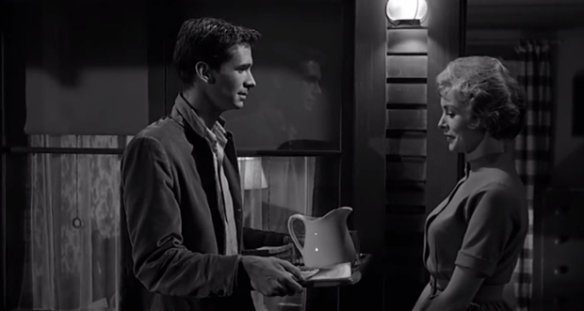
That brings us to Norman. Norman Bates (Anthony Perkins) is such a fascinating character because in one sense he’s like a shy little boy. The moment he asks Marion to have dinner with him is brimming with candor and a pitiful awkwardness — like a boy asking a girl out to the prom or something. That sweetness and social ineptitude are at the core of his being. He can’t hide it just as Anthony Perkins playing Bates feels like he is hardly acting at all. It’s just his way.

The Bates home could be a character in itself, a looming beast that hangs over Marion as the domain of the unobserved Mrs. Bates. It poses itself as a portent of Norman’s own ominous instability along with his pointed drawing room conversation with Marion where he freely discloses, “We all go a little mad sometimes. Haven’t you?” 

That, of course, brings us to the famed shower scene that is a tour de force not only in editing but in the synthesis of all the cinematic components from the image, to sound, to the scoring of Hermann’s impeccable cacophony of screeching strings. It stands alone as arguably the single most iconic scene in all the movies. Thus, it’s surprising that from the very moment Hitchcock was showing Leigh flush some pieces of paper down a toilet he was already making history — because bathrooms were long-held off-limit locations. Hitchcock made them far worse for folks after Psycho.

He also starts moving around the bathroom in a way that’s vaguely reminiscent of Rear Window’s opening. Finally, cutting from the drain to the eye of Marion Crane suggesting the same spiraling black holes of emptiness as Vertigo. It pretty much sums of the conclusion of her life.

But then we’re back to Norman. There’s an extreme distaste in how goes about cleaning up the bathroom but also a certain industry to it. He gets to it silently and efficiently in another one of Hitchcock’s great sequences that unfold without the aid of any dialogue whatsoever until it leads us the precipice of the swamp where Marion’s car is disposed of.

It’s in these interludes that we understand the full gravity of Hitch’s wicked humor. That money — the load of cash that propelled the film forward — is cast aside as simply as that. No two thoughts about it as if to say you thought that’s what this picture was about but he’s not entirely interested in that. He just wants to hook his audience on that objective before sending them hurtling in completely different directions.

psycho 3.png

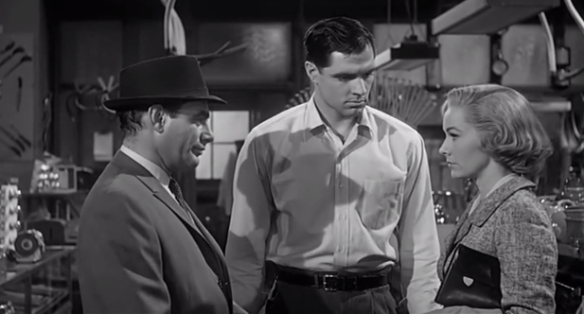
John Galvin plays Leigh’s lover and he’s the stark contrast to Perkins’ character. Both dark-haired and handsome but Sam is a virile man even a masculine ideal of the 50s and 60s. Nevertheless, he joins forces with Lila Crane (Vera Miles) Marion’s concerned sister, subsequently becoming the driving force in the latter stages.

But also of note is the hired private investigator named Arbogast (Martin Balsam) who coincidentally comes onto the scene at the same time at the behest of the old coot that lost $40,000. Balsam a wonderful character actor throughout his career, not surprisingly appeared in two episodes of Alfred Hitchcock Presents and he’s at his best as he questions Norman Bates in that genial manner of his about his person of interest, one Marion Crane.

At this point, in some small way, it feels like we are a bit of an accomplice in this crime of Norman’s.  Complicit in his secret and as Arbogast digs around for answers we crawl inside our skin. Norman tries to cover up and we know he’ll be caught in his lie.  Hitchcock frames his nervousness most overtly peering over to look at the guest registry knowing that something might give him away.

For its day and age, Psycho goes into admittedly dark and taboo territory. But what’s most unsettling is the subverted ideas of romance it showcases. Marion is looking for some form of companionship. She has desires for the American Dream including money and love. All the things that lifestyle entails and yet her desires are quickly snuffed out never to be realized. She doesn’t even receive the hope of love because on the horizon there is nothing for her — only the nothingness of a drain taking away her lifeblood.

Then, of course, Norman is so closely intertwined with his mother that it destroys his being so much so that he cannot even comprehend how to cope with other people. He’s so injured and wounded by a dominating woman and a lack of love that he has no healthy way to express his love and it’s not so much his undoing as it is his stumbling block. Sure it makes for chilling outcomes and a remarkable turn from Anthony Perkins but what resonates time and time again is the pitiful brokenness within Norman Bates. It’s all there in his famed observation that “A boy’s best friend is his mother.” His is a sorry state of mind.

Even in Sam and Lila, we find our best chance at romantic satisfaction. But that relationship too falls on problems when you cast it in the light of Vertigo. If they do continue their relationship, will it simply be because Sam sees Marion in his sister and wishes to have that or does he see the true worth of this woman in front of him blessed with an insurmountable persistence? If anyone can make it work they can but that is not to say it will not be messy. After all, this is a film of messiness — relationally, psychologically, morally. We all go a little mad sometimes. That’s why we’re not to go through life alone. We’re communal beings.

In the denouement, a psychiatrist tries to explain things away and provide a voice of reason that looks to stabilize everything his audience has just ingested. But even that fails to undo and rationalize Norman Bates completely. Yes, his psychological instabilities, his compartmentalized personalities, and the utter dissonance coursing through him can be understood at least partially by such deductions. Human psychology has its place as does scientific thought. Still, that cannot take away from that final shot as the voice inside Norman’s head keeps talking to us and he raises his eyes with a possessed grin breaking out over his face.

There is no explanation that can be given for that look. It burns into us. Emblazoned on our minds and sending shivers down the spine. That image and all those proceeding are what the cinema is capable of, evoking emotion far beyond what any word can possibly begin to unearth. That is the exorbitantly visceral brilliance of Psycho. Hitchcock was a proponent of so-called pure cinema and this is yet another showing of the “Master of Suspense” at the peak of his creative powers. Few filmmakers have made such a stream of classics of such variety and of such a multitude in such a condensed span of time — each one slowly reworking and ultimately rewriting the rules of suspense. Psycho is yet another testament to that.

5/5 Stars

The Fortune Cookie (1966)

The_Fortune_Cookie_(1966)_poster.jpg“You can fool all of the people some of the time, you can even fool some of the people all the time, but you can’t fool all the people all the time.” ~ Inscription in the Fortune Cookie

For some inexplicable reason, I expected The Fortune Cookie to be in color. Maybe in some subliminal way, I assumed it would be like a dry run for the zany Odd Couple (1968), pairing the two stars who would make the most delightful comedic coupling in years. But once you get into the nitty-gritty and The Fortune Cookie is less of an intangible idea floating up in the sky, it’s very obvious that this is more akin to The Apartment (1960) and the obvious reason is Billy Wilder.

Once more he lets Jack Lemmon do his sympathetic role, that guy that we all know who is a bit of a loser but not a bad sort of fellow. From such a characterization Lemmon’s scintillating skill at both physical comedy and verbal jokes come off like they always seem to. You can’t help but smile. But Wilder places that same man — that sorry individual — a simple cameraman named Harry Hinkle, into a very cynical world indeed. It’s Wilder’s version of America.

While he unequivocally loves the country that welcomed him when he was an immigrant, that by no means suggests that Wilder is unwilling to satirize its very flaws. In fact, he relishes doing just that. Sometimes it feels like that was what Billy Wilder was put on this earth to do. Make people laugh and do it with a biting style that forces us to look a little closer at the incongruities around us.

You can easily make the case that the main attraction here are two noteworthy dynamic duos (although it’s slightly dependent on how you want to draw them up). First Billy Wilder paired with his writing partner I.A.L. Diamond yet again after their string of successes with Some Like it Hot (1959), The Apartment (1960), and One, Two, Three (1961) among others.

But perhaps just as importantly we have the genesis of the longstanding comedic collaboration between Lemmon and Walter Matthau. It just works. It’s easy to see why they continued starring together because when they’re in the same room wonderfully hilarious things come into being.

Otherwise, the film takes a wacky premise involving a Cleveland Brown’s punt returner leveling a CBS cameraman and draws them out as far as they can possibly go. It’s actually rather impressive that this single spark of an idea gave way to a fairly substantial picture. Because all kidding aside, and without consideration of its title, the film is not unsurprisingly cut out of Billy Wilder’s cynical worldview as already acknowledged.

Yet again he finds his perspective of America derived from some combination of screwball comedy and a more downbeat, melancholy tone. True, he made some delightfully dark films-noir but this same malaise somehow worked fairly well in his comedies too.

Here it’s perfectly enhanced by world-class shyster Whiplash Willie (Walter Matthau) the conniving ambulance chaser who takes great interest in his brother-in-law’s purported injuries on the football field — even if they wind up being next to nothing. The insurance company doesn’t know that and that’s the key.

The periphery is complicated by a private investigator (Cliff Osmond) staked out across the way who has their room bugged and under surveillance. Harry’s mother is constantly bawling. The wife (Judi West) that he once loved and who ran off with another man is tantalizingly close to returning to him. Meanwhile, the soft-hearted football superstar who bulldozed him, Boom Boom Jackson (Ron Rich), looks for any way to make his little buddy’s life more comfortable and it’s taken a major toll on his success on the field.

It’s these very relationships that have Harry seesawing back and forth as his wily brother-in-law coaxes him to keep working the angle so they can nab their $200,000 in recompense. Watching Lemmon pirouette in his electric wheelchair, stiff-necked in a brace is priceless. Concurrently, Matthau seems to be limbering up for all his greatest roles from The Odd Couple to the Bad News Bears (1976) showing off his own impeccable adroitness with curmudgeon comedy — delivering dialogue in such a tone with such a way about him that’s at the same time devious and terribly hilarious. He even answers the phone like nobody’s business.

Lemmon owns the final scenes, however, as he must try and reconcile this lie he has been made to live — this charade he has been playing for the sake of $200,000. Perhaps even more troubling than Harry’s lie and less funny is what happens to Boom Boom. Because he’s such a kind soul even dangerously subservient in how he follows cinematic precedence. But we can make the case that this is part of what Wilder is poking at.

The one moment his protagonist shows any integrity, the one moment he stands up, literally, is in the face of a supposed bigot. Even if it says little, there’s no denying that it says something. Sometimes we don’t need comedies to win the big battles. A film called The Fortune Cookie is not going to garner a lot of respect (nor should it necessarily) but it can at least get us to stop and think. Maybe the utter absurdity in some ways isn’t all that far away from our own existence. That’s part of its charm. Crack it open if you’re so inclined.

3.5/5 Stars

Blast of Silence (1961)

Blastofsilence.jpgIt looks like we’re staring into a black hole. Disorienting. Dark. Swirling around us. Our eyes adjust as our narrator begins his voiceover that will cover the majority of the film’s canvas. In this moment he talks about that initial spark, that moment of birth when humans leave the womb behind and see the light of day for the first time. In that same instance, we burst into the open air and realize that what we were looking at all along was the long dark tunnel from a moving train.

It’s from that train that our main protagonist hops off to get to work. He settles in a hotel room. Gets his assignment laid out with all the applicable details. He spends some time getting to know his target from the comfort of his car and picks up the gun he’ll use to commit the dirty deed. His supplier is a pudgy beatnik with a penchant for rats — a real salt of the earth kind of guy — but Frankie (Allen Baron) was never looking for a new friend.

However, he does bump into an old one. Because New York City used to be his home when he was a boy. He tried to get away from it. His memories of the orphanage and the Nuns who once cared for him. But now he’s back and one of the boys he grew up with is staring right back at him with his good tidings and Christmas cheer.

Frankie gets distracted. This complication throws him off his agenda because for one brief moment he becomes an actual human being and his very human desires begin to overtake the mechanisms of a stone cold killer. These are the same callous instincts that dictated his actions thus far. Things begin to come into their own and evolve into something truly inspired. It’s when Blast of Silence stops being a mere atmosphere or an aesthetic and becomes something real.

Because initially, this crime film is a grungy unsentimental picture that wears its low budget on its sleeve, delivering the kind of crime scenes that Jean-Luc Godard would have been proud of. However, this is not a French New Wave auteur but instead the director and star Allen Baron. At first, it seems like an exhibition not so much in style but a look and a mood and a feel. Drudging up images of the gritty pavements of Brooklyn, shipyards, and train tracks. Meanwhile, the score meanders between jazzy interludes and melodrama given the mood.

There’s a sense that it relies too heavily on its voice-over — the inner monologue of its lead — and still, that’s hardly a criticism because the film does so much that is engaging. In the end, Blast of Silence begins to suggest the immense isolation of a man in such a position. We’ve seen it before but few portrayals are so unflinching and pointed. Even as he pushes towards his objective, he’s simultaneously a picture of loneliness. We begin to question what leads someone to this career path. Some hints are left for us to make our own inferences. He’s an orphan. He’s searching for love. He wants something more. He wants a life with other people. Love, community, family perhaps.

Yet as it goes, God works in mysterious ways and you’re alone again back in the cold black silence like how things began. The film takes on a thoroughly pessimistic ending that nevertheless feels like a fitting conclusion amid the whirling rage of real-life Hurricane Donna. A truly unsentimental journey in the existence of a hitman.

3.5/5 Stars

Bye Bye Birdie (1963)

bye bye birdie 1.png

Bye Bye Birdie has sunshiny singalong written all over it even before we know the premise. The fact that it’s about the frenzy following the draft notice of a beloved hunky teenage heartthrob Conrad Birdie (a knowing amalgamation of Conway Twitty and Elvis) doesn’t help its case much. It can be rather annoying for the complete and utter squareness of every successive moment. That is true.

But on the whole, that overwhelming peppiness bowls you over with its sheer gaiety and the fervor of teenybopper spirit. So yes, at times it’s nearly suffocating and still intoxicating due to that same excessively sweet 1960s optimism.

Birdie’s unfortunate fate creates the spectacle. In its wake is left a war zone of swooning girls who go absolutely gaga after a particularly spectacular performance. But that’s just the beginning. To set the stage we must look first to a biochemist turned composer named Albert Peterson (Dick Van Dyke) who after 6 years of fruitless toil is looking to leave the business.

But his gal, the chipper Rosie DeLeon (Janet Leigh), hanging onto the hope that he will one day propose marriage, brings a brilliant idea before America’s greatest variety show icon Ed Sullivan himself. Her idea: To have the beloved Birdie kiss an All-American girl as a symbolic gesture of his goodwill towards his booming fan base. Ed, of course, eats it up, and her Albert will pen the song to be heard by millions across the country that fateful Sunday night.

bye bye birdie 2.png

All that’s left is to find the girl and by the most coincidental circumstances the lucky tween winds up being Ohio’s own Kim McAfee (Ann-Margret). Her best boy Hugo (Bobby Rydell) has just “pinned her” and she sits chatting away on the telephone but it’s peanuts compared to the meteor that strikes her household that evening. Soon the whole student body and her family get carried away in the excitement promising them eternal bliss and stardom on the biggest stage imaginable.

The adolescent masses continue going baddie — namely those of the feminine persuasion — while the boys hate Birdie’s guts for stealing away their dates. In the end, Kim and her family, Albert and Rosie are on the brink of getting pushed off of Sullivan. It all seems for naught until some quick thinking gets them the outcome they were long hoping for. The Russian Ballet gets truncated to put it lightly.

What matters is that everyone gets a happy ending. Each person winds up with their respective significant other and just as it opened, Bye Bye Birdie goes out with Ann-Margret belting out the title chorus with a charisma that conquered many a young heart.

What the screen adaptation does well is act as a fitting forerunner for another cultural explosion that would occur on Ed Sullivan’s Show only a year later. In fact, Birdiemania looks strangely familiar and perfectly personifies the older generations befuddlement with their crazy kids. Paul Lynde is the perfectly idiosyncratic father figure to reflect the changing times.

Meanwhile, Janet Leigh seems to relish an opportunity to tap into one of her more ditzy personalities as Rosie DeLeon. While new to film, the beloved Dick Van Dyke struts his physical comedy and provides a charming performance of “Put on a Happy Face.”

Director George Sidney comes in with an innate understanding that musicals are a communal event and just as importantly with the realization that he had a star on his hands in Ann-Margret. If this story was on the stage, Van Dyke and Leigh would have been the stars and they did indeed have top billing. Still, with the purposeful framing device he chose and the many close-ups and set ups he picked Sidney made this Ann-Margret’s picture no question. She obliges by lighting up the screen with that unparalleled mixture of perky sensuality and early 60s innocence.

It’s all so cute and fluffy and sweetly sincere it’s almost difficult to sense the satire sitting there. But I would like to think that it’s purposefully here from the cameos of Ed Sullivan and John Daly to every other spastic characterization. My only hangup is that instead of Elvis Presley himself we got Jesse Pearson. No offense whatsoever, but he’s not exactly the King and besides having Elvis in the picture would have only accentuated the irony of the whole ordeal. Still, fans can still find solace in the fact that there’s Viva Las Vegas.

3.5/5 Stars

Viva Las Vegas (1964)

Viva_Las_Vegas_1964_PosterPreviously, whenever I thought of Elvis and films, my first inclination was to think musical and then secondly because, by some form of osmosis the culture had taught me this, Elvis went with Ann-Margret. In truth, they were astoundingly only ever in this one picture together but what a picture for them to be in. It left an indelible impact on both stars as much as it did their audience.

Sure, it’s at times utterly laughable, light, and saccharine with gaudy color schemes that make Las Vegas the flashiest spectacle known to man (which it might actually conceivably be), but there’s something still so winsome about it.

The story is one of those contrived Hollywood love stories that we know the rhythms of before they have begun.  Boy meets girl. Boy becomes infatuated with girl. Girl keeps him at arm’s length. Girl begins to fall for him. Girl gets turned off because of some trivial misunderstanding. In the end, girl gets boy or vice versa. Whichever you prefer because either way it still proves a formulaic picture.

But gosh darn it, Viva Las Vegas has a vibrant energy that probably makes every man, woman, and child wish they could go back to that era, especially all those rock ‘n rollers and beboppers who grew up with Elvis for breakfast, lunch, and dinner.

There’s no doubt that he had a magnetic charisma that went beyond a voice or a look but the very way he shimmies, snaps, and shakes his way into the heart of every gal. However, the real vivacity of the picture comes from the same kinetic friskiness that seems to charge through Ann-Margret as well. Because in most any given equation Elvis Presley is bar none going to be your dominating force commanding the screen as the indisputable Elvis the Pelvis, the King of Rock and Roll. But put him up against Ann-Margret and they tease and prod each other this way and that — the perfect romantic counterpoints.

It’s as if they both have a sense of the game that they are playing — the back and forth — the one-upmanship and playful toying that gives the story a hint of sensuality while still maintaining that squeaky clean sensibility allowing a picture like this to remain more charming than most films we are introduced to today.

And when it’s all said and done, aside from the title track which will undoubtedly be most familiar and exhilarating for audience members in its numerous refrains, there are quite a few truly dynamic sequences that go beyond tedious asides in a musical love story.

They reflect how Hollywood seemed to understand the collective power that musicals could have. Director George Sidney is not necessarily a noted name of great repute but if you look down the list of his directing catalog you see many a diverting musical (ie. Annie Get Your Gun, Kiss Me Kate, Bye Bye Birdie, and a whole slew of others).

With Viva Las Vegas it’s easy to acknowledge that he has a knack for the spectacle that remains light and amusing to the end including the notable Ray Charles tune “What’d I Say” played out on a giant roulette wheel, our leads making eyes at each other, surrounded by a crowd of fellow shimmy and shakers. But also the hip swinging, finger-snapping crowd pleaser “C’mon Everybody” that puts our stars on full display. They even end up making the smaller trifles like “The Lady Loves Me” and “If You Think I Don’t Need You” more than a complete drag.

To top it all off, far from being corny, the final Grand Prix sequence is actually quite marvelous as the cars speed through the desert past Hoover Dam and we see Lucky win out against his good-natured rival. The film truly does benefit from the on location shooting only topped by the breezy chemistry of its leads. More than The Rat Pack or Bond, this film gives me at least an iota of desire to visit Las Vegas. Although that might simply be the fact that Elvis and Ann-Margret, in particular, imbue the lifestyle with so much verve. Anyways there are no qualms in proclaiming, Viva Las Vegas!

3.5/5 Stars

Ride in the Whirlwind (1966)

Ride_in_the_Whirlwind_(movie_poster)Anyone who takes the time to search out this movie whether the reason is a young Jack Nicholson who wrote, helped finance, and starred in this western or because it’s directed by cult favorite Monte Hellman,  they probably already know it was shot consecutively with The Shooting. Whereas the first western has an unnerving existential tilt as the plot takes us through an endless journey across the oppressive desert plains, you could make the claim that Ride in the Whirlwind is a more conventional western.

However, it’s still highly intriguing for its main premise and the dilemmas that evolve as a result. But that’s enough with the big picture. Here are a few more details to fill in between the lines. The action begins with a holdup, a true western staple. True, a pair of men get injured but it’s about what you expect from such a skirmish. In the end, the stage rides off generally unimpeded and the bandits retreat to their lair up in the nearby mountains to wait it out for a while. Maybe they know a posse is on their trail and maybe not.

Either way, they’re mighty careful when a trio of riders make their way through the main pass. Of course, they don’t know that these are only a few cowhands making their way to Texas and they’re looking for a place to bed down for the night.

Both sides have a general sense of the other but rather than make waves they do the mutually beneficial thing and everything goes about their business nice and easy. There’s no need for guns and no ones looking for any trouble.

But the next morning a posse that means business rolls in and they’re not about to wait and ask questions. They set up posts to pin down their adversary and they hardly discriminate between who was a bandit and who is innocent. That’s not the way their righteous form of justice works.

Rather like the early Hollywood Classic The Ox-Bow Incident, they are searching for the men to lynch and it hardly seems to make any difference if the men are innocent or not. They shall be avenged. However, an interesting observation is that in once sense this does not seem like mob rule. The posse is calculated and cool in executing their objective although that’s no comfort to those who are actually innocent.

In the ensuing standoff, one of the ranch hands, caught in the crossfire gets it and the two bandits who come out with their lives get about what we expect. The second half of the film follows the two men who were able to escape and they just want to find a pair of horses so they can ride away from the whole business.

Their quest on foot leads them to a nearby homestead and this latter half of the story brings to mind earlier pictures such as Shane or Hondo where families are seen trying to make a life for themselves out on the plains.

Wes (Nicholson) and Vern (Cameron Mitchell) are desperate to get away yes, and they sneak into the families home but what makes them so different is the very fact that they are not real criminals. They are only doing this out of necessity. They treat the womenfolk respectfully including the ranchers taciturn daughter Abigail (Millie Perkins) but they’re also bent on taking for themselves a pair of horses.

First off, Evan ain’t so keen on having his home invaded or his family held hostage and he’s especially not obliging that they’re going to run off with some of his stock because they’re his after all.

This is in itself another brooding film like The Shooting but for different reasons. It’s filled with genuine tension because the irony of the situation is that we know these men are innocent and yet in order to survive in some ways they must take on the mantle of criminals just to live another day. There’s no space for a rational third way. There’s no grace or any type of understanding and so they’re forced to play by the rules already set up by the posse that’s pursuing them. That’s the moral conundrum at the core of this tale.

Ride in the Whirlwind has the dismal type of ending we expect with a bit of a silver lining but it’s that very shred of hope that makes it an affecting western. It feels right at home with the sentiments of the 1960s where the world is not as innocent as it used to be and the world often does not function by the most equitable standards. Some would say that’s why the western fell out of favor because in the classical sense, it no longer reflected the perceived world at large like it once did.

3.5/5 Stars

The Shooting (1966)

ShootingHellmanCrime films, westerns, and horror. It’s easy to see why these genres make arguably the best B-pictures, all things considered. It lies in their ability to deliver thrills with minimal capital and a bit of inspiration. Film Noir is by far my favorite but a film such as The Shooting makes me love shoestring westerns too. Except that’s just an initial gut reaction. What happens over the course of this film truly plays with our preconceptions. Its ambitions being rather curious.
The players are set fairly early on.  The cult favorite Warren Oates is cast as the laconic Gashade who however indifferent he might seem has some shred of decency in him as signified by his friendship with Coley (Will Hutchins) a needy and rather dimwitted miner.

His genial personality makes the addition of our third player all the more important. She’s a woman (Millie Perkins) who comes upon them unannounced and generally unwanted by Gashade. But she also comes with a proposition and money to boot.

Our protagonist is lukewarm to the whole undertaking but for some inexplicable reason agrees to become her guide in tracking someone. He wins a spot for Coley in their caravan as well and it’s easy to see Coley is very much taken with the lady to make up for his buddies complete lack of interest.

The acerbically biting Millie Perkins rivals Jane Fonda and Raquel Welch in the pantheon of cinematic Western women as she verbally spars with her fellow travelers. While the ever-leering Jack Nicholson, here in a very early role as a hired gun robed in black, adds another layer of tension to this extremely peculiar western exercise.

Monte Hellman follows a script penned by Carole Eastman that leads us through the blistering deserts of Utah on a very certain quest that nevertheless becomes increasingly vague and ambiguous as the film progresses. The very fact that The Shooting takes one of the archetypes of a man with a burning vendetta (for example The Searchers or The Bravados) and subverts it so completely denotes how unique this film manages to become.

It’s all orchestrated with a certain idiosyncratic paranoia both musically and otherwise. The opening moments prove just how effectively a score can impart a level of anxiety into a film without anything of much consequence actually occurring. It complements the slow burn that follows for the next hour — slow, brooding, perplexing, all those things — as we wander along with them like the Israelites in Exodus. But there’s an underlying goal to it all, the resolution that we expect to bring everything that has happened thus far to fruition. There will be a cathartic showdown where all is revealed if not made right.

Hitchcock’s long since overused quip that I will nevertheless mechanize one more time goes something like this and seems apt for this film. There is no terror in the bang only in the anticipation of it. That’s the key here. The “bang” as it were, comes but it comes in such a way that we were never quite expecting. The sequential narrative points that we are used to traversing are never quite passed in the succession that we are used to.

There’s a penchant for throwing out names that feel vaguely relevant such as Beckett or Kafka but not being literary enough I will forego such pieces of analyses to simply state in many ways The Shooting feels perfectly at home in the 60s. It’s a real trip and not simply on horseback. More in a precursor to Easy Rider sense. I believe the coined term is an Acid Western.

Paired with another Hellman-Nicholson collaboration backed by Roger Corman and filmed consecutively, The Shooting is made for a double bill with Ride in the Whirlwind. This number, in particular, proves just how mind-bending a western can be. There are no small films only small budgets and with enough vision, not even that can inhibit a truly inventive endeavor like this.

3.5/5 Stars

Charade (1963)

Charade_2.jpg

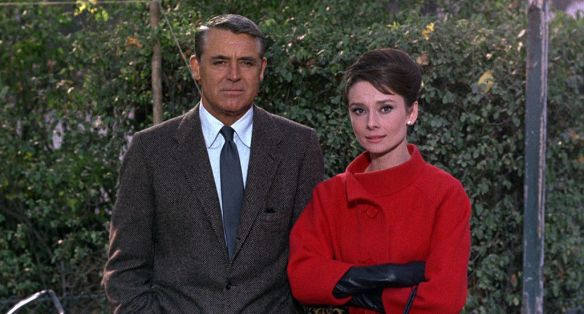
It’s easy to yearn for the days where they made stylish, amusing films like Charade which were equal parts charm, class, and wit all stirred together to perfection. Those were the days when two stars as beloved as Cary Grant and Audrey Hepburn could carry a picture no questions asked because people would turn out to see them no matter the story. And it’s true, though they were never in another picture together, there’s a wonderful chemistry that builds between them and never ceases from the outset of this lithe thriller.

From their first exchange up until their last, it’s hard not to delight in their every interaction, every word, every smirk. There’s a consistent playful patter bubbling up that’s at times suggestive but never loses its sensibilities. There’s a constant twinkle in the eyes of our stars interrupted every now and again by brief moments of sheer terror. Hepburn playing her elegant self but perpetually frantic while Grant exudes his general charisma that sees him through peril as well as innumerable comic situations (ie. an awkward game of pass the orange as well as showers with his clothes on).

Of course, it hardly hurts a bit that Charade has a surprisingly tense plot that while a little flimsy in some areas still manages to have a plethora of twists, turns, and about-faces to come off generally befuddling like many of the most enjoyable thrillers out there.

It all begins with a body getting tossed from a passing train. Regina Lampert (Audrey Hepburn) is on a vacation on a snowy mountaintop away from her husband with a wistful sense that her marriage is done for. Little does she know how right she is. She returns to her residence in Paris only to find all her belongings gone and her husband dead. The police believe it has to do with a missing $250,000 that Lampert was purported to have absconded with during the war. Their guess is that one of his old platoon mates let him have it so they could get the payload for themselves. All of this is news to Regie who was painfully ignorant of her husband’s affairs. And now with it all dropped in her lap, she doesn’t quite know what to think.

The police inspector (Jacques Marin) on one side questioning her and the Federal Agent Hamilton Bartholomew (Walter Matthau) frightening her out of her mind. The only real bright spot is her newest acquaintance Peter Joshua (Grant) and she’s bent on chasing after him before the people chasing after her catch up. Because life, even a spy life, is better with a companion.

Forget the fact that this film has often been attributed to Hitchcock. This is Stanley Donen’s creation and if nothing else it exhibits his admiration for the Master as well as his adaptability taking his own skills as a comedic and romantic director and adding a touch of the thriller to the mix.

He makes it work very well and paired with the typically jazzy score of Henry Mancini, a continually entertaining script by Peter Stone, and generally immaculate color cinematography by Charles Lang, Donen can’t miss.  If it’s not the greatest film if only for the very fact that it doesn’t take itself all that seriously, Charade uses that very quality to its advantage with plentiful splashes of fun and romance.

Audrey Hepburn robed as per usual in iconic creations by Givenchy looks to play the huntress on the prowl. While on his own admission Cary Grant takes the passive role as the pleasant older gentlemen who nevertheless wears many hats and many names. Though Hepburn and Grant undoubtedly take center stage and rightfully so,  that’s not to discount quality character actors like Walter Matthau, George Kennedy, and James Coburn filling in as the deceased Charles Lampert’s old war comrades each carrying a bit of a vendetta.

The surprisingly tense conclusion sweeps through the Parisian streets, subway stations, colonnades, and finally an abandoned theater. But, above all, Charade does well to neutralize its more intense or even grisly moments (at least by 60s standards) with its persistent charm. The type of charm that make those films of old so endearing much like the actors who starred in them.

It’s as if in the twilight years of the studio system some of the greatest names coalesced to gift the world another gem for the road. There certainly were signs of change with wistful mentions of Gene Kelly’s early classic An American in Paris or a passing remark about stamps commemorating Princess Grace’s coronation (which took her away from a brilliant film career). At 59 Cary Grant was aging gracefully but still near the end of his career with only two more pictures to follow. And Audrey Hepburn herself would finish out the 1960s with several notable classics and then she would all but conclude her illustrious career for good.With Stanley Donen still with us, he truly acts as one of the last strands connecting this generation with those Golden Years of Hollywood.

However, the most significant reality is that this film came out in December of 1963, a mere month after John F. Kennedy was assassinated near the Book Depository in Dallas Texas. That singular event more than any other was emblematic of the change that would surge through society and the world at large. That is the world that Charade was born into.

So if you were to use the unforgivable cliche at this point that they “just don’t make movies like they used to,” you probably would be correct because that’s close to the truth. Films like Charade are all but gone and when you actually consider the joy of watching Hepburn and Grant together, it really is a terrible shame, though it simply seems a testament to the rolling tides of change.

Still, there’s something truly magical that occurs when they’re together. They were an altogether different breed of star. Maybe it’s the way they carry themselves, dress, or speak. Maybe it’s the way they look at each other. Maybe it’s their quips. Maybe it’s something else entirely. But they’re two of the greatest we’ll ever know for the simple fact that they were so beloved. They made us love them and as a result, we buy into this entire film. We bought into their charade and enjoyed every last minute of it.

4/5 Stars