Review: The Magnificent Seven (1960)

themagnif1“Nobody throws me my own guns and says ride on. Nobody” ~ James Coburn as Britt

People always resonate with stories of valor, honor, and bravery. It doesn’t matter if it’s a war film, a tale of samurai, or a western. Thus, Akira Kurosawa’s Seven Samurai rather seamlessly became The Magnificent Seven, one of the most reputed westerns of the 1960s.

In theory & practice, it has everything you want in a western from a stellar cast to thrilling gunfights matched by one of the most epic soundtracks ever coming out of the annals of cinema.

But although it’s script is not exactly taut, you can hardly accuse The Magnificent Seven of being superficial. Its characters and its narrative are too satisfying for such a claim. After all, who wouldn’t want to see such a company as Yul Brynner, Steve McQueen, Horst Bucholtz, Charles Bronson, James Coburn, Robert Vaughan, and Brad Dexter? You have “The King and I,” “The King of Cool,” and about every other figure you would want in a good shoot’em up. They were seven who fought like 700.

In not completely splitting with its samurai roots, this western deals in moral codes and issues of honor perhaps more closely than even many of the best known western. The main issue here is that this laconic and sleek gang is brought together to defend a small Mexican border town made up of farmers against a bandit and his band of marauders. What causes men such as these to take on such a dangerous and in many ways such a one-sided job? For some it’s money (because they have none), some want the excitement, and for others, it’s something different. But all that matters is they all go into this together – some of the deadliest guns prepared to duke it out.

themagnif3Into the valley road the seven rather like the light brigade, at first simply preparing to train up and prepare their little village of farmers to fight back against the brutal outlaw Calvera (Eli Wallach). But there’s something that happens over time. When you spend time in close proximity with people, eating their food and sharing their shelter, it’s hard not to build a bond — a connection that holds you there. At first, it seems of little consequence when the enemy gets beaten back, but everyone knows they will return with a vengeance.

Ultimately, the seven are betrayed and are given a clear choice. They can keep moving on or turn back the way they came. It’s just a small inconsequential town, but they cannot turn their back on it, even when they were betrayed. They grapple with what’s good, what’s right, and what’s rational, and then make their decision. It goes against all reason and yet into the valley road the seven together (eventually).

themagnif2And we get the final skirmish with guns blazing, bullets flying, and lives being put on the line. Here is a film where the final body count deeply matters. Not so much of the enemy, but of our heroes, because each one chisels out a little niche for themselves. Everyone has worth and importance even as they jockey for screen time and it pays off in the end. They fight with honor just as they die with honor. Perhaps it might seem futile, but not without significance. The little village is left in peace to live out their days in tranquility. Calvera’s final words echo in their ears: “You came back – for a place like this. Why? A man like you. Why?”

Elmer Bernstein’s score is masterclass. Majestic, grand, playfully prancing about, and at the same time eliciting a grin from any boy who has ever dreamed of the Wild West. Furthermore, there are so many characters to idolize, because this film made ensemble action films the style along with the likes of The Great Escape, The Professionals, and The Dirty Dozen to name a few. This has always been one of my father’s favorite film’s and I can completely understand why. It has gunfights, bad guys, and good guys, quips, and tricks. But at the most basic level, it’s a striking parable about moral codes, personal pride, and the sacrifice that goes along with such things.

4.5/5 Stars
Review: High and Low (1963)

highandlow1High and Low (or Heaven and Hell in the original Japanese) is a yin and yang film about the polarity of man in many ways. Gondo (Toshiro Mifune) is an affluent executive in the National Shoe Company. He worked his way up the corporate ladder from the age 16, because of his determination and commitment to a quality product. Now his colleagues want his help in forcing the company’s czar out. They come to his modernistic hilltop abode to get his support. Instead, they receive his ire, splitting in a huff. What follows is a risky plan of action from Gondo that is both fearless and shrewd. He takes all his capital to buy stock in the company so he can take over, but his whole financial stability hangs in the balance. He knows exactly what it means, but he wasn’t suspecting certain unforeseen developments.

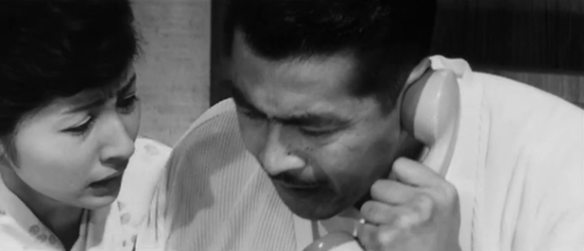
Then in a matter of moments, everything changes. Gondo gets a menacing phone call claiming that his young boy is kidnapped and an astronomical sum of money is expected in return. Gondo and then his wife are instantly horrified by the news only to be relieved when their boy winds up unharmed. The same’s not true for his chauffeur’s boy Shinichi. The mistake in identity is obvious, but it makes no difference to the perpetrator because he still has leverage. He wants to make Gondo sweat since this is more than an isolated incident. He wants to make the man suffer – bringing him down to the level of all the unfortunate souls who live in the wasteland down below.

highandlow2At this point, the police are called and they arrive incognito, ready to stake out the joint and do the best they can to get the boy back safe and sound. This section of the film almost in its entirety takes place within the confines of Gondo’s house and namely the front room overlooking the city. It’s the perfect set up for Akira Kurosawa to situate his actors. He uses full use of the widescreen and his fluid camera movements keep them perfectly arranged within the frame.
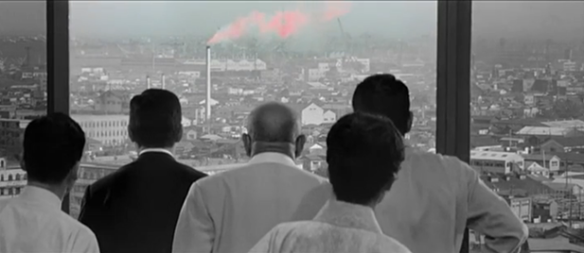
Although the number of bodies also increases the anxiety in the space with Gondo at the center of it all trying to figure out what to do. Moral issues begin bubbling up that no man would have to deal with and yet they end up right in his lap. His whole business empire that he’s given his heart and soul to hangs in the balance of this decision, but he must make it nonetheless. Make the difficult choice to pay the ransom and do what’s moral, or not pay it and maintain his financial stability. For once in his life, their’s a hesitancy.

It’s as if he’s getting pulled back and forth with his wife chiding him, “Success isn’t worth losing your humanity,” while his opportunistic right-hand man is chomping at the bit to get a move on. He’s not going to allow his superior to sink all their prospects at financial gain.

As things progress, we finally move from the living room to the train where Gondo prepares to make the drop, but his adversary has planned out everything and has a clean getaway. The money is gone and now the police double their efforts. Meanwhile, behind the scenes, his backers are prepared to push Gondo out, because of his inability to pay them. Public opinion soars for the selfless act, and we finally meet our protagonist’s unknown adversary.

Really this second leg of the film is mostly about the procedural aspect as they begin hitting the pavement canvassing and trying to close in on the culprit. This section intercuts the reports going on at headquarters with actual police work on the streets and it’s strangely engaging.

highandlow3Finally, with the help of Shinichi, they make a startling discovery that ties back to the kidnapper. And the boy’s drawings along with a colorful stream of smoke help them move in ever closer. What follows is an elaborate web of trails through the streets as they work to catch the culprit in his crime, to put him away for good. And it works.
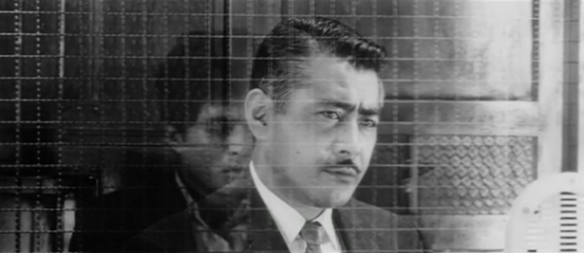
highandlow5But High and Low cannot end there without a consideration of the consequences. Gondo has been brought low. He’s losing his mansion and must start a new job on the bottom of the food chain once more. His enemy requests a final meeting as he prepares for his imminent fate, and this is perhaps the most grippingly painful scene. Gondo’s face-to-face with the man who made him suffer so much. Toshiro Mifune’s violent acting style serves him well as he wrestles so intensely with his own conscience. And yet at this junction, he is past that. What is he to do but listen? In this way, it’s difficult to know who to feel sorrier for — the man who is resigned to a certain fate passively or the one who goes out proud and arrogantly against death. Both have entered some dark territory and it’s no longer about high or low or even heaven and hell. They’re stuck in some middle ground. An equally frightening purgatory.
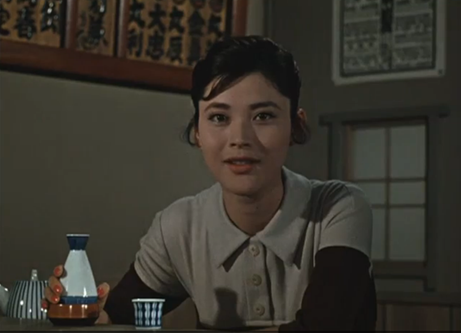
Yes, this works as an indictment of the justice system and even the capitalistic framework of an industrialist post-war Japan, but it’s even more so an acknowledgment of man’s own morality and mortality. We are far from indestructible, unfaltering beings.

4.5/5 Stars

Late Autumn (1960)

lateautumn1Yasujiro Ozu has the esteem of being christened “The Most Japanese Filmmaker.” It’s certainly a high honor, but at first, it can feel rather counter-intuitive because after all, such a great master of cinema cannot be considered average or a composite in the scheme of Japanese film history. And I don’t think that is what this title is trying to get at. The fact is that Ozu, over time, really experimented with the conventions written by classical western filmmakers and he built his own unique aesthetic that is quite evident later in his career. That being said, his film’s are very Japanese in the way they interact with and dissect the culture that he comes out of, and I think that is paramount to understanding and ultimately appreciating his work.

It’s no different with Late Autumn, Ozu’s penultimate film, a social-familial drama that shares a great deal of similarity to some of his earlier work. The fact is, he’s constantly returning to these ideas of marriage, family, generational differences, and the underlying etiquette that is so prevalent in Japan and Asian cultures in general. But of course, much of what he examines is universal and that’s what allows his films to remain timeless.

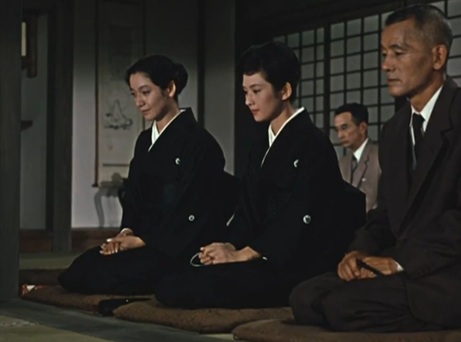
With Late Autumn, in particular, it’s easy to marvel at how the director frames his space because he seems to have tremendous spatial recognition. He’s confident in his aesthetics which he highlights with colors and axis lines, which are then further embellished with human subjects. Not many directors are brazen enough to show us an empty room, a hallway, or the mundane facade of a building, but Ozu is so self-assured in his composition. They are too long and occur too often to be establishing shots. He wants to continually convey to us the space that his characters inhabit and he’s meticulous. Everything is placed with pinpoint precision just the way he wants. And it shows.

On a basic level, Late Autumn can meld nicely with many of the director’s other works also based around the seasons. In this color installment, three adult men gather for the funeral of one of their mutual childhood friends. It’s a sad occasion as they wistfully remember the good old days when they were young and in love. But as a service to their deceased friend, they agree to find a husband for his sweet sunshine-faced daughter Ayako (Yoko Tsukasa). However, they also worry for his widower Akiko (Setsuko Hara), who is equally beautiful, since the years have been very good to her. What follows is the typical fumbling attempts at matchmaking, trading manners, and so on. When Mr. Mamiya inquires if he should ask for a young man’s picture and resume, we assume it’s a joke, but he’s quite serious.

What makes Autumn different than earlier classics like Late Spring or even Tokyo Story, is that it shows the next generation of young people.  The kids embrace the rockability of Elvis while reading Mickey Mouse cartoons. The young adults are folks who have grown up in the specter of WWII. They want to leave behind the world of useless honor and restraint.They speak their minds and show their discontent.

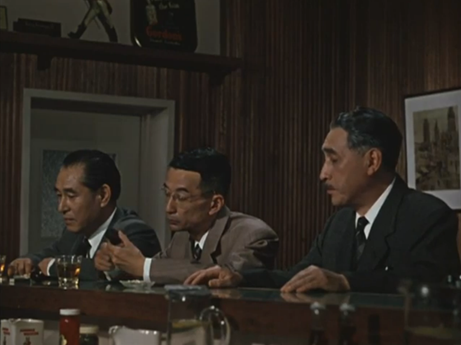
lateautumn2I enjoy the light touches of humor injected into this film because the three chums sit around the bar making observations with a bouncy score that seems more at home in a Tati comedy. Sometimes they’re genuinely trying to be funny, but more often it’s hilarious because they’re actually so dysfunctional. They take on this task of watching over their friend’s family with all seriousness, but they get sidetracked by their own desires and personal concerns. They stir up rumors, make waves, and ultimately cause a lot of trouble. Everything gets muddled and it’s the blunt and frank assertions of young Yuriko (Mariko Okada) that points out their failures. She sees how they have made a mess of things and calls them out for it. Perhaps it feels abrasive, but I think they like her for it and the audience does as well. She’s a reflection of this new generation that’s not looking to mince words or hide behind social etiquette. They’re fed up with that type of lifestyle. In fact, Yuriko is the one who says marriage is the worst. The ideal would be if love and marriage always went together, but they don’t.

lateautumn3Thus, although the relationship between Ayako and her mother takes center stage as the film progresses, Yuriko is extremely pivotal. It’s the lives of the first two women that are affected by the unintentional bungling of these men, but it is Yuriko, who signifies change for the better. In many ways, this story feels very similar to Late Spring in particular, but the interest is not so much in original ideas as it is in re-imagining ideas. It’s a film for the 1960s where men are slowly losing their vice-like grip and societal norms are changing as women move to the forefront. But what remains are the suggestion that it’s alright to push back against societal pressures, and interpersonal relationships are delicate flowers that must be cultivated with care. So easily they can be trampled and destroyed. It takes a certain type of person to acknowledge their own faults while persistently loving those around them.

This is the utmost compliment, but in many ways, Setsuko Hara reminds me a great deal of my own grandmother, a woman who radiated a genuine kindness that was apparent to everyone who walked through life alongside her. Bless their souls. Both of them.

4.5/5 Stars

Hombre (1967)

hombre1“You don’t get tired, you don’t get hungry, you don’t get thirsty. Are you real?” – Jessie

“More or less” – John Russell 

How to function within Western culture. That’s what John Russell must figure out as a man who was raised by Apache and then is forced to enter the “white man’s world” to collect his deceased father’s possessions (a watch and a boarding house). He starts out complete with long locks and a bandanna but soon switches over to more traditional western wear in a way blending into society — while simultaneously beginning to look more like the Paul Newman we know.

But he’s far from the affable ne’er do well. In fact, he hardly even utters a word. He’s not agreeable and about as terse as they come. He’s not looking for any favors and he’s not looking to hand out any charity. He’s also not going to take the white man’s flack. But his decision to sell his boarding house for horses is not too popular with the home’s residents, including the fiery Jessie (Diane Cilento).

hombre2Ultimately, Russell boards the local stage with a few other individuals. The destination doesn’t seem to matter much, but the people do. Leading the coach is affable Mexican Henry Mendez (Martin Balsam) and along with the two aforementioned, the other two misplaced tenants, young Billy Joe and his wife join the contingent. The coach is rounded out by Indian Agent Alexander Favor (Frederic March), his well to do wife, and finally, the vulgar tough-guy Cicero Grimes (Richard Boone).

When Dr. Favor learns of Russell’s background he requests that the Indian sit up top and such a reaction embitters Russell. But there’s not much time to worry about the prejudice because Cicero’s cronies hold up the stage in an effort to swipe some ill-gotten gain from the esteemed doctor. The survivors are left to die and Russell heads off on his own with a few stragglers trying to catch up with him. He has no sympathy to offer, but they follow him because he is the most knowledgeable among them.

Of course, the film must reach a crescendo and it occurs with Russell dealing with Dr. Favor and then Boone. Both men are crooked in their own ways. Grimes is sadistic in nature, but Favor is also a despicable and sorry excuse for a human being. And yet Russell himself has his own streak of heartlessness. What it means is that each man must face justice and in some way, shape, or form pay for their deeds. Just as the men come in different incarnations, they are complemented by varying degrees of women from all across the gamut.

Director Martin Ritt’s Hombre really feels like a riff off of Stagecoach and feels somewhat reminiscent of Boetticher’s western The Tall T (also featuring a no good Richard Boone). But it’s no doubt a western for the 1960s, coloring the West with more liberal and revisionist tones. However, the film deals not only with prejudice but morality. For although John Russell has a gripe with the world and its hypocrisy since his people are getting pushed out by men who call themselves “Christian,” he’s not without fault. Jessie so rightly points out, that if the whole world didn’t lift a finger then the whole world would go to hell in a hand-basket. And in many ways this world does.

3.5/5 Stars

101 Dalmatians (1961)

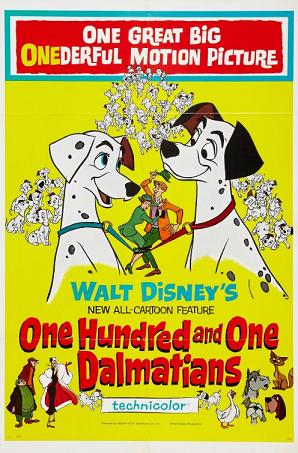
One_Hundred_and_One_Dalmatians_movie_poster.jpgDisney is, by now, a gargantuan media empire of parks, merchandise, and movie magic. It’s easy to forget that there were days when the studio was in desperate need of a hit. 101 Dalmatians proved to be just what the vet ordered.

The film enters the story originated from the Dodie Smith novel, by utilizing the point of view of our protagonist, the Dalmatian  Pongo (Voiced by Rod Taylor). He’s intent to get his faithful “pet” Roger the songwriter hitched, in order to liven up his life a bit. His escapades eventually end in success with Roger landing Anita and Pongo winding up with Perdita. They live in a humble little home perfectly happy with the kindly maid Nanny and a litter of puppies on the way.

In walks one of Disney’s most glorious creations in Cruella De Vil, the witchiest, cruelest, villain you could ever happen to encounter. With billowing furs and long cigarette holder, her presence is hard to avoid and she’s very eager to get some puppies for her nefarious purposes.

15 little bundles of fur arrive, but Roger puts his foot down and won’t give them up. Not about to be foiled, De Vil gets her two hired cronies Jasper and Horace to swipe them. And so begins Pongo and Perdita’s journey across hill and dale to rescue their children. They utilize the “Twilight Bark” to spread the news about the missing pups to try and get any help they can.

The word spreads and they are led to an old mansion in close proximity to a shaggy sheepdog “The Colonel” and his cohorts “Captain”  the horse, and “Sergeant Tibbs” an adroit tabby. Together they begin the operation to extract the pups. Although after doing recon, Tibbs realizes there are a few more hostages than he was expecting. Still, they put the plan into action trying to flee from the two menacing buffoons.  Jasper and Horace look threatening but only succeed in hurting each other. Pongo and Perdita arrive just in time to lead the pilgrimage back to London, but the snow and the adversary are nearly unrelenting. It’s in these moments that the tension is built up because on one side we have 10s upon 10s of these cute puppies fleeing in the snow with Cruella De Vil hot on their cute little tails. It’s enough to make kids young and old get invested in this animated classic. The most important part is that it ends happily ever after — at least until they have to feed all those dogs.

Although the animation is certainly not their most polished effort, Disney once more develops a setting in London and the surrounding countryside that is thoroughly engaging as a visual feast for the eyes. The voice work from the likes of Rod Taylor, J. Pat O’Malley, and Betty Lou Gerson is impeccably spot on. Perhaps most importantly of all, this film gives the dogs and other creatures of interest the perfect balance of reality and anthropomorphism. And of course, the pups like Rolly, Patch, Penny, and Lucky are endearingly cute with their baby British accents. Yet another reason Cruella De Vil is so evil. How could she ever want to harm cute bundles of joy like that?

4/5  Stars

“Cruella De Vil, Cruella De Vil
If she doesn’t scare you, no evil thing will
To see her is to take a sudden chill
Cruella, Cruella De Vil”


One, Two, Three (1961): Coca Cola and Communism

onetwothree1“On Sunday, August 13th, 1961, the eyes of America were on the nation’s capital, where Roger Maris was hitting home runs #44 and 45 against the Senators. On that same day, without any warning, the East German Communists sealed off the border between East and West Berlin. I only mention this to show the kind of people we’re dealing with—Real Shifty.” ~ James Cagney as C.R. MacNamara
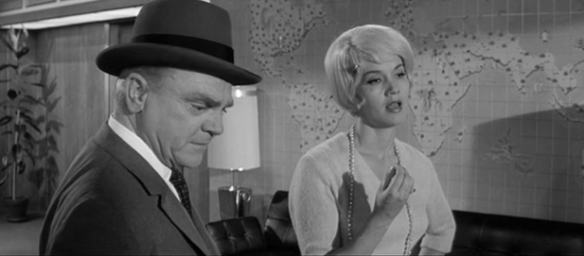
I love Billy Wilder. It’s as if he’s a lightning rod for all things controversial, biting, and politically charged, and he’s got a wicked wit. Thus, a cultural moment such as the Berlin Crisis must have been a juicy piece of material for him. Since it was, after all, his native land before the war, and he fills the frame with all the necessary touchstones. His collaborative script with I.A.L. Diamond carries a similar frenetic rapid firepower to Hawk’s His Girl Friday while maintaining a point of view relevant to that moment in time. The East Germans march in anti-American parades with signs plastered with the faces of Khrushchev and Castro. We pick out words like Little Rock, U2, Kennedy, and so.

This is really a film about Coca-Cola, capitalism, and Yankee ingenuity as it rubs up against the Soviet philosophy, where both sides end up getting poked at. It’s the arena of the Cold War played for comedic effect.

C.R. MacNamara (James Cagney) is an ambitious established Coca-Cola exec who is used to working all across the world with his wife (Arlene Francis) and children being towed along with them. He’s looking for the next big job to propel his career even higher and Berlin is his latest stop. Our first trip to his office offers a bit of the comedic corporate hierarchy of The Apartment.

There are the rather sardonic post-WWII sensibilities that the Germans are a new people, not to be implicated in the crimes — even going so far as to not acknowledge the name of an infamous Adolf. Although his heel-clicking righthand man Schlemmer furiously denies it, there’s a sense that he’s a closet Gestapo (a less crazed version of Dr. Strangelove). He cannot deny his conditioned urges after all.

onetwothree2When he’s not getting English lessons or doing dictation with his shapely secretary (Liselotte Pulver), Mac is trying to swing a deal to start selling his billion-dollar beverage in the Soviet sector. He’s met by three bumbling boobs led by the portly Peripetchikoff (Leon Askin), who feel like heirs apparent to Ninotchka’s Russian trio.

Once again underlying their entrance are the political sentiments at the time. After offering Mac a cigar, they giggle that they traded the cigars for some lousy missiles (The future Cuban Missile Crisis springs to mind). There also intent on winning the Space Race.

If these were the mains concerns of Wilder’s narrative it would be at least historically fascinating, but he gives us more. One of Mac’s higher-ups Mr. Hazeltine, based in good old Atlanta Georgia dials him up on the telephone to inform him that his little angel Scarlet (Pamela Tiffin) is coming for a stay in Germany. It becomes Mac’s duty to watch over her and keep her out of trouble. At first, things seem to be going beautifully, until Scarlet disappears only to return with a boyfriend (Horst Bucholtz) from the eastern sector. A bamboozled Mac tries to figure out how to get rid of the Commie only to find out the two contrarian lovebirds are married and there just might be a child on the way!

To add to the ruckus, Mr. and Mrs. Hazeltine abruptly decide to come visit their baby to see how she’s getting on across the pond. Being the clever capitalist that he is, Mac hatches a plan to dump Scarlet’s Soviet beau and get her back to her parents. But it’s not that easy. It means dealing with his three Communist counterparts, giving them what they want, in the form of Fraulein Ingeborg, and getting Scarlet to her parents in good health.

onetwothree3The monetized mayhem is complete with car chases, Soviet torture involving “Its Bitsy Teenie Weenie Polka Dot Bikini,” and a scramble to turn the belligerent Otto Piffl into a respectable capitalist. It’s a brilliant escapade blending social commentary and narrative hiccups as only Wilder could.
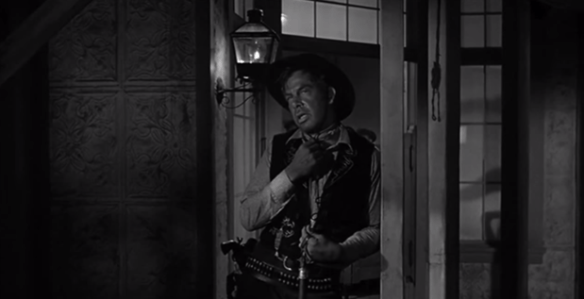
And, boy oh boy, can Jimmy Cagney deliver dialogue. He’s as dynamic as ever with every phrase and movement, snapping all the while with entrepreneurial abandon. Meanwhile, the score is constantly clapping, bouncing, tap tap tapping away in the background.

There are nods to Gunsmoke and Little Caesar all in the same scene. We get allusions to the Algerian situation, Freedom buses, Grace Kelly, Spartacus, Nat King Cole, Duke Snider, and columnist Ear Wilson — the only one I had to look up. There’s even a cuckoo clock that plays Yankee Doodle Dandy. If I’m not mistaken James Cagney was in a pretty decent film involving that song at one point in his career.

The film’s wicked wit is perfectly illustrated by the following bit:

“My father is an S.N.O.B.”

“A what?”

It’s a film that has a playful sensuality and potential rudeness that is all the while veiled behind 1960s sensibilities like Coca-Cola and baseball. Wilder was the master at subverting the norm and making us laugh the whole time. One, Two, Three is a blast from the past that is as refreshing as a sip of Coca-Cola, while also carrying a political charge.

“I wouldn’t touch the Russians with a ten foot Pole and I’m not interested in the Poles either!” ~ Mr. Hazeltine

4/5 Stars


Lee Marvin as Liberty Valance (1962)

libertyvalance.png

I can enter into a discussion of The Man Who Shot Liberty Valance from two different avenues. Most obvious is the film itself. As far as star power, Lee Marvin is playing third fiddle to John Wayne and James Stewart, the undisputed stars of this film.

However, Liberty Valance is a wonderful role, because certainly this is about Wayne and Stewart, but on the other hand its Marvin who has his name in the title, and that’s not something to be taken too lightly. He’s at the core of this film, because it is his villainy and criminal activities that create the conflict in this story line and elicit a response from both of our leading men. He forces their hand and it becomes the call to action for a final showdown.

The fact that the film’s narrative is told, rather like a film noir, with a flashback creates this type of aura not only around Wayne’s Tom Doniphin but the notorious Liberty Valance himself. Because although we see Ransom Stoddard (Stewart) in the present along with his faithful wife (Vera Miles), the  two other men are only made available to us through eyewitness account. Around them is built a type of legend and that ultimately makes Liberty Valance a fascinating figure. Dressed in black, swinging his whip menacingly and boisterous as all get out, Lee Marvin is the perfect man to portray Valance.

In a sense, it feels like he’s at the crossroads of his career, in transition from his heavy roles to being a top billed tough guy. The Big Heat and Liberty Valance represent his earlier turns before he progressed to The Dirty Dozen and Point Blank as a silver-haired tough-as-nails leading man. Marvin was arguably never more larger-than-life than his time as Liberty Valance. Perhaps it was because he was forced to hold his own against Stewart and Wayne. As the famous quotation goes, “When legend becomes fact, print the legend..” Well in this case, Lee Marvin did make Liberty Valance in a legendary villain deserving to be among the pantheon of baddies.

However, there’s also Gene Pitney’s billboard charting tune also called “The Man Shot Liberty Valance,” which although it was not featured in the film, sums up its story quite impeccably.

The lyrics read like so:

When Liberty Valance rode to town, the womenfolk would hide, they’d hide
When Liberty Valance walked around, the men would step aside
‘Cause the point of a gun was the only law that Liberty understood
When it came to shootin’ straight and fast, he was mighty good

From out of the east a stranger came, a law book in his hand, a man
The kind of a man the West would need to tame a troubled land
‘Cause the point of a gun was the only law that Liberty understood
When it came to shootin’ straight and fast, he was mighty good

Many a man would face his gun, and many a man would fall
The man who shot Liberty Valance
He shot Liberty Valance
He was the bravest of them all

The love of a girl can make a man stay on when he should go, stay on
Just tryin’ to build a peaceful life where love is free to grow
But the point of a gun was the only law that Liberty understood
When the final showdown came at last, a law book was no good

Alone and afraid, she prayed that he’d return that fateful night, aw, that night
When nothin’ she said could keep her man from goin’ out to fight
From the moment a girl gets to be full-grown, the very first thing she learns
When two men go out to face each other, only one returns

Everyone heard two shots ring out, one shot made Liberty fall
The man who shot Liberty Valance
He shot Liberty Valance
He was the bravest of them all

The man who shot Liberty Valance
He shot Liberty Valance
He was the bravest of them all

So if Marvin’s portrayal doesn’t already make Liberty Valance into a mythical villain, then this number certainly does. We can read it a bit like a western folktale, emotive and surprisingly true to the film’s narrative arc. But what it leaves us with are the result of that showdown that happened so many years ago…

The point of a gun was the only law that Liberty Valance understood, and he was forced to pay penitence for his misdeeds under the barrel of that same law — at the hands of the hero christened only by the name “The Man Who Shot Liberty Valance.”

Written as part of The Great Villain Blogathon featured HERE


My Night at Maud’s (1969)

nightatmaud's1I love the forum that is created in international cinema where all things can be debated and discussed without fear of what the audience will say. Hollywood caters to the audience and that more often than not means that thrills are given greater weight than substance. Eric Rohmer worked at Cahiers du Cinema alongside French New Wave visionaries like Jean-Luc Godard and Francois Truffaut, but he joined the game a little later than his colleagues with a different style. Rohmer took his pseudonym from director Erich von Stroheim and British novelist Sax Rohmer. He was a highly educated man and that comes out in his films.

My Night at Maud’s comes from the perspective of a man, who we have a sneaking suspicion might be a lot like Rohmer.  Jean-Louis (Jean-Louis Trintignant) is a reserved, highly religious, intelligent man. He attends mass on Sunday, bumps into an old school chum on the street, and willfully enters a discussion on all sorts of philosophical topics.

Whereas Godard interest himself in the lowly gangsters, the streetwalkers, or the lovers on the run, Rohmer’s character are in a completely different stratosphere. They are a higher slice of society, and it shows in what they spend there time philosophizing about. In fact, there’s a lot of discussion stemming from Pascal’s wager on whether or not it is beneficial to believe in God. Although he can be a bit of a clown, Vidal is also a philosophy professor and ready and willing to delve into such topics. He holds hypotheses on the meaning of life, and he’s considered where hope comes from. These are intelligent beings and deep thinkers, and by transference, they lead us to think. They drop by on Vidal’s friend Maud (Francoise Fabian), who is a divorcee, irreligious, and most certainly a free thinker. She’s also beautiful, and she likens there little late night convo to the salons of old as they gather around her bed to raise their conjectures.

nightatmaud's4I feel like I have known people like Jean-Louis, and I cannot help but like them. He’s a fairly resilient Christian, but not a perfect example mind you, and yet he feels far from a hypocrite. With his new dialogue partners, he speaks of his past love affairs and how they can exist with his religious convictions. Maud rather matter-of-factly labels him a “shame-faced Christian” and a “shame-faced Don Juan,” because he’s not fully committed or acknowledging of either. And yet she generally likes him a lot. He likes her company too and so they can continue talking in a genial manner. She pokes fun and ribs but never attacks. And she openly brings up numerous different ideas about Christianity. There are things that feel very human, but not very Christian to her. Maud asks if Christians are judged by their deeds? She assumes there is a bookkeeping aspect of Christianity where good deeds are weighted versus sin. Several times the rather obscure term of Jansenism is thrown around a bit in reference to the theology of Dutchman Cornelius Jansen. It surely is difficult to keep up we these folks at times, but it’s well worth it.

Maud has her own preconceived notions about religion, while Jean-Louis has some delusions about romance. He thinks he’ll meet a pretty blonde Catholic gal and fall in love. It sounds utterly preposterous and yet then he meets Francoise (Marie-Christine Barrault) after his night at Maud’s. She’s the perfect embodiment of everything he’s ever dreamed of in a romantic partner. They seem like a good pair, although she is still in school, they are intellectual equals with similar personal convictions.

nightatmaud's5Sure enough, 5 years down the line they are married with a young son. Jean-Louis has not seen Maud for many years now, but quite by chance they bump into each other on the beach. Both pick up where they left off as if no time has passed because it’s so easy for them to converse. Francoise is noticeably uncomfortable around Maud, but nothing more is said about it. Jean-Louis moves on and plays contentedly with his family on the beach. Maud heads back up the hill as cordial as ever. This is an ending that is made powerful in its subtleties above all else because Jean-Louis and the audience realize something about Francoise. Yet there is no need to voice those conclusions because all that matters to him is that he is happy.  It toes a soft line between romance and drama, instead resorting to a beautiful exchange of ideas. Noticeably, in Rohmer’s film, there is no score so the dialogue is elevated to the level of music. It fills the void using deep, introspective and personal forms of verbal expression.

4/5 Stars

The Exterminating Angel (1962)

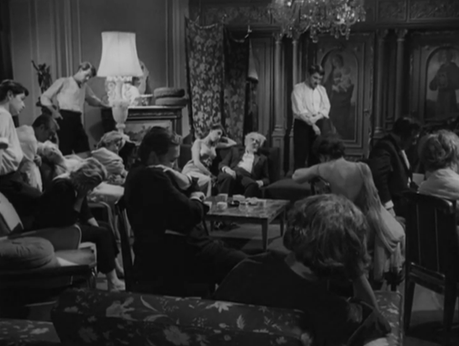
exterminating1In a sense, I’m scared to be confronted with Bunuel’s films more often than not, because even to this day they are surprisingly subversive. But with The Exterminating Angel, there is a different sort of apprehension to be faced altogether. It is a fascinating film because it shows the descent of humanistic man into the depths of his primordial nature. However, it builds off the cruelest and most interesting practical joke ever conceived. It’s played on a group of people within the confines of the frame and the audience watching in equal measures.

Of all places, it starts at a dinner party where good etiquette, manners, the upper class, and culture all collide. Luis Bunuel seems to have a preoccupation in placing his subjects around a table because really there is nothing more human than sharing a meal together. Although, he finds ways to make it interesting and in this case wickedly absurd. The table becomes an arena for gossip, loaded barbs, harbored feelings, and ruffled feathers.

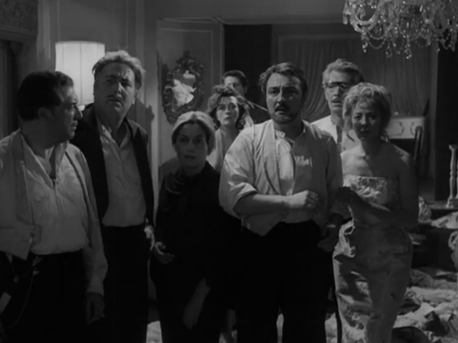
It’s quick to enter an almost surreal state as all the guests are unable to leave the confines of the room. We take things for granted so easily, but in their world leaving the room is not a given, even if it seems so straightforward to us. Some force is keeping them where they are, although we never see it or hear any mention of it. Our only inference is that there is some outside force holding them there. They are literally haunted by specters with a shroud hanging over them — an Angel of Death if you will.

exterminating2This prolonged period of isolation lends itself to the degradation of all pretenses. The animalistic tendencies replace all shreds of decency. All the dirty little secrets that lurk under the surface then begin to rear their ugly heads. Honestly, it’s hard to keep them at bay in such close proximity, for prolonged periods of time, because people see the real you. It becomes hard to hold your tongue, to keep those biting words from slipping out, especially when fatigue and hunger sets in. As many of the men and women begin to falter, the good doctor represents all things rational and seemingly honorable. But when he is cast aside it reflects an end of human dignity. These individuals who were once so high, have fallen such great heights. Lambs get taken to slaughter and pipes are busted just for even the smallest taste of water.

It strikes me that this film is literally a picture of hell. No, it’s not the fire and brimstone picture we are accustomed to, but instead, it is a hell created by the individuals themselves, feeding off their own evil and pride, and accentuated by their prolonged purposelessness. Just think, it takes a woman named Leticia (Silvia Pinal), to break all her companions out of this cycle they have become stuck in. She realizes the utterly pointless loop they are caught in and breaks them out of it with a few powerful pieces of induction. Also, could there be some symbolism in her nickname “Valkyrie” (The chooser of the living and the slain)? I think so.

exterminating3They leave the room just as easily as they entered it. It happens so unremarkably in fact that some might feel duped, and I would not blame them. Why did we watch this group of socialites remain in a room for an hour and a half if they could have gotten out this easily? But if you ask this question you miss out on the whole mind-bending aspect of Bunuel’s main conceit. We cannot fully understand; we can only marvel at the fact that something that we take for granted like leaving a room, doesn’t work so simply. Do I understand it, certainly not, but it makes for an amazingly powerful and frightening study of human nature. This is also a film that does not let off. In fact, although we finish one cycle, it looks like another one is about to begin with a few clergy trapped for another inexplicable reason in their cathedral with many parishioners. Outside a riot forms as another herd of lambs makes its way to the chapel. It’s as depressing as it is funny in some unnerving sort of way. Not only has Bunuel played a joke on his characters, but his audience as well. This time I didn’t mind all that much.

4.5/5 Stars

The Silence (1963)

thesilence4Mention of God and spirituality, faith and healing, feel completely unrelated to a film that’s seemingly devoid of all of those things. And yet if we place this Ingmar Bergman film alongside his two previous efforts Through a Glass Darkly and Winter Light, The Silence has just as much to say about such topics. The irony of this film is that it says a lot by saying the inverse–nothing. As the title implies, the two sisters who are the focal point of this film speak nothing of God or any kind of faith. God too is silent. No miraculous sign takes place to salvage this storyline. It is what it is, and yet Bergman again works so powerfully once more– even if it’s not quite his intention.

Ester (Ingrid Thulin) is the practical, rational sister, who is also very sick. In fact, it is her health that interrupts their vacation so that they wind up in a hotel in a foreign land. Anna (Gunnel Lindblom) is her sister, the sensuous one who is not afraid to flaunt her body. There’s also a boy, the 10-year-old Johan, who is along for this adventure as well. At first, I assumed that Ester was his mother, but it turns out he’s Anna’s son. It makes for another interesting dynamic because although she can be very touchy-feely with her boy to the point it almost feels uncomfortable, she does not show him a lot of affection. More often she’s aloof or tells him to go off and play somewhere alone.

thesilence1Things are even worse with Ester because for some reason we don’t really know, they have a strained relationship. You get the sense that they both disapprove of each other for different reasons. Ester’s too restrained. Anna’s too provocative. Their vices come in different forms as well. As Johan entertains himself throughout the hotel, shooting his pop gun, meeting some little people and a friendly old porter, his mother and aunt try and medicate themselves.

Ester combats her illness and bedridden state with cigarettes and alcohol, which probably only help in numbing her senses and blackening her lungs. Anna puts on her most tantalizing outfit and goes out on the town, ready for some quick and easy sex to gratify herself. Again, both sisters dwell on completely different ends of the spectrum, but they really seem to end up in the same place. There is no space or need for a God or spirituality in their lives because they’ve filled the void with other things.

thesilence2Meanwhile, Johan seems like a normal little boy, who is looking for affection and yet he doesn’t seem to get it, at least not typically. His mother and aunt might truly desire to connect with him at least sometimes, but more often than not it feels like he’s just left to fall through the cracks. He’s easily forgotten.

The sisters part ways after a confrontation where Ester comes in on Anna with her lover. They lay it all out with brutal honesty and the next morning Anna takes Johan with her on the train. Ester cannot bear to be left this way, and as spasms begin to overtake her, she acknowledges a great many of her fears. She’s not ready for death. Anna rides off with little interest in her sister and no doubt, little interest in thoughts of death.

When The Silence came out, it was, no doubt, risque for its frank depiction of sexuality and yet the way Bergman looks at such a  topic, suggests that it is not a superficial perspective. What any type of behavior does, really, is to provide a fuller, broader picture of the human who acts it out. Anna and Ester undoubtedly have their insecurities, fears, and desires. We see them acting out on those desires often, and we see their insecurities come out when they fight with each other. It’s yet another fascinating dissection of life, although it looks vastly different than its two predecessors. Bergman’s Persona a few years down the line also seemingly builds on the study of this film, even utilizing a similar dynamic. That’s not to say that The Silence is not worth a look in its own right. It takes on the subject of “faith,” ironically enough, by showing a complete absence of it.

4/5 Stars