Comanche Station (1960)

Comanche_Station_FilmPosterComanche Station opens with a man who willfully goes into Comanche territory. We don’t quite know why at first, but through haggling and bartering he’s able to save a captured white woman. It doesn’t come out until much later but it turns out that Jefferson Cody’s (Randolph Scott) own wife was captured by Comanche well nigh 10 years ago and he has never stopped looking.

The saved damsel Nancy Lowe gets the wrong impression about Cody believing the gruff figure was only in it for the money and that is far from the truth, as he intends to take her back to her husband out of harms way. That’s until they’re joined out on the trail by Ben Lane (Claude Atkins) and his two hired guns. Akins in fact takes on a role almost identical to Lee Marvin a few years before and he’s not quite as memorable. However, his two stooge sidekicks are more interesting, because although they are “outlaws” in a sense, we cannot help but like them for their buffoonery and conflicted morals.

Lane looks to ambush Cody and Mrs. Lowe so he can snag the reward, but Dobie will not take part. The shootout ensues between Cody and Lane. Afterwards the searcher leads the lady back to the arms of her husband. This final installment of Budd Boetticher’s Ranown Cycle shares some similarities to Seven Men From Now, but there is a totally different feel because the visuals are very different.

3.5/5 Stars

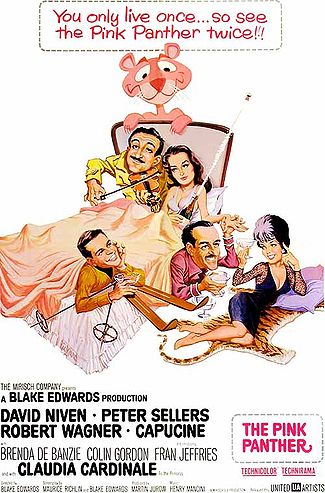
The Pink Panther (1963)

Pink_panther63I came into the Pink Panther with a bit of prior knowledge about the franchise and Henry Mancini’s legendary theme music. In all honesty, the first film I ever saw in the series was A Shot in the Dark (1964). Peter Sellers‘ Inspector Clouseau is the undisputed star of that film which came out only a year later.

That’s why this initial installment from Blake Edwards was rather surprising, to begin with. This is a David Niven vehicle with him playing a modern Don Juan of sorts who also is a world renown thief known as “The Phantom.” He and his female accomplice have their eye on the equally well-known diamond christened the Pink Panther. It now is in the possession of a beautiful young princess (Claudia Cardinale), but the people of the country believes the diamond belongs to them. Into this seemingly serious story of theft and international relations waltzes in the ever-bumbling but good-natured Inspector Clouseau.

Sir Charles Lytton (David Niven) has his eyes on Princess Dala, surveying her every movement. What he doesn’t know is that his young nephew (Robert Wagner) is up to some tricks of his own, and he flees the United States in search of his uncle. Clouseau leaves France with his lovely wife Simone (Capucine) and follows the princess to a ski resort to see if he can sniff out the culprit. They turn out to be a lot closer than he realized.

It’s during a chaotic masquerade ball when the diamond is in jeopardy, with several costumed apes having their eyes on it. The bumbling Clouseau clumsily tries to set a trap, and yet he unwittingly stumbles upon the culprits leading to a chaotic car chase. In fact, The Pink Panther has a rather odd ending with the culprits getting away and Inspector Clouseau getting the blame. Don’t be too worried, however, because Sellers brought the character back numerous other times.

Despite being initially relegated to a supporting role, there is no doubt that Sellers steals his scenes with his ad-libbing and numerous brilliant pieces of slapstick. He might be stepping on his Stradivarius in the dark or getting his hand jammed in a beer stein.  It’s all the funnier when everyone else is playing the scenes relatively straight. There were some other humorous sequences of deception as the culprits try and pull the wool over the Inspector’s eyes. It’s not all that difficult because he’s an utter buffoon. But lovable. Did I mention that?

3.5/5 Stars

Review: Breathless (1960)

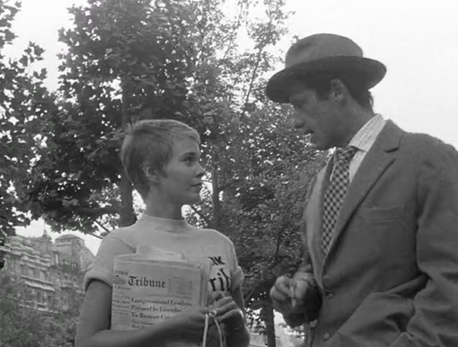
breathless2Breathless is such a fresh, smooth piece of cinema that feels as cool now as it was back then. The transcontinental French vibe paired with the revolutionary production is strangely still appealing. It does so many things with such style that is always unique but never quite off-putting. Not to mention the score which is playful in an elegant sort of way. The film has an array of quick cuts, it’s discontinuous, abrupt, and it literally jumps between images. Actions, like shooting a cop or sitting in a room with a girl, become more interesting than we could ever give them credit for.

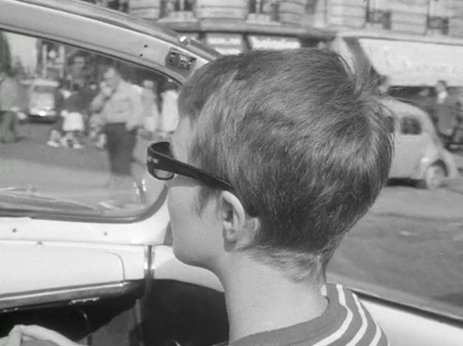
Godard is known for saying that all you need for a film is a girl and a gun and that’s basically all Breathless is. Michel (Jean-Pierre Belmondo) is a low down, no good hood who also happens to be quite funny at times. He shoots a cop for no good reason and after that, the police are after him on the streets of Paris.breathless5He’s also broke and all his buddies are either unavailable or in some trouble of their own. He swipes money from one girl and rendezvous with his latest fling, the aspiring American journalist Patricia (Jean Seberg). They do very little except drive around the city or lounge around her room. In one memorable shot, jump cuts piece together scenes of the back of Patricia’s head as she sits in the passenger seat observing the world around her pass by.

Michel, on his part, seems only to want sex and yet he says he’s never loved a girl before. He’s continually drawn to Patricia, and he never can quite pull himself away.

She, meanwhile, has another man with an eye on her, and she hopes to propel her fledgling journalism career. Her one assignment happens to be interviewing the highly philosophical and somewhat pompous Mr. Parvulesco (Jean-Pierre Melville).breathless10The billboards around town even foreshadow the impending doom of Michel. Patricia later learns from the police that her lover is wanted for murder, and she must decide what to do about it. In a memorable scene, Patricia is shown pacing around the room in a wide circle. In the end, she does turn in the hood to prove to herself that she doesn’t truly love him.

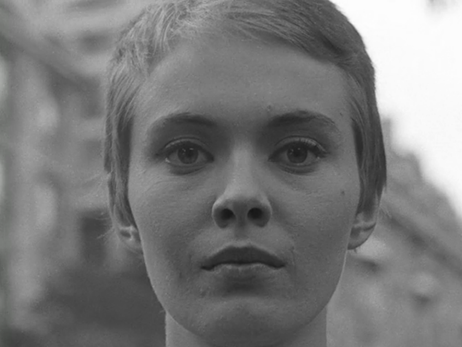
Michel looks utterly pitiful, like a wounded deer after he gets winged by the police and collapses in the middle of a quiet avenue. Patricia stares straight at the camera giving the queerest of looks as Michel breathes his last. If you wanted narrative clarity you’re definitely looking in the wrong place.

breathless9In some ways, Jean Seberg’s iconic look reminds me a young Audrey Hepburn another gamine glamour girl. The photography of Seberg is iconic from the reflection in her sunglasses to her donning Michel’s hat. Breathless proves film is not just entertainment, but it can also be lastingly stylish. There’s nothing wrong with that, and it still seems to work after over 50 years. Honestly, when I was starting out, Breathless helped open up all of European cinema to me and for that, I am indebted to Godard and The French New Wave.

4.5/5 Stars

Purple Noon (1960)

purplenoon4Right off the bat, there are two things that stick out about Purple Noon. First, you cannot help to notice the colors because the blues and reds pop like some vibrant 1960s painting. Then there’s Alain Delon who at the age of 23 made his rise to stardom, thanks to this film and Rocco and his Brothers (1960). As Tom Ripley, he finds a role that is fascinating in more ways than one.

During the first interludes of Rene Clement’s thriller, based on the Patricia Highsmith novel, I didn’t really know what I was watching or what to think. Tom was sent to Italy to bring the wealthy Phillipe Greenleaf back to San Francisco at the wishes of the man’s father who is paying Ripley. Their story begins as an entertaining jaunt through the city. They lounge at cafes, take carriage rides, and generally have fun living it up at night.

Tom is nothing like Greenleaf. He’s far poorer coming from a humbler background, but he is also much more resourceful and clever. When he takes a trip with the wealthy young man aboard his yacht, he finally hatches a plan to get what he wants. He abruptly stabs Greenleaf during a game of cards and the whole trajectory of the film changes in an instant. It began playfully absurd and quickly switches gears as a thriller involving murder, stolen identity, and deception.

purplenoon5

He plays up the tiff between Greenleaf and his girlfriend Marge, telling her that he is still angry and so he went off somewhere else without her. Thus, begins Ripley’s transformation into Greenleaf, forging a passport and signatures until he can pass off as the man himself. He starts dressing differently, spending more money, and continually acting as if he actually is Greenleaf. But things get difficult when he nearly runs into folks he knows, and Marge is desperate to know where her love is. These all prove problematic and yet Ripley skirts most of these entanglements with relative ease. It’s when a friend of Greenleaf’s named Freddie Miles figures out his charade that things begin to escalate because Tom’s only option seems to be murder. He commits the act coolly and plans his next move with calculated ease.

The police are after a murder, but it looks as if Tom has tied up all the loose ends and we find him relaxing reclined on the beach. He doesn’t know that the game is up, because of what the police found at sea.

The visuals of this film definitely do justice to the young Delon who is strikingly handsome with piercing eyes, but his turn is interesting in its own right because he was always so adept at playing the coolest of characters. He’s no different here and Purple Noon proved to be the initial boost to his storied career.

4/5 Stars

Bay of Angels (1963)

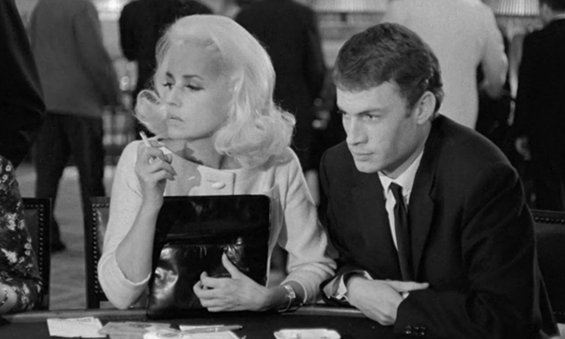
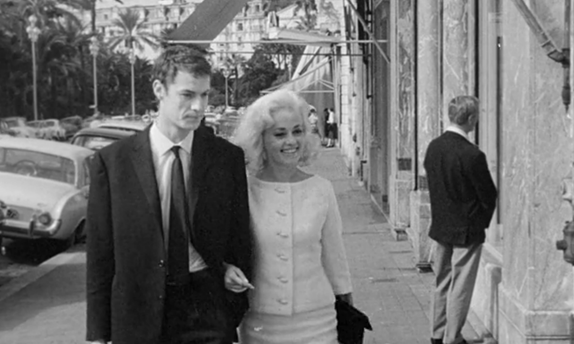
bayof3Bay of Angels is quite different than anything else I have seen by Jacques Demy. Similar to Lola (1961) it is shot in starkly beautiful black and white and it has a kind of love story, but it lacks the music or general whimsy that often characterized Demy’s later works.

This film finds its subject matter in gambling, and it follows one woman’s obsession and another man’s growing interest in roulette. At first, Jean is a rather bored young bank employee, who is coaxed by a colleague to take up gambling.

bayof2

Initially, he is skeptical, looking down at the pastime as a frivolous waste of time and money, after all, he is a sensible young man. However, he parts with the sensibilities that his father would have for him and instead take a few weeks of vacation to spend some time in the casinos of Nice and Monte Carlo.

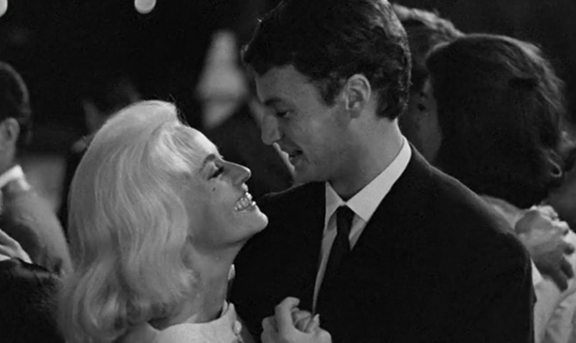
Soon he gets bitten by the gambling bug and he’s hooked. He finds an equally enthused companion in Jackie (Jeanne Moreau), who has had a far longer history with roulette. Jean falls for her very quickly and Jackie holds onto him like her good luck charm. Their many days spent in the casinos are constantly fluctuating roller coasters of luck. Once gambler’s fallacy has taken hold it’s hard to kick the habit, and Jackie constantly blows her money. If not at the wheels, it gets spent on fine dining and clothes. She has no restraint when it comes to spending and Jean indulges her willfully. It gets so bad that Jean begins to get as reckless as his companion, and he cannot bear to leave her, although she really does have a problem.

bayof4The formally reserved persona of Jean becomes violent and passionate for Jackie’s affection, but she’s not quite as ready to give it out. The ending felt a bit forced, but yet again Demy delivers a story that is riddled with feelings of love and passion.

It is an interesting observation that his male characters pale in comparison with his female leads ranging from Anouk Aimee, Jeanne Moreau, and Catherine Deneuve. These ladies who are always the object of affection, steal the screen with their mesmerizing performances. In fact, Claude Mann has a rather slumping posture, a glum face, and not particularly good looks. Thus, in contrast, Jeanne Moreau looks like an especially alluring beauty, who seems at home in gaudy gambling houses billowing with smoke or seaside promenades.

Bay of Angels is supposedly the place that brings the pair luck, but the reality is that this film is all about chance. Not fate so much as Demy usually explores, but a topic that is still somewhat similar. It is also a film that makes me never want to play roulette. I do not want the mundane lifestyle of Jean, but I would like to find my excitement somewhere else. I suppose that’s what made Moreau’s character so fascinating because her obsession was so great and yet she simply accepted it and thought little of it. But it drove her life.

We’re partners in a game. Let’s leave it at that.” ~ Jackie

4/5 Stars

Lola (1961)

Lola1961As the debut of Jacques Demy, Lola has some qualities that, for lack of a better term, are very un-Demy. First off, he was a member of the French New Wave period of filmmakers and yet he resigned himself to making mostly musicals, taking inspiration from Hollywood and setting them in his own unique world. He was not concerned with the experimenting or political undertones of many of his peers. However, this is probably the most typical looking of his work and thus a jumping off point for the rest of his career.

Not quite as elegant in camera movements as Max Ophul’s work which received a nod, Lola still has a pleasing sleek visual style representative of the French New Wave. Its silky smooth, black and white cinematography courtesy of Raoul Coutard (Breathless), however, makes the film look more like something from Godard.

Lola is what Demy himself coined “a musical without music,” I suppose because it lacks the signature singing of his later films, but keeps the music and some of the other elements. Demy’s film also has a sense of cinematic realism with characters crossing paths with one another in various coincidental moments. It may be highly unbelievable in its plotting and yet it works within the Demy world of romance and fatalism which he would often revisit later on.

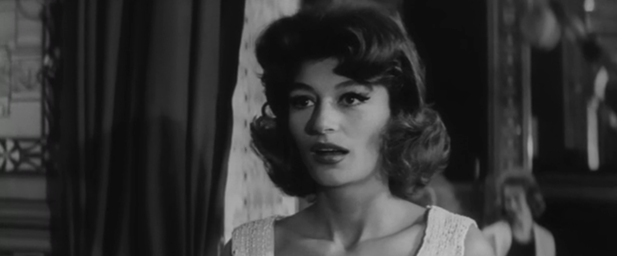
lola3This film follows a cabaret singer named Lola (Anouk Aimee) in a small seaside village called Nantes. She has a young son and a lover who she has long waited for. In the meantime, childhood friend Roland Cassard (Marc Michel) trudges on with his life without much drive. He is a befriended by a lady and her daughter Cecile at the local bookstore where they strike up a quick friendship. Then, by chance Cassard runs into to Lola, or Cecile as he used to know her when they were children. It’s been many years and although she has been getting together with an American sailor (Alan Scott) named Frankie, she is excited to go out for an evening with Roland. However, in another interesting meeting young Cecile runs into Frankie while buying a comic book and they have some fun together.

lola6In the end, Lola tells Roland that she will never truly love him and they must remain friends. It’s a bitter time for Roland as he decides to leave like he was originally planning. Finally, Michel returns and Lola is reunited with her love. It’s another bittersweet tale of love from the mind of Jacques Demy. Whimsical, poignant, and wistful too. That’s not the last we will see of Roland, though his luck doesn’t get much better (Umbrellas of Cherbourg), and  Lola returns too (Model Shop). Now only to go back and watch The Blue Angel (1930) from von Sternberg and Lola (1981) by Fassbinder which both bookend this work by Demy also chronicling a cabaret singer. There’s a lot of history here still to be seen and Jacques Demy is a worthy addition to the lineage even if this is not his best film.

4/5 Stars

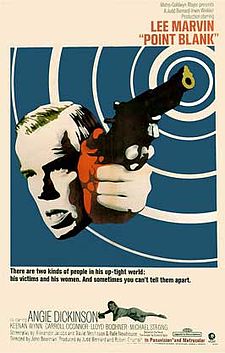
Point Blank (1967)

225px-PointBlankPosterJohn Boorman and Lee Marvin came together as equal parts in this venture called Point Blank and it’s quite something. You can call it neo-noir, you can call it a revenge story, a crime film, but nothing quite sums up what you end up with.

It’s a brutal, stark, psychedelic trip at times that never falters to any level of convention that we are used to. You have the clip clop of shoes on the concrete. Solemn, self-assured, repeating and ultimately deadly. There’s a man named Walker (Lee Marvin) on a seething rampage. He personally totals a car with the victim inside scared out of his wits. He’s shooting up victims all across kingdom come. Watching, waiting, then acting.

Point Blank is full of repetitive, reverberating sounds and images. Time too is repeating and evolving; fractured shards of the past followed by the present. It does not always line up or add up. Walker’s past is being fed to us through his own memories.

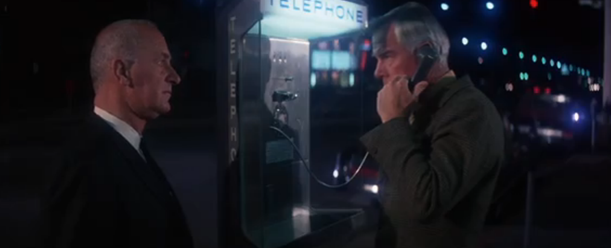
We get to pick up the pieces as he pushes forward on his vendetta. His wife is dead and he is after a man named Mal Reese, who double-crossed him, stole some of his money, and his girl. But the hunt doesn’t end with Reese. That would make too much sense and it would be too easy. Walker keeps going. Keeps hunting until it leads him to the next man and then the next. He gets together with the older sister (Angie Dickinson) of his wife Lynne (Sharon Acker). She is the repetition of Lynne who is now dead, just as each one of these targets is the new Reese.pointblank2There’s a point where we must beg the question? What does Walker even want now if all he gets is $93,000? What is going on in this world? Why does it tick in such a way, because to be honest, it doesn’t always add up? Is the Alcatraz we see and then the L.A. landscape true reality or is this a dream that Walker has created so he can act out his revenge? After all, he was shot, right? It might be a long shot, but the plan of Walker in itself is a long shot. He just continues pushing on and the hunt leads him back where he was in a perfect circle.

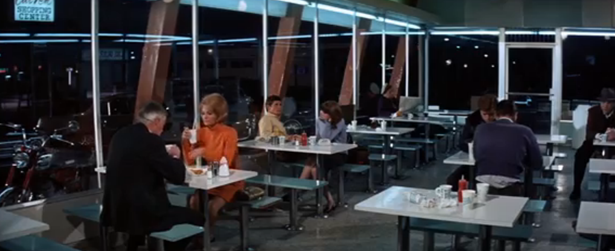
Now what? Reese is gone. Lynne is gone. Every single middleman is gone. He has a load of money laying out at Alcatraz for him and perhaps Chris is stilling waiting for him. We don’t know. That’s where Point Blank finds its conclusion and it’s just as vague as where we jumped in.pointblank3It’s understandable that it has gained a cult status over the years since Lee Marvin is an uber-cool gunman and his journey is hard to figure. His world is a bleak cityscape of 1960s L.A. and S.F. We can never hope to fully understand him or this world either and that’s the beauty of Point Blank. There is a degree of ambiguity that is fascinating. Heck, we don’t even know this man’s first name and yet we invest time in his story. I want to see Point Blink again because it’s not just your typical shoot ’em up action film. It makes you think and it has such a cool aurora and style. It deserves another viewing at some point soon.

4/5 Stars

Review: Goldfinger (1964)

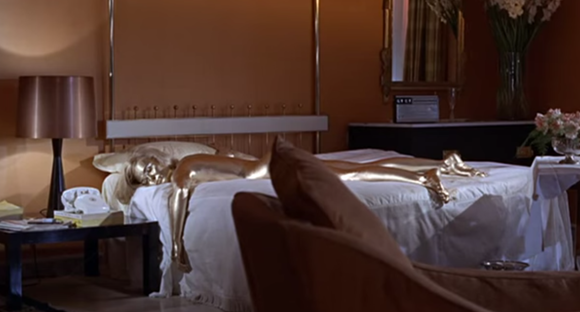
goldfingerThe film opens with a wonderfully unnecessary opening gambit, which allows us to reenter the world of dashing MI6 super spy James Bond (Sean Connery). His electrifying escapade culminates in the memorable quip, “Shocking, positively shocking” and just like that we jump headlong into his next adventure, Goldfinger!

Shirley Bassey’s striking rendition of the title tune reverberates over the metallic credits setting the tone for one of the great Bond films. It starts with the music and never wavers as we pick up with MI6 on a nice holiday in Miami Beach. He has his first run-in with international gold dealer and suspected smuggler Auric Goldfinger (Gert Frode). Bond has a little fun with the cheater at the expense of a young woman while also having his first encounter with the mysterious Odd Job.

Goldfinger leads Bond all over the place from Switzerland then back to the United States. MI6 discovers how Goldfinger does it while also crossing paths with Jill Masterson’s sister Tillie, who has a personal vendetta to make Goldfinger pay. It doesn’t go so well.

Bond is imprisoned but not before proving himself to be a nuisance. He is nearly mowed down by an industrial laser, but Goldfinger thinks better of it and ships him off to his base on a Kentucky farm. Bond gets his first tete-a-tete with pilot extraordinaire Pussy Galore, and needless to say, he is intrigued. Meanwhile, his American ally Felix Leiter attempts to track his whereabouts and keep tabs on his progress.

Imprisoned yet again, he, of course, escapes just long enough to witness the plans of Goldfinger to use a deadly Delta 9 nerve gas to incapacitate the defenses at For Knox so he can swipe all the gold from the stronghold.

He first gets rid of some lowly American mobsters and captures Bond again. Operation Grand Slam begins as Pussy leads her group of pilots over Fort Knox deploying the gas over the premises. It takes effect instantly and soon Goldfinger rolls in with his forces and Bond in toe. It’s like taking candy from a baby and Bond can do very little as he is handcuffed to the bomb which is to set off in the vault. A rather sticky situation indeed.

But alas it was all a ploy. The gas did not actually work and all the troops suddenly get up and convene on Fort Knox with Goldfinger and his forces still inside. The game seems to be up, but not before another shocking moment between Bond and his old nemesis Odd Job.

The rascally Goldfinger gets away but Bond at least ends up with Ms. Galore. He used all his power of persuasion to acquire her help. What happened to Goldfinger, you ask? He comes back to enact his revenge, of course, and it nearly works. Instead Bond and Pussy get in some passionate necking while the search parties are out looking for them.

It is hard to top this early Bond installment for a plethora of reasons. It has the best theme song. It has arguably the best villain (or villains if you include Odd Job). Perhaps the best Bond in Sean Connery. The best decked-out car in the Ashton Martin DB5. And a couple memorable Bond girls. When it is all said and done, it adds up to an enjoyable spy thriller stuffed with intrigue, wit, and a crumbling of early 1960s sensibility. Above all it’s a “positively shocking”  piece of entertainment sure to give you a volt.

4.5/5 Stars

Review: From Russia With Love (1963)

fromrussia1To Love it, To Love it Not… Sean Connery is back as Bond and so there is plenty to enjoy with From Russia with Love (1963). Out of personal preference, my top three favorite films in the franchise would have to include Goldfinger (1964), Casino Royale (2006) and this beauty, all packed with quintessential Bond.

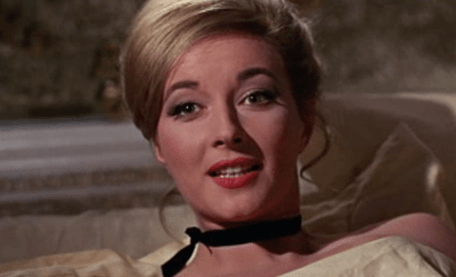
Sean Connery is arguably the best Bond. Some of that resulting from being the original and also simply because he was made for the role with dashing good looks, an impressive physique, and one smashing accent. Next, comes arguably one of the best so-called “Bond” girls in Tatiana Romanova (Daniela Bianchi) who plays the beautiful Russian opposite the handsome Brit. They’re a match made in heaven beginning with steamy encounters, followed by violent escapades, and topped off with playful romance. There’s not more you would want, except action and villains and gadgets, which we also get along with some ubiquitous Cold War sentiment.

In this installment, the Soviets are pitted against the CIA and MI6 with the nefarious SPECTRE manipulating both sides. They have received the aid of one of the Soviet’s highest officials in Rosa Klebb, who puts their plan into action. She, first and foremost, recruits deadly assassin “Red” Grant (Robert Shaw), followed by the pawn Tatiana Romanova, who works at the Soviet consulate in Istanbul. She is to be the siren to lure Bond into a trap with the tantalizing promise of a Lektor device (which MI6 desperately wants).

Thus, as any good spy would, Bond goes after this presumed admirer and first meets with station head Ali Kerim Bey. One man is dead and the Soviets suspect the Westerners. Bey’s office is bombed and the Soviets are the obvious culprit. However, the whole time it’s Grant working incognito.

Bond is taken by Bey to a gypsy camp for refugee and after an evening capped by ambush, he has his first meeting with none other than the beautiful Romanova. The new accomplices ultimately steal the Lektor without a hitch and board the train as “newlyweds” with Bey. However, the ever lurking Grant is waiting for Bond and his companions. Without getting into all the gory details, it sets the stage for a great fighting sequence.

007 gets away with a recently drugged Romanova and puts a helicopter as well as a fleet of motor boats out of commission single-handedly. Number 1 of SPECTRE is very displeased, and Klebb has one last time to make things right. She has a wicked pair of kicks. That’s over soon enough.

What’s left is a romantic gondola ride with our two lovebirds and the notes of Matt Monro playing over the kisses. Talk about a first date, this one was a great one, even for all us third-wheelers.

Goldfinger maybe the apex of Bond viewing, but From Russia with Love is a close contender for that title. Its action does not look half bad even after 50 years, and Sean Connery is quite the hero. What more is there to say about Daniela Bianchi except God was very good to her. Very good indeed. It’s a great adventure with everything you would want and expect in a spy thriller. It’s from Russia with love.

4.5/5 Stars

How to Steal a Million (1965)

220px-HowtostealamillionHonestly, the main attraction of this film is its leads in Audrey Hepburn and Peter O’Toole as well as its director, the great William Wyler. Otherwise, this film is a fluffy, silly caper comedy with a touch of drama. It falls somewhere in between a rom-com and an art heist film where everyone in Paris speaks English. Go figure.

Nicole Bonnet’s (Hepburn) father Charles is a master forger of all types of art which he supplements his own vast collection with. Many of his pieces have been sold for a pretty penny at auction, and he has yet to be found out.

He loans out a family heirloom, Cellini’s Venus, to a local Parisian museum for a large exhibition. Meanwhile, Nicole catches someone in the act of burglary and it ends up being a handsome young gentleman (Peter O’Toole).  She is given a fright but ultimately is taken by the man who hardly seems the thieving type. She lets him go without calling the police even giving him a ride home.

Eventually, they cross paths again and she recruits him to help her steal Cellini’s Venus from the museum. She doesn’t tell him why, but she has her reasons and he willingly obliges. It’s all good fun after all.

The caper scenes are no more harrowing than the rest of the film. In fact, it gives the perfect setting for more comedy as the two burglars get locked in a broom closet together after closing time, while also repeatedly setting off the alarm. But it’s all part of the man’s plan, because, after all, he’s a professional. And their plan works. They get away with the statue and the following day the news spreads like wildfire.

In the end, Nicole finds out that Simon Dermott is actually a private eye specializing in art and criminology. He’s no thief and so this was his first heist too. She thinks she’s in for it now, but they’re too in love for that to matter. He explains himself to Mr. Bonnet who reluctantly agrees to end his forgery career on top.

The two lovebirds drive off madcap down the streets of Paris with a beautiful life ahead of them. There’s not much else to say except Hepburn and O’Toole are fun together, while the score of a young John Williams has a recognizable bounciness. Hugh Griffin seems slightly miscast to be Hepburn’s father, and the film is far from pulse-pounding, but these small facts do not negate from its overall charm.

3.5/5 Stars