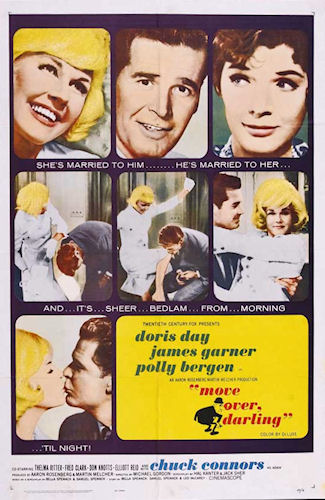
Move Over, Darling (1963)

Move_Over_Darling_-_PosterMove Over, Darling is a remake of My Favorite Wife (1940) and the unfinished Something’s Got to Give (1962). Thus, a Marilyn Monroe & Dean Martin vehicle ultimately turned into a Doris Day romantic comedy with James Garner and Polly Bergen. The dynamic feels so different and yet it ends up fitting nicely into the Doris Day canon. James Garner is always a fun actor and he plays an enjoyable role opposite Day.

The third time is still the charm with a plot involving a wife who is thought to be dead and returns after 5 years on a deserted island. Meanwhile her husband has moved on finally with a new wife who he has just recently married. One husband, two wives. That’s frowned upon in American society so he must figure out how to navigate these choppy marital waters. There are plenty of laughs in this screwball type plot line even if it is worn thin by this point.

The cast is full of great character players including Thelma Ritter, a very funny Edgar Buchannan, Don Knotts, John Astin and Chuck Connors. In this regard it is fun to compare and contrast the roles from the previous renditions such as Don Knotts versus Wally Cox as the shoe salesman, and so on.

It’s not a great film but certainly an enjoyable one full of marital mishaps and screwy situations. Not much more you can ask for so move over, darling and enjoy the show! Here’s to Doris Day who is still with us, James Garner who recently left us and a whole host of others.

3.5/5 Stars

Review: The Odd Couple (1968)

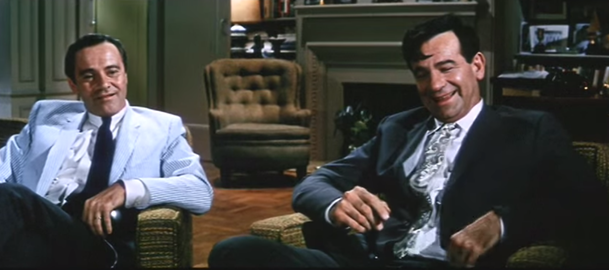
8ca16-oddcouple1By now The Odd Couple is rather like returning to an old group of friends. Jack Lemmon and Walter Matthau never had a better pairing than their turns as Felix Ungar and Oscar Madison. The roles seem to fit each man to the tee or at least they make them their own. Lemmon is as hilarious as ever playing the neat freak, hypochondriac who was recently divorced. He drove his wife crazy because he cooked better than her, cleaned more, and was allergic to her perfume. She had to put on his aftershave instead. Then, there’s Matthau reprising his stage role of Oscar the slob of a sportswriter with an affinity for messiness. Droopy jowls courtesy of Matthau. Put them together and you have some of the greatest comedic fireworks ever, and it’s so simple. You see, all the poker playing gang is nervous that Felix will commit suicide, which he attempts during the film’s opening sequence, but he cannot get the window open. Thus, Oscar obliges to take in his buddy with the rest of the buddies keeping a wary eye on Felix. It’s hilarious to watch them because they really care about Felix, but they have no idea how to act around him. They think every move will be his last.

Oscar does not know what he’s gotten into since Felix cleans up after him, follows him with an ashtray when he smokes, does the dishes, vacuums, sprays air freshener incessantly, and even distracts Oscar from a triple pay while telling him the evening’s dinner plans. Then there’s Felix allergies, his high maintenance, and yes, his pouting. He even ruins weekly poker night with cigar smoke replaced by fresh air and disinfected playing cards.

Bring in the twittering Pigeon Sisters Gwendolyn and Cecily and you’re bound to have more laughs, until Felix the killjoy hurts the mood. Now we truly begin to see Oscar’s sour side which was mostly saved for his former wife Blanche. Now it is specially reserved for Felix and his maddening cleanliness that’s gone too far. Oscar has a nervous breakdown and blows his top chasing Felix out. But Oscar is not a bad guy, Felix is his friend after all, and so enter the poker buddies once more to go searching for Felix. He has been taken in by the Pigeons and the two friends make up. As it turns out, the two men rubbed off on each other, but there’ no chance of completely changing them. They will always be The Odd Couple, just separate now.

The Odd Couple has such a wonderful mythology surrounding it thanks to Neil Simon’s play, the film adaption, and then the television show. Furthermore, it is one of those very special cases that was great on both the big and small screen, since Jack Klugman and Tony Randall were wonderful in their own right. Focusing on this film, the dialogue is not forcing the humor, and it ultimately leads to genuinely funny lines coming out of the circumstances. The poker playing buddies are a riot from Florida-bound Vinnie (John Fielder) to nervous cop Murray (Herb Edelman). The opening of the film is made by Neal Hefti’s theme, and I’ve got to say, the sequence where Felix has his sinus attack is priceless. Without fail it puts me in stitches everytime as the weirded out Oscar looks on along with everyone else. I cannot help but love The Odd Couple. By now it’s too ingrained in me and that’s fine by me.

4.5/5 Stars

Alfie (1966)

alfie“I’ve been doing things my whole life I’m not suppose to” ~ Alfie

Alfie is a real character, with his cockney accent and personal insight about the world he resides in and the people he crosses paths with. Before Ferris Bueller, there was originally Alfie constantly breaking the fourth wall. Although that’s where any comparison ends because Ferris may be a schemer but he is good at heart. Safe to say Alfie is no Ferris Bueller. Not by a long shot. He is a self-indulgent, hedonistic, womanizer, constantly playing the field without looking for anything real.

True he has a kid, a few affairs and casual trysts, but he never sees “Birds” as anything more than objects. Every girl is an “It” not a “Her.” They fulfill his desires and their main purpose is to be used for his pleasure and his needs. He is a man who lives for himself and no one else. He is a real cynic and a deplorable sort of person at that.

Initially I had nothing complimentary to say about the character because the reality is there really was nothing good to say about him. But in a single moment Alfie proved that he might be selfish but not heartless. He finally attempts to “settle down” only for it to backfire on him. That’s the way it works and so Alfie is about right back where he started. I would like to think his heart is a little softer though.

Michael Caine is likable enough to make me not completely hate Alfie and that is to his credit because it was difficult not to. His various conquests and companions were played by, among others, Julia Foster, Jane Asher and Shelley Winters. The film’s jazzy score may not be rock and roll but it seems to personify Swinging London as much as Double-Deckers and Tower Bridge.

3.5/5 Stars

Marriage Italian Style (1964)

Marriage_Italian_StyleI had never seen any of De Sica’s later work and with the quintessential pairing of Sophia Loren and Marcello Mastroianni this seemed like a perfect place to start the journey. The character Domenico is easy to dislike from the beginning because he constantly floats in and out of the life of the former prostitute Filumena who is ironically devoted to him.

The film relates the struggles of matrimony and family in Italy as Filumena tries to support her family while struggling with Demenico who is never truly ready to commit to her. In fact he becomes absolute fed up with her after a trick marriage, but that is just the beginning.

I can only imagine what Divorce Italian Style will be like (which also features Mastroianni). Without question Sophia Loren is certainly the driving force in this film.

4/5 Stars

Yesterday, Today and Tomorrow (1963)

Yesterday,_Today_and_TomorrowThis is the lightest of any De Sica film I had seen up until this point and interestingly enough it was split up into three narratives. The first one follows a woman who continually gets pregnant in order to avoid going to jail, but after seven kids, the toll is too much on her jaded husband. Needless to say there is a happy ending.

The second tale follows a superficial socialite with a Rolls Royce. She ditches her cars as quickly as she ditches her lovers. Although the story does not go very far it is easy to see she is a snob used to getting her own way. Ironically a humble man would in many ways be too good for her.

The final vignette follows an amiable prostitute as she befriends a young man destined to join the clergy. However, he becomes smitten and so she must do her best to encourage him to continue his calling.

That really is only the basics, but it was certainly enjoyable to see Sophia Loren and Marcello Mastroianni in three separate roles playing off of each other in different ways. They reflected three very different walks of life and three varying relationships mixing a great deal of humor with a few more somber moments. All in all it was fairly enjoyable.

4/5 Stars

Jules et Jim (1962)

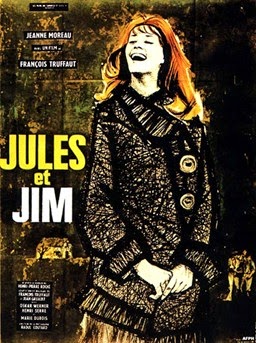
Jules et Jim (1962)Directed by Francois Truffaut, this film begins before WWI with two friends, the timid Austrian writer Jules and the more outgoing Frenchman Jim. Both men become enchanted by a statue that a friend had seen and soon Jules meets the free spirited Catherine after being with several women before her. Although he begins a relationship with Catherine, she soon casts her spell on both of them causing them to have a very close relationship. 
Just before the Great War begins Jules and Catherine are married but when the fighting starts the two men are on opposite sides. Fortunately, they both come out of the war and Jim comes to stay with his friends in their mountain home. Now they have a daughter but their marriage is difficult because Catherine has had several affairs. She begins to flirt with Jim and Jules gives his blessing hoping Catherine will still be present in his life. 
Catherine and Jim end up separating however when they struggle to have a child. Later, they reconnect in Paris but Jim resolves to marry another girl much to Catherine’s jealousy. They meet one last time and Catherine goes on a drive with Jim that ends fatally. Jules is left to grieve for his best friend and his true love.
It is interesting how Catherine is really the main character here despite the title suggesting otherwise. Jeanne Moreau does not seem like your typical beauty either and yet Truffaut makes her character truly special. If you want to become acquainted with Truffaut and the style of French New Wave this one of the films you need to go to. The 400 Blows first, Jules and Jim soon after. 
4/5 Stars

The Umbrellas of Cherbourg (1964)

umbrellas1 It is hard to remember a time when I was so devastatingly sad due to a film, and it does not leave a deep hurt but a more wistful despondency that is far more real. However, that’s enough misery for the time being. Directed by Jacques Demy and starring an exquisitely young Catherine Deneuve, this cinematic opera is a moving musical piece that looks to be conventional and turns out to be quite the opposite. 

The story begins in November of 1957 with a young mechanic named Guy (Nino Castelnuovo) who is deeply in love with the beautiful 16-year-old Genevieve (Deneuve). Guy cares a great deal for his godmother Elise who has a caregiver to look after her. Genevieve helps out her mother in running a small umbrellas shop in Cherbourg which allows them to scrape by. They must sell some family heirlooms to a kindly jeweler who is smitten with Genevieve. However, Genevieve and Guy have plans of marriage until Guy learns suddenly that he has been drafted for the war in Algeria. They spend their last hours together, and she vows to wait for his return. 

umbrellas7In the following months, it becomes evident that Genevieve is pregnant, but her mother tells her that Guy has probably forgotten her already. The jeweler, Roland Cassard (Marc Michel), professes his love for Genevieve and agrees to adopt her unborn child. Thus, partially on the urging of her mother Genevieve accepts his proposal and they are soon married leaving Cherbourg for good. 

Finally, Guy returns from the war and things have changed. He now has a limp and is fed up with his old work at the garage. Furthermore, the Umbrellas shop is sold and Genevieve is wed and gone. Adding insult to injury his godmother soon passes away. With no one else to turn to, he looks to the caretaker Madeleine, and he realizes her love for him. They get married and he turns his life around with her help. 

The years pass, and now during Christmas of 1963, a car pulls into Guy’s new gas station. After many years, the two former lovers come face to face once more. Now they have marriages and children, and their interactions are painfully aloof. They have moved on with their lives and they have moved on from their passionate romance. 

umbrellas13True, their lives have become sensible, but in this opera that Demy has constructed, this conclusion is sad and bittersweet. And yet if this were the only painful moment that would be one thing, but there are so many that touch the heart and move the viewer. When Guy goes off to the army and takes off on the train we can feel the great weight of anguish. More often than not, you can read the sadness on the face of these characters which complement the beautiful ballads they utter. In other words, it’s one thing to recount the plot and quite another to watch the events unfold.

I have to say that I had never seen a film that played out entirely through song, and even in the opening sequence, Demy consciously melds the diverse forms of film and opera. Umbrellas has the vibrancy and color of movies and takes the dramatic story line and songs of opera, to create a unique piece of musical artistry complete with acts and all. Its colors are bright and vibrant–utterly distinct in their composition. Everything from the bikes to the umbrellas and even back alleyways are beautiful. Although there are many magnificent melodies, rather surprisingly there is not one specific song that stands out (Well, maybe the theme), but instead, it plays rather like one continuous song with different sections and overtures that complement while not overshadowing each other.

umbrellas4Demy’s earlier film Lola also gives an interesting insight into the character of Roland Cassard who once again becomes acquainted with a mother and her daughter in a shop. This time around he has accomplished his dream of traveling the world as a diamond merchant, however, Lola is still heavy on his heart. Another thing that is remarkable about the film is the weather which in many ways plays as another character. The varying degrees of rain and snow dictate the mood and shift with the changing seasons. There’s no doubt that Jacques Demy and his collaborator Michel Legrand created something special here that elevates the musical to a heartfelt tragedy of romance. That’s something many men would not be brave enough to do. 

4.5/5 Stars

Review: Playtime (1967)

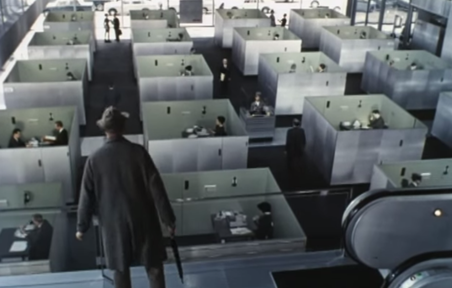
playtime1Playtime is a film that really can be broken into a number of set pieces elaborately constructed by director Jacques Tati. The vignettes begin, surprisingly enough, in an airport terminal, and a group of excited Americans are getting ready for a Parisian vacation. Mr. Hulot (Tati himself) is waiting to have a meeting in a glass office building, however, he soon gets lost in a maze of cubicles, playing cat and mouse with his contact.

Quite by accident, he wanders into an international trade exhibition and the tourists just happen to be there too. While there they are introduced to the latest gizmos, gadgets, and inventions to move society forward. They include silently slamming doors and retractable glasses. In typical Tati fashion, he gives us a glimpse of the old world from Mon Oncle. All that is left is one meager flower stand and a brief reflection of the Eiffel Tower.

Bumping into an old war buddy, M. Hulot is invited over and thus begins a long sequence in an apartment building. What makes it unusual is that the audience is left out on the street, but we can see multiple interiors through the glass. Thus, the conversation becomes unimportant, and the charades inside paired with the street noise is all we notice.

One of the most substantial sequences takes place in a place called The Golden Corkscrew. It is a packed house and the nightclub barely seems prepared for such an evening. Tiles are loose, food runs out, a band member comes late, the chairs leave marks on the backs of patrons, and much much more. Hulot stumbles in and comes in contact with several previous acquaintances. He also makes a few new friends including a boisterous American and a friendly female tourist.

After the crazy night, the morning comes and Hulot says goodbye to his new American friend but not before leaving her with a parting gift to remember her memorable time in Paris. It may not be the Paris of old, but it is still a cheery place made by its people who still remain the same even when the times change.

Jacques Tati’s Playtime took numerous years to complete and it was the most expensive French production at the time. It makes sense though because it truly is a magnificent piece of cinema. It is full of beautifully choreographed sequences and elaborate sets. Mr. Hulot often finds himself wandering through this labyrinth of modern Parisian humanity. Tati teases us, however, filling his world with Hulot doppelgangers.

Even when the gangly protagonist is on screen, he often pops off and on for minutes on end. He is no longer the primary focus of the film. Tati also takes great interest in the sterile modern society of glass, steel, and technology. The screen is filled with a wide array of individuals, which makes it fascinating to simply people watch. Furthermore, Tati almost refuses to use closeups, thus allowing the camera to capture more.

Playtime is slightly slower, to begin with than I remember, but it has wonderfully subdued humor paired with social commentary. Tati’s film may not have a lot of decipherable dialogue, but there sure is a great deal of noise. His sound effects seem to rival The Three Stooges in comical impact, often filling the void usually devoted to talking. It is moments like these where you see similarities to the old silent comics like Chaplin and Keaton.

Playtime is all about the minutiae and these moments are probably exhibited best at the nightclub. So much happens and much of it goes unnoticed, but oftentimes when you pick up on something the payoff is great because you slowly begin to notice more and more. Tati does not have to announce it, but he puts it there to be seen. For instance, there is the fish that is never served but is constantly being seasoned. Then, the doorman who opens the door without any glass. Finally, there is the waiter who gets all the ripped, torn and otherwise ruined articles of clothing. Together all these moments create some immensely funny sequences.

Another thing about Tati’s film. There is really no conflict. He is addressing the changing times, but at its heart, Playtime is just that. Light-hearted recreation.

5/5 Stars

To Sir, With Love (1967)

To-sir-with-loveStarring Sidney Poitier and set in London, the plot follows a former architect from British Guiana who becomes a teacher at a high school in a tough area. Early on Mark Thackeray faces a rebellious group of teenagers who dislike education and challenge authority whenever possible. He resolves to keep his temper and yet one day their actions are too vulgar for him and he loses it.

After that he develops a new strategy to treat them as adults and he teaches them practical skills they will need in the real world. He changes how they act and takes them on field trips so that even the most combative one Denham is won over. However, after an incident during gym class which he must diffuse, Thackeray loses the respect of much of the class. His mood changes slightly after receiving another job offer.

Later on in the gym class he is supervising he boxes with Denham. In the ensuing moments he wins Denham and then everyone else over once more. With the year finally over, Thackeray is invited to the year end dance where he is given a gift and serenaded with song (To Sir, With Love by Lulu)! Too choked up to speak he retreats to his office. After a chance encounter he resolves to continue teaching and rips up the other offer.

Besides a good theme in “To Sir, With Love,” Sidney Potier gives a great performance that makes this film both powerful and touching. If you want a small look into Swinging London this is one to watch. Although I am tempted to find fault in this film I find myself focusing on the positives and I will leave it at that.

4/5 Stars

Lilies of the Field (1963)

Original_movie_poster_for_the_film_Lilies_of_the_FieldStarring Sidney Poitier, the film opens with a black construction worker who has an overheated car in the middle of a desert. He spots at the residence of some European nuns to get water. Homer is intent on making a quick pit stop but the mother superior has other ideas. She sees him as a gift from God so that their Chapel might be built. He reluctantly decides to stick around for a little while to help them out and teach them some English. The stubborn Mother Superior wants everything her way and Homer ends up leaving them. Although he realizes he will not get paid, Homer’s ambition to be an architect leads him to eventually start the Chapel for the nuns. He takes on a part-time job and starts the undertaking while the nuns request materials. Soon the locals want to help but Homer is adamant that he do everything. Eventually, they do join in and more materials come. Progress picks up and Homer becomes the foreman. The building is finally put up and yet the proud Mother will not thank Homer. That night she is finally tricked into thanking him and Homer leads them in a spiritual one last time before driving off into the night. This film is a battle of sorts between two strong-willed people. In the end, it brings a great deal of good.

4/5 Stars