Support Your Local Sheriff (1969)

2e4c1-localsheriff5Funeral sequences are a mainstay of the western genre because they give us a chance to peer inside of characters and examine the time and place that is the west. It can be tough, hard, and most certainly brutal. Support Your Local Sheriff is a barrel full of fun because it takes many of these set pieces and subverts them for the sake of humor.

It opens with one of these typical solemn wakes for a man that no one seems to know or care much about. All too soon everyone is distracted by a speck of gold and mayhem commences. It sets the tone for the entire film and the people we will soon become acquainted with. All the action is wonderfully exaggerated by a frantic harmonica-laden score with jaw harp included. It’s twangy madness that works to a tee. But enough of that.

The mining town of Calendar is a wild, untamed place built for the sole purpose of mining. The rough and tumble Danby Family seem to have a monopoly on the gold trade controlling the only road out of the town. It’s a big mess.

That’s the climate that Jason McCullogh walks into (James Garner) on his way to Australia. After seeing Joe Danby (Bruce Dern) kill a man, he decides to sign on as the town’s sheriff. Town “mayor” Olly Perkins and his entourage are surprised that any person would want to take the job, but after seeing Jason’s marksmanship they giddily agree. Quickly he astutely breaks up mud fights, puts Danby in jail and finds himself a deputy in Jake (Jack Elam).

Most of the rest of the film follows Pa Danby (Walter Brennan) and his two nitwit sons as they try and get their equally dumb baby brother out of prison. It’s followed by a long line of hired gunman who all fail out knocking the sheriff off.  Jason also has encounters with Perkins’ often ditsy daughter Prudy (Joan Hackett). It would be wrong to say that Prudy is the only whimsy one, because it feels like everyone in town has a screw loose, from the hero to the villains.

That’s what makes Support Your Local Sheriff so appealing. James Garner is as charming a wisecracker as ever, but on a whole, this film is full of comedic misunderstandings, caterwauling, and stupidity with an ignoramus around every corner. There’s a jail without bars, villains who are wimps, a girl who hides in a tree and lights herself on fire, even a protagonist who seems bent on heading off to the real frontier in Australia. What?

Thus, this rewriting of your typical western trope of a man taming the west works out quite well and in many ways feels like a precursor to Blazing Saddles. It was a lot of fun to have two personal favorites in James Garner (The Rockford Files) and Harry Morgan (MASH) in a film together. Joan Hackett was a lot of fun too. I really want to see more with her (ie. Will Penny, The Last Sheila).

3.5/5 Stars
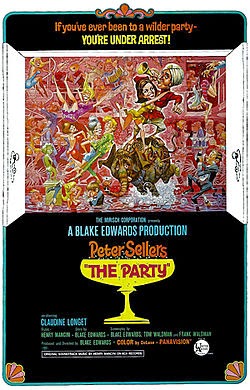
The Party (1968)

7af4c-party_movieWhen you begin to watch the Party it becomes obvious that it is less of a comedy film and more of a comedy concept. Peter Sellers in all his glory is a bumbling Indian actor who is mistakenly invited to an elegant party. He is in many ways very similar to Mr. Hulot. Both are likable mess ups who are constantly getting themselves into trouble.

I am of the opinion that Seller’s comic genius alone could carry a film. However, the Party has a great multitude of weirdos and snobs that create a great comedic collaboration. Possibly the best example would be the constantly inebriated waiter. Furthermore, by the end the Party is no longer distinguishable and it culminates in a surreal world of bubbles and groovy music. This was the only collaboration of Sellers and Blake Edwards that was not Pink Panther and it honestly is not half bad! We even get a performance from a young Claudet Longet.

This is one of those films that might be lacking in plot at times but it is more fun simply to sit back and watch the fireworks begin.

3.5/5 Stars

8 1/2 (1963)

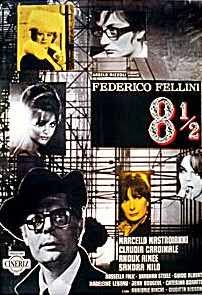
4b2c1-8mezzoDirected by Federico Fellinni and starring Marcello Mastroianni, the film follows the famous director Guido. After an opening sequence that reveals how he feels, we see Guido as he spends time at a spa trying to get healthy. However, he also must prepare for his next epic film production and he is constantly being bombarded by his writer, producer, actors, and all others involved. First his mistress arrives which he is unhappy about and then his wife comes and he is glad to see her. All these various things leave Guido confused since he does not have any answers. He wanted to make a genuine film full of truth and yet he cannot even be truthful in his own life. Even the ideal woman, the actress Claudia, has no real answers for him. Despite this, the film ends on a positive note with everyone holding hands in dance. What makes this film so fascinating is the interlocking dreams, reality, fantasy, and Guido’s childhood memories. Sometimes the viewer may get confused and yet often it is possible to decipher what is going on still. This is  a very personal film about film making itself and for Fellini it is also considered by many to be his greatest achievement.

5/5 Stars

La Notte (1961)

36075-lanotteposterHere is a film full of glitz reminiscent of La Dolce Vita, a cast starring the likes of Mastroianni, Moreau, and Vitti, with a meandering plot courtesy of Michelangelo Antonioni and gorgeous black and white visuals.

This film is certainly not for the action fanatic because we are given very little. In fact the story revolves around a couple who have trouble communicating so even the dialogue seems sparse at times. The marriage is slowly going down the tubes and neither partner is ready to acknowledge it until the end when the wife finally does.

Moreau definitely had stronger performances like Jules and Jim because here she hardly talks and is highly misanthropic. Monica Vitti is more interesting in her role simply because she has more energy infused into her.

One of my favorite moment in the film had to be at the party where Mastroianni first sees  Vitti playing a rudimentary shuffle board. We are watching just like he is except there is a strange sensation that something is doctored with the image. It turns out that we are only looking at the reflection and then the camera swivels to the right to actually show reality. It was one of the noticeable artistic shots that really stood out to me.

La Notte is a subdued film, more often than not, and so if you go expecting that type of pacing you start to enjoy the little pieces here in there that are given to you. By the end it is rather sad because the marriage not working. There is no huge fight, no bickering, just apathy and that is in many ways more painful to see.

4/5 Stars

L’avventura (1960)

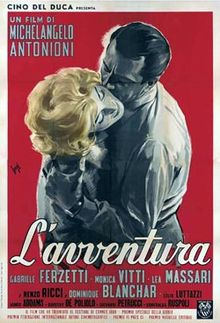
L'avventuraSmallL’avventura is one of those films that it is difficult to make a cohesive review for. If you are watching it purely to be entertained, you have it all wrong, because that is not its main purpose. Its greatest attribute is the special place it has in the pantheon of film art.

It is a film about a group of high society adventurers who go on a boat trip through some islands, only to have a woman passenger literally disappear, practically into thin air. Her boyfriend and her best friend search for her in the ensuing days, only to fall for each other, and that is about it. This is, of course, the most superficial level possible.

L’avventura is quite interesting visually and I wish I could have seen it on the big screen. The reality is, oftentimes, not a whole lot is happening, but it causes you to actually focus on the images in the frame. Michelangelo Antonioni gives us numerous settings all over Italy, and most have something to do with the wanderings of natural beauty Claudia (Monica Vitti) or her companion Sandro.

Anna (Lea Massari), despite her early importance, is hardly in the film. She is only a wisp in the wind and the mystery surrounding her is of lesser importance. The outcome is what matters as her friend and boyfriend become lovers. Theirs is the relationship that is explored as it develops, evolves, and becomes fully tested.

In the final moments, Antonioni toys with us, suggesting just possibly that Anna might be in the picture again. In fact, he must have a very cruel sense of humor indeed. Here in L’avventura as well as Blow-up (1966) he waves a mystery in front of our nose and leaves it unresolved. It is absolutely maddening, in some respects, and yet he makes us look at something else altogether. He also had the gall to name a film with a meandering plot like this L’Avventura! The nerve of it all, and yet I respect him for it because it messes with our conventions and forces us to be uncomfortable.

It is understandable that this was a polarizing film at Cannes in 1960, and I can only imagine that it has the same effect over 50 years later. One thing is for sure. This is no Gilligan’s Island with a three-hour cruise set in Italy. There is a lot more to it than the plot. Not my favorite adventure, but I respect its pure audaciousness of form.

4.5/5 Stars

Blow-Up (1966)

40940-blowup_posterDepicting the time and place of Swinging London in the 1960s, this film is directed by Michelangelo Antonioni and it stars Peter Hemmings as the protagonist. He is a fashion photographer in a hopping city. He spends his day working with models with countless photo shoot after photo shoot. He is skilled at his job and as such he is temperamental and at times irritated by his fashionable but arduous occupation.

After one such string of photo shoots he goes off on an excursion to an antique shop and a park where two lovers have met. He sticks around and snaps pictures of them before he is chased off by the woman. The next day the attractive woman comes to him asking for the negatives and at first he refuses. After she has left he develops the negatives and blows them up only to find something very intriguing. He goes back to the park at night and finds something very perilous indeed. He returns to his flat and then he spots the woman at a club only to lose her during a concert.

Following the lively evening he returns once more to the park, this time to find something even more unusual. Despite all his efforts everything is still a complete mystery that he cannot hope to solve or understand. There seemed to be some superfluous scenes in this film but it was interesting to watch it unfold. The photographer has an intriguing lifestyle but he is not a very likable character. Following the blow up of the image everything begins to change and we begin to sympathize with him. When the film ends and the mystery is still unresolved, it forces him as well as the audience to simply accept it and move forward. This is an anti-mystery if there ever was one.

4.5/5 Stars

Planet of the Apes (1968)

f0ab6-220px-planetoftheapesposter“Take your stinking paws off me, you damned dirty ape!” ~ Taylor

Planet of the Apes is a highly disconcerting tale despite the rubber visages of the apes which feel quite tacky at times. However, they are so unnatural that they seem to still work within the context of the film. This Sci-Fi classic also really works on another level, because it is an inversion of our accepted dogma. Yet it still shares a degree of similarity to our reality making it a frightening dystopian  world to take in.

The story begins calmly enough in outer space as a group of human explorers circle the solar system with the fate of earth up in the air. We assume the worst. After spending time in hibernation the crew finds that their ship is making a crash landing for an unknown reason so the three surviving passengers bailout. There’s Taylor (Charlton Heston), Landon and Dodge and though they do not always see eye to eye, they begin to explore the vast expanses of the seemingly lifeless world for any sign of life.

As time passes, they finally come across human life: a very primitive human society that has no form of communication. They assume they can run this society soon enough with their advanced intellect. However, what they were not counting on were the apes who have advanced far beyond the animalistic humans. Apes are the one with language, culture, weapons, and a whole stratified society.

Taylor and his shipmates are hunted down like common animals along with the rest of the mute natives. What ensues is a rather terrifying story following Taylor as he tries to prove his intellect only to be beat up and caged like a common zoo attraction. It feels strange watching the apes speak in common English as they laugh contemptuously at the stupidity of human lifeforms.

However, a pair of scientists (played by Roddy McDowall and Kim Hunter) become interested in Taylor and he must fight an uphill battle to prove he is different. It is no easy task with beatings, chains, and court trials. The society is so set in its ways that no one will believe that a human actually can have intelligence. It is utterly impossible. This gives context for the famous insult that Taylor hurls at the apes. It’s the first time a mere human has addressed an ape. Needless to say,  they don’t take it well.

Taylor has enough grit and stubbornness to get what he wants, but only when he has gotten away does he really understand what has happened and where he is. How he didn’t realize it before is a puzzle. Then again, he probably was not the only one blinded. Planet of the Apes works on a number of levels, although it can feel a bit corny. First off, the music of Jerry Goldsmith makes every sequence feel all the more unnerving. The lack of CGI in the panoramic images is a breath of fresh air. I will assume that those cinematic shots were actually real, and they would undoubtedly look fantastic on the big screen. Amazing! Furthermore, Charlton Heston does a decent job as the cynical explorer Taylor and as I noted early on he got the girl. Just not the one I expected.

There are a lot of sequels/prequels to be watched and I will certainly try and get around to them some day because this film was definitely enjoyable. Without a question.

4/5 Stars

Night of the Living Dead (1968)

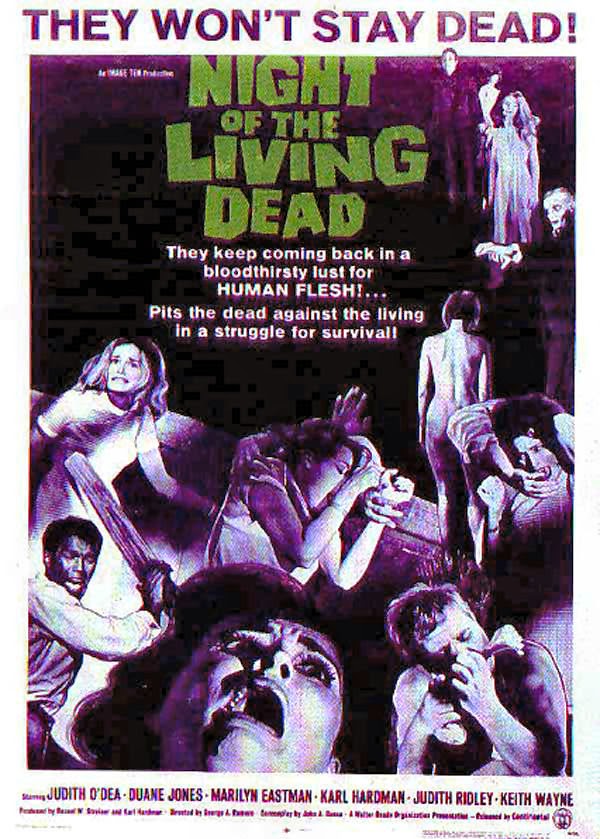
ee1cb-night_of_the_living_dead_afficheI came into Night of the Living Dead expecting a whole lot of zombies and some gore and a few deaths. There was most definitely some of that to be sure, but that was far from the whole picture.

First off, it must be acknowledged that George Romero’s picture is a true low budget B film, and it certainly looks the part with its choppy black and white cinematography. Instead of taking away from the film it adds to the aesthetic because we are even less sure of what we are seeing.  The inciting details are also rather blurry as well.

It begins with a prudish girl named Barbra (Judith O’Dea) who goes to visit her father’s grave with her brother. Their little sibling quarrel is soon interrupted by a thing. A zombie for lack of a better term. Johnny is taken down, but Barbra frantically escapes to an abandoned house. Soon she is joined by burly, level-headed Ben (Duane Jones) and a few others. Still little is known about the crisis as the men butt heads about the best plan of action in response to the impending onslaught. Whatever their decision it has no power to impede the ghouls from steadily multiplying and moving closer. The authorities can do very little as the men board of the house and get ready to defend their makeshift fortress.

Plans of escape with a truck go awry and they see all too quickly the ferocity and cannibalistic nature of the undead terrors.  Meanwhile, the Press and Big Whigs in Washington try to make heads and tails of what is going on across a third of the country. The only explanation is radiation from Venus, but that does little to help our protagonists in their predicament.

By its conclusion Night of the Living Dead becomes increasingly more suffocating and claustrophobic as the zombies close in and do their worst. Ben somehow pulls through, but fate does not smile fondly on him. After all, the line between undead and living is sometimes difficult to differentiate. So much so that sometimes I felt like I was watching some Vietnam footage or a White Supremacist posse instead of a fictional horror tale. Yet another layer that makes Night of the Living Dead strangely unnerving.

This film ushered in a new era of horror films, and it truly is the seminal zombie flick before it was cool. Although to the modern viewer this film can feel slow, it has a surprising amount of social and political commentary. One thing’s for certain. I never want to be stuck in a house with zombies closing in on me. Not fun. Not fun at all.

3.5/5 Stars

El Dorado (1966)

5a6c7-eldorado3 El Dorado is less of a remaking of Howard Hawk’s previous western production Rio Bravo and more of a reworking of it. This time the town drunk is sheriff J.P. Harrah (Robert Mitchum), who got his heart broke by a girl. The kid is Alan Bourdillion Traherne (James Caan) also known as Mississippi. He can be found with a shot up old hat on his head and a sawed off blunderbuss for a gun. It’s not his weapon of choice anyway. Then, there’s old reliable Bull Harris (Arthur Hunnicut), who holds down the fort and looks after the sheriff when he’s laid up. As the main love interest, there’s Maudie (Charlene Holt), a resident of El Dorado since her childhood days.
As always the man who calls the shots is Cole Thorton (John Wayne), an old war buddy of J.P.s. He has one of the fastest draws around but also has a surprisingly soft spot for doing good. He befriends the younger Mississippi and comes to the aid of J.P when he could have joined the other side.
Thorton rejects the offer of local villain Bart Jason (Ed Asner), but a threatened local ranch family wishes to take no chances. When it is all said and done Thorton receives a bullet in the back that causes him problems afterward.
Now lethal hired gun Nelson McLeod (Christopher George) has taken up Jason’s offer, and they ride into the town. One of their first meetings takes place in the old church and it ends in the arrest of Jason for his part in the whole affair. Another shootout takes place that night and now the formerly drunk sheriff also gets nicked in the leg.
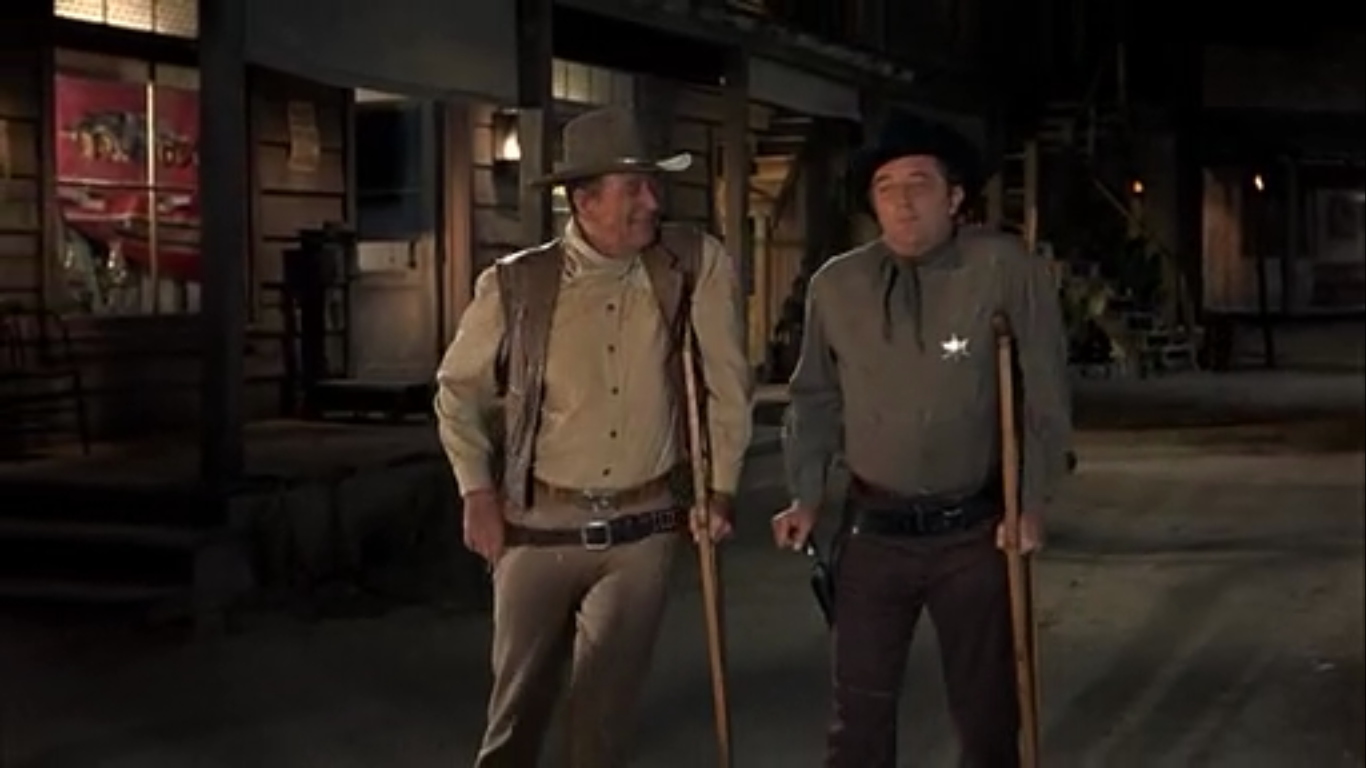
Maudie is fearful of the thugs milling around her place and when Thorton and Mississippi go over to investigate they get ambushed because Cole has physical ailments of his own. They get Cole back but not without giving up their own prisoner. With one of the McDonald’s kidnapped a quick plan is devised and the final showdown begins. Our ragtag crew gets the job done, but J.P. and Cole make quite the pair. They look more like crippled old men than hardened gunfighters, both hobbling down the street with a crutch.

I must admit I am partial to Hawk’s original Rio Bravo and I have yet to see Rio Lobo, but I did really enjoy these characters. Wayne and Mitchum seem to play against type because at times they are quite comical. Mitchum is not a tough P.I. or ruthless villain, but a town drunk! Wayne can hardly shoot a gun at times and he even gets taken. That’s unheard of. It’s as if they softened with old age, but I don’t mind, because the interactions between those two, Mississippi, Bull, and Maudie are a lot of fun. Even the antagonist McCleod is a man with a sense of honor and good fun. Some great moments include Mississippi’s miracle concoction and numerous bars of soap being brought to the dirty sheriff when he finally takes a bath! The initial introduction of the two leads is priceless too. They both were smitten with the same girl.

Howard Hawks really knew how to make westerns not simply about guns and shootouts, but colorful characters who oftentimes seem more content kicking it back in the jail than in smelling out trouble. He proved it again with El Dorado.

4/5 Stars
A gallant knight,
In sunshine and in shadow,
Had journeyed long
Singing a song, 
In search of El Dorado

Persona (1966)

f15de-persona1“Persona: The image or personality that a person presents to other people” ~ Merriam-Webster Dictionary 

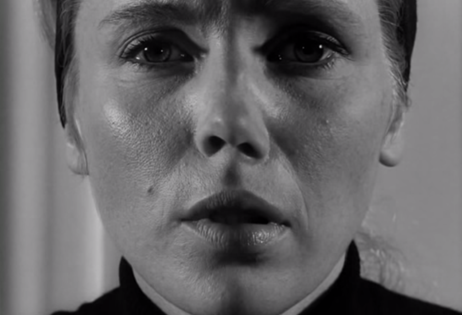
Ingmar Bergman’s Persona got me thinking. About what I’m not quite sure, but it did leave me confused and utterly perplexed which I suppose is a good thing. Since I am a fan of comparisons, I will go out on a limb and say I felt like I was watching the cross between L’Avventura and Repulsion. Persona is certainly befuddling psychologically and it has the crispest, most pristine black and white cinematography I have seen in a long time, courtesy of Sven Nykvist. 

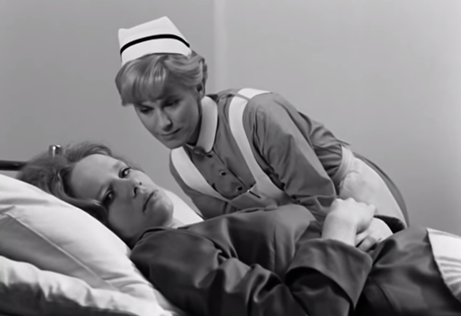
The opening sequences in the hospital are noticeably minimalist with an accentuated sterile environment. The close-ups feel reminiscent of The Passion of Joan of Arc and the highly dramatic and unnerving score  sends twinges down our spine. To top it off, the takes can be excruciatingly long, focusing on an inert face or a solemn figure crouching in a doorway. Silence is just as prevalent as dialogue.

At its core, Bergman’s film is an examination of individual characters in space. Alma (Bibbi Andersson) is the young sprightly nurse who is called in to take care of catatonic actress Elisabet Vogler (Liv Ullmann). Their interactions quickly move from the plain hospital room to the seaside cottage loaned out to Mrs. Vogler for her recovery.

What begins as attendant watching over patient soon evolves into a vulnerable woman finding a silent foil to confide in. The Persona is changing. 

All of a sudden roles are reversed and when Alma discovers a letter Elisabet sent away to the administrator, things are never the same. She feels betrayed learning that the actress has been analyzing her in silence. All that’s left is bitterness and anger towards her mute companion. No words come out of her mouth. Only blank stairs and more silence. She remains strangely calm in juxtaposition with the agitated Alma who becomes more and more tormented. But it is at this point we have lost much of our grip on reality. The lines, as well as the images, are often blurred and warped.

Persona takes on some brazenly edgy topics with frankness that is often abrasive. A repeated monologue by Alma follows the discovery of a recovered photo of Elisabet’s little boy. In the sequence, Alma speaks the words on Vogler’s mind and we are forced to labor painfully over her words yet another time. In many ways, Alma becomes the stand in or understudy for the actress and the role is far from elegant.

By the time the film came to its conclusion I hardly knew what to think. It elicited powerful feelings and reactions of aching and apprehension. If nothing else Bergman certainly makes you think and his Persona is unquestionably a striking piece of cinematic art. He has the skill of riddling our minds like a Bunuel or even Godard. It’s powerful if not completely satisfying because we can never hope to fully understand it.  

4.5/5 Stars