Le Samourai (1967)

2858d-lesamouraiStarring Alain Delon as the title character and with direction by Jean-Pierre Melville, this film pulls from the French New Wave as well as Hollywood Noir and Crime films making something entirely distinct in its own right. Jef Costello is Le Samourai, an expressionless and cold professional hit man who can be seen in his trench coat and hat with a cigarette. He executes a hit on a nightclub owner and he is seen leaving by the female piano player. His girlfriend gives him an alibi and the eyewitness accounts do not line up but the investigator still suspects Costello. The hit man is let off and goes to pick up his payment only to be shot instead. He gets away and fixes himself up only to return to the night club later. He returns to his room knowing something is up because the canary is agitated and he finds a bug. The police keep on his girlfriend as well but she will not retract her statement. Costello is confronted by his assailant from before only to be offered a new contract, but they struggle and Costello gets the name of the boss behind it all. Jef is on the move again and he says a goodbye to his girlfriend before going to Rey’s home to knock him off. One last time he returns to the night club piano player and in view of everyone he walks up to her a pulls out a gun. With all eyes on him he explains his new target is her, but before he can do it, Le Samourai is gunned down. The police are relieved to have got there in time, but then they realize Jef never meant to kill her. 

Delon plays such a delightfully deadly killer with a moral code. In a sense he is a tragic hero we ultimately respect because he lives a life full of solitude and honor as is the code of the samurai. I must admit that I cannot wait to see more Melville or Delon for that matter.
 
5/5 Stars

Wait Until Dark (1967)

Starring Audrey Hepburn and Alan Arkin, this is a harrowing suspense thriller. The film opens with a man being given a doll by a fearful woman. Little does he know what is inside and there is a thug trying to retrieve it. The man’s blind wife spends most of her time at home with the doll unknowingly in their care. The thug enlists two other incriminated men to help in the elaborate plan. The key is the blind woman and so they get to work by luring her husband away and then gaining her confidence. Through a course of events they hope to scare her into telling where the doll is. She begins to become suspicious but she still does not know where the doll is herself. However, soon it comes into her possession. Night is falling and she is cut off from all outside help. She waits anxiously in her darkened home and when the enraged thug returns Susy fights back the only way she knows how, in a struggle to survive.

Audrey Hepburn is usually a sympathetic figure but when you make her blind the audience worries even more for her safety. The climatic moments are thrilling and they certainly make the viewer uncomfortable. It is questionable if a real blind person would be so trusting or if an actual person would bring home a doll that was handed to them. Aside from that this is an entertaining film and Hepburn was great.

4/5 Stars

Two for the Road (1967)

Starring Audrey Hepburn and Albert Finney,this romantic comedy gives a more realistic view of love and marriage. Mark and Joanna have been married about 10 years now and despite their wealth they seem unhappy. The non-linear story relates how they both met each other while vacationing in France. They were young, energetic  and in love. The film also covers their travels across France with Mark’s former girlfriend, her analytic husband, and their spoiled daughter. Then, we learn Mark finally got work as an architect. However  now with a small daughter, the marriage is dragging and they both have their own affairs. Despite the loss of their original passion, the couple realizes they are in love so Mark quits his job so they can start anew in Rome. This film gives off a sunny 60s vibe with a playful score by Henry Mancini, bright colors, French scenery  and of course love. I always enjoy Audrey Hepburn but I also felt Finney did an excellent job playing opposite of her. Most importantly  director Stanley Donen may have made a Hollywood style romance, but he made it more recognizably human than most. It does not simply examine the passion alone because there are many aspects of this big, messy experience called love.

4/5 Stars

My Fair Lady (1964)

Adapted from the play Pygmalion, originally written by George Bernard Shaw, My Fair Lady stars Audrey Hepburn and Rex Harrison. It follows a speech therapist (Harrison) as he tries to win a bet with an old acquaintance that he can pass off a poor flower girl as a duchess. He takes Eliza Doolittle (Hepburn) and begins to train her, not as a person but as an experiment. Eliza eventually gets fed up with this treatment but at the same time also wants to become sophisticated. With Harrison’s help she does become that person and is no longer a subject to be experimented with. This is a role where Hepburn plays completely against her image for most of the film but she does pull it off in the end. Putting together a good cast, plot, and songs, this film is quite good.

4.5/5 Stars

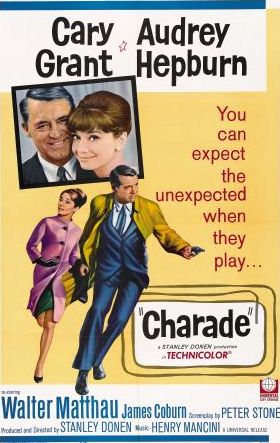
Charade (1963)

Starring the romantic pair of Cary Grant and Audrey Hepburn, with Walter Matthau, James Coburn, and George Kennedy, this film is considered the best “Hitchcock film” which the director did not make. While on vacation, Grant and Hepburn first meet briefly and then she returns to her home Paris. Hepburn goes there only to find out her husband, who she wanted to divorce, has been murdered. When meeting with a CIA man (Matthau), she learns that her husband and three buddies stole some money during a war but the three chums never got their shares. Upon meeting Grant again, he agrees to help Regina (Hepburn) and also says he is looking for the money. Through a series of events the three other men are all killed and everything seems to point to Grant. Hepburn runs for her life with Grant close behind and winds up meeting the CIA man. However, everything is not as it seems and after a shoot out Hepburn finally realizes the truth. Along with the thrills this movie has a nice score and a touch of playful comedy (including Grant’s many aliases including Peter Joshua, Alexander Dyle, Adam Canfield, etc.). Cary Grant was hesitant of playing opposite Hepburn since he was quite a bit older, but that is used nicely in the film as a source of even more comedy. Furthermore, Mancini’s score gives the film a 1960s spy vibe or I guess I should say agent… Hope you enjoy Stanley Donen‘s Charade.

4/5 Stars

Breakfast at Tiffany’s (1961)

Starring Audrey Hepburn and George Peppard, the movie follows the lavish lifestyle of the ditsy Holly Golightly. Moving into her apartment building, the down-on-his-luck writer Paul immediately grows fond of Holly’s quirky personality. Considering each other simply friends, Paul comes to one of Holly’s wild parties and they journey through New York together. However, although Paul is falling for Holly, his circumstances seem to prevent it and besides she is oblivious to his affection. Slowly they fall farther apart with Holly’s upcoming marriage to a wealthy man. In the end they do reconcile, embracing in the rain (of course). Holly has finally found a man who truly loves her and does not use her. The love story is an interesting one and Hepburn gives a lively performance. Henry Mancini’s “Moon River” is a wonderful addition to this film. I would say however that this is not my favorite film with Hepburn because it is certainly hard to top Roman Holiday.

Needless to say, this is a film that I have a difficult time  making my mind up about. I will wholeheartedly admit that I enjoy Audrey Hepburn movies ranging from Roman Holiday and Sabrina to Charade and Wait Until Dark. Of all of her performances, Holly Golightly is arguably her most iconic. Perhaps this is because she played against her usual gracefully timid image or maybe it was  the memorable wardrobe put together by Givenchy. Breakfast at Tiffany’s also has some wonderful supporting actors such as Patricia Neal, Martin Balsalm, Buddy Epsen, and an unfortunately badly cast Mickey Rooney. I think I would conclude that if Tiffany’s was just composed of its beautiful opening sequence accompanied by Moon River and the final romantic moments, I would thoroughly enjoy it. However, some of the moments in the middle I suppose are not as memorable or downright strange, making this a far from perfect film. It is, however, still an enjoyable romantic comedy that showcases Audrey Hepburn and includes the best of Henry Mancini and Johnny Mercer.

4/5 Stars

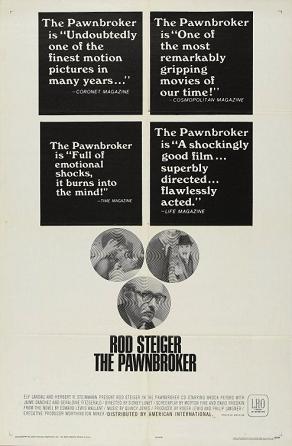
The Pawnbroker (1964)

Starring Rod Steiger with support from Jaime Sanchez and direction by Sidney Lumet, the film chronicles the present life of a Holocaust survivor turned pawnbroker. Sol Nazerman is a man who keeps to himself and he is callous to everyone who enters the doors of his shop. Under the surface, it is evident that the reason for his demeanor are his constant tormenting memories of the death camp as well as the loved ones he lost. In present day Haarlem Sol feels fear for the first time in a long while when he learns his shop is being used as a front for illegal activities. The energetic Ortiz (Sanchez) who eventually got fed up with his boss, shows his loyalty in the end. Despite his specters, Sol seemingly feels humanity after such a long time of being cut off from the world. Steiger gives a stunning performance and although sometimes it seems confused, I think this is an important film to see.

4/5 Stars

A Hard Day’s Night (1964)

5b3a7-a_hard_days_night_movieposterA Hard Day’s Night directed by Richard Lester and starring the Beatles, showcases the eponymous album and plays out rather like a documentary more than a full-fledged movie. 

The opening sequence has the Fab Four running frantically away from a mob of fans as they try to get to their train without being carried off. On the train we get a bit more acquainted in a day in the life of the Liverpool Lads. Paul’s clean but crafty grandfather has come along for a change of pace and the boys try to pick up girls, while their manager attempts to keep them in line. They get to their destination, but would rather dance, talk with girls, and frolic in an open field rather than answer fan mail and attend a press conference. They find themselves in trouble a number of times in between rehearsals for their show. It might be Paul’s grandfather getting in trouble at a casino, George taking a wrong turn, or John being cheeky and childish. Then, thanks to Paul’s grandfather they lose Ringo when he decides to get out and live a little! Time is running out and so they try to run him down with the police hot on their trail. They make it to their performance in time and Beatlemania takes over as they perform complete with swooning girls and deafening noise. The Beatles are a success and then they quickly head off in a helicopter, stopping one of Grandad’s schemes in the process. 

We can only assume they were heading to American and as we all know the rest was history. I read an interview with Bob Dylan once and he said the true 1960s did not really start until about 1965. With Marx Brother antics and their challenging of authority you could say that the Beatles led this change. They may have looked like four clean cut boys, but their music, hairstyle, and nonconformist demeanor, at times, reflected a new generation. If you like the Beatles’ music this film is for you, and it also gives an interesting representation of 1960s London.
 
4.5/5 Stars

Bonnie and Clyde (1967)

b1a0c-bonnie_and_clydeStarring Warren Beatty and Faye Dunaway, with director Arthur Penn, the film chronicles the crime life of a group of notorious gangsters during the 1930s. Clyde Barrow (Beatty), a small time thief meets the beautiful young girl Bonnie Parker (Dunaway) and together they begin robbing banks. Soon they enlist the help of a dim-witted mechanic C.W., and then Clyde’s brother joins the fray bringing along his wife. They have a string of successes and they become infamous nationwide. Soon they begin to bicker among themselves and the police start to buckle down. In a shootout Buck is shot dead and Bonnie, Clyde, and C.W. just barely escape. However, their actions eventually do catch up with them and thus ends the story of these two figures depicted as anti-heroes. This film is significant because it was influenced by the French New Wave but it in turn ushered in a new era of American film . It has a unique combination of comedy, romance, violence, and of course banjo music.

5/5 Stars

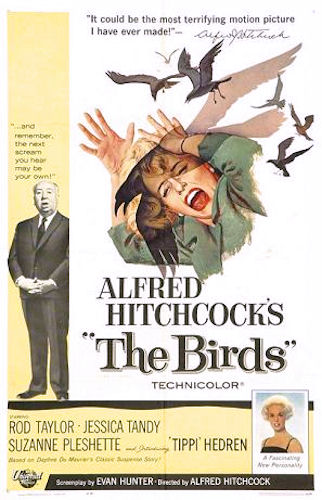
The Birds (1963) – Alfred Hitchcock

ebc31-the_birds_original_posterDirected by Alfred Hitchcock and starring Tippi Hedren, Rod Taylor, and Suzanne Pleshette, this film follows the journey of a rich woman who travels to Bodega Bay in order to visit a man who intrigues her. This love story is already odd to begin with and then add thousands of berserk birds to create far more chaos. Everything is innocent enough at first but Hedren gets attacked by a seagull. Everyone brushes it off but the next day at a birthday party a wave of birds attack. A couple of deaths and many injuries occur causing tumult all over the bay. The birds keep on attacking in cycles so the citizens must either try and flee or barricade themselves in their homes. Soon the threat of the birds seems overwhelming and Hedren and her new relations must fight to survive. Although this film ends with the family finally escaping in Hedren’s Ashton Martin Coup, the birds still sit there as ominously as ever. With the use of special effects and no score, this film sends shivers down the spine. However do not think it is just a horror flick. Much like Psycho it is also a very well made film.

4.5/5 Stars