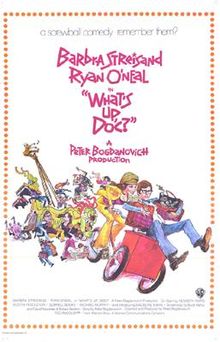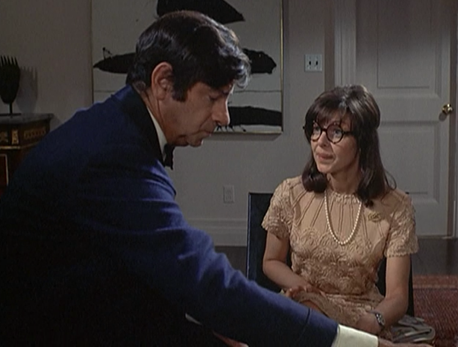
A nod to the 1930s screwball comedies, this hilarious film is directed by Peter Bogdanovich and stars Ryan O’Neil and Barbra Streisand. It opens with the prologue, “Once upon a time there was a plaid overnight case,” however very soon it becomes obvious that there are four of these cases!
One belongs to the bookish Ryan O’Neil who is going to a musicologist convention with his annoying fiancée Eunice, the other to the free spirited Judy, one has top secret information, and the last is full of jewels. This dramatic irony is set up early on for the audience and things really get chaotic when Judy tries to pick up Howard. She masquerades as his fiancée and creates a good impression with a Mr. Larabee who is in charge of giving out the grant. However, later, Judy succeeds in completely destroying Howard’s room while causing more problems for Howard with Eunice in the process.
The next day Howard is invited to a party at the home of Mr. Larabee and he is instructed to bring his charming “fiancée.” That’s where the mayhem hits its peak. All four bags end up together. There are gangsters, government agents, guests, servants, and Judy and Howard all a part of the chaotic ruckus. The unlikely couple finds themselves on the run through the hilly streets of San Fran where an epically frenzied car chase takes place. Put together a pane of glass, some bumpy steps, three cars, a parade, and a large body of water to add up to some hilarious moments. The bedlam carries over into the local courthouse where everything is eventually figured out. Everything is back to equilibrium and Howard flies off into the sunset with his new love and an in flight Bugs Bunny short.
4/5 Stars
Category Archives: 1970s
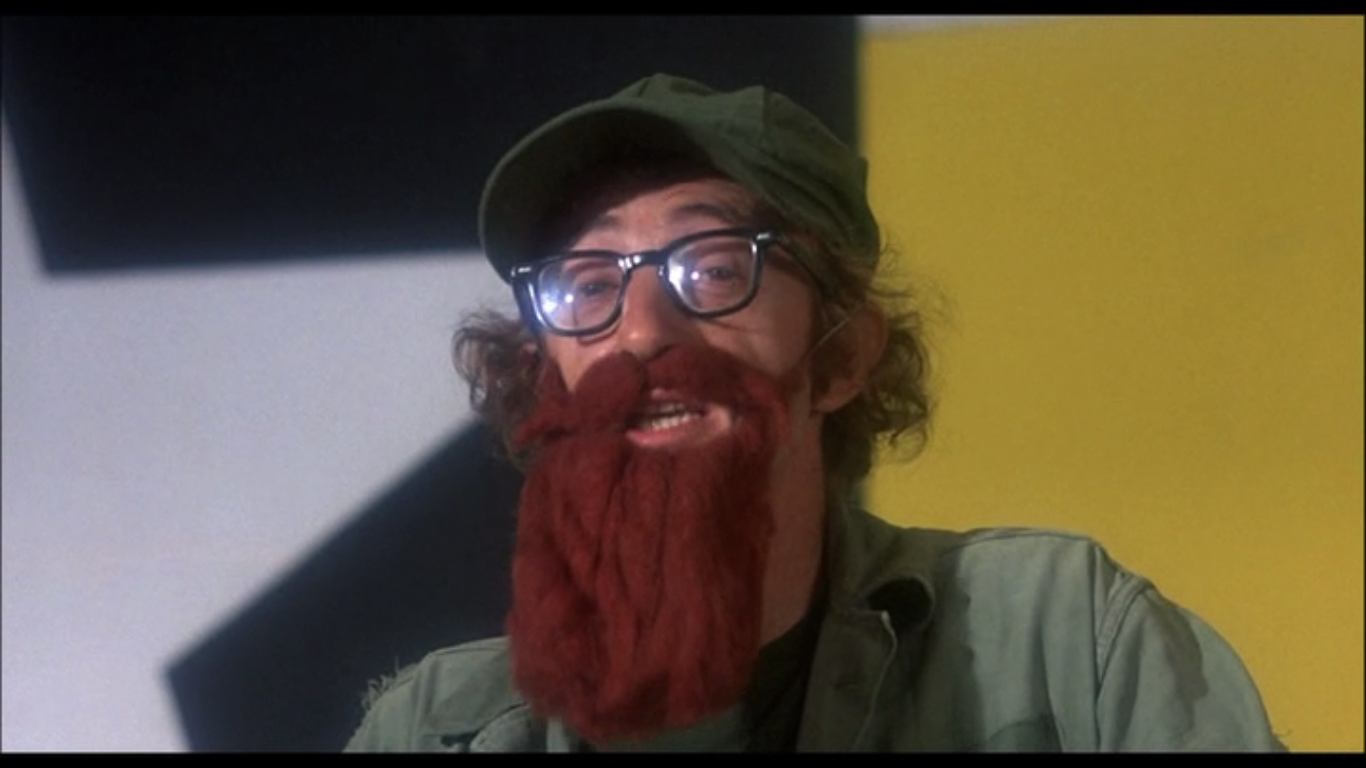
Bananas (1971)
In the vast realm of Woody Allen films Bananas feels more like Take the Money and Run (1969) with its zany comedy than his later films which often take on a more somber and philosophical note.
A South American assassination with play-by-play commentary by Howard Cosell is the epitome of this film’s humor. A coup de’tait follows in the banana republic of San Marcos and somehow Fielding Mellish (Allen) fits into this picture. He starts out as an inept machine tester, gets beat up on the subway by thugs and falls for a female activist named Nancy (Louise Lasser). In order to impress her he heads to South America and winds up joining a revolutionary group.
Now somehow made president of the rebels, he heads back to the United States to gain support and funds. However, he ends up on trial and things are not looking too good for him. However, he gets back with Nancy and she agrees to marry him. The films ends with the consummation of their marriage book ended nicely by commentary by Howard Cosell once more. Woody Allen has always been a comedian and Bananas truly fits its title. It is utterly wacky.
3.5/5 Stars
Kramer vs. Kramer (1979)
The title Kramer vs. Kramer brings to mind a film about two people, formerly married, fighting over their kid who is stuck in the middle of their feud. It has the potential for high drama and tense courtroom scenes full of malice and bitter resentment. Sounds like a real winner.
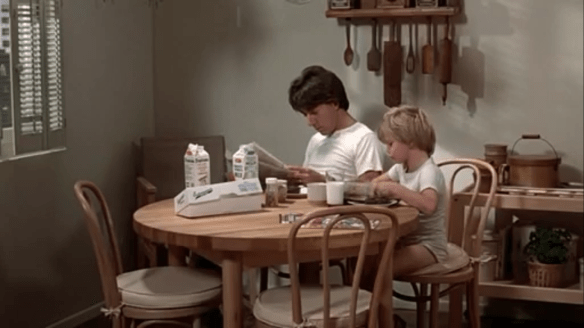
Don’t get me wrong, there is some of that, but Kramer does better. It follows the complex relationship between a working man and his 7-year old son as the newly separated dad struggles to take care of them both. It shows the pain that forms between former spouses as they try and navigate life as best as they can. It shows the pain and heartache that comes with both loving their boy so dearly. There’s a realness and a vulnerability that is extraordinarily hard to discount.
It does not dawdle and within minutes a solemn Joanna Kramer (Meryl Streep) tells her husband she is leaving him, and he can hardly believe her words. What comes next is the imminent trouble of balancing work and his home life. There is an emotional toll that comes since they were together for over 7 years. Their neighbor isn’t helping matters.
The frustration manifests itself in outbursts over breakfast and anger directed pointedly at others. The most vulnerable is little Billy who is a cute kid but dearly misses his mother. At first, he and his dad don’t always see eye to eye. He does all the typical kid things. Refuses to eat food, disobeys, and causes messes. The best example is the notorious ice cream seen where he defiantly starts eating from a pint of ice cream against his father’s wishes. He’s so cute, but it’s not pretty.
Work is hardly getting any better; in fact, it’s getting worse as Ted has more responsibilities to worry about at home. His friend and superior is not happy with what he’s seeing. On her part, Joanna seems mostly out of the picture, still sending cards to Billy faithfully. His only friend becomes the also separated Margaret (Jane Alexander) and they act as confidantes.
One significant moment occurs at the playground where Billy falls from the jungle gym and cuts himself before his father rushes to his crying son’s aid and runs him to the emergency room. He stays with his boy through all the stitches and tears, solidifying their bond and his resolve to continually be there for his son.
On the work front, Ted is regretfully let go and rushes to find another job. On the home front, Joanna is back in New York and a custody battle is in the making. However, neither parent understands what they have subjected themselves to. Things get ugly and it is something that neither Ted or Joanna wanted. They don’t want to make each other hurt — all they want is their son. It’s a complex flood of emotions and feelings as a product of character assassinations. There can be no nuance only “yes” or “no” and that’s the way the court will decide the outcome.
When the process is done it is decided that custody of Billy will be awarded to his mother. Gasp! However, what Ted does next is more noteworthy. He goes home to his boy and with the greatest of fatherly love he tells his boy he will be going to his mother. Billy will have so much fun with his mommy and they will get to see each other a lot. He is strong and positive for his boy while his insides nearly burst.
Then, in a scene mirroring their earlier morning, they calmly make french toast as a team, a happy fat, er and son together. Joanna asks for a meeting and Ted goes down to meet her. Her decision is yet another surprise and this time he peeps through the elevator with a smile waiting downstairs while she goes up to see her boy. It is very taxing to work through divorce. For all parties involved so Kramer vs. Kramer ends at the happiest place it could realistically be.
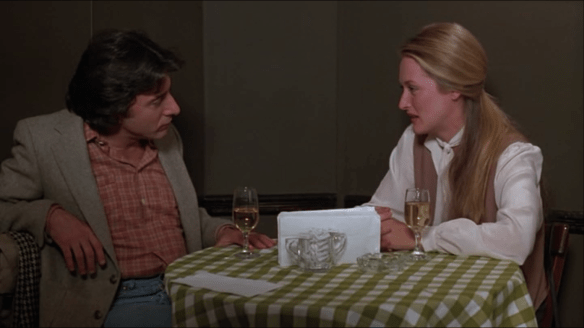
I admire the portrayals, however, because Hoffman’s character is far from an angel (sometimes prone to outbursts), and yet he acknowledges his shortcomings and proves just how all encompassing his love for his son is. Meryl Streep, on her part, is relatable but it is still difficult to reconcile her leaving. By the end however, it is quite easy to feel sympathy for her and she too proves to be a well-meaning, albeit, flawed individual.
The scene that really solidified this film for me had to be when Ted is reading to his son from The Adventures of Tintin. It’s a classic moment and it hit home, because it was a story I read many a time with my own father and will hopefully get to read to my own kids. That’s what makes movies truly wonderful. When they transcend time and place making it possible for us to relate to them on even the most basic or mundane level. That is part of the reason Kramer worked for me. At it’s most intimate, it’s about connections. Between men and women and fathers and sons. Not always pretty but always an integral part of life.
4.5/5 Stars
Love and Death (1975)
Most every Tom, Dick and Harry has heard of the great Russian epic War and Peace. Love and Death is Woody Allen’s companion piece. It has nods to Tolstoy, Dostoevysky and channels a bit of the Marx Brothers. As one would expect, Boris aka Woody Allen comes from your typical Russian family where he is atypical in his stereotypical, bookish and misanthropic way. He was not made for 19th century Russia trading in valor and facial hair for his glasses and nihilistic philosophy. But he winds up going to war anyway watching his beloved second cousin (Diane Keaton) marry herself off to a run of the mill fishmonger.
Eventually, Boris is able to get his true love back and they are wed. It’s a union full of philosophical debates as only Woody Allen could have. But the invasion of Napoleon puts all this on hold as Sonja resolves to go and assassinate the Little Corporal. Boris hesitantly agrees to accompany her. In an ending fit for a Woody Allen film parodying Bergman, Sonja goes through a life altering conversation while the recently executed Boris skips off with The Grim Reaper. It’s hard to beat Annie Hall but this still fairly early Allen piece has its quintessentially Woody Allen moments that are quirky and fun poke at Russian culture.
3.5/5 Stars
Kelly’s Heroes (1970)
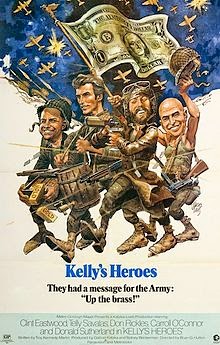
Kelly’s Heroes suffers from the same deliberate pacing problem that The Dirty Dozen has. However, if you accept that and accept that this is not your typical war film, you will learn to enjoy it. With a name that hearkens back to Hogan’s Heroes, Clint Eastwood plays Kelly, a man intent on going behind enemy lines to grab his weight in gold bars during WWII.The lure of gold proves tempting enough to bring many men on board for this ludicrous mission. Among the gang you have Telly Savalas, the always whining Don Rickles, Donald Sutherland, Gavin Macleod, and Stuart Margolin. Overall the cast was a fun mix of stars of the big and small screens. Do not assume that this is simply a comedy. It has its fair share of explosions and drama. In other words this film has Don Rickles (comedy) sure, but it has Clint Eastwood (action) to bring it back.
All in all Kelly’s Hereos is a decently fun romp right up there with The Dirty Dozen and Where Eagles Dare.
3.5/5 Stars
Little Big Man (1970)
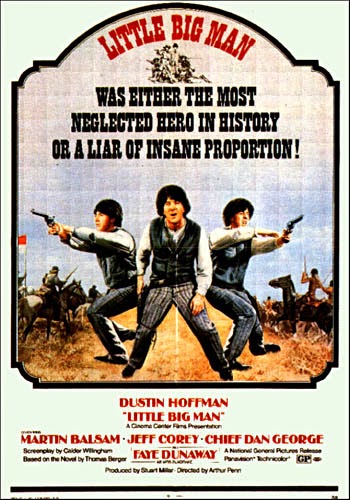
Although the film certainly had so good parts for some reason it did not quite jell with me. Focusing on the positive first, this was a revisionist western that tried to depict an alternative picture of the American west from the eyes of Native Americans. Although not perfect it was trying. Dustin Hoffman also gave an impressive performance that found him drifting between the worlds of “the White man” and “the Indians.”
Here is where I get into the main problem that I had with the film. Most of it had to do with age and casting. It was brave and somewhat strange that Dustin Hoffman portrayed his character from his teen years up until he was over a century old. For the most part Hoffman pulled it off. I also was kind of uncomfortable with his sister Caroline who looked like she was 30 even though she was only supposed to be a child. Then, you have Faye Dunaway. That had to be the strangest thing in the film. Although younger in real life, she was Dustin Hoffman’s adopted mother for a time and she played it up.
In some ways this film reminded me a bit of The Butler because we have a main character who grows old in front of us and he ultimately has a role in many diverse bits of history. Like that film, Little Big Man is quite interesting and at times entertaining, but the implausibility of the plot can get to you.
In defense of this film, I really did not know what I was getting myself into and so it surprised me with its mix of violent drama and a sprinkling of comedy. I would have liked to have seen more of Faye Dunaway and Martin Balsam, but it is what it is. Chief Dan George was the breakout character for sure. He was very enjoyable to listen to as he mentored Little Big Man.
3.5/5 Stars
Paper Moon (1972)
Directed by Peter Bogdanovich and starring the father, daughter pair of Ryan O’Neil and Tatum O’Neil, this film is set filmed in stark black and white and set during the Depression.
Addie Loggins is a little girl who has just lost her mother and her closest relation is the shifty Bible salesman Moses Pray. Reluctantly he agrees to take Addie along to some kin in St. Joseph’s Missouri where she can be cared for and he also pockets $200 which is rightfully hers. Sparks fly from the beginning between the perpetually grouchy Addie and the constantly annoyed Moze. However, with the tricks of Moze and the cuteness of Addie, this unlikely pair is able to sell numerous Bibles all over the state to hapless widows.
However, all that is put on hold when they stop at a carnival and Moze becomes infatuated with a high maintenance, exotic dancer named Trixie (Madeleine Kahn). Trixie and her young maid tag along and Addie becomes annoyed with all the attention Trixie now receives. Addies devises a plan with Imogene and it results in a disgusted Moze heading back on the road with Addie.
Their next job includes taking a store of whiskey from a bootlegger so they can sell it back. However, they run into trouble with the local sheriff, who just happens to be the bootleggers brother! They escape thanks to Addie, pawn the car, and get across to Missouri. There everything catches up with Moze and he gets beat up and all their money is stolen. Soon after, he and Addie finally part ways. But in the end this rag tag pair realizes they actually care for each other and they head out to pull more cons all across the country… so Moze can pay Addie her $200.
The strained relationship between the two leads unfortunately reflected the real relationship of father and daughter. In the film however, they were great together adding both humor and drama to this bleak story. As always Bogdanovich loves his nostalgia and there is plenty of it here to be enjoyed.
4/5 Stars
A New Leaf (1971)
Elaine May garnered fame in the early 1960s as the female half of the comedy duo alongside Mike Nichols, who later directed such classics as Who’s Afraid of Virginia Woolf? and The Graduate. This was May’s film debut, and she did everything; directing, writing, and of course acting as Henrietta Lowell. Interestingly enough, the film we see is not necessarily the film she wanted, but it is what it is I suppose.
Obviously, Elaine May did a lot for this film, but the story starts with Walter Matthau who gives another memorable turn playing a variation on his prototypical grumpy grouch of a character. This time he’s stuffy Henry Graham who lives beyond his means riding horses, driving a Ferrari, and keeping servants. But he is very bad at what he does…which is nothing. His Ferrari suffers from carbon on the valves, his latest check has bounced, and Mr. Graham is not a happy camper much to the chagrin of his long-suffering lawyer Beckett (William Redfield). His only hope is to get his uncle to bail him out one last time, but it does not come without a price. $50,000 with interest unless Henry can find a wife lickety-split. The prospects seem grim and both men know it. On the urging of his faithful manservant Harold it becomes a mad race against the clock to find a lady with money to spare.
At a social gathering, he finds the perfect object for his mock affection. Clumsy, bespectacled, messy, and filthy rich botany professor Henrietta Lowell (Elaine May). The courtship is quick and as clumsy as ever because Henrietta is present. Henry only has one objective: get the girl and get the money with her. A little glass in the knee and wine on the rug means little. The wedding happens and what ensues is strangely comedic. Henry has outwitted his uncle and Henrietta’s shady lawyer with his own intentions ahead of him. Soon he is running his wife’s home, firing her servants, putting her life in order and generally being condescending. He even dabbles in toxicology over their honeymoon, because a nice simple murder would be nice.
But in a sentimental moment, Henrietta names her new species after her hubby who actually is touched by the honor. On a camping and canoe trip in the Adirondacks, Graham is as miffed as ever as he prepares to get rid of his wifey. Their canoe capsizes and it’s the opportune moment since she cannot swim. In a moment of weakness, he goes to her rescue and resigns himself to be a professor as she has always dreamed. He’s a married man now. He’ll need to leave the pesticides alone at least for awhile.
This is far from your typical comedy and yet Walter Matthau is quite enjoyable as he navigates the upper echelon with an air of snootiness and bother. In some strange sense, I suppose it’s even a love story because in a weird way Henry Graham needs Henrietta. She for one fell in love with him. But as Harold notes, she has caused Henry to be far more competent than he has ever been in his life. By the end, we’re not really sure what to think. In some indirect way, they are a perfect match because they seem oh so wrong.
3.5/5 Stars
Alien (1979)
In the wake of other Sci-Fi smashes like Star Wars (1977) and Close Encounter of the Third Kind (1977), Alien was a radically different film, since it lacked the same sentiment of its precursors. One would wager a guess that this core variance stems from director Ridley Scott who certainly is no George Lucas or Spielberg. His films are generally darker, more world-wearied, and disillusioned. Blade Runner is a perfect illustration of this, but three years earlier came Alien, a Sci-Fi Horror film of immense critical acclaim and impact even to this day.
The film opens as a spacecraft called the Nostromo gets ready for a return trip to earth after a commercial excursion by its 7 member crew. However, a distress signal halts their plans and the captain named Dallas (Tom Skerritt) resolves to go investigate. On the surface of the abandoned planet are the remnants of what seems to be an ancient alien empire. One member of the crew Kane (John Hurt) comes upon a chamber full of what appear to be eggs and as is expected he is attacked. We knew it was building up to this point.
Back on the craft, Kane is still alive but now he has an octopus-like alien clinging to his head. It’s an acidic situation because it appears to be feeding him oxygen and it has no plans of coming off anytime soon. Next, comes the calm before the much-anticipated storm as the tension slowly increases exponentially.
What ensues is a cat and mouse game between the crew and this belligerent alien which has grown increasingly larger. Its evolutionary adaptations make it seemingly immune to extermination, but the crew tries desperately to destroy it with electric prods and flamethrowers. Soon it’s difficult to know who the cat and who the mice are, but it certainly favors the alien.
It doesn’t help that Jones the cat is on the loose and there is even a bit of mutiny aboard the craft. It feels a bit like a tense Agatha Christie novel with person after person slowly getting knocked off. But that sensation does not last long when we actually see what we are dealing with. This creature has no conscience. No humanity. It only cares about survival by killing its prey. To win you must do the same and beat it at the game.
Thus, although I initially thought it a weakness to only have one alien, it turns out that it makes this film all the more tense. Also, very little of the action actually takes place outside of the ship. They are stuck on board in the middle of outer space fighting for their lives. Not much can be more horrific than that, and it is a very unnerving ride with surprisingly good pacing and many graphically shocking moments
The cast is a nice diverse group of actors including Skerritt, Hurt, and Ian Holm, but Sigourney Weaver is undoubtedly the standout as 3rd in command Ellen Ripley. She is the last one to keep her head and her story would set the framework for the entire Alien franchise. Not to mention the role propelling Weaver to stardom and introducing the archetypal model for future female protagonists.
Alien definitely has a lot to offer and I am excited to see the next installment Aliens. That added “s” has me intrigued.
4.5/5 Stars
Monty Python and the Holy Grail (1975)
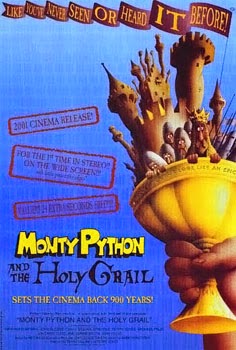
The beauty of The Holy Grail is that it is absurd in every sense, and it is keenly self-aware the entire time. The comic troupe Monty Python found fame from its British T.V. show Monty Python and the Flying Circus. Now Graham Chapman, Eric Idle, Terry Gilliam, John Cleese, Terry Jones, and Michael Palin transferred their brand of humor to the big screen. What better canvas for their brand of humor than Medieval Europe? It’s got Castles, Trojan Rabbits, French Soldiers, Swords, Knights who say Ni, Headbanging monks, a killer rabbit and so on.They offer us the weirdest, oddest, and downright hilarious revisionist parody of King Arthur’s legend. I use the term plot loosely because The Holy Grail follows no strict set of parameters or plot points. The quest for the Grail by Arthur and his right-hand man Patsy is purely an excuse for gag upon gag upon gag. Even while he recruits his Round Table, the fun is not in the completion of the quest, but the detours the plot takes for the sake of a laugh. And it goes all over the place. Tangents abound and the story jumps back and forth, oftentimes for no good reason. The film has the oddest of openings (involving llamas) and it ends just us weirdly as it began with the arrival of the police. Don’t question it. Just enjoy.
When is the optimal time to watch The Holy Grail you ask? The real answer is anytime, but it reaches its maximum potential when you watch with others late at night in a giddy delirium. Let the comic absurdity of it all carry you off into the Monty Python world. The first time watching it you might be a little befuddled, but the beauty is that it gets better nearly every time. Anachronisms become your friend, quotability skyrockets, and there is a kind of joy that surfaces from each vignette of comedic madness.
It works so well because the ensemble is so wacky and fun with no one individual completely outshining the others. They are never relegated to a certain role but instead are given free reign to show off their skills in many zany incarnations. Thus, the actor playing a certain character becomes less important and the comedy that is found in this or that role takes precedence.
I never have been too keen about living in the Middle Ages, and after watching The Holy Grail I… definitely would not want to live in the Middle Ages. It’s certainly good for a few laughs, though. Ni! Ni! Ni!
4.5/5 Stars