Two Days, One Night (2014)

Deux_jours,_une_nuit_posterIf people watch Two Days, One Night, they’ll probably recognize one face and you’ll hear something similar to the following: “That’s the girl from Inception and the Dark Knight Rises right?” The more observant viewer might say something like: “Isn’t that Marion Cotillard?” And they would be right on either of these accounts and yet the Dardenne Brothers (who the average viewer, unfortunately, might not know), take Ms. Cotillard and place her in a completely different type of role altogether. They take an A-List Hollywood star and drop her in the every day, lower class world that the brothers themselves came out of. In fact, the story and most of their stories are set in Seraing, a French-speaking area of Belgium that is known for industry.

They have an immense fascination in simple people just trying to make ends meet. Most of their stories have mundane narratives like The Kid with a Bike (2011), and Two Days, One Night is little different in that respect. It’s so basic in conception and yet in this banal and rough-edged world, the Dardennes find immense beauty.

Our chief subject is Sandra, a young woman who is married has two kids and has just battled her way back from depression. Undoubtedly it was a tough road, but she is obviously resilient and ready to get back to work. After all her family needs the money because her husband only works at a restaurant. But her whole reality is changed in a matter of minutes when she learns she will be laid off. Her company can either keep her on or give all their other employees bonuses. The majority took the bonus over Sandra. Her work friend Juliette buys her another ballot for the following Monday, so Sandra has a few days to try and plead her case. But she’s done fighting. She’s tired and defeated before she begins. It’s her husband Manu who urges her forward and reluctantly Sandra follows through.

This is the core of the film as Sandra goes from home to home, ringing doorbells, and talking with the people hidden away in their homes. They are no longer her faceless colleagues, but soon they become living, breathing people. Just like Sandra, they have a personal stake in this decision. Maybe it’s to pay for a daughter’s schooling, remodeling a home, or trying to stay afloat as a single parent. There are those who are simply fearful of being laid off and those who hope that Sandra will succeed while admitting they’ll vote for the bonus. They all seem like generally legitimate responses, and Sandra knows that just as we do, but she tries anyway, at least to talk with them–get them to see her side. Because this decision has major repercussions, and it’s not just occurring in a vacuum.

Things are teetering dangerously on the edge of equilibrium for everyone involved because everyone seems to be between a rock and a hard place. And there’s no difference between Marion Cotillard and all these other unknown actors. They’re all bracing themselves for sinking in the same boat.

In a way I found myself comparing this film to the courtroom drama 12 Angry Men because in a similar manner Sandra must go about trying to convince her colleagues to change their minds, and talk them out of their convictions. It’s a difficult task, and this film speaks to the logic and rationale that dictate human decisions. There are individuals all across the board from those who only are looking out for themselves. Is it too hypocritical to call them selfish? It’s hard to know. There are those who want to good, but just cannot, and finally those who stand by Sandra, because they feel it is the right thing to do. The most painful of these interactions occur with those colleagues, who are so conflicted inside. You can see the situation at hand tearing them apart.

Other directors would be terrified of such a film, looking to fill slow moments with some kind of heightened state of action. The Dardennes are content with having their actors rock out to Them’s “Gloria” after a long day. And true, there are many moments of tension and even conflict, but most of this film is about people talking, mirroring the rhythms of real life. The camera is constantly by Sandra’s side, peering at her face, and staying on her hip. Her face has to carry some scenes at times, and it does so wonderfully. Really, this is a film that displays her resilience, grit, and determination to push forward. It had the potential to be either feel-good drama or a tragic story, but it finds a beautiful middle ground. Sandra comes out an undisputed winner, just not in the way that she expected.

4.5/5 Stars

Zootopia (2016)

ZootopiaDisney has scored again. On almost all accounts Zootopia is grade-A family entertainment. To address the elephant in the room, the film is rather formulaic in its hero’s journey and at times it feels like we are attempting to systematically check off all the necessary moments in the rise, fall, and redemption of our spunky heroine. However, there are moments of wit and grace that begin to slowly grab hold of us an audience. It, in turn, becomes ceaselessly inventive with this metropolis of anthropomorphic animals, whether it is the rhythms of daily life or the social issues present that look strangely familiar.

In truth, it works as a thinly-veiled parable for mankind in our present condition. The lines are not black and white, but predator and prey. True, there are differences and they give way to pernicious spells of racism or more aptly in this context, “specism,” but there is room for understanding and symbiosis, to use an ecological term. We could go back and forth for a long time about the actual mechanisms and minutiae of evolution and whether it makes sense or not, but the bottom line is that humans and animals have a lot in common.

Zootopia playfully makes that blatantly clear, and within all the subtle ribbing, it does have a broader message which is true of all great pieces of family-oriented animation. Movies have the ability to allow us to more fully understand the world we live in and that applies to children as well–in fact, they are even more malleable.

There are various other reviews alluding to Animal Farm, In the Heat of the Night, and Who Framed Roger Rabbit. All are interesting touchstones for this film, but obviously, all comparisons falter at some point. For me, Zootopia has surprisingly interesting social undertones to its drama that try to make sense of these things even for young viewers. That’s no small feat and perhaps even more praiseworthy it delivers it in a delectable story that follows in the footsteps of the best buddy films and police procedurals. It’s all wrapped up in the encapsulating animation of Disney that at points feels overwhelming, but the characters of Judy Hopps (Ginnifer Goodwin), Nick Wilde (Jason Bateman), and even the likes of Clawhauser give it winsome charm.

Everything from Sloths at the DMV to a raspy Godfather possum is on point, and the film continues with a stream of gags. However, we are always being drawn back to the journey of Officer Hopps as she tries to prove herself and solve the mystery behind the 14 missing animals. But if this was only her journey it wouldn’t be all that interesting. Thank goodness she has a buddy to cross her will, make her stop and think, and ultimately stand by her when the world isn’t a utopia anymore. I’m not sure what I think about Shakira’s presence in the film, but I’ll let it slide this once.

4/5 Stars

Ex Machina (2015)

Ex-machina-uk-posterThe film industry needs films like Ex Machina. They’re smaller productions, but that usually means they’re more audacious and oftentimes far more interesting. First time director and veteran screenwriter Alex Garland delivers up a story that takes place in an isolated, ultra-modern getaway that’s a helicopter ride away from civilization. Caleb (Domhnall Gleeson) gets dropped into this little piece of paradise thinking he’s won a huge honor, and in truth, he has hit the jackpot. He makes his way to this isolated locale and comes face to face with Nathan (Oscar Isaac), the mastermind behind his little company. We don’t quite understand why Caleb was called in or what the following hours will look like exactly.
Nathan quickly clears up any ambiguity with one pointed question: “So do you know what the Turing Test is?”That begins the jumping off point for the entire narrative which is compartmentalized into different sessions of observations. It’s Caleb’s job to interview the one and only Ava (Alicia Vikander) over the course of a couple days to decipher whether or not she can pass the Turing Test. Yes, Ava is a highly intelligent A.I., but just how intelligent we’ll find out over the course of the story.

This is most of the film, but there are a lot of oddities that plant themselves in back of our minds. Who is Kyoko the maid? Is Nathan to be trusted? After all, Ava induces powercuts so she can talk with Caleb in confidence. Because she knows we act differently when unobserved — when all the eyes aren’t watching us.

Ava is strikingly metallic, mechanical, and still somehow incredibly lifelike. Nathan has developed her in such a way that she has attraction down to a science. She somehow exudes a robotic sexuality.  The trick is finding the perfect algorithm for action that is not automatic. Getting the precise equilibrium of nature vs. nurture.

The mind games delve ever deeper as Caleb tries to maintain a balance between his intellect and his own insecurities. Ava asks to question him, and the tables are quickly turned. Caleb is manipulated constantly and he himself manipulates. But he realizes too late that he served one function, only to be quickly discarded.

Ex Machina is fascinating as it spirals deeper and deeper into an abyss of deception and disorientation. It exists in that terrifying realm of the not so distant future, and while we are not there yet, it feels like we may be on the cusp of such a world. It brings up questions of man’s desire to be God and the dichotomy that arises between the creators and the created. The history of computer science arguably extends all the way back to Alan Turing, and it certainly has opened grand avenues of exploration. But with such power, including Artificial Intelligence, Search Engine Optimization, and the like, we are opened up to a far more perilous world. A world, where if we’re not careful we can lose all grasp of reality and all confidence in our fellow man.

4/5 Star

Still Mine (2012)

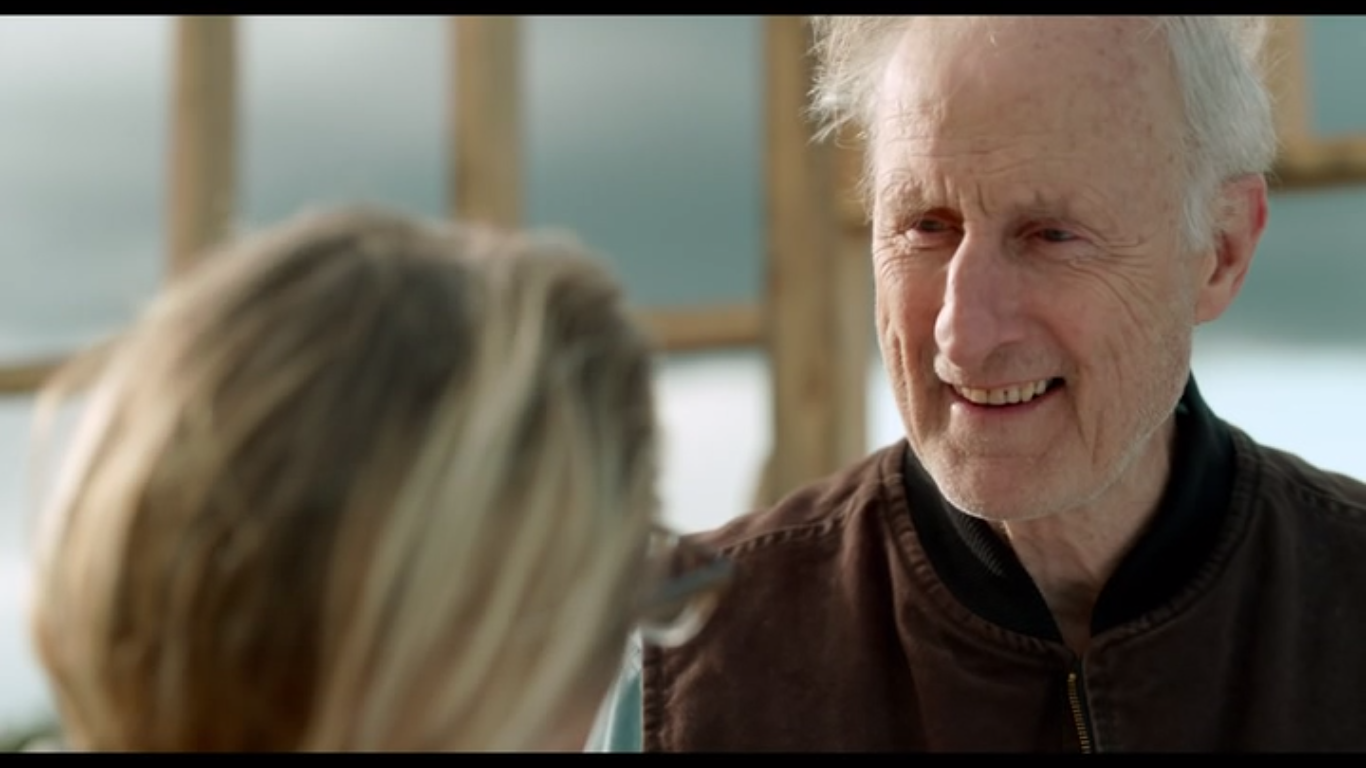
stillmine1This is not a powerhouse film, but it’s bolstered by a powerhouse performance from James Cromwell. His career has always been one worth watching. He’s been prolific for many years now in films like Babe, L.A. Confidential, The Queen, The Artist, and so on. And yet he’s never been a star, simply a wonderful character actor making each film he appears in all the more interesting. He has an imposing frame, often a quiet persona, and a relatable quality.

Still Mine is certainly a romance film, but it’s about one man almost as much as it’s about a couple. Craig Morrison (Cromwell) is well into his 80s now and he is still living in a farmhouse with his wife of 60s years. Her health and memory are quickly deteriorating and he, along with all his children, knows it. He resolves to build her a newer, smaller farmhouse that will be easier to manage.

We like him as an individual because he still has ties to the old world and the way it used to be. He doesn’t beat around the bush, and he gets fed up with the impracticality of modern-day bureaucracy. He’s proud and independent. His idol was Babe Ruth, and he has a great passion for lumber because he father was a shipbuilder long ago.

That’s why when his new project hits roadblock after roadblock in the form of building code violations, he’s peeved and annoyed. But he tries to push through, going past them, because that’s his way. His main opposition is building inspector Mr. Daigle, who although he might be a sour apple and a stickler for rules, is by no means a villain.

stillmine2So in a sense, this story is twofold. We get to see the ties that bind two people together even after so many years of marriage. They are so closely knit. They can have their tiffs, they can get frustrated, but ultimately there is an almost insurmountable amount of faith and affection that holds them together. It makes the mundane beautiful and yet at times, it becomes difficult to watch because Craig knows that his other half is slowly losing her edge, and yet he still loves her so deeply. He gets angry with her, but he has an extraordinary capacity to love her still.

But also this film is interesting because we get to watch the resolve of a man on another front. He wants to keep busy. Despite his advanced years, he wants to do this on his own. It’s the principle of the thing, and he sticks with his convictions no matter what children, neighbors, or members of the bureaucracy say. Although Cromwell still feels fairly young and spry, I didn’t mind him playing a man quite a bit older than himself. Also, the ending including Mumford’s “After the Storm,” was a rather surprising inclusion, but not a bad thing. It adds a contemplative tone to this film’s resolution.

3.5/5 Stars

Spotlight (2015)

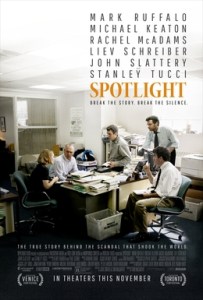
Spotlight_(film)_poster“They say it’s just physical abuse but it’s more than that, this was spiritual abuse.”
I wrote a piece tracing the obvious parallels between All the President’s Men and Spotlight, two films that I could easily see both shaking the very framework of American society through their very candid portrayal of journalism. When actually getting to see Spotlight the connections became even more prominent. Our narrative begins, not in Washington D.C., but in Boston Mass, 1976. It even goes so far as having a Ben Bradlee connection. Bradlee Sr. worked with Woodward and Bernstein while the Big Throat story was breaking. Of course, numerous years later Bradlee Jr., continuing the family profession, was working at the Boston Globe and becoming an integral part of what was going on there.

But enough with similarities, this film, written and directed by Tom McCarthy, deserves its own personal set of commentary. Spotlight is the investigative unit of the Globe and as such their work is not for the quick news flash, but grinding out long, detailed stories, although at times it takes a while to latch onto a juicy tidbit.

However, a new, rather stiff editor named Marty Baron points the team towards a story where a lawyer is accusing a local Cardinal about doing nothing after he found out a local priest was sexually abusing children. It’s a problematic scenario that deserves a little more time, but at this point, it’s an isolated event. It’s one man’s evil. One man doing nothing to remedy an outlier in the Catholic Church.

What follows is as troubling as it is imperative storytelling. The members behind the Spotlight team are not arrogant, self-righteous people, or figure pointers, only truth seekers. That’s their job, after all. The cast is well rounded and credible while no one figure steals the spotlight, literally. Michael Keaton is their leader “Robby” who has close ties with the community even going to high school across the street. Mark Ruffalo is the integral member Michael Rezendes who not only writes the story but has the important task of trying to needle a local attorney for information and documents that can blow the story wide open. Meanwhile, Sascha Pfeiffer (Rachael McAdams) carries out numerous interviews of her own in this multiple-pronged assault for the truth.

Their investigation looks to victim organizations, lawyers, priests, and a psychotherapy specialist. If it’s not obvious already, Spotlight makes it painfully clear that this is not a story of a few isolated incidents but an entire epidemic. This is the whole country — the whole world. It makes you positively squeamish and it’s perturbing in its brutal honesty. There’s no way for it to be sanitized and that’s indubitably frightening. We should be angry, we should be grieved, it should be abrasive to our senses.

It’s bringing to light an entire conspiracy of corruption. There are no paper trails, evidence is swept under the rug, and person upon person remain tight-lipped either due to guilt or shame. Humanity is drawn to darkness, but we want things to be brought to light. It’s the dissonance of what it is to be a person — the constant battle going on in our own human hearts. This isn’t meant to be about individual finger pointing, but an indictment of a system. An indictment of what we all are capable of. If it’s not being able to maintain the celibacy requirement, then it’s a pastor addicted to pornography, or a man sleeping with someone else’s wife. They’re different scenarios, but the people behind them are all similarly broken.

With the narrative of Spotlight cataclysmic events such as 9/11 shift focus, but they cannot fully distract from the bleeding that is still going on behind the scenes. There’s still a need to get to the root of the problem and they do. Mark Ruffalo’s character talks about having some deep down inclination that he will one day go back to the church and then came the day that all that came crashing down as they prepared to break the story. All his hopes went unrealized. It has to be an abysmal feeling. These are folks living in a secular world and a Church that falters so greatly is of little comfort. God is a distant deity, not a personal one, so it seems.

When the story hits the pavements you know that all hell is going to break loose, but what really happens is that all the pain, suffering, and shame has finally received the spotlight it deserves. The major realization is not that one person is the problem or even that another person is the problem. But the most frightening revelation Spotlight offers up is that we’re part of that problem. That’s tough news to swallow and this is a film that does it with immense credence and poise. Perhaps the toughest moments of the film come when the lights have died down and we see the staggering numbers of just how many cities were rocked by similar scandals. If you’re like me you see cities that are all too familiar. A film of this magnitude begs for some kind of response from its audience. It’s up to the viewer to decide what that will be — whether social, spiritual or something else entirely.

This is a potent film of the highest nature that lifts up journalism as a noble profession, while simultaneously rocking its audience with a real-life narrative of substantial magnitude. I’m not one prone to bloated statements, but this just might be the best picture of the year. Its impact has been duly noted.

4.5/5 Stars

A Most Wanted Man (2013)

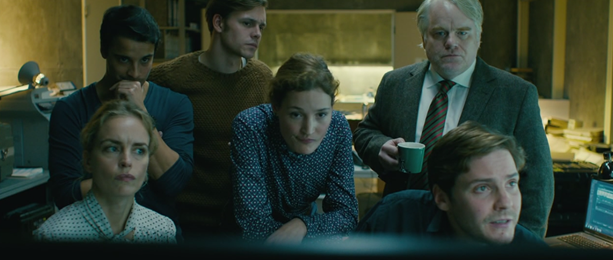
mostwantedman1A Most Wanted Man gained some notability as one of the last works of Philip Seymour Hoffman, and it must be acknowledged that he gives a truly worthwhile performance. No surprise there.

He’s Gunther Bachmann, the German head of a covert team that is looking to undermine potential threats from Islamic terrorist organizations in a post-9/11 society. The film features cinematography that can be best described as sullen and pale, fitting the mood of a, at times, dismal Hamburg, Germany. It looks to be everything a spy thriller is supposed to be, boasting an international cast including the likes of Rachel McAdams, Willem Dafoe, Daniel Bruhl, Nina Hoss, and Robin Wright, who are all intriguing to see in action.

But it is Hoffman with his team that commands the most attention, as they try and monitor an escaped political prisoner from Chechnya, who is seeking refuge but is also suspected of terrorist affiliations. He is contacted by a compassionate lawyer  (McAdams) who wishes to help him, but they get caught up in Gunther’s plan and try and flee from his prying eyes. It doesn’t exactly work. But really they are both part of a bigger ploy to pin down a wealthy Muslim philanthropist who could be in it even deeper with terrorist organizations. They just have to catch him with the help of some insiders and a banker (Dafoe), so Dr. Abdullah can be put away unequivocally. But Gunther also has his superiors and the American diplomat (Robin Wright) continually questioning his plans and mistrusting his motives. After all, he works for a, technically, unconstitutional organization that’s supposed to be off the radar.

mostwantedman2What A Most Wanted Man becomes is a brooding game of watching and waiting interspersed with a few moments that get the heartbeat up. But honestly, it’s mostly waiting, and it does serve to build the tension. There is one final turn that we could probably expect, and overall this is not a film of high volumes of action. In fact, there is barely any. Except by the time it ends, we are left with the same hopelessness and moroseness that seems to float over these characters in a haze. We are constantly wondering, “Where do their allegiances lie?” or “Why are they doing this?” and in the end, it doesn’t seem to matter. This is by no means Chinatown in its intricacy or otherwise, but you do get that same sense of futility.

I must admit I was a little surprised to see Rachel McAdams playing a German, but ultimately I was able to accept it. And although my knowledge of German film is limited, it was exciting to see two talented actors like Nina Hoss and Daniel Bruhl be featured, but they regrettably were relegated to smaller, hardly interesting turns. We might have to simply content ourselves with their other roles. Because this is most certainly Philip Seymour Hoffman’s show first and last. And it would, unfortunately, end up being his last. However, he left us as jaded and distraught as ever, and that’s a compliment to the actor he was.

3.5/5 Stars

The Revenant (2015)

The_Revenant_2015_film_poster (1)By definition, a revenant is someone who returns, but there is often a connotation that they are returning from the dead like a specter. The term gives major insight into Alejandro González Iñárritu’s latest undertaking with Leonardo DiCaprio. It’s a fully immersive, grimy, gory, grisly, grizzly-filled piece of cinema caked in blood, sweat, and tears in every sense of the word.

Its production took the cast and crew to Canada and Argentina to shoot sequences that were probably just as desolate in person as they looked onscreen. In that way, Iñárritu did not fudge or cheat with the use of excessive computer-generated imagery. Even if his production was overlong and undoubtedly volatile, you could say he was rewarded with vast expanses of engulfing cinematic visuals. Emmanuelle Lubezki yet again probably becomes one of the film’s biggest assets and his use of natural lighting is superb. In truth, it’s a painful exhibition in acting by DiCaprio and this icy frostbitten wilderness becomes the backdrop for a gargantuan feat of survival.

What would inspire such a film? I think many people were asking that, and it does find some of its story from the true circumstances of Hugh Glass, a 19th-century explorer, trapper, and guide who was part of a fur trapping expedition out west. After enduring an onslaught from a group of belligerent Pawnee, Glass can hardly recover from a bear mauling that essentially leaves him a lifeless carcass of a man.

His scared and scattered band is just hoping to get to their outpost to regroup, but their leader (Domhnall Gleeson capping off a phenomenal year) is intent on holding onto Glass because he’s the only one who knows the way back. His main insubordinate is the grubby, paranoid, scumbag John Fitzgerald, played so invariably corrupt by Tom Hardy. Glasses Pawnee-born son, the young trapper Bridger (Will Poulter) and a reluctant Fitzgerald agree to stay behind with the feeble man, while the others push forward. But being the backstabber that he is, Fitzgerald looks to bury Glass alive or finish him off for good with his musket. It doesn’t make much difference to him, but Hawk doesn’t want to see his father dead. Fitzgerald could care less. After all, what is he supposed to do? Keep this man alive only so he might die too?

Bridger naively follows Fitzgerald’s lead and they leave Glass behind for dead. There is no man who could survive, half-frozen, half-dead and still find a way to live another day. That’s where the story goes into stage two of survival.

The images that follow are ceaselessly gripping with majestic landscapes that are raw and brutal in the same breath. DiCaprio forges through streams, makes fires by some miracle, and keeps warm any way humanly possible. To don such a role you almost have to give up any human sensibilities and allow yourself to simply exist. He crawls and claws painfully, eats raw meat torn from a dead bison carcass, and sleeps inside the hide of his dead horse. It should repulse us in our modern lifestyles of comfort and excess, but in the same sense, it is a fascinating portrait of realism taken to the extreme.

The final chapter follows Glass as he returns to the fort, gets in contact with Captain Henry, only to chase after the fleeing Fitzgerald one last time. When he caught news of the ghost man’s return from the dead he knew the implications. Dead men tell no tales, but it’s a different story if they don’t die.

Unfortunately, The Revenant is rather laborious in the end and it’s a fatalistic revenge tale certainly but it’s not altogether satisfying. True, the perpetrator of evil is brought to justice, but that doesn’t mean a great deal. Perhaps because we admire Glasses gumption, but we never really build a connection with him. He truly is a solitary figure looking to avenge the death of his boy. There’s not more to grab hold of with this dynamic, maybe due to the fact that he is really a ghost. He’s so gaunt, battered, and spent that there is little space for emotions to fill all the nooks and crannies. Only a constant, pulsing desire for vengeance.

Still, we can always go back and be contented in Lubezki’s gorgeously stark visuals. The frontier look of this film brought to mind Malick’s film (also with Lubezki) The New World for a brief instant, and it makes me want to give it another look. Otherwise, The Revenant stands as an impressive feat, but it does not quite have the emotional wallop that it had the potential to wield. Although, the performances are thoroughly impressive, even if it’s more for their singular commitment than anything else.

4/5 Stars

Inside Llewyn Davis (2013)

insidel2More often than not Llewyn Davis turns out to be a worthy character and I mean that in the sense that he is readily watchable. This probably isn’t the real folk scene of the 1960s, but it is the time and place seen through the Coen Brothers’ somber lens. Inspired by musician Dave Von Ronk, Llewyn is his own unique entity entirely. The film itself has a dreary look of washed out tones mimicking the days that most of us now know from black and white imagery. There are folk tunes wall to wall, befitting such a melancholy film, adding layers of melody and ambiance to this austere world of isolation.

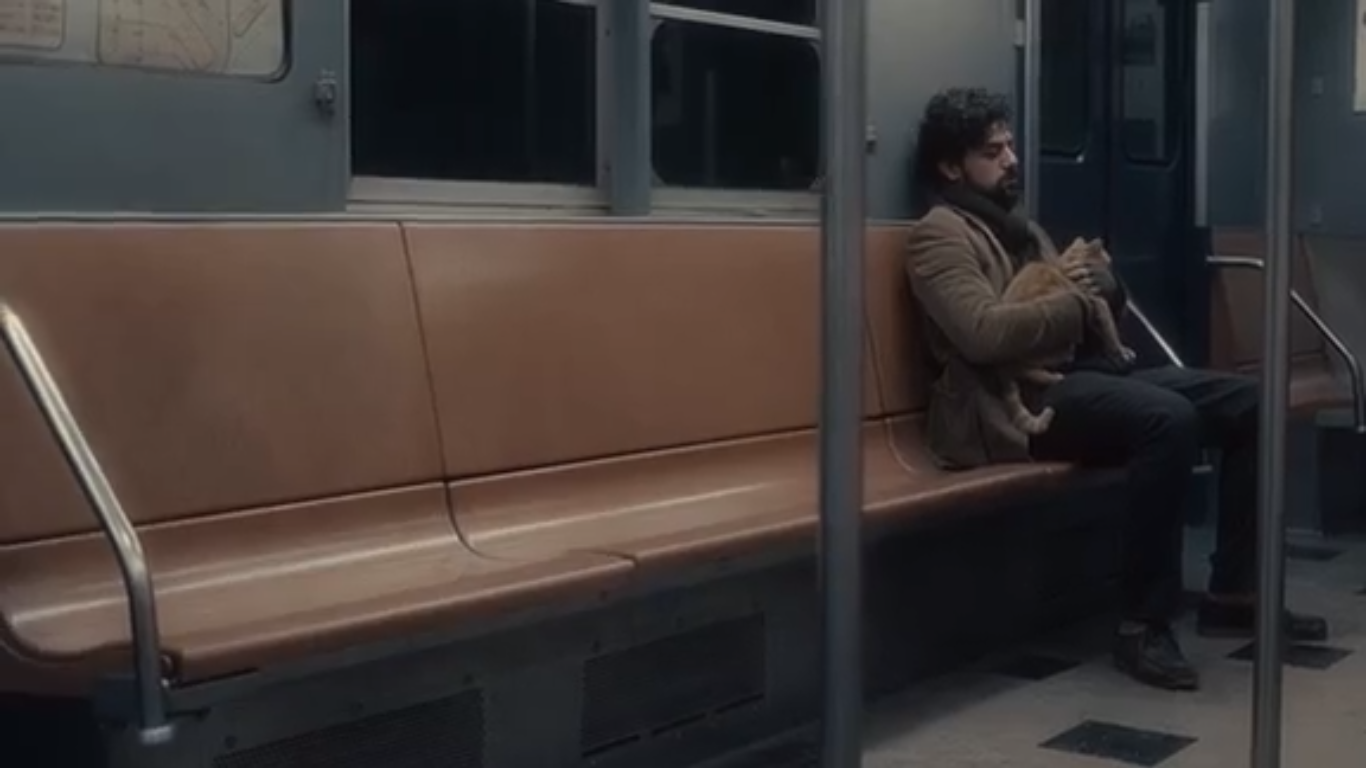
In fact, we first meet Llewyn in a low lit bar singing the ode “Hang me, Oh hang me.” He’s not some budding talent or has-been. He had a partner once, who committed suicide by jumping off a bridge. They had a record that came and went out almost as fast. The unsold copies sit in a warehouse somewhere rotting away with the rats. That’s really Llewyn’s life. He’s couch hopping his way through Greenwich Village, a pitiful wanderer with the cat he was entrusted with in one hand and his guitar in the other. In the frigid winter air, he doesn’t even have a real overcoat. He can barely afford it.

insidel4The film goes so many places only to return to where it was. So much goes on without anything happening and so on. Llewyn has it out with Jean, a transformed and caustic Carey Mulligan, who doesn’t know who the father of her baby is. How it could ever be Llewyn’s doesn’t make much sense, since she seems to despise his guts. Why would she sleep with him?

Llewyn alienates his sister with his misanthropic outlook and foul mouth. He loses and tries to recover the cat of his folk-loving friends the Gorffeins. How they ever became friends we’ll never know. A spur of the moment trip to Chicago comes up and with it, there’s the token John Goodman performance that feels like an absurd aside to the entire plot. Then again, the film’s only plot is the wanderings of Davis, so if meeting passengers while hitchhiker marks his journey it seems pertinent.  A trip to the Gate of Horn for an impromptu audition turns out to be unfruitful and it is the film’s most difficult scene. Davis lays all his heart and soul out there in a poignant performance and all he gets from the producer Bud Grossman (F. Murray Abraham) is that he should join a trio. He’s not solo material.

insidel5Llewyn returns to Greenwich dejected and things continue going poorly for him. So we end up leaving him about where we started. Bob Dylan, Joni Mitchell, Joan Baez would come in time, but it’s the musicians like Davis that are a sadder tale. Those who faded away over the years. Who lay beat up in an alley for heckling a performance in a hole-in-the-wall bar. It’s the circle of life of a folk singer and you wonder if he would ever have it any other way. Undoubtedly this folk oasis was a more hopping, more welcoming place than the Coen’s painted it, but it does suggest something powerful.

Why would somebody subject themselves to this type of lifestyle? Unless they’re insane and like to suffer, it must be that they really believe in the music. They believe in bearing their heart and soul because the music makes them feel alive. Obviously, there is more to life than music, some would argue that point, but it is a brilliant starting point. We can respect someone who sticks by their convictions and their passions. Even if it means chasing through the streets of Greenwich Village looking for a cat. You would never see me doing that. Maybe if it were a dog. Maybe.

4/5 Stars

Room (2015)

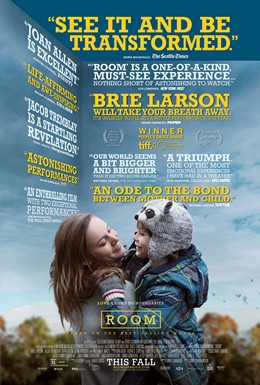
Room_PosterBrie Larson has been on my radar for a while, ever since The Spectacular Now and Short Term 12. But she’s also a personal favorite who deserves to be in the company of other such shooting stars as Jennifer Lawrence, Shailene Woodley, Miles Teller, and Michael B. Jordan just to name a few.
Some of us already knew Larson had great performances on tap, but Room was just the ticket to get more people to finally prick up their ears and take notice.

From the annals of contemporary literature comes a story that asks us to buy into a premise that constantly unravels and unfolds until we are opened up to entirely new worlds. Ironically enough, it comes from shedding all falseness, getting outside of the box, and getting back to the old world — the real world.

Jack (Jacob Trombley) has spent his entire existence in Room with Ma (Brie Larson). Television has become his main educator and he believes in magic realms beyond Room that exist within the world of T.V. In truth, he has an utterly false sense of reality, but how could he not? All he knows are the dimensions of Room with a little skylight to peer out of and a tiny closet where he keeps his bed. His hair is overgrown like a little Samson and Ma tries to keep him fit and healthy the best way she knows how.

But Jack cannot quite comprehend what is happening around him, after all, he’s only 4. After his birthday, Ma decides it’s time to try and explain it to him. They are being held in Room against their will. A man name Old Nick kidnapped Ma, continually abuses her, and keeps her locked up. She doesn’t give Jack all this, but all he needs to know is that Nick is bad and they must try to escape. That is enough.

In essence, Ma fabricated this reality to keep him out of harm’s way. This bubble, known as Room, is all Jack has ever considered to be real. The rigidity and the regiment are what his life runs on. Now it’s time to leave the rabbit hole behind and relearn how the world ticks.

The initial conceit brings to mind Bunuel’s Exterminating Angel whereby the main characters are simply unable to leave a room — but the reason is arbitrary. Here Ma and Jack are able to get help and reacquire their freedom. But being outside of the confines of that space does not make life any easier.

Jack is an inquisitive, skeptical little boy, who even has moments of belligerence. However, when getting to the outside he clings to Ma like never before, because she is the only human form he has ever known besides Dora the Explorer and his imaginary dog.

Although the camera work feels rather shoddy at times and unextraordinary at best, the film nevertheless evolves into a human drama and its true substance dwells therein.

There’s a matter-of-factness to Trombley’s voice-overs that deliver his honest observations of all that exists around him.  The aftermath of abuse is volatile. Director Lenny Abrahamson’s film removes any notions that life can simply be normal again in a normal world with normal relationships because that’s just not true. It cannot be. The mundane is never as simple as all that. There are complications and confusions. Room‘s latter moments are quieter, more tender, and even more heart-wrenching. But there’s also searing pain and red-hot altercations. They’re about survival in the wake of something so horrible like abuse, but it’s also about surviving all the repercussions that follow.

For Jack, that means making discoveries with a fresh, innocent pair of eyes. There is absolute sensory overload with new and novel stimuli flooding his senses constantly. He’s subjected to new sights, sounds, words, and the entire world that he hardly ever knew. He even needs to learn how to play like a little boy.

For Joy it involves dealing with what’s going on in her head and coping with pain that has been festering for years, causing her to lash out at her family.  Even interviews cause her to question her own choices that are now fully solidified with the passing years. Could she have reacted differently? Did she have Jack’s best interests in mind?

The relationships of father, mother, and daughter, mother and son, dredge up pain and hurt. However, a suicide attempt and a stay in the hospital for Ma, reveal Jack’s child-like faith in what it means to live. They are two wounded individuals. One who has entered into a world that he has never known, and the other trying to settle into a life that now feels so distant and foreign.

Room is about two people making their way in the world. It succeeds not simply because of its anchoring performances, but due to the fact that it is willing to dwell in the difficult, heart-wrenching, and even mundane places. In those areas it speaks of love and strength that allows even the smallest most damaged goods among us to shed any shackles that inhibit our joy in life. Love knows no boundaries. That doesn’t make it easier. It’s just the truth.  Ma and Jack are able to give up their baggage — reconciling the old with a new way of life.

4.5/5 Stars

Drive (2011)

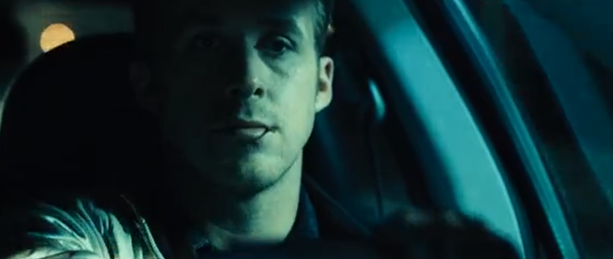
drive1You always think of the man in the getaway car as the wimp. Why else is he supposed to keep the engine running instead of helping with the job? Well, not anymore. Ryan Gosling completely demolishes that myth with Drive. It’s a neo-noir of sorts, but don’t get the wrong idea. This isn’t your conventional Hollywood action flick. Albert Brook’s corrupt thug sans eyebrows says he used to back sexy European action films and that’s ironically enough what Drive is. There’s a new age electronic score to match the stylized action. Silky smooth slo-mo mixed with golden illumination of the characters and the L.A. nightscape.

Although he’s really a stunt driver and spends his spare time working as a mechanic for the shop owner (Bryan Cranston), the Kid (Gosling) works jobs on the side as a getaway car driver, and he’s the best of the best. He proves it in the opening minutes, perfectly timing his escape with the conclusion of a Clippers game. It makes disappearing into the night that much easier.

He keeps things in check, keeps his cards close to his body, and at times reminds me of Alain Delon in Le Samourai. He’s not quite so icy cool, almost serene, and yet that can disappear in a flash. So still, so slight of word and movement, and yet behind the wheel, he has so much purpose. He doesn’t use a gun. His methods are more brutal, and he only uses them when absolutely necessary. Such a role gives me a newfound respect for Ryan Gosling. He really does seem to have the true ability to take on some interesting roles of varying degrees and intensities.

drive2All the characters around him are not necessarily fully developed entities on their own, but they function as more of an essence, developing this stylized world. Carey Mulligan is the aloof woman next door with the far-off gaze and quiet demeanor. There is an aura around her much like the Driver, maybe because they don’t talk much. There’s a mystery to them. Oscar Isaac and Christina Hendricks have relatively short screen time, but they play pivotal roles in the film and they lend credence to the story because even if they’re no good, we have at least a little empathy towards them. And then Albert Brooks and Ron Perlman are real crud of the earth who we don’t mind seeing suffer. It may not be a nice thing to say, but it’s undoubtedly the truth. The Driver seems outside of this fray at first, but he ends up getting involved in it whether it’s because of Irene or her husband’s botched robbery attempt. It becomes his business and it proves cataclysmic.

Aside from Le Samourai, there’s a bit of Bullitt here thanks to the ultra sleek car chases, and maybe even some Point Blank, another film that functions as a dreamy, unconventional thriller. We never see the inside of whatever jobs are being pulled, but it actually builds the tension as we sit on the outside waiting with the driver. He’s all business as the audience sits sweating it.

drive3What this film has and what I am not necessarily a proponent of, is the brutality and stylized gore. It fits the overall tone of Drive, but it does rub against me rather abrasively in a way that seems to make a spectacle of violence. That’s something that I don’t want. But then what is that saying about me? Do I find violence more palatable when it looks like an ugly and vile act? Yes, certainly, but I think I like it best when it is implied because that in itself seems perhaps even more stylized, and far less offensive.

But nevertheless, this story that parallels the fable of the scorpion and the frog is an engaging, albeit jarring ride.  You can help someone, you can want no part of them, but they will come right back and sting you because it’s in their nature. This is a story of relationships, of destruction, and a man who kicks it into high gear.

4/5 Stars