Blade Runner: 2049 (2017)

Blade_Runner_2049_poster.pngThe finest compliment that can be paid to Blade Runner 2049 is that it is indubitably the most enigmatic film I have seen in ages. Typically, that’s newspeak for a film that probably deserves multiple viewings, because its intentions, much like Ridley Scott’s Blade Runner (1982) are not always clearly laid out. Especially in this day and age when we often expect things to be given to us and our hands to be held as an audience.

For that very reason, those who admired the original will potentially find a worthy successor in Denis Villeneuve’s rendition but this cult franchise might be hard-pressed to convert a new fanbase. Because while the greatest cinematic achievements are often equally artistic endeavors and continually entertaining, Blade Runner is worthy of the former while still lacking the kind of visceral fun that will grab hold of a new generation.

Still, there’s a necessity to draw up a distinction between faulty pacing and a film that is completely comfortable moving at the pace it deems important. The film paints in panoramas and epic strokes that the Ridley Scott’s original simply could not manage. Though perhaps more importantly, it did develop a cyberpunk, tech-noir aesthetic that created a new template for so many future projects.

The veteran cinematographer and Villeneuve favorite, Roger Deakins, produces visual splendors of the first degree with his own brand of photography. They are the kind of immaculate frames where shot after shot can be admired each one on its individual merit as if perusing a vast gallery of paintings. One important key is that oftentimes we are given enough time to take them in without frenetic editing completely cannibalizing the pure joy of a single image.

It can similarly be lauded as not merely a piece of entertainment for thinking people but a piece of visual art and a philosophical exploration. That last point will come up again later.

But it’s also quite easy to liken this installment to George Miller’s Mad Max Fury Road (2015) which was able to provide a facelift to its material by successfully expanding the world that had been built in the original Mad Max trilogy. Likewise, this movie maintains much of the integrity of its predecessor by seeing the return of several cast members, screenwriter Hampton Fancher, and even Ridley Scott to a degree as executive producer.

Our story in this addition begins with a new model of replicants, Nexus-9, who are used as the current force of blade runners as well as other more menial duties. Among their ranks is K (Ryan Gosling) an officer assigned by his boss at the LAPD (Robin Wright) to track down the last remaining rogue models of “skin jobs” still surviving.

Simultaneously the Tyrell Corporation has been replaced by a new organization led by a visionary named Wallace (Jared Leto) who has aspirations to create an even more magnificent android in search of true perfection of the human form. He’s also very much interested in a mysterious discovery that K makes while performing his duties.

Wallace sends out his henchwoman (Sylvia Hoeks) to do his recon for him. Meanwhile, K travels far beyond the metropolis of Los Angeles with its unmistakable imagery full of Coca-Cola ads, Atari game parlors, and countless women walking the streets looking to pick someone up.

It’s comforting to know that my home away from home, San Diego, has been turned into a giant rubbish heap while Las Vegas looks more like the Red Planet than any earthly locale though still strewn with the remnants of the strip’s sleaze. If we ever took for granted that this is an apocalyptic world then we don’t anymore.

In keeping with the integrity of the picture and the curiosity of the viewers, it’s safe to say that Edward James Olmos makes his return as Gaff still partaking in his origami-making ways though his subject matter has changed slightly. And of course, the man everyone has been waiting for, Rick Deckard (Harrison Ford) is of crucial importance that becomes at least a little bit more clear as K progresses in his search for concrete answers. The cornerstone of the story is, of course, Deckard’s beloved Rachael and the life of anonymity he has taken up since his retirement as a blade runner.

But until its very last frame Blade Runner 2049 feels cryptic and mesmerizing in a powerful way. The narrative is so expansive and grandiose making it questionable whether or not the film is able to maintain a cohesive core with a singular purpose but some potentially profound ideas are undeniable.

Plenty of spiritual imagery courses through it and hardly by accident. An almost Christ-like birth of a supernatural nature remains at its center and what we can presume to be several very conscious references to the book of Galatians —  a letter that not only tackled the so-called “fruits of the spirit” but Gnosticism or the idea that the Creator was a lesser divinity (not unlike Wallace).

Upon reflection, I’m still partial to the original because while both films grapple with the dividing line between the human and the non-human, the first Blade Runner came from a human perspective and that’s even in how it was shot and the technology of the time. It looks like our world, dark, dank, and gritty as it may be.

But in this narrative, while a further extension of that same world much of what we know is in question and it hardly feels like we are taking on a human point of view anymore but we are put in the place of a replicant — an android — even if he has a desire to be human. And again, that lack of humanity reveals itself in the very frames of the film full of unfathomable sights acting at times like a tomb-like mausoleum– so bleak and austere and cavernous.

That is to say that the original even in its darkness still managed to have a soul in the incarnation of Deckard. This picture though trying so desperately to do likewise feels even more detached. It, in some ways, brings to mind Gosling’s Drive character who was very much the same. And yet the other side still deserves some acknowledgment because there is an underlying sense that K does evolve into a more sympathetic individual as time passes. The case can be made that he is the most human.

Going beyond that, it’s also an exploration of how the world is saturated with sex and probably even more so than its predecessor. There’s a particularly unnerving scene where a man tries to combine fantasy with physical intimacy in a way that feels all too prevalent to our future society and consequently it brings up similar themes to Her (2013).

Even in such a future, it’s comforting to know that Presley and Sinatra live on in the hearts and the minds of the populous though that reassuring truth cannot completely overshadow the myriad of issues still to be resolved.

The final irony remains, the problems do not begin with the replicants themselves but in the hearts and souls of mankind. I see that central complexity of the film very clearly reflected in the two iconic objects. One an origami unicorn, the other a wooden horse.

Because we can read into the first if we want to as an indication that Deckard is a replicant and we can see the latter as confirmation that K is, in fact, human and yet on both those accounts we might be gravely mistaken. It comes downs to our own personal perceptions. Whether these beings were “born not made” or vice versa.

It gives more credence to the assertion that the eyes remain the window to the soul. That is never truer than in Blade Runner a film that fittingly opens with a closeup of an eye — the ambiguity established in the first shot. As K notes later, he’s never retired something that was born. Because “to be born means you have a soul.”

Of course, that razor-thin dividing line can be very difficult to dissect completely and that’s Blade Runner 2049 stripped down to arguably its most perplexing issue. Could it be true that an android could act with far more humanity than any human? The verdict might well be out far longer than 2049.

4/5 Stars
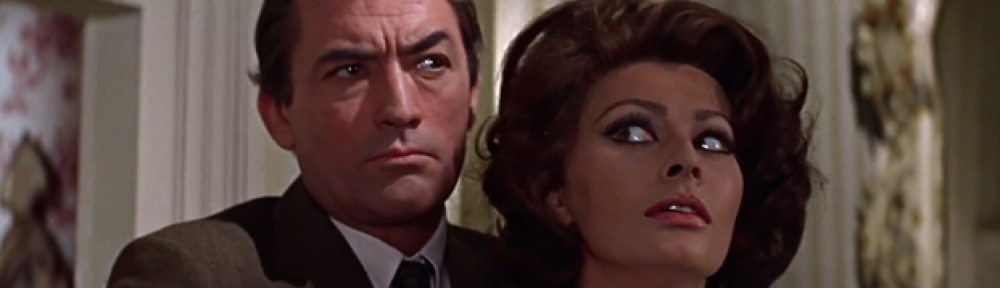
That Man from Rio (1964)

our man from rio 1

That Man from Rio is a find. It’s a dazzling picture that’s as comedic as it is entertaining bursting with a Brazilian energy that brings to mind the Bossa Nova rhythms of Sergio Mendes somehow married with the world of James Bond. And it’s true, there’s without question a major debt to be paid to Dr. No and From Russia with Love.  It’s a good old-fashioned international thriller in the most delightful sense.

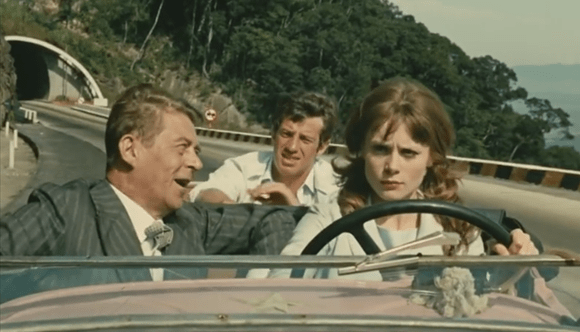
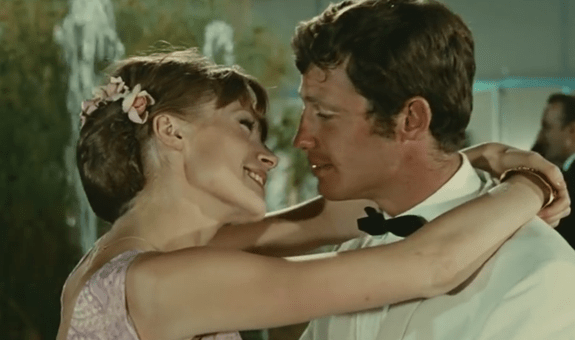
Jean-Pierre Belmondo is one of our intrepid albeit reluctant heroes–more of a Gilligan than a masterclass spy–a bungling Bond if you will.  In fact, Adrien is fresh off a stint in the air force with a week’s worth of leave. And he’s planning on some nice relaxing R & R with his best girl our spunky heroine Agnes (Francoise Dorleac). But that all quickly goes to hell.

Because he doesn’t know what’s going on while his train is rolling into the station. A mysterious statue belonging to the indigenous Maltak peoples of the Amazon Rainforest is purloined from its place at a Parisian museum in the wake of a silent murder. It’s in these opening moments that the film feels strikingly similar to the following year’s caper comedy How to Steal a Million starring Audrey Hepburn and Peter O’Toole.

our man from rio 4

However, the story rapidly leaves behind the museum corridors for territory more at home in, if not Bond films, then certainly Tintin serials. Most memorably pulling from his adventures in South America as well as snatching some eerily similar plot points from Herge’s Prisoners of the Sun and Red Rackham’s Treasure.

Belmondo quickly is thrust into the ruckus as our comical and nevertheless compelling action hero who can be found riding a commandeered motorcycle through the Parisian streets in pursuit of his kidnapped girlfriend.

He’s more than once seen pitifully chasing after a car on foot and his being in the air force must explain why he’s utterly lacking in hand to hand combat skills, more often swinging wildly with blunt instruments and getting knocked to the ground for his efforts. There’s a bit of Indy in him with his own personal Portuguese Short Round, the local shoeshine boy and if rumor serves as fact it’s no surprise that Spielberg supposedly saw the film nine times in a flurry of infatuation. If the influences of Tintin can be seen in Rio, then the film undoubtedly inspired Raiders and its sequels, making it no surprise that Spielberg would produce a Tintin picture of his own.

our man from rio 2

The madcap antics are in one sense reminiscent of It’s a Mad Mad Mad Mad World also featuring trains, planes, and automobiles of every color and description. It too has an outlandish progression of events that nevertheless make for a thoroughly entertaining adventure.

The stolen statue and murder lead to kidnapping and a spur of the moment trip to Rio where Adrien somehow snags a ride on a flight so he can catch up to his girlfriend. But soon they’re both on the lamb, looking for the missing statue and trying to rescue Professor Catalan (Jean Servais), a friend of Agnes’s late father who as luck would have it, also winds up kidnapped. That’s about all you need to know to latch onto to the workings of the plot as they surge ever onward through crazy chase scenes, frantic escapes, bar fights, and whatever else you could possibly imagine.

Phillippe de Broca’s film right from its opening credits boasts gorgeous photography that positively pops making the most of Parisian streets and most certainly the luscious Brazilian locales that still somehow purport a grittiness. There’s the juxtaposition of the worn street corners that at times feel cavernous and somehow still manage to be quaint with a tropical affability thanks to the myriad locals and tourists who inhabit the world.

Having first become acquainted with Francoise Dorleac in The Young Girls of Rochefort opposite her sister Catherine Deneuve, it was easy to consider her the lesser star despite being slightly older. That’s how hindsight gives us an often contorted view of the past. After all, following her own tragic death in a car crash, her sister Catherine has gone on with an illustrious career that has kept her at the forefront of the public consciousness as one of France’s preeminent cinematic treasures.

But after seeing The Soft Skin and now Our Man in Rio with Cul de Sac still to see, it could easily be questioned whether or not Dorleac or Deneuve was a greater star early on as both were involved in some stellar projects. Umbrellas of Cherbourg probably still gives Deneuve the edge but a film like Rio and its star at the very least deserve a brighter spotlight.

Alongside Belmondo, Dorleac is his comic equal as they gallivant frantically every which way both pursuing and being pursued. And from both actors, there’s an obvious exercising of their comic chops that really becomes the core of this film even with its certain amount of intrigue. In truth, they both perform wonderfully and their work here serves as a light, refreshing change of pace. Do yourself a favor and enjoy it.

4/5 Stars

Mission Impossible: Rogue Nation (2015)

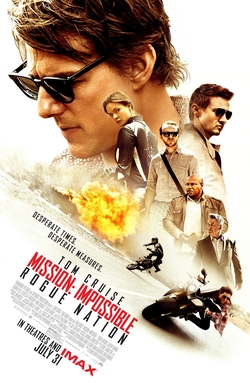
Imission_impossible_rogue_nation_postern the last decade or so arguably the greatest action/spy/thriller franchises have been Jason Bourne, James Bond, and Mission Impossible. To their credit, each series has crafted several passable films fortified by a few real stalwarts of the spy thriller genre. Although many of these series thrive on gadgetry, set pieces, and a cynical tone more at home in the modern millennium, one thing that set some of the better films apart were interesting female characters.
James Bond is an icon. Jason Bourne is a modern icon. Tom Cruise as an action hero is an icon on his own merit. But we expect that to a certain degree. What the cinematic world has not had for as long are phenomenal female action heroes and the parameters seem far more complicated than simply being adequate at kicking butt. For instance, Casino Royale boasted Vesper Lynd (Eva Green) arguably the greatest of the Bond Girls because she was far from simple eye candy — a throwaway sidekick — she actually was witty and interesting and tragic. All those things.

It’s also no surprise that writer-director Christopher McQuarrie teamed up with Tom Cruise yet again to follow up the surprising success of Edge of Tomorrow which showcased another strong female lead in Emily Blunt.

Thus,  in some ways, it makes sense that Rebecca Ferguson steals the show in Mission Impossible: Rogue Nation. But it’s not any less surprising. There are numerous other major names. Obviously, Cruise first and foremost then Jeremy Renner, Simon Pegg, Alec Baldwin, and Ving Rhames. But they’re all playing the parts that we’ve seen before. Computer geniuses. CIA Operatives. Rogue agents. Program Directors. There’s a shadowy villain played by Sean Harris and yet another organization with vague but nevertheless ominous intentions called “The Syndicate.” You get the picture.

But for the simple fact that female action stars are often few and far between on the big screen, Rebecca Ferguson is a true scene stealer. And she starts off quickly by subverting our expectations as an audience. She’s very pretty indeed but her role is not necessarily about her looks which is terribly refreshing. She’s smart, clever, enigmatic, and she seemingly has the most complicated trajectory in the entire film. As an audience, we don’t know where her loyalties lie although we have our suspicions. But more powerfully, she does not quite know herself. Best of all there are no overtly provocative scenes crammed into the story line with the sole objective to sell tickets.

Tom Cruise proves he can still carry a great action movie yet again and that’s because he’s playing it smart — surrounding himself with great talent — and benefiting from his supporting cast. Rogue Nation is not groundbreaking by any means but it’s wonderfully diverting with all the impossible missions, double crosses, and intrigue that we could want. What it sets out to do it does quite well and keeps us entertained in the process.

As a caveat, the fact that our main heroine is named Ilsa and because the film found its way to Casablanca amid its jet-setting, it made me eager for a little bit of Bogart & Bergman. Also, I wouldn’t mind catching a few reruns of Peter Graves. But that’s not to take away from this film. Enjoy it unabashedly. It really is a great deal of fun.

3.5/5 Stars

Spider-Man: Homecoming (2017)

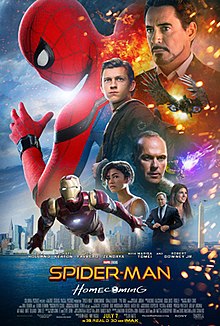
220px-Spider-Man_Homecoming_posterThis was yet another pleasant surprise. Just when I think I’ve finally washed by hands of superhero movies the cineplexes are blessed by two pictures like Wonder Woman and then Spiderman: Homecoming. And they couldn’t be more different. Still, as much as Wonder Woman was invested in its heroine, you get the sense that the crew behind this film care some about Peter Parker too.
Peter (Tom Holland) is living the dream. He got to do battle with the Avengers and Tony Stark has taken him under his wing and he has video proof of it all. He’s expecting great things. He’s expecting to leave the drudgery of high school classes, band, and academic decathlon behind.

Except for most of the film, he is relegated to thwarting small-time crime and he never gets to fight extra-terrestrials or other unearthly beings from outer space. It’s precisely this point that suggests there’s something profound about this character without any of that added white noise.

It’s the very fact that Peter is struggling with his own identity, how to be Spiderman and keep it a secret while simultaneously trying to realize the full extent of his abilities. He’s walking a tightrope because he wants to tell his Aunt May (Marisa Tomei) and he wants Mr. Stark’s right-hand man Happy (Jon Favreau) to call him up for his next assignment so he can prove himself. And yet nothing happens like he wants. No one takes him quite as seriously as he wants. After all, he is a teenager. As some famous philosopher once noted, “with great power, comes greater responsibility.”

But Tom Holland imbues Peter with a genuine likability that lights up his performance from end to end. This guy isn’t a jerk or a moody loser. He falls somewhere in the middle, making idiotic decisions but always because he believes them to be right in that wayward teenage brain of his; he only gets distraught because in his world Spiderman is all he has. Without it he is nothing. That’s his own insecurity speaking.

In one scene that’s undoubtedly meant to be impactful and which subsequently gets referenced later, Tony Stark takes away Peter’s suit after a debacle with an ocean liner and in so many words he says that if Peter needs his suit to be someone then he doesn’t deserve it. Maybe this and the related scenes are needlessly overt in reflecting our hero’s fall and redemption but if nothing else they cast our protagonist in a positive light. He is one of us.

Another thing that constantly reminds us of this fact, has to do with the world and characters he is surrounded by. First of all, the writers do something fairly refreshing and they give him the honor of fighting a villain who is grounded on earth — a man (Michael Keaton) just trying to provide for his family. He is vengeful when the government (Tyne Daly) cancels his contract in favor of the affluent private corporation of Stark Industries. It’s a very real issue wrapped in a superhero film similar to Civil War’s antagonistic dilemma, part of what made that previous film and this one compelling.

But whereas that was a battle among friends, this picture is understandably a high school story. In fact, I couldn’t help noticing the John Francis Daley/Jonathan Goldenstein writing credit not to mention the inclusion of a certain decathlon advisor (Martin Starr) making it hard not to draw up a minor Freaks & Geeks connection.

Honestly, it’s hard to put Spiderman on that level but it does begin to tease out the high school experience as Peter is forced to live a double life while chasing after Adrian Toomes and his clandestine arms operation all across town. Because just as important are his friendship with his Star Wars-loving best bud Ned (Jacob Batalon), teenage crushes, parties, National Decathlon Championships, and, of course, Homecoming.

That’s the beauty of this story. It never tries to take on some epic agenda but far from settling it finds the importance in both the hero’s journey and the growth of someone in the throes of their adolescence. Peter knows that his nighttime activities are hurting his relationship with his aunt and hindering anything that could be between him and his amiable dream girl Liz (Laura Harrier).

The film’s greatest twist (which I’ll consequently omit)  is a beautiful bit of storytelling because it links together Peter’s two worlds so openly. Before they were two entities crisscrossed and tied together like chords of his spider webbing. But there comes a point where they are so closely connected he can no longer keep them separate. He must face it all even if it can’t be resolved as he would like.

So as the Marvel Universe rolls ever onward this picture turns out to be a rewarding entry because in some respects it chooses to tell a smaller story. Still, that story has some lovely touches and a rich cast that more than carry our attention.

The fact that the school outcast (Zendaya) wears a Sylvia Plath t-shirt cracked me up as did a bit of shameless Star Wars product placement, not to mention Captain America fitness videos. But there’s also some sentimental nods as well, namely to Ferris Bueller and the war memorabilia in the Principal’s office honoring his relative who fought alongside Cap during WWII (played by Kenneth Choi in both films).

Michael Keaton turns in a surprisingly sympathetic performance as a “villain” and everybody from Marisa Tomei to Donald Glover are enjoyable in their admittedly small parts. Of course, we have the laundry list of cameos from Robert Downey Jr., Jon Favreau, Gweneth Paltrow, and Stan Lee too as expected.

I won’t harp on this topic too much but it’s obvious that Spiderman is making a concerted effort to be ethnically diverse with its cast which is awesome and refreshing on so many levels. Whether they’re trying too hard with this perfect spectrum of ethnicity is not something to criticize at this point in time. Still, it does suggest that surrounding your typical characters with a lot of diverse individuals in cameos and supporting roles is good enough. Rather than forcing these smaller roles to meet public outcry, there’s a necessity for a better solution.

If the recent Hawaii Five-O pay equality news is any indication, the current state of affairs often has more to do with how the parts were initially created whether in Spiderman or Hawaii Five-O and not how they are interpreted. What might be more radical still is creating these same types of stories and standalone parts for actors who have normally been relegated. I would love to see a Donald Glover movie (on top of Community of course), a Kenneth Choi movie, or even a Jacob Batalon movie. But while we wait, go enjoy Jon Watt’s film for all it’s worth without an ounce of reluctance.

4/5 Stars

Wonder Woman (2017)

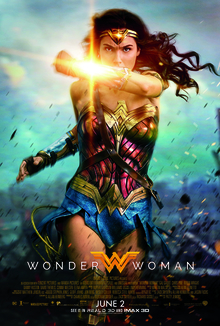
Wonder_Woman_(2017_film)It might sound like meager praise but Wonder Woman is the most engrossing DC offering thus far. It also seems almost unfair to compare across the aisle against main rival Marvel with its terribly lucrative cottage industry or for the very fact that any comparison might suggest how derivative this feature must be.
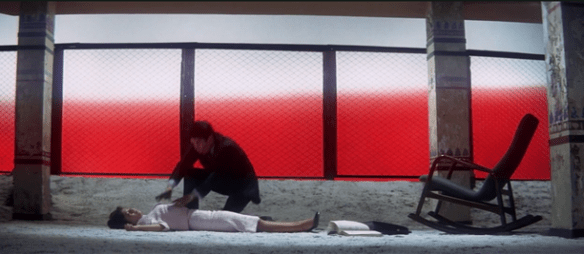
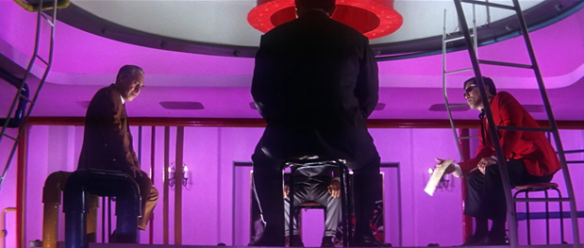
Yes, Man of Steel and Batman V. Superman cannot hold a candle to most of their competition and Suicide Squad was an atrocious misfire. But this is a film that stands on its own two feet — on the feet of its director Patty Jenkins (Monster) and its heroine Gal Gadot.

Jenkins’ Wonder Woman is ripe for praise and adulation on multiple fronts.  Its closest equivalent would be Captain America: The First Avenger (2011) with its period setting as a stunning backdrop for a superhero narrative. In this one, Diana Prince (Gadot in her first true starring role) is joined by a ragtag band of renegades including Steve Trevor (Chris Pine) and his eclectic compatriots including a drunken sharpshooter, a failed actor with a penchant for linguistics, and a resourceful Native American of formidable stock. They look to sneak into the heart of enemy territory to bring a decisive end to the war (in this case WWI).

But the film also plays a bit like a fish out of water comedy. Diana is the girl born of the Amazons in antiquity and isolation living out the legacy of Greek mythology  — which consequently also seems fused with the Judeo-Christian God and the Fall depicted in Genesis.

Like Thor, she too is god-like, a being outside the realm of humans, trained by her aunt Antiope (Robin Wright) and shielded from the outside world by her mother (Connie Nielsen). Thus, when she actually enters into their world it’s ripe with humorous cultural incongruities. Casual conversation about ancient treatises on sex, sporting the latest fashions which are a bit more modest than her typical attire, learning how to dance, and getting her first taste of an ice cream cone. Each brings a smile to our faces as an audience.

Still, despite her immense skills and innumerable abilities, Diana like Agent Peggy Carter from Marvel is faced with a culture that is not ready for someone who is simultaneously beautiful, strong, independent and wholly unencumbered by normal male patriarchy.  Someone who will not be repressed, blasting through the glass ceilings and cathedral steeples for that matter.

Diana can hardly comprehend how these discrepancies exist. In her eyes secretaries are only glorified slaves and powerful men who sit together in rooms making decisions have no honor whatsoever as their men are brutally slaughtered. It’s ludicrous and it many ways she’s not wrong. We begin to empathize with her character and the problems she sees in the world — the innate desire she holds to make everything right.

Because that gets to what is really truly phenomenal about Wonder Woman. For even the mild superhero enthusiasts she is emblematic of the entire genre with everyone from Batman to Superman, Captain America, Spiderman, Hulk, and all the others. But the one thing that puts her in a class entirely her own is that she is a woman. And this is not meant to single her out but to suggest how important this film is. Lynda Carter gave a landmark performance on the television airwaves in the 1970s but this is the first time this monumental icon has made it to the big stage and it is long overdue.

As such this film becomes a fitting parable reflecting the struggles of women in a callous industry and an oft callous world. Diana becomes a champion of all those women thoroughly capable of living life with individuality, confidence, and above all love for their fellow human beings. Diana comes at life from what some narrow-minded folks might call a woman’s perspective caring deeply about the helpless and their suffering but for the rest of us, it’s a very human point of view.

However, it’s equally important to note that in an attempt to make Diana of great import does in no way relegate the other characters and Steve (Chris Pine) becomes one of the most enjoyable supporting blokes in recent memory.

Gadot and Pine play complementary roles that perfectly mesh together. They’re both brave, they’re both extraordinary, they both care deeply but it can be in different ways. Steve finds himself rescued by Diana and protected by her immense powers as he continues his espionage activities behind German lines. Still, he’s able to explain the intricacies of the world to her and lead her to realize that humanity is not as black and white as she assumed it to be. That is big. In Diana’s eyes, the whole arc of the film is like so. If she can kill Ares, war will be over and mankind will fall back into unity as Zeus had originally ascribed.

Wonder Woman supplies a final twist that while somewhat understandable from a cinematic point of view still manages to take a little of the meaning out of Diana’s realization. Since this is also a love story, that in some ways slightly salvages an ending that succumbs to the usual superhero tropes and pyrotechnics. It’s this further discovery that while Diana may not be to blame for all this chaos, humanity despite their faults is still worth fighting for. What Steve calls “truth” I would probably call “grace” and it’s semantics really but it simply suggests this idea that we do for others what they do not deserve, out of love, the highest noblest form of sacrificial love — always seeing others before yourself even those you disagree with — even when it comes at great cost. For Steve and Diana, those mean two entirely different things again as he tries to thwart the Germans nefarious intentions and she battles it out with someone with powers, not unlike her own.

Despite an admittedly clunky framing device to set up its narrative, the film does learn something from the Suicide Squad as well by focusing on origin story over a mere objective or mindless action. Wonder Woman begins to falter when it simply gets caught up in the normal rhythms of superhero films with villains, explosions, and the like.

What’s interesting are these characters, the wounds that they carry with them, their environments and how that shapes the world that they find themselves in. In this case, Gal Gadot proves to be a winsome heroine with an impeccable blend of innocent beauty, boldness, and heart that’s completely disarming. Meanwhile, Pine’s as charming as ever but let’s not forget whose film this is because we’ve waited long enough. Wonder Woman has made a triumphal return and not a moment too soon for DC.

4/5 Stars

Happy Independence Day!

Tokyo Drifter (1966)

tokyo-drifter-1

Seijun Suzuki’s Tokyo Drifter is a paramount attraction of 60s camp packaged in a yakuza   B-film. It opens with highly stylized black and white imagery injected with almost psychedelic shades of color that never again leave the film’s palette. Its setting is Tokyo, Japan — but far different than any Tokyo humanity has actually seen in recent history. As such it does not exist and never has. Only in the mind of the director. It’s a swinging place of ultra-cool yakuza, jazzy vibes, and a fantastical atmosphere. Oddly indicative of the shoestring budget it was hewn from and still somehow invariably engaging.

tokyo drifter 2.png

We spend much of the film following in the footsteps of our eponymous lead Phoenix Tetsu (Tetsuya Watari), a yakuza hitman whose every effort to go straight is being challenged and impeded on all sides. He cannot escape the life that defines him and finds himself continually caught in a web of yakuza gang wars that will not give him a moment’s peace. There are gunfights, brawls, even a bit of swordplay. He has a romantic flame, a sullen nightclub singer who serenades the world with her melancholy tunes, but even she cannot redeem his existence. There are always hitmen either after his life or looking to drag him back into the fray that he threw off.

But going into plot points and character arcs already strays too far from what makes this film enjoyable. There’s often the heightened tension found in many of Sergio Leone’s greatest Spaghetti Westerns here, employing many of the same stylized characterizations. The fact that our main protagonist announces himself through song and whistling strangely feels reminiscent to “Harmonica” (Charles Bronson) in Once Upon a Time in the West. But this is a different beast. Rambunctious, chaotic and vibrant as it is.

tokyo drifter 3.png

Once more Suzuki is gifted in taking the mediocre — a narrative with very little to it — then instilling it with all sorts of energy similar to other inspired mavericks like Sam Fuller. But by the end, he’s transformed the narrative into an incomprehensible bedlam blessed with his own wickedly stylish aesthetic. There are sweet suits and shiny wheels. Nothing feels the least bit realistic. And it’s filled to the gills with surrealist situations conceived out of Suzuki’s own whimsical vision. Still, all the while it’s influenced by pop art and to some degree Technicolor musicals of the 1950s. It’s a sight to be sure, leaving its indelible mark on the b film niche. If anyone says low budget gangster flicks are the dregs of cinema, they’ve obviously never been acquainted with Seijun Suzuki

3.5/5 Stars

Lethal Weapon (1987)

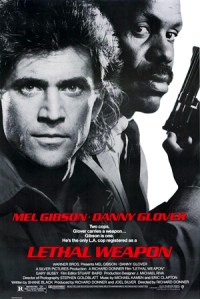
Lethal_weapon1Richard Donner (Superman) has an understanding of the balance of grand spectacle and more subtle moments. The opening aerial shot and the tenuous desert rendezvous with a helicopter churning up sand capture our attention. But it’s the little bits of humor and vulnerability that make the showmanship of Lethal Weapon ultimately worth it. There’s a vibrancy that runs through Shane Black’s script in both the action sequences and character-driven moments.

It’s the quintessential buddy cop action film that in many ways defines the ’80s and that’s because it has a different slant. That’s part of the secret to its success. The main man (Danny Glover) is different and it’s not simply because he’s African-American. His family holds an important place in his life and he’s a genuine person — not an action hero. His partner in crime (Mel Gibson) also has his own deal. We meet Riggs in an abandoned trailer with bedhead, smoking and drinking a beer before he’s even awake. The loss of his wife causes him to contemplate suicide and everyone on the force questions his sanity. But when duty calls these two men are thrown together and out of their initial incompatibility comes mutual respect and genuine fun. As an audience, we enjoy watching them together.

What sets Lethal Weapon apart is how the violence is almost a side thought because what really matters are the characters and their relationships. Friends and family are important. Certainly, there are profane moments but they come in moments of extreme provocation. There’s even gratuitous violence at times but there’s consequence to it, more often than not.

Those in trouble are not simply damsels in distress because most everyone is in the same boat. Martin and Roger both are put in danger, captured and tortured. They don’t just dispense retribution. Their lives and families are put on the line too. However, it’s easy to point out the fact that some characters are killed, most notably in the opening moments, and they feel like mere plot points. For such reasons, the film’s certainly not perfect.

Also, its final moments are admittedly out there. It could be a scene out of Mad Max as Mel Gibson battles in the deluge of a spewing fire hydrant nearly to the death. The question is why, can’t they just arrest the culprit? It’s this scene that allows the character of Riggs to get his desired resolution. In fact, both he and Roger Murtaugh earn a bit of satisfaction as they rise up above the tumult. They are a pair of lethal weapons. But what matters most is that after a hard days work they can get together for a mediocre Christmas dinner. That’s true friendship.

3.5/5 Stars

Review: The Adventures of Robin Hood (1938)

the adventures of robin hood 1As a young boy, no hero was greater in my mind’s eye than Robin Hood and only Star Wars held a more honored spot in my childhood imagination. Because, to this day, Robin of Locksley remains the quintessential hero of mythical lore. Part historical truth mostly canonized myth and that’s the beauty of him. We can believe in him — see how he was in so many ways real but in the same instance larger than life.

To his credit, Erroll Flynn does a surprisingly phenomenal job in portraying the legendary outlaw in Lincoln green with a bit of British (Australian…) cheekiness, as well as bravado and charm. In fact, the film is full of so many wonderful elements from its engaging action sequences full of timeless spectacle and a plethora of characters who come right off the pages of the greatest Robin Hood narratives. Will Scarlett, Much the Miller, Friar Tuck and of course Little John still hold a great deal of esteem in my heart. While there are no men more villainous and corrupted than the likes of Prince John (Claude Rains), The Sheriff of Nottingham (Melville Cooper) and Guy of Gisbourne (Basil Rathbone).

Meanwhile, Michael Curtiz took the reigns of the film and makes it a lively swashbuckler that revels in a sense of good fun and that starts with Flynn’s performance radiating out from there. While this early use of three-strip Technicolor only serves to add yet another layer of elegance and vibrancy to the film’s look. It truly was made for color and every shade of Lincoln green and every bit of medieval opulence proves to be a feather in the film’s cap. It looks absolutely stunning and the same goes for young Olivia De Havilland as Maid Marian.

Olivia_de_Havilland_and_Errol_Flynn_in_The_Adventures_of_Robin_Hood_trailerFrom what I know from Robin Hood folklore, specifically Howard Pyle’s seminal edition, the film is surprisingly true to many of the origin stories and tales that have long since proliferated. As an audience, we become privy to the first meetings of Robin and the formidable Little John (Alan Hale) who lays him out in the local stream after a bout with quarterstaffs. Then, in another instance, Robin provokes the portly Friar Tuck (Eugene Palette) who happens to be a master swordsman and a lover of good food and drink. Still, other vignettes include Robin’s successful masquerade as a lowly archer who wins the grand prize at the Sheriff of Nottingham’s Archery Tournament.
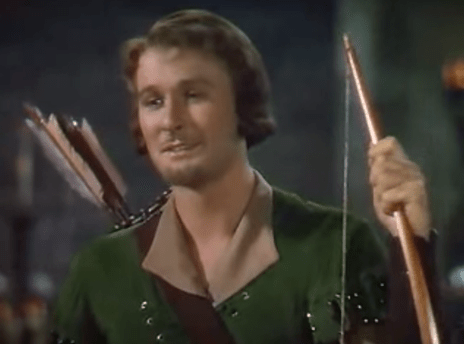
Of course, the most thrilling set pieces occur in Nottingham Castle, initially when Robin brazenly drops in on Prince John and his cronies bearing a deer over his shoulders. Admittedly I have Star Wars on the mind, but this sequence is rather reminiscent of Luke wandering into Jabba’s Palace.

Then, the climax comes later with the return of King Richard and Robin’s assault on the castle full of stellar swordplay and general chaos. The duel between Flynn and Basil Rathbone is especially thrilling and it holds up well even today because there is something so satisfying in watching them thrust and feint back and forth.

the adventures of robin hood 2For me, the reason very few heroes surpass Robin Hood is based on his innumerable qualities. He’s a superior fighter with bow, sword or staff. He’s blessed with a wonderful wit and impressive leadership capabilities. He wins over the girl with his charm. He gets to live out in the forest with his best friends, eating great food. But most of all, he’s a rebel with a heart of gold, robbing the rich to feed the poor.
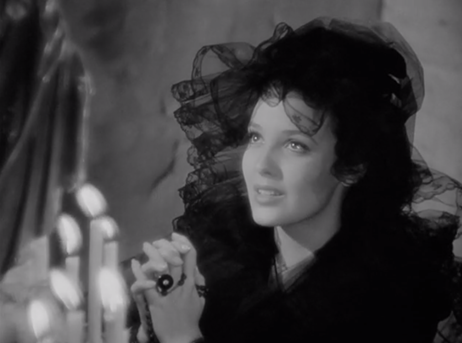
He’s an embodiment of all things that a little boy dreams of as a kid and in many ways, he’s a fairy tale, but the kind of fairy tale that a boy readily conjures up in his own imagination. The villains are formidable and the action is unmistakable, but it’s all in good fun. That’s why the Adventures of Robin Hood remains an enduring folk tale of the cinema. Its hero transcends a single medium. Because he lives in the heart of many a young lad long after the title credits have rolled.

5/5 Stars

The Mark of Zorro (1940)

markofzorro1Madrid–when the Spanish Empire encompassed the globe and young blades were taught the fine and fashionable art of killing…

The mythology of Zorro most certainly starts with the swashbuckling silents of Douglas Fairbanks, but the character’s legacy would be carried forward into the 1940s. So much so that it even gave some inspiration to a young Bruce Wayne, along with numerous boys picking up comic books in his generation.

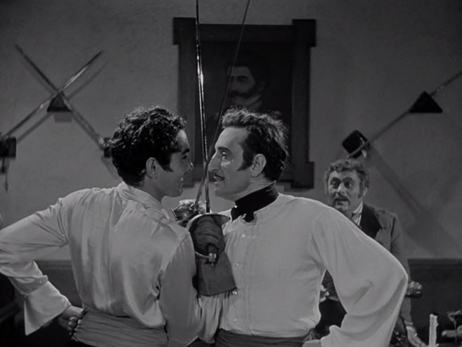
In all fairness, I don’t know a whole lot about director Rouben Mamoulian. I assumed his forte was costume dramas and stage production as he did do a lot on Broadway. And if that is true, The Mark of Zorro, while not seemingly the work of some creative mastermind, is invariably enjoyable. That is also to the credit of 1940s matinee idol and dashing leading man Tyrone Power. Although over his career and even in this film, he proves to be more than a handsome face. He seemed to hold his own up against Basil Rathbone when it came to swordplay and he danced between the superficial and heroic personas with relative ease. It brings to mind other such roles as Christopher Reeves in Superman (1978) for instance. That of course, brings up the need for an origin story.

markofzorro2In many ways, it feels anachronistic that Don Diego Vega makes the long voyage from Spain to Los Angeles California, but then in the 1800s Spain still had some presence on the West Coast. It’s there were Vega gives up his sword, rendezvous with his father and mother, while slowly taking on a second life. Zorro certainly has a wonderful double life going. By day a stuffy, foppish playboy fascinated with magic tricks and given to fatigue. Then, by night he dons the black mask and saber as “the fox” wholly prepared to rob from the oppressors and bring hope to the common man. He’s the Robin Hood of the Spanish settlements marking his territory with his iconic “Z” and simultaneously getting a bounty stuck on his head.

markofzorro3The corrupt tub of lard Luis Quintero pushed Vega’s father out of office with the help of his menacing right-hand man Captain Pasquale (Basil Rathbone). On the surface, Don Diego plays into the older man’s hand, while at night he fools everyone including the local priest (Eugene Palette) with his masquerade.

Perhaps most importantly of all Zorro is able to romance the young ingenue Lolita Quintero by eventually letting her in on his little secret and taking down her nefarious uncle. But of course, everything must come down to some epic swordplay and heroics. Zorro and Pasquale eventually face on in an office sword fight that made me absolutely giddy with excitement. As he leads the revolt against the powers that be there is an obvious energy pulsing through the storyline. This is a pure cinematic action-adventure that glories in the age of swashbucklers.

True, we have a pair of tragic stars in Tyrone Power and Linda Darnell. He died of a heart attack at the age of 44 and she died only a few years later at 41 years of age after a house fire. But, for the time being, they are young, vibrant, and full of life. Perfect protagonists in a film where love and justice reign supreme and heroes always conquer evil.

4/5 Stars

The Three Musketeers (1973)

threemusk6In the beginning, this Dumas adaptation was to be the next zany live-action vehicle for the Beatles following the success of A Hard Day’s Night and Help. In fact, they even were ready to work with the same director. Well, Richard Lester stayed and the Beatles were disbanded for several years before this film even got going. In this incarnation, it was set to be a three-hour star-studded epic. Instead, it was thought better of, and this became the first installment with a second film coming out a year later.

Thus, The Three Musketeers has impressive star power, but the direction of Lester also supplies action with a constant barrage of gags for good measure. To top it off the film actually does follow the general story arc of the novel, but invigorates it was bits and pieces of humor that lighten up the tone. So perhaps it’s a light and fluffy piece of entertainment, but it’s still easy to enjoy what Lester’s been able to do here. It’s a great deal of fun.

threemusk4Our audacious d’Artagnon is a strapping Michael York, who has picked up plenty of swashbuckling skills from his father. So he heads out on his own to seek out adventure and uphold his family honor. In a matter of minutes he already a succession of duels lined up, and of course who are they with? The Three Musketeers: Athos (Oliver Reed), Porthos (Frank Finlay), and Aramis (Richard Chamberlain). He sides with his new comrades against the corrupt Cardinal Richelieu (Charlton Heston), and attempt to help the Queen (Geraldine Chaplin) get out of a tight jam.

What follows is a rambunctious array of treachery, romance, and royalty that involves Anne’s lover the Duke of Buckingham, a sly chambermaid (Faye Dunaway), the King, and of course the Cardinal. Peace stands in the balance not to mention the Queen’s self-respect, and so d’Artagnon and the boys do the honorable thing and bail her out. I said before that this film has it’s fair share of sword fights which are fun in themselves, but the laughs really accent the story nicely.

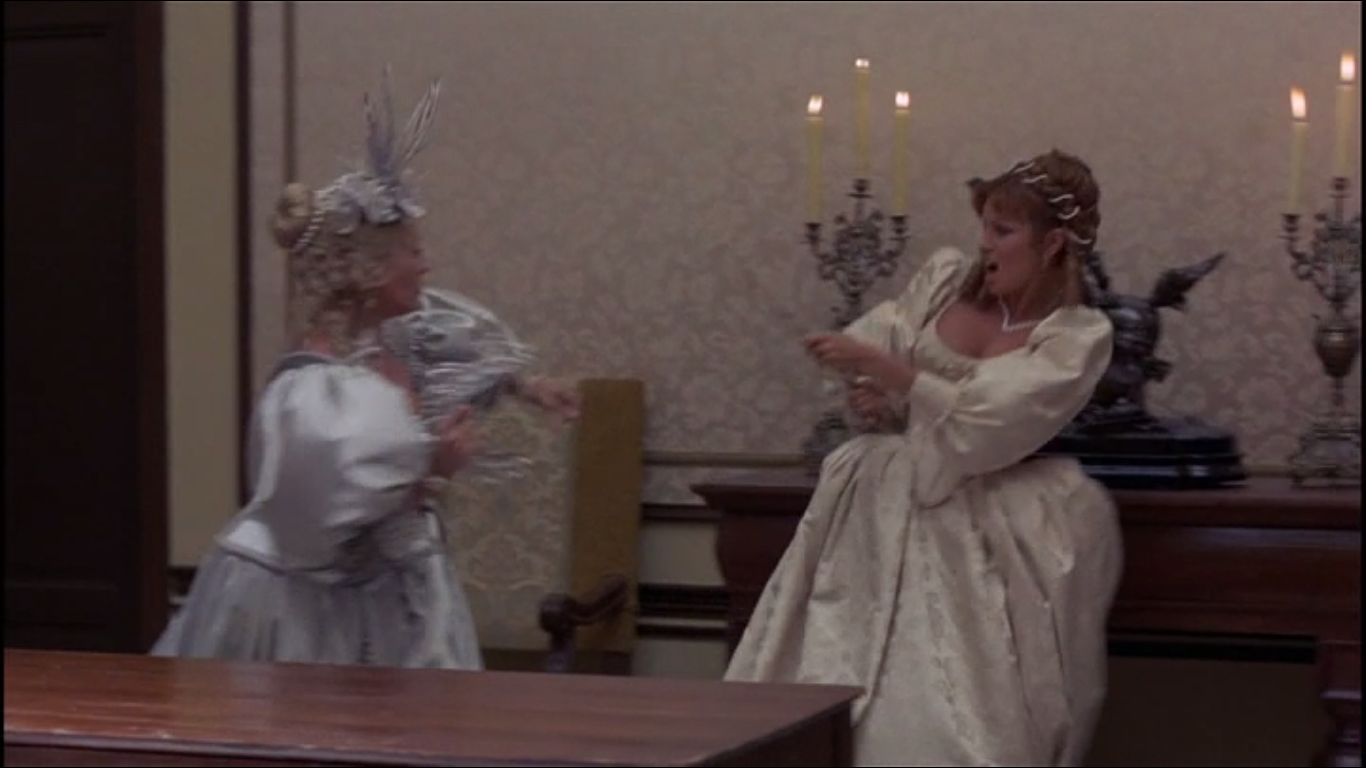
threemusk5The plot is there and we can appreciate the work of Alexandre Dumas, but it is not necessarily the focal point. Charlton Heston gives a seemingly uncharacteristic turn as Cardinal Richelieu, the corrupted man of the cloth, who cares more about politics and social unrest than he does about his faith. He’s no Moses or Ben-Hur for that matter. Furthermore, we are treated to a little tooth and nail type action courtesy of Raquel Welch and Faye Dunaway. It turns out to be yet another rewarding scene because these two ladies were two of the defining icons of the 1970s, and here we get to see them face off.

I’m already revving up for part two because I wouldn’t mind returning to these characters. There’s a lot of good old-fashioned fun to be had here.

3.5/5 Stars