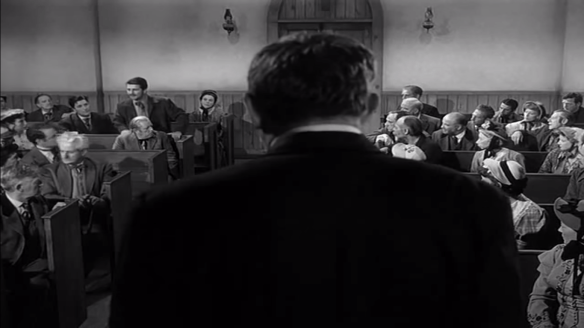
Teresa Wright in The Best Years of Our Lives

teresawright.jpg

I was born and bred a California boy, but there’s a certain something about the girl-next-door. Maybe it’s my midwestern roots, because after all, my mom was born in Iowa before making the move westward.

Anyways, the first time I saw Teresa Wright onscreen I was immediately smitten. She is the complete antithesis of the blatant sexuality of a Marilyn Monroe, a Sophia Loren or Elizabeth Taylor. Granted, all very beautiful women of Hollywood’s Golden Age, but as their predecessor, a very different sort of actress, Wright exudes a certain sweet charm that epitomizes the ideal American girl. Before Donna Reed or Doris Day.

In The Best Years of Our Lives she plays Peggy, the thoughtful, funny and mature daughter of Al and Milly Stephenson. Right from the get go, it’s hard not to love this girl from the quintessential post-war family. She knows how to cook, drives well, has all the skills that are desirable of a lady circa 1946. But the bottom line is her utter sincerity. She seems real.

When she first meets Fred Derry then, there’s no agenda or master plan to seduce him or make him fall in love with her. It just happens. She doesn’t quite want it to happen and she tries to resist the urges. She’s not prone to drama. She’s above that kind of behavior. In other words, she’s a real winner.

Thus, the moment when she begins to fall for a married man, unhappily married, our heart aches for her–at least that’s what I felt, because she deserves to be happy. How could Teresa Wright not be happy? And in the end she gets the ending that she deserves–the one we want for her and Fred.

The legendary critic James Agee wrote this of her performance:

“This new performance of hers, entirely lacking in big scenes, tricks, or obstreperousness—one can hardly think of it as acting—seems to me one of the wisest and most beautiful pieces of work I have seen in years. If the picture had none of the hundreds of other things it has to recommend it, I could watch it a dozen times over for that personality and its mastery alone.”

Took the words right out of my mouth J.A.

And beyond simply this film, there was a string of equally amiable performances that came before and after. She’s the sweet innocent ingenue in The Little Foxes and Mrs. Miniver. In The Pride of the Yankees she was the perfect incarnation of Lou Gehrig’s faithful wife, while also playing the intrepid “Charlie” in Hitchcock’s home thriller Shadow of a Doubt. Later on in her career she would star in the psychological western Pursued and opposite Marlon Brando in The Men.

Perhaps the roles share a degree of similarity, but it should not go unnoticed that Teresa Wright had a string of three academy award nominations, that suggest that she was a pretty big deal in her day. To this day, no one has equaled that feat of hers.

But why had I never heard of this wonderful, pure actress until so much later in my cinematic odyssey? She had slipped through the cracks and crevices of my film education. And that might best be explained by Teresa Wright’s own words:

“I’m just not the glamour type. Glamour girls are born, not made. And the real ones can be glamorous even if they don’t wear magnificent clothes. I’ll bet Lana Turner would look glamorous in anything.” 

“The type of contract between players and producers is, I feel, antiquated in form and abstract in concept. We have no privacies which producers cannot invade, they trade us like cattle, boss us like children.”  – (Wright would not allow herself to be shot in certain manners for publicity photos and ultimately lost her contract with Samuel Goldwyn)

“I only ever wanted to be an actress, not a star.”

So certainly this girl was not your typical Hollywood movie star. She lacks flamboyance and your typical glamour, but she makes up with it by being a deeply heartfelt and sincere individual onscreen. She feels real and in her earliest roles, completely innocent. It’s hard not to fall head over heals for a girl like that.
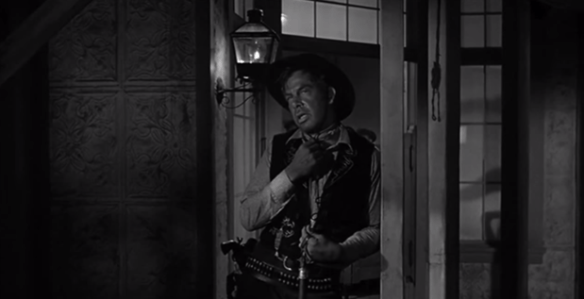
Lee Marvin as Liberty Valance (1962)

libertyvalance.png

I can enter into a discussion of The Man Who Shot Liberty Valance from two different avenues. Most obvious is the film itself. As far as star power, Lee Marvin is playing third fiddle to John Wayne and James Stewart, the undisputed stars of this film.

However, Liberty Valance is a wonderful role, because certainly this is about Wayne and Stewart, but on the other hand its Marvin who has his name in the title, and that’s not something to be taken too lightly. He’s at the core of this film, because it is his villainy and criminal activities that create the conflict in this story line and elicit a response from both of our leading men. He forces their hand and it becomes the call to action for a final showdown.

The fact that the film’s narrative is told, rather like a film noir, with a flashback creates this type of aura not only around Wayne’s Tom Doniphin but the notorious Liberty Valance himself. Because although we see Ransom Stoddard (Stewart) in the present along with his faithful wife (Vera Miles), the  two other men are only made available to us through eyewitness account. Around them is built a type of legend and that ultimately makes Liberty Valance a fascinating figure. Dressed in black, swinging his whip menacingly and boisterous as all get out, Lee Marvin is the perfect man to portray Valance.

In a sense, it feels like he’s at the crossroads of his career, in transition from his heavy roles to being a top billed tough guy. The Big Heat and Liberty Valance represent his earlier turns before he progressed to The Dirty Dozen and Point Blank as a silver-haired tough-as-nails leading man. Marvin was arguably never more larger-than-life than his time as Liberty Valance. Perhaps it was because he was forced to hold his own against Stewart and Wayne. As the famous quotation goes, “When legend becomes fact, print the legend..” Well in this case, Lee Marvin did make Liberty Valance in a legendary villain deserving to be among the pantheon of baddies.

However, there’s also Gene Pitney’s billboard charting tune also called “The Man Shot Liberty Valance,” which although it was not featured in the film, sums up its story quite impeccably.

The lyrics read like so:

When Liberty Valance rode to town, the womenfolk would hide, they’d hide
When Liberty Valance walked around, the men would step aside
‘Cause the point of a gun was the only law that Liberty understood
When it came to shootin’ straight and fast, he was mighty good

From out of the east a stranger came, a law book in his hand, a man
The kind of a man the West would need to tame a troubled land
‘Cause the point of a gun was the only law that Liberty understood
When it came to shootin’ straight and fast, he was mighty good

Many a man would face his gun, and many a man would fall
The man who shot Liberty Valance
He shot Liberty Valance
He was the bravest of them all

The love of a girl can make a man stay on when he should go, stay on
Just tryin’ to build a peaceful life where love is free to grow
But the point of a gun was the only law that Liberty understood
When the final showdown came at last, a law book was no good

Alone and afraid, she prayed that he’d return that fateful night, aw, that night
When nothin’ she said could keep her man from goin’ out to fight
From the moment a girl gets to be full-grown, the very first thing she learns
When two men go out to face each other, only one returns

Everyone heard two shots ring out, one shot made Liberty fall
The man who shot Liberty Valance
He shot Liberty Valance
He was the bravest of them all

The man who shot Liberty Valance
He shot Liberty Valance
He was the bravest of them all

So if Marvin’s portrayal doesn’t already make Liberty Valance into a mythical villain, then this number certainly does. We can read it a bit like a western folktale, emotive and surprisingly true to the film’s narrative arc. But what it leaves us with are the result of that showdown that happened so many years ago…

The point of a gun was the only law that Liberty Valance understood, and he was forced to pay penitence for his misdeeds under the barrel of that same law — at the hands of the hero christened only by the name “The Man Who Shot Liberty Valance.”

Written as part of The Great Villain Blogathon featured HERE


The Strange Love of Martha Ivers (1946)

strangelove1“I don’t like anybody pushing me around. I don’t like anybody pushing you around. I don’t like anybody getting pushed around.”  Van Heflin as Sam Masterson

Lewis Milestone never quite eclipsed the heights of All Quiet on the Western Front. Still, The Strange Love of Martha Ivers is brimming with some engaging performances. Although it is, at times, more of a  melodrama than noir, there is still merit in Robert Rossen’s script. When it does not falter with didacticism, the film has a certain twisted, deep-seated emotion that runs through it. Barbara Stanwyck is the one at the center of it all, as the title suggests.

The film begins in 1928 with three children. The assumption is that these three individuals will become of greater importance later on. After that fateful evening, one would be left without any family, one would leave for good, and one would be left in the perfect position to rise up the ranks. These opening moments boasts spiraling staircases, thunder, the pounding orchestration of Miklos Rozsa, and a complete gothic set-up.

strangelove317 or 18  years later a full-grown Sam Masterson (Van Heflin) decides to return to his old stomping grounds, Iverstown, on a whim. He’s surprised to learn that the “little scared boy on Sycamore street” is now District Attorney (Kirk Douglas). And he’s now married to Martha Ivers (Stanwyck). She and Sam had something going long ago, but he’s all but forgotten it by now. He’s made a living as a gambler who has a pretty handy dandy coin trick, but really Heflin’s character could be anything.
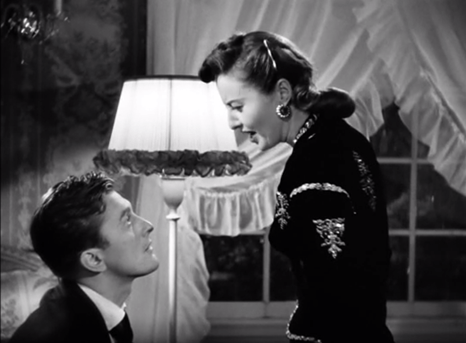
He meets a sultry, smoky-voiced Lizabeth Scott with the pouting face. For those unfamiliar, I would liken her to a Lauren Bacall-type, although she was less well-known and ultimately got typecast in noir roles. Here Scott’s “Toni” Marachek is an often despondent woman who just got out on probation.

strangelove2We don’t actually see Barbara Stanwyck’s face until 30 minutes into the film, but it doesn’t matter. She as well as Kirk Douglas (in his screen debut), leave an impression right off the bat. They are a married couple alright, but she seems to hold the keys to the kingdom, so to speak. All her power is propping him up as he makes his political rise. Perhaps there’s more going on here, however.

From its outset, Martha Ivers looks to be a tale with two threads that slowly begin to intertwine, bringing together some old pals and acquainting some new ones. When Sam wanders into the lives of Martha and Walter O’Neil, it’s putting it lightly that they’re taken aback. The district attorney is good at putting on a face for an old boyhood chum. His wife, on the other hand, is not about to hide her excitement in seeing her old flame.

However, they both think he has an agenda, misreading the twinkle in his eye as intent to blackmail, for a payoff after what he saw all those years ago. But that’s just it. Only we know that he didn’t see anything. Martha Ivers slips up, caught between love, hate, and a suffocating life. She has so much power and yet so little. So much affection and yet so much bitterness.

strangelove5Honestly, although Stanwyck is our leading lady, it’s quite difficult to decide whose film this really is. Van Heflin and Barbara Stanwyck are at its core, but then again, Scott and Douglas do a fine job trying to upstage them. There’s a polarity in the main players, meaning Stanwyck and Heflin have the power, and the other two are the subservient man and woman respectively. However, the film really becomes a constant tug-of-war. Douglas is not just a spineless alcoholic. There’s an edge to him. Scott seems like a softy and yet there’s an incongruity between her persona and that prison rap that hangs over her. Heflin seems like the one relatively straight arrow because as we find out, Stanwyck is fairly disturbed. She’s no Phyllis Dietrichson and that becomes evident in yet another climatic conflict involving a gun. But she’s still demented, just in a different way.
3.5/5 Stars

Some Came Running (1958)

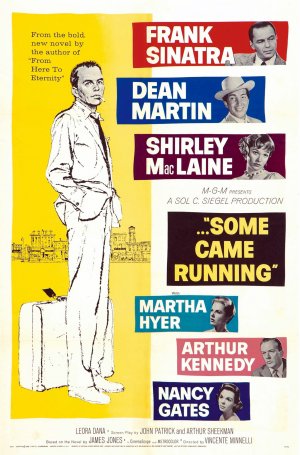
Poster_of_the_movie_Some_Came_RunningSome Came Running is a film that can so easily get lost in the shuffle of 1950s Hollywood. It’s hardly the most well-known picture of director Vincente Minnelli, known generally for his musicals and excellent set direction. Furthermore, this is most certainly a melodrama, certainly affecting, but not quite as falsely superficial to the degree of Douglas Sirk’s work. In a way, it feels like a 50s variation on The Best Years of Our Lives.

In the post-war years drifting vet and one-time author Dave Hirsh (Frank Sinatra) comes back to the town he skipped out on as a young kid. He’s a bit hung over getting off the Greyhound and realizes he has another traveler in his wake. The fellow passenger is the potentially disreputable and slightly dumb Ginny Moorehead (Shirley MacLaine), who came along for the ride from Chicago on his invitation.

Now that he’s back home, he just wants Ginny to head back the way she came, while he gets over with the obligatory meeting with his older brother. After handing his brother over to a boarding school, Frank Hirsh (Arthur Kennedy) did pretty well for himself. He married a wife (Leora Dana) from a good family and inherited a profitable jewelry business. By now he’s living the American Dream and his daughter Dawn (Betty Lou Keim) is growing up to be a beautiful young woman. In fact, you might call Frank a pillar of society, because everything’s working for him and people look up to him for what he has made for himself.

Thus, the arrival of Dave is not without its problems. The brothers have not talked for well nigh 16 years now. Frank looks to play things up like nothing’s changed and they’re both pals. He sets his brother up to an evening with a Professor French and his beautiful and highly intelligent daughter Gwen (Martha Hyer), who happens to be a literature teacher at the local high school. This is his way of trying to get his brother into good company. After all, he can’t bear that people should talk. He’s got a reputation to uphold.

But Dave’s not much for that type of company, although he takes a liking to Gwen, who avoids his advances while still taking a great interest in his work as an author. Furthermore, the cynical drifter begins to keep company with jovial gambler Bama Dillert, played by none other than a boozing, poker playing Dean Martin. Thus, there are some genuinely entertaining moments that feel like nothing more than a Rat Pack hangout.

But Some Came Running is quick to plunge back into dramatic turmoil. There are affairs, hypocrisy, unbridled passion, bar fights, parades, and carnivals all highlighted by the eye-catching staging of Minnelli. In fact, Minnelli always has an eye for his scenes, and there’s nothing different about this film. We are watching the players of course, but the space they fill, the clothes they wear, and so on are almost just as interesting. Colors pop making for vibrant viewing to match the spectacle. The climactic moments feel rather Hitchcockian with the pulse-pounding intensity set to the backdrop of a bustling carnival and the Elmer Bernstein score reverberates with his usual fervor.

Dean Martin is the comedy. Arthur Kennedy is necessary. Shirley MacLaine is the tragedy. Martha Hyer is rationality. But Frank Sinatra is the core of this film because he balances a surface level cynicism with genuine affection. He shows his interior on multiple occasions. His eyes watch over his niece with great care. His heart yearns for Gwen ardently, and he holds a deep sympathy for Ginny. Sinatra was in many quality films, but this is perhaps his greatest performance.

Is it blasphemy that in many ways I appreciate this James Jones adaptation just as much, if not more than, the long-heralded From Here to Eternity?  I suppose I am entitled to my opinion.

4/5 Stars

Noah Beery Jr. (1913-1994)

It’s putting itbeery-red-river lightly to say Noah Beery Jr. came out of an acting family. His father, and namesake, Noah Beery Sr., much like his son, was a character actor well respected during the dawn of the film industry. He appeared in both silents and talkies as diverse as The Mark of Zorro (1920) and She Done Him Wrong (1933). Young Noah’s uncle Wallace Beery achieved a wide degree of fame during the 1930s with such classics as The Champ (1931), Grand Hotel (1932), and Dinner at Eight (1933). Even Noah’s mother Marguerite Walker Lindsey was an actor at one point.

Thus, it makes complete sense that Noah Beery Jr. followed in the footsteps of the family lineage. Some of his most notable films included: Only Angels Have Wings (1939), Of Mice and Men (1939), Sergeant York (1941), Red River (1948), Jubal (1956), and Inherit the Wind (1960). And he could always be counted on to play a slightly pudgy, generally good-natured side kick or victim. That was his niche in Hollywood and it served him well even if it was not the most prominent of careers. However, it would prove useful in his later years.

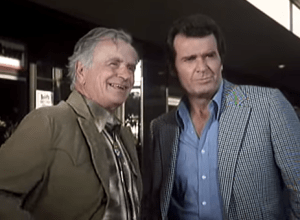
Noah_Beery_Jr-stillFor most of us, including myself, Noah Beery Jr. will always and forever be the beloved “Rocky,” the concerned and often comical father of Private Investigator James Rockford (James Garner) on The Rockford Files (1974-1980).  What made the show work was the fact that they gelled so well together, because the roles already seemed to fit who they were so perfectly. It could have been just another cop show from any decade really, but that duo made the show a cut above. We wanted to watch them together, because it was good old-fashioned fun and we actually cared about them as individuals.

Fittingly Beery and Garner began in westerns. Beery in mostly films and Garner as the gambling drifter Bret Maverick in the TV western Maverick. By the 1970s they were both a pair of vets and the chemistry they created was perfection. There was no need to don a role, because they appeared to be playing themselves or at least the version of themselves that they had played for so many years now.  It felt like a genuine relationship between a son and his father. Even facially they share some resemblance.

noahbeery
I truly love James Garner, undoubtedly like many others. He made the Rockford Files  a perennial favorite, but Rocky gives the character of Jim even more depth. In fact, I will go out on a limb and say that in the world of fictional television parents Rocky is one of my personal favorites. Maybe he feels different than most because his son is grown up, but he still has such a tremendous relationship with him. Rocky’s a bit of a country bumpkin,and still a generally caring man who worries about his son and can be a nag like any good parent. He has to let Jim be, and yet that doesn’t mean he can’t worry about him still.

Invariably some of the greatest moments in Rockford came not in the climatic car chases or frequent fist fights (which are great!), but in the equally frequent family squabbles between father and son. Maybe Jim borrowed something like Rocky’s truck or Rocky needs a favor, but in every one of these instances we feel connected with these two. Their lives play out in that beat up Malibu trailer much like our lives play out in reality. They come across as so human, and that has been rewarded over the years by a dedicated fan base.

I just hope no one every calls me “Sonny.” Rocky can get away with it but no one else! Here’s to you Noah Beery Jr. Here’s to you Rocky!

Au Hasard Balthazar (1966)

auhasard1Robert Bresson’s Balthazar is the best piece of art I have viewed in some time and it is art in the sense that it may have various interpretations, it causes us to think, and it elicits an emotional response. In truth, it is a story that I do not fully understand and I can never hope to know, but there is nevertheless an austere beauty to this parable. Furthermore, there is a kind of magic in this air of ambiguity. I want to watch it, again and again, to see if I can understand, to see what revelations come my way. It was one of those experiences that left me wondering what I had just watched, however, I know enough by now not to fight it, but enjoy that feeling of not comprehending in full.

Essentially this is a tale about a donkey cherished by a young girl and over the years they lose contact, reunite, and go away again, as is the rhythm of life day to day. The plot points started becoming less important in comparison to the images and emotions that begin to well up inside of us. At the same time that the donkey is often being mistreated or carrying the burdens of his various masters, his girl Marie (Anne Wiazemsky) is growing up trying to figure out what love is. She is close to a boy named Jacques only to have him drift in and out of her life several times. She cannot decide how she feels exactly about him. There’s the boy Gerard who is good at raising hell and Marie spends some time with him. But it remains to be seen what the real agenda of her parents or Gerard and his friends are. What of these matters of honor and murder? Do all the particulars even matter that much?

Balthazar’s own path includes whippings, long hard toil as a beast of burden, a stint in the circus with all the other captive animals, and happy times driving Marie’s cart. But is that wrong to personify him? Is he even capable of emotion? I’m not sure if he is, but the audience certainly is. We can be joyful when we see that cute young donkey being enveloped in hay with young children playing. We can become somber as Balthazar is slowly being worked to death as the years drag ever onward and his master considers putting him down in lieu of getting a new harness. Somehow a donkey can be a victim of his circumstances, bravely taking the abuse of others, and living without a shred of retaliation. In some strangely entrancing way, it works.

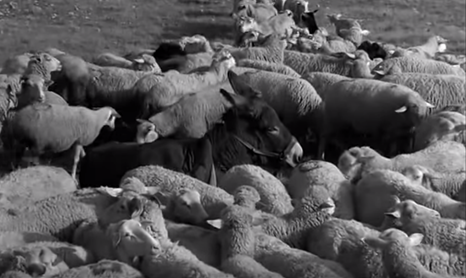
auhasard2Then, Balthazar takes a stray bullet and weakened he comes upon a green pasture where he kneels down peacefully to die. Around him comes a flock of sheep led by a shepherd. It’s a deeply heart-wrenching and visually arresting moment evoking Biblical imagery from Psalm 23. The full life having been lived and now it’s over in tranquility. It’s really a summation of the spiritual journey that each one of us traverses in our lifetime and yet Bresson brings us this allegory through simple, clean strokes. Images and sounds balanced exquisitely together in a completely naturalistic mode of expression.  Wiazemsky on her part is a natural beauty who positively captivates with every move she makes (reminding me of Anna Karina) Furthermore, Bresson somehow causes us to build a deep connection with a donkey which is hard to believe.

It’s the trademark of Bresson to have a stripped-down, straightforward approach to film-making, so much so that his style almost feels like no style at all. It’s so clean and unobtrusive. He shows us the world simply, succinctly, and without pomp. Even with the casting of non-actors, and in this case a donkey, as his main players. But he’s undoubtedly the master of inducing a response based on even the most basic of subjects. There are times it’s almost easy to forget you’re watching a film entirely because you get so wrapped up in what he is showing us.

4.5/5 Stars

The Young Girls of Rochefort (1967)

rochefort1If the Umbrellas of Cherbourg is a piercing operatic drama, The Young Girls of Rochefort is pure, unadulterated escapism at its finest. 

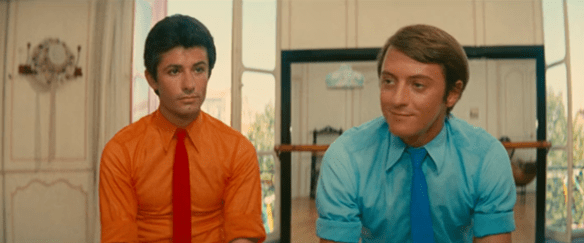
Directed by Jacques Demy and starring an ensemble cast including Catherine Deneuve, Francois Dorleac, Gene Kelly, Michel Piccoli, George Chakiris, Grover Paul, and Danielle Darrieux, this is a whimsical French musical that has no equal. 

rochefort9

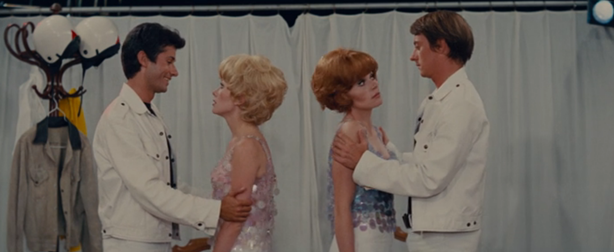
The film opens with a group of performers coming into the town of Rochefort to get ready for a big outdoor show. They become acquainted with the local hangout that includes a kindly matron (Darrieux) and many locals including an idealistic artist and sailor who is searching for his ideal lover. Nearby her two adult twin daughters hold piano and ballet lessons as they too get their little prodigies ready for the big show. Delphine (Deneuve) is fed up with her suitor and desires a new love, while Solange (Dorleac) on her part hopes to advance her career as a pianist. She goes to the proprietor of a local music store to see if he can introduce her to a prestigious American Friend.

A great deal of dramatic irony sets in and the plot is constantly moved forward through song. Yvonne at the café is still depressed over a split with a lover 10 years prior, because he had an unfortunate name. Solange has a chance encounter while stopping to pick up her kid brother Booboo, and Delphine becomes curious about an artist who painted a portrait that looks strikingly like her. All of these events reach their apex on the Sunday of the big performance, and in need of some performer, the carnies enlist the help of the twins. They are a huge success and things wind down.

rochefort4

The next morning the performers get ready to leave for Paris and the girls decide to follow suit. However, Solange has another encounter that changes her plans and then Yvonne is united with her love. That leaves only Delphine to go with the boys to Paris, but not to worry, she would be united with her painter soon enough.

The light and very French-sounding tunes are hard not to like, but that is only the very beginning. Demy pays homage to Hollywood musicals of old going so far as casting Gene Kelly (Singin’ in the Rain) and George Chakiris (West Side Story) in his film. He undoubtedly owes a debt to Vincente Minnelli and Stanley Donen with some striking moments reminiscent of An American in Paris (1951). It makes sense. Demy uses the pastels and costumes of a Hollywood musical extravaganza while also including dashes of French style.

rochefort2

Rochefort takes place in a real location, but it truly is a fantasy world that the characters inhabit, full of perpetual dancing and dialogue that is delivered through song. The real-life sisters do a wonderful job in this film and there is something reassuring about seeing Gene Kelly. Rather like an old friend who gives comfort in a whimsical, but altogether new experience. The story arc of dashed, renewed, and ultimately newfound love allows Demy to once more explore the issues of fate and chance that always seem to enchant him.  His partnership with Michel Legrand is once again bountiful including the enduringly memorable “Chanson Des Jumelles,” an infectiously bouncy, trumpet-laden number performed by the sisters.

There’s nothing much else for me to say except The Young Girls of Rochefort is one of those underappreciated gems that is thoroughly enjoyable and chock full of all sorts of fun. It delivers a serving of something with a familiar flavor while giving it a little extra panache. It’s about as playful and fluffy as you can get which in this case is not a bad thing at all. 

4.5/5 Stars

Review: High Noon (1952)

highnoon1Drums softly beating. A voice mournfully bellowing,”Do not forsake me, oh, my darlin‘.” It can only mean one thing, the beginning of High Noon, a western that has grown near and dear to my heart in the recent years. And yet how can a western of under 90 minutes mesmerize and cause goose bumps to form time after time? That opening ballad sung so wonderfully and folksy by Tex Ritter is one great reason. It’s a mournful dirge of a song which nevertheless draws us into this film, and personally, I cannot help but belt out a few lines now and then (I’m unashamed to say I know the whole song). After all, it’s this song that reflects the story of our main character Marshall Will Kane (Gary Cooper) and reiterations of the tune can be heard throughout for the following hour as we all wait for the noon train.

The song makes it clear that Ben Miller is coming after Kane for sending him to prison. He’s got revenge on the mind and three of his buddies, including his brother, are waiting for his arrival, along with everybody else in town. Meanwhile, the Marshall is about to hang up his badge as it were, because he’s gotten hitched to a pretty young quaker (the estimable Grace Kelly), and they look to settle down with a store in some sleepy town. He’s well-deserving of it after all he’s done and the town stands behind him.

But the news of Miller’s return is no way to start the honeymoon. Still, the couple sets off, but Kane turns around realizing he cannot run (I do not know what fate awaits me. I only know I must be brave. For I must face a man who hates me, Or lie a coward, a craven coward; Or lie a coward in my grave).

highnoon4

This is the backdrop that he’s trying to scrounge up a posse with. Others getting out of town, some telling him he should get out of town too, and a general commotion about what they should do about the whole mess. There are numerous cross-sections and enclaves all with different motives and most importantly excuses. They all turn down a chance to help Kane for one reason or another (even his closest friends). It seems so easy to pass judgment, but then again what would we do in such a situation? In fact, it brings to mind the Hollywood Blacklist which this story was supposed to be an allegory for. This is not just some fictionalized parable, it was mirroring real life to some extent.

What really resonates about this film is the resolve of one man, because when it comes down to it, Kane did not need to stay, he did not need to do what he did, but he stood by his guns, literally, when no one else would stand with him. It’s easy to conform, easy to go with the crowd. It takes real courage to walk out on your own — although the Marshall did have a little help. So whether or not John Wayne thought this film was wholly “Un-American” or not, I think I would have to disagree with him on this one. Maybe what Kane has is reluctant courage, and I could see how the Duke would be disgusted by such a “spineless” individual. But for me, he’s all the more relatable played so aptly by Gary Cooper.

highnoon7It continues to amaze me that a film of this length can have so many wonderful characters who leave an indelible mark on the story. Certainly, you have the hero and the villains, but then we have character actors such as Thomas Mitchell, Harry Morgan, and Lon Chaney Jr. playing some of Kane’s buddies. There’s the gang at the bar and the hotel clerk, who are no friends of the Marshall. There’s his former flame Helen Ramirez (Katy Jurado) and his hot-headed deputy (Beau Bridges). The rest are filled out by men, woman, children, town drunks, and churchgoers. Zinnemann does a wonderful thing aside from just using the clock as a plot device and tension builder. He also calls back all these many characters as the noon train comes in with smoke billowing black. The audience and all these people know what that shrill whistle means. Things are going down, and Kane is going to face it all alone.highnoon2The isolation is so wonderfully conveyed by an aerial shot where the camera moves up to show the stoic Marshall standing in the middle of a ghost town. No people around and no one showing their faces. Then of course, when it’s all over, the floodgates open and all the folks rush into the center of town. Fittingly,  Kane drops his tin star in the dirt in disgust as the refrains of Tex Ritter’s ballad continue.

Put High Noon up against other films and it could be criticized as nothing more than a western, but perhaps that’s why I like it. I cannot help but gravitate towards it. In some ways, it reminds me of growing up and it allows me to forget about any sort of deeper meaning for an instant so I can be fully enraptured with this story, this song, and these characters. It’s a worthy incarnation of the mythic west, that also leaves a little space for some humanity.

People gotta talk themselves into law and order before they do anything about it. Maybe because down deep they don’t care. They just don’t care.” – Martin Howe (Lon Chaney Jr.)

5/5 Stars

Dinner at Eight (1933)

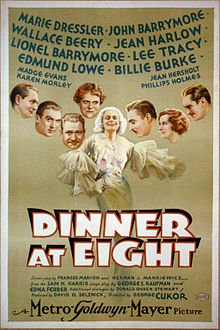
220px-Dinner_at_Eight_cph.3b52734Dinner at Eight is another all-star slug fest from MGM meant to capitalize and top the success of Grand Hotel from the previous year. This time around, well to do wife, Millicent Jordan is setting up a charming dinner party for a wealthy English couple Lord and Lady Ferncliffe who are traveling to New York. The hostess is frantically trying to figure out dinner guests for the big occasion because everything must be perfect. Observant viewers will notice that the high strung lady of the house is played by Billy Burke (more widely known as the Good Witch Glenda). Her husband Louis (Lionel Barrymore) is a kindly shipping magnate, who was hit hard by the depression, and his health is also failing as a result. Their daughter has problems of her own since she does not really love her fiancee and has fallen for the much older, and washed-up alcoholic actor Larry Renault (John Barrymore).

Next on the list of probable invitees is Carlotta Vance (Marie Dressler), the formerly prominent actress, who is now still in the twilight years of her career, but she still carries on a lavish lifestyle with furs and all. She is old friends with Louis, and she is always ready and willing to reminisce, fish for compliments, and offer a little sage advice on the side. She’s a character we like.

The most dynamic pair is most certainly Wallace Beery and Jean Harlow. They play the gruff, crooked businessman and his equally feisty wife, Dan and Kitty Packard. They’re hardly together because he’s working and she’s buying up clothes and caught up in an affair. When the two of them finally are together in the same room, they are constantly at each other’s throats. No punches or barbs are spared. And yet on the invitation to the Jordan’s they both pull their act together. He wants to meet the highly prestigious Ferncliffes, and she wants a chance to get dressed up. They’re quite the match.

With a title like Dinner at Eight, you expect the drama to take place around the table with the guests all seated together. However, that would be rather stuffy, I suppose, and instead, the dinner only acts as the culminating event to push the plot along. We actually never see the guests at the table, only the action leading up to it. Millicent is in a tizzy, especially when she hears the Ferncliffes have a change of plans. Her husband’s health is slowly deteriorating at the same rate as his company. The arrogant actor Larry Renault bickers with his agent about his next role. Honestly, this was the most unsatisfying of the threads, and it did ultimately end in tragedy. However, I’d be interested to know how close this parody actually came to John Barrymore’s actual life, because sometimes it’s hard to know how to parse the fiction from the reality when they seem to overlap.

Once all the guests are assembled it’s a rather ragtag group, but it is a fun mix of characters, and Millicent gets her cousin Hattie to attend along with her Garbo-loving husband who is unenthusiastic about the whole affair. It’s a satisfying overall result and an enjoyable enough ensemble that George Cukor directs with relative ease.

4/5 Stars

Grand Hotel (1932)

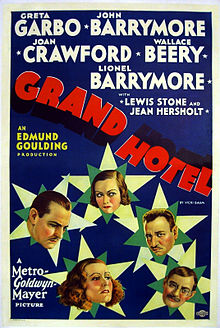
GrandHotelFilmPosterGrand Hotel is the epitome of a Hollywood superstar ensemble, and it would set the bar for all the films that would try to imitate and surpass it. Thanks to Irving Thalberg and the studio with more stars than there are in the heavens, MGM delivered a film that was a smash hit and after well over 80 years, it still remains an important visual relic.

The cast was beyond a contemporary viewer’s wildest dreams. It was that good. You had Greta Garbo, John Barrymore, Joan Crawford, Lionel Barrymore, and Wallace Beery among others. Nowadays many of these names do not carry as much clout (I must admit even to me), and the idea of a film starring numerous big names seems almost mundane. Just take a look at Oceans Eleven or The Avengers. But we must understand that at that time it was a stroke of genius because usually only one or two stars were set aside to be in a certain film. It was seen as the most commercially viable philosophy at the time.

Then came Grand Hotel: As Dr. Otternschlag (Lewis Stone)  muses it’s “always the same. People come, people go. Nothing ever happens.” It’s counter-intuitive but in some ways, that’s what makes this film so much fun. People love stories with fun vignettes that criss-cross and weave in and out. It’s even better when the stories contain the likes of Garbo and the Barrymores. Not to mention Joan Crawford.

It’s a fun world and a lasting tradition that many films have attempted to replicate because honestly, most audiences love these types of realities that they can escape to and in turn, be a part of. In this case, it’s this opulent hotel in the heart of Berlin full of bustling bellboys,  lavish suites, and all the pleasures life could afford.

Furthermore, the guests come from every walk of life imaginable making it all the more enjoyable to watch their intermingling and chance encounters. There is the prima ballerina (Greta Garbo), who has recently gotten cold feet and even canceled a show in her melancholy. It allows for Garbo to utter her famous line, “I want to be alone.”

Then there’s the baron (John Barrymore) who is also in desperate need of money. You might label him a cad because he resorts to theft several times, but if he is a thief he also has a heart of gold befriending and comforting nearly everyone he meets. He especially makes Ms. Grusinskaya very happy and it allows for some amorous scenes between John Barrymore and Garbo.

Next comes Mr. Kringelein (Lionel Barrymore) who is the lowest of all the individuals in the hotel, but since his imminent death is ahead, he is finally going to live a little and he finally gains some of the friends and respect that he has always wanted. On the other hand, Wallace Beery plays Preysing the big magnate who is trying to swing an important deal to keep his company afloat.  Mr. Kringelein is one of his nameless underlings who keeps his books. Preysing has little concern for the “little man,” until he is desperately in need of help.

Last, but not least, is a radiant and spry Joan Crawford as the stenographer. She’s far from the star, but she does seem to steal many of the scenes that she pops up in. Also, despite all the ups and downs, she gets the happy ending she deserves.

I must admit that Grand Hotel takes a little time to set the scene and pick up steam, but when it does it’s a lot of fun. You know it’s a special film when the two Barrymore brothers are acting together, playing two so very different individuals. Yet underlining every scene they share together is the indisputable fact that they are related.  You also have Garbo and Crawford in the same film without either sharing a scene with the other! For an updated take on this type of story give some attention to Wes Anderson’s Grand Budapest Hotel. Otherwise, this lavish 1930s production is worthwhile, because it really does feel like you’re watching film history.

4/5 Stars