The Princess Bride (1987)

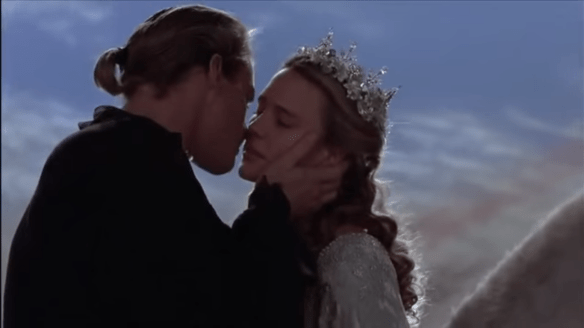
the princess bride 1.png

Few films can please the restless masses that inevitably gather at some unfortunate souls home for a movie night. Because as varied and diverse individuals of a myriad of backgrounds we very rarely agree on anything especially given the proliferation of content that is available to us at any given time. But most can agree on one thing. The Princess Bride is one of the great crowd pleasers of its generation and for good reason.

If quotability was the sole parameter for a great movie then The Princess Bride has few equals and it also happens to be the most fun you’ll have in a single sitting because all that it does, it does with an unquenchable zeal. There’s a spirit to the film full of romance and humor and adventure, even playing to those who will forever be skeptical.

Adapted from his own novel, the venerable William Goldman carries over his framing device of a grandfather reading to his sick grandson and it works marvels to bring us into this tale. Especially when the two actors in question are a precocious Fred Savage (Pre-Wonder Years) and the inimitable Peter Falk (Post-Columbo) slipping seamlessly into the role of a grandpa with a twinkle in his eye.

The story unravels like many great fables with a love story torn asunder by circumstance. A young man who goes off to seek his fortune only to die (or more likely take on the identity of the Dread Pirate Roberts) and a young maiden who is made a princess and remains unhappy all the same without her true love. Of course, she does not understand the nefarious intentions of her soon to be husband Humperdinck nor that her love is going to great lengths to find her. And amidst the fantasy, swordplay, trickery, and rampant humor, love conquers all as it has a habit of doing in fairy tales with everyone of note living happily ever after.

This unabashed tale also boasts near pitch-perfect casting. Cary Elwes as Westley does embody a certain quietly confident charm that while not quite Flynn or Fairbanks still manages to guide the film with similar charisma. He can be the hero, handsome and witty, made to play perfectly off all the intriguing figures who inhabit this fairy tale.

In her debut, Robin Wright glows with a radiant beauty and stubborn defiance that’ s enduring and which in many ways has remained a defining moment in her career and it’s certainly not a bad film to be forever remembered for. Meanwhile, Mandy Patinkin plays the vengeful Spaniard Inigo Montoya with the perfect amount of bravado, honor, and charm in his lifelong search for the six-fingered man who killed his beloved father. He’s the perfect accompaniment for Andre the Giant’s lovable brand of brawn and Wallace Shawn’s hilariously irritating turn as their cackling leader.

But what makes the film even better or the odd sorts who pop up here and there including Miracle Max (Billy Crystal) a curmudgeon wisecracker like no other and The Impressive Clergyman (played by the oft-underrated Peter Cook) who single-handedly ruined the solemnity of wedding vows for all eternity.

Rob Reiner is rarely considered a masterful director but if anything it’s easy to make the case that The Princess Bride remains years later his greatest achievement because it has so much life provided indubitably by Goldman’s superlative script and the very figures who dare to fill his world. And Reiner captures it all with a clarity that comprehends the humor but very rarely goes for that at the expense of characters or story (unless they are villains or Billy Crystal). After all, this isn’t a Mel Brooks film.

By this point, it’s a disservice to call The Princess Bride a parody or mere homage– simply a cult classic that’s garnered widespread affection. The reason people love this film is connected to those aspects but also the very fact it stands on its own.

As Falk sings the praises of the story early on, so we can affirm, it has “Fencing, fighting, torture, revenge, giants, monsters, chases, escapes, true love, miracles…” If that’s not exciting nothing is and it’s quite easy to forget that the film is continuously hilarious but there’s something remarkably moving about its story.  It plays the comedy well but simultaneously builds its own road through the mythology and fantasy of fairy tales that have captivated all people for eons.

In The Princess Bride, there’s not simply roots in comedies like The Court Jester but swashbucklers like The Adventures of Robin Hood or the magical journeying of the Wizard of Oz. It covers the spectrum of entertainment which is part of the reason it’s so satisfying.

It has scenes, moments, lines, those little idiosyncrasies and quirks that have left an indelible mark on viewers and as a result our culture as a whole. Lines like “As you wish,” “INCONCEIVABLE,” or best yet, “My Name is Inigo Montoya, you killed my father. Prepare to die.” Each has its special place within the context of the film and is still imbued with that same meaning hours after.

If I write about this film more from my heart than my head you’ll have to forgive but it truly is a weakness. I can envision being little Fred Savage enchanted by the sheer magic of fairy tales. I wouldn’t begin to care about romance until years later but swashbuckling and humor always had me enthralled and they continue to capture my imagination to this day–no more powerfully than in The Princess Bride.  It’s sheer magic in all the best ways.

5/5 Stars

Blazing Saddles (1974)

Blazing_saddles_movie_posterThough it’s easy to be a proponent of Support your Local Sheriff for its sheer scatterbrained zaniness, Blazing Saddles has that and something more to offer, making it arguably the greatest western satire of all time. Brooks took part in all facets of the film as was his normal prerogative and he sets up the introduction with Frankie Laine belting out the main theme with a tremendous gusto that evokes the grandeur of the West. It makes it ten times funnier when the film actually begins to hit its stride. Because it sounds like a western in the beginning, it even looks like a western, and it goes through many of the plot cycles that we’ve grown used to, but in other ways, it’s so fundamentally different.

The most obvious demarcation Blazing Saddles takes in telling its tale of the Old West involves the very fact that Bart (Cleavon Little) is made acting sheriff of the quaint frontier town of  Rock Ridge. In actuality, it’s all part of a nefarious scheme by the local man in black Hedley Lamarr and his right-hand thug Taggart (the iconic Slim Pickens). Hedley Lamarr uses the incompetent, womanizing governor as his pawn to get the new sheriff installed so the town will be sent in an uproar and he can swoop in and buy off all their land. After all, none of the white folk could possibly hope to live in a town with a black sheriff.

So that is the main conflict at the center of Blazing Saddles and it’s absolutely ludicrous and at the same time still somewhat unnerving and telling about American society. Mainstream white society did not really know how to cope with African-Americans and other racial minorities in some ways and even more so they didn’t know what to do with their own amount of messy history. Because it’s true that even in film, the mythic Old West was not very good to Native Americans or Asians and African-Americans were all but nonexistent. And in his film, Brooks takes all of that on thumbing his nose at every archetype as well as political correctness (although that term undoubtedly did not exist as prevalently as it now does throughout our culture).

Supposedly the writer’s room was utter mayhem for this film with Brooks certainly at the center of the mix with the likes of Richard Pryor and Andrew Bergman also heavily involved. No matter the amount of chaos, however, the film does come off fairly well. It’s laden with purposely absurd anachronisms like Count Basie’s orchestra, for instance, a medieval hangman’s noose complete with a medieval hangman, and of course, droves and droves of Nazis and other baddies who answer Hedley Lamarr’s call for criminal types of all descriptions.

There’s a local dance hall singer (Madeline Kahn) who does her best Marlena Dietrich knockoff from Destry Rides Again, while Mel Brooks even manages to portray a Yiddish-speaking Native American who allows the segregated black wagon train to pass as the whites get attacked.

Gene Wilder takes on a typically understated role as the town drunk and deputy who shares some traces of Dean Martin’s role in Rio Bravo. Meanwhile, the locals (all named Johnson) gather at their place of worship to have a plaintive dialogue about what they are to do to protect their good names a la High Noon. So there you have it. That’s the film in a very small nutshell as Bart must try to calm the townsfolks fears and quell his enemy all the while trying to not go crazy with all the racist white folk.

Be warned that this film does have funny segments but it also happens to be fairly crude which is not necessarily a surprise. Still, it’s obviously something to consider before watching. But it does seem that sometimes comedy such as this is able to enter territory that we’re squeamish to go in our everyday conversations and more serious moments. Because in some sense maybe comedy can poke fun at all the things we take so seriously — the things we need to lighten up about and connect over by the very fact that we’re all human beings.

However, it can also be pointed, ribbing its audience as it highlights the very things problematic not only in our past but in our present too. And that’s one of the most redeeming things that can be taken out of Blazing Saddles. Sure, you can take it simply as a raucous, inane, often vulgar western comedy from the estimable nut Mel Brooks, but it also speaks a little bit to film’s ability to enter into areas that we as a society still need to address.

The use of the “N” word throughout the film personally makes me tense as that word has so much history and a racial charge going through it. But when Brooks used it, apparently with the vehement backing of Cleavon Little and Richard Pryor, you could even argue that its very use takes some of the power away from those who wish to use it perniciously. But that’s necessary dialogue to have.

The best scene in the film has to be near the end, at the studio, as the camera pulls back and we realize we’re only on a film set. An absolute doozie of a pie fight ensues at the commissary to punctuate the utter tumult that is going down thus far and Hedley is pursued by Sheriff Bart and the Waco Kid to the film’s premiere. In the end, they get their man and ride, err, are driven off into the sunset. The fitting ending to arguably Mel Brooks greatest cinematic achievement.  If John Wayne’s any litmus test, Duke famously told Brooks being in the film didn’t fit his image, but he would be the first in line to see it. That gives you a good idea of what you’re in for.

4/5 Stars

The Big Steal (1949)

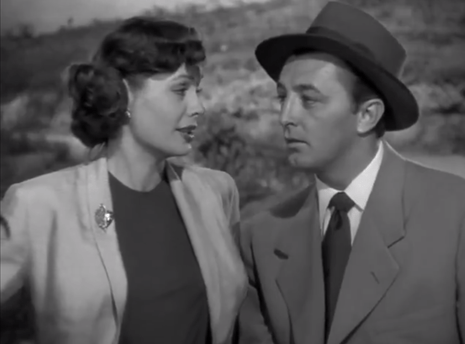
the big steal 1.png

Granted you have star power but it’s easy to assume that The Big Steal will be a no name picture. A minor triumph at best. Not so! This film fares far better than countless of its bigger competitors.

It proves to be a winking romp full of bedroom brawls, car chases, and twists and turns every which way that send us whipping through Mexico. Equally important to the pace of the action is the levity of the script from Daniel Mainwaring (under a pseudonym) that gives our stars something to do and they do it effortlessly.

Robert Mitchum and Jane Greer (partnered again after the undisputed classic Out of the Past) meet as the two obvious foreigners in a sea of locals as Mitchum is getting accosted by a street vendor to buy a parrot. He’s one of those foreigners coming off as a buffoon navigating other cultures and the languages that go with them. Though I can’t ride him too hard as one of those blundering Americans myself. Still, his Spanish is mediocre at best and she is aghast at his cultural insensitivity. So right there you have the needed romantic tension and things only get better going forward.

Because their association doesn’t end there. Of course, it doesn’t. Duke Halladay is out to nab the man named Fiske (Patric Knowles) who absconded with some of his hard earned cash and Joan had a similar job pulled on her — the man of questionable integrity also just happened to be her boyfriend.

The unlikely partnership is formed after Mitchum leaps for the running board of the other man’s fleeing vehicle and winds up dragging Greer in front of the Inspector General to explain the public disturbance.

The Inspector General (Ramon Novarro) happens to be a budding pupil in English as his second in command (Don Alvarado) attended the University of California which while being convenient for the story also manages to make our Mexican characters into actual individuals who are endowed with an animated quality all their own.

If the main chase is our leading couple trying to track down Fiske, who gives them the slip on multiple occasions then the scenario simply gets more convoluted as Duke’s superior (William Bendix) is tailing him. They have some unfinished business to attend to because Blake believes the other man took part in a theft of his own. Thus, The Big Steal is just that. Even the soft-spoken John Qualen (probably best remembered for Casablanca) gets in on the party and flaunts a bit of a villainous side.

Some of the finer moments are the lighter ones. There’s the ongoing patter of the dialogue firing off between Mitchum and Greer which couldn’t be better and it comes from the days where a guy could call a dame “Chaquita” and it’d stick. But the beauty of their relationship is Greer with that quizzical look of hers can dish it right back in Mitchum’s direction.

Likewise, during a winding car chase, the same character can quite seriously exclaim “Watch out for the cow” only to turn right around and create a livestock blockade of his own. Or because we are in rural Mexico cars can get stuck behind a caravan of hay wagons ambling along leisurely. They have no respect for the drama at stake. On another note, I’m flabbergasted that the cars involved survived at all with the dubious amount of off-roading they managed. I guess in the 1940s they built things to last.

There’s one hilarious roadblock in particular where Jane Greer uses her Spanish and Mitchum’s obliviousness to tell a local road worker (Pascual Garcia Pena) that they are madly in love and running away from her disapproving father. They must get through at all costs and it just so happens that Captain Blake is right behind him and receives a fine welcoming committee.

But the key is that the film ends not on the downward plunge but on the upswing as our two lovebirds observe the local mating rituals and give it their own twist. What a great picture and sure, it’s no Out of the Past but no one needs it to be. We already have one of those and The Big Steal is a leisure ride of its own making.

Set this against a backdrop beyond the Mexico border, a spliced together version of on location atmospherics and studio shots, and you are blessed with the wonderful patchwork of authenticity and artificiality that old Hollywood was known for in the 40s and 50s.

What’s more fascinating is that The Big Steal at least in this form might never have been. Robert Mitchum was hot off his notorious jailtime term because of marijuana possession, an event that undoubtedly solidified his reputation as an antihero. Meanwhile, not too happy with Jane Greer, RKO studio head and temperamental mogul Howard Hughes gave her this role out of spite.

How could a picture this small be any good with a leading man saddled with bad publicity? I cannot speak to contemporary audiences but today The Big Steal plays quite well. We have our stars and screenwriter to thank as well as a young up and coming director named Don Siegel who started out as a montage man and transitioned into B-pictures.

What makes him a wonderful worksmith is how he always seems to have a pulse on the action and he turns situations into truly dynamic entertainment even when it’s on a small scale. He didn’t need a big budget to still make a rip-roaring good time. The Big Steal is a stellar testament to what the Classic Hollywood studios were capable of with meager means. It’s an absorbing effort.

4/5 Stars

Hellzapoppin (1941)

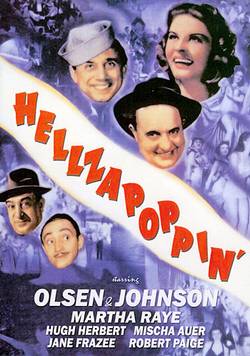
Hellzapoppin_movie.jpgIt essentially begins with a fourth wall break. That’s all you need to know. Because that gives you exactly an idea of what you’re in for with Hellzapoppin’ or rather it gives you no idea whatsoever what you’re in for but really they’re one in the same. I’ve seen the movie and I still don’t quite know what it was.
If you wanted to put labels on it, I think it would be relatively safe to say that this is a comedy. In some small way, it transplants the feel if not the entire success of Ole Oleson and Chic Johnson’s Broadway hit of the same name. And Hellzapoppin’ was a big hit. It only makes sense that Hollywood would want to try and commoditize it.

But fearful of such a fearless anything goes endeavor the studio got cold feet and wanted some “substance” too. And not to be outdone the film’s two stars gave them a plot, ironically, about Ole and Chic finding a plot for the movie they’re in. So there you have it. Problem solved and everyone’s happy. The two nutcases go from an opening routine in hell with a steady barrage of gags to a mediocre plotline at a stately mansion still strung out with a line of gags and it wears its movie within a movie reality right on its sleeve, brazen enough to bring in its director and plucky screenwriter (none other than the always imposing Elisha Cook Jr.). So it’s as close to an “Anything Goes” musical as you can actually get. Yes, you heard that right. Cole Porter eat your heart out.

Anyhow, it’s a testament to the front half of the film, it’s so wonky and zany with wall to wall gags, non-sequiturs, and bits that by the film’s latter half it just cannot maintain that same frenetic pace. And how can you blame it? It does absolutely, insane, inane, and absurd things in the course of an hour or so.

To begin with, it’s barely functioning as a story or if it is a story only for the purposes of its fourth-wall breaks, sight gags, stupid puns, slapstick, and general stretching of all narrative conventions for the sake of some guffaws. But it also happens to be absolutely uproarious in nearly all the right ways — a sheer delight of pure nuttiness.

It’s a comedy disguised as a musical on top of a romance all wrapped up in a metanarrative that will make you scratch your head again and again. You’ll have no idea what you’re watching. You’ll question if the real-life director (not the one in the film) went through a midlife crisis, or if the scriptwriter (again, not the one in the film) was on something, or the projectionist (also not the one in the film played by Shemp Howard) accidentally spliced together multiple reels from different movies right before the film was sent for mass production.

As such, there are no comparisons to be made. Nothing comes close. Maybe Night at the Opera (1935) is the closest I can come– somehow matched with the fourth wall breaking of Rocky and Bullwinkle serials and the metaness of some of Community’s most self-aware episodes. Unfortunately, that’s the best I can do.

When you keep throwing mud up against a wall hoping it sticks comedically speaking, making funny faces, having random people walk in front of the camera, talking to people behind said camera, inserting a storyline to give the pretense of narrative, using every kind of prop imaginable, all while taking some allotted time for song and dance and random asides, this is what you get. Nothing more. Nothing less. That’s all I can say. Because there’s no possible way to even begin to describe what this is.  It’s Hellzapoppin. That’s what. Just watch it. Unless you’re Stinky Miller. Then, go home. Your mother’s calling you (wink, wink)…

3.5/5 Stars

Monsieur Verdoux (1947)

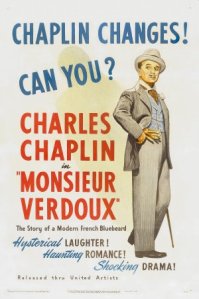
Monsieur_verdoux57Prior to the making and release of Monsieur Verdoux Charlie Chaplin had undoubtedly hit the most turbulent patch in his historic career and not even he could come out of scandal and political upheaval unscathed. To put it lightly his stock in the United States plummeted.
You would think that he more than anyone would have been aware of his current state of affairs. It’s a plausible assumption and yet that’s precisely what makes the release of his latest film during that very climate all the more remarkable.

Chaplin always had a handle on emotional clout and he was the king of pathos but with time as film evolved he did evolve with it and it could easily be said that his sound pictures were imbued with much more prominent political overtones, most notably in The Great Dictator and Monsieur Verdoux. The first was a blatant lambast of the world’s resident tyrannical dictator and his cronies with a tremendous bite that goes beyond simple comedy. The latter film takes a broader scope that’s not quite as evident at first.

It shares similarities with Shadow of a Doubt, Kind Hearts of Coronets, or even The Bigamist and it took inspiration from a passing whim of Orson Welles. But Chaplin plants his particular drama in the previous decade–the age of poverty and depression and that allows him to relate his protagonist once more to the plight of man as the Tramp did perennially. However, Chaplin’s latest incarnation is a far cry from the Tramp and no doubt on purpose. Chaplin had officially retired the character after Modern Times, but with the similarly depicted Jewish Barber in The Great Dictator, Monsieur Verdoux was a character with no semblance of his predecessors.

For lack of a better term, he is a wife killer, a Bluebeard, a gentleman murderer and there’s no other way to put it. Yes, he began as a bank teller with an invalid wife and little boy who hit hard times following the crash. True, he maintains his pretenses at civility and yet here is a character so vastly different from all others because for once Chaplin is making his hero difficult for the audience to like. At the very least, he’s a conflicted hero and as such the contemporary viewer was not about to pity him given Chaplin’s already muddied reputation. This was another nail in the coffin and it’s probably part of the reason Verdoux was generally scorned by the American Public at the time. But now, with the clouds of the cultural moment dissipated we can look at Chaplin’s blackest of comedies without the established biases.

The narrative is comprised mostly of Verdoux cycling from wife to wife, town to town, identity to identity with such fluidity it’s mindboggling. Our only indication that he’s moved is the ubiquitous image of the locomotive always chugging along to the next destination. But we’re introduced to this whole charade through the most curmudgeon, bickering household ever known to man in the Courvais.

The only reason they matter for this story is that Verdoux has married their sister who has just recently taken all her money out of the bank and vanished. Only the culprit knows what happened but presently he busies himself with tidying up his affairs in one location so he can check in on his other “business endeavors.” To Annabelle (Martha Raye) he is a sea captain away months at a time which explains his frequent absences.

Consequently, his Pigeon also has to be one of the most annoying chatterboxes of all time. It makes sense he’s crafting a poison to kill her even if it’s not quite forgivable.  He also calls upon his second asset the rightfully suspicious Lydia while looking to woo the affluent Marie Grosnay who happens to be less of a boob than the rest of his conquests. Though he is a persistent devil. Soon enough wedding bells chime again and that becomes the fateful day when his many strands get tangled in one brief moment at his latest marriage ceremony.

If nothing else it suggests that the time is running out as global tensions rise and Verdoux finds his fortunes dwindle in the wake of his imprisonment. But now on trial, he’s allowed to be up on the stand and mount his final defense–his rebuttal against the indiscretions of mankind. Ultimately, it’s an invariably cynical take on the ways of the world comparing his spree of mass killing to the prospects of the very scientific mass destruction of the world at present. It’s all business, war and anything else you can imagine, merely profiteering endeavors to get ahead. As he walks off to the guillotine the Priest asks him if he has anything to confess and strikingly he asserts, “I am at peace with God, my conflict is with man.”

This is where we overtly see Chaplin’s stance once more as he stands up on his soapbox as it were but he gave us some indications earlier on as well. Verdoux’s most telling interactions come in the form of chance encounters with a particular young woman. At first, he sees her as a test case for his poison, but soon he’s taken with her words, the way she sees the world. It affects him deeply (You better go before your philosophy corrupts me ). And in a striking parallel to Limelight several years later, Chaplin’s character falls to his demise as this young woman’s fortunes increase. She doesn’t forget him. But the rest of the world isn’t quite so kind.

Monsieur Verdoux goes to the chopping block deservedly so as did Chaplin but the verdict’s still out on whether he deserved it all. Perhaps that’s what his film is getting at. He was full of faults as a human being but then again we all are. It makes sense that God is other, perfect, and outside of our messiness. It’s the rest of us that cause ruin, pain, and suffering. That’s where the blackness of this comedy finds its source and it’s something to ponder and then resolve to allay with doses of love and compassion.

4/5 Stars

That Man from Rio (1964)

our man from rio 1

That Man from Rio is a find. It’s a dazzling picture that’s as comedic as it is entertaining bursting with a Brazilian energy that brings to mind the Bossa Nova rhythms of Sergio Mendes somehow married with the world of James Bond. And it’s true, there’s without question a major debt to be paid to Dr. No and From Russia with Love.  It’s a good old-fashioned international thriller in the most delightful sense.

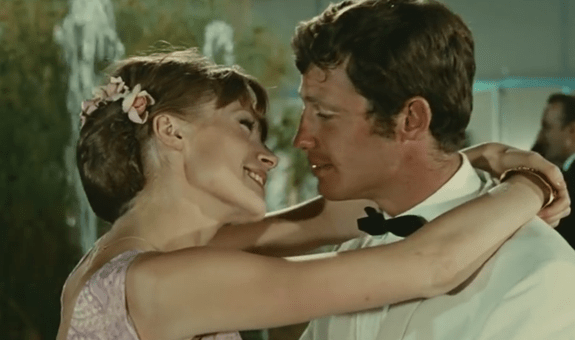
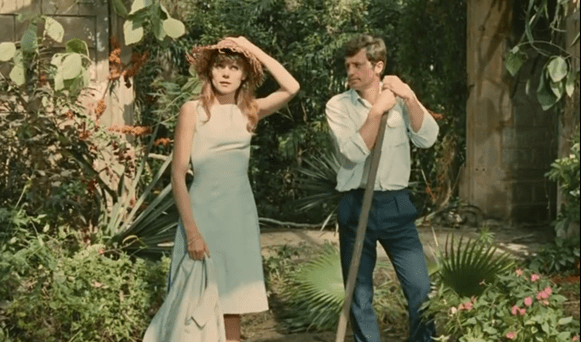
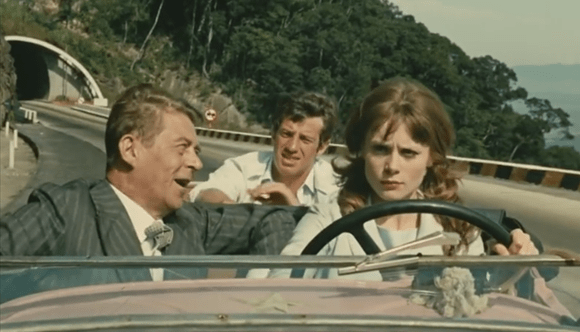
Jean-Pierre Belmondo is one of our intrepid albeit reluctant heroes–more of a Gilligan than a masterclass spy–a bungling Bond if you will.  In fact, Adrien is fresh off a stint in the air force with a week’s worth of leave. And he’s planning on some nice relaxing R & R with his best girl our spunky heroine Agnes (Francoise Dorleac). But that all quickly goes to hell.

Because he doesn’t know what’s going on while his train is rolling into the station. A mysterious statue belonging to the indigenous Maltak peoples of the Amazon Rainforest is purloined from its place at a Parisian museum in the wake of a silent murder. It’s in these opening moments that the film feels strikingly similar to the following year’s caper comedy How to Steal a Million starring Audrey Hepburn and Peter O’Toole.

our man from rio 4

However, the story rapidly leaves behind the museum corridors for territory more at home in, if not Bond films, then certainly Tintin serials. Most memorably pulling from his adventures in South America as well as snatching some eerily similar plot points from Herge’s Prisoners of the Sun and Red Rackham’s Treasure.

Belmondo quickly is thrust into the ruckus as our comical and nevertheless compelling action hero who can be found riding a commandeered motorcycle through the Parisian streets in pursuit of his kidnapped girlfriend.

He’s more than once seen pitifully chasing after a car on foot and his being in the air force must explain why he’s utterly lacking in hand to hand combat skills, more often swinging wildly with blunt instruments and getting knocked to the ground for his efforts. There’s a bit of Indy in him with his own personal Portuguese Short Round, the local shoeshine boy and if rumor serves as fact it’s no surprise that Spielberg supposedly saw the film nine times in a flurry of infatuation. If the influences of Tintin can be seen in Rio, then the film undoubtedly inspired Raiders and its sequels, making it no surprise that Spielberg would produce a Tintin picture of his own.

our man from rio 2

The madcap antics are in one sense reminiscent of It’s a Mad Mad Mad Mad World also featuring trains, planes, and automobiles of every color and description. It too has an outlandish progression of events that nevertheless make for a thoroughly entertaining adventure.

The stolen statue and murder lead to kidnapping and a spur of the moment trip to Rio where Adrien somehow snags a ride on a flight so he can catch up to his girlfriend. But soon they’re both on the lamb, looking for the missing statue and trying to rescue Professor Catalan (Jean Servais), a friend of Agnes’s late father who as luck would have it, also winds up kidnapped. That’s about all you need to know to latch onto to the workings of the plot as they surge ever onward through crazy chase scenes, frantic escapes, bar fights, and whatever else you could possibly imagine.

Phillippe de Broca’s film right from its opening credits boasts gorgeous photography that positively pops making the most of Parisian streets and most certainly the luscious Brazilian locales that still somehow purport a grittiness. There’s the juxtaposition of the worn street corners that at times feel cavernous and somehow still manage to be quaint with a tropical affability thanks to the myriad locals and tourists who inhabit the world.

Having first become acquainted with Francoise Dorleac in The Young Girls of Rochefort opposite her sister Catherine Deneuve, it was easy to consider her the lesser star despite being slightly older. That’s how hindsight gives us an often contorted view of the past. After all, following her own tragic death in a car crash, her sister Catherine has gone on with an illustrious career that has kept her at the forefront of the public consciousness as one of France’s preeminent cinematic treasures.

But after seeing The Soft Skin and now Our Man in Rio with Cul de Sac still to see, it could easily be questioned whether or not Dorleac or Deneuve was a greater star early on as both were involved in some stellar projects. Umbrellas of Cherbourg probably still gives Deneuve the edge but a film like Rio and its star at the very least deserve a brighter spotlight.

Alongside Belmondo, Dorleac is his comic equal as they gallivant frantically every which way both pursuing and being pursued. And from both actors, there’s an obvious exercising of their comic chops that really becomes the core of this film even with its certain amount of intrigue. In truth, they both perform wonderfully and their work here serves as a light, refreshing change of pace. Do yourself a favor and enjoy it.

4/5 Stars

Review: Butch Cassidy and The Sundance Kid (1969)

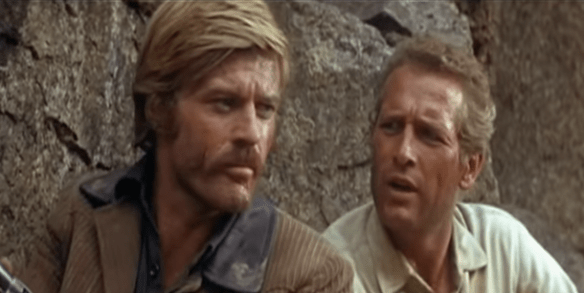
butch cassidy and the sudance 1.png

Despite my general reluctance to say that the Western in its classical form was on the way out, it’s hard not to make such an assertion looking at the landscape of the late 1960s. The Wild Bunch is a common marker of the seismic shift leading to the complete obliteration of the classic western mythology, but there are some related themes strewn throughout Butch Cassidy that make it equally representative of an era or so one could argue.

The times were changing historically speaking and that plays out cinematically in Butch Cassidy and the Sundance Kid. Bicycles are the future, destined to replace the old reliable horse. And the western hero as we knew him has long since gone, replaced instead by vengeful tough guys and in this case a pair of bank robbing antiheroes. Bonnie and Clyde were the new standards and out of that trend, we saw more like them.

So it’s not just the fact that the film takes place at the tail end of the Old West, slowly evolving into the modern, or New West, but simultaneously the genre would never be the same. There’s a bit of a wistfulness to it all. The legend is fun. The mythology is something to be thoroughly embellished, but it too comes to an end. It’s only a wisp of a memory made of sepia tones and silent newsreels. But Butch Cassidy and Sundance will be remembered fondly by the audience just as the West is. Maybe that is enough.

Unfortunately, Butch Cassidy as a film does have its shortcoming which became more apparent with time. It’s possible to be a dated period piece as this film is (although it’s hard not to love “Raindrops Keep Falling on My Head). Still, it can be plodding and some would argue it’s about nothing substantial, nothing meaningful at all. Still, it manages to be one of the greatest western comedies of all time only eclipsed by its own heavy dose of cynicism.

It’s funny watching Butch and Sundance go through their motions. Butch (Paul Newman) is the brains who bemoans the fact that banks are getting upgrades and shipments are being made by trains. After all, they are constantly on the move and it becomes a constant guessing game. He’s given more grief by his gang that looks to overthrow him led by the hulking thug Harvey (Ted Cassidy).

And on top of that every lawman wants him dead. In such moments, being the idea man that he is he entertains thoughts of joining the army for the Spanish-American War or even going to a far off land like Bolivia. Content with his gunplay and letting Butch do the thinking, Sundance rides by his side, certainly his own man but also part of this comic duo.

William Goldman’s script is brimming with wry wit that’s almost inexhaustible. But Paul Newman and Robert Redford loom even larger as the titular stars in this epic buddy comedy. In the age where winning charm and star power still seemed like a genuine box office draw. You came to see actors and in 1969 there were few actors as commanding as Newman and Redford. They had looks and charm. Cool and comedy. Charisma goes a long way. For those very reasons it’s an impressive film and enduringly entertaining. If we cannot watch a film and enjoy it as pure entertainment at least on some level, it really is a shame because that’s one of the many joys of the cinema.

But there’s also something admittedly depressing in how their story evolves. It can no longer be about snide repartee and living the good life robbing banks, continuously augmenting their legendary notoriety. It’s light and funny for a time before slowly spiraling into a deadly cycle.

Perhaps my faith in Butch and Sundance wavered slightly but I will go on resolutely and maintain my immense affection for them that began as a boy. This is still a wonderful film. Outlaws do not have to be one-dimensional. They can be just as funny as they are depressing. That is their right and the legend of the Hole in the Wall Gang is exactly that type of story. We don’t have to see them die. Instead, we get the satisfaction to leave them in one last shining moment of triumph. One final triumph of the West as we once knew it.

5/5 Stars

McLintock! (1963)

mclintock_4

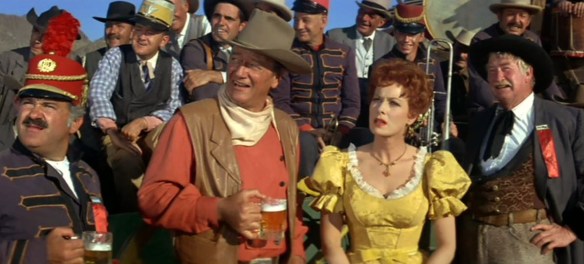
Apparently the name McLintock doesn’t come with the letter T. At least that’s the sense you get when the townsfolk send a salutation to the estimable cattle baron G.W. McLintock (John Wayne). Those who do pronounce that T are either out of towners, educated people, or probably the folks GW doesn’t like much. It’s true that the film is a western reworking of Taming of the Shrew so it’s very much a comedy. For all intent and purposes, it acts as a slapstick farce highlighted by a particularly raucous town-wide fist fight followed by a bungled hanging that just happens to commence right above a mudhole. The results speak for themselves.

But with the influence of its iconic star John Wayne, McLintock is also a fairly obvious commentary from one of Hollywood’s staunch conservatives. Still, the film never acts as a typical Western is supposed to.  In some ways, McLintock is a very modern representation of the West where you have the most amiable sheriff in the world, hardly anyone ever pulls out a gun, and numerous folks have college educations. Except in so many ways, this film can be critiqued for being outdated by today’s standards. There are “Indians,” belligerent Chinamen, and feisty women. GW has mutual respect and good relationships with many of these people but some of the usual sensibilities are still visible.

If the auteur theory can pertain to an actor than this film has Wayne’s handprints all over it. This isn’t a Ford film or a Hawks film or a Hathaway film starring John Wayne. This film is John Wayne’s, even more so than usual.

His son Michael helped produce, he enlisted the son of his old buddy Victor McLaigen to direct, his own son Patrick got a prominent position as a plucky young cattle hand, and so on. He fills the ranks with numerous veteran performers beginning with his greatest female costar Maureen O’Hara as his estranged wife who comes back to town threatening to divorce him and whisk his daughter away to the high society back east.

His trusty right hand Drago is played by Chill Wills while Strother Martin, Hank Worden, and even Edgar Buchannan take supporting turns. Perhaps the most unusual appearances are the presence of the radiant young Stefanie Powers as his daughter and yes, Jerry Van Dyke as a dorky college boy. A special guest spot was found for Yvonne De Carlo as a favor due to the fact that her husband had recently been injured on another film production.

But there’s also a pointed jab at Hubert Humphries in the form of the spineless, insensitive governor Cuthbert H. Humphrey, proving that even Wayne’s politics are channeled into the picture.

The final climax is played for laughs and it does provoke uneasy laughter, at least by today’s standards. It’s hard not to feel strange watching Maureen O’Hara running through town in her undergarments as G.W. pursues her and the town follows behind in hot pursuit. It’s full of pratfalls and slapstick moments that are indeed funny but at what cost?

For some reason, despite the light tone up to this point, it feels cringeworthy when Wayne knuckles down and gives his long-absent wife a shellacking right in front of everyone. Of course, by the end of the film they are together again and I wanted to be happy but this was not The Quiet Man (1952). It felt like Maureen O’Hara had conceded and lost. She returns to the cult of domesticity with her husband which isn’t inherently a bad thing but she hardly feels like a full partner in their complementary relationship.

By this point, although she had the upper hand the entire movie, digging in her spurs, she’s put in her place. In the end, she and GW get to live the life he wants. Because as he notes, “all the gold in the United States Treasury, all the harps in heaven, can’t equal what happens between a man and a woman with all that growing together.”

It’s true that using the word petulant to describe McLintock just doesn’t work. His daughter tries it and he laughs it off and I’m sure if any critic wrote as much Wayne would have done the same or cuffed him one maybe. There were invariably many people who didn’t much like John Wayne but it’s hard not to respect him–even in a comedy.

3.5/5 Stars

The Whole Town’s Talking (1935)

the_whole_towns_talking_1935_posterComic mayhem was always supercharged in the films of the 1930s because the buzz is palpable, the actors are always endowed with certain oddities, and the corkscrew plotlines run rampant with absurdities of their own.  Penned by a pair of titans in Jo Swerling and Robert Riskin, The Whole Town’s Talking opens with an inciting incident that’s a true comedic conundrum.

Bald and beady-eyed Mr. Seaver is called upon to fire the next employee who comes in late to work. A tough proposition to begin with but it gets worse.  Arthur Ferguson Jones has not been late to work in 8 years and of course, today’s the day his alarm clock doesn’t work. Although he gets a reprieve. Still, the next person walking in isn’t so lucky. The hardy, wisecracking Miss Clark (Jean Arthur). And that’s our introduction to our main players.

But the real wrench comes from an age-old device that’s easy to scoff at initially. There’s a doppelganger. Yes, the same upstanding, timid Arthur Ferguson Jones is cut in the spitting image of Public Enemy No. 1, Killer Mannion. But before you check out, consider what this does for this ruckus of a story. It ties it up in knots.

Jones is the talk of the town. Exploding flashbulbs. Cover stories. Tumult. Back in the glory days when the press ran in a pack like hyenas.  His boss invites him to dinner, wants an autograph for his boy. He’s being ribbed by his coworkers and Miss Jones takes an interest in his literary endeavors. This leads to a gig ghostwriting the gangster’s life story in the local paper.

Meanwhile, the police argue about what to do about him. They finally decide to give him a special passport. It says he’s not Killer Mannion. And hapless little Mr. Seaver still badgers his employee to finish up his waiting caseload. What no one expects is that Mannion will sneak into Jones’ home and sets up camp.

And from that point on, everything gets confused. Robinson gets a chance at a great deal of range sometimes having his two diverging roles playing off each other in the same frame. All you need to know is the gangster is looking to leave his new benefactor holding the bag for his numerous crimes. Whether it works out or not is quite another story.

This a particularly odd film for the talent assembled. It doesn’t especially feel like a John Ford film and not simply because it’s not a Western. But at this point in his career, his stock company isn’t even assembled.

Edward G. Robinson will always be identified with gangster pics and it’s true he was tired of that association. Here he’s playing comedy. He has one foot in his usual wheelhouse but the other seems utterly alien to his usual persona. As such it’s great fun.  And his timid common man isn’t even a tragic figure like Chris Cross (Scarlet Street). The comedy is far more apparent and that in part stems from Arthur.

She shows up late to work, gets fired, and still has quips coming out of her ears. She plays all the journalists trying to pump her for facts and at the same time falls for this dope who has her picture framed by his bedside. Perhaps better than anyone she perfected how to be cheeky but still wholesome and caring. Arthur feels most at home in this film more than anyone else, given her comedic pedigree but she and Robinson bounce off each other well.

In a few years she would play a Miss Jones but for right now she’s content calling her colleague by the pet name “Jonesie” and (tiny spoiler) she does become Mrs. Jones. So an oddball romantic pair they might be, but that doesn’t make the partnering of Robinson and Arthur any less amusing. They’re both on their A-game in The Whole Town’s Talking and thankfully there would be many more arresting performances to come.

4/5 Stars

Shoot the Piano Player (1960)

shoot-the-piano-player-1

Shoot The Piano Player begins thrillingly with a car chase. The man being pursued flees down a street corner, his assailants disappear into the night, and he subsequently bounces off a streetlight like an idiot. The man who brings him back up on his feet proceeds to regale him with stories about how he met his wife before walking off, never to be seen again.

In fact, none of these characters are our main protagonists but it perfectly encapsulates the glories of Francois Truffaut’s stroke of genius in this early emblematic film of the New Wave.  It’s a petty crime story with a comical streak. The two tough guys aren’t tough guys at all but with their hats and pipes they look like a pair of Monsieur Hulot doppelgangers or something. That is until they pull out a gun. But even then, they’re hardly thugs.

Listed out as simple plot summary, it has certain flourishes fit for a Hitchcock thriller. A man on the run. Lurking criminals, kidnapping, murder, romance, humor, but there’s no doubt, even with this being only his second feature, that this is very much Truffaut.

It’s all a wonderful front for Truffaut’s own explorations. And the bottom line is not simply homage to film-noir and the Master of Suspense but more broadly all his fascinations of men, women, love, and everything that intrigues him about putting a mirror up to humanity–cinema itself. However, as the director long suggested, he preferred film to reality because he could orchestrate it, make it to his liking, with touches of humor and tragedy.

This pseudo-storyline starts with Charlie who placidly knocks out honky tonk for the public’s enjoyment. It’s hard to know if he’s content or simply biding his time. The latter seems more likely. Except when his big brother Chico busts into the joint with a couple of hoods on his tail, in some small way it brings everything rushing back on Charlie.

shoot-the-piano-player-2

It’s not much but the ensuing events have him wrapped up in his own bit of intrigue as he navigates his romantic inclinations and every other thing that is thrown his way.  A Hollywood reference point would certainly be Out of the Past and similarly sinks back into a flashback. But here it is used in a way that’s completely jarring, hardly convenient for those seeking comprehension. And Truffaut’s character utilizes voiceover as well but this is not the laconic, cynical speak of film-noir, instead the nervous inner monologue of a timid piano player.

His sometime bedmate and the housekeeper for his kid brother is Clarisse. Meanwhile, the waitress at his work Lena has his heart going pitter patter, not quite a Hitchcock blonde but a woman who is willing to get involved with his drama. But there was also another important woman in Charlie’s life: His wife.

It’s from these three women in their relationships with Charlie and all the other male characters that some very blatant realities become evident. There’s a conscious separation of the woman into parts whether it is her heart or her body. In one sense, the aforementioned women are strong characters. Meanwhile, the men are all fairly passive, their main outlets include objectifying, ogling, even ridiculing their female counterparts.

At least Charlie’s candid about it but he’s still part of the problem. In many ways, in looking at the women as the tragic figures often used by men as a cinematic object, Truffaut could very easily be wrestling with his own issues of love and romance. What does that actually mean? What causes people to marry? What causes them to love and fall out of love, break up and come back together or even commit themselves to death?

All that can be found within this film although it is obviously veiled by scenes masquerading as crime and comedy. The crowning joke of them all is really a kind of tragedy. Amid the strangest turn of events, Charlie or Edouard (as we now know he is called) is resigned to play behind his piano once more.

The final moments at the snowcapped cabin are madcap and still almost surreal with some stunning sequences captured vividly by iconic New Wave cinematographer Raoul Coutard. In breaking so cleanly with his initial effort of The 400 Blows, Truffaut simultaneously positioned himself as a very special filmmaker. He’s beholden to drama, comedy, crime, and romance, but most of all, he’s beholden to the magic of the silver screen.

4.5/5 Stars