The Graduate (1967)

thegraduate1“You’re living at home. Is that right?
Yes. 
Do you know what you’re going to do?
No.
Are you going to graduate school?
No.” ~ Elaine Robinson to Benjamin Braddock

As a recently graduated person, I thought it was only pertinent to return to this landmark film to see if I could glean any new insight. In many ways, the main premise of The Graduate always repulsed me. I couldn’t get behind the comedy because it seemed so at odds with what is going on onscreen.

But now I think I more fully understand Mike Nichols’ style as he leads us through Buck Henry’s script. There certainly is a wicked wit dwelling there, but there’s also more to it. He’s trying to undermine social mores and say something by switching tones on us. In this case, it seems like he’s talking to all those listless souls just set adrift after college. He was their elder, but in the characters of Benjamin Braddock (Dustin Hoffman) and some respects Elaine Robinson (Katherine Ross), young people found their equals.  People they could relate to in their own anxiety and at times apathy about the future. And it’s as much Elaine’s story as it is Ben’s since they both are riding off into the great unknown of their future together.

Thus, this isn’t just about an affair, though that did help to shatter the Production Codes. There is so much more that actually causes Benjamin to get involved with Mrs. Robinson (Anne Bancroft). The implications extend far beyond.While The Graduate‘s main hook seems rather curious, the rest isn’t all that crazy. In fact, it’s quite relatable.

We get our first view of Ben, sullen and anxious as he rides the moving walkway in the airport terminal. The haunting vocals of Simon & Garfunkel’s “Sound of Silence” ring in our ears, but there’s also that almost comical voice reminding travelers to use the handrails.

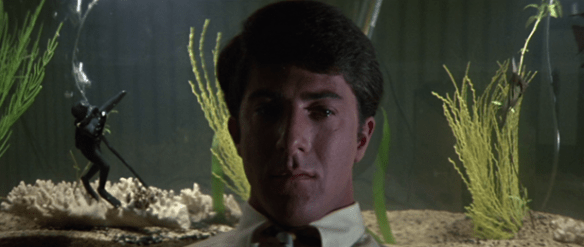
It’s when he touches down and gets home that things become all too real. He’s entering back into his parent’s world which is reinforced by this general theme of suffocation and in some sense alienation, fawned over by parent’s friends and encased in a scuba suit. Ironically, he’s no hippie or counter-cultural revolutionary, but he still feels at odds with the community he finds himself in. There’s a generational gap, and even Hoffman’s own portrayal is so contrary to this WASP society. In casting Hoffman, not a particularly handsome young man, an atypical example,  Nichols is ratcheting up the irony.

thegraduate2Then Mrs. Robinson coolly enters his life. It’s perhaps best signified when she tosses him the keys. They end up in the fish tank almost as if on purpose and after that she has him reeling for good. Soon he’s walking into the lion’s den (or lioness’s) as she expertly manipulates and elicits the precise response from him. In these moments the film is elevated by the awkward, huffing and puffing, and nervous chattering of Hoffman. We often forget the second part of his famed line, “Mrs. Robinson you’re trying to seduce me. Aren’t you?” His general naivete and hesitancy say it all.

I also made a startling discovery. Ben doesn’t have any friends! Or else, where are they? The inference perhaps being that he spent so much time being a track star, being on the debate team, and being editor of the paper that he never stopped to do the other things that college is all about. Building relationships with other human beings your own age. When he gets out and realizes his directionless anxiety, he tries to remedy it in other ways. The most obvious way is sleeping with Mrs. Robinson.
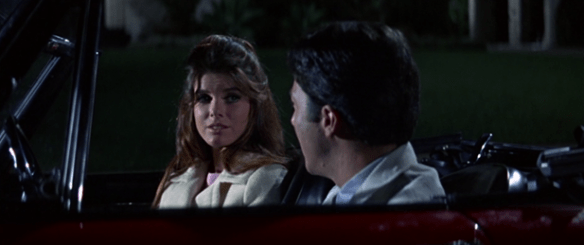
thegraduatesBut when he meets Elaine Robinson and finally begins to connect with her on a peer-to-peer level, it’s something so profound to him. Having someone his own age that he can relate to, who feels the same unnamed apprehension and angst that strains on him. It’s what makes Ben become so mixed up. He has true feelings for her, while his affair with Mrs. Robinson only serves to poison all that could be good. And his illogical, unhealthy pursuit of Elaine continues to Berkeley where she is attending school. Still, Mrs. Robinson and her now estranged husband look to send their precious daughter far away from Benjamin Braddock.
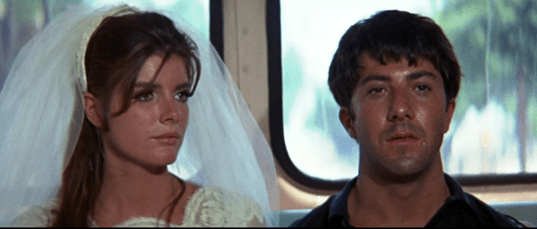
thegraduateThat’s what makes his final Herculean effort all the more climactic. He bursts in on her marriage to another man and whisks her off to another life altogether. A life that seems exciting at first, because, oh how great it is to be young and in love. But once they climb aboard that bus in their tattered garments, have a chance to sit down and really think about what they are embarking on, you see something else in their eyes. The laughter slowly dissipates and as they look around nervously, they begin to somber up. True, Ben is no longer alone in an airport terminal, he has a fellow traveler, but that does not make the future any less unpredictable or scary for that matter.

That is the life of a graduate. In so many ways feeling like an outsider, a foreigner in a land that you used to know. You’re living at home. You don’t know what you’re going to do and you’re not going to put off the decision by going to grad school. We’ve all been in a similar place one time or another and that’s why this film resonates, not only with the generations of the 1960s but even to this day.

What truly elevates The Graduate above Nichols’ other films, aside from this universal quality, is the stellar soundtrack courtesy of fellow New York natives Simon & Garfunkel, who became icons of the folk scene during the 60s and 70s. Their album Bookends is still a classic, featuring the fully polished version of “Mrs. Robinson.” While not all the lyrics are here in the film, it became an anthem, reflecting the gap created between the older generations and their kin. While the likes of “Sound of Silence,” “April Come She Will,” and “Scarborough Fair” lend themselves to the more introspective moments of the film like no score ever could. It’s part of what makes The Graduate a cinematic watershed of the 1960s.

4.5/5 Stars

Man in the Moon (1991)

maninthe1Robert Mulligan is an unassuming film director. Man in the Moon would be his last film in a career that was not so much illustrious as it was respectable. In truth, I’ve only had the pleasure of seeing one of his other films — his crowning achievement To Kill a Mockingbird.

There are in fact some similar threads running through these two films, starting with the Deep South nostalgia and close analysis of adolescence. Both these films take the point of view of a young girl. Their narratives hope to shed at least a little bit of light on that intricate stage of life. This time a 14-year-old Reese Witherspoon is our lead, playing the Elvis-loving, gum-chewing, spunky dynamo named Dani. She and Scout share a lot in common because as young people there’s an inherent tendency to mope, question, and disregard. They have not quite grabbed a hold of the mature world of their parents. After all, they still have a great deal to experience. That’s what makes these film arcs necessary.

Man in the Moon starts with Dani, but there’s a whole family unit around her. A father (Sam Waterson) who is a decent, down-to-earth-man, and he would rather commune with nature in his fishing boat than go to typical church. A mother (Tess Harper) who loves her husband and daughters dearly, knowing when to trade tough love for hugs. Maureen (Emily Warfield) is Dani’s oldest sister and her idol, along with the object of every local boy’s desire. She’s beautiful and yet what’s more extraordinary is her good nature. She doesn’t deserve the creepy father and son duo eyeing her in the local town.

maninthe2Arguably, the next most important character in Dani’s story is Court (Jason London). They have your typical terse meet-cute that signifies only one thing. They must fall in love. It turns out he’s the eldest son of an old friend of Mrs. Trant. Soon things change for young Dani because she’s never known someone like Court, much less liked a boy.

Their relationship is one of those complicated entanglements. He’s a few years older and is the man of the house. He has to grow up quickly and views Dani as a child. But their friendship blossoms with frolicking afternoon swims. Dani is ready for something more. She thinks she’s in love. Now if Court was one of the other boys, he could easily take advantage of the situation — this fawning girl who is madly in love with him. But he’s not like that. Dani can’t quite get that through her head. It just doesn’t make sense. They enter friend territory and Dani’s heart is still aflutter, but she’s happy again.

maninthe3The second half of the film enters melodramatic territory that first hits the Trant’s with familial turmoil, and then Court. Dani for the first time in her life is faced with the full brunt of tribulation. What makes matter worse is her feelings are all mixed up. She loves her sister. She hates her sister. She cannot bear to see Court. She cannot bear the suffering. It’s in these moments that uncomfortable feeling well up in the pit of your stomach.

Man in the Moon like many of the great coming-of-age movies is really about adolescents coming out of their innocence and being inundated with the often frightening realities of life. It reminds even the youngest of us that more often than not life is unmerciful. It’s how we pick ourselves up out of that fatality that matters. It’s hard but that pain is often how we grow and mature — learning how to cope with the way things are. That’s what makes the people around us so integral to existence. They can be our lifeline that keeps us afloat. Thus, Dani’s friendship with Court matters so much. That’s why Dani’s relationship with Marie matters too.

Perhaps the drama is laid on rather thick, but nevertheless, it’s difficult not to get behind this film. Reese Witherspoon’s perkiness is wonderfully disarming, and Jason London plays a decent young man. These are characters I want to watch and emulate. Not quite Scout and Atticus, but they are still definitely worth the time.

4/5 Stars

You’ve got a right to grieve, Dani. You got a right to be hurt. But if you get so wrapped up in your own pain that you can’t see anyone else’s, then you might just as well dig yourself a hole and pull the dirt in on top of you, because you’re never going to be much use to yourself or anyone else. ~ Mr. Trant 

Note: This review previously said Marie (Gail Strickland) instead of Maureen (Emily Warfield)

Garden State (2004)

gardenstate1Garden State was written and directed by Scrubs star Zach Braff before he made it big, while he was still struggling to get into the business. It’s one of those deep blue funk movies where a person has to find themselves in the giant mass of humanity. Andrew Largeman’s mom just died from drowning in a bathtub. He hasn’t seen his dad (Ian Holm) for about a decade because they haven’t really been on speaking terms. Now he lives in L.A. across the vast expanses from his native New Jersey. He works in a very zen Vietnamese restaurant and surreal daydreams clutter his apathetic mind.

The question is what will shake him out of his despondency because the death of his mom is only the inciting incident. As it is with a small town community, he’s constantly meeting all the old acquaintances from his high school days. Most are impressed by his foray in acting even though he hasn’t made much a career of it yet. The people he reconnects with include his old friend Mark (Peter Sarsgaard), who works at the cemetery and doesn’t have much of a life except smoking weed. Then there’s Jesse who made a killing off Silent Velcro and now has all the time in the world for parties in his huge mansion.

That’s not what does it though. It’s when Andrew is sitting in the doctor’s office, hoping to get checked, because he’s been having headaches after being off the meds he’s been prescribed all his life. There he meets Sam (Natalie Portman) for the first time, and he’s never the same. She’s a scatterbrained, off-the-wall personality with a lot of energetic pizzazz. That about covers it except she also has epilepsy and is a compulsive white-lier. But in her Andrew finds a genuine spirit, who can revitalize his life, by giving him sympathy in his pain, while also brightening up his everyday reality.

gardenstate2On his last day in New Jersey, Andrew obviously wants to spend the time with Sam, but it ends up turning into a daylong treasure hunt as Mark tries to track something down. It isn’t much, however, it’s the thought that counts, and on their odyssey, Andrew is finally able to let go of a lot of the hurt and pain he’s been harboring. He’s ready and willing to forgive his father.

Then, there he is in the airport terminal getting ready to leave Sam for L.A. He has to get back and he promises to call her, but he seems to remember he’s a different person now. It’s a delightfully sweet ending to the film and we absolutely want it.

gardenstate3Braff’s wistfully apathetic demeanor is so wonderfully personified by a memorable soundtrack including alternative rock groups like Coldplay and especially The Shins. His brand of acting is really just playing a wet noodle, but he does it well. Those beady eyes of his constantly scanning back and forth nervously around the space he inhabits. And the film certainly has some dirtiness around the edges, but our main couple is so endearingly sweet. I respect a film that respects its characters such as not needing to show them having sex all the time, but it can paint their romance in more playful, soft, even intimate shades. Andrew takes drugs and curses, but only to dull the pain or express his bitter frustrations. Sam’s the kind of girl who states that she’s not innocent, confirming our suspicions of just the opposite. We appreciate both of them exactly for those reasons. He rides an army issued motorcycle with a sidecar for goodness sakes, and she gets teary-eyed over a deceased hamster. They’re quite the pair.

3.5/5 Stars

Starter for 10 (2006)

215px-Starter_for_tenOftentimes I get my greatest excitement not simply from the masterpieces I get to discover, but also hidden gems that get unearthed along the way. This one just happens to have some of Britain’s best talent. Starter for 10 is a coming-of-age film which immediately sets off a number of ideas in one’s head, and it has most of what you expect in that department. However, it also has an astounding plethora of young British talent. The list of names is as follows: James McAvoy, Alice Eve, Rebecca Hall, Benedict Cumberbatch, Dominic Cooper, and even James Corden.

The heart of this film is Brian Jackson a college-aged kid, who grows up wanting to be clever and he has a passion for trivia because he always wants to learn more and he spent some formative moments in front of the telly with his now deceased dad. Now in 1985, he gets ready to leave his mother (Catherine Tate) and head off for new experiences at Bristol University. But she’s not the only one he leaves behind. His friends Tone and Spencer are not as ambitious as him, but he promises not to forget them.

Still, when he gets to college, he’s excited for the new challenges ahead and although his first acquaintances are rather odd, he does meet the winsome girl Rebecca Epstein (Rebecca Hall), who has an affinity for political protests. Soon he’s quick to join the University Challenge quiz team anchored by a very stuffy post-grad (Benedict Cumberbatch) but that’s not all. He also gets his first encounter with the posh girl with a gorgeous figure (Alice Eve). He’s immediately smitten with this new quiz kid and for good reason.

But what follows is all the drama that one would expect. The pitter-patter of his beating fragile heart as he dreams of days with the beautiful Alice. It even manifests itself in a dinner date and a rather awkward New Years with her parents. But then there’s Rebecca too. She’s brilliant as well and he has to figure out what he’s doing. Mixing up names on New Year’s Eve is not the best plan, but of course, that’s what happens.

His best friend Spencer (Dominic Cooper) comes to visit and that fosters more turmoil than Bri would like with the old world intersecting with the new. He’s confused and apathetic about the University Challenge by now. Everything goes wrong before the big day of the final competition and to top it all off Brian messes things up in a big way that leaves him dejected. He cannot even face his team now. Early on Brian latched onto the idea that knowledge is the key to being happy, not a job that you might hate. Although that can be true, it seems he slowly realizes that there’s even more to happiness than knowledge. If that’s all you have, you’re probably not going to be all that content. You see, he’s certainly clever, but that doesn’t mean he doesn’t do some stupid things and make some big mistakes. Don’t we all, and otherwise, this could not be a coming-of-age story full of discovery, confusion, and love.

It’s a bad metaphor, I know, but do you want the Marilyn Monroe blond bombshell or the sweet Audrey Hepburn brunette? Everyone has their proclivity, but Brian seems to make the right choice because he doesn’t go with the outward appearance, he goes with the one with a depth of character and the ability to forgive. That’s big.

There’s a formula being followed certainly, but it’s easy to look past that and enjoy Starters for 10 for its heartfelt performances and simply the good fun it brings to the table. The names attached to the picture were slowly on the rise and it’s impressive to see how far their careers have taken them.

3.5/5 Stars

Me & Earl and the Dying Girl: Depth and Dying (2015)

meandearlandthedyinggirl1What struck me about Me & Earl this time around was not just the cinematic homage or the quirky indieness, but the fluid movement of the camera matched with the ever-evolving score of Brian Eno. It made me appreciate this film yet again because some people might say it’s weighed down by over-trod tropes, but it leaves those in the dust. Others might criticize it for playing up to all the cinephiles out there in order to garner respect. Which might be true.

But in essence, this film resonates on such a greater level. All the side characters are fun and interesting and I’m sure all the various parodies will open the floodgates for some enthusiastic young moviegoers to discover film’s roots. Those are all wonderful perks of this story. And yet again, Greg Gaines feels so relatable it’s almost scary at times. He’s so insecure on so many levels, drifting in and out of the school corridors, awkward around dying girls, and awkward around girls in general. Most of this I pointed to already in my initial review.

However, it’s the work of director Alfonso Gomez-Rejon along with cinematographer Chung-hoon Chung that contribute an added layer of depth to this film. The gracefully spiraling camera is at times reminiscent of Ophuls ascending a staircase. There are perfectly symmetrical shots popping with colors that Wes Anderson would most certainly approve of. But like the great minimalists out there, the camera is still when necessary. In poignant moments when Greg and Rachael have real, heartfelt, even hurtful conversations, there’s no need for flashiness. It’s in these moments where those behind the camera prove their skill because we can see them having fun with their artistic vision, but we also notice the great deal of care they have for these characters.

meandearl2It never feels flashy or superficial in these crucial moments. Any slick plot device or cinematic allusion falls away to get at the heart and soul of this film. It’s about coping with death and finding closure in that terrible event in life. Specifically for this one young man, but it is universally applicable to most every one of us. Especially when you’re young because as young, naive individuals, death can feel like such a foreign adversary. It’s so far removed from our sensibilities, and that’s what makes it so painfully unnatural when it strikes. In many ways, Greg is our surrogate. For all those who struggled to find themselves in high school, or college, or even life in general. And for all of those, who took risks on friendship in a world full of death and dying. Once more Me & Earl and the Dying Girl proved its worth, not by being a perfect film, but by being a heartfelt one.

4.5/5 Stars

The Virgin Suicides (1999)

VirginSuicidesPosterIn her debut, Sofia Coppola fashions the 1970s with a washed out wistfulness that feels like a distant memory — lingering for a time — leaving a few far away remembrances to be eulogized and reminisced about.

Her film is really about two groups. There are the Lisbon girls who live with their militantly authoritarian parents and then the neighborhood boys who look on with awe. These girls are the unattainable prize that all of these young men are entranced by. They are not besmirched or dirtied by the ways of the world, stuck in the ivory tower of their parent’s home. It’s almost as if they come out of a dream, so pure and in the same way so provocative.

However, things get shaken up when the youngest daughter attempt to commit suicide and then in a free moment she jumps out of the window and meets death by the metal fence posts below. Red flags should be going up everywhere, but stubborn Mrs. Lisbon only becomes more stringent in her moralistic ways. She should be trusting her daughters, allowing them certain freedoms, but she only takes away more. And reluctant Mr. Lisbon does nothing to stop her. He just lets it be.

Only allowed to socialize at one dance under strict guidelines, the girls relish this opportunity and so do the boys. They finally get their chance with a different class of girl. But after the smitten Lux breaks curfew, all the sisters lose all contact with the outside world. The iron gates go down, and she never gets another moment with high school heartthrob Trip. On top of that, their mother makes her burn all her records in another strict turn.

Lux defies her passively in any way possible as she and her sisters try and maintain contact with the boys on the outside. But there is a point for any person where this type of confinement, this type of prison, gets to be too much. The girls reach the end of their rope and take the only way out they can see.

Oddly enough, most of the boys have little personality, but the focus is the Lisbons and specifically their daughters. The Virgin Suicides was partly intriguing because it never seemed to take on some dramatic tone and it never felt all that personal. I felt so far away. As Carol King mournfully sang, “Doesn’t anybody stay in one place anymore. It would be so fine to see your face at my door. Doesn’t help to know you’re so far away.” That’s exactly what this film does. It doesn’t allow us to get close and that aloofness lent itself to the intrigue we have in these girls. We’re pulled into their story along with all these young boys.

3.5/5 Stars

Adventureland (2009)

AdventurelandposterOddly enough, the same year the cult favorite Zombieland came out there was another film starring Jesse Eisenberg, also set in a theme park, that did not seem to get as much acclaim. That film is, of course, Greg Mottola’s Adventureland, a coming of age comedy-drama which I actually enjoyed a lot more than his previous effort Superbad.

Adventureland is the basic graduate, boy meets girl, summer job formula. Undoubtedly we’ve seen it before in many forms, but Jesse Eisenberg makes it work again as James Brennan, a high school graduate living in Pennsylvania circa 1987. With little money under his belt and his father getting a pay cut, the only choice he has is to get a summer job. He’s an extremely bright kid. Good at mathematics and the like, but he also has little real-world experience so his last resort is the local amusement park Adventureland.

Instead of an interview or a resume, they look him over, take down his name, and hand him a t-shirt. And so begins his reign as a games booth attendant for Bobby and Paulette (SNL vets Bill Hader and Kristen Wiig playing their typically lovable weirdos).

The staff is rounded out by an eclectic mix of misfits and characters steeped in folklore. There’s the constant jerk of a best friend Tommy Frigo. The bespectacled wisenheimer Joel who also has a penchant for high-end literature. The legendary and alluring Lucy P. who is the park’s eye candy. Mike Connell the parks handyman and part-time musician who is rumored to have played with Lou Reed.

But the most important character, for the purpose of this story, is Em who also works in the games department and saves James from literally being stabbed by a shifty customer over a giant stuffed panda. There’s nothing overly romantic about it at first, and that’s what makes it so intriguing. He’s not the kind of guy who has a lot of experience. School was his forte. Em is cool, collected, and went around with a lot of boys during high school. She’s been around the block as well as watching her mother die. She’s in many ways more wise to the world than Joe.

But she openly invites him into their little community, extending an invitation to a party she is having at her place. He never could imagine being so lucky, but to Em, it’s not a big deal. His mind is racing, and he cannot help but get excited about this amazing new girl he has met. Em is sleeping with Connell who is struggling in his marriage. This looks to be very messy in the foreseeable future.

It is. Em and James share their first kiss, and it’s magical like it’s supposed to be. It all moves so fast and James has heightened feelings for her. But she wants to take it slow with all the crap still in her life. It’s seemingly understandable, but it’s not what James wants to hear.  She’s so hard for him to read.

On the advice of Connell, James accepts Lisa P’s invite on a date, because, after all, it’s any boys dream to go out with her. But afterward, being the kind of guy that he is, James feels almost unfaithful and candidly shares his actions with Em. She thanks him, but her own rendezvous now weighs on her mind. She looks to end it with Connell, but of course, James finds out and it hurts him like nothing ever has.

It’s at this point in the story that the downward spiral begins. James turns to Lisa P. as his confidante, but the news of Em gets out and she quits, moving away to New York. A downtrodden James has little more to do but get drunk, and it does not bode well. All the money he tirelessly worked for ends up going down the drain. But he ends up going to New York anyway, to take a chance on a girl, because he is overwhelmed by his feelings, but he also sees Em differently than she even sees herself. She is far from a perfect human being, but she is someone who cares about her friends and loved ones. So although she is a mess-up, James sees only the good in her.

Really the only reasons to set this film in the ’80s was nostalgia sake and then you have a better excuse to have a classic soundtrack of oldies. And it did the trick because I did enjoy the film for the most part and it reminded me somewhat of the Way Way Back.  It’s another film about a summer job at a theme park in the ’80s which would feel exactly the same if it was not for the standout characters that make the story interesting.

4/5 Stars

The Sure Thing (1985)

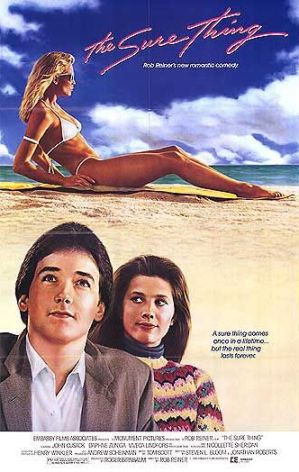
Sure_thingposterThe Sure Thing is one of the early works of both director Rob Reiner and young teen star John Cusack, and it proved to be a success for both parties. In the film, Walter Gibson and his friend Lance are heading off to college. Gib is heading to a stuffy school on the East Coast, while Lance is venturing off to the sun-soaked southern California shores with the female prospects at an all-time high. It doesn’t help Gib who has recently been striking out with the opposite sex, because, to put it bluntly, they don’t buy his astronomy inspired pick-up lines. He’s just too much of a jerk.

And so the two friends go off to their separate spheres and for Gib things do not end up too bad. His school’s not a bore, but he’s not getting the kind of action Lance has, not yet. That is until his friend tells him about a “sure thing.” The girl who is one out of a million and who is available, just waiting for Gib in California. So as any red-blooded American college student would do, Gib begins the cross-country trek over his Christmas Break.

The catch is this. He’s forced to travel with an overly enthusiastic couple obsessed with singing show tunes and that’s not the worst of it. His backseat companion is fellow classmate Alison Bradbury (Daphne Zuniga) who happens to be very attractive, but she also hates his guts.

She and Gib happen to be polar opposites, and they did not get off to a good start at school. She already has a boyfriend. She is always on top of her academics, and she never does anything outrageous. Gib is a showboat, prone to wildness that includes shotgunning beers and trying to pick up girls.

Their constant bickering and nagging find them sitting on the roadside in the middle of nowhere trying to thumb their way to California. And so it looks like they will go their separate ways, but they end up traveling together, broke, wet, and starving. Somehow they get there and along the way they begin to genuinely appreciate each other. There does not have to be anything between them. Of course, right before they get to their final destination a disagreement leaves them at odds. However, after spending so much time with someone like Alison, a sure thing just does not have the appeal it once did for Gib. He proves to himself that’s he’s not quite as shallow as he thought he was. If only Alison could know that.

The enjoyment of this film is not so much in discovering the result because any Joe Schmoe who has seen at least a handful of romantic comedies knows how the story is supposed to end. The true joy of the experience is how we arrive there with these two characters. In the back of our minds, there is a kind of peace of mind, because although they seem so far apart and at odds, we know where they will end up. We can take a little bit of enjoyment out of every single moment they spend together mundane or not. In many ways, the road movie feel of The Sure Thing brought to mind other similar storylines like Train, Plains, and Automobiles as well as It Happened One Night. I have to say I was pleasantly surprised by this film. Cusack pulls off the lovable jerk well and despite her initial stuffiness Daphne Zuniga is a lot of fun too.

4/5 Stars

Me & Earl & the Dying Girl (2015)

Me_&_Earl_&_the_Dying_Girl_(film)_POSTERI can say unflinchingly, without a single waver in my voice, that this is the best new release I’ve seen this year. Truth be told, I have not seen a whole lot of new films this year, but even if I had, Me and Earl and the Dying Girl would be the best by far.

The title in itself exudes a quirkiness that continues in a steady stream throughout the film. The same quirks can be found in our main protagonist, the self-proclaimed awkward, pale, rodent-faced high school senior Greg (Thomas Mann). He’s gone through high school with the mission of ingratiating himself to all and befriending no one. At this point in his high school career, the closest thing he has to a friend is Earl, who he simply considers his “co-worker,” since they develop homage short films together (ie. A Box of ‘Lips Wow). That’s another thing. Greg is obsessed with film: He eats up anything from Werner Herzog or The Archers thanks to the influence of his father (Nick Offerman). His other “friend” is the chill history teacher Mr. McCarty with an office that is the lunchtime oasis for Greg. But that’s about it.

That is until his doting mother (Connie Britton) forces him to go visit a girl who has been diagnosed with Leukemia. It’s a very forced scenario and both Greg and Rachel know it right from the get go. They haven’t even hardly talked since kindergarten. But, despite that, the two of them hit it off and Greg begins this doomed relationship with this dying girl.

The next 209 odd days or so Greg navigates this friendship and all that goes with it, while also developing a film for Rachel on the urging of the classmate that he is infatuated with. But do not get me wrong, this film does not fall into some contrived love triangle or sordid high school drama. It has a far broader more mature scope than that.

Yes, this is a high school teen film. Yes, it is a coming-of-age story, but it boasts so much more. It’s a film about films, a film about friendship, a film about regret, and most importantly a film about what it means to be alive. And yet, all the while, it tries to sidestep the normal tropes we expect.

Greg and Rachel have two very different perspectives. Two very different lots in life, but somewhere in between all of that, amidst the fear, laughter, and even anger, they find some special connections.

There is so much to appreciate about the film and for me, it starts with the character of Greg, because in some ways he was analogous to me in high school. I too was a nomad who traveled from group to group never being fully known. I found a passion for film and slowly began to learn about Kurosawa and Bergman among others. It was not until senior year where I finally began to feel comfortable in my own shoes and that was the perfect time for a new adventure in college. Thus, I resonate with Greg, because although he is certainly not me, he’s the most relevant high school character I have seen in a long while.

As for Connie Britton and Nick Offerman, both of them have some nice scenes that add a lot to this story. One as the over-involved mom who generally cares and the other as a free spirit of a dad who likes exotic food, bohemian garb, and art-house, not to mention the family feline Cat Stevens.

With great films, it is always difficult to pin them down, and the same can be said for this one. It has an awareness of film history that is unequivocally refreshing and unheard of for a genre potentially aimed at teenagers during the summer months. It has its own heartfelt crescendo that in some respects reminded me of Cinema Paradiso. In all other facets, it works beautifully as a teen dramedy and it does a better job in that niche than most. Miraculously, it couples humor and quirks with touching notes that are relevant to the here and now, while somehow still being universal. Also, do not get me started on the music, which is absolutely fantastic.

I look forward to seeing it again sometime soon!

4.5/5 Stars

Say Anything… (1989)

Say_Anything“How’d you get Diane Court to go out with you?”
“I called her up.”
“But how come it worked? I mean, like, what are you?”
“I’m Lloyd Dobler.”

She’s a brain, he’s not, sounds simple right? For such a basic premise Say Anything… has surprising depth. A lot of this is a credit to the performances of John Cusack and Ione Skye, along with the script by Cameron Crowe. The story is this: high school is over and the unknown future is what looms ahead. For Diane Court that means college, a fellowship in England, and the like. For Lloyd Dobler, we do not know what that means and he doesn’t either. For the moment he still has time, and he wants to use that moment to pursue Diane, the seemingly unreachable girl.

First of all, you have to understand how insane that goal is for a guy like Lloyd. He is a lover of kickboxing, The Clash, and he is an average student who lives with his sister and little nephew. Diane is the class valedictorian, doted over by her loving father, and she is a surprisingly sweet girl who dresses well and is a cut above. Not in a million years is he supposed to get her, but I said that already.

Anyways, Lloyd is a straightforward and to the point kind of guy, so he simply calls her house to ask her out. She finally gives into to his requests, and they go to a party to celebrate the end of their high school career. For him, it’s their first date, and she sees it just as a very nice evening. Diane leaves with a new found appreciation for Lloyd because he’s not like other guys. He periodically checks on her during the party to make sure she is alright and points out broken glass on the pavement for her to avoid. He is a gentleman in a trench coat, a strangely vulnerable figure.

Lloyd’s only future plans are to hang out with Diane as much as possible and as far as career plans he is not really sure. When everyone else, even his high school counselor, worry about the future, he always seems strangely, even naively, content.

Diane and Lloyd are slowly growing more and more connected and intimate. However, when Mr. Court goes under criminal investigation things begin to change. At first, everything is the same, with Lloyd teaching Diane how to drive stick shift and Diane growing more and more comfortable with him. And yet, with the familial situation at hand, she feels it necessary to break it off with him, leaving him a pen to write her with. Lloyd is especially wounded, confessing to his sister over the phone, “I gave her my heart and she gave me a pen.”

Soon enough Mr. Court’s account is cut off and in some ways, I felt strangely sorry for the man, but more so for Diane. One day Lloyd comes by with his boombox in tow, standing outside her window in one last monumental act of devotion. Nothing happens right then. Diane is still struggling with her father who it turns out has been swindling his elderly clients, but all for her future. She feels lied to and the only person she could run to is Lloyd, so she does and he takes her back.

Later on, he sees her father in prison and shares that his plan is to go to England with her, despite all the objections that come with it. The two jet-setters are together again proving all the doubters wrong. They wait for the ding of the smoking sign signaling the beginning of the rest of their lives.

This is perhaps one of the greatest high school romances ever, because it is far from the typical superficiality. Lloyd Dobler is played so wonderfully by John Cusack. You cannot help love this lanky guy who is fearlessly straightforward and willing to take a chance. Ione Skye is a bit overshadowed, but she is still convincingly sweet as the victim who finds the perfect guy. John Mahoney’s character is a despicable man and yet it is a credit to him that he actually makes us feel a bit of pity, for an instant. Obviously, the boombox scene is iconic, but I think it is the little things about Lloyd that make this film great. Every person could probably take a page out of his playbook by being honest, vulnerable, and most definitely loyal.

4.5/5 Stars