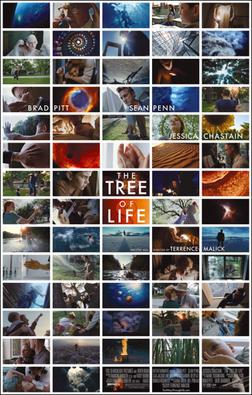
The Tree of Life (2011)

9f8e8-thetreeoflifeposterDirected by Terence Malick and starring Brad Pitt, Jessica Chastain, and Sean Penn, this film is a grand and audacious piece of cinema that intertwines images of the creation of the world with the life of a young boy in 1950s Texas. 

When I say daring, I mean that you will either find it fascinating or very, very dull. There does not seem to be much middle ground here. The film begins with a biblical allusion to Job and depicts a flickering golden light. Over these images are whispered words urging the listener to follow either grace or nature in life. 

Then, both Mr. and Mrs. O’Brien (Jessica Chastain and Brad Pitt) find out separately that one of the sons has died, and the reason is not explained. In the present, one of their sons (Sean Penn) who is now an architect contemplates his life while trying to get through his day. Then, we witness the breathtaking formation of creation, with the creation of the planets, sea, and life itself.
Back in 1950s Waco Texas, a young couple has had their first baby boy, and then two more follow in the ensuing years. Most of their life is focused on the conflict inside of the young boys, Jack. He must struggle with a mother who is gentle and loving, and a father who is authoritarian and even abusive. After one friend dies and another is burned, Jack begins to grow more disillusioned with the world and his parents. During a summer, their father goes away and during that same time, Jack becomes even more rebellious. Then their father is in trouble of losing his job, and he questions how he has lived his life to deserve such a fate. Back in the present, Jack has a fantastical vision seeing his younger self, as well as his family and others walking on the beach and the film, ends soon after. 

The closest movie that I can think of with the same thought-provoking intentions as The Tree of Life is probably 2001: A Space Odyssey. However, I think I surprisingly appreciated Tree of Life a little more, because it focused more on the human aspect instead of the fact that humans are insignificant and primitive in the realm of outer space. Furthermore, the ending of this film somehow seemed reminiscent of La Dolce Vita, since both had rather cryptic conclusions taking place on expansive beaches.
 
4.5/5 Stars

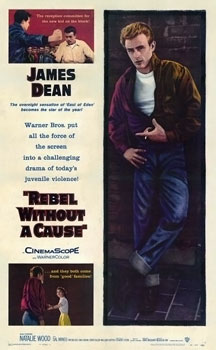
Rebel Without a Cause (1955)

A film starring James Dean, Natalie Wood, and Sal Mineo,  with direction by Nicholas Ray, Rebel Without a Cause follows three teenagers, who are confused and conflicted about their lives. 

The initial sequence rolling behind the opening credits has the inebriated Jim Stark lying in the street fiddling with a toy monkey. Then, he is brought into juvenile hall, and simultaneously the story gives us a glimpse of not only the rowdy Jim, but discontented Judy, and the distant boy Plato. Each one has their own personal pain, and thus this film from the beginning really focuses on three rebels, who embody the adolescent generation. James Dean is Jim Stark: the new kid on the block, who is constantly moving with his parents. In the station when his parents retrieve him, there is obvious tension on all fronts, which include heated arguments, and outbursts on the part of Jim.

The morning after being brought in he meets Judy only to get mixed up with her friends. Stark however also befriends the isolated loner Plato, who was in the station the night before. The trouble with the other teens starts with a switchblade contest during a school excursion to Griffith Observatory, but the stakes get bigger when they compete in a “Chickie Run” over a cliff. Stark lives but the other boy, Buzz, dies in the accident. Everyone flees the scene before the police arrive.

Stuck between a rock and a hard place, Dean and Wood’s characters gravitate towards each other. Their parents seemingly do not understand them, and so they find comfort in each other instead. Their new found friend Plato tags along as they hold up in an abandoned mansion for the night. They spend the evening lounging around, making light of their parents and just talking. 

However, all does not bode well when some of the high school thugs come looking for Stark. Plato flees the scene with a gun, and soon he has policemen on his tail. Plato is in a paranoid and unstable state. Jim tries to console him and bring him out peacefully. But despite his best efforts, tragedy strikes one final blow.  All is not wasted, however, because Jim’s father (Jim Bachus) vows to be a better and stronger parent than he was before. 

Following his breakthrough in East of Eden, Rebel would be the movie that defined Dean’s short but iconic career. His line “you’re tearing me apart!” would further define the angst felt by many teens at the time. There is a certain aura around this film for some reason, maybe because of Dean’s portrayal that is at times so moody, and at other times so subtle, but powerful nonetheless.

I think part of the credit must go to director Nicholas Ray, who gave Dean free reign to improvise and develop his character in the way he saw fit. The film is tragic in another sense because all the primary stars died at an early age. Dean’s is the most remembered, but Mineo and Wood, both died extremely young as well. In Rebel Without a Cause, they all gave memorable performances and there are other notable players in this film including the usually comedic Jim Bachus and a very young Dennis Hopper.

I think Rebel ultimately survives today because it tells a universal tale of a generational divide and a divide between young people fighting peer pressure. In the heads of teenagers the world can become jumbled and between school, fitting in, and home life it can be a struggle. This film dramatically illustrates that fact. So maybe the kids look different, the cars are older and such, but the struggles of Jim Stark, Judy, and Plato are still relatively the same.  I must say this film really makes me want to visit the Griffith Observatory too, because it became such an integral part of this film’s story, and it is still around to this day.

James Dean only had three major film performances and you could make a case for which was the best. I think it is safe to say that this role was his most iconic. It’s hard not to identify him with his red jacket, blue jeans, and the ubiquitous cigarette. He was the Rebel Without a Cause.

 
5/5 Stars

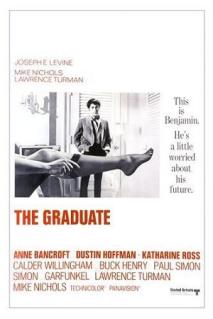
The Graduate (1967)

Some may see this film as a comedy drama that is not in the category of great movies. However I feel if nothing else, The Graduate is culturally significant because it ushered in an age in the late 1960s where films focused on trying to attract younger audiences. Along with its good writing this film was one of the forerunners in using popular music in its soundtrack.
*May Contain Spoilers

Starring Dustin Hoffman, Anne Bancroft, and Katherine Ross with direction by Mike Nichols, the film opens with Benjamin Braddock returning home from college. He has excelled in many ways and yet he feels bored and alienated from his parents. However the naive Benjamin soon finds himself in an affair with an older woman. This further confuses him as he figures out what to do with his life. His unknowing parents want him to date a girl attending Berkeley. Things become complicated since it turns out to be Mrs. Robinson’s daughter. Not wanting anything to happen between Benjamin and Elaine, Mrs. Robinson sabotages the relationship and tries to marry her daughter off while her own marriage goes down the tube. Benjamin who is ultimately in love with Elaine crashes the wedding and takes her away to face an unknown life ahead. With the help of a memorable Simon and Garfunkel soundtrack, this film ushered in a new age geared toward the younger generations.

4.5/5 Stars


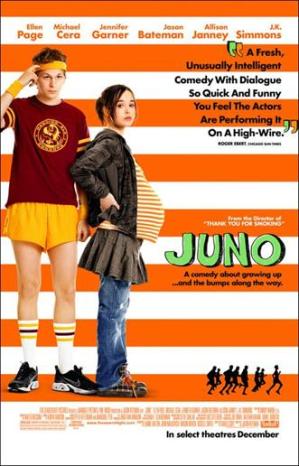
Juno (2007)

This movie covers a sensitive topic, it is a little rough around the edges, and oh so quirky, but despite this it comes across as a good film all the same.

The cast is led by a strong performance by Ellen Page as a forthright and unique 16 year old named Juno Macguff. Quickly she learns that she is now pregnant and she must figure out how to deal with the situation while also facing her friends and family. Finally, she realizes she doesn’t want an abortion and Juno becomes invested in finding foster parents for the baby inside of her. All the while she is ostracized at school and her relationship with the father Beaker changes. In a moment of providence, Juno seemingly comes across the perfect parents in a Penny Saver and when she meets them they appear to be a perfect fit. They have a perfect marriage, beautiful home, and are unable to have kids. There might be something too perfect here, but Juno pushes forward just relieved to find someone who can take her baby. She keeps them up to date on her condition and forms a bond with the husband (Jason Bateman) who also enjoys rock music and horror movies. However, when the husband gets cold feet which leads to divorce, Juno’s situation is thrown into jeopardy. She is still willing to go through with it if the wife (Jennifer Garner) is prepared still. The day of the pregnancy comes and Juno gives birth. The foster mother gets her child and Juno is able to go back to being a teenager, playing guitar, and having high school romances.

There is not a single throw away character in this film, everyone has some peculiarity that makes them tick. The perpetual group of runners, the happily innocent soundtrack, and the script create a heartfelt coming of age dramedy that succeeds beyond any doubt.

4.5/5 Stars

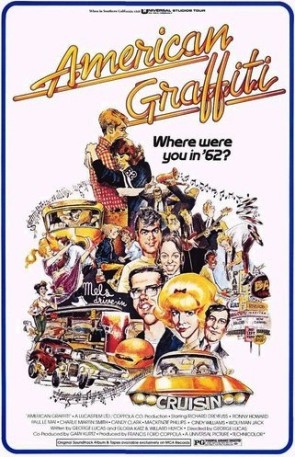
American Graffiti (1973)

Starring Ron Howard and Richard Dreyfuss with a host of others, this George Lucas directed film follows the lives of young people in California during the early 60s. It is the night before Curt and Steve are going off to college. They both want to make the most of the time left. However, Steve spends all his time trying to strengthen his relationship with his girlfriend (Cindy Williams). Curt, on the other hand, finds himself out in the town talking with girls and proving himself to a group of thugs. The rest of the film consists of the hot rodding antics of two other characters. A tough speedster (Paul Le Mat) finds himself driving around a 12-year-old girl. “Toad” the nerdy one (Charles Martin Smith), finds himself spending a wild night with a nice but peculiar girl.

With its classic music accompanied by Wolfman Jack and the vintage cars, American Graffiti is a blast of nostalgia that allows us to remember simpler times. It takes this important day in the life of these young individuals and it allows us to be a part of it. Each character has his own experiences that cause them to grow. Toad matures, Curt realizes he must experience college, Steve learns the importance of his girlfriend, and Milner realizes he really does not want to be “The King” anymore.

This film may have slower parts but that just makes it more enjoyable because then the night kicks into high gear when Toad loses the car, Milner beats up the thugs, or Curt has visions of a blonde in a T-Bird. Fittingly as he flies away to his unknown future he sees her white car cruising down the road. It was something that I had wanted to see the first time around but I had seemingly missed it. It made the ending even better.

5/5 Stars

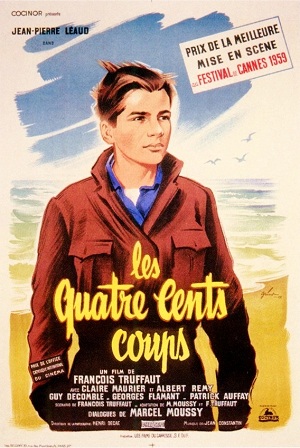
The 400 Blows (1959)

This French New Wave film directed by Francois Truffaut, more aptly titled The Wild One or Raising Hell, is about a young boy named Antoine. He comes from a working class family and his parents are struggling and frustrated. In school he gets poor grades and his teacher often punishes him. Annoyed with his life, he runs off for a time committing petty crimes and exploring the streets with a friend. That ends when he is caught stealing his father’s typewriter. Fed up for the last time his parents send him away to an observation center for boys. After he arrives Antoine escapes and runs to the ocean a sight he has never seen. With that the camera zooms in and we clearly see the face of this troubled, young boy. It is easy to appreciated this film because it does not glamorize the situation but tries to deal with it sensitively. Truffaut made a very good one here reflecting on his own experiences.

5/5 Stars