Raging Bull (1980)

This autobiographical boxing film directed by Martin Scorsese, stars Robert De Niro, Kathy Moriarty, and Joe Pesci. The film begins with a flashback to 1941 when Jake LaMotta (De Niro) lost a close fight. However, after that loss he begins his run for the middle weight title. Despite a difficult marriage, Jake’s brother and manager introduces him to the young and beautiful Vickie. He continues to fight and in 1947 he is married once again. LaMotta has his share of troubles in the ring but he eventually becomes champion. At the same time his personal life is in a shambles thanks to his constant jealousy and paranoia towards his wife and brother. First, he is estranged from Joey and his career declines. Then after his retirement, Vickie files for a divorce. His days are spent entertaining in nightclubs as a washed up boxer. I enjoyed the reference to On the Waterfront at the end and despite the coarse language, the film had good characters, cinematography, and directing. LaMotta’s life is one that I hope no one would have to experience because there is so much pain and anger in it.

5/5 Stars

Chariots of Fire (1981)

In honor of these London games I thought I would review one of the best Olympic films in Chariots of Fire .

Telling the intertwining stories of two runners, Eric Liddel and Harold Abrams, the film leads up to their trials and triumphs in the 1924 Olympics. Liddel is a Christian Scot who believes he has been called to run and he takes his faith very seriously. Abrams on the other hand is a proud Jewish runner who wants to be the best. Liddel is faced with the prospect of running on the Sabbath which goes against his beliefs. Abrams is extremely afraid of failure because running is his life. With those problems they enter the Olympics and end up flourishing for Britain. After the two men are deceased two of their mates reflect on those great days that they experienced together. This film may seem simple but that does not make it any less powerful. The main theme reverberates through your head hours after wards. What more of a compliment do you need then a Mr. Bean parody at the London games?

                                                        4.5/5 Stars

The Godfather Part II (1974)

Starring a cast including Al Pacino and Robert De Niro with director Francis Ford Coppola, the film opens with a young Vito Corleone coming to America. The story switches gears to 1958 in Nevada where Michael Corleone has successfully moved the family. However, after a close call Michael goes to Miami and then Cuba to attend to some business having to do with a man named Hyman Roth (Lee Strasberg). The story alternates off and on to Vito as a young man who begins making a life for himself. Upon returning to Michael, he is in a senate hearing where he narrowly avoids being indicted for his activities. From that point on Michael shows no mercy to anyone who is in his way and that includes his family. By the end of the film he is no longer the former idealistic Michael but a callous, cold mobster.

This film was a good installment of The Godfather, acting as both a sequel and prequel. However, at times the split story did seem unnecessary but it does show a contrast between Vito and Michael. The acting, the score, and the directing were all very good. I will let others decide which installment is superior but I will say that this film shows the darker side of Michael. Ironically, he worked so hard to be strong for his family but as he feared he ultimately lost them.

4.5/5 Stars

The Shawshank Redemption (1994)

68168-shawshankredemptionmovieposterStarring Tim Robbins and Morgan Freeman, the film begins with a young banker who is falsely accused of murdering his wife and her lover. He soon finds himself in Shawshank prison, the year 1947. When he arrives the resourceful “Red” (Freeman) believes the aloof man will be a pushover. However, after a major turning point Andy does many extraordinary things in the prison. Whether it is a nice deed for a friend, improving the prison library, carving chess pieces out of rock, or doing taxes for the guards, he keeps himself busy. The strict warden keeps him down but unlike others, Andy does not lose hope. He still has one miraculous trick up his sleeve. Fittingly he instills “Red” with hope and in the end they are reunited. I found this film intriguing because in such a corrupt and immoral place, Andy always seems to strive for good. His spirit is ultimately inextinguishable.

4.5/5 Stars

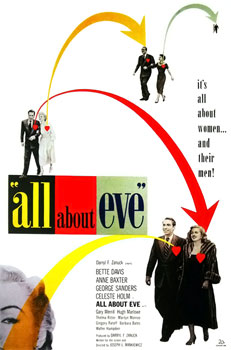
All About Eve (1950)

f37d4-allabouteveEve Harrington (Anne Baxter) is a seemingly modest and conscientious girl who gets the chance of a lifetime. She is able to meet a great Broadway star (Bette Davis) as well as her close circle of friends. Soon she is helping this Margot Channing by taking care of errands and odd jobs. This ambitious girl finally convinces one of Margot’s friends Karen (Celeste Holm), to let her be an understudy. And so when Margot is detained the night of a show, Eve gets her chance at the big time. However, Eve soon shows a different side of herself; one of back-stabbing and blackmail. Through her manipulation, she meets a famous critic (George Sanders) and wins an award. However, he has her pegged and the truth becomes evident. By the end of the film, Eve seems to have fallen for the same trap that Margot had. This film was pretty good and featured a good cast including Thelma Ritter and a young Marilyn Monroe. As Davis exclaims, “fasten your seat belts!”

4.5/5 Stars

Sullivan’s Travels (1941)

63a32-600full-sullivanStarring Joel McCrea and Veronica Lake, with director Preston Sturges, Sullivan’s Travels is about a highly successful film director (McCrea) who wants to make a movie about the common man and suffering. However, he usually writes comedies and so he decides to go on the road as a hobo to try and understand the lifestyle. During his adventures he meets a young failed actress (Lake) who is about to leave Hollywood. Wanting to help her, Sully tells the girl what he is doing and they go off together masquerading as tramps. After taking a short respite, he goes on the road again, this time alone. Through a series of events he finds himself in a chain gang while his friends assume he is dead. Eventually he is freed but not before learning a valuable lesson. If he wants to relate with the poor he should give them laughter instead of hardship. I found this movie to be an enjoyable  light comedy (even though I had never heard of it beforehand).

5/5 Stars

12 Angry Men (1957)

34a39-12_angry_men12 Angry Men is a very intriguing film, that begins with a jury that is 11 to 1 in favor of giving the death penalty to a young boy. In this ensemble cast headed by Henry Fonda (the one unsure man), tempers flare as the heat rises. By the end this lone juror finally wins over the opinions of the others through discussion. The cast is a wonderful mixture of veteran and young actors, with everything in between. The cast includes Lee J. Cobb, Ed Begley, Martin Balsam, Jack Warden, John Fiedler, and Jack Klugman. However there are no women or black jurors because this film was made back in 1957. Aside from that, it has a great story which takes place almost entirely in one room. In this way it is much like another classic and favorite of mine, Rear Window. Get ready to fight it out with every word and piece of evidence in 12 Angry Men.

5/5 Stars


Forrest Gump (1994)

f0e31-forrest_gump_posterIn the classic starring Tom Hanks as the slow-witted but kindhearted Forrest, we see him as he takes part in history. From the day we see him teach Elvis how to dance, up to the point he runs across country, he is constantly part of or making history. However despite everything he has accomplished whether it be in Vietnam, playing ping-pong, or in the shrimping business, Forrest still is humble and seemingly oblivious to it all. His innocence is heartwarming amidst all the turmoil around him in the 60s,  70s, and 80s. Hanks is supported wonderfully by Robin Wright, Mykelti Williamson, Gary Sinise, and Sally Fields. This film is funny as well as touching, making it wonderful to watch. The soundtrack also helps to transport you back to the different eras.

4.5/5 Stars

In the Heat of the Night (1967)

19363-in_the_heat_of_the_night_filmWith an interesting conflict between two policemen, one white and one black, In the Heat of the Night is a thrilling crime film. Rod Steiger delivers a wonderful performance as the common place and prejudiced officer who heads a southern police force. Things do no start off well when a policeman from Philadelphia, Mr. Tibbs (Poitier) is accused of murder simply because of his race. Only afterwards do they learn he is a highly respected detective. Because they need help, they reluctantly ask for his assistance. Tibbs must learn how to deal with the prejudice while Gillespie (Steiger) must curb his own racism. Over the course of the film, the two men face opposition but they stick with it to see the case through. When the crime is finally solved, Tibbs is about to leave and Gillespie with a new-found respect tells him to come back sometime. In an age where racism was still a tremendous problem, this film combated the issue and created something very special in the process.

5/5 Stars

Casablanca (1942)


Considered one of the greatest films of all-time, this well-loved classic deserves to be here. It is the hallmark of Humphrey Bogart and Ingrid Bergman’s careers. It has one of the greatest scripts of all time, and it has achieved legendary status over the years. Many consider it purely the best film ever made and in all honesty, I would never try to refute that.
The film opens quickly, and we are immersed in a world that is at the height of the Nazi terror, and many people are fleeing Europe by way of Casablanca. It is a treacherous place full of pickpockets, corrupt authorities, refugees, and some tourists as well. Two German couriers have been murdered, and some invaluable letters of transit have been stolen. That’s when we are first introduced to Rick’s Café Americain along with its cynical proprietor Rick Blaine (Bogart). A shady fellow named Ugarte (Peter Lorre) comes to him with the letters and asks Blaine to keep them for him. However, later that night Ugarte is taken into custody and things get even more complicated. 

Wanted resistance leader Victor Laszlo (Paul Henreid) is now in Casablanca, however, a Major Strasser (Conrad Veidt) has arrived from Germany to take him in. To top it off Laszlo’s wife Ilsa (Bergman) was Blaine’s old flame in Paris and it didn’t end well. Laszlo desperately needs the letters of transit to escape and he inquires about them. Soon he is led to Blaine but as he often admits Rick sticks his neck out for nobody. Laszlo shows his defiance against his enemies by leading the people in a round of “La Marseillaise” and as a result, Rick’s is shut down. 

All the memories of Paris begin flooding back, and then Ilsa confronts Rick in order to get the letters. This is possibly the most critical point in the film because the tense altercation ultimately renews the relationship between Rick and Ilsa. Rick asks her to trust him and he begins to take things into his own hands. The results of his actions created one of the great romantic and cinematic moments in the history of film. The whole film leading up to this point hints at it, but Rick truly is a sentimentalist at heart. He can live with the notion that they will always have Paris and that leads him to commit a selfless act of love.
This film holds such a tremendous presence in movie history it is quite extraordinary. Upon seeing the movie it made complete sense what all the hype was about. What more could you want than Bogey, Bergman, Casablanca, and some of the greatest quotes ever said? Do not forget the French Captain Louis played by Claude Rains or the immortal tune of As Time Goes By sung by Dooley Wilson. However, you also gain an appreciation for the other interesting characters of Casablanca, some comical, some sympathetic, and others mysterious. We have a rogue gallery of everybody under the sun from Peter Lorre, Sidney Greenstreet, German soldiers, various guests, and all the staff at Rick’s place. 

This movie has conflict and the uncertainty of war practically in every scene because at the time World War II was in full force. There are a broken romance and a forlorn hero who shows his courage in the end. As an audience, we realize the transformation of Rick into a truly great man. Ilsa, on her part, has the most radiant face I have ever seen! If you take into consideration when this movie was made, it truly is wonderful to watch. You do not need explosions and violence, only great characters and a story with both drama and humor. Up until the final moments of the movie you are captivated the entire time. Then, fittingly you are left with the two men walking off into the night with the words, “Louis I think this is the beginning of a beautiful friendship.”

 In fact, with this film, my thoughts always go back to the script. Lines like “Here’s looking at you kid,” “We’ll always have Paris,” and “Round up the usual suspects” are so rampant that you cannot possibly remember them all, and I doubt there will ever be another film that is so entrenched in American culture. Many of my favorite lines in the film are those that get overshadowed by the more famous ones. That is the sign of an amazing film that never grows old. Even those who have not seen this classic film like to think they have because the influence of Casablanca reaches everywhere.

5/5 Stars