River of No Return (1954): Mitchum and Monroe on a Raft

River of No Return is nearly worthwhile for its opening visuals alone. There stands the vestige of American manhood: Robert Mitchum — unmistakably himself — felling a tree. He pulls off his hat, wipes his brow, and we get a gorgeous lingering look at his backyard. God’s majesty as far as the eye can see. Absolutely breathtaking stuff.

After the credits roll, he enters a much livelier environment. It feels a bit like a choreographed dance as his horse trots through the hubbub of the newly erected tent town bitten by the gold bug. At the hitching posts, he has a momentary encounter with a padre, the religious man came for the Indians but having a look around, he notes he might need to stay in the hell-hole for the sake of the white men.

It’s in such a seedy world Matt Calder (Mitchum) goes hunting for the son he doesn’t know. He finds him soon enough, shielding the young boy (Tommy Rettig) from some drunken bullies. The only question remains, where is Marilyn Monroe? She’s set up in one of the many tents as a bright and sultry nightclub singer, who cuts through the otherwise scuzzy world around her with a voice and a guitar. Her silver dollar song catches the eye of Calder, but their real connection is little Mark. She’s been keeping an eye on him and doesn’t take kindly to the father’s malfeasance.

If this were the only interaction, we wouldn’t have a movie. Because they are on divergent paths. Matt and Mark look to build up a life for themselves in a cabin, living off the land earning an honest day’s wage far away from the lottery-style debauchery of the gold mines.

Meanwhile, Kay’s man, an unreliable big-stakes gambler (Rory Calhoun) has a promising claim to track down. He, no doubt, won it off some unsuspecting sucker. Whether it was legitimate or not remains to be seen.  They plan to go by riverboat to the distant territory; he wasn’t counting on the perilous waters. Instead, he forcibly takes Calder’s horse and gun as a bit of a “loan.” His scruples (or lack thereof) are all too clear.

The local Indians make their presence known through drums and smoke emanating up from the mountains. They also conveniently force the next move. With no horse and no gun, Calder goes with his boy and Kay (who stayed behind out of sympathy) aboard the raft. It is the river already warned against for its many perils. But in their present circumstances, they now have no recourse but to take it.

It’s hardly The African Queen. It’s not even Heaven Knows Mr. Allison (both directed by Huston). The movie falters in its most expositionally-heavy scenes. Is this the fault of Monroe for not masking the lines better or the script for laying it on too thick? I’m not sure.

It’s also a bit of nausea-inducing sequence, even as the interior studio shots with water splashing look immediately tacky. They take away from the import of any long shots actually out on the choppy rapids. Nor are they as interesting as Preminger’s staging of the previous town or the vast landscapes away from the river. In such moments, he exhibits an attuned eye for the width of Cinemascope all but undermined by these talky static shots inside a studio.

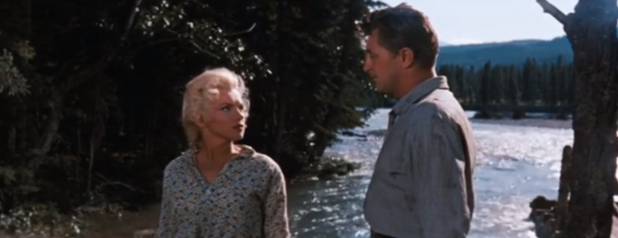
However, Mitchum and Monroe do manage a mild distaste for one another, playing quite well, especially when they’re stranded out in the forest with little prospect of survival. But perhaps, most telling of all, you see Monroe’s ability with children.

There’s a quality to her that while partially maternal almost tacitly understands their innocence and vulnerability. Wanting to keep the naivete precious and maintained in a world that can often be so very uncaring. You might hazard a guess similar qualities might be found in her.

Adulation might be aimed at Mitchum’s meaningful interactions with his son as well for altogether different reasons. He says it straight and honest and doesn’t pander when the questions come his way. There is a certain amount of buy-in when you see him give his son the unadorned truth as he sees it.

In one candid encounter, he tries to articulate how men make laws to live by. And when you break them, there must be some form of justice, some consequence. But we might go a step further. Laws of this nature — deep, universal human laws — are almost innate in us. He wants to help his son understand his rationale. It remains a work in progress.

The perceptive son is continually probing him with candid questions in order to understand the inconsistencies of the world around him, whether it is his father’s own past or their plan to catch the man who stole from them.

It enters its most uncomfortable territory when Mitchum all but assaults his co-star in the forest. What’s more, apart from being totally disconcerting, as a more callous observation, it simply does not fit the continuity of the scenes around it. The only true purpose seems to be shock value; not providing any amount of exposition or even logical progressions of character. That makes it even more flagrant.

Purportedly this was one of a handful of scenes commissioned by Daryl Zanuck and shot by Jean Negulesco after primary photography, to make the relationship more clearly defined. To a modern viewer, it undermines everything our actors have managed thus far.

Fortuitously, a cougar comes along and poses a more suitable threat, making it easy to forget what has just come to pass. Then, a pair of conveniently placed prospectors arrive and one happens to be a dandy shot with a rifle in close quarters.

Meanwhile, the Indians exert their force on the story once again in a portrayal that is a lame use of them and frankly, a shoddy excuse for storytelling on top of the inherently trivial portrayal. In other words, they are only a mechanism for storytelling, and it does not even manage a gripping outcome.

The revenge narrative gets its inevitable ending in a town. Not unlike the boy (Ron Howard) in The Shootist, Mark gains a new understanding of violence and a renewed appreciation for his father.

Surveying the results, River of No Return is saddled with flaws, though its star power and intermittently marvelous imagery, courtesy of Otto Preminger, serve as a decent distraction. Mitchum and Monroe aficionados might well find themselves treated to an average piece of entertainment.  Take from it what you will.

3/5 Stars

The Violent Men (1955) and Rockefellers on The Range

the violent men 1.png

The Violent Men is an age-old tale of cattle wars on the range. The local apothecary warns about Wilkerson a man from the long tradition of land eaters. There are only two choices: run or stand and fight.

Before we ever see him, his cronies are messing around town. In the town’s main street the Sheriff is gunned down in the back by a hotshot gunman (the always smirking Richard Jaeckel). Everyone either turns away or is in the coattails of the local tyrant. We learn so much about them from their inaction. This is a community that has acquiesced to a thug and conformed to a type of general passivity.

No one is willing to stand up or speak up or do anything involving gumption because it means sticking their neck out and being vulnerable to the consequences. Glenn Ford starts getting perturbed, realizing he is just as liable as everyone else.

He’s been stewing to the point of exasperation, even as his future in-laws and his girl coax him to mind his own business and think of their extended future happiness. Again, it’s this constant mentality of the individual over the common good. Maybe it’s a product of reading a book on the Red Scare, but I cannot help but see it as a parable of benevolent socialism versus the tenets of a particularly ruthless capitalism.

For well-nigh 20 minutes the name Wilkerson is all but mythologized and lifted up as one of the most ruthless, bloodthirsty names on the frontier; he is Rockefeller on the range. With such a build-up, there must be performances to hold up the bargain. Fortuitously the movie delivers with not only Edward G. Robinson but Barbara Stanwyck as well. Of course, Stanwyck is no stranger to the West, and she’s quite adept at exuding this certain balance of necessary toughness and femininity.

Robinson is hardly the image of a western cattle baron (he was, in fact, a late replacement for Broderick Crawford), but he still has the presence of Edward G. Robinson. The fact he is crippled with a pair of crutches and still so ornery makes for an intriguing character biography. He completely subverts conventional expectations.

Meanwhile, Dianne Foster feels a little like Martha Vickers in The Big Sleep — the first impression is important — and she leaves the audience wary of this family’s pedigree. They’re not allowed to have one normal member.

Next, comes the entrance that is of utmost importance. The hobbling old codger himself. He’s particularly boisterous and hard-nosed when it comes to land dealings and taking over the valley. Behind closed doors, his wife is equally cunning and calculating, along with his kid brother (Brian Keith). His main enforcer (Jaekcel) follows up murder in the streets with another grisly murder on the range as a message to the holdout, Parrish, and anyone else brazen enough to stand up to Wilkerson.

For the 1950s, it’s quite the brutal exhibition as they whip a man, rope him up, nearly choke him to death, before leaving him for dead. Words do not do it the justice it deserves.

If Wilkerson didn’t sanction these egregious actions, he gave Cole (Keith) free reign to enforce their presence on the territory in whatever manner he deems applicable. The crooked deputy, a seemingly obliging fellow, has the system conveniently tipped against anyone who dares stand in opposition. There’s no way to win.

The movie might easily end here if only our hero were to wash his hands of the situation and move back east. He loses his bride-to-be for the sake of his own private moral integrity. Whether it’s because this is Glenn Ford or his character, need not be important. He resolves to stay, playing the fool, only to draw in his foe and retaliate.

Soon he’s taken his army training and put it to good use, fighting a war against his neighbors who, by all accounts, seem more formidable. What he has are determination and tactical advantages. The distinction of who the actual foe is remains dicey.

Robinson is just the blustering frontman. Cole blasted the range open with his pack of thugs. Martha Wilkeson pulled the strings, working all the while in her husband’s shadow.

Cinemascope offers some expected monumental views of the west compete with all the trimmings of the great outdoors. Ironically, the actual montages of the stampedes, burnings, and killings are relatively uninteresting. It might as well be stock footage from other pictures, and it probably is. The most invaluable moments are delivered by the characters, served up just as much as psychological warfare than any physical grudge match.

As the Wilkerson girl perceptively berates the men in her climactic stand, at their core is this barbarism, causing men to constantly be driven by a senseless need to kill one another for a lousy piece of land. Merely to prove something to themselves and others. What makes it worth it?

There is the subsequent realization this is not wholly good versus wholly evil. There are corrupt people, selfish ones, yes, but even Ford, who is supposed to act as our moral center, has no qualms about retribution and annihilating his enemy, since they were first poised to kill him.

It makes for a volatile experience, and the leads are a worthy ensemble, capable enough to suggest these particular nuances and personal ambitions. The irony remains in the title. On a cursory glance, it’s a lurid eye-catcher, but it also happens to be an apt descriptor for a movie with a main conceit about the implications of such escalated violence. The Violent Men takes its most obvious attribute, only to turn it right on its head. The surprise punch is a much-appreciated admonition about violence in the guise of popular entertainment.

3.5/5 Stars

Lonely Are The Brave (1962): The Last Cowboy

lonely are the brave 1.png

Armed with black and white and rolling plains full of instantly recognizable western exteriors, Lonely Are The Brave goes for an intimate approach. The camera focuses on a man splayed out with his hat tipped over his eyes in slumber. This could have been out of many earlier pictures up until this moment. An instant later the illusion is stripped when a jet cuts across the skyline. It’s an indication of where we are.

Because this is not a blaring lack of continuity. This is a telling signifier. What proves to be out of place is not this jet but the main character at the center of our story. If one of these things is not like the other, then he is indeed the anachronism.

This is the continual struggle of Kirk Douglas’s John W. Burns because even as he fights to maintain his rootless lifestyle reminiscent of the bygone drifting cowhands of old, it’s hardly in vogue with the introduction of social security cards and, for a lack of a better word, civilization. The two diverging stratospheres just don’t gel very well.

The film must sit somewhere atop the list of deceptive film titles. Going in imagining a High Noon-like film about one man standing up in the face of many, instead we get an equally meaningful meditation on the lingering ways of the west in a contemporary context. No thanks to the marketing department, I might add.

However, what does that matter when you employ the considerable wit and wizardry of Dalton Trumbo? He has a ball toying with the most obvious thematic idea of a near-mythical man — an old-time cowboy — whose code of conduct and dwindling philosophy on life butts up against a world that will not have him. He is at odds with it. Averse to fences, boundaries, sectioning off of lands — all now common practice.

He’s indicative of a certain romanticism with his horse and hat out on the range. Even as the pragmatic world around him as passed him by in favor of changing forms of living. This intersection of the remnants of the West with post-war American modernity is made visibly evident when he is forced into playing animal crossing with his horse on a heavily trafficked highway.

When he pays a visit to a woman (Gena Rowlands), there’s something enigmatic about the encounter. A wife, perhaps a lover. At first, we’re not sure. It’s more complicated and less understood. Until it comes out her husband — his best friend — is in prison, and she’s worried about him. Rowlands would have to wait for a true tour de force, but the best compliment I can give is her role has something equally bewitching about it. She’s not quite an entirely conventional housewife.

The subsequent scene takes place in a Mexican-flavored cantina. It proves to be the unlikely arena for an explosive fistfight with a belligerent one-armed man, for what seems to be no reason at all.

If we’re ever told, I’ve no recollection of it and if we weren’t, it doesn’t much matter. It conveniently serves the story twofold. Because we get a rowdy action piece with Douglas duking it out “mano y mano,” while subsequently landing himself a jail sentence so he can drop in on his old buddy as a favor to the incarcerated man’s wife. If this makes little logical sense, then at least it’s different — not where we expect the story to go.

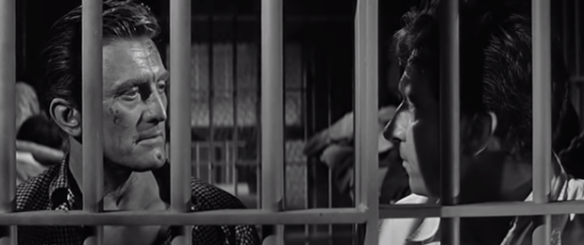
His jail sentence gets dropped and then upped following a police station scuffle carried out while the booking officer dryly lists off the unidentified drifter’s personal belongings like it’s just another day in the office. In the end, Burns keeps his promise to see Paul. There are momentary glimpses this could be a prison movie not unlike Brute Force, Caged, and certainly Cool Hand Luke.

We have a sadistic George Kennedy on the outside of the bars instead of inside. His main adversary is obvious. However, true to character, nothing can keep the cowhand in one place, not even prison.

lonely are the brave 3.png

The movie is beholden to a cast of giants (current and soon-to-be). Trumbo’s impeccably inventive scripting gives them all the words to emote with wry humor and assorted ticks making them come alive beyond the range of flimsy cinematic outlines.

The plotting itself is of a strange and unorthodox nature, nevertheless buoyed again by the talent and words on the page. Payoffs abound for these very reasons. Otherwise, it would wander as an ill-paced, unfulfilling mess. Thankfully, this is far from the case. The payoffs are strangely affecting, thanks to a story that bides its time, allows for asides, and spends time in untrodden places.

Between Douglas playfully cajoling a recalcitrant new mount and Walter Matthau observing the daily rituals of an unseen mutt outside the office window, Trumbo continually adds these delightfully offbeat touches.

William Schallert — as the good-natured bumpkin officer manning the police radio is in one sense totally aggravating and yet endearing in an innocent way. Even a fresh-faced Bill Bixby is manning the police helicopter the fugitive promptly shoots down from overhead. It’s an unceremonious reversal of fortune with the cowboy’s bullet taking on the whirly gridiron machine down from its illustrious heights.

Still, he cannot hang on forever. Eventually, even his tried and true way will betray him against the rapid assault of constant advancement. It cannot survive just as he cannot. Carrol O’Connor gets only a few solitary lines at the beginning and the end of the picture with rain pounding the highway, but his truck driver has a crucial moment we can all but see coming from a mile away. Though such a realization does not make it any less impactful when it arrives. It was inevitable.

Kirk Douglas, a man known for his intensity (some would say overacting), gives a performance bridled back with his winsome charm. In fact, the entire story plays with this generally lackadaisical, at times, melancholic pacing.

The final act in another picture might be chockful of moments. Lonely are the Brave needs only one. Turner makes one final push to freedom — his escape route, a harrowing ascent into the mountains. As gravity determines, the only way to go is down. It must be the so with John Turner.

So he never quite reaches his apotheosis. He is a partial embodiment of the sentiments of Dylan Thomas’s most famous work — the fight to rage against the dying of the light. Except the light is the way of the West and the battle is lost. It is a foregone conclusion. As time marches on, there is no way to claim victory. One wonders if being the last cowboy is an act of bravery, futility, or folly. Perhaps the answer runs the gamut of all three.

4/5 Stars

Note: This review was written before the passing of Kirk Douglas on 2/5/2020.

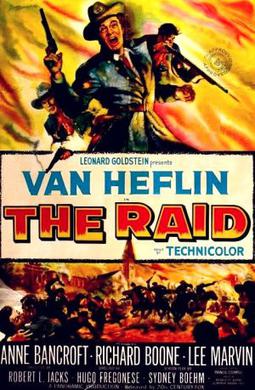
The Raid (1954): Starring Van Heflin

The_Raid_FilmPoster.jpeg

On first glance, The Raid feels like a punchier, B-grade version of John Ford’s The Horse Soldiers (1959). In time, it winds up being a fairly apt descriptor. The fact that the other Civil War piece is a lumbering giant gives The Raid an unpretentious edge. Because in the casting department it still has a fine ensemble to work with, despite its humble production values. When Lee Marvin is your fourth bill, the prospects for an absorbing experience are great.

Likewise, the story grabs hold of the real-life events, taking a few artistic liberties, but honing in on an interesting theme. It begins as a mere mission movie — a vehicle for revenge — only to evolve into something more nuanced and ultimately, heartbreaking. This time we see the action from the other side, beginning on September 26th, 1864. These are not rogue Union cavalry looking to wreak havoc but renegade Rebels preparing to break out of their prisoner-of-war camp.

In essence, we have Stalag 17 meeting not only The Horse Soldiers but some amalgamation of The Professionals and The Dirty Dozen, except, again, we are working within budget constraints.

Major Neal Benton (Van Heflin) is the calculating ringleader, who gets his men across the border to Canada in order to plot out the next plan of action. The Raid becomes a story of infiltration, watching and waiting for the best moment to strike. The man sent ahead to do the recon is of course Benton. He dons his best gentlemanly duds to make the necessary arrangement and takes on the name Neal Swayze as part of the masquerade.

News of General Sherman’s march to the sea stokes the flames kindling behind their ire. The purpose becomes twofold. They want to avenge their brothers-in-arms as much as they want to become a thorn in their enemy’s side. Their spot of choice is the Northern oasis of St. Albans. The undercover Rebel makes acquaintance with the local bank owner (Will Wright) and finds agreeable domicile in the home of a war widow.

Anne Bancroft’s role is not altogether demanding as she plays the docile love interest. Regardless, she does this well, even getting a few moments to assert herself. After all, she is the enemy with a human face and we care for her as much as we do for Heflin. This equal footing is key. It causes a schism because alliances have been split. We begin to understand the deep fissures running through the ravaged society.

Even with the mistrusting Captain Lionel Foster (Richard Boone), it’s less about him thinking the other man is traitor and more so, his belief Swayze is elbowing in on his territory. After all, he’s known Katie Bishop far longer. He’s protective of her.

So with time, these relationships grow and Swayze receives a generous amount of acceptance. Soon the Confederate forces slip into town incognito, ready to tear it apart and hit the Yankees where it’ll hurt — in their pocketbooks. An auction of scavenged Rebel goods boils the outsider’s blood. It instigates a contentious bidding war that he finally diffuses. It’s not yet the time for action.

Lee Marvin, forever the loose cannon, all but blows their cover, threatening to set off a disastrous chain reaction. After going on an alcoholic binge, he gets it together just in time to stumble into the local sanctuary of worship. Their hard-sought plans look perilously close to being spoiled. Swayze steps out of the house of God a local legend and feeling even more like a heel.

As such, The Raid is this strange jolting empathy machine. This crisis of conscience comes to bear because the enemy has surprised him and welcomed him into the fold as a fellow human being. Of course, he can barely look them in the eye much less take their generosity, knowing full-well what he has been commissioned to do — completely obliterate their homes.

After all, their soldiers did little better to his home in the South. If we were simply to go by the eye-for-an-eye mentality, and the fact this is wartime, he has more than a right. However, this does not make the endeavor any easier. On top of the logistical elements, Northern troops patrolling through, and the need for stealth and efficiency, all of a sudden he has to deal with complicated relationships.

In the form of the widow Anne Bancroft and her precocious son, the local banker Will Wright, and even the standoffish Richard Boone. He starts to soften to these folks. The most impressive evolution is with Captain Foster. He shows a vulnerability and an ultimately retained dignity as the plot progresses. He would be so easy to villainize because Boone, Marvin, and Claude Akins were so good at those parts. And yet they can all be in this picture and function differently. Boone actually comes out looking extraordinarily sympathetic.

The fact that these characters become more and more like human beings, makes his mission all the more perplexing. This very element gets at the core dissonance of the Civil War because we were literally turning brother-against-brother, sometimes across arbitrary lines of distinction.

What this film suggests is that we have more bringing us together than separating us. Still, we stand doggedly to our presuppositions. Certainly, we cannot downplay the crucial issue of slavery (though it doesn’t play into this tale at all), but I think there are already some intriguing implications.

The line between feelings and duty become perilous roads to traverse. Van Heflin, while never the classically handsome lead, had something far more compelling. There’s an inherent honesty within his stock. He can be genial, pragmatic, even harsh and unfeeling. Whatever he is you never feel like he’s being inauthentic as both hero and villain. This ability carries the picture’s emotional core opposite Bancroft and the stellar troop around them.

Events run their course and yet there is an unquestionable toll to them. A war picture often fails if we don’t feel abhorrence for the violence. But there also needs to be a human connection. The Raid somehow manages both with relative ease. Movies such as this never grow tiresome because they carry with them an invigorating life, in spite of the inherent restrictions hoisted upon them.

3.5/5 Stars

Saddle The Wind (1958): In Memory of Richard Erdman

Saddle-the-wind_posterJulie London provides her airy voice to the title track and Elmer Bernstein gives his scoring talents for the rest of the picture. In these beginning moments, Saddle the Wind evokes the expanse of the majestic landscapes of the West like the best of its brethren. There is a sense we really are out on the frontier, not some manufactured piece of artifice. For the time being, the film maintains this sense of the wind-open spaces away from Hollywood soundstages.
It gets its first jolt of action when a leering Charles McGraw stomps into a saloon and shoves his weight around for food and a bottle. He’s got his feet kicked back and starts breaking bottles over counters just to get his point across. The locals aren’t looking for any trouble, but he’s certainly looking for someone: gunslinger Steve Sinclair (Robert Taylor).

Here we must introduce the glut of Saddle The Wind. Robert Taylor is still Hollywood handsome but time has set in and made his features more applicable for the West. Where a hard life and past wounds lead people to make a new existence for themselves. The reformed gunfighter is not a new concept, but it is a handy one. It gives a man menace without him having to show it, until it’s absolutely necessary.

The real action arrives in the form of his spunky dynamo of a little brother, who comes back to the family ranch with a woman (London) betrothed to be his wife. His big brother is less than pleased to find Tony has gone and got himself hitched and spent his money on a spiffy new gun.

If anything is cemented in this preliminary scene, it is that one is the hothead, the other maintains reproachful silence. They are the yin and yang of the West. Cassavetes and Richard Erdman, as rowdy Reb veterans, form a rambunctious partnership looking to tear up the town and have themselves a bit of fun. They positively take the bar by storm, only to have their merriment disrupted by the same out-of-towner. Except the man Venables meets up with isn’t an old local or a squeamish bartender.

Tony is on top of the world, and if there’s one thing he’s never gonna do is back off even when the other man isn’t looking for trouble. His quarrel, after all, is with the elder Sinclair. Still, the feisty buck takes it as a personal affront. He goads the man into action. There is no other way for it. Guns are drawn.

Steven rushes on the scene an instant too late. His brother isn’t killed, but something worse happens. He’s filled with renewed fire. The taste of power — the ability to strike a man down with the pull of a trigger — is like an intoxicating liqueur.

Steve Sinclair has long kept the peace with the main landowner in the area Dennis Deneen (Donald Crisp), who is, by all accounts, a businessman and a pacifist. The stage is set for something…

Clay Ellison (Royal Dano) is a proud man clinging unflinchingly to the promise of land out west, formerly bestowed on his dearly departed father when the territory was still wide-open. He’s come on the scene to take back what’s his even as Steve tells him, brusquely, he’s trespassing. In a different context, that might be the end of the incident.

What ignites it irrevocably is a remnant of North vs. South animosity left over from the Civil War (Ellison is a proud Union man with great distinction). The torchbearers are Tony and the impish Dallas as they have a grand old time with the squatters, upending their wagons and chasing away their livestock in fits of gunfire and laughter. It’s a bit of festering payback for wartime grievances, and it’s easily the most devastating scene, right smack dab in the middle of the picture.

It’s a testament of what happens when men take squatter’s justice into their own hands and when the protective big brother does little more than beat back his baby sibling and throw money at a problem. Nothing is remedied.

However, Saddle The Wind ends up being far more contained than I was expecting. It’s fundamentally a character study about two brothers and how they grapple with one another, based on outside stimuli.

We could name a number of people, first the new wife who is brought home. The old vagabond war buddy who is an instant enabler. A gunfighter with a vendetta looking to tromp up old wounds. Even the obdurate homesteader who’s not about to get pushed out by a punk kid.

None of these characters seems to truly exist for themselves. Even lord of the valley, Mr. Dineen, though deeply humanized by Donald Crisp, is just another piece in the brother’s story. This observation might seem too harsh, but with Rod Serling as the story’s scribe, it seems conceivable to say the intriguing idea — because it is that — takes some precedence over the characters.

There are moments to turn the stomach, feelings of conflict, and wrenching segments of tension. This is not a completely lethargic film by any means. If anything, Cassavetes alone sets it ablaze with his youthful fire. Still, some component seems to be missing.

With this vast assemblage of characters, it could be that there are a handful of stories worth telling when the credits roll, and we only got over the cusp of one of them. The ending lacks all the cathartic payoffs we craved so dearly. The strands don’t entirely tie together, though the movie does try and solve everything with a silver lining. Surely it’s not that easy.

Whereas the opening moments felt like a regalia of western imagery, Saddle The Wind settles into almost small-screen paces, going from long shots full of real sagebrush to close-ups with backdrops painted on.

Although it’s hardly fair to consider the film’s merits on this issue alone — I think the suspension of disbelief being broken speaks to something — even as these characters never settle into something truly genuine. It’s allowable to be harsh with critique only because Saddle The Wind has its share of all-too-brief shining moments to go along with its potential. It’s an oater with enthralling elements not fully realized.

3/5 Stars

Note: I watched this film literally two days before the passing of Richard Erdman at the age of 93. He was one of my most beloved supporting actors. He will be deeply missed for his myriad of classic roles and for his work as Leonard on Community.

Un Flic (1972) and Fatalistic Forms of Masculinity

Un flic 1.png

“The only feelings mankind inspires in policemen are indifference and scorn.” – Eugène     François Vidocq

Some of the great filmmakers are not great because they document a reflection of the world. More so they bend the world unto their own artistic vision, allowing us to see landscapes, plotlines, and people under a very particular microscope.

One might wager Jean-Pierre Melville is such a filmmaker. All his works are noir whether photographed in black & white or color. The palette does not matter. Because it has to do with temperament, stylings, the way characters talk, what they wear, and the things that take up their time.

Un Flic is about as typical as you might get in such an underbelly. It’s about a cop on a beat. He gets to work when the city sleeps. But of course, what does make him extraordinary is the very fact he is played by Alain Delon. If there is a man we could nominate for defining Melville’s hero, it would be he. Again, whether good or bad, it really does not matter. In this world, both function in a similar manner. There is a calculated aloofness. A predilection toward violence and yet some semblance of a moral code, wayward as it may be.

The events begin with immediately novel imagery. Torrential rain, crashing waves, a beachfront bank, in that order. It’s both environment and plot being established because said banks are often in the habit of getting burgled. So it is with this one.

The ubiquitous trenchcoats and fedoras are donned by the perpetrators. In a Melville picture, they are always in vogue. The added touch is dark sunglasses to conceal their identities. The quick cutting back and forth to wordless close-ups of the four co-conspirators help give the heist the much-needed cadence. It’s all in the build-up of the suspense, whereas Melville moves quickly through the events.

The deed is stripped down to the barest essentials. Guns coming out. Cut to cash in a bag. A bank vault being opened. Bank employees with their hands up. The audience needs little else. Except for the designated hero trying to fight back and thence the wrinkle in the plot. They screech off into the fog and our story is born like all the great heist films of yore.

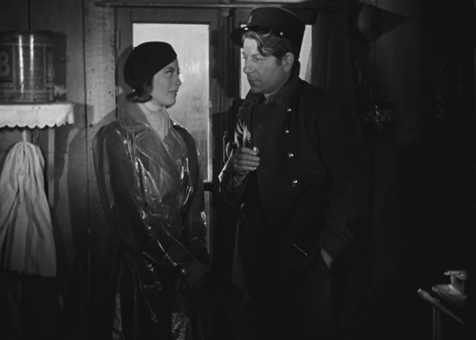
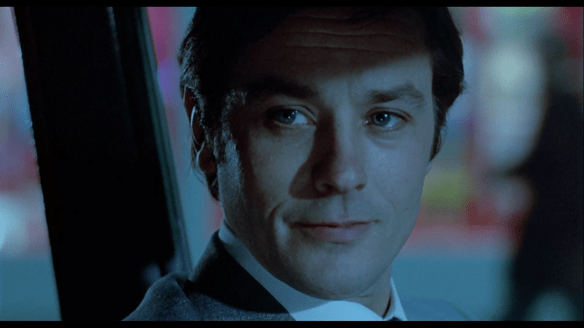
Beyond black and white, blues and grays seemed to be Melville’s fondest companions. His world is made of them. Sleek and austere. Cool and detached. There are few better descriptors. Alain Delon’s piercing eyes match them well and as Un Flic is often a film of searching glances and competing eye lines, it’s more than a good fit.

Un flic 2.png

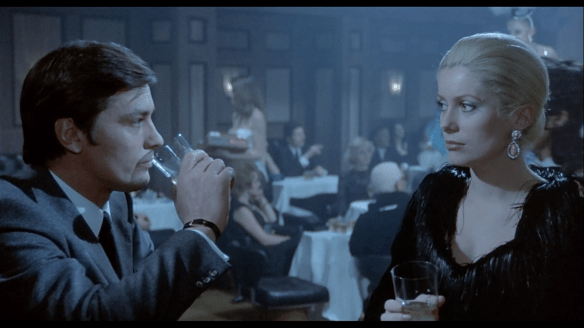
Is there a more spectacular power couple of the 1970s than Alain Delon and Catherine Deneuve? It’s hard to think of one. There’s the most peculiar scene with the commissioner wandering through a nightclub, staff getting ready for the evening. He goes to the piano, tinkers for a few notes, and sits down to play. Cigarette between his lips and I think there’s a drink sitting on the edge almost like it’s there waiting for him. Deneuve comes out — hears the tune — listens as if it’s a song they’ve known for years, shared together in each other’s company.

Mind you, it’s possible none of this could be true, but in Melville’s world they might as well be Bogey and Bacall or Bogey and Bergman and this is their “As Time Goes By.” Why the commissioner was there and how they all relate is not explained and somehow I like it far better this way. It foregoes realism and logical exposition for something of a far more tantalizing nature. Their scenes together are surprisingly few and yet little feels wasted.

There is a robbery to be solved and accordingly, the accomplices reconvene in an art museum to make their plans — including what to do about their compatriot currently sitting beleaguered in a clinic. However, the film’s most intriguing interplay has some roots in the traditions of Double Indemnity, where the criminal element is sometimes too near — too closely entwined — for you to even see them right next to you.

A kind of unspoken kinship forms between Delon and Richard Crenna, who, aside from the dubbing, fits relatively seamlessly into this picture. Again, it comes down to representing alternate sides of the same coin.

We might also consider Deneuve vaguely coming out of the imprint of Phyllis Dietrichson, playing the men, stuck on her, like pawns. And yet it could merely be the wordless spell she casts, but we almost are drawn to believe she does love them both. Again, the words are never put to it so no easy answers are ever arrived at. Everything is conjecture.

For all intents and purposes, the majority, or at least long stretches, of Un Flic are silent cinema, and it’s easy to appreciate them. The most fascinating criminals or often defined not by word so much as deed. Whereas the opening job is done in quick and efficient strokes, the second effort involving helicopters, trains, and elaborate inner workings, is a far more intricate, far more methodical endeavor. Melville seems to relish the mechanisms of the criminal most of all.

The perils of Un Flic are not unwarranted. It develops a razor-thin dichotomy between romanticized cops-and-robber tactics and this underlying toxicity. Guns at one time stylish, as a token of machismo, are also exponentially deadly. Men exist duplicitously as both handsome rogues and cold-hearted cads, backhanding the weak who get in their way. Friends and lovers are won and lost in a glance and the blink of a moment.

It’s a social tradition out of a different era, which is true. Of course, in retrospect, we must take the bad with the good. It would be Melville’s last film in a truncated, albeit stellar career. But one cannot help and still find something mystifying even a tad alluring about the world he accentuates. Where his style feeds into his characters and back again in this self-perpetuating ecosystem. Ultimately, what’s presented is a fatalistic form of masculinity. There is no more pertinent analysis of France’s foremost noir auteur.

4/5 Stars

Two For The Road (1967): A Rom-Com for a New Era

two for the road 2.png

“If there’s one thing I despise it’s an indispensable woman.” – Albert Finney

The world seemed a very different place in 1967. It had changed and with it, love and the romantic comedy underwent a transformation of its own. Because, in some sense, humanity had reached a new tipping point. It’s easy to make assumptions: to cite Vietnam, social unrest, student protests, racial violence, any number of issues. There was this underlying implication the 50s and the early 60s (before November 22nd, 1963) were a time of hope and promise — surplus naivete.

Even the films had changed. Just look to Who’s Afraid of Virginia Woolf?, The Graduate, Bonnie and Clyde. Then, there was a new batch of progressive works like In The Heat of The Night and Guess Who’s Coming to Dinner?

Two for The Road must fit into this puzzle as well, though it’s place is more difficult to explain and thus, we might wager a guess why it’s not often voiced in the same company. It doesn’t necessarily have to do with it being a weaker movie. Still, because it doesn’t capture the “moment” as much, it cannot easily be rewarded for being cutting-edge.

And yet, in its own way, it was of its time and representative of this ongoing form of change. Because it is a mature romance. Audrey Hepburn — the movie-watching world’s darling — has had her heart broken, been trampled on, and done some irreparable damage of her own.

This was not just make-believe, mind you. Reality and the theatrical overlap closer than we probably realize (Hepburn’s marriage to Mel Ferrer was sadly on a fast decline). However, Stanley Donen, coming from his pedigree as a musical maestro, never quite lost the sense of romanticism — his belief in magical things.

You could say Audrey Hepburn was one of the perfect embodiments of his beliefs because she was so sweet, demure, and beautiful. We can all imagine her at the center of romances galore — she was in some of the most iconic, after all. And yet amidst the lingering illusions of Hollywood, there is this sense of something more heart-wrenching and hard.

Albert Finney might be the finest vehicle to acts as an opposite force of nature — larger-than-life, barrel-chested, and in many ways the utter antithesis of Audrey. He came of age in the resurgence of Britain’s gritty kitchen sink dramas. He was by no means a counter-cultural figure, but he has the gusto of a Brando and his disciples — a bit of the cocky bravado that’s nevertheless disarming. In no small way, they make the perfect couple in cinematic terms, sitting at the crossroads of the decade. Somehow they’ve met and found themselves on near equal footing.

The story itself, by Frederic Raphael, is ambitious as it skips and jumps through a love story, a constant exercise in cuts and whip-fast transitions. In fact, you might say Two For the Road is won in the editing room even more so than most films because it builds peaks and valleys with both a frenetic pace and constant changing snapshots of life. It resonates on these levels without ever feeling turgid. If it does turn on a dime, then it gives the freedom — the necessary space — for leeway and visual connections between past and present.

two for the road 1

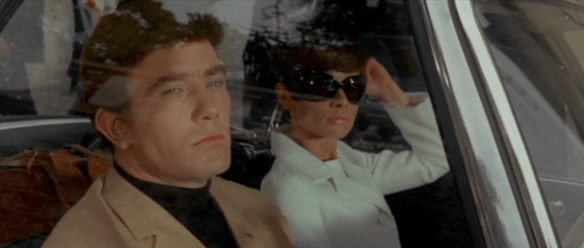
It commences at the beginning of the end. The husband and wife slump in a car, watching cynically as a pair of newlyweds walk out of a church. They see their youth reflected back at them. But there were happier times once, what now seems like many eons ago.

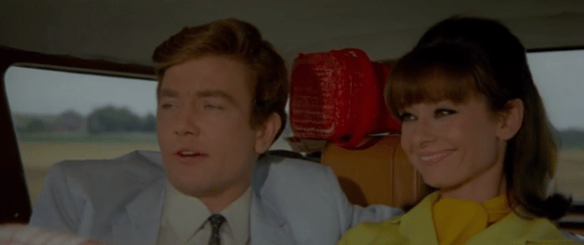
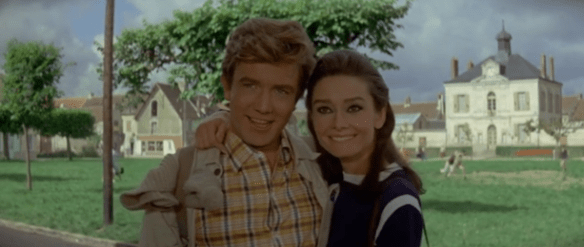
The adolescent days full of sun-soaked afternoons and equally idyllic intentions. The French countryside was ripe with promise. Open-air automobiles and “thou” was all that necessitated a contented life. Of course, those were the days when “thou” meant a happy companion. Riding in the MG with a persistent “donk” in the engine only facilitated moments to look back on and laugh.

Finney is constantly mislaying his passport, chomping through apple scruff, and doing his Bogart impressions. One of his finest hours is strolling into a ritzy hotel that they can’t afford, his coat bulging with the edible spoils from the outside — only to drop them all over the lobby.

two for the road 4.png

Hepburn is clothed in red, hair free, and alive on so many levels. Picking up a ride as a hitchhiker a la Claudette Colbert. Seeking shelter from the rain or frolicking in the shallows without a care in the world. It’s an extension of her earlier personas from Roman Holiday and Funny Face.

Then come the spirals charting the bitter dissolution of a marriage as it crumbles into fractured pieces of apathy. Affairs follow on both sides, involving a cajoling lady motorist and a supremely confident French romantic. We cannot help but feel they are pale imitations of the real thing. They are only a momentary antidote. They cannot truly satisfy and repair the wounds.

The paradoxical aspect of love is evident with time. Yes, the honeymoon is over, the nagging begins, the arguments, raised voices, life gets in the way. And yet somehow it seems true that you often only know you love somebody else after the speed bumps and roadblocks. Closer still, you love them in spite of them.

Henry Mancini’s score is one of his most lastingly melancholy, striking the notes back and forth between a whirly gig warmth of summer carnivals and then the summers after when you’ve fallen out of love. The repeating string motif continually reinforces this feeling even as he reaches out for lingering bits of nostalgia.

Because there’s a playfulness dancing within the frames just as there is elegance. How can it not be with Audrey Hepburn? So, while we have a sense these are movie stars — glamorous, richly-attired, all the superlatives — their love affair is besieged with the slings and arrows aimed at each of us.

Petty squabbles. Tedium. Poor communication. Evaporating memories. Jobs and families. Reprioritized lives. Most important of all, falling back in love — even if it’s only the hint of a spark — sometimes it’s enough. So have Audrey and Donen grown into a new decade? We must admit they are different, wiser, wounded even, but the great gift is how Two for The Road still leaves some space for love to exist.

In the midst of a myriad of distractions and messy lives between flawed people, it really is a miracle. It is romance coming to terms with changing times and yet not quite giving up on the ideals of romantic commitment.

4/5 Stars

Port of Shadows (1938) and The Face of Jean Gabin

port of shadows 1.png

“Like the movies. I see you. I like you. Love at first sight.” – Jean Gabin

Jean Gabin has one of the great visages of the cinema. But in making such a statement you immediately run the risk of giving the wrong impression. To actually see him on the big screen is to know what I mean. He is not classically handsome in the Hollywood sense, fitting somewhere in between Spencer Tracy, Bogart, and Fonda when Hank had a chip on his shoulder. And yet set off in black and white as Gabin always was during his most prolific periods, there is something unmistakable about his face.

It is worn with the grooves, contours, and the residual sadness that come with life. He gives the impression of seeing the world, having his heart ripped out, being battered and bruised, while still choosing to press on anyway. You could say he has the entire French experience of the early 20th century on his brow. He’s simultaneously a projection of their best self in the face of hardship.

Historically, the cultural mood and the looming world war to come were ill-omens, as far as the release of the film was concerned. It was far too portentous to be met without some amount of resistance

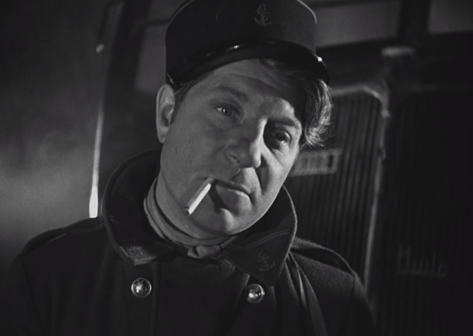
In Port of Shadows, Gabin fittingly plays a jaded soldier who catches a lift to the nearby port town of Le Havre. In an opening act of clemency, he keeps his truck-driving benefactor from quashing a mutt masked by the billows of fog. It’s an instant flag. We know this man. His emotions are not obvious, but they are there; he concerns himself with the well-being of others. There is a heart under there somewhere. Scene after scene his constant companion is the runty little dog, a continual reminder of who he is as a man.

Along with setting up its star, we soon learn director Marcel Carne cares about his characters and takes care of them. Not that the environments are unimportant. Between the pitch darkness of the highway or the smoky and garish interiors of the club, there’s atmosphere aplenty. But Carne is focused on his players; their faces and distinct movements, allowing them to be focal points of scenes in a generally clean, uninterrupted fashion.

Between the instantly palpable world and the menagerie of players cycling in and out, Port of Shadows cannot help but feel like a prototype for everything from Casablanca to the entire film noir movement with its smoky brand of realism.

I don’t know much about the time frame of when the picture takes place. In all honesty, I’m not all that concerned with that so much because instantly you are pulled into a world’s depth of field with its shadow and fascinating figures. There’s a compulsion to fall into the story and be as fully involved as possible.

He’s in town, flat broke, and there’s an unspoken understanding he’s not looking to get noticed by the local gendarmerie — most obviously a deserter. This is one of those picturesque places where you can fall in with drunken vagabonds and find yourself on the receiving end of neighborliness.

As is, everyone who is down-and-out or in trouble seems to go to Panama’s, though it serves as little more than an old shack with a couple of rooms.  A sorry excuse for a hangout and yet it has far more life than the fancy club in town. It’s the people there who truly make it worthwhile.

port of shadows 2.png

Jean (Gabin) is given a meal by the ragged proprietor, gets some fancy talk from an amiable artist, before meeting the most important person: Nelly (Michele Morgan). She’s young but precocious, mature beyond her years. The same might be said of Morgan who assuredly holds her own against all her male costars. She’s thoroughly outnumbered yet she handles it poise.

It’s a testament to the strength and varied colorfulness of the characters that the illustrious Michel Simon almost becomes of less interest as Nelly’s despicable godfather, especially compared to the peculiar sots he was tasked with portraying in Boudu and L’Atalante. His big scenes come near the end of the picture anyway.

Mostly this is a love story. In a rare moment of self-reflexity, Jean mentions how theirs is a movie romance. It’s this heightened sense of romantic reality. If we put it up against anything we experientially know to be true, it’s poppycock, but between the eyes and embraces of Morgan and Gabin, it just feels right.

We also learn more about Jean. Not only is he capable of deep measures of love, but he has no tolerance for lowlifes and scum — those lacking a sense of honor or principle. You have it out with a man face-to-face with fists, not from behind. One of his main targets is the local gangster Lucien who is nothing more than an arrogant rich kid with too much time on his hands. He wants his hands on Nelly. Jean is having none of it. He cuts directly through the artifice, slapping him around for his impudence.

The story comes to a head on the docks and again, of all places, at the bumper cars in the middle of a carnival. You do not mess around with Jean Gabin when a girl is involved. This could be the movie’s ending; the romance would be the euphoric and the hero would remain triumphant. However, it is a movie and so a greater, darker, more wistful avenue of drama is in order.

Because Jean knows he is not safe, though he has gratefully taken another man’s identity. It is better for him to leave on the latest vessel shipping out to Venezuela the following day. His love for Nelly is great, but there is a need to move on, to let her be while also keeping her away from the trouble that would come from knowing him. He does the selfish or heroic thing (depending on how you look at it), in cinematic terms, and he doesn’t tell her. He holds off as long as possible.

One fine sequence is at the waterfront bar with kegs of alcohol lodged right outside the door. There’s a conversation at the bar between the bartender and an old acquaintance we’ve already met. At a distant table, our protagonist, with his new identity bequeathed him by the philosophizing painter, charts his course for Venezuela aboard the freighter now sitting in the harbor.

These seem like mundane enough scenarios, but instead of a normal cut, Carne rides an extra with his camera, acting like the seamless segue between the two conversations. It’s a classy and efficient way to keep the scenarios fluid even in a seemingly sedentary state.

These lulls lead up to what can only be seen as the film’s inevitable tragedy. Like the most sublime expressions of cinema, Port of Shadows is a visceral, emotive experience capable of so many things. It’s a piece of art: humorous, tragic, brooding, and searingly romantic. In short, a sheer pleasure to take part in.

4.5/5 Stars

Floating Clouds (1955): Capturing Japan’s Post-War Zeitgeist

floating clouds 1.png

The Odyssey to finally get to Mikio Naruse has been a long and arduous one. I must admit, like many before me, his name carries none of the recognition we commonly lavish upon Kurosawa, Ozu, Mizoguchi, and a select few. So, for the longest time, there was no pursuit. His name was totally unknown.

However, as you begin to familiarize yourself with Japanese cinema (and I must admit to still being a relative novice), there are certain names that you keep coming back to. Masaki Kobayashi and Kon Ichikawa fall right behind the illustrious trifecta. Certainly, you have the Japanese New Wave directors like Shohei Imamura, Nagisa Oshima, Masahiro Shinoda, and Hiroshi Teshigahara.

However, for some reason, I just could not stop thinking about Mikio Naruse. It seemed like I was always being reminded of him. Whether it was Kurosawa praising his writing or Hirokazu Kore-eda saying his style was more akin to the lineage of Naruse and not Ozu. Again, it reflects an oversight on many film aficionados. We do not pay Naruse much respect because, frankly, there’s not much access to his work in America.

In fact, because I am so fortunate to come of age as a cinema lover in a world that is so globalized, with content so accessible, it is not a form of helplessness that I have felt too often. It’s not simply a matter of his film’s being hard to come by; it felt like only a few were readily available.

This absence of his work made it all the more imperative to reach him. Finally, I can attest to dipping into his filmography and finding myself deeply fortunate to have made his acquaintance. If it’s allowable to use a German word to describe a Japanese condition, Floating Clouds captures the zeitgeist of Japan in the aftermath of WWII.

The film’s structure feels as fluid as its title. It trusts the audience to follow along without voiceover cues of any kind, drifting in and out of the present and flashbacks set before the war had ended. This is the fashion in which we get to know our two “destitute expatriates” now reunited in 1946.

They met for the first time in Indochina. It’s a world we can contrast with another romance like Red Dust. An outpost out in the forests of Asian proves a far more bearable place to pass the war.  If you recall, the earlier film is made by the red hot chemistry between Clark Gable and Jean Harlow (and with Mary Astor).

Except in such a patriarchal society, like Japan, it always seems to be the man who has the say. Tomioka (Masayuki Mori) begins his acquaintance with Yukiko (Hideko Takamine) with slight jabs at her, all but solidifying his gruff character for the entirety of the film. These rocky foundations give way to passionate romance and Naruse does something dynamic by cutting right between a kiss in the past to one in the present. So much has changed and yet nothing at all. Much of Floating Clouds is about this reconciling this past with the present.

The pensive serenity is one of the unifying hallmarks of the picture. This is another point of departure with a Hollywood romance like Red Dust. This, paradoxically, feels like a grand statement — choosing a tranquil path in a medium that is so often filled with noise and a world full of constant turbulence.

Even in considering his countrymen, Kurosawa is often more dynamic in composition and action. Thus, it seems most obvious to contrast Naruse with Ozu. However, whereas Ozu heralds his presence within the frames through the meticulous craftsmanship and attention to detail, you do not necessarily see this to the same degree in Floating Clouds.

It is stripped down to a near Verite approach, which still cannot be mistaken for shoddy work. In fact, it boasts beautiful interludes between two people on par with a picture like Late Spring. It’s not a perfectly ordered fabrication of reality where human drama plays out. The spaces feel rich with the impoverished and worn layers of Japan as it lay. The people are much the same, unadorned yet imbued with truth.

Hideko Takamine is extraordinary for how she is able to manage a spectrum of emotions — exuding an inner strength and individuality — while still giving way to honest feelings of regret. She can be the adulterer, the nagging lover, the broken heart, all of the above , as they cycle through time.

No less important is Masayuki Mori as he acts as her perfect counterpoint. He gives her nothing, or at least very little. Every potentially thoughtful action is dismissed and any form of commitment is avoided doggedly. There is even so much about their preferred temperaments putting them at odds. It seems like circumstance and they’re own interactions together all but destined them to part ways and move on with life. He returns to his wife “nobly,” while she is supported by the brother-in-law who formerly took advantage of her. Every relationship is riddled with these personal dilemmas.

There is another brief snapshot that resonated with me — both in its mild humor and how it proved indicative of the times — when Yukiko is walking down a street alone. In the periphery, we see what looks to be a Japanese woman with an American G.I. He seems to be at least a head taller than everyone else. Then, almost on cue there comes a voice, speaking my native tongue: English.

It’s a second G.I. looking for a date, and he affably asks her in broken, bastardized Japanese (rather like what I’m capable of speaking), if she’s alone and where she’s going. She simply smiles and moves on, either to brush him off or resign herself to a superficial evening of companionship. He exists as more of an archetype than a fully defined character even given that his name is “Joe.”

However, what it provides is a fascinating counterpoint to what we are used to in our little universe, where everything commonly revolves around the western world, if not America. Pictures like House of Bamboo, Sayonara, Teahouse of the August Moon, they all give us a very specific and tailored experience.

It’s somewhat strange and fascinating to feel like the “other.” The soldier here is the sailor in Lola (1961) or the soldier in The Marriage of Maria Braun (1979). In fact, they all serve much the same function. They come to represent a different type of relationship and with it a diverging life, even if it’s only meant to be a momentary fleeting fancy. 

This is not a picture where we see the chaos and the bloodshed. After all, these two were the “lucky ones” stationed in Indochina. And yet we see the shadowy imprint of a former life involving suffering, poverty, and the ignominy of surrender. It doesn’t seem too farfetched to claim Floating Clouds somehow channeled the thoughts and feelings of a generation. The Best Years of Our Lives might be similar to a generation of Americans.

Consequently, as a viewer in this contemporary moment and an American on top of that, there is a realization of how much I take for granted in this story. I am more like the American soldier than I am this couple. It proves a humbling observation, carving a path toward some sense of empathy.

floating clouds 2.png

 Eventually, her lover turns up again — still as brusque and egocentric as ever, looking around at her plain surroundings and commenting on how well she’s doing. These types of evasive, indirect proclamations are all she ever gets. So she’s hanging on his words, getting whisked this way and that with partial promises and empty hopes, never going anywhere. Later on, he has his eyes on the pretty young wife (Mariko Okada) of an acquaintance (even soaking in the public bath together). After all, in superficial terms, she is much more “desirable.”

To consider the American soldier again, he was on leave for two months before shipping home. Even in the short amount of time, he was overflowing with geniality. If we take Floating Clouds as indicative of all of Japanese society, it proves a telling portrait. There is no affection or sense of vulnerability within men. Endemic to the society and more so a holdover of the war. It’s not simply about women being overly emotional, though this is often the cultural expectation. More emphatically so, the men lack any type of emotion. They are ingrained with this stoic (sho ga nai) mentality.

There are numerous walk-and-talks, and the scenery and setup might as well be interchangeable, but the subtext and junctures in their lives are starkly different each time. So we have all these snippets wedged in between their life events as they orbit in and out of each other’s lives.

It’s easy enough to juxtapose it with Citizen Kanes dinner table scene where a relationship is seen crumbling in a matter of minutes. Stretched out as it is, within Floating Clouds, these walks continue this metaphor of progression. It is the progress of life, of a relationship, and of the world existing around us. Because while the steps might remain the same, the circumstances are different around every bend. Time marches on with each footfall.

It’s not about being ships in the night either — that they missed out on one another’s company — simply put, they are abrasive together. Their traits and identities are constantly causing them to attract and repel each other again and again.

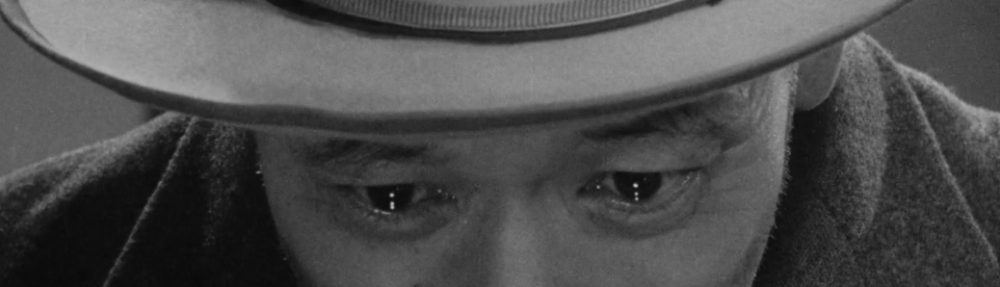
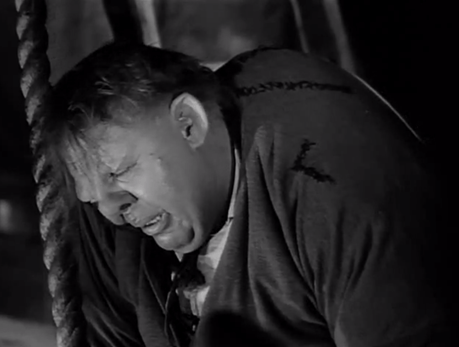
The lasting image is a bent head, but this is not one of Ozu’s quiet forlorn scenes where a father has just made the honorable decision to give up his daughter. These are ugly, bitter tears. He is weeping. And this man, for the first time in his life, is providing physical acknowledgment of how much another individual human being meant to him. In a Hollywood picture, the action would be meaningful, but not unprecedented. In this movie, it feels heart-wrenching because we have yet to anything so transparent.

It’s an evocative final note in a work rarely prone to this kind of overt outpouring. It’s the cathartic release in a bittersweet tragedy. All we can do is bemoan the fact this man was never vulnerable enough to admit the depths of his love during life. Unfortunately, in this particular life, there is no resurrection.

4.5/5 Stars

Close Encounters of The Third Kind (1977): Sci-Fi, Spielberg, and Truffaut

close encounters of the third kind 1.png

Close Encounters is built on a mystery and Steven Spielberg’s follow-up to Jaws starts off in a jarring fashion challenging us to stay with him. Because he quickly throws us into the action and suggests this is a sci-fi tale on a global scale.

Bob Balaban, a cartographer-turned-French translator, speaks for all of us trying to figure out what’s going on, yelling out against whirring old WWII fighter engines, “I don’t understand!” Two lines of juxtaposed dialogue are all we need. The planes were reported missing in 1945. But they look brand new! It takes a moment to tease out the dramatic situation, but there we are. The question is how did this happen? As this is a Spielberg creation, we must point our gaze heavenward or more precisely to the outer reaches of the galaxy.

Francois Truffaut somehow feels like a special piece of casting. The Nouvelle Vague director and hero of Spielberg is cast as Lacombe, a French scientist leading a surprisingly cooperative international team.

It’s not simply because this is the only film he acted in that he didn’t also direct. It has to do with his temperament and the subject matter. There’s something serene and utterly profound about Truffaut. He’s deeply human and engaged and yet feels implacable even as everyone else — the Americans especially — seem frantic and harried. He’s a calming force in a literal maelstrom.

Because Spielberg immediately sets the picture up as not only a national but a global storyline with implications for the entire world. It’s not just higher-ups and government officials covertly working on the issue. Extraterrestrial life would mean potential hysteria, especially for the common man. In this regard, he introduces a few stand-ins.

One is Roy Neary (Richard Dreyfuss). He loves to tinker, isn’t a particularly devoted father or husband, and he’s a staunch believer his kiddos should grow up with the quality entertainment he had as a kid like Pinocchio, instead of vacuous putt-putt games.

If we are to be honest, Dreyfuss can be a perfectly genial hero in something like American Graffiti or even Jaws, but within this narrative, reflected by his family life, he often comes off whiny and obnoxious, and it hurts his rapport with the audience.

In this particular instance, there’s some difficulty in feeling a true human connection with him even as we are drawn and fascinated by what forces he might have witnessed because that is the million-dollar mystery propelling the picture and keeping humanity agog with visions of UFOs and the great unknown of outer space.

Yes, we are planted in the ’70s so if you want to blame his wife (Terri Garr) for not being a particular understanding or his children for being exasperating you can, but today it just makes him out to be a selfish dolt. This isn’t the same whimsy of some of his cinematic predecessors; it just feels like immaturity.

Sadly, without a substantial protagonist, a Hollywood blockbuster like this can feel intermittently detached and impersonal. It’s not based on lack of effort by the director or the actor. We simply don’t like the man.

It’s much more agreeable to stick with the sci-fi elements because this is where the film really has its deepest successes. Special effects hardly feel like a detriment. They are simple and practical casting just enough of a spell to hold up. But they are not there to do all the heavy lifting.

The first encounter happens when Roy is driving down a country road in his truck only to be ambushed by the most spellbinding sight he’s ever witnessed in his life. It’s greater than any Aurora Borealis and sends his car into a state of zero gravity. The only indication he has after the fact of what he’s just seen is a burning sunburn across the side of his face.

From that point on Roy is doggedly firm in his resolve. It’s almost a primordial urge. He has to see the beautiful lights again, he has to understand them, he needs everyone to appreciate them as much as he does.

One person who does is a single mother, Jillian Guiller, whose little boy Barry has some transcendental encounters in the evening hours, drawn to forces outside of himself — the same forces pulling Roy to something unnameable. In fact, they are the same forces Lacombe is so intent on learning more about. It leads his team traipsing around Mexico, India, Mongolia, etc. all on the trail of this great unexplainable mystery.

For Roy, unadulterated obsession sets in. He can’t get the image out of his head. His wife is frightened. His kids think he’s crazy, and they have every right to. He drags all the family out to stare at the sky. He loses his job. He starts shoveling dirt through the kitchen window with the whole neighborhood watching the spectacle.

With his wife driving off in a tizzy, trying to rescue her family from a maniacal husband who needs mental health, he goes back inside. They fail to see the final destination, the symbol so many people have subconsciously remembered. It’s a clue of where our story must travel.

That leads us to a family road trip — at least one my family took while I was in high school. One of the stops was Devil’s Tower, christened the first National Monument by Teddy Roosevelt in 1906. Like Mt. Rushmore in North By Northwest — which I coincidentally saw on the same vacation — Devil’s Tower is an iconic American symbol. Natural and still somehow mystifying even otherwordly. The perfect seat for our finale.

It’s a mesmerizing experience sitting atop Devil’s Tower taking in the bright lights, the musical patterns of communication putting John Williams’ talents to the best possible use. Though it would be lying to say it didn’t verge on monotony in patches, at its very best, Spielberg has an unabashed appreciation for the wide-eyed spectacle and his stroke of genius is taking a very concrete relic and making it so integral to this encounter.

There’s something totem-like, it is a monolith in its own right, and suggests something as ancient as time itself. His other choice is to make the creatures on the other end the most amiable beings imaginable. Years of watching The Thing from Another World and Body Snatchers taught a different paradigm, but Spielberg is an optimist at heart. It shows through and through as the story is carried away by the exponential magic of the final climactic moments.

In many regards, it is a taste. For those still capable of awe where special effects or time or comprehension don’t get in the way of enjoyment, those final moments can indeed be spellbinding. It’s true their trance-like grip reached out to me. The only regret is some of the momentary distractions leading us on this road. It takes a whole lot of roadblocks and digressions to finally get us to our close encounter.

There’s something else nagging inside me. Dreyfuss fulfilled his unerring obsession like an angelic pioneer sent off to the great unknown. He reached the apex as he conceived it. There is nothing more for him to do. Still, one must wonder how exactly are the wife and kids doing at his sister-in-laws? It seems Spielberg has conveniently left the problematic issues of earth behind for the extraterrestrial. Too bad we are not afforded the same luxury.

4/5 Stars


Note: I viewed the Director’s Cut although there is also the previous theatrical cut and the special edition featuring an extended “mothership” scene.