Close-Up (1990)

close up 1I’ve heard people like director Jean-Pierre Gorin say that there is little to no distinction between documentary and fiction. At first, it strikes us as a curiously false statement. But after giving it a moment of thought it actually makes sense, because no matter the intention behind it, the medium of film is always subjective. It’s always a created reality that’s inherently false and even in its attempts at realism — that realism is still constructed.

So you see, this is the start of an interesting idea. Film is about what you decide to put within the frame and what you keep out. Directors, cinematographers, screenwriters, and editors among others all play a part in this process. They all formulate what we see on the screen — the reality that we perceive.

It occurs to me that Abbas Kiarostami’s film Close-Up stands at the crossroads of the documentary and classical fiction filmmaking with the two lineages blurring together like very few undertakings have ever been able to do, at least to my knowledge.

The story feels simple. It follows the real-life trial of a man who impersonated popular Iranian film director Mohsen Makhmalbaf in order to gain the confidence of a family of film enthusiasts. He wanted to make a movie and they were to be his actors. Abbas obviously took interest in the story that he read of in a magazine because of its relation to film. Here was a seemingly ordinary man who loved movies so much, that he was willing to masquerade as a film director. The irony is that this cinephile Hossain Sabzian also became an actor in the process, donning this role for the family. The family who accused him consider him a confidence man, even a burglar but that’s not how he sees himself. In fact, in a way, this film reminds us that we’re all actors. It all depends on your definition and the circumstances at hand. In some way, shape or form at a given point in time, we’re playing someone who is supposed to be us.

close up 2The beauty of Close-Up that not only does it feature the real individuals involved in this whole ordeal: There’s Sabzian playing himself, the Ahankhah family who brought the case to court, and Kiarostami appearing as well. But it blends the actual footage from the trial with reenacted scenes set up by the director as if they are happening for the first time.

One of the few things to tip us off that some of these moments are reenactments is that we see the same sequence twice, just from different perspectives. Thus, the whole docudrama becomes this blend of reality and falsity. Documentary paired with purposeful re-creation, utilizing a kind of cinema verite filmmaking. I almost don’t want to know what is real and what is fake and in some respects, I don’t care. And that’s what’s fascinating about Close-Up. The story is not altogether extraordinary but, again it’s this dichotomy between reality and fiction. The dividing line proves to be paper thin.

Since much of the film is made of a close-up on Sabzian’s face, it does bring up some questions about the defining factors of identity. Is this man in front of us really what he says he is? Is how he is acting genuine and real. Is it all a facade? Was this whole sequence contrived by a director for the benefit of the viewer? You could go on and on with such assertions and with such questions I think you start getting at the profound aspects of Kiarostami’s film and film as an artistic, expressive construction.

If you’re ready to actually consider what you are being fed, what you are viewing and how you can react to it, this is a film worth your time. I have never known a film to be more engrossed in the dilemma of reality versus fiction.  It took me long enough to see a film by this late great of Iranian film, but now that I have been opened up to his oeuvre, I look forward to more on my horizon from Abbas Kiarostami.

4/5 Stars

Model Shop (1969)

Model_Shop_FilmPoster.jpegAt face value, Model Shop is an ordinary film of little consequence but look a little deeper and it’s actually a fascinating portrait of the L.A. milieu in 1969. Part of that is due to the man behind it all.

Jacques Demy is among the foremost of French directors, most obviously for his work in musicals like The Umbrellas of Cherbourg and The Young Girls of Rochefort. And Model Shop, his first American production, functions in some capacity as a type musical (featuring a score from SoCal rock band Spirit), while also incorporating Anouk Aimee’s character from his earlier success Lola (1961).

It’s a musical in the way that American Graffiti is a musical except its soundtrack is a mixture of Spirit and classical music in equal measures emanating from car radios. But it also maintains Demy’s type of storytelling where he weaves characters together with acts of fate.

The film follows a typical day in the life of Gary Lockwood who is an architecture grad floundering in a general malaise as he lives in a shack with his girlfriend who is making a go of becoming an actress. He’s not ready for a long-term commitment and the fact that his car is about to be impounded pretty much sums up his life.

On a whim, he follows a beautiful woman up into the hills by car and nothing happens right away, although he is taken by the panoramic views of Los Angeles. The sequences that follow develop L.A. into a character on its own. One moment George stops for a girl who quickly rolls a joint and offers him one as KRLA hums over the radio waves, in another, he is making his way down the Sunset Strip. There’s a substantial cameo from Spirit keyboardist Jay Ferguson, who genially gives George a helping hand while trading a bit of small talk. It’s might seem a rather odd inclusion and yet from Demy’s point of view, this group evokes something of the L.A. ethos. It’s understandable.

The biggest reveal comes midway through the film when George learns he’s been drafted to go fight in Vietnam. It’s a bitter twist of fate that shakes up his existence in only a matter of minutes. His freedom has instantly been constrained to a matter of days. That’s all the time he has to get to know this mysterious woman who he professes love to. These are the last moments he will see his girlfriend as their relationship subsequently goes down the tube.

So in some ways, Model Shop shares a bit of Demy’s earlier sensibilities but it by no means feels like he’s trying to transport his style flatly to an American audience. If I didn’t know any better, initially, I would say that this was a purely American production because it feels relevant and realistic to the degree that it can be. Except as he always does Demy is making a sort of fantasy, even if we don’t realize it at first. There’s the reverence of an outsider, someone who sees this City of Angels for its beauty and utopian qualities, while others have begun taking it for granted, seeing only the smog and the violence. That’s what Demy lends to this story, a hint of admiration. And in the moments the dialogue gets more introspective it hardly feels stale but really evokes a candidness.

It strikes me that George is mesmerized by the French woman, although his own girlfriend is very pretty. In my own mind, for me, it becomes a sort of an allegory for European versus Hollywood cinema. One perhaps is more glamorous, namely Hollywood, but other countries oftentimes have far more intriguing films. However, it’s important to note that Demy seems to have an appreciation for both. He more than some had a deep admiration for the musicals of Hollywood’s Golden Age especially.

Another fascinating caveat about this unassuming film is the fact that it could have featured a performance from a young unknown named Harrison Ford. Wouldn’t that have been interesting? But in the studio’s infinite wisdom they assumed Lockwood would be a bigger box office draw. It’s probably because he was in a little film called 2001 A Space Odyssey the year prior. For what it’s worth, Demy’s film didn’t do so well and it still resides in relative obscurity. However, it gives an image of Los Angeles that is rather like a time capsule, starkly different than Demy’s other work and still beautifully tied together with his previous films through a photo album showcasing faces that are very familiar. It’s a striking callback and in some strange way, it connects the director’s work together in a surprisingly satisfying way. Jacques Demy is still worth a watch.

3.5/5 Stars

Red Desert (1964)

red desert 1John Donne is noted for writing that no man is an island, but if this film is any indication, there might be a need to qualify that statement to suggest that some women are islands — at least when portrayed by the elegiac Monica Vitti. Red Desert begins with blurred images and a high-pitched piercing melody playing over the credits. From its opening moments, two things are evident. It gives off the general sense of industry and it features one of the most extraordinary uses of color ever with the blues and grays contrasting sharply with the brighter pigments.

In fact, it’s oftentimes easy to think of Michelangelo Antonioni as a filmmaker well-versed in the poetic imagery of black and white but you have only to see Monica Vitti in her green coat standing with her son like two solitary beacons, to know that he is equally fit for color. He is a master equally skilled with a new palette.

You could make the assumption that the world has become a sort of wasteland. More comic depictions of these themes are obvious in the works of Chaplin and Tati. In my own mind, a bit of Modern Times and Playtime began to float to the fore. There were bits and pieces of those films that felt like they could be analogous to what Antonioni is trying to accomplish here with his images of the industrial Ravenna. There are smokestacks, bells, whistles, factories, machines and so on.

It’s easy to quickly surmise that this is all a condemnation of the world slowly going to hell because there’s no doubt that many of the opening visuals are bland and austere. But underlying Red Desert is a stark beauty that permeates the entire landscape. Thus, Antonioni’s perspective is perhaps a lot more nuance that the viewer will even acknowledge at first.

In an interview, he once said the following, “It’s too simplistic to say—as many people have done—that I am condemning the inhuman industrial world which oppresses the individuals and leads them to neurosis. The line and curves of factories and their chimneys can be more beautiful than the outline of trees, which we are already too accustomed to seeing. It is a rich world, alive and serviceable.”

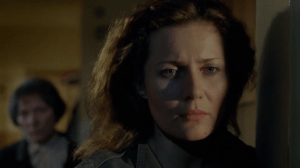
red desert 2However, even if this word does reflect its share of beauty, it is Monica Vitti’s character who still embodies paranoia and disorientation with the modern civilization. In other words, she is the one out of step with the contemporary world that she finds herself in, due in part to an auto accident and a subsequent stint in a hospital. She is struggling to readjust to reality.

And it’s no wonder that Antonioni made a string of four films with her because she has a remarkable gift for personifying all that is distant and aloof in a human being, while still bearing immense powers of attraction. In this case, it’s the visiting recruiter (Richard Harris) who is taken with her. But not even a fling with him can remedy what she is struggling through. There’s no one who can fully understand her, not even the audience.

red desert 3As per usual with Antonioni, his film invariably feels to be altogether more preoccupied with form over content and that’s what is most interesting. It’s fascinating some of the environments he develops. Atmospheres full of billowing fog, wispy trees, stark alleyways, gridiron structures, and all the while the color red pops in every sequence. There’s no score in the typical sense, instead, the dialogue is backed by foghorns, machinery, and an occasional electronic sound effect.
We get a little better understanding of her psyche when she recounts a mesmerizing story to her young son about a young girl who spends her afternoons swimming in the glassy water off the coast of an immaculate island. The pantheistic fantasy she so vividly paints for him is strikingly juxtaposed with the world around her — a world she has yet to feel fully comfortable in. However, both worlds somehow seem empty.

4.5/5 Stars

Silence (2016)

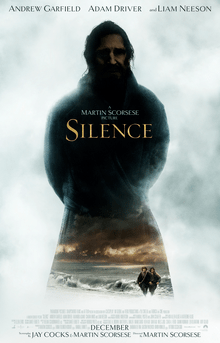
Silence_(2016_film).pngIf we can take Martin Scorsese’s varied film career as a reflection of the human experience, then his completion of his long-awaited passion project Silence is not all that surprising. He’s crafted numerous classics, countless cultural touchstones, some spiritual, some historical, and some incredibly honest. But at this point in his career it seems like he has nothing left to prove to us as his audience and maybe at this point in life, if nothing else, we could do well to try and learn from someone like him. Because given the climate with funding and the like, Scorsese could not have made such a film just for other people or money or acclaim. He must have made it, at least partially, for himself.

There’s no question that his life has been tough at times, even taking him to the brink of death, and in Silence, we see a period tale that touches on everything that is thought-provoking and all that is paramount in life. Man has long wrestled with God. Jacob did it literally in the narrative of Genesis. Nothing is new under the sun in a sense. And Scorsese by way of Shusaku Endo is doing a truly remarkable thing to consider these very questions. I admire him for having the wherewithal to even begin to tackle this material.

Coincidentally this is also a very faithful adaptation of Endo’s novel and so rather than recount the entire plot, my best advice is to read Endo for yourself and watch Scorsese’s own musing on the text afterward. But for those who don’t know, Silence is a fictionalized account based on true events involving two 17th century Portuguese priests Rodrigues (Andrew Garfield) and Garppe (Adam Driver) who head to Japan in order to spread their Christian faith–a faith that already has approximately 300,000 believers. Their mission is twofold as well, to track down their illustrious mentor Father Fereira (Liam Neeson) who is rumored to have apostatized.

However, their beloved faith is under fierce attack by the Japanese magistrate and for good reason. As articulated by the oddly compelling and strangely comical antagonist Inoue, foreign missionaries sometimes come to Japan like jealous women looking to steal the country away. They often are lacking cultural understanding meaning their message is neither contextualized or delivered in such a way that is helpful to the people. Is the message missionaries brought even the same anymore or do they simply trust that it will reach the people as they intended?

But delve into this issue and doubters can beg the question, can the Truth (capital T) be universal? There are certain similarities between religions. From a cursory level, you can either draw up the similarities between Christianity and Buddhism or cast them far apart. Father Ferreira finally conceded that doing good is enough. It leads to human flourishing but also to the detriment of his previous beliefs. And that’s only the one conflict.

Silence delivers numerous other tough questions to any viewer who is willing to consider them. How do you equate personal suffering versus the suffering of others? If to die a martyr is what some call Christ-like, to let others die for you could easily be called selfish and weak.

Still, is recanting Christ, the core of these missionaries’ belief system, worth it for the safety and well-being of others? The answer seems simple and yet somehow still so divisive. Most importantly of all, and potentially the most volatile and insidious question of all is this: Can you still be worthy of love if you have doubted, turned away, or committed evil? That is the central question at the heart of Silence.

In different ways, Scorsese’s film brings to mind droves of others from the likes of Bergman and Dreyer but the polarities of the emotions are more pronounced here and somehow the nuances still manage to be incredibly subtle. Bergman’s The Silence already seems to assume God is out of the equation entirely. Ordet takes the spiritual doubts of mankind and culminates in a miraculous crescendo of hope. Scorsese’s work strikes a tougher middle ground. And for that matter, this film is undoubtedly rough going. It’s long, pensive, and unsettling.

The heroes do not arrive at some Oscar-worthy self-actualization. Violence is not some entertaining cathartic release. On the contrary, these characters are at times pitiful–even the dregs–and the violence is methodical and repetitive like a deluge of ocean waves beating us back.

But as such, this is not a film to stew in or even a film to view alone. It is meant to be seen together, ruminated over in tandem, and considered with a certain amount of thoughtfulness. It asks for its viewer to be open, to be aware, and if need be, do their own amount of soul-searching. Are there questions that you’ve never been willing to confront? And this goes for anyone from any type of background, belief, or point of view.

For the spiritual, this undoubtedly would be a tough picture because it confronts their doubts head-on. For those who do not consider themselves all that religious, it throws you right into the dilemma of fallible man and demands you at least consider the problems therein.

Thus, to call it slow or plodding completely circumvents the entire point. Such an assertion strips this film of its power which is derived from the very audacity of its silence. The way in which Garfield practically whispers his dialogue in voiceover. How there is hardly ever a score because Scorsese takes his title seriously. He’s not about to disrupt the novel’s power with Hollywood expectations. Silence can be just as powerful as noise if not more so. Some would argue that is the very power of the God of the Bible. It’s these very paradoxes that run through Endo’s entire novel.

The humility of the Japanese throughout the film is astounding and the utter hopelessness of the priests at times is equally telling. It flips the savior paradigm that we expect. The most substantive example is the Japanese guide Kochijiro and Father Rodrigues. The Father sees the other as the Judas figure, the betrayer, and yet he is Peter. He too has denied the one who loves him most. They’re no different. Except Kochijiro is far more aware of his shortcomings–there’s no pretense to think he is Christ-like. He is humbled just as we can be humbled by the sheer boldness of Silence.

4.5/5 Stars

Mustang (2015)

Mustang_posterThere’s something inherently striking about the title Mustang. It signifies something about the title girls, their free-spirits, billowing brown locks, continually running in a type of a herd, constantly full of life, movement, and motion. But with a mustang and any other creature full of life and vitality, there’s always an opposite force looking to impede, tame, and prod the spirit into some sort of submission. Because being free, being wild is constantly challenged in the world that we live in and this story is a prime example.

The film opens when what can be called little else except for a “tribe of girls” leave their school to go traipsing along the beach with a group of boys. In these moments we begin to understand quite well since frolicking, laughing and playing chicken are the same in every culture. But that’s not how their elders see this seemingly innocent act. Instead, it’s full of passion, lust and moral depravity.

In many ways, although it’s set in Turkey, Mustang plays with some of the same themes of Sofia Coppola’s Virgin Suicides but it is a film that surges with vim and vigor rather than wistful detachment. And even though it has those aloof moments at times, they feel more personal because most of the time instead of being on the outside looking in, we’re constantly being shown the perspective of these girls, a far more frightening point of view.

Furthermore, this isn’t simply about one fundamentalist family that’s the outlier but an entire culture that holds women in a certain regard. There’s obviously something amiss in cultures that lack social mores and a sense of reality, but there’s something equally frightening in those cultures that are utterly repressed. Life is literally driven by fear and shame. Bringing dishonor and gaining the respect of your neighbors. A life like that can be nothing aside from taxing because you can never possibly measure up to the societal standards.

The television, the media, and everything else seems to reinforce exactly these points. Meanwhile, the girls go sneaking out to a football match only to miss the bus, only to hitch a ride with an unfortunate bystander who gets them there in time for the excitement.The images at the football match carry an almost infectious backbeat, hyperactive and frenetic with hair flying, hands flailing and bodies going every which way, but still, every action has a consequence. Every moment of freedom is met with an equal event of restraining power.

In this case, the girls are prepped and prepared for marriage, arranged between families like a shrewd business deal to save face. Their fearful grandmother and domineering uncle think it’s the best for everyone and the girls have little say in their fate.

The youngest girl, Lale, is a tomboy, a perpetual climber but she like the others feels trapped. And they are, as first one sister than another are hitched up in a marriage. But it’s when marriage no longer becomes a joyful union but a suffocating prison of unhappiness, something that it was never meant to be at all. True, one girl gets a bit lucky, the other is utterly unhappy. Still, two down and three to go. That’s the way grandmother thinks of it.

By this point, the three remaining girls are forced to find any little piece of rebellion they possibly can whether it be snickering at the dinner table or something altogether more audacious. Grandma and uncle are unrelenting in their matchmaking and finally, Lale and the only sister she has left are at a crossroads. They must take a plan of action or resign themselves to their impending fate. You can probably guess what their decision is but that doesn’t make executing it any easier.

Mustang is certainly a cultural commentary and you get the sense that it’s a very personal work by writer-director Deniz Gamze Erguven. However, within its portrait of youth, womanhood, and marriage there are also some universal truths to be gleaned. There’s something to be said for freedom — in youth and adulthood. To take it lightly is to commit a grave error

4/5 Stars

An Officer and a Gentleman (1982)

an officer and a gentleman 1Lou Gossett Jr. What a performance. He imprints himself on our brains just like the new recruits he berates, pushes, and toughens on a daily basis. He’s inscrutable. We want to hate him. We want him to get his comeuppance.  Yet in the end, we cannot help but appreciate him. We are just like one of his recruits and that’s, in part, why this story works at all.

We’re there in the mud and the mire. We hold our breath in preparation for the latest inspection. Every drill has some consequence. Each failure and each conquest is like one of our own. And the desire for intimacy and love is in us too. This film takes many of its characters through the hell that is Aviation Officer Candidate School. But isn’t it the most trying times that remain the most memorable and truly mold us as human beings? It seems so.

It’s easy not to like the coolly defiant Richard Gere as Zach, even when we know a bit of his past because he can be distant at times. But we learn more about who he really is and as with most people, he grows on us. The same goes with his best buddy  Sid (Keith David) who is well-liked by everyone but realizes he’s been living his life all wrong. Likewise, Paula (Debra Winger) and Lynette (Lisa Blount) the two bodacious gals who have dreamed of dancing the night away with a pair of up and coming cadets, have their own set of problems.

an officer and a gentleman 2Watching An Officer and a Gentleman, it is rather amazing that it succeeds as part romance, part war drama since all its action takes place at an air force cadet school. They haven’t even reached the front yet. There are no explosions or bombs bursting in air. It even shares similarities with Fred Zinneman’s star-studded From Here to Eternity (1953) years before. But that story had far more star power and a climatic event like Pearl Harbor to build the story around. Here there’s nothing quite like that. But it’s not really needed. We are reminded that mankind is inherently interesting and when you throw a bunch of them together under duress it’s a formula for heightened emotions.

an officer and a gentleman 3Certainly, the film functions because it has all the necessary components, a rebellious hero played by Gere, troubled pasts, innumerable odds and the like. However, breaking the film down to its simple plot points hardly gives the film the credit it is due. There are so many intangibles when you watch something on the screen that really gets to your gut. It’s not necessarily manipulation on the part of any one person, director, screenwriter or otherwise. It’s simply the emotional clout that the medium of film is capable of.

As I watch Richard Gere carry his love (Debra Winger) out of her dead-end factory job, rather like a groom taking his bride over the threshold of their new lives, I too cannot help but smile ruefully. This is the schmaltzy ending of passionate love. But that is only one scene bookending so many others. Some that take us in a stranglehold. Others that fill us with contempt or pity. And as with any film, some that feel superfluous. What stays with you though when the screen goes black are the highs and the lows. An Officer and a Gentleman hits them both with ample fortitude.

4/5 Stars

Penny Serenade (1941)

cary_grant-irene_dunne_in_penny_serenade

Irene Dunne still remains one of the most underrated actresses of the 20th century. She was both a lively comedienne, an impressive singer, and performed in melodrama better than most. Pair her with Cary Grant and director George Stevens and you have an impressive bulwark to build a film out of.

I disdain the rather condescending term “Woman’s Picture,” but if Mildred Pierce was one of the darkest exemplars of the genre than Penny Serenade might be one of the most heartfelt. It finds its inspiration in the revolving melodies of records on a Victrola. It’s true that music is so very powerful in evoking emotion and it is precisely these songs that lend themselves to Julie Gardiner’s myriad memories. They began when she initially met the love of her life, a budding journalist who was not too keen on getting hitched or the future prospect of having kids. But Roger’s career took him to Asia and he tied the knot with Julie because he was not about to let another man take her away from him.

The rest of the film can best be described as a marital drama concerned with the many moments that make up a marriage. The thrill of the honeymoon period. The little marital tiffs. The tough times when your fledgling self-run paper is not doing the best. The struggles of trying to have kids or wanting to adopt and realizing the process is far more arduous than you first expected. All of these moments can be found in Penny Serenade. But it is one of the sweetest that also becomes the most heartbreaking.

Julie and Roger get the child that they so desire and it’s hard and trying and oh so scary, but they make a go of it and truly revel in being parents. But even that joy is taken away from them. It’s that same pain that shakes the foundations of their marriage just like the deadly earthquake they experienced in Japan. Once more amidst the heartbreaking tremors, there are wonderful revelations and an ultimate resolution that is good.

It’s true that Penny Serenade is overlong, lacking a great deal of substantial conflict or direction but it certainly plays to its strengths. The third time around Grant and Dunne continue their impeccable chemistry that carries the film alongside the direction of George Stevens who always seems to know how to helm both drama and comedy with ease. And the secondary roles are filled out marvelously by the always venerable Beulah Bondi and a noticeably younger Edgar Buchannan playing his usual old softie with a gravelly voice.

So if you’re in a sentimental mood tune into Penny Serenade a film that is less of a classic than a film that rides on the laurels of its main players who elevate the storyline above the normal fray through sheer charisma and ingenuity. While Grant is always remembered as a comedic actor, there are several notable heart-wrenching sequences where he taps into a different side of his persona.  In the end, having Cary Grant and Irene Dunne together again is worth it in itself.

3.5/5 Stars

The Snake Pit (1948)

Snakepit1948_62862nThere is a lineage of psychological dramas most notably including the likes of Shock Corridor and One Flew Over the Cuckoos Nest. But one of their primary predecessors was The Snake Pit which is a haunting, inscrutable and thought-provoking film in its own right.

But rather than trying to sum it up with words, it’s necessary to look deeper at what makes this such a potent film and it begins most obviously with Olivia De Havilland. She undoubtedly gives the best performance of her career — in so many ways drifting so effortlessly across the emotional spectrum. She’s either sane or “crazy” with fits of paranoia and inner turmoil, voices sounding off in her head and the like. But the most beautiful things are the moments when all the drama derives from the look on her face, a furrowed brow or a panic-stricken reaction we cannot fully understand.

That’s why it takes us the entire film to comprehend what is actually happening and it’s wonderful that we enter her story while she is in a sanitarium. Why and how she got there we don’t know right away, so as an audience there’s a similar sense of disorientation. Several reliable points of reference exist early on. Those being the genial Dr. Kik (Leo Genn)and Virginia’s concerned husband Robert (Mark Stevens) who visits her during every possible hour.

The film does intermittently feel disjointed but that hardly seems due to faulty storytelling and more a convention of Virginia’s narrative. It all comes to us in incoherent bits. In reality, months have passed but her memory is poor, causing her to lose track of the days. She drifts in and out of different wards and soon forgets the people and places that have been there all along. Furthermore, her progress waxes and wanes, with special visits from her husband and the faint chance of being released. Then in her darkest moments come electroshock therapy and even a straight jacket confining her in the depths of the sanitarium.

Anatole Litvak would hardly be considered an auteur but he still finds a way to heighten the tension with whip pans and nightmarish imagery when necessary. A pounding score adds yet another layer of anxiety reverberating with a vengeance, most memorably to simulate the jolts of electroshock therapy. But the greatest compliment that I have for his film is that it knows when to simply sit back and watch, like many of the great Classical Hollywood films. It lets its story, actors, and script all work and, in this case, they develop something with lasting depth.

Earlier I alluded to  The Snake Pit being part of a lineage including Shock Corridor and One Flew Over the Cuckoo’s Nest. It contains similarly shocking revelations about the reality behind sanitarium walls except they feel more realistic than the former film. Furthermore, De Havilland is surrounded by a wide array of odd bodies and patients with all sorts of psychoses rather like Randle McMurphy. But although there are some antagonistic people, her problems stem partially from the system around her and mostly from the pain buried deep within her own past.

It’s Dr. Kik who is able to dredge up the truth hidden inside of her over time. His calming, reassuring voice balanced with his psychoanalytic practices are able to work on Virginia’s psyche systematically. But in the same instance, it’s easy for her to get lost among the masses. Nurses do their jobs, doctors pass verdicts but they’re woefully understaffed and overworked.

The film’s resolution is actually hidden within its title. Because like the madmen of old, Virginia was thrown into a snake pit of her own that, far from driving her crazy, revealed to her that she must, in fact, be sane — at least compared to many of those around her. It’s up to the viewer to decide, aside from the happy denouement, if this is a troubling conclusion that the film comes to or not.

However, it’s paramount to note The Snake Pit’s conclusion on personal trauma and mental illness, based on childhood experiences. A lot of Virginia’s struggles came out of guilt and dysfunctional relationships with her parents. Yes, this is the punchline of the movie, but I only say this to point out how frightening or more precisely, how universal that revelation make this movie. Virginia’s parents weren’t altogether bad people and the reality is that all of us will face personal tragedy. We will have our share of guilty consciences too.

It’s how we cope with those things that matter most because it’s going to happen. We can hide it but we can’t escape it. All of us are broken in one way or another — even if we don’t want to admit it. That’s part of what The Snake Pit begins to bring to light.

4/5 Stars

The Strange Affair of Uncle Harry (1945)

the strange affair of uncle harry 1It’s a B-picture title to be sure but with Robert Siodmak and such an ensemble, this is an enticing noir all the same. The well-to-do Quincy family of small-town America are an odd bunch, still holding onto their surname with pride as they slowly drift further and further into obscurity within the walls of their old mansion.

George Sanders is always a perennial favorite due to his dry wit and often snooty manner but here as Harry, we see him as all those things yet also trapped by his circumstances. Ella Raines, unfortunately, one of the often forgotten starlets of the 1940s, plays his savior in a sense and when she comes into his life there’s a chance to shake up all that is monotonous and stuffy about his existence.

Because he is constrained by his family name and a pair of sisters who rely on him continually for moral and emotional support. The eccentric Hester is always carrying an accusatory tone towards the housekeeper and getting bent out of shape about small trifles.

the strange affair of uncle harry 2The dominating sister Letty, played by Geraldine Fitzgerald, is more aloof in her ways, veiling everything with a conviction that what she does, she does for the good of her brother. But it’s all really due to the fact that she cannot bear to let him go. In this way, she’s constantly controlling his life and undermining his happiness. She’s hardly your typical femme fatale, more cultured and refined than most, but there’s still something exacting about her.

It’s when the tempered exterior and well-mannered formalities begin to crumble that her ulterior motives become more evident. Feigning illness just to keep him on a string and buying poison for some nefarious purpose. This unnerving dynamic between siblings becomes more tenuous for Harry,  accentuated by the fact that Letty, as played by Geraldine Fitzgerald, is quite attractive.

As far as the ending, there could have been five different outcomes and the one chosen fits the expectations of the contemporary audiences and the censorship board. Frankly, the affability of Ella Raines makes me want to enjoy this denouement, but my appreciation for film-noir makes me realize that this story deserved a dark turn to hammer home a genuinely twisted little picture. Still, Robert Siodmak is time after time one of the most interesting craftsmen of film-noir big and small. So it is with this morsel. Above all, I gained a newfound appreciation for the noteworthy work of Fitzgerald in particular.

3.5/5 Stars

Rogue One (2016)

Rogue_One,_A_Star_Wars_Story_poster.pngFor so many, there is a deep connection to Star Wars that started at an early age. As I have alluded to on numerous occasions, I am no different. And if I feel that way about even the prequels, it’s exponentially greater for the original trilogy, as I can imagine it is for legions of others. Thus, when I watch Rogue One I do not linger on its shortcomings, though they most certainly exist, instead, I’m fixated on that very same suspension of disbelief that overtakes me every time I enter that world, a long time ago in a galaxy far, far away.

If Rogue One had been an unredeemable, thoroughly bad film I would have been the first to say so. Perhaps it sounds crazy (or to fans maybe not so much) but I am deeply protective of Star Wars. I only want fanservice if it’s logical, fits the parameters of the world, and so on. I’m not a voracious fact checker of every Star Wars Wookieepedia page known to man and yet I might as well be. I was one of those who was deeply defensive when Disney looked to shake up George Lucas’s original canon. Though I digress…

But even as it stands as a mediocre story with vague contours at times, Gareth Edward’s Rogue One is propelled by fun characters, space opera entertainment, and, of course, A New Hope nostalgia. For those very reasons, it’s invariably easy to lend a heavy dose of grace to this standalone entry. And that’s what I will do.

We are introduced to Jyn Erso at an early age which gives context to her later exploits. In fact, when the story flashes forward after traumatic beginnings she (Felicity Jones) is a prisoner — not on behalf of the Rebel cause — and she has no plan to help the Rebels anytime soon. But in this way, she becomes one of their unassuming champions receiving news from her father (Mads Mikkelson) that the Death Star must be destroyed and she must spread the word.

It leads her to join forces with Rebel scoundrel Cassian Andor (Diego Luna) and his sarcastic droid co-pilot K2SO (voiced by Alan Tudyk). The bottom line is that all the various trips to planets and skirmishes with the Empire lead to a final showdown on the planet of Scariff where the ragtag group of Rebels lands a sneak attack on their unsuspecting enemy led by Imperial Director Krennic (Ben Mendelson). Meanwhile, a space battle erupts in the skies above and Jyn looks to transmit the vital plans to the Death Star before it is too late — so that hope might live on in the galaxy — and she does.

Not surprisingly, Rogue One has its share of callbacks involving the likes of Ponda Baba, Mon Mothma, and Bail Organa all returning to the Star Wars cinematic universe. And unused footage from the original film of Gold Leader exchanging callsigns is repurposed in the final offensive sequence as well. Although Grand Moth Tarkin and Princess Leia (the late Peter Cushing and Carrie Fisher returning from 1976) somehow look like carbon copies of their prior selves, they nevertheless sound vaguely different, giving off this peculiar sensation that they are CGI constructions and not the real thing. Still, it’s a remarkably impressive piece of work.

Obviously, the main objective of Rogue One is simple from a narrative perspective. The Rebels must obtain the plans to the Empire’s Death Star because without those, A New Hope would not be possible. But in order to get there, there are other necessary outcomes that feel a touch more suspect. I can see the need for finding Jyn’s father since his work is so critical to the Rebellion’s objective. However, the idea of a main switch to open up communication, her father’s hologram, Jyn’s final push to broadcast the vital schematics by reaching an antenna, and yes, even Kyber crystals, all seem like easy fixes to explain away the need for certain plot outcomes. I am, however, still trying to come up with an explanation how that is any different than the Force, aside from the very fact that its balance is crucial to the entire galaxy. I’ll get back to you on that one…

Furthermore, the idea of hope comes center stage in Rogue One. In fact,  even despite the influences of eastern monism, Star Wars’ mythology reminds me of the Biblical text that reads like so, “We rejoice in our sufferings, knowing that suffering produces endurance, and endurance produces character, and character produces hope, and hope does not put us to shame.” The same could be said of the Rebels. And people might scoff but in its resolution, the film even takes a page out of Shakespeare’s Hamlet. That’s what makes this idea of hope so important because there could very easily be none at all with so much death and destruction.

My loyalty towards the franchise (more so than DC or Marvel or Star Trek) makes me also fear the continued mechanization of this world into a continuing box office cash cow. With film after film, story after story, it’s indubitable that Star Wars too will lose its allure. It will be run into the ground or become besmirched by some egregious plot hole, discontinuity, or for some far worse fates like the return of another Jar Jar Binks.

That is my major concern with Rogue One because with the absence of an opening crawl, what it really did was signal a changing of the times, a new seed has been planted as the extended Star Wars universe continues to germinate and grow. Time will indicate if it flourishes or sucks all the nutrients out of the vibrant creations that were given so much vigor by the likes of George Lucas, Mark Hamill, Carrie Fisher, Harrison Ford, John Williams, and so many others. Only then will we see if this franchise is one with the force and the force is in it. Because with so many films, it’s difficult not to falter. Being both critical and an avid fan, I care all the more deeply about its fate. But for the time being, enjoy Rogue One and afterward slip in A New Hope again to be reminded exactly why Star Wars remains a cultural landmark.

4/5 Stars