Day for Night (1973)

dayfornightposter10 years prior Jean-Luc Godard made his own film about movie-making entitled Contempt (1963). It too delved into what it looked like to make films, as well as the individuals behind the camera because their relationships undoubtedly affect what is revealed in front of it. His colleague Francois Truffaut came out with his own meta-film about film, but Godard was open with his criticism. In fact, their long friendship suffered because Godard accused his longtime collaborator of selling out and telling a lie.

However, if we look at Day for Night today, that feels a little harsh, because while Truffaut’s film is engrossing and different than his earlier New Wave work, he is, in general, a more accessible director on the whole than Godard. That should certainly not take away from what he gifted to his audience. What he does is color the lines between film and real life. Because, while one mirrors reality, it can never quite replicate it and things get messy when the two begin to get in the way of each other.

Immediately we are thrown into a street scene only to learn minutes later that it’s only a set; these commonplace people only extras filling up a cinematic space. It’s the perfect entry point into the meta nature of the film. Ferrand (Truffaut himself) is the director flooded with all your typical problems, setbacks, and deadlines. He must work around his stars, navigating the drama that comes about with so many personalities all gathered together. Severine is a has-been starlet with troubles remembering her lines. Alexandre is her love interest, a fading star in his own right who is aging gracefully. Alphonse (Jean-Pierre Leaud) is the young heartthrob, who secured a script girl position for his girlfriend, but their playful romance is not without bumps. All the while everyone waits with baited breath for the arrival of transcontinental star Julie Baker (Jacqueline Bisset), who has recently recovered from a nervous breakdown followed by a marriage to a distinguished doctor.

We are privy to series of takes, rushes, and all the decisions that are going on behind the scenes. It is in many ways far fuller and more in-depth than the picture Godard gives, but Truffaut maintains the same respect for his heroes. He goes so far as name dropping: Hitchcock, Hawks, Bresson, Godard himself, Bergman, Rossellini, Lubitsch, Bunuel, Jean Vigo, Jean Cocteau, not to mention an initial dedication to the Gish sisters. Even Citizen Kane and The Godfather, two of cinema’s landmark achievements, are both alluded to in passing.

But adding an exclamation point to everything is the drama of death, romantic affairs, and even a pregnancy, suggesting that life is a lot messier than a moving picture. All the strips of celluloid get tied together in a nice bow. They can be explained away by a plot point. They can be completely discarded on the cutting room floor. Or a double can be hired as an easy fix for any discrepancy. In this, there is a falseness that fails to perfectly align with reality. There is no perfect way to convey the truth, because everything, even a documentary, can never be complete subjective reality. A mirror image is only a reflection of what is real. That is part of what Truffaut is getting at and that is part of the irony of his row with Godard.

You only have to look at its title, because Day for Night points to the inherent artificiality of cinema, but Hollywood films especially.  So, far from telling a lie, Truffaut seems to riddle the film industry with all sort of holes, pointing out the difficulties that come with such a business. Life and film may meet and overlap, but they can never truly reconcile their differences because there is bound to be contention along the way that cannot be perfectly remedied by even the greatest director.

But far from condemning the art form, it’s important to realize Truffaut is pronouncing his undying affection for the medium. He was the one who famously asserted, “I have always preferred the reflection of life to life itself.” This man unquestionably loved movies and it shows.

4.5/5 Stars

Philomena (2013)

Philomena_posterStephen Frears is not the foremost of directors, but he very rarely makes bad films, and Philomena is yet another jewel in his crown. It’s a simple enough story, but those are oftentimes the most rewarding because they tap into something near and dear to most of us. This is indeed another one of those based-on-true-events type tales, and it starts off with Martin (Steve Coogan) a former journalist and political spin doctor. He’s now not doing much of anything aside from contemplating writing a book on stuffy Russian History. He’s also lacking in conviction while being weighed down by cynicism, so it’s not exactly the most uplifting of perspectives.

But then he’s put in contact with the retired nurse and spirited Irish lady Philomena Lee (Judi Dench), on track for a great story. Although he’s not very experienced with human interest stories, he forges ahead with her’s. 50 years before Philomena met a young man and ended up getting pregnant, but the local nuns forced her to work in the convent out of penitence for her “sin.” She could only see her son briefly each day and then one day she lost her Anthony altogether when he was taken away from her, never to be seen again. The events still haunt her years later, but she is finally ready to share her secret.

With Sixsmith by her side, they first visit the convent where it all happened, but very little information is unveiled because while the nuns are polite, they are far from obliging. Martin is able to discover that Anthony was adopted by an America family as was the custom in the 1950s, and he ultimately ended up in the United States. He and Philomena travel across the sea to D.C. to try and get a lead on him.

There Martin makes another discovery. In the U.S. Anthony went by the name Michael Hess and was a prominent aide to both Ronald Reagan and George H.W. Bush. The hardest discovery, however, is that he passed away 8 years prior. Although deeply troubled by this news, Philomena resolves to try and meet anyone she can who knew her boy. They make the rounds without much luck, but there are several revelations that make the whole trip worthwhile.

Everything comes full circle, and it’s in these difficult moments that Philomena shows her true character, and her unwavering ability to forgive in the hardest of circumstances. By now Martin is as invested as she is, and for the life of him, he cannot understand how she could forgive such injustice done to her. But that’s exactly what grace is, an undeserved gift, and she gives in willingly.

For the entire film Martin has been hounded by his editor about angles and getting the juiciest bits for his story, but by the end, it resonates with him too much for him to publish it in some superficial outlet to grab waves of media attention. He respects Philomena too much for that, and yet being the strong and resilient lady that she is, she resolves that people need to and deserve to know all that has happened.

This film was a lot more thoughtful than I would have initially given it credit for because I assumed it would be a weepy tale full of heart, which it was, but it also had great insight into life. Some may see the film as an indictment of hypocrisy that crops up in religion and that is certainly noticeable, but what stands out more to me is the indefatigable spirit of Philomena. She is a woman of great resilience and faith, loving others well even when it is most difficult and really reflecting what it is to be a genuine person of faith. Thus, the dynamic between her and Martin is a wonderful one, because their differences in temperament and worldview do not stop them from forming a far deeper bond of friendship.

4/5 Stars

Carnal Knowledge (1971)

carnalknow1“If you had a choice would you either love a girl or have her love you?”

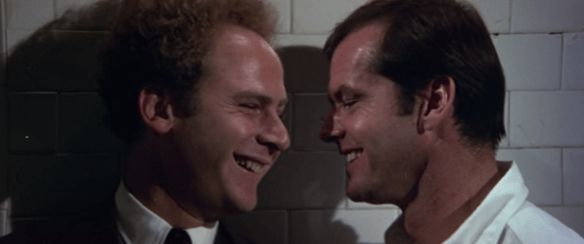
That is the question posited to commence the daydreamy dialogue rolling over the credits of Mike Nichol’s Carnal Knowledge. The nostalgic refrains of Glenn Miller’s “Moonlight Serenade” bring us in as we begin to listen to the cadence of two voices. We’ve heard those voices before probably numerous times. One has a sneering quality, and it belongs to none other than Jack Nicholson, coming off a few early classics like Easy Rider and Five Easy Pieces. He’s got the trademark snideness in his delivery. It’s all there. The other voice is more soft-spoken and calming. It can be heard on numerous folk records of the ’60s and ’70s — the voice of Art Garfunkel.

These two men play Jonathan and Sandy, two college roommates who spend their entire lives confiding in each other as they try their hands, usually unsuccessfully, with relationships. The age-old debate between looks and brains is only one major point of contention.

There are the awkward opening moments at a college mixer. The college dorm room talks cluttered with girls, girls, and more girls. In fact, they both get tangled up mentally, emotionally, and physically with a girl named Susan (Candice Bergen).

Both leave college going off in two different directions in the realm of romantic relationships. Nicholson’s character is more about the open-minded approach keeping his options open and he thumbs his nose at any ultimatums a woman gives him. He’s his own man and he’s not going to be held down — even going berserk with his longest partner Bobbie (Ann Margret), because of her insistence on wanting more. He’s not about that but ends up cycling through the women. The irony, of course, is that although he seems like a more stable, contented than his best friend, Sandy still winds up in several different marriages just the same.

Really, the film fits somewhere in there with Who’s Afraid of Virginia Woolf and The Graduate if only for the fact that Carnal Knowledge engages with broken human relationships once more. In one sense, there can be a great deal of hurt, pain, and even abuse that come out of them. But also they can be wellsprings of depth and even humor at times. What makes this film, based off of a Jules Feiffer script, is the buddy perspective. It’s the buddy perspective that you could argue that was given a facelift and re-popularized by When Harry Met Sally. And yet you can see it here as well.

There’s candid, frank, sometimes even overtly crass dialogue. And it continues through their entire lives no matter who they are with, what jobs they are in, or how their looks have changed. The conversations continue. The sobering fact is that both haven’t been able to figure things out. It doesn’t seem like they’ve come all that far from their naive college days. Jonathan now seems like a lonely dirty older man compared to a dirty young man. Sandy is enraptured by a young woman who can mystify him with her thoughts. They haven’t really changed a whole lot.

The closing moments of Carnal Knowledge are perturbing not necessarily because of what happens, but because of the realization of what these men have become (or haven’t). We see first-hand that Jonathan has fully succumbed to his own self-narcissism while Sandy tries to convince himself that he’s happy. It’s sad really.

3.5/5 Stars

The Hurt Locker (2008)

220px-HLposterUSA2Being ignorant of the term “Hurt Locker,” I did a reasonable thing and looked it up. According to IMDb:

To put someone in a “hurt locker” is to physically mess someone up, badly. It is roughly synonymous with causing someone “a world of pain.” According to the movie’s official website, “In Iraq it is soldier vernacular to speak of explosions, as sending you to the hurt locker.”

Well, that about sums it up, and it does so, beautifully by getting to the core energy that pulses through this film. It gets dicey and intense when these highly trained individuals are put into the most volatile of situations. It doesn’t get more volatile than bomb detail, and how they maintain composure in such circumstances is a miracle, a testament to grit and willpower. That’s not to say they don’t go through their own moments of turmoil. How could you not, at least at some juncture?

It struck me that this film does not feel like a political statement, even less so than Bigelow’s other war epic Zero Dark Thirty. In a sense, that would be a major disservice to the men who fight, by taking all the attention off of them and instead placing it on agendas and politics. However, all of that is left to the politicians, and we simply are given a very small taste of what those fighting the War on Terror experience. Can we fully comprehend it? No, but at least now we have a better idea of how post-traumatic stress disorder can develop. The constant strain that these people are going through takes its toll physically and emotionally. Yet they still push through their tours in order to do the job that has been handed to them. They brave a world of suicide bombers and ambiguity that could quickly send you into the hurt locker. In that way, it reminds me of a modern take on Battle of Algiers, because not everything is as clear-cut as we would like it to be.

The Hurt Locker follows Bravo Company during the tour of duty. Their first disposal expert (Guy Pearce) meets with tragedy and his buddies are forced to welcome a new member to their team, Sergeant William James (Jeremy Renner). He hasn’t disarmed 873 bombs for nothing, but he maintains such a streak by being very cavalier in his conduct. He’s a maverick, a man who will unflinchingly ditch all communication in order to focus on the task at hand. He’s a bit of a loose cannon and that’s not always the best type of personality for such a tightly knit group. They have to be if they want to survive since such behavior can be the difference between life and death. There’s a camaraderie and a rapport that builds over time, but before that he causes his compatriots to squirm more than once, and when they squirm we’re positively crawling out of our skin.

Shot in Jordan, quite close to the real-life locales, there is a gritty and raw quality to how Kathryn Bigelow frames the world with the help of cinematographer Barry Ackroyd. It manages to be personal and unsettling all at once. In comparison, it’s invariably striking how stagnant American life is when James returns home.That’s potentially a good thing, but does it mean that we’re taking life for granted, or living eternally thankful for each day that we still have breath in our lungs? That’s what The Hurt Locker does. It gives us a deeper respect for these men and a deeper appreciation for life.

4.5/5 Stars

After The Wedding (2006)

After_the_WeddingThere is a scene in After the Wedding where the new bride Anna gets up and announces that it’s not usually customary for a bride to give a toast, but something is bound to go wrong at some point, so she might as well get it over with. It’s like she’s unknowingly cushioning the blow. She does not know, and the audience certainly doesn’t know, the gravity of what she says next. There are two people in the room who do. Anna voices how much she loves her parents even though she realizes Jorgen is not her real father, she cherishes him all the same.

I try and not use the label “tearjerker” lightly, but with this Danish film from director Susanne Bier, I mean it wholeheartedly. It cuts so deeply because there’s a bitter-sweetness to it that lingers, and that only occurs when you’re actually invested in characters. We meet Jacob first (Mads Mikkelsen), a middle-aged man, who seems to have built a rewarding life teaching in India. But on a trip back to his homeland, to hopefully acquire some funding, he comes across a familial secret that impacts him greatly. It all happens because the friendly businessman Jorgen invites his new acquaintance to his daughter’s wedding the following night. We get the film’s main jolt during the wedding and the whole story is never the same afterward because it flips everyone’s life upside down.

The next big revelation comes out when loving wife Helene presses Jorgen about his heath. Anna has her own problems when she walks in on her new husband with another woman. These up the drama, but it’s important to make it clear that this story doesn’t rely on soppy drama to maintain the stakes. The peaks are powerful, but even in the valleys, it keeps our interest. Certainly the melodrama is deeply jarring, however, it only delivers such an impact, because the people involved are far from one-dimensional cardboard cutouts. This could have easily becomes some Danish attempt at a telenovela and yet it does not. Far from it, Jacob, Jorgen, Helene, and their daughter Anna are figures, who we can almost feel the contours of. They bring to mind glimpses of friends or family perhaps. Generally good folks, who have made mistakes along the road.

In his past, Jacob acknowledges a drinking problem and sleeping with other women. Now he runs an orphanage in India and he’s matured greatly. Helene admits to not knowing all the answers for the decisions she made as a young woman. She probably should have done things differently, but the bottom line is that she loves her daughter deeply and is completely devoted to her husband. Jorgen might be a mogul and a powerful man, but he also has a deep devotion to his family. Seeing him with his kids you know he is a good father because he loves and provides for them in all possible ways. He actually makes time for them and it shows.

Hellene voices the audiences concern that all this drama is too great of a coincidence, but overshadowing that detail is something very heartfelt that Jorgen says. When he knows he probably doesn’t have too much more life ahead of him, he voices the sentiment that time is so utterly important. Furthermore, every relationship, every acquaintance we make, is important to life. Without those, life is meaningless. That’s the core of this film. It’s people parsing through the mess and finding what’s important. That’s what keeps Jorgen and Hellene together. That’s what makes Anne cherish her parents so deeply. That’s what makes it so difficult for Jacob as he weighs whether to stay in Denmark or go back to India.

4/5 Stars

Please Give (2010)

Please_Give_FilmWhat is Please Give about? The most succinct answer I can muster up is that it is about the simple rhythms of life. It’s about people rubbing up against each other, the neighbors you try and be nice too, but speak about behind closed doors. In writer-director Nicole Holofcener’s fifth collaboration with Catherine Keener, the latter is Kate, a woman who lives a life of uncomfortable dichotomy with her husband and teenage daughter.

Next door is the cranky grandma Andra, who is quite along in age, and she gets assistance from her granddaughters, who are both young professionals. Rebecca (Rebecca Hall) works as a radiology technician often spending her days giving mammograms, while her fashionable sister Mary (Amanda Peet) works as a cosmetologist. Their grandmother is not exactly the most agreeable person, and her acerbic nature earns the disdain of Mary and the quiet industriousness of Rebecca. They both have different ways of dealing with other people just as they have different ways of approaching love. Rebecca is quiet and looks for love in a nice young man. Mary constantly checks out the woman who stole her old boyfriend and embroils herself in an affair.

Meanwhile, Kate feels uncomfortable for buying Andra’s flat and waiting for her passing to start renovations. Likewise, in her joint venture with husband Alex, they buy people’s old possessions at estate sales and make major profits on their furniture. These issues along with a rebellious streak in her daughter, make Kate noticeably agitated, and she tries to overcompensate. She gives money to every homeless person she ever sees and tries to volunteer at numerous spots across town without much success.

The film suggests that we can tread a thin line on the margin of what is honest and what is termed “the ways of the world.” After all, if we balance it out with enough good deeds it ends up okay in the end, right? On her part, Kate has an odd way of dealing with her own sense of morality when it comes to her family business and the homeless on the street corner. Her husband is a generally agreeable man, who has no trouble with what they do, but he at least admits it, just like admitting when he flirts with other women.

Above all, I think Please Give boasts interesting female characters, in fact, they are the focal point of Holocener’s story, and it makes for a worthy character study in an industry that is often male-centric. Within these women is hypocrisy, pettiness, and a lot of insecurity, but it manages to be invariably funny as well as perturbing at times.

3.5/5 Stars

Greed (1924)

Greed3With some cinematic endeavors, there is simply an aura that surrounds them which informs how we look at them. Erich von Stroheim’s ambitious silent film Greed is such a picture. To this day, a full cut of the film has never been found and perhaps never will be, but it has survived in two versions. A four-hour cut which attempted to maintain the original continuity through stills and then a 2 and a half hour cut which I saw. So you could question whether I got the full experience of Greed or not, but that is almost beside the point because the essence of this film is summed up in the title. True, it could just as easily be called sin, avarice, grudge, humanity, or all of the above. But allow me to explain more fully what I mean.

The narrative follows a slow-witted man named McTeague (Gibson Gowland), who picks up the dentistry trade from a traveling doctor. He moves to San Francisco and soon becomes smitten with the cousin of his boisterous pal Marcus (Jean Hersholt). Trina (Zasu Pitts) is quiet and a bit timid around a man as intimidating as McTeague, but they make it work. Soon enough they’re engaged and a lottery ticket Trina picked up on a whim pays off handsomely. $5,000 to be exact and this is the 1920s! They’re getting on alright because McTeague is still working and his wife is very, very frugal. But Marcus feels entitled and a grudge over the money ensues. He wants part of the cut because he thinks he deserves some good fortune too. Things between him and John finally reach the boiling point and there’s no turning back. Rather than try and patch things up, Marcus decides to get into ranching and says goodbye to his formerly close friend, but not before serving up a little revenge. He sets the dentistry board on McTeague and since he doesn’t have a true credential, his right to practice is terminated.

The loss of John’s job is aggravated by the fact that Trina is increasingly stingy, never wanting to dip into her big payoff, even when they really need it. Gold in many ways has become her master, and it leads to marital turmoil. McTeague was always a big man, but usually quite gentle. But his inner fury is finally uncorked and in one angry outburst, he goes so far as to bite his wife.

Mac leaves only to come back again and the results are not pretty. Soon he has a price on his head and he makes his way as a fugitive into the desert. And thus, the finale is shot on location in Death Valley, the perfect place for a climactic showdown between McTeague and his old pal Marcus. Of course, money doesn’t help much when you’re trapped in the desert, or when you’re dead for that matter.

Obviously, greed doesn’t bode well, but this story is an interesting inversion of the typical plot line, because in this case it is the woman who has the money, and she’s the one that the greed eats away at. She becomes obsessive and even bitter about every last piece of change. But her money also has a ripple effect that reveals the pettiness, avarice, and begrudging nature that plagues both her husband and cousin.

So in order to enjoy this film, you need to have an appreciation for the spectacle that von Stroheim has developed and the commentary he has weaved through his narrative about greed. That in itself makes this film one to truly ruminate over because it suggests so much about the ugly side of human nature, and that has hardly changed in the past century.

The Sessions (2012)

220px-The_Sessions_posterI was a bit skeptical of this film at first, but I can say unreservedly that it boasts true heart and sensitivity. In many respects, it reminds me of another film about a man with a so-called disability, The Diving Bell and the Butterfly. In both, a highly creative individual is able to defy their physical barriers and truly impact the world around them.

In the case of Mark O’Brien (John Hawkes), he graduated from Berkeley destined to become a journalist and poet, the only difference with him is that for most of his life he has been confined to an iron lung that keeps him alive. It seems like an obvious roadblock to success in life, and yet not so for Mark because he faces each day with a sense of humor and even a spirituality that is impressive. He relies on his caretakers for so much and yet they enjoy helping him because he is a generally kind spirit. First, it’s the beautiful Amanda (Annika Marks), who he sincerely professes his love to and then there’s Vera (Moon Bloodgood), who while frank, is still deeply concerned with his well-being. Furthermore, the local priest (William H. Macy) is equally willing to listen to Mark’s confessions, not simply about sins, but more importantly his life on a whole.

Mark’s a very transparent individual, who attacks life with a positivity and tenacity that goes beyond the physical. Wit becomes his precious ally in facing every day, and he also takes great care in the relationships around him. He wants to live his life to the fullest, and he won’t let an iron lung impede him. Thus, he decides that he would like to try and have sex since he is still a virgin and feels that he might not have long left to live. And so, after consulting with his priest and acknowledging the sensitive nature of the decision, he tentatively decides to go for it. Cheryl Cohen-Greene (Helen Hunt) becomes his sex surrogate, and yet she is more of a therapist than anything else. She helps Mark become more and more comfortable in his own body and there is a beautiful vulnerability and openness to their time together.

The Sessions proves that there can be depictions of sex that can be as tender and sensitive as the characters involved. It’s not some vulgar act or a simple gratification of desire. It has more significance than that, just as these characters carry more significance. Father Brendan is not a perfect character just as Mark is not perfect, but we appreciate them for their geniality and light touches of humor. As for Cheryl, she does a great favor for Mark, and yet in the process she herself is deeply moved by this man in front of her. He’s seemingly so weak, so unassuming, and yet there is so much vibrancy to him.

The day Mark dies is sad for all of us and gathered at his funeral are all the people we expect to be there. The Father gives a heartfelt eulogy as all the women he touched sit in the pews looking on. The beauty of this story is that Mark finally did find love quite by accident, and he touched so many lives in the process. Though not a perfect film, The Sessions is heartfelt and that covers a multitude of faults.

4/5 Stars

Copenhagen (2014)

Copenhagen_film.jpegSometimes you attempt to make a mental pros and cons list to try and convince yourself in one direction or the other after watching something. Copenhagen was such a film for me. Bike rides through the city. Pro. At times this film loses its steam and flounders a bit. Con.

In truth, the narrative does feel pretty thin when it comes to the main character William trying to track down his grandfather in Copenhagen. William for that matter is a foul-mouthed and generally annoying jerk of an American for most of the film. Also, the weird romantic tension that builds between him and Effy is obviously uncomfortable, but the will-they-won’t-they component is key to the entire narrative. Because essentially this is a film about a grown man finally coming to age, with the help of a very mature 14-year-old girl, who acts as his guide through Denmark.

That being said, the scenery in and around Copenhagen is obviously a lot of fun to partake of, and it truly is the perfect place to ride a bike around, day or dusk. Furthermore, with her husky voice, feisty nature, and winning charm Frederikke Dahl Hansen makes this film with her turn as Effy. True, she’s playing a character quite a bit younger than herself, and yet she succeeds wonderfully and really thrives as the winning force in this film. Because, if we don’t like her this film has little hope of rising above its narrative foibles and the utterly annoying nature of its other main players. Effy makes us like William at least a little tiny bit by the end of this story. And that’s a major compliment to her. To his credit, Gethin Anthony is easy to dislike, but that undoubtedly can be credited to his acting. His character does come around in the end too, not so much because of the quest for his grandpa, but he learns what it is to be a man and to treat others with the respect they are due. Namely in this case a 14-year old girl, and also is his best bud, Jeremy.

So is this a film I would recommend… Yes, but I tried to lay all the cards on the table because you could easily enjoy this film or just as easily find it disconcerting and tiresome. I fell into both categories at different times, but there were some truly entrancing moments that are hard to forget. Effy is almost hypnotic during her singing session in the bar. And traipsing through an art museum becomes a fascinatingly intimate study of the human form. Perhaps now more than ever Denmark will be on my travel radar since it looked like an absolutely brilliant place to spend a summer.

3.5/5 Stars

The Earrings of Madame De… (1953)

MadamedeposterThe Earrings of Madame De…, in essence, feels like the perfect incarnation of an Ophuls’ film. In fact, sometimes I forget that Ophuls is actually German because his films are full of French sentiment. I mean that not because of their cast, although we do have Charles Boyer and Danielle Darieux, but more so due to the fact that his films are about elegant, melodramatic romances that fit the decadence of Parisian high society. For instance, in Madame De… Danielle Darrieux is positively swimming in luxury, whether it means dresses, furnishings, or especially jewelry. Materially her husband Andre (Boyer), a French general, has lavished all the worldly possessions upon her. Except that’s not what she wants. At least that’s not what will make her happy. She may be obsessed with the material, but even the material which she so desires is ultimately poisoned over time. Over time Andre cannot even win her over with trinkets and gifts. She cares little for the eponymous earrings until they come from her true love Baron Donati (Vittorio De Sica).

These are the same earrings that she sold to pay off a debt. The same earrings that Andre reacquired from the jeweler and then made the rounds once more. Ophuls said himself that he was drawn to this narrative because “there is always the same axis around which the action continually turns like a carousel. A tiny, scarcely visible axis: a pair of earrings.” And really it is a fascinating plot device that ties the entire narrative together, while also seeming to reflect the utter frivolity and triviality of it all. How can these earrings hold so much weight to one person? And yet that’s only the face value, because, to begin with, they are only an object to be coveted and maybe cherished. Over time they become a token, a symbol of true love and Louise gives them away to the parish because she no longer needs them. She has some notion now of what true love actually feels like.

For the majority of the film, Andre is forever civil with her. He knows that she does not really love him, and he even has time for a mistress on the side. He handles her opportune fainting spells and little charades with grace and at times amusement. But when he gets a hint at Donati’s relationship with his wife, he does what any honorable gentlemen would do. He’s indignant of his rival and builds a huge feud out of nothing. What follows is a duel and the rest is history.

Madame De… probably does not get as much acknowledgment as it should, because Ophuls was a champion of so-called “Women Pictures,” which actually take on the point of view of women, in an industry that’s so male-dominant even to this day. Thus, Madame De… is a little different in perspective, and it tries to hide all of its tragedy behind superficiality. It makes for an interesting lesson in romance and the female psyche. Yet again the director shows his immense affinity for staircases turning them into the personal playground for his camera. He loves to twirl, pirouette, and glide just as much as Louise and Donati do as they dance the night away at the ball. De Sica is a champion director in his own right, but it was especially fun to see him in front of the camera and he seemed an apt player opposite his costars. The worthy equal of Boyer and a suave love interest on top of that. There’s nothing more romantic than Danielle Darreux dreamily repeating to him, “I don’t love you, I don’t love you, I don’t love you.” The sad irony is that those words ring true with her actual husband as reflected by a pair of earrings.

4.5/5 Stars