Venus (2006)

Venus_ver2“God, he was gorgeous.”

When the waitress looks at the image in the obituary, she’s talking about Maurice Russell, but for all intent and purposes, she might as well be talking about Peter O’Toole. In some ways, they’re one in the same. He certainly was a ruggedly handsome young man with piercing blue eyes. Certainly capable and epic enough to play the inscrutable title character in Lawrence of Arabia. But his life had as much turmoil as it did success. O’Toole in his present incarnation looks wrinkled, perpetually tired, and dare I say, somewhat decrepit. It’s not just the fact that he is so many years older, but his life was a hard one involving heavy drinking and many related health issues.  In many ways, it was a miracle he was still alive, but the fact is he persevered and gave us Venus.

I must admit the idea of Venus intrigued me perhaps more than the actual film. Here we have O’Toole, arguably one of the greatest actors ever to come out of the British Isles, playing a version of himself well into his 70s. The opportunities abound for reminiscing and deep soul searching as he looks back at the life he has led. Pair him with another British star like Leslie Phillips and the chance for fun little moments between two old pros seems all the more likely. And Venus is a bit like this; certainly boasting moments of immense depth of character, sadness, and emotional sequences.

However, I had some trouble parsing through the other side of aging star Maurice Russell (O’Toole). In many ways, he just looks like a dirty old man. The assumptions begin when he begins to make small talk with Ian’s (Phillips) grandniece Jessie (Jodie Whittaker), who isn’t too keen on living with her great uncle. But a sort of dysfunctional friendship forms thereafter. Maurice gets immense vigor out of spending time around Jessie, who he encourages to model, buys clothes for, and takes out for drinks. But as he deals with his illnesses and ailments, he also seems to have a deep desire to be close to her, bequeathing her the name Venus, the goddess of love, after taking her to his favorite piece in the National Gallery.

However, this symbiotic relationship that they build at times feels excruciatingly uncomfortable and it turns destructive more than once as they have one falling out after another. If you put aside a few scenes of awkwardness — Venus really does have goodness to offer — you just have to be patient. In fact, perhaps Maurice is not dirty-minded but is greatly enraptured by beauty. He notes the most beautiful thing a mortal man can ever see is a woman’s body. But when asked about the woman’s perspective, he candidly replies that their first child is the most beautiful thing they could ever imagine.

I am quickly reminded of the moment where the two old-timers begin to wander the halls of the church acknowledging plaques inscribed with the names of Boris Karloff, Robert Shaw, Laurence Harvey, and Richard Beckinsdale among others. They must come to terms with the fact that someday they too will be up there, but for right now they resign themselves to dancing joyously together. There’s another moment when Maurice drops in on his ex-wife played by a genial Vanessa Redgrave, who has long forgiven him for the hell he put her through. Now as the years have gone by, they have become friends once more, and there is an earnestness in Maurice because he knows he might not be around much longer. Finally, the film comes full circle returning to the tranquil shores in Kent, where it all began, and Maurice is reconciled with Jessie as he feels the water between his toes one last time. His work here is done. R.I.P. Peter O’Toole. You were a true romantic of Shakespearian stature.

3.5/5 Stars

Blue Velvet (1986)

bluevelvet1It’s certainly not a news flash that I often have immense troubles dealing with black, satirical comedy. I think the difficulty for me lies in the dividing line between comedy and tragedy. Oftentimes, although I’m not always fond of violence or profanity, I can make a concession if there’s something deeper behind it. With Schindler’s List, this means watching the scenes of the Holocaust, because there are vital realities to be gleaned from that. In a Scorsese film, aside from being well made, I often see them utilizing profanity in such a way that shows the corruption and baseness that lies within mankind. Take Goodfellas for instance.

All this to say, Blue Velvet was hard to pronounce a verdict for. Without a doubt, David Lynch is a worthy director with his own surrealist vision, that is nevertheless polarizing to the viewing public. There is no doubt that his films are fascinating and in moments mesmerizing; there’s no arguing on that account.

However, Blue Velvet is a dark and brooding film, as are many others, but the big difference here is that all of that is buried under a thinly layered caricature of suburbia. These scenes are so superficial; almost stupid, because the dialogue seems torn off some billboard or magazine cover. There are flowers, white picket fences, and robins denoting the changing seasons. It reminded me of some precursor to American Beauty, except the ending was brighter and the depths seemed darker.

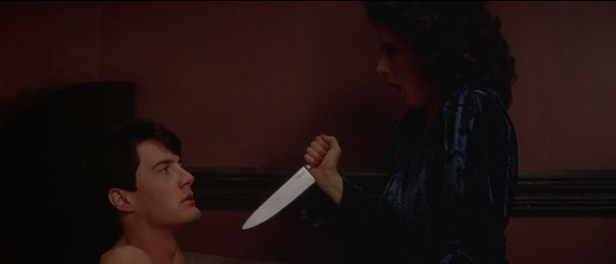
Under the surface lies something sinister and it all comes to a boil when Jefferey Beaumont (Kyle MacLachlan) returns to his hometown of Lumberton to visit his injured father in the hospital. The college boy comes across a severed ear, and it leads to stakeouts, and eventually brazen attempts to break into a mysterious woman’s apartment.

And as you would expect Jefferey gets in too deep, getting sucked into a twisted, subversive spiral that includes singer Dorothy Vallens (Isabella Rosellini), a sociopathic maniac named Frank (Dennis Hopper), and a whole lot of ambiguity. All things return to the status quo in this suburbia and we can go back to singing “Blue Velvet” and “In Dreams” in peace. But there’s this nagging sensation that Lynch’s treatment of this topic is utterly cruel. Isabella Rosellini gives a stellar performance that is a constant emotional roller coaster, while Dennis Hopper is the definition of a screwed up, drugged up, lunatic. These individuals have so much darkness and twisted caverns in their characters that it’s hard to leave them like this.

After all, this isn’t a big joke, and it shouldn’t be, but it’s hard to get away from that idea since the dichotomy between the two is separated here by a hair’s length. However, for others who find it easier to parse through the tonal problems I have with Blue Velvet, there’s undoubtedly a lot to take note of. This is one of those enigmatic films we leave with more question than answers; more confusion than clarity. It’s not always the easiest, but it can certainly be rewarding.

3.5/5 Stars

Museum Hours (2012)

Museum_Hours_posterThere are few films where art and film more obviously intersect than Museum Hours. In fact, its director and general mastermind Jem Cohen blends the line between filmmaker and multimedia artist. His generally deliberate piece on Kunsthistorisches Museum of Art follows two figures in the vibrantly beautiful city of Vienna, Austria

Johann (Bobby Sommer) is a museum guard with a reassuring face full of kindness and good humor. He spends his days in the museum, a place where he finds tremendous tranquility and great contentment in the vast intricacies of the beauty around him. For others, this would be wearisome work. From his perspective, it’s an immense joy. His eyes are constantly taking in the world around him, bright and full of awe. Always ready to help.

In one such occasion, his gaze happens upon Anne (Mary Margaret O’Hara), an obviously frazzled traveler, lost in a world that is foreign to her. In truth, she came to Austria after receiving news of the deteriorating health of a distant relative. Johann willingly gives her directions to the hospital and soon enough the museum becomes her little oasis too.

So if the film did have a plot that would be it. Two people finding a connection in a great big city. And yet this film is hardly Coppola’s Lost in Translation. The arrival of Anne in Austria is seemingly only a pretense for the audience to spectate. In some ways, it’s quite reminiscent of the contemplative nature of Christ Marker’s Sans Soleil, at times blended with the naturalistic visuals of Malick’s Tree of Life. It operates as part film, part documentary, with voice-over often playing over images. Everyday scenes mixed with works of art, and ultimately leading to a greater appreciation of both.

Often the camera is stationary and as such it watches the world of Austria rather like the patrons who wander through the halls of the museum surveying the most mundane things with a degree of awe, peering at the beauty that lies there within. We can use the same critical eye we use to look at art for life. Not to find fault but on the contrary, to develop a greater appreciation for all that is around us.

The likes of Cranach, Rembrandt, and especially Bruegel bring to light the beauty that can be found in our world, even in the smallest of instances. Different people take it different ways. A tour guide will become didactic, patrons in a tour group will try to come up with all the answers, and kids are content sitting in a corner to stare at their phones as the world passes them by. But Johann has the right idea. It really is rather a child-like perspective, in the sense that each day brings new excitement and he garners great joy out of the little things.

Obviously, I’m a bit biased as someone who likes paintings and art history, but Museum Hours is a powerful film that truly elicits a greater appreciation for art, but more importantly life itself. Really, there’s no need for a score, because that would almost detract from the pensive nature of Cohen’s work. It’s about the juxtaposition of visuals. That’s where it gets its power.

4/5 Stars

Claire’s Knee (1970)

claireskneeClaire’s Knee is a film made for color. Eric Rohmer’s other films up to this point had almost exclusively been black and white, but it’s as if he knew that his newest oeuvre deserved different treatment. It’s vast countrysides and glistening lakes abundant with flowers and fruits fill up our senses. We get to watch and see and experience the beauties of this oasis. And there is no music because the songs of the birds suffice.

Jerome (Jean-Claude Brialy) is a reserved but genial diplomat, who also pulls off his beard quite well. He’s taking a peaceful holiday at Lake Annecy as he prepares himself for marriage with his longtime sweetheart. Quite by chance, he bumps into an old friend named Aurora during a jaunt in his speedboat. Through her, he meets her landlady Madame Walter, the lady’s daughter Laura, and finally Claire, Laura’s older half-sister. It’s an increasingly interesting chain of acquaintances.

The course of the film follows the progression of the summer days signified by white inter-titles expressing the date and time. During these days Jerome, in a sense, willingly becomes Aurora’s “Guinea pig” for her next novel as they discuss love, life, relationships, desire, and the like. Early on, Aurora notices that young Laura has taken some liking in Jerome, and he good-naturedly pursues the relationship, to see what happens.

clairesknee2She’s a young girl who has some big ideas. Laura admits feelings for Jerome, but it’s seemingly only fleeting young love. She still has many years ahead of her, and yet her opinions on love and friendship are already forged. She’s willing to discuss them in depth with her much older counterpart. They take a hike through the mountains together, dance together on Bastille Day, but it’s not a romance. She moves on to a younger boy more fitting for her.

But that’s enough skirting around the uncomfortable. It’s the entrance of Claire that feels integral to the film, if not simply for the fact that the film’s title revolves around her. The fact is Claire is a beautiful girl, who intrigues and disturbs Jerome for the simple fact that her physical appearance is all he knows about her.

The moment he witnesses her picking fruit off a tree up above him, he cannot stop looking. He’s absolute powerless around her. She intimidates and casts a spell that mystifies him. The fact he wishes to touch her knee is hardly a thing to be taken all that seriously. By this point, we know that Jerome and Aurora are not all that serious. It’s almost as if they’re playing a game. And yet Jerome still earnestly wishes to touch Claire’s Knee.

In a moment of sincerity he even acknowledges he is drawn to thin delicate girls, but having a girl made to order would hardly be a recipe for true love. Because the fantasy could never equate to actual compatibility and joy for two individuals. The perfect moment does finally arrive, and it seems like Jerome can finally act out on his desire. He is caught in the rain with Claire and they must wait, taking refuge from the rain. He has news about her boyfriend that brings her to tears. In an instant, he caresses her knee, but soon enough all the desire is gone and it gives way to a good deed.

clairesknee3Thus, somehow Jerome maintains his good-natured personality despite his potentially disastrous relationships with the two girls. It’s as if he knows that inconsequential flings and fantasies can never measure up to true love. He heads off ready to marry his bride to be. We never get a feeling that this is some odd ploy to get a dramatic rise out of its audience. Rohmer’s moral tale is genuinely curious about love. In truth, it’s packed full of musings and revelations on the issue. It draws the conclusion that love means nothing without action.

To his credit, Brialy pulls off the role nearly flawlessly, because he could have so easily seemed like a perverted jerk, but somehow he still comes out of this film with his reputation intact. Perhaps it’s because Laura and Claire are such striking characters. Jerome somehow pales in comparison, despite his age. Although young, Laura seems beyond her years and then there’s Claire. A young woman so exquisitely beautiful in a natural, carefree sort of way. She is perfect to be the subject of this film.

4/5 Stars

3 Women (1977)

3womenposterSupposedly Robert Altman’s inspiration for 3 Women came from a dream he had, as with many of the most original ideas out there. Admittedly, in some ways, the resulting project feels like his rendition of a European art-film. It has some roots in Bergman and Polanski while transposing the action to his usual locales that are inbred into the fabric of America — places like the California deserts and Texas.

The film revolves around two rather pathetic individuals who meet while working at a facility for the elderly.

One is passive and dependent, the newbie trying to learn the ropes as she becomes acclimated to her new position. The other believes she is independent and exists self-assured, but really she is an oblivious outcast in her own right. Millie Lammoreaux (Shelley Duvall) becomes the teacher, in a sense, and savior of timid young Pinkie (Sissy Spacek). She offers her a home and makes countless recipes that are meant to be enlightened, but were probably even antiquated in their day.

Furthermore, Millie drinks, smokes, shoots guns, and likes to have a good time, because that’s what you’re supposed to do. Except, the only problem is, no one seems to want to interact with her. All those in the apartment complex avoid her like the plague, talking about her quietly in their little enclave. Meanwhile, she likes to tell herself that all the boys are fawning over her. She’s one of those people.

Pinkie makes her seem important, but Millie also grows tired of the other girl’s constant presence. She’s so needy, so withdrawn and homey. That is until the film reaches its main turning point…

Pinkie ends up in the hospital and Millie stands by her faithfully, even going so far as getting in contact with her roommate’s parents. They come and they go. Eventually, Pinkie returns home a different person.

It is around this point where the film’s constant foreboding finally reaches its apex. Pinkie has nightmares following her disconcerting transformation. In this stretch, it’s akin to Persona and Repulsion as she simultaneously becomes a version of Millie and begins to enter psychological distress.

The film at times feels like an expansive lucid dream constantly steeped in symbolism and uneasy anxiety for no apparent reason. The narrative is constantly intercut with enigmatic underwater images of the human form lurking under the surface of the pool. It becomes a film swimming with psychological anxiety, estrangement, and identity disorder. However, it, unfortunately, deteriorates into an incoherent jumble at times. Although, if it is based on Altman’s subconscious, then perhaps he hit the nail on the head.

Its score also becomes overly theatrical, bringing to mind NBC movie mysteries like Columbo, but otherwise, 3 Women is a perplexing piece from one of the cinematic masters of subversion. We exit the film with the eponymous three women and no idea of how we quite got there.

4/5 Stars

Random Harvest (1942)

220px-Random-harvest-1942There’s not a mean bone in Ronald Colman’s body. He’s the perfect gentleman and Greer Garson is his perfect counterpart. Theirs is the story of Paula Ridgeway and Smithy, or Charles Rainier and Margaret Hanson, or closer yet, both of these stories together. But there’s need for some explanation.

A man (Colman) returned from the great war with no memory to speak of, barely able to talk, and no family to vouch for him. His life is one of isolation in an asylum. Until the day he escapes and happens to run into Paula (Garson), a compassionate stage performer who never lets him alone again. She sees it in his eyes that he’s a good man, and watches over him rather like a guardian angel. His war injuries inhibit his speech, but Paula’s vibrant personality is the best possible therapy he could ever receive. She brings him out of his shell, making him feel like a man again. Marriage comes soon after and they are deliriously happy with a child on the way soon enough.

Then comes the fateful day that “Smithy” visits Liverpool to inquire about a new job. But a street accident leaves him shook up once more, and this time around he has no recollection of his last 3 years of life. Paula is forgotten and all he can recall are the trenches and his old family name, Charles Rainier. His relatives are all in a hubbub upon his arrival with his young step-niece Kitty (Susan Peters) taking an especially great interest in her uncle. He tries his hand in the family business and finds himself very handy at the work while young Kitty continues to correspond with him as she goes through school. She pleads and coaxes him to marry her, and since he is genuinely fond of her, he agrees. It seems like ages since we’ve thought of Paula, but this is the true tipping point of the film.However, at the last minute, Kitty calls off the marriage realizing it was always a dream. It would never work out.

In this stage of his life, Ronald begins to confide in his secretary who is strikingly familiar to the audience. But he has no idea who she might be,  except for Ms. Hanson, a highly competent, very beautiful woman. She doesn’t dare reveal her identity but here lies the portion of the film that tugs at the audience’s heartstrings. Paula or Margaret (whatever you want to call her) is caught in such a delicate and maddening predicament. She wonders if her love even has the capacity for happiness now. There’s little hope of getting out of this cycle, and yet as we would surmise from the very beginning, love wins out.

This film hinges on these faint wisps of memories and near deja vu moments that Rainer encounters. They are what separate him mentally from the love of his life who he isn’t even capable of knowing anymore. Their tragedy is not of their own doing or even due to human depravity. It is fateful circumstances outside of their control that keeps them apart, reminding us that oftentimes the world is unjust for no apparent reason.

Ronald Colman is always a wonderfully restrained actor who nevertheless is a pleasant lead. He’s even more muted here, and it works beautifully in juxtaposition with the vivacious energy of Greer Garson. In her own right, Garson is photographed in such a way that is so pure and unblemished with softened features that captivate the screen with true Hollywood glamour.

You can easily toss around words like sentimentality or schmaltz with a love story like this, but sometimes it’s better to let all the emotions of the film pervade your mind and overwhelm your senses. It’s an easy film to give in to and an easy film to forgive, because it’s main players are generally so likable. If modern actors tried their hand at such a masquerade, more likely than not, we would scoff at their attempt and then throw them out with not so much as a second glance.

But not so with Ronald Colman and Greer Garson. It’s not a waste of time giving them a couple hours because in that time they make us believe in love. True, it is an over-trod cliche, but in a cynical world that edges more and more towards a worldview of self-preservation and pessimism, maybe Random Harvest is what we need. It undoubtedly pumped invigorating life into wartime viewers and if you give it a chance, it can do the same today.

4/5 Stars

Review: Shadow of a Doubt (1943)

Teresa_Wright_and_Joseph_Cotten_in_Shadow_of_a_Doubt_trailerIt is well documented that Shadow of a Doubt was Hitchcock’s personal favorite of his own films. That’s quite a telling statement when you do a quick scroll through some of the titles up for contention. Vertigo, Psycho, Rear Window, North by Northwest, Notorious, even The Birds. And yet the famed “Master of Suspense” chose the often glossed over Shadow of a Doubt.  If we take a slightly closer look it makes a great deal of sense as the film follows through with one of Hitch’s most prominent credos, “There is no terror in the bang, only in the anticipation of it.”

That’s, in fact, a great deal of what Shadow of a Doubt is. It’s the cringe-inducing anticipation for what is bound to happen. The inevitable that is plain as day, except not everyone sees it so clearly. But that’s enough ambiguity.

The story opens in a depressed urban city with Charles Oakley (Joseph Cotten) laid out pensively on his bed. Dollar bills are scattered haphazardly across his floor. Soon he learns two men want to talk with him, and he’s not about to get acquainted so he gives them the slip and heads to the one decent place he can think of. Santa Rosa, California, the peaceful abode of his older sister Emma and her family.

What we learn over time is that Charlie is known at large as the “Merry Widow Murderer,” because he has strangled three such women and taken their valuables. Hitchcock playfully alludes to the fact by opening his film with the “Merry Widow Waltz” and it will pop up throughout the entire story if you’re paying attention.

shadow-of-a-doubt-trainHis train comes barreling towards town with smoke spewing ominously. For now, his oblivious family is just happy to see his face, especially his oldest niece and namesake Charlie (Teresa Wright) who is ecstatic to have something to shake the family out of their funk of normalcy. At this point, there is little to be uneasy about, because Uncle Charlie is not about to do anything rash, but there are a few moments where he gets uneasy. Covering up a paper headline and doing his best to avoid two men taking photos for a national survey. Charlie doesn’t think much of it at first, and it feels just like old times with uncle giving gifts and receiving the royal treatment.

Except the ring he presents to Charlie is plundered jewelry with a mysterious pair of initials engraved on it. Of course, the men interviewing the Newton household are actually trailing Uncle Charlie, and Detective Graham fills Charlie in while also becoming fond of her. But it’s not the kind of news she’s willing to accept. How can she? It’s a late night visit to the local library that finally confirms all her deepest fears. Soon, the telltale signs become more apparent to the audacious girl, and Charlie simultaneously notices the changes in her as well.

This is where the film becomes fidget-inducing because it’s out in the open. Uncle Charlie knows that she knows, and still he remains in their home, in quiet little Santa Rosa, as if nothing has changed. For most of the family, nothing has, but Charlie’s demeanor is completely different. She just wants her uncle gone, away from her family, and then there’s the impending threat that her own life might be in danger. In truth, Uncle Charlie doesn’t want her around, even though it looks like he might get off scotch free.  His mind is already so twisted — so far gone — that he coolly attempts to get rid of Charlie, right under the very noses of their family.

It turns into a psychological mind game between uncle and niece, Charlie vs. Charlie. There’s no detective to save her now because he’s already left town and there’s no other direction to turn. She finally does succeed in getting dear uncle to leave town, and it looks like the living suburban nightmare is coming to a close. Then, in a final instant on the outbound train, Hitchcock’s lets off a BANG! The film’s culmination arrives and is just as quickly passed over. It’s done just like that, but it’s not really what was important. All that nerve-wracking build-up — the meat and potatoes of the drama was what was paramount.

Thus, Hitchcock delivers us a shocking nightmare of a film. It’s not anything like Psycho, existing in a far more mundane world. But Shadow of the Doubt brazenly suggests that murder can reach us even in our homes, even in the places that feel the safest. Hitch exhibits his wicked sense of humor with two characters who love to talk murder in Mr. Newton (Henry Travers) and the next door neighbor Herb (Hume Cronyn). They obsess over crime fiction and discussing ways to get away with murder. Little do they know that the man in their midst is trying to do just that.

Teresa Wright is certainly one of my favorite actresses and her role as Charlie is one of her bests highlighting her cordial charm, while also revealing her adeptness in the role of a tortured heroine. We want her to succeed more than anything, and as an audience, we worry for her well-being the entire film. Meanwhile, Joseph Cotten generally plays laconic types, but still, they usually have more goodness than baseness in their souls. Uncle Charlie is a fine role for him because he’s so sweetly cunning and at the same time sadistically twisted.

Shadow of a Doubt pic 3Unfortunately, the role of Detective Saunders feels rather shallow, but that’s hardly something to get stuck on. If that were the case, we could easily point to Charlie’s parents who seem way too old. But they are perfectly average, ordinary folks, as played by Henry Travers and Patricia Collinge. The script work of the preeminent Thorton Wilder (Our Town) and the on-location shooting in the Everytown of  Santa Rosa lend a universality to this thriller’s impending dread.

Dimitri Tiomkin heightens the film with his usually stirring, pulse-pounding approach to scoring. Hitchcock’s camera, while in black and white, is nevertheless noticeably dynamic. He always emphasizes the necessary focal points, and extreme close-ups and high angles only accentuate the drama. His use of the stairwells in the house is absolutely marvelous, implying both distance and foreboding in numerous shots. For every shot that Cotten looks menacing, there is an equal number highlighting the pure innocence of Wright. It’s the perfect juxtaposition of character, in a film that is really only your typical see-sawing struggle of good versus evil. Except it takes place in our own backyards.

5/5 Stars

Review: Red River (1948)

redriver1Any conversation on quintessential American Westerns certainly has to at least consider Red River. It has genre mainstay John Wayne in one of his most stirring performances, a moody precursor to The Searchers. It boasts the debut of the often criminally under-appreciated method actor Monty Clift. Moreover, it’s cinematic space is filled out by a colorful array of prominent Western stock players. You have the always ornery Walter Brennan, pudgy Noah Beery Jr., Harey Carey Jr., Hank Worden, and numerous others. For a second you can even forget that this isn’t a John Ford film, but instead, the story is placed in the ever-adept hands of Howard Hawks, who knows how to craft compelling stories no matter the genre he’s working in.

In 1851, before Tom Dunson (Wayne) settles on a new plot of land near the Rio Grande and begins to raise his cattle with the brand of the Red River D, he loses the love of his life to an Indian raid, while also picking up an orphaned boy in the aftermath. That young man, Matt Garth (Clift), would become like Dunson’s adopted son and his right-hand man when it comes to running his ranch. The rest of Red River is essentially a road film that chronicles the first cattle drive along the Chisolm Trail. It’s bound to be a gritty, sweaty, and undoubtedly smelly road ahead as Wayne and Clift take the reins on this journey. The intrigue comes with power dynamics because when you put two or more people in a confined space sparks are bound to fly at some point.

redriver2When Dunson begins the massive journey to sell his cattle in Missouri, many wranglers sign on for prospects ahead, but they don’t quite know the degree of hardship that they will face. Soon enough, a stampede leaves one man dead and the company without one of their chuck wagons of provisions. Dunson is a hard taskmaster, who expects his hired hands to finish their job. Morale in the band begins to sink from lack of food and fierce downpours that leave most everyone dejected and distraught.

Then, when Dunson prepares to hang two deserters to make an example out of them, Matt must finally step in. He’s always the subservient one, always backing Dunson with his gun, but for the first time in his life, he crosses the will of his mentor. All the wranglers are quick to continue the journey as they change course for Abilene Kansans and the prospect of the railroad. But Garth leaves a brooding Dunson behind, vowing to kill Matt if it’s the last thing he does. It’s this act of the story which brings to mind the Biblical vendetta of Esau as he pursues his kin for stealing his birthright.

red river 6Garth and his contingent do end up getting to Abilene and are met with open arms by the kindly Mr. Melville, however, perhaps, more importantly, Matt falls in love with a fiery beauty (Joanne Dru) and must leave her behind. Days later Tess Millay also meets Tom Dunson, the man she has heard so much about, and he’s far from being dissuaded from his mission.

Thus, the expected showdown comes with Dunson riding into town with his hired guns, the alarm being sounded, and Garth waiting for him. Dunson draws and Garth will not. It’s a fitting moment, but Howard Hawks develops it in a fabulous way. He fills it with tension and ultimately a hint of humor. The addition of Joanne Dru shifts the power dynamic and she says what everyone else is thinking while angrily packing a pistol.

redriver4Because if Red River was story alone, it would not be the preeminent Western that it is, and I think I made that mistake before. Hawks is a master at using all his actors to perfection in not simply the climactic moments, but also the lulls. With such a substantial ensemble, even the way he positions all his players in the scene holds importance. His scenes are continually interesting from talk of Walter Brennan’s false teeth to complaints about the abysmal quality of the coffee.

My only qualm with the film is the rather shoddy transitions, and so I am interested in getting a look at the theatrical cut with narration from Brennan. John Ford famously quipped that he never knew that Wayne could act until this film, and it’s true that he gives a darkly vengeful performance. But in many ways, Clift proves himself as a worthy co-star. There’s always a tightness, a lilt to his voice, that signals an earnestness and vulnerability. It starts coming out in this film right when he knows that he’s no longer going to follow Dunson. It took two starkly different actors to make the narrative work as well as it did, and Hawks added yet another classic to his catalog. On a side note, the music of Dimitri Tiomkin was noticeable, because the refrains can be heard verbatim in Rio Bravo. If something’s good why change it, right?

4.5/5 Stars

The Hunt (2012)

The_Hunt_(2012_film)One lie. That’s all it takes to completely decimate one person’s life. Out of the mouth of babes can oft come gems, but also deadly slander that leads to public scandal and personal destruction. In a small Danish village that’s what happens to Lucas (Mads Mikkelson), a sympathetic kindergarten teacher, who generally cares for his kids, while he tries to maintain a relationship with his teenage son Marcus, who is the casualty of divorce. It’s not easy for Lucas either, but he finds solace in his work and the companionship of his coworker Nadja, who moves in with him. On top of that, he is well-liked in his community which includes his close friend Theo, who has a son and a little girl Klara — dearly fond of Lucas’s dog Fanny.

But in one instant Klara makes the life of her adult friend a living hell. In a moment of confusion, she makes a confession to her teacher. Both surprised and worried, the information sends all sorts of alarms off in Grethe’s head and Lucas is relieved of his position quickly. Next, Klara’s parents are brought in and soon the rest of the community is let in on the troubling news. The following contradictory statements brought forth by Klara are quickly dismissed. After all, she has been thoroughly traumatized by Lucas. He’s arrested but finally released because the testimonies of the children do not add up. Still, he’s now labeled as a sexual predator and ostracized by everyone. His former friends have turned against him, and he is no longer welcome in the local grocery store.

The only place he can turn is his friend Bruun, who does not abandon him, as well as his son Marcus. That does not do any good for faithful Fanny as the witch hunt continues.  The sequence of events has the Christmas holiday as its backdrop, and it seems like peace on earth and goodwill towards men need not apply to Lucas. In one potent moment, the solemn outcast wanders into Church for service, only to be forced to sit in a pew all alone. There gathered around him are all the people who have destroyed his life. All the people who professed to be his friends, and yet quickly turned on him.

His response is uncalled for perhaps, but certainly not unwarranted. Theo is deeply affected and it only takes listening to the listless whisperings of his little girl to know that Lucas is innocent. They make peace on Christmas day and things die down.

Time passes. Lucas is happy. He’s back with Nadja. Marcus is about to get his rite of passage as a hunter. Everyone’s friends again. But still, there’s something not quite right. In the final moments, the motif of a hunt takes on a deeper meaning. The drama has all but subsided and yet it still lingers. Lucas is still being hunted even if it’s only in his dreams.

After the Wedding gave me tremendous respect for Mads Mikkelson as an actor, and The Hunt only solidified that conviction. He is facially so recognizable and expressive. Not exactly a handsome face, but there is a raw beauty to it, and it is wonderful for expressing a broad spectrum of temperaments. It can be an evil mug or a sympathetic face revealing layers of anguish. In many ways, it’s a great enigma, so reserved and yet so emotive. Thomas Vinterberg’s bare-boned film rides on Mikkelson’s shoulders, and he is able to carry the weight brilliantly.

4/5 Stars

The Verdict (1982)

Verdict1Paul Newman is one of those people who bring other people into theaters. They’ll watch him on reruns when they’re surfing through the channels or tell their children and grandchildren about him. That’s just it. He’s a universal actor who transcends the years with his magnetism and charisma. A lot of folks would follow him to the ends of the earth cinematically-speaking, and he plays the bums and ne’er do wells like nobody else.

In some ways, it seems like he should have no place in the film like The Verdict. It’s a slow, brooding drama that churns and grinds methodically through a script courtesy of David Mamet, adapted from Barry Reed’s novel. It’s completely void of humor or charm in many respects. It’s bitter and battered, personified by Frank Galvin, a washed-up lawyer drowning in booze and drifting in a fog of cigarette smoke. His pedigree isn’t so hot either. In the last three years, he’s had four cases and has not won a single one. To make matters worse, he’s an ambulance chaser, the type of prosecutor that every self-respecting citizen would scoff at with contempt.

The film generally lacks polish or pizzazz for that matter, but Paul Newman and director Sidney Lumet are well-established professionals, who know how to develop the courtroom drama in such a way that it remains compelling. All the necessary bits and pieces are there to go along with generally stark and somber visuals.

James Mason is the opposition, a white-haired man with a penchant for winning and doing his homework so that all the holes are stopped up. He’s representing not only two renowned doctors but also the Archdiocese of Boston since they own St. Catherine’s hospital. Galvin’s mentor and colleague is Mickey (Jack Warden), who watches out for him despite his many failings. Being divorced, Frank also tries to find companionship with the aloof beauty Laura (Charlotte Rampling).

Galvin is tempted by a giant settlement, but there’s something inside of himself that says, take the case to trial. Of course, right from the beginning, it’s a train wreck, because he cannot find the witnesses he needs, and Ed Concannon is a real pro with an extensive legal team to do his bidding. On the other side of the room, you only have Frank and Mickey.

They’re able to dig up key witness Kaitlin Costello, although Concannon turns that against them as well. Furthermore, Frank learns something about Laura that doesn’t help. And there we are at the end of the case, a gray-haired lawyer sitting there seemingly defeated. But he does the only thing he can do, in all sincerity plead with the members of the jury to do what is right and just. That is all he can do.

Some might find comparisons to The Verdict in Lumet’s earlier masterpiece 12 Angry Men, including the casting of Jack Warden and Edward Binns. However, I think what makes the director’s courtroom dramas work so well is that they really don’t dwell too much on the actual courtroom. 12 Angry Men is about the discussion going on behind closed doors and The Verdict concerns itself with all that is going on outside in preparation. We see Frank for who he is in the office and out of it. Thus, by the time we actually get into that court of law there’s so much more riding on this verdict.

What’s especially striking about Newman’s performance is that there is almost a complete absence of drama. There is one violent outburst and aside from that, it’s as if he’s utterly fed up with the world. Throwing his hands up in a sense and giving in. Instead, he plays pinball or sits pensively with a drink in hand. That’s why this case is so important because it means something. It signifies an attempt to care again about right and wrong. But the question is, Does anything actually change in the character of Frank Galvin? We leave him sulking in his office, slowly nursing yet another drink as the phone rings out in the silence. What’s the verdict then? Is he a winner or a loser? I’m not sure he even knows the answer to that question.

4/5 Stars