 “You’re living at home. Is that right?
Yes.
Do you know what you’re going to do?
No.
Are you going to graduate school?
No.” ~ Elaine Robinson to Benjamin Braddock
As a recently graduated person, I thought it was only pertinent to return to this landmark film to see if I could glean any new insight. In many ways, the main premise of The Graduate always repulsed me. I couldn’t get behind the comedy because it seemed so at odds with what is going on onscreen.
But now I think I more fully understand Mike Nichols’ style as he leads us through Buck Henry’s script. There certainly is a wicked wit dwelling there, but there’s also more to it. He’s trying to undermine social mores and say something by switching tones on us. In this case, it seems like he’s talking to all those listless souls just set adrift after college. He was their elder, but in the characters of Benjamin Braddock (Dustin Hoffman) and some respects Elaine Robinson (Katherine Ross), young people found their equals. People they could relate to in their own anxiety and at times apathy about the future. And it’s as much Elaine’s story as it is Ben’s since they both are riding off into the great unknown of their future together.
Thus, this isn’t just about an affair, though that did help to shatter the Production Codes. There is so much more that actually causes Benjamin to get involved with Mrs. Robinson (Anne Bancroft). The implications extend far beyond.While The Graduate‘s main hook seems rather curious, the rest isn’t all that crazy. In fact, it’s quite relatable.
We get our first view of Ben, sullen and anxious as he rides the moving walkway in the airport terminal. The haunting vocals of Simon & Garfunkel’s “Sound of Silence” ring in our ears, but there’s also that almost comical voice reminding travelers to use the handrails.
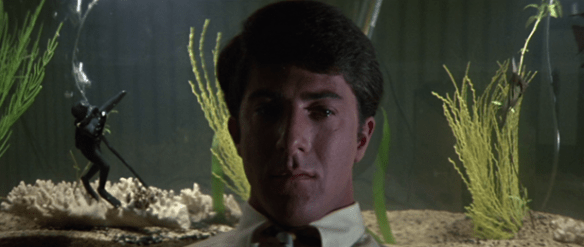
It’s when he touches down and gets home that things become all too real. He’s entering back into his parent’s world which is reinforced by this general theme of suffocation and in some sense alienation, fawned over by parent’s friends and encased in a scuba suit. Ironically, he’s no hippie or counter-cultural revolutionary, but he still feels at odds with the community he finds himself in. There’s a generational gap, and even Hoffman’s own portrayal is so contrary to this WASP society. In casting Hoffman, not a particularly handsome young man, an atypical example, Nichols is ratcheting up the irony.
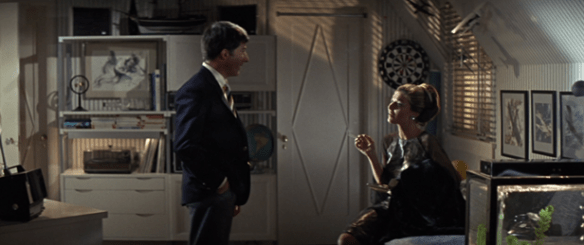 Then Mrs. Robinson coolly enters his life. It’s perhaps best signified when she tosses him the keys. They end up in the fish tank almost as if on purpose and after that she has him reeling for good. Soon he’s walking into the lion’s den (or lioness’s) as she expertly manipulates and elicits the precise response from him. In these moments the film is elevated by the awkward, huffing and puffing, and nervous chattering of Hoffman. We often forget the second part of his famed line, “Mrs. Robinson you’re trying to seduce me. Aren’t you?” His general naivete and hesitancy say it all.
I also made a startling discovery. Ben doesn’t have any friends! Or else, where are they? The inference perhaps being that he spent so much time being a track star, being on the debate team, and being editor of the paper that he never stopped to do the other things that college is all about. Building relationships with other human beings your own age. When he gets out and realizes his directionless anxiety, he tries to remedy it in other ways. The most obvious way is sleeping with Mrs. Robinson.
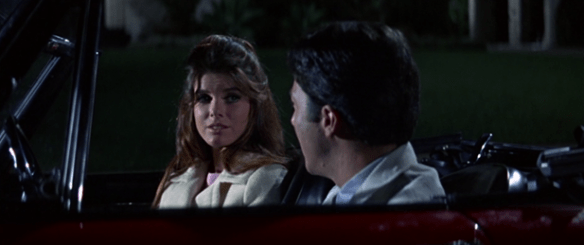 But when he meets Elaine Robinson and finally begins to connect with her on a peer-to-peer level, it’s something so profound to him. Having someone his own age that he can relate to, who feels the same unnamed apprehension and angst that strains on him. It’s what makes Ben become so mixed up. He has true feelings for her, while his affair with Mrs. Robinson only serves to poison all that could be good. And his illogical, unhealthy pursuit of Elaine continues to Berkeley where she is attending school. Still, Mrs. Robinson and her now estranged husband look to send their precious daughter far away from Benjamin Braddock.
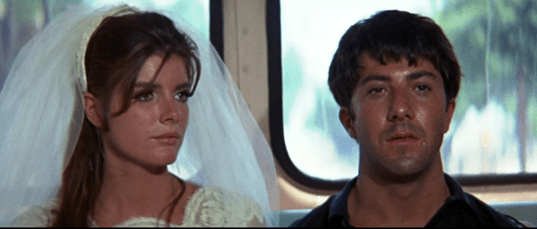 That’s what makes his final Herculean effort all the more climactic. He bursts in on her marriage to another man and whisks her off to another life altogether. A life that seems exciting at first, because, oh how great it is to be young and in love. But once they climb aboard that bus in their tattered garments, have a chance to sit down and really think about what they are embarking on, you see something else in their eyes. The laughter slowly dissipates and as they look around nervously, they begin to somber up. True, Ben is no longer alone in an airport terminal, he has a fellow traveler, but that does not make the future any less unpredictable or scary for that matter.
That is the life of a graduate. In so many ways feeling like an outsider, a foreigner in a land that you used to know. You’re living at home. You don’t know what you’re going to do and you’re not going to put off the decision by going to grad school. We’ve all been in a similar place one time or another and that’s why this film resonates, not only with the generations of the 1960s but even to this day.
What truly elevates The Graduate above Nichols’ other films, aside from this universal quality, is the stellar soundtrack courtesy of fellow New York natives Simon & Garfunkel, who became icons of the folk scene during the 60s and 70s. Their album Bookends is still a classic, featuring the fully polished version of “Mrs. Robinson.” While not all the lyrics are here in the film, it became an anthem, reflecting the gap created between the older generations and their kin. While the likes of “Sound of Silence,” “April Come She Will,” and “Scarborough Fair” lend themselves to the more introspective moments of the film like no score ever could. It’s part of what makes The Graduate a cinematic watershed of the 1960s.
4.5/5 Stars

 The Blue Angel is the name of a nightclub and it turns out to be a very fateful nightclub indeed. It just takes us a while to figure out why. Although Josef Von Sternberg’s film is known, rightly so, for making a star out of Marlene Dietrich — in the first of their 6 collaborations — this early German sound film is nevertheless about the decline and fall of Emil Janning’s character. Immanuel Rath begins as a professor at the local college, and although his pupils are unruly, he commands the utmost respect. He sees it as his prerogative, and he is quick to bring order and discipline to these young lads. But boys will be boys and they become corrupted by the beautiful cabaret singer Lola-Lola (Marlene Dietrich). One evening the professor drops into the seedy joint to look out for some of his troublemakers and talk with the proprietor. Of course, he unwittingly ends up meeting the gorgeous girl backstage and returns the following evening with a seemingly very flimsy excuse.
 But by this point, he is a sorry figure, so pitiful and bedraggled in every way. He reluctantly parades himself in front of audiences as a clown just to make some money for him and his wife. It is, of course, inevitable that he return back to his old stomping ground, and it does eventually happen. He reluctantly goes onstage and it is difficult to watch this final chapter. Lola is no longer his. He’s completely ruined. Completely destroyed. Oh how far the man has fallen, as he winds up keeled over on top of his former desk in the gymnasium.


 Disney has scored again. On almost all accounts Zootopia is grade-A family entertainment. To address the elephant in the room, the film is rather formulaic in its hero’s journey and at times it feels like we are attempting to systematically check off all the necessary moments in the rise, fall, and redemption of our spunky heroine. However, there are moments of wit and grace that begin to slowly grab hold of us an audience. It, in turn, becomes ceaselessly inventive with this metropolis of anthropomorphic animals, whether it is the rhythms of daily life or the social issues present that look strangely familiar.




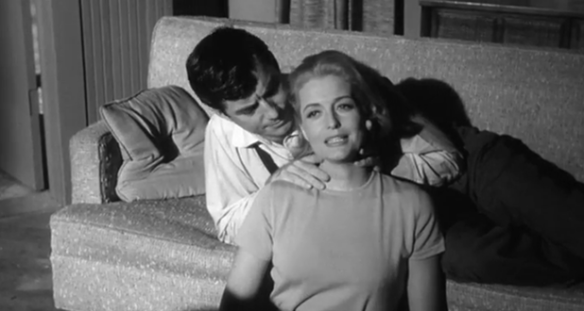 Of course, her first customer happens to be a police chief named Griff (Anthony Eisley), who advises her to skedaddle out of town as quick as possible. He gives her the details on a cozy joint across the border known for their Bonbon girls. He thinks he’s got her pegged, but Kelly goes and does something even he wouldn’t expect.
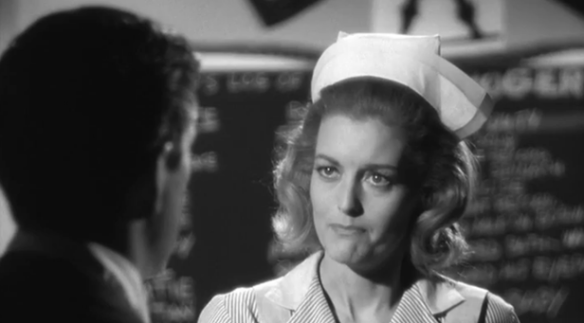 The social commentary is there. The characters are interesting. Meanwhile, Fuller slices and dices through taboo subjects that would have horrified censors and yet he brings them to the forefront in such a way that hardly glorifies them, but actually gets them out in the open. Every detail isn’t written out, but Fuller throws us into the narrative and allows us to track with him. He puts a little faith in his audience.
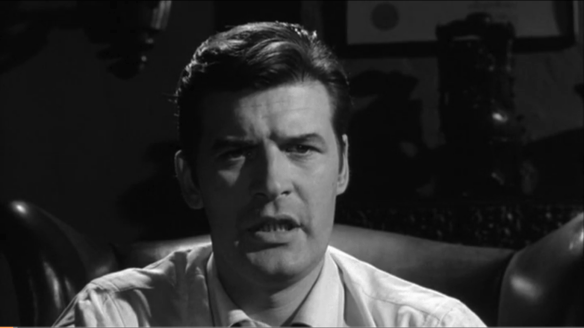 “This long corridor is the magic highway to the Pulitzer Prize” – Johnny Barrett
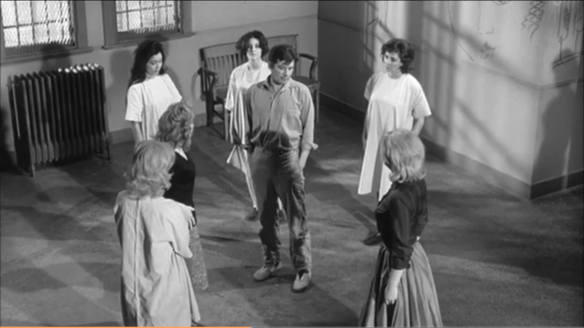 Behind the pearly gates, there are brawls galore and noisy neighbors riddled with all sorts of neurosis, quirks, and ticks. There are the good cop and bad cop who help care for the patients and keep them at bay. Johnny even begins to have hallucinations of his girlfriend drifting through his dreams. He gets introduced to hydrotherapy, dance therapy, and even faces a traumatizing experience at the hands of women in the female ward.
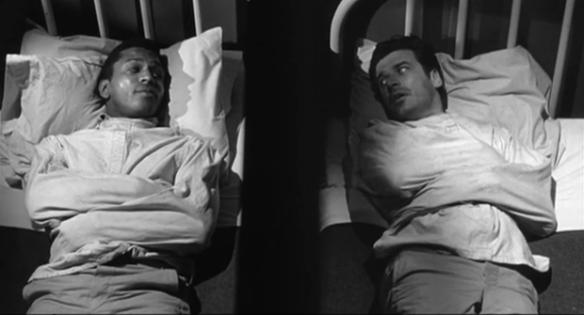 The boisterous, tumultuous chaos of the ward does almost become maddening, even to the viewer. Johnny has a few angry outbursts of his own as the strain of the facility gets to him more and more every day. Electric shock therapy among the other treatments leaves him mixed-up, confused, and overtly paranoid. He’s hardly the man we met in that office so many days ago and even if he got the scoop he was looking for, at what cost? Shock Corridor has a thunderously disconcerting ending worthy of a Fuller production.
 4 Star Films