Review: Double Indemnity (1944)

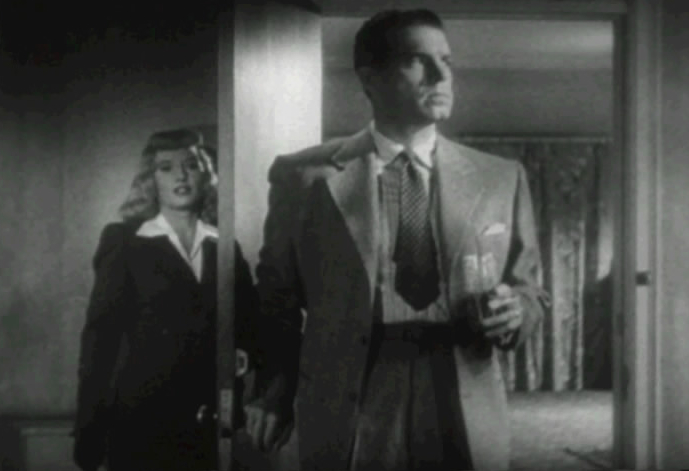
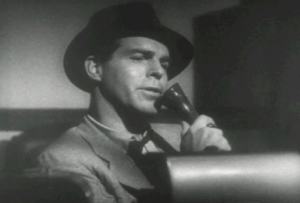
Double_indemnity_screenshot_8It was a hot afternoon, and I can still remember the smell of honeysuckle all along that street. How could I have known murder can sometimes smell like honeysuckle?” – Walter Neff

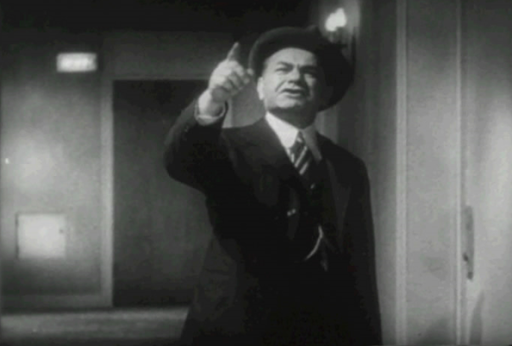
I can’t say this enough. Double Indemnity is so deliciously enticing each and every time I see it. Maybe it’s the A-grade script from Billy Wilder and crime novelist Raymond Chandler with its noir cynicism and memorable phraseology. Maybe it’s the shadowy, low-key interiors or L.A. exteriors. The monotonous beating score of Miklos Rozsa, mourning impending doom. Maybe it’s the plain, laconic way of Walter Neff or his bloodhound buddy Keyes. Is it the innocent Lola who gives the film morality? Or the artificial wig and the silky smooth purring of Phyllis Dietrichson?

In fact, I named many, if not all, of the many facets of this film, because I want to attempt to acknowledge all of them before I forget. But the reality is I love Double Indemnity at its most basic level as a piece of prime American cinema. Yes, it is film-noir and yes, it came from a European director, but it is very much a product of 1940s sentiment as the war years waned.

The story is pulled right from some pulp fiction sleaze by James M. Cain and cemented itself as a noir classic in its own right with all the trappings that are called for.

It opens with the beginnings of Rozsa’s score reverberating in our ears and it very rarely lets up. A car blazes wildly down the street and winds up in front of an insurance agency. Out stumbles our protagonist Walter Neff (Fred MacMurray) and for the rest of the film, he relates the recent happenings over the Dictaphone of his colleague Barton Keyes (Edward G. Robinson). It goes something like this:

During his first visit to the home of a Mr. Dietrichson, he instead has his first encounter with the man’s sensual wife, and his heart goes pitter-patter from then on. His motivation is no longer insurance. Now he just wants the chance to see her more. He gets his chance to advise her on a plan, and it all seems playful enough until she insinuates that she wants to knock off her ol’ hubby. At least that’s how Neff reads it. However, he cannot get her out of his head as he has fallen into her web. There’s no turning back.

They think of everything and Neff has everything figured out to a tee. As he suggests, it’s like having the perfect odds on the roulette wheel, you just need an accomplice to spin and Phyllis is just that person. From then it’s just straight down the line. They corroborate on all the details at local Jerry’s Market, Walter sets up his alibi, and he does the devilish deed as Phyllis stares with cool satisfaction at the road ahead.

They set it all up like an accident as the last touch, because as Neff knows all too well if it looks like Mr. Dietrichson was killed from riding a train the Double Indemnity clause of the insurance will mean double the payoff due to how unlikely the occurrence is.

 Double Indemnity (1944) - UpdatedHis only fear is the inquisitive nose of Keyes and the “little man” inside the claims investigator’s stomach, who warns him of the first sign of anything fishy. He gets close to the truth but not quite there. Neff is too close for him to see it. However, as things begin to heat up Phyllis and Neff must separate.

As Neff tries to console Lola Dietrichson over the death of her father, he quickly finds out what the naive girl has to say about her step-mother. It puts a little light on the subject, and Neff realizes what he’s been taken for. He wants to remedy things while he can, patching Lola up with her boyfriend, and going to confront Phyllis one last time.

It’s the perfect set-up. Darkened rooms with curtains drawn. Phyllis reclined in an armchair with evil intentions on her mind. In walks Walter and they have it out. Shots are fired, literally. Phyllis will never let up with her ploys until Walter gives her a little help for the final time. I’m sure the Hays Codes loved this one. I certainly did.

Back in the office Keyes finally overhears the end of Walter’s “confession” as his friend bleeds to death. In one last touching moment, Keyes returns the favor and lights the cigarette like Walter has been obliging to do the entire film.

Walter: “Know why you couldn’t figure this one, Keyes? I’ll tell ya. ‘Cause the guy you were looking for was too close. Right across the desk from ya.”
Keyes: “Closer than that, Walter.”
Walter: “I love you too”

Billy Wilder traded longtime partner Charles Brackett for Raymond Chandler, and despite a rocky partnership, they ended up with one of the greatest scripts, chock full of memorable bits of dialogue. You know you have an impressive cast when Edward G. Robinson is your third lead and each character is playing against type. It’s great casting, in a quintessential American drama solidified by great cinematography and storytelling.

It doesn’t get much better than this and it certainly does not need to. You know Double Indemnity is good when I’ve seen it multiple times and each time the bullets still keep me on the edge of my seat. Thank you, Billy Wilder, for teaching us murder sometimes smells like honeysuckle. That’s absolutely beautiful.

Phyllis: “No, I never loved you, Walter, not you or anybody else. I’m rotten to the heart. I used you just as you said. That’s all you ever meant to me. Until a minute ago, when I couldn’t fire that second shot. I never thought that could happen to me.”
Walter: “Sorry, baby, I’m not buying”
Phyllis: “I’m not asking you to buy. Just hold me close.
Walter: “Good-bye baby.”

5/5 Stars

Lilies of the Field (1963)

Original_movie_poster_for_the_film_Lilies_of_the_FieldStarring Sidney Poitier, the film opens with a black construction worker who has an overheated car in the middle of a desert. He spots at the residence of some European nuns to get water. Homer is intent on making a quick pit stop but the mother superior has other ideas. She sees him as a gift from God so that their Chapel might be built. He reluctantly decides to stick around for a little while to help them out and teach them some English. The stubborn Mother Superior wants everything her way and Homer ends up leaving them. Although he realizes he will not get paid, Homer’s ambition to be an architect leads him to eventually start the Chapel for the nuns. He takes on a part-time job and starts the undertaking while the nuns request materials. Soon the locals want to help but Homer is adamant that he do everything. Eventually, they do join in and more materials come. Progress picks up and Homer becomes the foreman. The building is finally put up and yet the proud Mother will not thank Homer. That night she is finally tricked into thanking him and Homer leads them in a spiritual one last time before driving off into the night. This film is a battle of sorts between two strong-willed people. In the end, it brings a great deal of good.

4/5 Stars

Written on the Wind (1956)

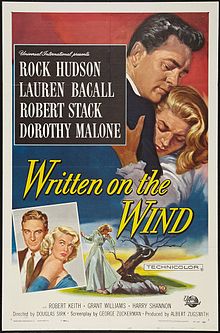
WrittenOnTheWind2Here is a film that wholly personifies an over the top melodrama or soap opera. Douglas Sirk’s film is full of complicated romances, tense relationships, drunkenness, and murder. Yet when the two stars drive away through the gates of the Hadley Estate everything is resolved (at least to a degree).

It seems that Sirk undoubtedly knew how over the top his story is and he reinforces it with his blatantly loud colors, dramatic music, flashy cars, gaudy interiors, and so on. He embraces a style that seems stereo-typically 1950s Hollywood and he makes it work.

Ironically Rock Hudson gives a good performance and Lauren Bacall is okay but the real drama flows from Robert Stack and especially Dorothy Malone. They are the black sheep of the Hadley family and by the end of the film they definitely deserve the moniker. Except there is more to them then that. Kyle is a tragic figure to be sure and despite her sex-crazed ways there still is a bit of sympathy for Marylee.

I cannot wait to see more Sirk because he seems quintessentially 1950s.

4.5/5 Stars

The Lives of Others (2006)

This is a moral tale that could only be told in the context of the GDR. A loyal member of the Stasi is given the task of bugging the home of an influential playwright and he spends countless hours listening in on The Lives of Others. In what would have been a very uncommon occurrence this loyal comrade sees another side of the nation he lives in. It is a place full of corrupt officials, double crossing girlfriends, repression, little free speech, and above all suicides.

In an act that proves detrimental to his own career and even his way of life, Wiesler caves to his emotions to do what is ultimately good and right. After the wall crumbles he and others like him seemingly fade into oblivion. However, the one man who was unknowingly saved finally learns of his savior and resolves to write his next great work. The Sonata for a Good Man. 

I think there is certainly a universal quality to this film because although it is German language and focuses on a subject that is distinctly German, the quality of the characters translates into any language because they are human. The struggle of Wiesler is the same for many of us and we can empathize with his evolution and ultimate resolve. We can only hope that people are not put in these same positions in the future and we must also constantly question our own government so they are never reach this degree.

4.5/5 Stars

Good Will Hunting (1997)

9db12-good_will_hunting_theatrical_posterGood Will Hunting is an extraordinary story on multiple levels because it is about the little guy. The trajectory of a lowly janitor being propelled to MIT genius is moving no matter how often it gets copied or imitated. It just never gets old. Then, there is the story of two young unknowns named Matt Damon and Ben Affleck who shot to fame thanks to some big dreams and a few mentors. Now they are two of the top names in Hollywood over 15 years later and they continue to be (Gone Girl and Interstellar are proof).

However, back then they were a long shot with only a solid idea for a film. It worked wonderfully though because of its core themes. It’s about friendship. It’s about romance. It’s about fear and aspirations. It’s about vulnerability. It’s about long shots making the most of their lives. Admittedly, that could be almost any film so there’s a need to bring the microscope in a little closer.

At face value Will Hunting (Matt Damon) seems like a young thug from South Boston who loves his beer, buddies, broads, and brawls. He and his friends including Chuckie (Ben Affleck) spend their days trying to make ends meet and fill the rest of their time with the aforementioned. We get glimpses of a different Will, however, a brilliant young man holding a plethora of book knowledge and blessed with a photographic memory. He’s able to philosophize rings around conceited Harvard students catching the eyes of a cute British girl named Skylar (Minnie Driver). They are a sweet couple and it seems like it might add up to something good.

Then, comes the necessarily fateful day when Will solves the unsolvable equation on the MIT wall, following that feat with a brawl fight that lands him with a potential jail term hanging over his head. It’s a strange dichotomy and it deeply surprises Professor Gerald Lambeux who quickly realizes the unassuming genius that is Will Hunting. He’s fantastic, but in order to utilize his potential Lambeux agrees to have him meet weekly with a therapist.

What follows is an absurd string of therapy sessions where Will, who wants none of this analysis, makes a mockery of his psychologists. When Lambeux’s former roommate and last resort Sean Maguire (Robin Williams) is called in it looks like more of the same.  But he is different. He sees something more and Sean is not about to give up on the kid. Their sessions begin as a battle of wills until Will’s defenses finally break down. They construct something beautiful, something real,  and in many ways vulnerable.

It is then that Sean teaches Will about true love and living life with no regrets. He had a wife who passed away from cancer, and he is hardly a big name academic, but he wouldn’t trade his life for anything. That’s enough for him. All the while, in between sessions, Will must figure out his life whether he wishes to work in the stuffy world of academia with professor Lambeux, continue living with his chums in Southie, or move forward with Skylar who is off to Stanford soon.

Sean doesn’t force him into one decision or another but he gives him personal advice. As a young man, he met a pretty girl in a bar, the same day in 1975 that Carlton Fisk hit his famed home run. But Sean gave up his seat to spend that evening with a girl and it paid off. She would be his wife for all those happy years before she came down with cancer. In Will’s eyes, and perhaps even the eyes of the audience, he was utterly insane to pass that up, but for Sean, there were no regrets. That’s enough.

On the verge of turning 21, there are so many choices, thoughts, feelings, and fears swirling around. Not to mention Will’s ugly past as a foster kid full of abuse and a heavy rap sheet. It’s the steady and pragmatic consoling of Sean where he finds relief. Sean will not be quelled in reminding him, “It’s not his fault.” That’s simply the hand he was dealt.

In another beautiful scene that is oft cited, Chuckie tells his friend, in the most genuine way that he can, that he doesn’t want Will to stick around. Because, the reality is, Will has been given a ticket out of Boston, and it would be a knock to all of his friends if he stayed around. On the day Chuckie won’t need a note. He’ll have satisfaction enough that his friend will be gone. To this day, it still feels a tad corny, but it works within the film so I will go with it.

Down the line, Sean receives a sincere note in his mailbox and Chuckie walks up the steps to Will’s place and no one answers. No one needs to say anything because they all know Will has gone to follow his dreams. Go west young man after the girl you love and take a chance. No regrets. It is the perfect ending for this film and at the same time the most aggravating.

Robin Williams was an obvious standout in this film, and it saddens me to think that he is no longer with us. I think I appreciate him most in his dramatic roles because he is so genuinely funny it comes out organically. He is a great counter to Matt Damon. Without that dynamic, this would be a far less noteworthy film. Also, the script is full of quips and a great balance of intellectual and laymen terms making for a unique story. It takes time to acknowledge the idiosyncrasies and pain that are a reality of human existence.  That’s why it hits home. Hopefully, Will as well as all of us find what we are hunting for.

4/5 Stars

The Grifters (1990)

b2415-grifters1When you have Martin Scorsese producing and Stephen Frears directing you are bound to get something intriguing, and The Grifters is just that. It’s a Neo-Noir starring John Cusack (no Lloyd Dobler), Angelica Huston and Annette Benning. It’s got everything you can expect with a title like that from small-time swindling and horse races in La Jolla to deadly Femme Fatales with shady intent.

The film really has three stars in the above, but at the center of it is young grifter Roy (Cusack) who has been doing nicely for himself ever since he went off on his own. But his type of life does not come without a price. Lilly (Huston) is an old vet who has worked all the angles for a long time and now she is in the service of one tyrant of a bookie named Bobo. She hasn’t seen her son for 8 years, and all of sudden she comes back into his life finding him in need of medical attention. Their reunion is far from civil.

Then last but not least is the despicable Myra (Benning) who seduces her way into the hearts and the wallets of many men. Now she’s with Roy but before there was another con man and she is far from exclusive using her sexual wiles to get anything and everything she wants. It’s not surprising Lilly can’t stand her guts. No one could. If he’s honest not even Roy. Soon enough Lilly poisons him towards Myra and the seductress wants revenge and she seemingly gets it.

What follows involves lots of blood, lots of money, and a descent deeper towards a hellish conclusion that feels hollow and cold. Elmer Bernstein’s score accentuates the mood with a tense and altogether creepy string section.  As far as character dynamics, go this has to be the strangest triangles around. Each one of these confidence tricksters is a grifter and each one has a slightly different angle. However, when it’s all said and done only one of them can come out on top even if they didn’t want it to end that way. That’s just the way things go. There is no turning back, only running away for dear life.

The three leads played their roles to a tee and The Grifters proved generally engaging even if all the questions were not answered with loose ends still to be tied up. It also blends the general themes and outlook of noir with a setting that almost feels anachronistic at times. It’s hardly a complaint though and maybe things are better this way anyhow.

3.5/5 Stars

The Imitation Game (2014)

09cf1-the_imitation_game_posterWhen you think of decisive moments in WWII the conversation leads often to D-Day, The Battle of Midway, The Russian Front and The Battle for the Atlantic. If Britain had been cut off from U.S. supplies the case could be made that The Allies would have undoubtedly lost the war. That’s where the Enigma cipher comes into play and along with it Alan Turing.

Alan Turing is one of the unsung heroes of WWII and in many ways the father of modern computers. He’s a big deal and it’s hard to make that point enough. That’s what makes it exciting that he finally got the biopic treatment and with a portrayal by Benedict Cumberbatch no less. It does not get much better than that!

As far as biopics go The Imitation Game is a polished period piece set in War-torn Britain spanning the years of WWII into the early 1950s. Visually beautiful, scored nicely, and generally uplifting, it feels as wonderfully English as a cup of tea and the English countryside. Although the film at times may trod the typical path of other troubled-genius type films,  it often rises above the usual based-on-a-true-story fray. A primary reason for this is Benedict Cumberbatch who plays Turing not with dramatic outbursts, bravado, and bluster, but quite the opposite.
In the year 1939 Turing, a professor at the time, attempted to join the top secret project at Bletchley Park to crack the German’s Enigma code. He seems like an odd candidate for the job since he has only an affinity for puzzles and no knowledge of the German language, but that proves to be unimportant.
He has the right amount of vision paired with the obsession to come at the problem like no one before him. He does not just want to crack one of the tedious strings, he wishes to crack them all using a machine. It was absolutely unheard of and his colleagues discount him, understandably, because he is not much of a team player and far from a social butterfly. However, he discovers a worthy ally in Susan Clarke (Keira Knightley) who proves to be indispensable in his work as well as repairing his rapport with the team.
With the prospect of all his work with the machine being wasted and terminated, his colleagues back him up in front of his superiors. Turing has one last chance to succeed and someway, somehow he does. But success does not come without great responsibility. Once they have the weapon to counter the Germans they must use it cautiously only taking the most necessary steps. It becomes clear that there is a fine line between playing God with human lives and winning a war.
The war is won in the end, however, and the top secret endeavor is disbanded. Alan Turing is far from a war hero because few know what he did. His only label is indecency and he is given the option of imprisonment or hormones in response to his charges of same-sex attraction. A year later he committed suicide at the age of 41.
Cumberbatch is seemingly the perfect Turing with all the quirks you would expect. Except there are also traces of sensitivity and he so adeptly shows subtle emotions on his face. He was an oft-tortured man inside and out, spanning from his boarding school years to his post-war existence. Keira Knightley on her part is enjoyable as a counterpoint, remaining true to Turing no matter the circumstances.
Obviously you can always call into question the accuracy of these types of films and no doubt artistic liberties were taken, but all in all The Imitation Game did a commendable job of painting a picture of a man’s life in a very different age. Alan Turing finally got the credit he was due, and it was done with a great deal of sensitivity, heart, and even humor which mostly overshadowed any saccharine moments.
4/5 Stars

The Diving Bell and the Butterfly (2007)

ca161-divingbellbutterflympIt’s beyond me how a film about a man who is all but paralyzed, except for his left eye, could be interesting. The main plot point follows his struggle to write a memoir using a tedious system where he blinks his eye for an assistant to transcribe. Maybe this does not sound all that engaging, but it most definitely is. No question. It has to do with how the film narrative is developed.

Bauby’s struggle is experienced first hand by the audience as we are stuck inside his head for the first portion of the film. It is a disconcerting perspective as we begin the film as helpless and confused as he is. We are there for every painfully difficult piece of progress, every one-sided conversation that Bauby (Mathieu Amalric) is unable to respond to, and every moment when he is powerless to act out. It is absolutely eye-opening. No pun intended. It’s simply the truth.

His progression is absolutely extraordinary. Beginning as a supposed “vegetable” who wished to die, to a man with an imagination that he was able to share with the world. He still had the ability and the passion for sharing his thoughts, memories, and desires with the world. He was physically so powerless and yet mentally so empowered.

Fragments of his story are given to us in pieces, although we still continue to return to the limited perspective he himself experiences. It is not easy to be sure. He must have others bathe him. The television channel is out of his control. There are doctors, therapists, friends, and family coming to see them, and he has no ability to physically interact. He still has feelings for his mistress, but the mother of his children still cares deeply for him. Sundays are hell with no one around.

Despite all that seems to drag him down, Bauby still is able to flutter above it all like a butterfly. With the help of his assistant and a strong will, he completed his memoir. 10 days later he would die, but his mission was accomplished. Maybe it seems like a rather unfortunate ending, but even if the lack of closure is unsatisfying, how it ended is the truth. Bauby was undoubtedly content because, despite the seemingly surmountable obstacles, he never lost his humanity. Being Locked-in could never take his mind from him. Ultimately, he was a winner and so his story ends on a somber yet powerful note.

It has been a while since I have been so affected by a film. I hope I will see another one like it very, very soon.

4.5/5 Stars

Auntie Mame (1958)

32347-auntie_mameWith Rosalind Russell reprising her role from the stage, this film is made by her scene stealing portrayal. The film opens when a rich man dies suddenly and his young son is sent to live with his Auntie Mame. She is a social, energetic and free-spirited woman. Despite the fact that Patrick was raised proper, Auntie Mame soon teaches him how to enjoy life and they grow close to each other.

However, Patrick is taken to a boarding school against the wishes of his aunt. They still remain close as Mame tries to get work and then she meets a southern gentleman. Patrick is growing up as Mame travels the world with Beau. He is killed in an accident so Mame returns home to work on a memoir. She soon realizes how grown up her little Patrick is because there is a girl he is intent on marrying.

Mame does not voice her displeasure with this upper class girl and her superficial parents. Instead she invites them all to dinner and by sabotaging everything Mame makes Patrick realize he is not like these people. He once again embraces her idea that life is a banquet and most poor suckers are starving to death. You have to get out and live a little.

This film was shot almost like a stage play and I found it rather long but Russell is superb and she holds the film together nicely.

4/5 Stars

Kramer vs. Kramer (1979)

c367a-kramervkramer1The title Kramer vs. Kramer brings to mind a film about two people, formerly married, fighting over their kid who is stuck in the middle of their feud. It has the potential for high drama and tense courtroom scenes full of malice and bitter resentment. Sounds like a real winner.

Don’t get me wrong, there is some of that, but Kramer does better. It follows the complex relationship between a working man and his 7-year old son as the newly separated dad struggles to take care of them both. It shows the pain that forms between former spouses as they try and navigate life as best as they can. It shows the pain and heartache that comes with both loving their boy so dearly. There’s a realness and a vulnerability that is extraordinarily hard to discount.

It does not dawdle and within minutes a solemn Joanna Kramer (Meryl Streep) tells her husband she is leaving him, and he can hardly believe her words. What comes next is the imminent trouble of balancing work and his home life. There is an emotional toll that comes since they were together for over 7 years. Their neighbor isn’t helping matters.

The frustration manifests itself in outbursts over breakfast and anger directed pointedly at others. The most vulnerable is little Billy who is a cute kid but dearly misses his mother. At first, he and his dad don’t always see eye to eye. He does all the typical kid things. Refuses to eat food, disobeys, and causes messes. The best example is the notorious ice cream seen where he defiantly starts eating from a pint of ice cream against his father’s wishes. He’s so cute, but it’s not pretty.

Work is hardly getting any better; in fact, it’s getting worse as Ted has more responsibilities to worry about at home. His friend and superior is not happy with what he’s seeing. On her part, Joanna seems mostly out of the picture, still sending cards to Billy faithfully. His only friend becomes the also separated Margaret (Jane Alexander) and they act as confidantes.

One significant moment occurs at the playground where Billy falls from the jungle gym and cuts himself before his father rushes to his crying son’s aid and runs him to the emergency room. He stays with his boy through all the stitches and tears, solidifying their bond and his resolve to continually be there for his son.

On the work front, Ted is regretfully let go and rushes to find another job. On the home front, Joanna is back in New York and a custody battle is in the making. However, neither parent understands what they have subjected themselves to. Things get ugly and it is something that neither Ted or Joanna wanted. They don’t want to make each other hurt — all they want is their son. It’s a complex flood of emotions and feelings as a product of character assassinations. There can be no nuance only “yes” or “no” and that’s the way the court will decide the outcome.

When the process is done it is decided that custody of Billy will be awarded to his mother. Gasp! However, what Ted does next is more noteworthy. He goes home to his boy and with the greatest of fatherly love he tells his boy he will be going to his mother. Billy will have so much fun with his mommy and they will get to see each other a lot. He is strong and positive for his boy while his insides nearly burst.

Then, in a scene mirroring their earlier morning, they calmly make french toast as a team, a happy fat, er and son together. Joanna asks for a meeting and Ted goes down to meet her. Her decision is yet another surprise and this time he peeps through the elevator with a smile waiting downstairs while she goes up to see her boy. It is very taxing to work through divorce. For all parties involved so Kramer vs. Kramer ends at the happiest place it could realistically be.

I admire the portrayals, however, because Hoffman’s character is far from an angel (sometimes prone to outbursts), and yet he acknowledges his shortcomings and proves just how all encompassing his love for his son is. Meryl Streep, on her part, is relatable but it is still difficult to reconcile her leaving. By the end however,  it is quite easy to feel sympathy for her and she too proves to be a well-meaning, albeit, flawed individual.

The scene that really solidified this film for me had to be when Ted is reading to his son from The Adventures of Tintin. It’s a classic moment and it hit home, because it was a story I read many a time with my own father and will hopefully get to read to my own kids. That’s what makes movies truly wonderful. When they transcend time and place making it possible for us to relate to them on even the most basic or mundane level. That is part of the reason Kramer worked for me. At it’s most intimate, it’s about connections. Between men and women and fathers and sons. Not always pretty but always an integral part of life.

4.5/5 Stars