Zootopia (2016)

ZootopiaDisney has scored again. On almost all accounts Zootopia is grade-A family entertainment. To address the elephant in the room, the film is rather formulaic in its hero’s journey and at times it feels like we are attempting to systematically check off all the necessary moments in the rise, fall, and redemption of our spunky heroine. However, there are moments of wit and grace that begin to slowly grab hold of us an audience. It, in turn, becomes ceaselessly inventive with this metropolis of anthropomorphic animals, whether it is the rhythms of daily life or the social issues present that look strangely familiar.

In truth, it works as a thinly-veiled parable for mankind in our present condition. The lines are not black and white, but predator and prey. True, there are differences and they give way to pernicious spells of racism or more aptly in this context, “specism,” but there is room for understanding and symbiosis, to use an ecological term. We could go back and forth for a long time about the actual mechanisms and minutiae of evolution and whether it makes sense or not, but the bottom line is that humans and animals have a lot in common.

Zootopia playfully makes that blatantly clear, and within all the subtle ribbing, it does have a broader message which is true of all great pieces of family-oriented animation. Movies have the ability to allow us to more fully understand the world we live in and that applies to children as well–in fact, they are even more malleable.

There are various other reviews alluding to Animal Farm, In the Heat of the Night, and Who Framed Roger Rabbit. All are interesting touchstones for this film, but obviously, all comparisons falter at some point. For me, Zootopia has surprisingly interesting social undertones to its drama that try to make sense of these things even for young viewers. That’s no small feat and perhaps even more praiseworthy it delivers it in a delectable story that follows in the footsteps of the best buddy films and police procedurals. It’s all wrapped up in the encapsulating animation of Disney that at points feels overwhelming, but the characters of Judy Hopps (Ginnifer Goodwin), Nick Wilde (Jason Bateman), and even the likes of Clawhauser give it winsome charm.

Everything from Sloths at the DMV to a raspy Godfather possum is on point, and the film continues with a stream of gags. However, we are always being drawn back to the journey of Officer Hopps as she tries to prove herself and solve the mystery behind the 14 missing animals. But if this was only her journey it wouldn’t be all that interesting. Thank goodness she has a buddy to cross her will, make her stop and think, and ultimately stand by her when the world isn’t a utopia anymore. I’m not sure what I think about Shakira’s presence in the film, but I’ll let it slide this once.

4/5 Stars
The Incredibles (2004)


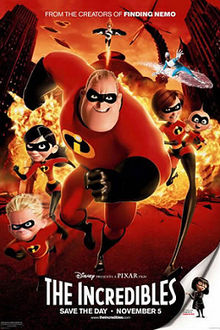
The_IncrediblesCertain superhero storylines are beginning to overstay their welcome. Spiderman, The Fantastic Four, and even The Avengers spring to mind. The remarkable thing is the fact that this wildly popular genre headlined by numerous wildly popular franchises does not appear to be leaving us anytime soon. And when the prospects of monotonous superhero film after monotonous superhero film get a little too much, it’s rather comforting to return to The Incredibles. Yet again Pixar proved they knew how to craft animated films with great storytelling, but also a depth of character.
Over a decade ago now Brad Bird helmed a project that would introduce us to a very different batch of superheroes. Yes, they began as individuals named Elastigirl and Mr. Incredible, but soon enough they ceased being that. But these weren’t a ragtag alliance like the Avengers or the Guardians of the Galaxy. They were something perhaps more broken and complicated – a family.

Back in the glory days, the superheroes were civil servants held in high regard – one of the foremost of those being Mr. Incredible (voiced by Crag T Nelson), but they soon fell out of favor due to scandal and public controversy. Thus, they drifted into obscurity and their aliases quickly became their real life.

This is where this story gets interesting, as Bob and Ellen Parr, as they are known now, are living life with three kids. Ellen (voiced by Holly Hunter) is happy to give it a go and live the normal everyday existence, but Bob yearns for something more than rush hour traffic and a cramped cubicle in a thankless job. And when he gets a mysterious message with mission impossible-like implications. He is indubitably intrigued.

He begins moonlighting again, sneaking around behind Ellen’s back not wanting to needlessly worry her. He touches bases with his old friend and colleague Edna Mode (Bird himself), who supplies him with a new super suit sans cape. It’s just like old times with the super getting the respect he once garnered from everyone, and his family is happy and healthy. Everything is looking up.

But of course, behind these missions of his is something a little more sinister than he could have ever imagined. Of course, when his wife catches wind of it she expects something completely different – their marriage must be failing. That’s the only possible reason for him sneaking around.

Thus, mother and two stowaways head to a volcanic island smoldering with destructive peril. Mr. Incredible meets his match and is brought low as his past mistakes finally catch up to him. He realizes his weakness and more importantly how much his wife means to him. He could not go on without her. However, his wife and kids do not wallow in their predicament as they try and save the world from the dastardly deeds of the begrudging supervillain Syndrome. It’s in this final showdown that Mr. and Mrs. Incredible are back in their element with their compadre Frozone (Voiced by Samuel L. Jackson). Except now they are joined by their speedy son Dash and their invisible, force-field wielding daughter Violet, who both feel confident in their skin.  A giant mechanical robot is no match for such a crew, especially when they’re a family.

True, these characters have superpowers and special abilities, but then don’t we all in some way, shape, or form? This is a story about the nuclear family when that dynamic is blowing up, and a story about being comfortable in your own skin, in a society that often makes that difficult. So Pixar does the seemingly superhuman yet again by delivering up a popcorn-action-adventure-family film, that still somehow holds up to multiple viewings. It’s retro cool, quotable, and gives its voice actors space to gel. They breathe life into this story, while their contours come alive on screen. It’s a childhood favorite and for a very good reason.

4.5/5 Stars

Review: The Grapes of Wrath (1940)

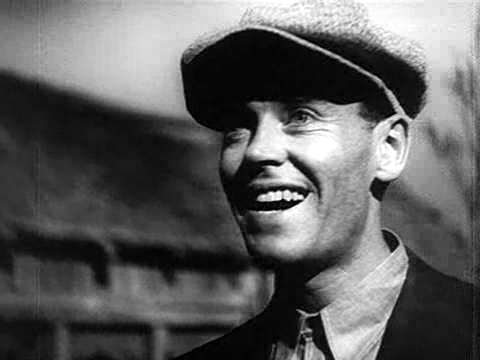
Grapes_of_Wrath,_The_-_(Original_Trailer)_-_01The Grapes of Wrath is in special company with a number of literary adaptations where film and source material are both so highly regarded and culturally significant. A few other names spring to mind such as Gone with the Wind, A Streetcar Named Desire, and To Kill a Mockingbird.

However, even more so than all of those stories John Steinbeck’s novel of exodus during the Dust Bowl has a universal ring reverberating for the common man. The Joads are a humble, simplistic Oklahoma clan, but they are only one family out of many who are forced to make the migration out to California. The Dust Bowl and big business push them off their homes and their only hope is the distant promise land of California. They cling to that hope which keeps them going resolutely onward toward the Orange Groves.

Tom Joad (Henry Fonda) who has just gotten out on parole is the figure from which we see the story through. He’s the focal point certainly, but he is defined by all those around him. Ma Joad (Jane Darwell) is the rock of the family, keeping them together, civil, and spirited even when the worst hardships of life hit.

Grandpa dies on the land that he called home. Grandma dies without the company of her lifelong partner. Rosasharn’s husband cuts out when prospects look bad. The family is slowly drained of money, food, gasoline, and hope when they see that the prospects in California are far from good. The book has so much to say politically and socially, using the Joads as a universal parable to reflect the reality of a great many people.

Obviously, John Ford’s film cannot contain all the exposition and commentary of the novel, but he uses the visual medium brilliantly and the Nunnally Johnson’s script fills the screen with all sorts of folks. There are no true villains and the only heroes are those who maintain their humanity and treat others well on a day to day basis. Ma Joad is one, offering food to starving children because it’s the right thing to do. A roadside waitress comes off brusque at first before extending a true act of kindness. You have the genial caretaker (Grant Mitchell) of the Wheat Patch Camp, who is angelic in comparison to so many of the other gruff people the Joads come in contact with.

There’s the scum of the earth. People just doing what they’re told, men just worried about profit, and crooked cops looking to run Okies out. There are those who just grin and bear it to feed their families. They’re part of the problem too and finally, you have Jim Casy and then Tom following in his footsteps.

Former preacher Jim Casy (John Carradine) is a critical figure because he, like so many of the other characters, has lost himself and yet over the course of the film he finds his purpose again. He’s the film’s Christ-like figure (with the initials JC), and yet he seems counter-intuitive to what we expect. But he has the most important things down. He fights for justice and lays down his life for his friends.

Rather like an extensive Dorothea Lange exhibition, cinematographer Gregg Toland shoots the film in beautifully austere and gritty black and white, which feels like a test run for Citizen Kane. However, it remains iconic in its own right with the ways in which it makes the plain, simple, and ordinary cinematic. It’s truly a visual snapshot of Americana with Henry Fonda as our All-American poster boy.

Speaking of Fonda, how could I have lost sight of his character here? Fonda in many ways synonymous with Tom Joad, and I always equate him being a kindly, true blue American. But that’s only part of him. That’s how he acts around his family, but he’s a young man disillusioned by the world. He speaks his mind and is not opposed to fighting back against the injustice. Because that’s what he sees around him. That’s why he kills the man who beats Casy and that’s why he goes out on the road; to be a champion of justice where there isn’t any. It’s an ending more suited for Hollywood at the time than Steinbeck’s original denouement, but it no less poignant or powerful. It doesn’t just stop with the Depression, but it ends up being a whole lot bigger and more universal than that. This is one of the great tales about the human condition, courtesy of one of America’s greatest directors starring one of America’s most legendary actors.

4.5/5 Stars

“I’ll be all around in the dark. I’ll be everywhere. Wherever you can look, wherever there’s a fight, so hungry people can eat, I’ll be there. Wherever there’s a cop beatin’ up a guy, I’ll be there. I’ll be in the way guys yell when they’re mad. I’ll be in the way kids laugh when they’re hungry and they know supper’s ready, and when the people are eatin’ the stuff they raise and livin’ in the houses they build, I’ll be there, too.” – Tom Joad

Make Way for Tomorrow (1937)

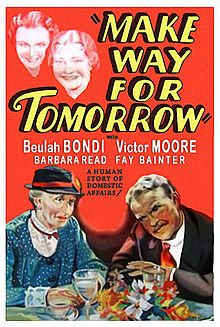
Make-way-for-tomorrow-1937It seems like Leo McCarey and this film for that matter often get lost in the shuffle. In his day he was a highly successful and well thought of director of such classics as The Awful Truth and Going My Way. However, his moving drama Make Way For Tomorrow is now often overshadowed by a similar film that used it as inspiration, Ozu’s Tokyo Story (1953).

I will not pass judgment on which film I like more. In fact, to even begin to make a decision I would have to go back to both. However, this film opens by restating the 5th commandment. Honor thy father and thy mother. After all, this film is certainly about the gap between generations, parents with children, grandparents with grandchildren, but at its core is this main concern. Honor thy father and thy mother.

The film opens in the home of Barkley (Victor Moore) and Lucy Cooper (Beulah Bondi). 4 of their 5 grown children are gathered together on the request of their parents who have something to tell them. Because their father has not been able to work, the bank is taking their house and so they will be displaced. Thus, the story is set up as the kids worry about what to do, because no one feels capable of taking both parents. Finally, it is decided that eldest son George (Thomas Mitchell) will take Mother, and one of the sisters will take father.

It is difficult for everyone. The old folks are split up for one of the first times in their 50 years of marriage. Meanwhile, grandma disrupts bridge lessons, makes life more of a nuisance on George’s daughter, and forces the maid to take on more hours. It does not make anyone angry at first, but it begins rubbing and chafing. Creating bitterness and annoyance which is arguably worse. Things reach the breaking point when George’s peeved wife finds out that her daughter is rendezvousing with men, and she is not happy at all when grandma confesses to knowing about it. She loses her temper and grandma apologizes. Seeing a letter from a retirement home she quietly decides it would be better for all if she simply moves there.

Her husband does not fare much better, and the harsh New York weather is taking a toll on his health. Furthermore, his daughter is obviously getting tired of him as her patience continues to wear thin. Mr. Cooper does make a friend in a kindly old shop owner (Maurice Moscovitch), but he soon is turned off as well. Finally, his daughter decides to send their father out of California. She says it’s for his health, but the real reason is she wants him off their hands so her other sister can deal with him.

With this new turn of events, Barkley and Lucy have one last meeting set up so they can spend time together before he is sent off to California. This is the most touching part of the entire film because underlying this oasis is the doubt that they might not see each other again. In the wake of that proposition, they have sort of a second honeymoon. They ditch the kids and have a magical evening just the two of them, reliving their youth and remembering the olden days. The miracle of this sequence is that everyone seems to finally understand them, appreciate them, and really honor them. They are offered a ride in an automobile and are met by the hotel manager who offers them drinks and listens to their wonderful stories of times past. Even the conductor plays a slow waltz just for the two of them. It’s a beautiful extended moment that is made especially moving in contrast to the earlier scenes. These are two people who, despite their advanced years, are still very much in love. It speaks to the importance that marriage holds in the life of some people. In certain circumstances, it is not a shallow event, but a lifelong friendship that carries so much weight.

When the time comes, the two lovebirds say goodbye at the train station and we don’t know what happens to them. We can guess certainly, but McCarey leaves a sweeter taste in our mouths before finishing with a realistic ending. It’s beautiful, moving, and tearful, but not in an overdramatic sort of way. In the mundane, sorrowful way that seems to reflect the rhythms of real life. Beulah Bondi was featured in some many great films, but I’m convinced that this was her greatest performance as an individual. Victor Moore was a worthy companion for her as well. However, my favorite character was probably the shopkeeper Max, because he was such a personable man in a sea of grumbling and annoyance.

5/5 Stars

Review: To Kill a Mockingbird (1962)

Atticus_and_Tom_Robinson_in_courtHere is one of the rare occasions when novel and film are so closely connected in my mind that I cannot help love Harper Lee’s initial work and its adaptation to the screen. They’re both so timeless in their own ways. Don’t get me wrong. They are very firmly entrenched in a bygone era, but this story exudes certain themes that are universal.

It’s rather like visiting an old friend. It seemed like so long. I can hardly remember the last time I sat down with To Kill a Mockingbird the book, or the movie for that matter. And yet it rushes back so easily. The characters, the settings, the story. I can almost visualize the words on the page as the scenes take place on screen. It’s a wonderful experience and I wish I could connect with something like this more often. But To Kill a Mockingbird is special to me because I read it at a young age and really ate it up. Thanks to Peck’s performance the story was just moving the second time around. It never ceases to be.

It struck me that I thoroughly enjoy Gregory Peck’s iconic performance as Atticus Finch, because of Mary Badham. Finch is a stalwart father figure and that comes out in the ways he guides and leads his young daughter Scout through life. She has a very cut and dry view of the world, not getting down the nuances or complexities around her. What Atticus does is model what it is to live life with other people, pure and simple. He takes the complexities of life and simplifies them in terms his daughter can try to make sense of.

To a lesser extent, that means telling his kids to leave the Radleys be and complementing the always ornery Mrs. Dubose. He is not prone to bravado by acting his age instead of playing football and not gloating about his skill with a gun. He’s too humble a man for that. He also does not fight back. He has more self-respect for himself and other people.

He attempts to instill this and other skills like tact in his kids, especially naive Scout. He gives her the eponymous metaphor that it is a sin to kill a mockingbird because they are a bird (supposedly) that brings only beauty and goodness into the world. And as he says, and I’m paraphrasing, you never understand someone else until you climb into their skin and walk around a bit. He delves into what empathy is and it’s what allows him to feel sorry for the Ewells, instead of desiring vengeance.

Atticus Finch is one of the special characters that I would actually use as a model. He makes me question my own actions as I take on a role much like Scout. He’s constantly reminding, constantly being patient, and modeling what it means to do what is right. All this is done without condescension, without lecturing. It’s done out of love.

His greatest act is, of course, defending accused African-American man Tom Robinson (Brock Peters), because after all, without this central point there is no film or book before it. But rather than focus on the depiction of these African-American characters and whether they are objectionable or not, I would rather acknowledge that this was a simpler time with a lot of evil still left in the world (as there is now), so this film speaks to me, because on a basic level, it is a story of good in the midst of all this blind discrimination and hatred.

That simple truth still speaks to me even with a story that is over 50 years old. The only adult cast member who is still with us now is Robert Duvall, and he is well into his 80s. Gregory Peck with his bespectacled visage and his soothing yet commanding voice is gone. Brock Peters is no longer with us, nor are the many other lesser known figures. But their story and these characters they embodied remain as a testament to Harper Lee’s original work.

It seems important to ask ourselves why would a man like Atticus do what he did? Why would he take that risk when no one else would? He answers Scout in this straightforward manner, “If I didn’t I couldn’t hold up my head in town, I couldn’t represent this county in the legislature, I couldn’t even tell you or Jem not to do something again.” He’s a man who holds himself to a different set of standards.

5/5 Stars

Inside Out (2015)

Inside_Out_(2015_film)_posterIn a generation often bloated with unoriginal ideas, Pixar has been one of the most prominent fountains of creative inspiration. Pete Docter has always been a master class storyteller (“Monster’s Inc.” and “UP”), but “Inside Out” finds him at perhaps his most innovative yet if you can believe it. Not everyone would be audacious enough to make their latest animated film on the inner workings of the human psyche. A film following a girl and her emotions could easily be insensitive or some downer emo tale at best.

However, Inside Out ends up being a wonderful and heartfelt film that comments on a difficult time in life without making the parents flat out buffoons or the children complete jerks. It finds a great deal of its substance in the personified emotions, positive and negative, that course through a young 11-year-old girl on a daily basis. Joy, Sadness, Fear, Anger, and most certainly Disgust.

From the get go it looked to be a veritable field day for stars like Amy Poehler, Mindy Kalig, Bill Hader, Lewis Black, and Phyllis Smith. In other words, the casting was impeccable and everyone delivers the goods.

As Pixar so often does, the characters are wonderful and the writing develops a tirelessly inventive world full of creative entities for the main players to bounce off of. Our two main settings are essentially San Francisco and the mind, and both come off pretty well, although by default the mind becomes the visual playground of abstraction that lends itself to the most mirthful moments as well as touching enlightenment. San Francisco is the city that ruined pizza. That’s pretty bad.

Above all, I think Inside Out makes a powerful suggestion to its audience. Going in we have a certain set of presuppositions. We live in a society that says joy is good. Sadness is bad. Among other things. However, this film dares to point out that all emotions have their places. All of them are meaningful and there is a season for each. Because as it turns out, without Sadness, you really would not be able to know what true Joy feels like. And that is a beautiful thing. Overall, this is not the best of Pixar, but it is a wholly memorable outing, especially when we are allowed to get inside the heads of each character. That’s when the story is at its creative best. Those jingles in commercials are really annoying too. They really struck a chord with that.

4.5/5 Stars

Ratatouille (2007)

RatatouillePosterOnly Pixar could make me empathize with a rat, and they did it with true style and sensitivity like they have done many times before. Ratatouille is often a forgotten classic that I easily forget in a repertoire that boasts such modern masterpieces as Up, Finding Nemo, The Incredibles and of course the Toy Story trilogy. However, Brad Bird’s tale of a gifted rodent and a hapless chef deserves to get its just desserts too and so I will attempt to do that now.

As was already hinted at, Remy (Patton Oswalt) is a very unique rat, because he has an incredibly sensitive palette thanks to an impeccable sense of smell. He cannot stand digging through the trash heaps like his brother Emile and he has higher aspirations than his single-minded father. One day Remy comes across the revelation of mixing foods and flavors in a culinary epiphany. His family doesn’t quite understand his more cultured aspects (walking upright, reading, cooking, etc.), and it ultimately gets him into trouble.

He winds up in none other than Paris and sitting on a rooftop he sees his own personal Mecca. The restaurant of Gusteau (Brad Garret), the man who famously said that anyone can cook before he was taken down by pernicious food critique Anton Ego (Peter O’Toole). After his tragic death, Gusteau’s lost two of its stars and that’s right about where a young man named Linguini (Lou Romano)  comes in.

He’s a bumbling nobody with little talent and only a note from his deceased mother vouching for his character. The incumbent tyrant of a chef (Ian Holm) reluctantly gives him a job as a wash boy which he barely is able to perform. In a fateful moment, he ruins a soup and Remy drops in to salvage the dish. Now after an initial berating, great things are expected of Linguini after a critic loves his new dish. Skinner suspects something is up.

In this predicament with nowhere to turn, Linguini looks to this little chef, and Remy decides to help him. Thus, begins the strangest of symbiotic relationships as Remy learns to control Linguini who acts as the front for the artistic genius who just happens to be a rat. For a while, it works really well. They keep Remy hidden under Linguini’s hat while also keeping Skinner constantly delusional with visions of rats.

Then, success continues to come Linguini’s way. Thanks to Remy the restaurant is a hot spot once more, he gets the girl Colette, and he has become the main attraction at Gusteau’s displacing Skinner. But it gets to his head a little too much, and he and Remy part ways.

The big night of Anton Ego’s return to Gusteau’s is fast approaching and the culinary dream team is no more. Once again Linguini is lost without his culinary partner. But the ever faithful Remy gets the support of his family and returns to the kitchen to aspire to his dreams. Linguini also finally has the courage, to tell the truth which ultimately loses him the respect of his staff.

However, Remy and Linguini both learn something about family and relationships, realizing the need to be who they are. In a brilliant stroke of genius, the ever resourceful Remy makes a simple yet elegant Ratatoullie. Everyone expects the disdain of Ego and yet it never comes. You see Ego also learns something about himself. Upon seeing the mind behind the dish that took him back to his early years, he remains pensive for once. He finally understands the wisdom in Gusteau’s simple adage.

The voice talents of this film are obviously wonderful, from the impeccably-casted Patton Oswalt to Brad Garrett as the jolly Gusteau and Peter Sohn as rollie-pollie Emile. However, I want to focus specifically on the late great Peter O’Toole.

It is rather extraordinary that just before seeing this film again, I took in How to Steal a Millionaire. It too is set in Paris, involves deception, and has its share of drama. Featured in that film is a younger O’Toole, handsome, blue-eyed and far from world-wearied. But the reality is, he had a hard life and you can hear it in his wonderfully Shakespearian, but still noticeably older voice. He brings such a wonderful lineage to this film, and he turns in one of his great roles. Peter O’Toole was part of a dying breed of theater-trained actors who will be greatly missed for their tour de force performances.  But once again many thanks to Pixar for doing the impossible. In some weird, disgusting way I love rats now.

4.5/5 Stars

“In the past, I have made no secret of my disdain for Chef Gusteau’s famous motto: Anyone can cook. But I realize, only now do I truly understand what he meant. Not everyone can become a great artist, but a great artist can come from anywhere. It is difficult to imagine more humble origins than those of the genius now cooking at Gusteau’s, who is, in this critic’s opinion, nothing less than the finest chef in France. I will be returning to Gusteau’s soon, hungry for more.” – Peter O’Toole as Anton Ego

The LEGO Movie (2014)

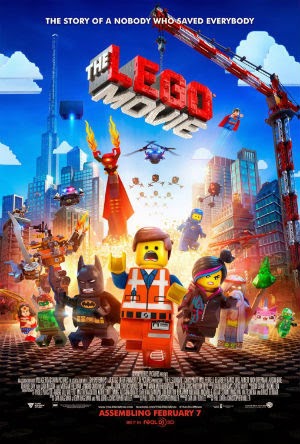
 adada-the_lego_movie_posterKudos to the minds behind The Lego Movie, because it is unlike any animated movie I have seen before and it is due to remixing, so to speak. For one thing, their story satirizes the ever popular action-adventure trope complete with an evil mastermind who is bent on controlling the world, and an every man who ultimately becomes the chosen one to save the…Lego race.

The world that Chris Miller & Phil Lord created is filled with annoyingly popular music, a superficial television program, overpriced coffee, and of course cities full of Lego people living in Lego places. They’ve taken the pieces and people that every little boy knows and spliced it into their own little unique universe.

In their world, Emmett (Chris Pratt) is a simpleton construction worker who is suspected to be the chosen one by the fugitive master builder Wyldstyle (Elizabeth Banks). They track down the prophetic Vitruvious (Morgan Freeman) and after gathering support, they enact a plan to take down the evil Lord Business (Will Ferrell) who wants to subject the world to the Kragle super weapon. I might as well stop the synopsis here because for one I do not want to spoil the film, and for another, it probably sounds like I am speaking complete gibberish.

That is the beauty of this film because it takes a previous concept like Legos and builds on it. After all, that is what you are supposed to do with Legos. Build things! In many ways, I could easily see a version of myself making a movie like this when I was younger. In the Lego world, everything collides into a wonderfully beautiful collage. You have cities, Cowboys, Pirates, Superheroes, Basketball players and  Star Wars all tossed together in a giant melting pot. Thus, the Lego movie I would have made would have been a lot different than this one, but that is absolutely okay. Legos are meant to stimulate the mind and allow the bricklayer to build and tell any story they might want to. The minds behind this film certainly did that to great effect with a story that is clever, witty, and even touching.

Furthermore, it is necessary to give a shout out to the voice actors. The two leads in Christ Pratt and Elizabeth Banks did well with their roles. However, they were also surrounded by the likes of Morgan Freeman, Will Ferrell, Will Arnett, Liam Neeson, Nick Offerman, and Alison Brie. Parks and Rec, Arrested Development, and Community were all represented here.

You cannot leave out cameos by Jonah Hill, Channing Tatum, Cobie Smulders, Anthony Daniels, Billy Dee Williams, and Shaq. There are undoubtedly others that I left out. Hopefully, they forgive me.

By the end of the film you will probably be convinced that everything is AWESOME and that each one of us is, in fact, a chosen one, we just have to truly believe it.

4/5 Stars

Searching for Bobby Fischer (1993)

19491-searchingfor2Josh Waitzkin (Max Pomeranc) seems like your average little boy with a bowl cut and an affinity for Legos and sports. However, soon his parents discover that he has a special gift for chess and his father (Joe Mantegna) especially wishes to cultivate his skills. He finds Josh a teacher named Bruce Pandolfini (Ben Kingsley), a former chess champion himself who looks to discipline the boy’s playing so he can be the next Bobby Fischer. He eggs Josh on with the promise of a grand master certificate once he earns enough points, and so Josh listens to his instruction. His dad enters him in tournaments that Josh wins easily and rapidly moves up the ranks, but as always happens the game is no longer fun and the father gets more intent on his son excelling on the highest stage. The trophies stack up, but Josh is missing a lot of school as well as his friends.

On the urging of Bruce, Josh is no longer allowed to play with the men in the park because they play undisciplined. Stepping back for a moment, there is the realization that this is a seven-year-old boy and yet this really happened, and it happens very often. Parents push their kids so much so because they wish for them to succeed, and they want to give them what they never had.The film deals with this circumstance sensibly with Josh’s mom acting as the voice of reason. His father is not a bad man by any means, and it is during one scene in the rain after Josh loses again that we see that. Josh sits on the curb in silence as his dad talks to him and the boy genuinely asks, “Why are you standing so far away from me?” It’s at this moment that Mr. Waitzkin realizes that he has blown things out of proportion and embraces his boy telling him that everything is okay.

Eventually, Josh goes back to playing with his buddy Vinnie (Laurence Fishburne Jr.) in the park and takes some fishing trips with his dad. Despite the initial cautions of Pandolfini, Josh goes into the biggest tournament against his greatest competition without stressing over chess. He just uses all the knowledge he has accrued and plays a beautiful game. Over the course of the game, he deviates from Fischer, winning on his own terms, the way that he wants. He may have been searching for Bobby Fischer, but ultimately he found himself instead and Josh is better for it.

The film is framed with the voice-over of Josh as he recounts the exploits of Fischer which then is juxtaposed with his own story. When the film came out back in 1993, Josh was still playing in his early teens and Bobby Fischer had come out of solitude to finally beat his old rival Boris Spassky. Both were master chess players, but with two very different stories.

This is certainly a feel good story, but it has wonderfully nuanced characters that make it a step above other such films. Max Pomeranc is wonderfully innocent and unassuming with his big doe eyes and a slight lisp. Kingsley and Fishburne on their part give two worthy performances as his two starkly different mentors with dueling strategies. It is, however, Joe Mantegna and Joan Allen who have the most important roles as Josh parents because their hopes and struggles are universal for all parents. We can empathize with them and the life they want for their son. It’s then the film becomes about far more than chess. It’s about family, friends, and being true to yourself.

4/5 Stars

Beauty and the Beast (1991)

7bdf2-beautybeastposterMy affinity the past decade has gradually turned from the classical Disney formula to the seemingly more inventive storytelling of Pixar. However, Beauty and the Beast certainly has all the makings of a great Disney film, and it is perhaps one of the last classics to come out of the canon.

As per usual, the story gets its inspiration from books and fairy tales. This time from France. Of course, any good fairy tale must have a prince and this specific prince was unfortunately turned into a great ugly beast by an old woman-turned-beautiful enchantress who he insulted. After that trauma, he is resigned to that awful fate until he learns what true love is. Until then he lives locked away in an enchanted castle with no human contact and only a magic mirror to gaze into.

Belle is the most beautiful girl in her little French village where she devours book after book and deflects the increasing advances of the handsome yet conceited Gaston. She lives with her quirky father who has a knack for crazy inventions. One such contraption actually works and he rides off to show it off, but on the way he gets lost out in the wilderness. Lo and behold he ends up at the Beast’s fortress and is soon imprisoned. His daughter goes after him and receives a warm welcome from the enchanted staff of the castle, but the Beast will only let her father go if she stays. So she tearfully agrees. The drama is heightening.

It is slow at first, but over time the Beast’s timid side is revealed, and he begins to fall for Belle. The breaking of the spell seems imminent and yet he reluctantly lets the homesick Belle go see her father again. However, Gaston has been working in the shadows and riles up a mob to lock Maurice away and then go after the child-killing Beast. Humanity must be saved from such a villainous creature after all.

In typical Disney fashion, the final act is a wholly entertaining conclusion with an often uproarious skirmish between the villagers and the enchanted inhabitants of the castle. Top that off with a necessary final showdown, some passionate kisses, and some sumptuous final sequences, and everyone is happy. Disney has always been adept at making films with a wide range of appeal and they do it again here with their foolproof formula. They take a universal story and fill it with mellifluous music and absorbing visuals. The animation is often inventive and fun while the characters fill all the necessary spots. You have your villain, your beautiful girl, your anti-hero, a bickering clock and candle, along with a kindly teapot. What more could you want?

I must say I am curious to watch the original French version La Belle et la Bete (1946) by Jean Cocteau to see how this version varies. Until then I am happily content with this film. This is the type of animated film audiences deserve to see and hopefully they will. Bonjour and Be Our Guest!

4.5/5 Stars