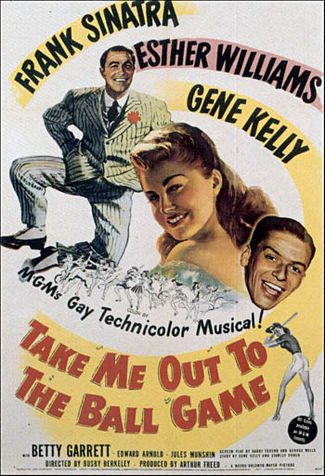
Viva Las Vegas (1964)

Viva_Las_Vegas_1964_PosterPreviously, whenever I thought of Elvis and films, my first inclination was to think musical and then secondly because, by some form of osmosis the culture had taught me this, Elvis went with Ann-Margret. In truth, they were astoundingly only ever in this one picture together but what a picture for them to be in. It left an indelible impact on both stars as much as it did their audience.
Sure, it’s at times utterly laughable, light, and saccharine with gaudy color schemes that make Las Vegas the flashiest spectacle known to man (which it might actually conceivably be), but there’s something still so winsome about it.

The story is one of those contrived Hollywood love stories that we know the rhythms of before they have begun.  Boy meets girl. Boy becomes infatuated with girl. Girl keeps him at arm’s length. Girl begins to fall for him. Girl gets turned off because of some trivial misunderstanding. In the end, girl gets boy or vice versa. Whichever you prefer because either way it still proves a formulaic picture.

But gosh darn it, Viva Las Vegas has a vibrant energy that probably makes every man, woman, and child wish they could go back to that era, especially all those rock ‘n rollers and beboppers who grew up with Elvis for breakfast, lunch, and dinner.

There’s no doubt that he had a magnetic charisma that went beyond a voice or a look but the very way he shimmies, snaps, and shakes his way into the heart of every gal. However, the real vivacity of the picture comes from the same kinetic friskiness that seems to charge through Ann-Margret as well. Because in most any given equation Elvis Presley is bar none going to be your dominating force commanding the screen as the indisputable Elvis the Pelvis, the King of Rock and Roll. But put him up against Ann-Margret and they tease and prod each other this way and that — the perfect romantic counterpoints.

It’s as if they both have a sense of the game that they are playing — the back and forth — the one-upmanship and playful toying that gives the story a hint of sensuality while still maintaining that squeaky clean sensibility allowing a picture like this to remain more charming than most films we are introduced to today.

And when it’s all said and done, aside from the title track which will undoubtedly be most familiar and exhilarating for audience members in its numerous refrains, there are quite a few truly dynamic sequences that go beyond tedious asides in a musical love story.

They reflect how Hollywood seemed to understand the collective power that musicals could have. Director George Sidney is not necessarily a noted name of great repute but if you look down the list of his directing catalog you see many a diverting musical (ie. Annie Get Your Gun, Kiss Me Kate, Bye Bye Birdie, and a whole slew of others).

With Viva Las Vegas it’s easy to acknowledge that he has a knack for the spectacle that remains light and amusing to the end including the notable Ray Charles tune “What’d I Say” played out on a giant roulette wheel, our leads making eyes at each other, surrounded by a crowd of fellow shimmy and shakers. But also the hip swinging, finger-snapping crowd pleaser “C’mon Everybody” that puts our stars on full display. They even end up making the smaller trifles like “The Lady Loves Me” and “If You Think I Don’t Need You” more than a complete drag.

To top it all off, far from being corny, the final Grand Prix sequence is actually quite marvelous as the cars speed through the desert past Hoover Dam and we see Lucky win out against his good-natured rival. The film truly does benefit from the on location shooting only topped by the breezy chemistry of its leads. More than The Rat Pack or Bond, this film gives me at least an iota of desire to visit Las Vegas. Although that might simply be the fact that Elvis and Ann-Margret, in particular, imbue the lifestyle with so much verve. Anyways there are no qualms in proclaiming, Viva Las Vegas!

3.5/5 Stars

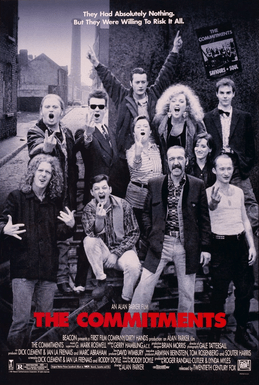
The Commitments (1991)

The_Commitments_posterThe Commitments is a very coarse film, extremely rough around the edges, and yet to its credit, the real appeal of this crowd-pleaser from Alan Curtis is the way that music is able to bring so much good into a dire situation. Because in some ways The Commitments are not just the christened “Saviors of Soul” but for one brief shining moment, they’re the “Saviors of Dublin” too.
It feels almost unfair to call The Commitments a cover band because although their debt is to soul and they cover soul tunes from the likes of the late great Wilson Pickett, from those tunes we begin to see the individuals coming into their own as together they create a sound that has the local crowds cheering in the bars and pool halls.

Their visionary leader is Jimmy Rabbitte a young man with ambitions to create a successful band that will play real music and in his humble opinion soul is where it’s at. Not the Beatles. Not the Stones. Not even U2. But the likes of “The Godfather of Soul” himself James Brown.

Far from being mere cultural appropriation, taking a very much African-American inspired music and imitating it, with The Commitments, their allegiance to soul seems to suggest mimicry is the highest form of flattery. And it seems like Jimmy as manager and the main ringleader sees this clearer than anyone else.

Soul represents something so simple and powerful and moving. A sound that speaks to the working class Dubliners in a way other strains of music simply cannot muster. So yes, Irish Soul sounds like an oxymoron but The Commitments prove that far from being incongruous, Irish Soul is capable of quite the following.

Part of the enjoyment is getting to know all the figures who play a part in the band’s journey and there are quite a few. Deco is the lead singer, a slobbish jerk who also has an impressive pair of pipes. Lead guitarist Outspan (Glen Hansard of Once fame) with other local lads filling in on saxophone, bass, and drums. The backing vocals are provided by a trio of gals including the fawned over beauty Imelda.

But the oldest member of the band Joey “The Lips” Fagan is a rather mythical figure with a laid back almost spiritual streak. It’s also no joke that he’s played trumpet with some of the biggest soul brothers out there. He too provides guidance to the band’s vision but sometimes he’s not as zen as he lets on. Getting so many different people together is bound to cause friction — namely shouting matches, fistfights, and more than a few hurt feelings. Strangely enough, these are some of the very places the story finds its comic inspirations. People constantly bickering and getting on each other’s nerves in this way or that.

Equally enjoyable are the actual rehearsals and jam sessions which in truth are the heart and soul of this film. No pun intended. The music is what matters in the community from street corner performances of Cathy’s Clown, a father belting out his best rendition of Elvis, and the most wholesome member of the Commitments, Steven, playing a rather soothing version of Whiter Side of Pale on a grand church organ. That’s the stuff that makes the movie buzz.

We see the energy that gets people to notice. Sure, it’s not the type of coverage that will make them into international sensations but with this film much like its progeny like Sing Street, you see the pure ability of music and song to enrich the world. They not only give the musicians a powerful avenue of expression and joy but those performances can evoke an equally gripping reaction from their audiences.

In the end, The Commitments as a group begin to split at the seams after a number of promising gigs, even a bit of cash for their efforts and a spot in the local paper. But in the end they implode and it’s probably for the best as everyone goes their separate ways. Maybe they never quite got around to jamming with Wilson Pickett, but they did play with him in spirit every time they put all their passion into one of his songs. It didn’t turn into some profound watershed moment in musical history, but like this film, it was a recurrently lively ride.

3.5/5 Stars

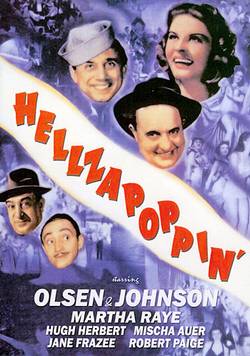
Hellzapoppin (1941)

Hellzapoppin_movie.jpgIt essentially begins with a fourth wall break. That’s all you need to know. Because that gives you exactly an idea of what you’re in for with Hellzapoppin’ or rather it gives you no idea whatsoever what you’re in for but really they’re one in the same. I’ve seen the movie and I still don’t quite know what it was.
If you wanted to put labels on it, I think it would be relatively safe to say that this is a comedy. In some small way, it transplants the feel if not the entire success of Ole Oleson and Chic Johnson’s Broadway hit of the same name. And Hellzapoppin’ was a big hit. It only makes sense that Hollywood would want to try and commoditize it.

But fearful of such a fearless anything goes endeavor the studio got cold feet and wanted some “substance” too. And not to be outdone the film’s two stars gave them a plot, ironically, about Ole and Chic finding a plot for the movie they’re in. So there you have it. Problem solved and everyone’s happy. The two nutcases go from an opening routine in hell with a steady barrage of gags to a mediocre plotline at a stately mansion still strung out with a line of gags and it wears its movie within a movie reality right on its sleeve, brazen enough to bring in its director and plucky screenwriter (none other than the always imposing Elisha Cook Jr.). So it’s as close to an “Anything Goes” musical as you can actually get. Yes, you heard that right. Cole Porter eat your heart out.

Anyhow, it’s a testament to the front half of the film, it’s so wonky and zany with wall to wall gags, non-sequiturs, and bits that by the film’s latter half it just cannot maintain that same frenetic pace. And how can you blame it? It does absolutely, insane, inane, and absurd things in the course of an hour or so.

To begin with, it’s barely functioning as a story or if it is a story only for the purposes of its fourth-wall breaks, sight gags, stupid puns, slapstick, and general stretching of all narrative conventions for the sake of some guffaws. But it also happens to be absolutely uproarious in nearly all the right ways — a sheer delight of pure nuttiness.

It’s a comedy disguised as a musical on top of a romance all wrapped up in a metanarrative that will make you scratch your head again and again. You’ll have no idea what you’re watching. You’ll question if the real-life director (not the one in the film) went through a midlife crisis, or if the scriptwriter (again, not the one in the film) was on something, or the projectionist (also not the one in the film played by Shemp Howard) accidentally spliced together multiple reels from different movies right before the film was sent for mass production.

As such, there are no comparisons to be made. Nothing comes close. Maybe Night at the Opera (1935) is the closest I can come– somehow matched with the fourth wall breaking of Rocky and Bullwinkle serials and the metaness of some of Community’s most self-aware episodes. Unfortunately, that’s the best I can do.

When you keep throwing mud up against a wall hoping it sticks comedically speaking, making funny faces, having random people walk in front of the camera, talking to people behind said camera, inserting a storyline to give the pretense of narrative, using every kind of prop imaginable, all while taking some allotted time for song and dance and random asides, this is what you get. Nothing more. Nothing less. That’s all I can say. Because there’s no possible way to even begin to describe what this is.  It’s Hellzapoppin. That’s what. Just watch it. Unless you’re Stinky Miller. Then, go home. Your mother’s calling you (wink, wink)…

3.5/5 Stars

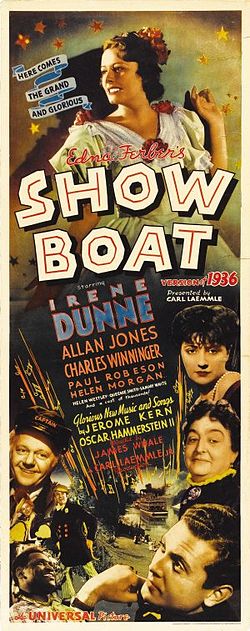
Show Boat (1936)

ShowboatposterMost of what I know about riverboats can be gleaned from Mark Twain, Davy Crockett and the River Pirates, and that ever beloved Snoopy incarnation The World Famous River Boat Gambler. The 1936 musical Show Boat falls into that very same rich tradition but some clarification is in order.

In truth, this is not the most remembered or even the first adaptation, for that matter, of the wildly popular stage hit of the 1920s. Those laurels go to the 1951 version starring Kathryn Grayson and Howard Keel and then the original partial-talkie released in 1927. But it’s easy to go out on a limb and reckon this is the best of the lot.

James Whale noted for such reputed monster movies as Frankenstein and The Invisible Man proves an equally compelling helmsman of musicals. Here his obvious attention to period authenticity is highlighted making the riverboat world of Missippi circa the 1880s incredibly atmospheric.

The story starts exactly where its title suggests with a Show Boat and the traveling crew of performers who turn up in every town to add a little gaiety and charm into every man, woman, and child’s life. The personable mastermind of it all Cap’n Andy Hawks promises big things to the general public who turn out in droves to get a chance on the entertainment.

But as is the case with any such narrative the true meat and potatoes is either on the stage with every song and dance or behind the curtains where people are living life and trying to get by the best they know how. Hawk’s wife is constantly nagging him and demanding that their daughter never become an actor. Instead, young Magnolia (Irene Dunne) is relegated to sit behind the piano.

Still, there is another plot thread with major implications on the contemporary constitution of race relations. I personally had no idea what was at the core of Edna Ferber’s Show Boat. I assumed it was only a musical perhaps bred in the rather sorry tradition of Gone with the Wind and other such pictures when it comes to depictions of African-Americans.

It’s true that there are some of those stereotypes present but this is a surprisingly forward-thinking narrative at first because at its core is miscegenation–in simpler terms the marriage of a white man with a woman of color. The two tragic lovers are actually depicted in a sensitive light while at the same time giving Magnolia her break with their sudden ignominious departure in the midst of the public scandal.

Still, in this small way,  it’s not unlike Ferber’s later work Giant in how it begins to dissect the hypocrisy in society. For his part, singing giant and future blacklist casualty Paul Robeson’s epic rendition of Old Man River is one of the true capstones of the film imbuing the story with even more meaning and power. For another minor instant, it seems like the point of view of the downtrodden and marginalized is, at the very least, being acknowledged and given a place of significance. as if to say even for a split second that there are dignity and worth there.

Of course, it loses all the credibility it could have in one regrettable stage number where the happy notes make the blackface feel even more abhorrent. Though I have no major qualms enjoying this movie on a whole, any discussion must come with a substantial caveat.

In its second half, Show Boat does admittedly succumb to some pacing problems hitting its peak early on and slowly dropping off from its frenzied and energetic openings to more wistful conclusions that are understandingly less diverting even purely from a tonal perspective. It seems to even acknowledge its own weaknesses by condensing decades for the sake of time and the audience’s attention span.

It all began with lively commotion, spirited passion, and young love. In the end, it settles for a sentimental reunion of two lovers torn apart by destitution and time itself. It’s a lovely feel-good conclusion but it’s not nearly as satisfying as it could have been if Show Boat had kept its steam from the starting gates.

Though this is far from being Irene Dunne’s greatest role, she still gives a winning performance that memorably showcases her vocal training opposite her romantic co-star the rich-toned tenor Allan Jones.  As a side note, she also exhibits the most unique churning dance you’ve seen rather like a caterpillar in a dress–only surpassed by Lauren Bacall’s shoulder shimmy in To Have and Have Not.

Still, Paul Robeson stands as one of the titans of this film. I hope he got the respect that he deserved for this role and if nothing else time seems to have honored him as “Old Man River” still remains one of the great musical numbers out there.

4/5 Stars

Review: A Hard Day’s Night (1964)

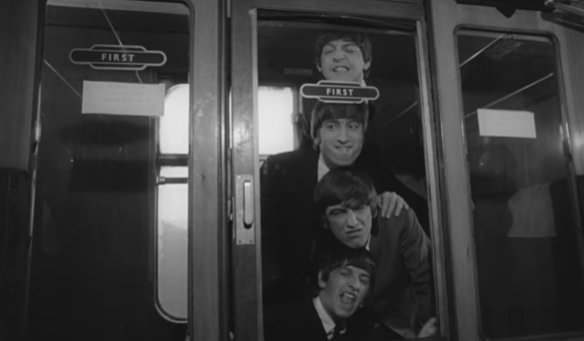
A Hard Day's Night 2.pngAre you a mod or a rocker? ~ reporter

Um, no, I’m a mocker ~ Ringo

As a 4 or 5-year-old, I didn’t know who the Marx Brothers were and no one had told me yet about Cinema Verite and what that meant. But I loved the Beatles. Also, I didn’t find out until years later that Richard Lester was an American director who caught the eyes of the Fab Four and predicted the MTV age with its frenetic editing style. But if you actually watch A Hard Days Night with the eyes of an unabashed fan — like I was as a boy — none of that matters. So let’s leave that on the drawing room floor and look at what makes this film pop with vitality all these years later.

Any conversation must begin with the music. The film bursts onto the screen with the iconic riff of A Hard Day’s Night as the Beatles scramble down a street corner fleeing frantically from a screaming mob of fans. It perfectly encapsulates this rash of Beatlemania that was exploding onto the world stage and making its way across the pond.

And what the film does so well is create this fun aura around the four lads from Liverpool. There silly, fun, a bit cheeky too but there’s something so endearing about them still. It struck me this time around that these are four men are hardly over 20 years of age and yet they had fame and stardom thrust upon them. And they are superstars but they don’t act quite like superstars.

A Hard Day's Night.png

The filming style and handheld camera work lend themselves not only to Lester’s frantic style but there’s also an indication that this is a day in the life type of musical comedy (no pun intended). It’s the perfect combination of quotable one-liners and zingers paired with a certain British humor (I now declare this bridge open!) and some of the early classics from the Beatles canon (Can’t Buy Me Love, She Loves You, etc).

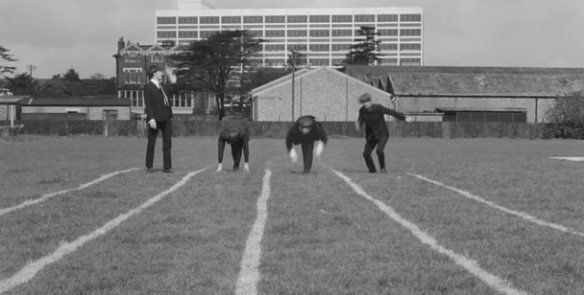
Paul’s Grandfather (Wilfrid Brambell) is very clean but that’s only a veneer for a searing personality that looks to manipulate others and stir up trouble. On Paul’s own account he’s a real mixer.  Norm is their road manager and general killjoy while Shake is his gangly hapless sidekick good for a few laughs of his own.  If you want a “plot” in the conventional sense you probably won’t get it but it’s enough to watch the boys run out on their obligations by sneaking off to dance parties or abandoned fields to do their own renditions of Monty Pythons silly Olympics.

A Hard Day's Night 3.png

We watch them in their idle moments as John messes around in the tub and George exhibits his shaving prowess on Shake’s mirror image.In another moment George takes a wrong turn and finds himself in some new age advertising agency where he unwittingly tears their campaign to shreds by calling their merchandise “grotty.” Meanwhile, the boys are herded from press junkets to tapings, from makeup to answering fan mail (a train and a room and a car and a room and a room and a room). That’s about their life at this stage.

It’s odd to think that the name The Beatles is never spoken in the film. It just is. It’s part of the world consciousness. It brings to mind a chance encounter John has with a woman who while she doesn’t utter his name notes his striking resemblance to one of the boys. In the end, she’s mistaken and he walks away muttering that she looks more like “him” than I do. So A Hard Days Night is a film that while boasting great music and wonderful comic mayhem still is a slight commentary on the Beatles stardom.

They have become beholden to their rigid tour schedule. Prisoners in a sense. But they still find time for personal expression and a bit of playful rebellion despite those very restraints. Of course, the backbone of this comic-laden rock musical is the pinnacle of their artistic expression — their music. By now all these songs are like old friends to me that it hardly seems necessary to list them off one by one. You just have to hear them.

In the final moments before their climactic show, Grandad stirs up Ringo to go out and live a little and so the boys must track him down before time runs out. What follows is an inane ruckus involving the majority of the local bobby population. But all four make it back and put on a lively showing for their adolescent admirers screaming their heads off the entire set.

As quick as they arrived they get whisked off by a helicopter to their next destination ready to rock another day. I’m not sure if this is based on the film or my own wishful dreaming, but I like to think that they’re heading across the ocean blue as the flagship of the British Invasion. When you watch this film it all comes into clearer focus what all the hoopla was about. They had a genuine charisma, a certain presence, and their music speaks for itself after all these years. Still sincere, catchy, and enduring even in its pure simplicity. Billions of screaming girls can’t all be wrong.

5/5 Stars

La La Land (2016)

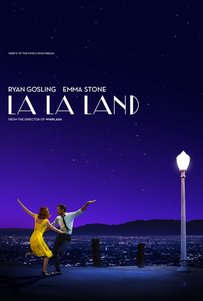
La_La_Land_Poster.jpgAfter watching this film two things become astoundingly obvious. Damien Chazelle has an equally unquenchable passion for film and for jazz. He’s also extremely bold, going all the way when it comes to choices as a director with everything from camera set-ups, lighting, staging, even casting. In fact, let’s start right there.

Emma Stone and Ryan Gosling do not initially pop as performers. They’re not song and dance entertainers equal to the likes of Astaire & Rogers or Gene Kelly or Judy Garland. There’s no contest. But the brilliance of this decision is the very fact that these two beloved stars are one of the few remnants of the bygone Hollywood era where romantic stars were paired up together for more than one movie. Bogey & Bacall, Tracy & Hepburn, Loy & Powell, yes even Fred & Ginger.

And in a generation that’s often lacking that kind of history, Emma Stone and Ryan Gosling still have a bit of that cinematic romance tying them together not just in one film but in multiple allowing the audience an even greater connection with them.

It makes the musical thoroughly modern and yet most certainly takes cues from the past and the rich tradition that it was born out of. The film’s knockout opening sequence is a far grander more audacious riff off of The Young Girls of Rochefort’ while the film’s ending reflects Chazelle’s deep affection for Umbrellas of Cherbourg wedded with the fantasy scapes of An American in Paris.

But sandwiched in between those obvious touchstones is a film that’s at moments mesmerizing, beautiful, and engaging on its own merits. Chazelle’s sheer boldness behind the camera is thoroughly impressive because he commits to telling his story in the most extraordinary way possible. It dares to dream, succumbing to the glories of the movie musical, taking risks that generally pay off in a big way. Like Jacque Demy he plants his film in the real world, in this case, contemporary Los Angeles, but he also stylizes it through elements such as production design, color, and lighting.

Beginning with the extended artistry of the initial traffic number, cinematographer Linus Sandgren’s camera is about as fluid as they come, even overtly so, bringing such attention to itself that in many respects it becomes another figure, shaping how we view every one of these environments. Its conspicuous ways generally help to turn dance sequences and musical numbers into dynamic spectacles but there are individual moments where we might still question if a more static perspective is in order.

Still, it’s easy enough to disregard this as the camera is constantly casting its gaze on the world painted with the vibrant tones that brighten Los Angeles and allow it to enter a stylized awe-evoking state of eye-popping energy. Likewise, the storyline mixes and matches real-life locales with the artistic and the magical. It succeeds in becoming a diverse patchwork of lights and staging that sets the tone for every moment our stars are on the screen as everything from the backdrops to the very clothing that the actors wear is an extension of their current state.

Emma Stone is a real winner, genuinely hilarious and cute while still being overwhelmingly compelling as she struggles through her acting career balancing her “real job” as a barista with her true aspirations as an actress. And to his credit, although I wasn’t all that sure about Ryan Gosling in this film, with Stone by his side somehow it works rather magically superseding any other objection we might have about his performance. Like Astaire & Rogers, the song and dance routines become the galvanizing moments in the film as they should be. True, they hardly have the same caliber but their chemistry is what it holds it all together.

The minor influences of The Band Wagon can also be seen when they dance together in the night air overlooking Los Angeles. Meanwhile there gravity-defying routine at Griffith Observatory leaves behind simple references to Rebel Without a Cause and becomes its own spectacle entirely.

In all the other nooks and crannies you see the affection for film. The Killers poster on the wall, Ingrid Bergman’s face plastered up in the bedroom, and movie nights watching Bringing up Baby and Notorious with Grandma. But that’s only matched by the infatuation with jazz that similarly surges through the narrative. In this case, Sebastian is the vehicle for this passion. As far as criticisms the only one that I have heard voiced and I too can call into question is the very fact that a Caucasian male wants to resurrect jazz in its purest sense.

If nothing else it’s highly ironic because tradition says that this is an African-American art founded in those roots. That’s not to say that others cannot take the mantle necessarily but in some ways, Sebastian seems to think that people like Keith (John Legend) have sold out on their culture. I suppose that issue is still up for debate long after the credits roll.

Although “City of Stars” might be the most noted number developed by Justin Hurtwitz and Chazelle for this film, I must admit my personal favorite had to be “Audition” because Emma Stone delivers the song with such an earnestness that it’s mesmerizing to watch as all else disappears and we are left to watch her sing in empty space. Perhaps the film is often lacking the minimalistic moments and the juxtaposition of a scene such as this becomes especially striking. It’s so simple.

The final question to be asked is, what is La La Land or closer yet, what is Chazelle trying to say about fame and pursuing your dreams? Because in the end, it feels like a mixed message. The film is constantly a seesaw back and forth of following your passion, versus just making ends meet, to selling out or turning to alternative paths entirely. And when it’s all said and done and the movie has wrapped up we don’t know quite what we think.

We leave both characters in a place where they are undoubtedly better off than we found them in some respects. Still, there’s a wistfulness that hangs in the air, a bittersweet quality that lingers a moment longer and that gives La La Land a certain power that feels more complex than a simple musical fairy tale. That is yet another thing Chazelle borrows from Demy that works so well.

In some ways, it’s a very “un-Hollywood” ending and though the film does spend a lot of its time infatuated with that very industry, that doesn’t mean it can’t still be conflicted in the same breath.  In fact, that’s probably the most honest conclusion it could have arrived at. Dreams are good, the world can be a magical place if we let it be, but that does not mean for one instant that we will not be met with heartbreak or difficulties along the way.

I found myself unconsciously asking myself, What does the title La La Land even mean? I had not fully considered the implications of the phrase. Yes, it’s having your heads in the clouds, maybe even existing in an ethereal world of fanciful dreamscapes as much as it is a moniker for those who live the Hollywood lifestyle.  And it’s in both these places where the film dwells. Partially in the magical realms of dreams but also in those extremely human moments of confusion and failure. That is La La Land in a nutshell.

4.5/5 Stars

Gentlemen Prefer Blondes (1953)

Gentlemen_Prefer_Blondes_(1953)_film_poster“I can be smart when it’s important, but most men don’t like it.” ~ Marilyn Monroe as Lorelei

Marilyn Monroe and Jane Russell together. It’s a crackerjack combination and Howard Hawks milks it for all its worth. There’s streetwise Dorothy  (Jane Russell) wooing all the boys from here to kingdom come. She cares about more than just money, especially when it entails having fun. Her other half is the vivacious bubble-headed beauty Lorelei like only Monroe could pull off. She’s the girl looking to get hitched with her bookish millionaire and she’s not afraid to admit that his money sweetens the pot. It certainly doesn’t hurt (Don’t you know that a rich man is like a pretty girl? You don’t marry her just because she’s pretty. But, my goodness, doesn’t it help?).

Time and time again words and bits of dialogue leave her lips that are almost astonishing. She delivers them with such a fluid air of seriousness that they force a double take and each and every time she has the audience in the palm of her hand. We think she’s dumb, but whether it’s the just the persona she puts on or a bit of Marilyn Monroe herself, she is extremely intelligent. If nothing else she knows how to captivate an audience, not letting them soon forget her magnetic performance.

If she had been playing against anything else Jane Russell would have been the primary attraction and she’s always wry and lovely, but with Monroe in the equation, they develop into a dynamic duo, leaving a wake of hapless boys behind them. There’s the old playboy Piggy (Charles Coburn) with a tiara Lorelei has ambitions for, the hired private investigator Ernie Malone (Elliot Reid) who finds himself falling for Dorothy, the diminutive Mr. Spofford and, of course, the hapless Gus (Tommy Noonan).

It can be easy to write Gentlemen Prefer Blondes off as a superficial musical — a provocative color extravaganza aboard an ocean liner. After all, it’s a story complete with pools, water slides, romance and a whole squad of athletes with bulging biceps. But it is a genuinely enjoyable film with Howard Hawks once more showing his aptitude for skirting between genres, this case indulging in musical comedy.

The sparkling and most remembered number is, of course, Monroe’s sultry turn in “Diamonds are a Girl’s Best Friend,” clothed in velvety pink,  but really for the entire running time of the film, Monroe and her costar are continually strutting and snapping their way into the hearts of everyone they cross paths with. A final comedic twist of an ending, playing off the comedic dynamic of the film’s pair of heroines, gives Jane Russell an equal chance to show off her star power. This truly is a team effort, even if gentlemen circa the 1950s were discriminatory towards all non-blondes.  Obviously, this film and my commentary are not meant to be taken too seriously. Still, they can be enjoyable. At least in the case of this film. My commentary, not so much.

3.5/5 Stars

Love Me Tonight (1932)

lovemeto1This is unequivocally the age of sound! That’s what this film proclaims from the rooftops with its symphony of syncopation as the world of Paris awakens from its slumber. Its opening rhythms are pure ingenuity and the glorious unfoldings never cease for the rest of the cheery production.

In its efforts to tip a hat to Lubitsch, Rouben Mamoulian’s film manages to eclipse him or rather make a name for itself completely removed from the previous Maurice Chevalier musicals. In fact, Love Me Tonight feels like the obvious precursor to later classics like An American in Paris and the works of Jacques Demy. Whereas Lubitsch’s films almost always function as a comedy and social commentary, Love Me Tonight is first and foremost a musical and it rides on its melodies even while simultaneously driving forward its plot line.

When our humble but nevertheless jovial tailor winds up chasing after one of his notorious spendthrift customers to his relative’s aristocratic residence, things are in motion. Maurice is certainly out of his element, but his charm wins him many an admirer in the household including the Duke (C. Aubrey Smith) and his man-hungry niece (Myrna Loy). In fact, there are only two people who seem wary of this new arrival, the Duke’s skeptical daughter, Princess Jeanette (Jeanette MacDonald) and her feeble suitor.

Everybody else persuades The Baron — as he is called — to stay because his is such a magnetic and disarming personality. Of course, when the real news about him gets out following an incriminating wager for his honor, it dooms his romance. But every story needs a final epiphany of realization and, in this case, Princess Jeanette comes to her senses. She throws the utter absurdity of family rank and status out the window.

True, this is a love story, but while that could be the focal point there are wonderful sequences that fill all the nooks and crannies. Fine gentlemen walking around a tailor’s shop without their pants on or a trio of aunts who come right out of the pages of Hamlet. As a Pre-Code film, it certainly has a few risque moments including a Doctor’s visit and one or two mentions of a nymphomaniac — all played for comedic effect of course.

Meanwhile, tunes like “How are you?” and “Isn’t it Romantic” literally takes the country by storm manifesting themselves in all forms imaginable. “Mimi” is a particularly saucy number that pays homage to our main female heroine and it’s opening refrains boast some wonderful point of view shots of our fated lovers. Love Me Tonight winds up being an operetta of repeatedly and ingeniously inventive rhyme and melody all the way through. It also has brilliant sound design from head to toe.

Maurice Chevalier is as charming as ever, still melding his song with a magnetism that flows right into his role, ironically enough, as a character named Maurice. Although Myrna Loy might have become a bigger name arguably, this is Jeanette MacDonald’s film and she plays her part with the necessary aloofness that nevertheless gives way to amorousness. By the end, we like them both and we can’t help but be won over by their songs. For being lesser known on the generally accepted spectrum of classic musicals, this one is a gem.

4.5/5 Stars

Sing Street (2016)

Sing_Street_posterA famed philosopher of the MTV age once sang “video killed the radio star,” and John Carney’s Sing Street is a tribute to that unequivocal truth. Certainly, it’s what some might call a return to form for the director, landing closer to his previous work in Once, and staging the way for some wonderfully organic musical numbers set against the backdrop of Dublin circa 1985. In this respect, it’s another highly personal entry, and Carney does well to grab hold of the coming-of-age narrative.

Our main point of interest is Conor, a lad thrown into a new school of hellish proportions and of course, there’s a girl, and he wants to get to know said girl. What follows soon thereafter is the inception of an entire band, the eponymous Sing Street. So in essence, the band forms so he can get the girl. It’s that simple and it works…sort of.

By all accounts, she’s an untouchable goddess, a year older than him, with a mature boyfriend and aspirations of modeling in England. And yet Raphina deigns to stoop to their level and take part in their first foray into music video-making. It’s in such moments that the film unabashedly hoists up its 80s sensibilities, suggesting Carney’s own personal affection for that day and age. Because amidst all the god-awful make-up, outrageous costumes and mimicry of the new wave scene, there’s a sense of amusement. Since every boy, at one time or another, has gone through these different phases and stages, like a sponge soaking up all conceivable inspirations. In this case, Conor’s older brother Brendan becomes his pontificating Buddha of rock n’ roll. His influences run the gamut from Duran Duran to the Cure and most definitely a little David Bowie.

But his band also develops into a wonderfully liberating beast to combat the furies of the world. Conor is consumed by grand dreams of Back to the Future themed prom nights at an American-style high school. Meanwhile, his parents are continually squabbling at home and his dream girl leaves for London without a word of goodbye. But he uses his newfound outlet paired with the guidance of his brother to turn his stray thoughts and accumulating angst into something of true substance. Namely, Conor and the versatile Eamon, have a bit of a Lennon-McCartney partnership going, as far as creative genius goes, proceeding to run with each spark of an idea that strikes. In fact, with all the boys, there’s a matter-of-fact gravity to it all, because forming a band is a serious business — it’s a concerted effort not to succumb to the grisly fate of yet another gutted cover band.

Like any formative tale about young men and women, Sing Street suggests the vital importance of personal identity and chasing after dreams in particular. You see it with Conor as he constantly dons new facades, not simply in a search for greater artistic expression, but personal freedom.

But where he breaks with his big brother, is what he actually does with the inspiration that has been passed down to him from the rock gods. He uses its whole potential as a gateway to the way of life that he desires — making the most of the opportunities that are afforded him — even if they are a long shot. As the movie progresses Raphina looks younger and younger, and it hardly seems by accident. Over time, she sheds layer after layer of makeup and manicuring to reveal a bit more of herself, until the tipping point where all her dreams come cascading down, and she has nowhere to hide. In fact, in these more fragile moments, Lucy Boynton is reminiscent of a young Felicity Jones.

Admittedly “Sing Street” has a ludicrous ending and there are moments that it tilts towards the plastic production values of  “Begin Again” rather than the sincerity of Once, but that’s a lot of what the 80s feels like. It’s fake. It’s this construction projected up on a screen. And that’s precisely what this film is saluting and celebrating, but that’s only the half of it. Raphina rightfully points out you can never do art half way. That’s what rock n’ roll is in a sense. It’s audacious exploration, risk-taking and a bit of foolishness in the name of chasing your dreams, usually involving a girl. Thus, the film is not wholly original, even for Carney, who has drawn from the same well three times over, but like any artist, he’s able to discover fresh inspiration from old cisterns. After all, every member of humanity is in one way another a broken work of art, beautifully complicated, and that’s worth returning to again and again.

4/5 Stars

Review: Nashville (1975)

nashville3What to say about Robert Altman’s Nashville? It has a lot of songs and music so it’s technically a musical. It has its smattering politics and Altman is typically one for subverting the norm so you could call it a satire. There’s romance, drama, in-fighting, and star power certainly, but that hardly gets to the heart of the film.

In fact, Nashville has an ensemble bulging at the seams with 24 individuals billed in alphabetical order and their names called out at the beginning of the film as if someone is trying to sell us an album. It’s a little over the top, feels superficial, and it’s a little pretentious. Maybe the director’s trying to tell us something. Over the course of the following minutes, Altman gives us a picture of a few days in the life of the country music capital of the world, and he shows us all sorts of people.

nashville1To name all of them would be tedious and would not give a whole lot of illumination as far as the plotting, but a few of the more prominent names are as follows: Barbara Jean, the sweetheart of Nashville, who opens the film receiving a warm welcome at the airport from her adoring public. But she is physically and emotionally fragile after recovering from a traumatic injury. Then there’s Haven Hamilton, who is an established country star, who still enjoys large popularity and political ambitions are on his radar. Jeff Goldblum, Lily Tomlin, Karen Black, Ned Beatty, and even Keenan Wynn all make appearances. So as you can see the cast is oozing through the cracks.

Their stories are constantly colliding, intertwining, and weaving in and out of each other. Making for a type of narrative that feels organic despite having a script. It feels like a realistic and truthful immersion into Tennessee reality. We even get appearances from a couple Altman regulars Elliot Gould and Julie Christie. Furthermore, it wasn’t much of a secret that the industry in Nashville did not take a liking to the film, but really is that any surprise?

Going into the film we already expect to get a look at the industry’s underbelly and we do, but it’s hardly seems sensationalized; it almost feels commonplace until the final moments. Singers griping, sleeping around, reporters ingratiating themselves to whoever they can find, and the general public coming from far and wide to be a part of the spectacle. It’s about what you expect from an industry that can be ruthless, superficial, and very rewarding to some. To those on the outside, it’s something to be fawned over.

nashville2The story is framed with the political campaign of the unconventional Hal Philip Walker of the Replacement Party. You can see his van going all across town proclaiming his wisdom to the honest citizens of Nashville. Most of them could care less about politics. Even in the closing moments at a concert in the park with a big flag patriotically displayed on stage with a giant campaign banner underneath, you get the sense that no one has gone there for political reasons. They want to hear Barbara Jean, Haven Hamilton, and maybe tolerate anyone else who comes up on stage. In a sense, that’s the American way wrapped up in a nutshell.  Taken in that light, the way that Altman ends his film is not all that surprising. There has to be something to break up the normalcy. Subvert all that is good and patriotic. Throw a wrench in the every day, because after all his whole film has revealed everything that besmirches the industry. It’s just that it usually stays under the surface or is thrown away to be trampled on or forgotten. Take the no-talent Sueleen Gay, who stubbornly tries to make it in an industry that doesn’t want her.

I’m the first to acknowledge that I’m not much of a fan of country, except if it’s someone like Johnny Cash. So overall I find the tunes of Nashville to be homely and often tiresome, although I do appreciate the fact the actors wrote most of their own songs supposedly. The one exception I cite is Keith Carradine’s memorable tune “I’m Easy” which works as a simple ballad reminiscent of a Jim Croce-type singer-songwriter.

However, I don’t get hung up on Nashville‘s music too much, because this film represents so much more to me. It’s about the intermingling of people and the analysis and dissection of the relationships that are so closely entwined with the country music industry. Whether it’s the insiders or the fans who make them big, Nashville is a thoroughly interesting view of America circa 1975. Some things have certainly changed, fashion-related and otherwise, but I think we can all agree that a lot of things certainly have not. Politics, music, and most certainly people essentially exist as they always have.

4.5/5 Stars