The Young Girls of Rochefort (1967)

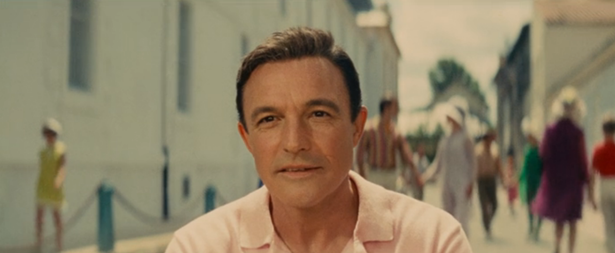
rochefort1If the Umbrellas of Cherbourg is a piercing operatic drama, The Young Girls of Rochefort is pure, unadulterated escapism at its finest. 

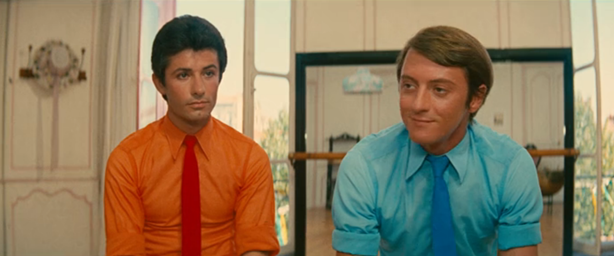
Directed by Jacques Demy and starring an ensemble cast including Catherine Deneuve, Francois Dorleac, Gene Kelly, Michel Piccoli, George Chakiris, Grover Paul, and Danielle Darrieux, this is a whimsical French musical that has no equal. 

rochefort9

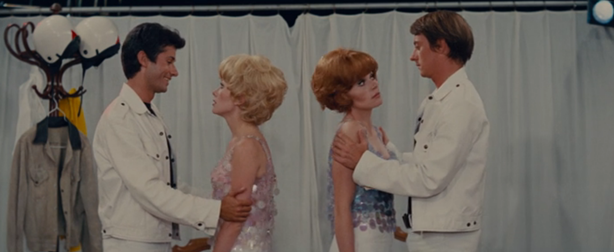
The film opens with a group of performers coming into the town of Rochefort to get ready for a big outdoor show. They become acquainted with the local hangout that includes a kindly matron (Darrieux) and many locals including an idealistic artist and sailor who is searching for his ideal lover. Nearby her two adult twin daughters hold piano and ballet lessons as they too get their little prodigies ready for the big show. Delphine (Deneuve) is fed up with her suitor and desires a new love, while Solange (Dorleac) on her part hopes to advance her career as a pianist. She goes to the proprietor of a local music store to see if he can introduce her to a prestigious American Friend.

A great deal of dramatic irony sets in and the plot is constantly moved forward through song. Yvonne at the café is still depressed over a split with a lover 10 years prior, because he had an unfortunate name. Solange has a chance encounter while stopping to pick up her kid brother Booboo, and Delphine becomes curious about an artist who painted a portrait that looks strikingly like her. All of these events reach their apex on the Sunday of the big performance, and in need of some performer, the carnies enlist the help of the twins. They are a huge success and things wind down.

rochefort4

The next morning the performers get ready to leave for Paris and the girls decide to follow suit. However, Solange has another encounter that changes her plans and then Yvonne is united with her love. That leaves only Delphine to go with the boys to Paris, but not to worry, she would be united with her painter soon enough.

The light and very French-sounding tunes are hard not to like, but that is only the very beginning. Demy pays homage to Hollywood musicals of old going so far as casting Gene Kelly (Singin’ in the Rain) and George Chakiris (West Side Story) in his film. He undoubtedly owes a debt to Vincente Minnelli and Stanley Donen with some striking moments reminiscent of An American in Paris (1951). It makes sense. Demy uses the pastels and costumes of a Hollywood musical extravaganza while also including dashes of French style.

rochefort2

Rochefort takes place in a real location, but it truly is a fantasy world that the characters inhabit, full of perpetual dancing and dialogue that is delivered through song. The real-life sisters do a wonderful job in this film and there is something reassuring about seeing Gene Kelly. Rather like an old friend who gives comfort in a whimsical, but altogether new experience. The story arc of dashed, renewed, and ultimately newfound love allows Demy to once more explore the issues of fate and chance that always seem to enchant him.  His partnership with Michel Legrand is once again bountiful including the enduringly memorable “Chanson Des Jumelles,” an infectiously bouncy, trumpet-laden number performed by the sisters.

There’s nothing much else for me to say except The Young Girls of Rochefort is one of those underappreciated gems that is thoroughly enjoyable and chock full of all sorts of fun. It delivers a serving of something with a familiar flavor while giving it a little extra panache. It’s about as playful and fluffy as you can get which in this case is not a bad thing at all. 

4.5/5 Stars

Love & Mercy (2015)

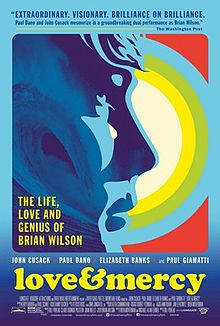
Love_&_Mercy_(poster)It’s a tough one. How do you do justice and even begin to scratch the surface of a living legend like Brian Wilson? His songs have brought joy to countless millions and numerous generations of music lovers. And yet out of all the joy he gave people, his life was steeped in so much pain and suffering. If anything became all too clear, it was the harsh reality of his life back then, but thankfully not now. At first, I didn’t understand the significance of the title (It’s the lead track of one of his albums back in 1988), but the words it hoists up are so perfect in describing his character.

I must say that I was a little skeptical of two actors playing Wilson. For those who don’t know, Paul Dano plays a young Wilson in the ’60s during his creative peak and familial turmoil. Then John Cusack picks his portrayal up in the ’80s when a messed up Wilson is being controlled by his quack psychiatrist Eugene Landi. They seem like two starkly different touch points, displaying two very different actors. Again, how could a director, in this case, Bill Pohlad, find cohesion out of this narrative chaos? But it works and ironically, that’s exactly what Brian Wilson did in his lifetime. That’s why he was such a mastermind.

As a young man his father abused him — hounded him to death. He suffered panic attacks, stopped touring, and embarked on some of the greatest musical odysseys anyone could ever hope to imagine.  We are thrown headlong into his genius during the Pet Sounds and Smile sessions. It might be a reenactment, but it feels like I am watching an artist at work. He’s on a different level, and it makes me appreciate each one of his songs even more. On a side note, I recently saw the documentary The Wrecking Crew, about the famed group of session musicians. And while they brought the skill in their craft, Wilson did truly bring artistic genius that was unique to him. That’s what, in many ways, caused a rift between him and his bandmate cousin Mike Love.

We are tossed back and forth from earlier past to later past as Wilson meets cars saleswoman Melinda Ledbetter (Elizabeth Banks) and embarks on a new journey as the manipulative Landi continues to drag him deeper and deeper into hell. In fact, sometimes it’s hard to imagine that this is the same Wilson and that is helped by Cusack’s performance. He is jumpy, helpless, muted, almost in a haze. But in him, you can see there is an immense vulnerability and capacity for love. That’s what Melinda sees as the layers get peeled back and that’s why it tears her apart seeing Brian suffer so.

As it turns out, Brian Wilson’s mind is not only a place of musical creation, but of fear, pain, and confusion. He was stuck between an antagonistic father and Landi’s manipulating presence. Whether it was the abuse, the drugs, the hallucinations, or a little bit of each, his story is one with a happy ending, and the film plays out that way. Isn’t it fitting that his immortal tune “Wouldn’t It Be Nice” closes the gates on this chapter of his story? It certainly is not over, still going, forever hopeful, and continuing to soar ever higher on a wave of positivity.

His genius astounds and now his resilience amazes me. He finally has found the Love & Mercy he deserved. Thank you Brian Wilson for gifting us such immortal tunes.

4/5 Stars

Seven Brides for Seven Brothers (1954)

Seven_brides_seven_brothersThe title gives a clear indication of what this Stanley Donen musical will be about, but it does not tell us how we will arrive at that conclusion. It all begins when a woodsman named Adam (Howard Keel) comes to town intent on finding himself a cute and handy bride. That he does in Milly (Jane Powell) and soon enough, in a whirlwind, they are married and heading back to his home. There she is greatly surprised to meet his rambunctious and rough-edged younger brothers. Six to be exact, but you already guessed that.

Once she accepts her new life, it becomes Milly’s mission to straighten them out and find them girls to court. It isn’t easy but soon they learn table manners and proper etiquette before the big barn raising takes place. There the boys make quite the impression and the audience is given quite the show complete with bright colors and inventive-foot-tapping choreography. It’s an understatement to say that the Pontipee brothers are not popular with the locals, and not only is there a barn-raising but some hell-raising as well.

Adam is proud of their showing, but the rest of the lads are lovesick as the long cold winter begins, separating them indefinitely from their girls. With Adam’s encouragement, they decide to do as the Romans and kidnap their sweets, but they fail to think about the consequences. The town’s in an uproar, the girls are frightened, and a man-made avalanche means there is no contact with the outside world for at least 5 months!

Milly is appalled by their actions, especially Adam’s part, and the lads are made to sleep in the barn as she dotes over the scared group of girls. Not liking what he’s seeing, Adam heads off on his own for a while. Spring brings a fresh start as young love flourishes and the boys are forgiven. Milly gives birth to a baby girl, and Adam finally returns home with a new perspective. But what about the town folk you ask? They do come after the  Pontipees, and they don’t like what they see when they ride in. Needless to say, it is a happy ending with each boy getting his girl, thanks to a few shotguns.

With catchy songs, beautiful color cinematography, lively dance numbers, and an amusing premise, this is a very strong MGM musical, even if it is not the best of the lot. That is not saying much because the studio could hardly go wrong with such previous titles as On the Town, An American in Paris, Singin’ in the Rain and The Band Wagon. Seven Brides is a nice addition although I will say it vaguely reminded me of Oklahoma. However, it is different enough to be well worth it. The only question left to ask is, “Are Adam, Benjamin, Caleb, Daniel, “Frank,” and Gideon natural red-heads? I’m not sure I know the answer but I could wager a guess.

4/5 Stars

The Umbrellas of Cherbourg (1964)

umbrellas1 It is hard to remember a time when I was so devastatingly sad due to a film, and it does not leave a deep hurt but a more wistful despondency that is far more real. However, that’s enough misery for the time being. Directed by Jacques Demy and starring an exquisitely young Catherine Deneuve, this cinematic opera is a moving musical piece that looks to be conventional and turns out to be quite the opposite. 

The story begins in November of 1957 with a young mechanic named Guy (Nino Castelnuovo) who is deeply in love with the beautiful 16-year-old Genevieve (Deneuve). Guy cares a great deal for his godmother Elise who has a caregiver to look after her. Genevieve helps out her mother in running a small umbrellas shop in Cherbourg which allows them to scrape by. They must sell some family heirlooms to a kindly jeweler who is smitten with Genevieve. However, Genevieve and Guy have plans of marriage until Guy learns suddenly that he has been drafted for the war in Algeria. They spend their last hours together, and she vows to wait for his return. 

umbrellas7In the following months, it becomes evident that Genevieve is pregnant, but her mother tells her that Guy has probably forgotten her already. The jeweler, Roland Cassard (Marc Michel), professes his love for Genevieve and agrees to adopt her unborn child. Thus, partially on the urging of her mother Genevieve accepts his proposal and they are soon married leaving Cherbourg for good. 

Finally, Guy returns from the war and things have changed. He now has a limp and is fed up with his old work at the garage. Furthermore, the Umbrellas shop is sold and Genevieve is wed and gone. Adding insult to injury his godmother soon passes away. With no one else to turn to, he looks to the caretaker Madeleine, and he realizes her love for him. They get married and he turns his life around with her help. 

The years pass, and now during Christmas of 1963, a car pulls into Guy’s new gas station. After many years, the two former lovers come face to face once more. Now they have marriages and children, and their interactions are painfully aloof. They have moved on with their lives and they have moved on from their passionate romance. 

umbrellas13True, their lives have become sensible, but in this opera that Demy has constructed, this conclusion is sad and bittersweet. And yet if this were the only painful moment that would be one thing, but there are so many that touch the heart and move the viewer. When Guy goes off to the army and takes off on the train we can feel the great weight of anguish. More often than not, you can read the sadness on the face of these characters which complement the beautiful ballads they utter. In other words, it’s one thing to recount the plot and quite another to watch the events unfold.

I have to say that I had never seen a film that played out entirely through song, and even in the opening sequence, Demy consciously melds the diverse forms of film and opera. Umbrellas has the vibrancy and color of movies and takes the dramatic story line and songs of opera, to create a unique piece of musical artistry complete with acts and all. Its colors are bright and vibrant–utterly distinct in their composition. Everything from the bikes to the umbrellas and even back alleyways are beautiful. Although there are many magnificent melodies, rather surprisingly there is not one specific song that stands out (Well, maybe the theme), but instead, it plays rather like one continuous song with different sections and overtures that complement while not overshadowing each other.

umbrellas4Demy’s earlier film Lola also gives an interesting insight into the character of Roland Cassard who once again becomes acquainted with a mother and her daughter in a shop. This time around he has accomplished his dream of traveling the world as a diamond merchant, however, Lola is still heavy on his heart. Another thing that is remarkable about the film is the weather which in many ways plays as another character. The varying degrees of rain and snow dictate the mood and shift with the changing seasons. There’s no doubt that Jacques Demy and his collaborator Michel Legrand created something special here that elevates the musical to a heartfelt tragedy of romance. That’s something many men would not be brave enough to do. 

4.5/5 Stars

Cover Girl (1944)

5fff5-covergirlmpRusty Parker (Rita Hayworth) is a chorus girl at Danny McGuire’s place (Gene Kelly), however she has the chance of a lifetime to be the cover girl of a major magazine. She is going places with a rich suitor who wants to hire her and then propose marriage. Rusty neglects her old job and it leaves Danny dejected and angry. He knows that Rusty has a great future in front of her but he cannot stand to break up their team that includes their mutual friend Genius (Phil Silvers). At first Rusty does not understand her true feelings and rashly decides to get married. However, much like her grandmother before her, Rusty realizes in the nick of time how she feels.

This Technicolor film has one or two decent numbers and I was surprised how nimble Phil Silvers is on his toes. He dances well with Kelly and Hayworth. As always Eve Arden is as humorous as ever and Gene Kelly used his artistic control fairly well.

3.5/5 Stars

White Christmas (1954)

58e88-white_chrismas_filmMany times I feel like a broken record (this time playing a Christmas tune), but White Christmas is one of those classics that I never get tired of. It is so ingrained, so integral to my childhood memories, that I have difficulty analyzing it or finding fault.

Wonderful, visceral films stop being something that must be thought about and simply become an all out experience. That’s what White Christmas is for me. A full blown Christmas experience courtesy of Bing Crosby, Danny Kaye, Rosemary Clooney Vera-Ellen, Dean Jagger, director Michael Curtiz and of course Irving Berlin.

I mean this as a compliment, but at a basic level, I always thought of White Christmas as a Christmas-like version of Singin’ in the Rain. We have a talented and dashing leading man in Crosby (Bing Crosby) and his mischievous and hilarious partner in crime (Danny Kaye). They are never better than during their parody of the sister’s act (It’s a priceless gem of a moment). Although, there is constant chemistry throughout the film thanks to the bickering and back and forth between two buddies.  Similarly to Singin’ in the Rain, you also have big spectacles, lavish sets, great songs, dancing, and constant quotability. It brings out the most reluctant of crooners and even the guys with two left feet. But what about the story?

White Christmas follows those two war buddies as they make it big as a boffo double act. Along the way, they help out a pair of sisters as well as their washed-up former commander General Waverly (Dean Jagger), who owns an inn in snow-less Vermont. Although, it’s lacking in business,  it’s the perfect locale for matchmaking, acts of kindness, and misunderstandings courtesy of local innkeeper and resident eavesdropper Emma (Mary Wickes). But what we end up receiving is a joyous romance with plenty of Christmas cheer and sentiment to go around.


Bing Crosby’s pipes are as good as ever (“Count Your Blessings”) and Danny Kaye can make his voice crack like no other. Vera-Ella has a talented pair of legs and Rosemary Clooney can carry a tune in her own right opposite Crosby. Whether it’s “Snow,” “Sisters,” or the eponymous track, there’s so much to offer. Weather any slow sections and you will be rewarded thanks to the even-handed direction of Michael Curtiz (Casablanca), paired with the ever memorable compositions of Irving Berlin. Now go spend the holidays with your kith and kin. Vermont must be nice this time of year, all that snow.

4/5 Stars

The Band Wagon (1953)

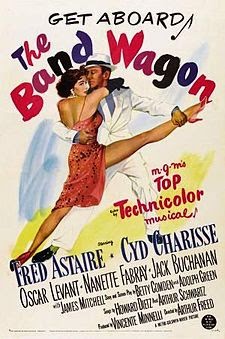
4c8bf-the_band_wagon_posterGoing into this film I must admit that despite hearing good things, I had zero expectations. I must say I was pleasantly surprised by this Minnelli musical because it was a deft and often beautiful production. Channeling the same vein as Singin’ in the Rain and The Red Shoes, this film is a spectacle in its own right. You have headliners Fred Astaire and Cyd Charisse matched nicely. Oscar Levant and Nanette Fabray act as wonderful comic relief as the wedded playwrights, who also do some song and dance. Finally, there is Jack Buchanan, as the stereotypical theater maestro Jeffrey Cordova.

It all begins with Tony Hunter (Astaire) a washed up has-been who is headed to New York for some relaxation. There is little fanfare during his arrival except coming from his friends the Martons, who have a new production for him to star in. They get the famed Cordova on board and next comes an up and coming choreographer and his girlfriend, who is none other than the young starlet Gabrielle Gerard (Charisse)

Following an initial misunderstanding, the leads finally clear up their differences and push forward to make The Band Wagon the smash hit it is destined to be. However, Cordova has turned it into a modern-day Faust and when opening night comes the after party is more like a wake.

All the players seem strangely nonchalant and then the idea hits! Make The Band Wagon over again and take it on the road. Everyone in the cast from the bottom up is excited for the second chance with Hunter at the helm. All that is except choreographer Paul Byrd.

Despite Paul’s departure, Gaby is still enthusiastic and they turn the Band Wagon into the production that the Martons had envisioned from the beginning. Tony is a success once again, and he receives a round of rousing cheers from his new family. Gaby speaks for all of them (and herself) when she says they love him and believe that the show will go forever.

I immensely enjoyed many of the numbers including: “Shine Your Shoes,” with the camera following Astaire as he frolics around at an arcade with a shoeshine man. The extras, the exquisite set, and Astaire himself all culminate in an often comical and always upbeat number that is great fun to watch. Then, of course, there is the ever memorable “That’s Entertainment,” which even spawned a series of musical documentaries, and for good reason. The words and melody are quite a catchy ode to the stage. Perhaps the most beautiful sequence in the film involves Astaire and Charisse in “Dancing in the Dark” where they positively glide through Central Park together in perfect cadence. They move not as individuals but as a poetic unit in motion. It is fitting that it was their first dance together in the film.

For never seeing Cyd Charisse in another film (except briefly in Singin’ in the Rain), I must say that I really did enjoy her performance opposite the always likable Fred Astaire. Furthermore, I am in complete agreement with her character, “I don’t think a dancer should smoke,” it’s bad for the lungs.

The cameo of Ava Garner was an odd surprise (especially due to her resemblance to Charisse). Furthermore, I never thought it could exist, but this film proved me wrong. There is such a thing as a film-noir musical! That’s The Band Wagon for you folks! That’s Entertainment!

4.5/5 Stars


Guys and Dolls (1955)

8d99c-guys_and_dolls_movieposterHeadlining this film are Marlon Brando and Frank Sinatra as Sky Masterson and Nathan Detroit respectively. Both men are high stakes gamblers and things have heated up in town because the police are trying to crack down on a floating crap game. That’s not the only thing that turns hot though. Masterson is bet by Detroit that he cannot get a sidewalk missionary (Jean Simmons) to fly with him for an evening in Cuba. Detroit has his own problems brought on by his reluctance to marry the girl he has been going with for 14 years. All along the way money constantly switches hands and “markers” are doled out as IOUs.

Both Masterson and Detroit ultimately show their noble sides and as you would expect the guys get the dolls.

This musical certainly had its moments and it looked lavishly beautiful in color like many of the contemporary musicals. I will say that there were some great personalities here including Vivian Blaine. However, Brando seemed painfully out of his element here and I’m pretty sure Sinatra had better roles. I wonder what this film would have looked with a different cast? We can only speculate now.

Also, the dialogue almost completely lacking in contradictions was quite noticeable, but I’m not sure if that was a bad thing or not. Overall I think this one would be better for the stage than on film. But don’t get me wrong a lot of the numbers like Sit Down You’re Rocking the Boat were catchy. I will say I was surprised that Brando ended up singing Luck Be a Lady and not Sinatra. I had previously only heard the Sinatra version.

3.5/5 Stars

The Sound of Music (1965)

88ab0-sound_of_musicI would like to dedicate this post to my sister since this is her favorite movie !
Starring Julie Andrews and Christopher Plummer, this musical follows a light-hearted nun who becomes the governess for the seven children of a widowed Austrian naval captain. When she first meets the children they are hostile towards her but they quickly become fond of Maria. However, when the captain gets wind of their adventures he is angry. Initially Maria is sent away but then the captain has a change of heart. After an evening full of fun, Maria is sent off this time by a jealous baroness. She returns later on the urging of a nun and Von Trapp then realizes his true love for Maria. However, everything is not well as the Von Trapps get ready for the Salzburg Music Festival since the Nazis are on the rise. With a little kindly help they are able to make their getaway in the end. I have to say that this is not one of my favorite films but the soundtrack is one of the most memorable of all time and Andrew’s voice is truly beautiful.

                                                               4.5/5 Stars

Funny Face (1957)

c8b15-funny_face_1957Although not a tremendous musical, Funny Face is a fun film that is worth a watch because it pairs Fred Astaire and Audrey Hepburn.

My main purpose for watching this film was to commemorate what would have been Audrey Hepburn’s 85th birthday today. This was a great film to go to in that respect, because it features many iconic shots of true Hepburn fashion. The film facilitated it since Hepburn was the newest model for a fashion magazine and Fred Astaire was the photographer who brought her on and ultimately fell for her.

So much color, style, and a good deal of relatively entertaining song and dance courtesy of Gershwin. Although this is no American in Paris you still have some of the Parisian allure.

I must admit that Audrey Hepburn certainly does not have a “Funny Face” in my opinion, but I will say that she always was a pleasant and charming beauty to watch. She is one for the ages as an actress, a fashion queen, a humanitarian, and an all around beloved lady.

Happy Birthday Huckleberry Friend

3.5/5 Stars