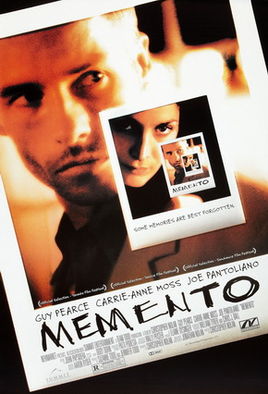
Memento (2000)

6c3e2-memento_posterDirected by Christopher Nolan and starring Guy Pierce, this thriller has an interesting narrative that stars in descending order, simultaneously goes in ascending order, and then meets in the middle. Leonard is a man whose wife was murdered and he wants to find the culprit. However, he has short term memory loss so he must use Polaroid pictures and tattoos to help himself remember. He talks to a policeman on the phone about a case he recalls. He meets the man Teddy and also gets involved with a woman who wants his help after her boyfriend was killed. However  Leonard makes his own truth and when reality is revealed to him, he will not accept it. The story meets and so the audience must come to realize this is in fact true. I feel the storytelling style alone is intriguing because it is so different and it truly makes us think. Nolan made another such film in Inception 10 years later.

4/5 Stars

Chinatown (1974)

89858-chinatownposter1Starring Jack Nicholson with Faye Dunaway and John Huston, this skillfully written neo-noir is a nod to the work of Chandler and Hammet. J.J. “Jake” Gittes is a P.I. in the L.A. area during the 30s who specializes in marital cases. When a woman calling herself Mrs. Mulwray asks Gittes to watch her supposedly cheating husband, he enters something he does not understand. Soon he meets the real Mrs. Mulwray (Dunaway), learns Mr. Mulwray is dead, and discovers Mrs. Mulwray’s father is the powerful water tycoon Noah Cross (Huston). As he tries to uncover the truth behind some odd events, Gittes meets with opposition, more confusion, and eventually some answers. The mystery is twofold and he begins to understand the plot over the L.A. water, however he does not figure out the secret kept by Mrs. Mulwray right away. When he finally does find out he is too late and tragedy ultimately comes in Chinatown. This film was enjoyable in the buildup and the ending was okay if not tragic. However, it did seem that the mystery surrounding the water was predictable.

4.5/5 Stars

The Third Man (1949) – Film-Noir

In this film starring Joseph Cotten, Valli, and Orson Welles, an American western writer (Cotten) travels to post-war Vienna to meet a friend. Upon arriving he learns that his buddy has been killed in an accident. Not quite satisfied, he does some of his own investigating and along the way meets his friend’s beautiful lover (Valli). Together they try to cope and make sense of the loose ends. However, neither of them expected the shocking evidence which was to come. Who is the Third Man and where is he? Made in the film-noir fashion, The Third Man utilizes lighting and contrasting black and white cinematography effectively. The actual on location shooting in post-war Vienna helps add to the gritty realism. Although simple, the score comprised solely of zither music is no less powerful.

This movie will have you engrossed in the mysterious occurrences since The Third Man simply has some good twists. Whether Holly Martins is whisked away in a car, Harry Lime makes a dramatic entrance or Lime runs away into the sewer system, many of the moments are full of intrigue. I also think this is one of Orson Welles finest performances, because although his screen time is minimal, he has such a tremendous impact on the film. He portrays a very mysterious character in Harry Lime who certainly has his complexities. The ironic and abrupt ending seems to close the film just as it began. However, so much happens in the course of events. The film is even realistic in the language and dialogue, showing the differences between people. Because when it all comes down to it this film may revolve around one man, but it is really about the varying relationships between people.

5/5 Stars

Rashomon (1950)

Directed by the famed Akira Kurosawa, the film starts off with two men eventually joined by a third. Both seem very melancholy and they explain this is because of something that happened three days earlier. Apparently a bandit met a husband and wife on the road and raped the wife with the husband being killed. However, this event is shown in four different accounts all varying greatly and we never learn what is fact and what is actually fiction. Because of this horrible event, one of the men who is a priest loses faith in mankind. The film ends just as it began with the two men alone under a pagoda watching the driving rain. However, an act of kindness quickly renews the priest’s belief. Kurasawa’s film certainly has an interesting plot device and camera work. Historically, it is also important because it introduced the world to Japanese cinema

5/5 Stars