The Heiress (1949)

fa57e-heiress_wylerStarring Olivia de Havilland and Montgomery Clift with director William Wyler, the film takes place in New York in the 1840s. Catherine is a shy and awkward young woman who lives with her domineering father who is a prominent widowed doctor. At a party a young man introduces himself and begins seeing Catherine frequently. Quickly their plans turn to marriage but her father will not approve. Since her lover is not rich, he sees him as a fortune hunter. Catherine decides to elope with her love, but he never returns leaving her feeling rejected and forlorn. soon the doctor gets ill and dies, but the relationship does not end will since Catherine blames her father. And in the process she has grown cold. Clift’s character finally returns and after some reluctance Catherine seems to agree to get married. he leaves to gather some belongings only to return to a bolted door. Catherine gives him some rejection of his own after what she endured. This films becomes interesting because you do not know who was truly in the right. First Clift seems to be the heel and then de Havilland evolves so much the audience turns on her.

4/5 Stars
West Side Story (1961)

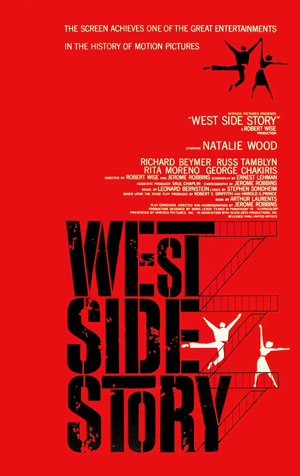
354d1-west_side_story_posterIn this 1960s, musical adaption of Romeo and Juliet, two lovers become infatuated with each other but the problem is that none of their friends would ever approve. They come from two different classes and backgrounds which are constantly at odds. The two sides frequently clash as represented by the Shark and Jet gangs. Naively, the lovers believe they can get away and be happy forever. However, the situation escalates when the gangs take part in a rumble. Pretty soon the situation is out of control and it has become something nobody wanted. Hope for the future finally seems possible for the pair but it is brutally crushed in an instant. The viewer is left with a feeling of tragedy. This is a very good film for the most part and many of the songs are great, sticking with you afterwards. I suppose it is quite difficult to go wrong with a story from Shakespeare .

4.5/5 Stars

Meet John Doe (1941)

Starring Gary Cooper and Barbara Stanwyck with direction by Frank Capra, the film begins with a news woman (Stanwyck) creating a made up story about John Doe, a man willing to commit suicide to protest big government. In order to keep the story going, they take a man off the street to effectively be John Doe. At first John (Cooper) and his friend the Colonel (Walter Brennan) are attracted by the chance to work. However, slowly he seems to become John Doe and the whole nation is seemingly behind him with Stanwyck’s character falling for his image as well. A political machine tries to discredit him and prove he never was John Doe. Now all along John decides to go through the suicide to prove his point to all. The political machine tries to stop him and Stanwyck finally does saying they can still keep the ideals of John Doe alive. Sharing some similarities with Mr. Smith, this film is one of those feel good films.

4/5 Stars

Double Indemnity (1944) – Film-Noir

If the Maltese Falcon was the first great film-noir then this film has to be a refining and improvement of the genre. Billy Wilder put together a crime film that is still intriguing today with its femme fatale and other techniques in storytelling and cinematography.
*May Contain Spoilers

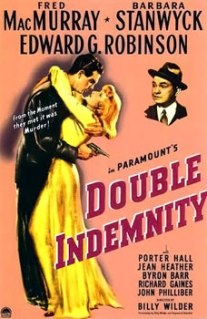
Starring Fred MacMurray, Barbara Stanwyck, and Edward G. Robinson, this is a classic film-noir. Walter Neff is your average American insurance salesman. However while trying to sell some accident insurance he falls for a woman who is married to a former widower. Together they plot and carry out a murder on her irritable husband trying to cash in on a double indemnity clause. Although everything goes as clockwork the two of them must stay apart and Neff’s colleague is hot on their trail. Through a series of visits with Deitrichson’s depressed step-daughter, Neff himself finds out Phyllis was seeing someone else. In their final confrontation he figures out she killed her husband’s first wife . Then she preceded to use Neff for her own purposes.Following their confrontation Neff feels guilt and so he records all he knows for his colleague Keyes to hear later. This movie was definitely full of suspense as well as great characters. Directer Wilder utilizes the voice over with flashback very effectively to tell the story.

5/5 Stars


Murder, My Sweet (1944) – Film-Noir

murder my sweet

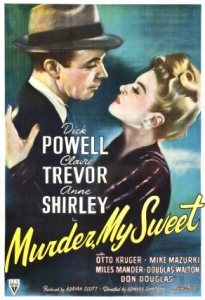
This film-noir adaptation of the Raymond Chandler novel stars Dick Powell, Claire Trevor, and Anne Shirley. It opens with a blinded Philip Marlowe being interrogated and so he agrees to spill everything he knows.

It all started one evening in his office when a big thug named Moose came in to get his help in finding a girl. Marlowe agrees to take the case and he questions a drunken bar owner but all is not right. He returns to his office where a man named Marriot wants his protection during a ransom drop off. However, at the location Marlowe is knocked out and the man is left dead. Through a series of events he meets Helen Grayle and her significantly older husband, who are both involved with a necklace. Also involved is the shady psychic adviser Jules Anthor, not to mention Mr. Grayle’s protective daughter Anne. Marlowe is forced to meet with Anthor and he eventually finds himself locked up in a facility. He gets away and after a meeting with Anne they head down to the Grayle’s beach house. There they have a confrontation with Helen. Now Anther is dead and Marlowe agrees to show Moose his girl Velma. They head down to the beach house and Marlowe puts all the pieces of the case together in front of Helen. Then Ann, Mr. Grayle, and finally Moose all burst onto the scene in a final chaotic finale.  Despite this bleak conclusion, there is also a hint of a happy ending. Much like the Big Sleep this film at times becomes incomprehensible but it just means your brain must work fast to catch up. Dick Powell I felt was a great Marlowe and Anne Shirley was a strong heroine. This is a quintessential film noir to say the least.

4/5 Stars

The Lady from Shanghai (1947) – Film-Noir

Starring Orson Welles and Rita Hayworth, the film is narrated by an Irish sailor (Welles) who meets a beautiful but unhappily married woman (Hayworth). Michael is given a job on the yacht of the wealthy lawyer Arthur Bannister and he is near the alluring Elsa once again. While he is aboard the yacht, Bannister’s partner Grisby asks Michael to fake a murder so Grisby can disappear and claim the insurance money. Michael is suppose to confess to the crime but Grisby will be long gone and there will be no evidence. However, things go awry when Grisby kills another man and then he himself ends up dead. This leaves an innocent Michael facing the gas chamber. Only after he makes a desperate escape from court does he learn who was behind the murder of Grisby and also actually in league with him. In a surreal climax ending in the hall of mirrors, Elsa, Michael, and Bannister all face each other. However, only one survives. Despite a slow beginning the exciting second half of this film is a credit to the directing of Welles.

4/5 Stars

The Postman Always Rings Twice (1946) – Film-Noir

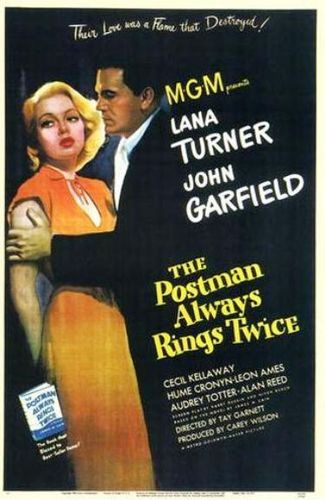
Starring John Garfield and Lana Turner, the film begins with a drifter taking a job at a roadside diner for a jolly older man with a beautiful young wife (Turner). After initial conflict, Frank and Cora fall passionately in love. They try one disastrous attempt to take the husband’s life, and in desperation they try again, this time succeeding in getting rid of him. Soon they are in court fighting the murder rap. Miraculously the two of them get out of it but ironically by the time the trial is over they hate each others guts. They live in constant loathing of each other but after thwarting a blackmail scheme their wild love is rekindled. In an equally cruel twist of fate, they both end up paying for their actions the second time around. With the voice-over, femme fatale, cinematography, and twisting plot, this is a quintessential film-noir that I really enjoyed. I would consider it the landmark performance for Lana Turner and maybe John Garfield as well. They learn the hard way that the postman does always ring twice and there is nothing you can do about it.

4.5/5 Stars

Gilda (1946) – Film-Noir

*This May Contain Spoilers

This film-noir and twisted love story stars Glenn Ford and Rita Hayworth. Johnny Farrell is a shady gambler who has just arrived in Buenos Aires. Through certain  circumstances, he quickly meets a mysterious man. Soon he learns this man is a casino owner and Farrell gains a job as his right-hand man. However, things get complicated when Farrell’s boss marries Gilda, a beautiful woman who Farrell had been involved with a long time ago. Quickly their mutual dislike becomes evident but Mr. Mundy has Johhny constantly watching over Gilda. Seeing her flirting with many other men increases Johhny’s hatred for her. Soon he learns his boss is in something much bigger and after a murder, Mr. Mundy attempts to escape on a plane. Johnny sees it crash but little does he know his boss is alive. To get at Gilda, he marries her and keeps her confined. Despite their hatred, they still hold complicated feelings for each other. But then Mr. Mundy comes back seeking revenge on both Johnny and Gilda. However, his plans fail and the romance is complete. If there was ever an essential femme fatale, Hayworth’s character certainly would fit that category. Her performance of  “Put the Blame on Mame” is definitely memorable.

4.5/5 Stars

The Adventures of Robin Hood (1938)

Starring Errol Flynn, Olivia de Havilland, Basil Rathbone, and Claude Rains, the film chronicles the legendary exploits of the outlaw Robin Hood. Whether he bolder enters the royal castle, meets Little John, or encounters Friar Tuck, Robin always exhibits bravado and bravery coupled with lightheartedness. Ultimately, he always helps the needy and that makes him the sworn enemy of both Prince John and Guy of Gisbourne. After narrowly escaping death again following an archery match Robin soon returns to the castle to profess his love for Maid Marian. However, after he leaves, Robin learns she has been imprisoned but also King Richard is rumored to have returned. With one final bold and clever move Robin aids Richard and duels Gisbourne to the death. Of course everything ends happily ever after. This film is full of swashbuckling fun, a good score, striking color cinematography, and light moments as well.

5/5 Stars

“Hanging would be a small price to pay in the company of such a charming lady” – Robin Hood

Adam’s Rib (1949)

Starring Spencer Tracy and Katharine Hepburn as a married pair of lawyers on the opposite sides of a case, this film begins with a bang. A distraught wife followed her husband home to find him cheating and she shot a gun off. In the ensuing days she is being charged with assault and the case is getting major publicity. Adam Bonner is the district attorney put on the case believing the law must be upheld but much to his chagrin she chooses to represent the other side. Thus begins an uproarious battle of the sexes. The pair continually spar inside the courtroom then return to their normal lives at home. However, after some bad publicity they are pulled apart by the case and their marriage is in trouble. After the case is won by Amanda Bonner a seemingly angered Adam shows up with a gun. Hilarity ensues along with a fight, however importantly in the end the Bonners reunite. They realize they cannot live apart. As always Tracy and Hepburn are wonderful together and they have a good supporting cast behind them including Judy Holliday, Tom Ewell, and Jean Hagen.

4/5 Stars