David & Lisa (1962)

Keir Dullea is an actor who will always be most prominently remembered for Stanley Kubrick’s 2001: A Space Odyssey. He’s Dave of pod door fame. However, part of me wants to promote him as the lead in David and Lisa because this film from Frank Perry, in its quiet empathy and emerging relationships, feels more deeply like his film.

It relies heavily on his turn as a grim young man with OCD-like symptoms. As his mother drops him off at a psychiatric center for a brief stint, he immediately carries himself as a youth too smart for such an establishment. He’s an aloof loner with cold temples and the most severe eyes. Surely, this is a story about David’s transformation.

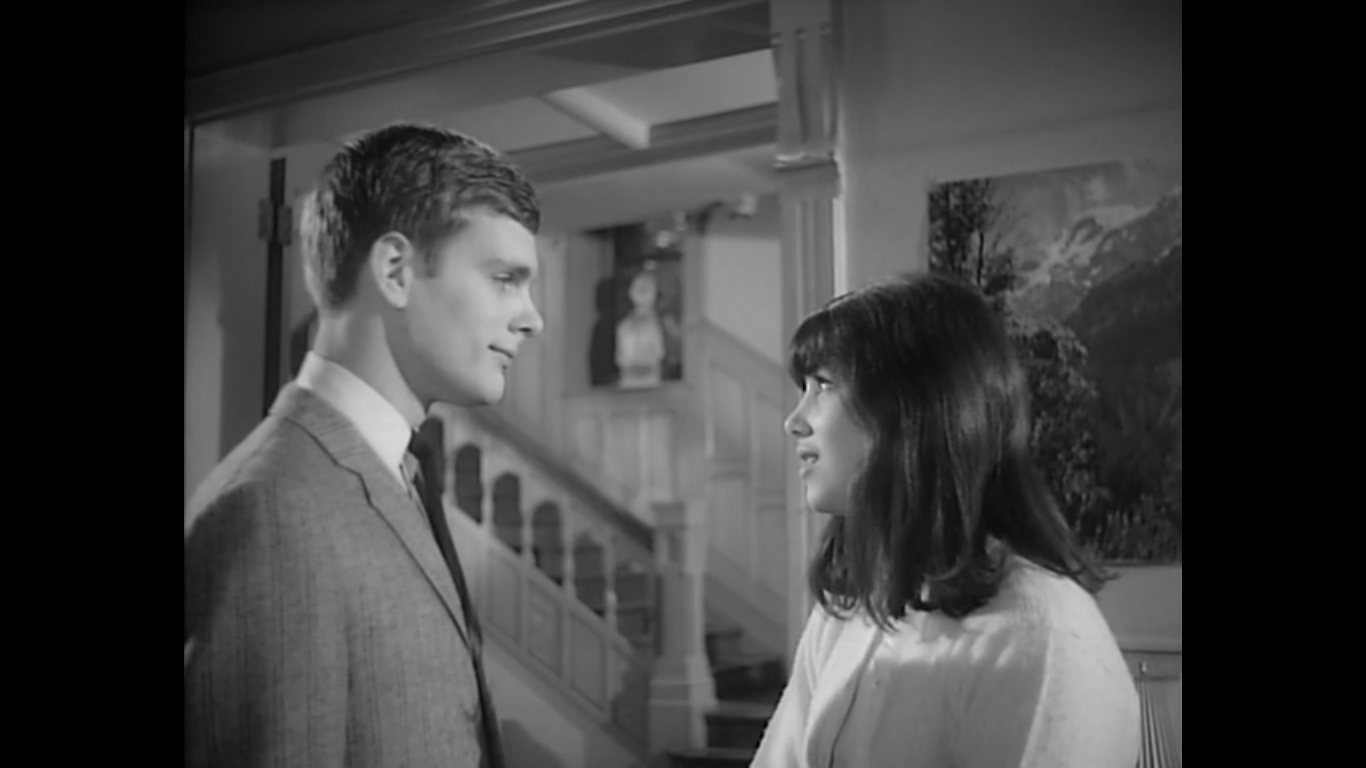
But the ampersand in the title reminds us that he only works in tandem with another life. Likewise, Dullea’s performance gains more meaning when he is put up next to Janet Margolin in her screen debut. She causes him to change and shift even as he elicits something out of Lisa.

Since I got my first introduction to Margolin in Take The Money and Run and became instantly smitten, it’s fabulous to see her in another role that plays so exquisitely off her inherent human charms. Lisa is a young teenager with a penchant for rhyme. If we want to diagnose her, she has schizophrenia, but the beauty of the film is watching people reach out to each other, instead of categorizing each other dismissively.

Even someone like Howard Da Silva is a pleasant surprise. In the old days, he mostly played conniving heavies in film noir; here he settles into the role of benevolent authority quite easily, and it’s a fine look for him. He wears it well. David is so quick to distrust him and what he stands for. Over time, the authenticity is so apparent that even he is won over. He comes to appreciate the place as home. It’s a space to belong.

However, if I’m honest, David and Lisa is the kind of film that feels like it might be frowned upon today if we know nothing about it. Still, there’s a tenderness in the love story that I can’t quite shake. It’s disarming and totally flies in the face of expectations.

I realized that whatever way you take it, there are these kinds of overt metaphors to the film. People who are different than the society around them somehow find solace in this shared sense of otherness. He meets her with rhyming and she meets him in a way by not reaching out with human touch. The things that ostracize them also have the inertia to draw them together.
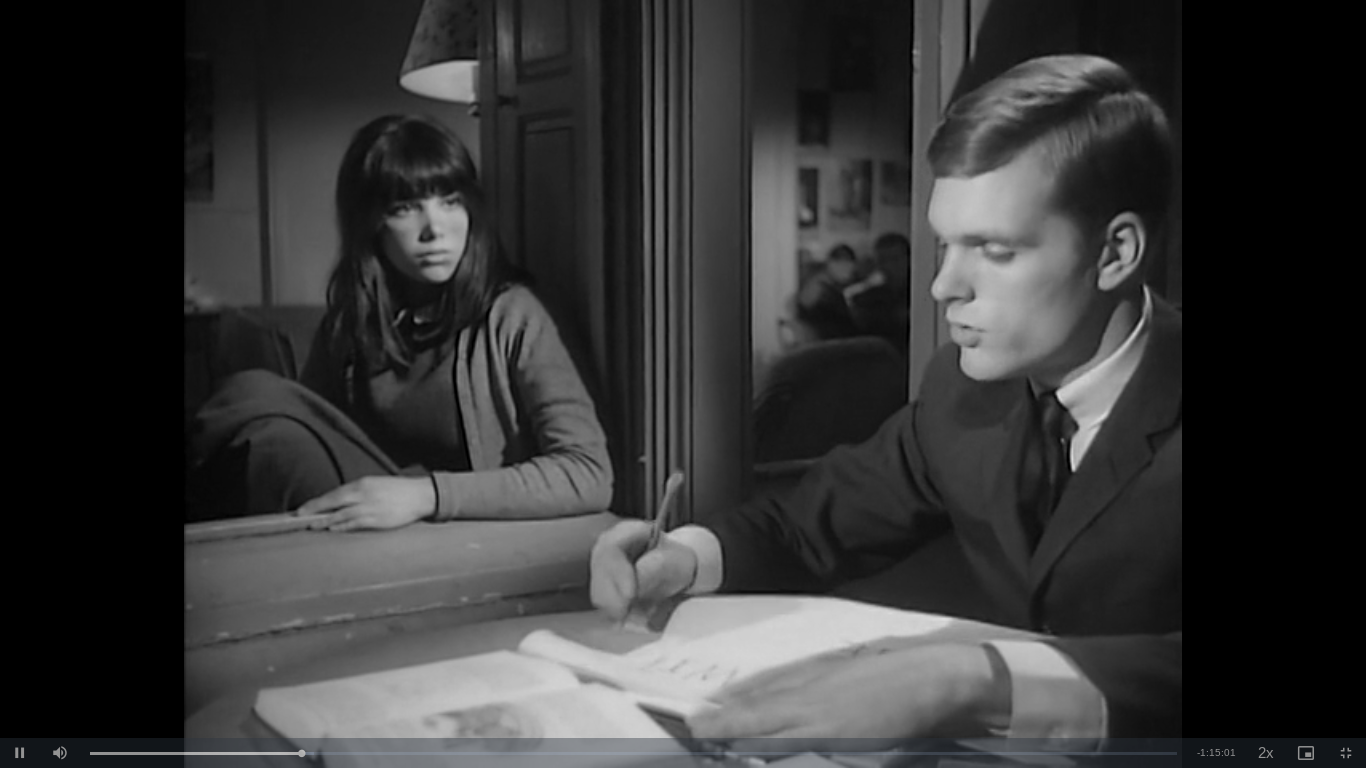
If these are idiosyncrasies, then they respect them and respect each other enough to take their predilections seriously. Meanwhile, “normal” well-adjusted people at the local train station castigate them as weirdos better resigned to the funny farm.

But even when David makes a brief return home, the perceived distance at the dinner table and the manifold hangups of his own parents, make it apparent we do not live in a society of the well-balance and the imbalanced. Those in the former category either do a better job at hiding it or they have enough money to smooth it over. Success and status can cover a multitude of social sins, at least on the surface.

There’s one particularly crucial moment where I became mesmerized with Margolin watching her sway with the metronome although it precipitates a kind of demonstrative ending that doesn’t do the story much service. In one moment of annoyance, David lashes out at Lisa only to work tirelessly to win her back. Their chemistry is so fragile, held together by wisps of gossamer thread, but that makes it all the more vital to maintain.

When Dullea scampers up the Philadelphia steps, and they share a moment so much unspoken emotion is carried with them in the scene. It’s only the two of them. She no longer rhymes. She’s fully herself. “Me,” she says.

He reciprocates by doing the bravest most vulnerable thing he can, asking her to reach out and touch him. I remember a line of prose by C.S. Lewis about love being vulnerable and this lasting image is a testament to this truth. Here the pain and transparency brim with sympathy.

David and Lisa can be characterized as a romance, although it is one where the leads never kiss, never embrace and only touch in the final frame. Somehow it’s packed with more import than many other films claiming the same genre conventions. Because what some other films forget is that love and affection, romance, they all require so much more than physical touch. It’s about warmth and stillness. Willing to open yourself up and be hurt by other people even as you stretch yourself as a human being.

For a film about psychological disorders from so many years ago, there’s a gentle subtlety to David & Lisa; it’s quite extraordinary, and Dullea and Margolin make a wonderful pair together. It’s only a shame they were not both allotted even more high-profile vehicles commensurate with their talents.

3.5/5 Stars
Mirror (1975)

the mirror 1975.png

Andrei Tarkovsky has already left such an indelible impression on me even after only seeing a couple of his films. This already makes it very easy to place him atop that ever fluctuating, never quite established, constantly quarreled over, list of the greatest filmmakers of all time. He’s subsequently one of the members of the fraternity with the least recognition; the key is visibility or lack thereof. Because once you see his work, even if it doesn’t completely speak to you, something is released that’s all its own with a singular vision and the unmistakable brush strokes of an auteur.

There has never been a film more fluid and uninhibited in the distillation of memory than Mirror as it slowly slaloms between the past and the present, enigmatic dreamlike movements with unexplained conversations and encounters, spliced together with bits of wartime newsreels and spoken poetry.

In order to even attempt to ingest any of this rumination at all, there’s a near vital necessity to shed all the traditional forms and languages that you have been taught by years of Hollywood moviegoing.

Not that they are completely excised from Mirror but it’s never driven by logical narrative cause and effect. Rather it’s driven by emotion, rhythm, and feeling — what feels intuitive and looks most pleasing to the eye.

It’s precisely the film that some years ago might have been maddening to me. Because I couldn’t make sense of every delineation culminating in a perfectly cohesive, fully articulated thesis, at least in my mind’s eye. It’s far too esoteric for this to happen. But this unencumbered nature is also rather freeing. There’s no set agenda so as the audience you are given liberty to just let the director take you where he will.

To its core, Mirror gives hints of a very personal picture for Tarkovsky as it memorializes and canonizes pasts memories and shards of Soviet history. Because they are tied together more than they are separate entities. And yet, as much as it recalls reality, Mirror is just what it claims to be. It is a reflection. Where the world is shown in the way that we often perceive it.

The jumbled and perplexing threads of dreams, recollections, conversations, both past and present. Childhood and adulthood, our naivete and our current jaded cynicism, intermingled in the cauldron of the human psyche. Back and forth. Back and forth. Again and again.

Because what we watch is not simply about one individual. As with any life, it’s interconnected with others around it. A woman (Margarita Terekhova) sitting on a fence post during the war years in an interchange with a doctor. In the present, Alexei, our generally unseen protagonist, converses with his mother over the phone. We peer into the printing press where she worked as a proofreader. Rushing about searching for a mistake she purportedly made. Regardless, it hardly matters.

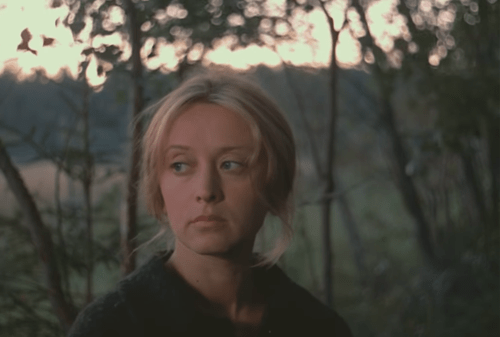
In the present, Alexei quarrels with his estranged wife on how to handle their son Ignat. The fact that his wife is also played by Terekhova is more of a blessing than a curse. In a passing remark, he notes how much she looks like his mother did and it’s true that she is one of the connecting points. Even as she embodies two different people, the performance ties together the two periods of the film. Visually she is the same and that undoubtedly has resonance to Tarkovsky.

As the film cycles through its various time frames so do the spectrums of the palette. The color sequences have a remarkably lovely hue where the greens seem especially soft and pleasant as if every shot is bathed in sunlight. It’s mingled with the black and white imagery as the story echoes back and forth, past and present, between different shades and coloring. But whereas these alterations often provide some kind of cinematic shorthand to denote a change in time, from everything I can gather, Tarkovsky seems to be working beyond that.

Because there are scenes set in the past that are color, ones in the so-called present that are monochrome, and vice versa. It’s yet another level of weaving serving a higher purpose than merely a narrative one. If I knew more about musical composition I might easily make the claim Mirror is arranged thus — the cadence relying more on form than typical cinematic structure.

mirror 2.png

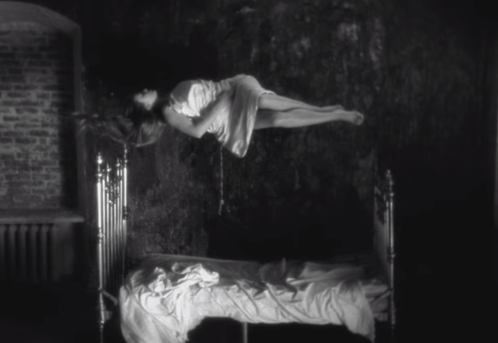
That and we have Tarkovsky’s long takes (though not as long as some) married with his roving camera that nevertheless remains still when it chooses to. The falling cascades of rain are almost otherworldly in their spiraling elegance. The wind ripping through the trees a force unlike any other though we’ve no doubt seen the very same thing innumerable times. Fires blaze like eternal flames. Figures lie suspended in the air, isolated in time and space. Each new unfolding is ripe for some kind of revelation.

We also might think our subjects to be an irreligious people but maybe they still yearn for a spirituality of some kind. I’m reminded of one moment in particular when, head in her hands, the wife asks who it was who saw a burning bush and then she notes that she wishes that kind of sign would come to her. If there is a God or any type of spiritual world, the silence is unappreciated.

I recall hearing a quote from the luminary director Ingmar Bergman. He asserted the following, “Tarkovsky for me is the greatest, the one who invented a new language, true to the nature of film, as it captures life as a reflection, life as a dream.”

The words are striking to me because you could easily argue Bergman’s films also had such an ethereal even refractive quality. Look no further than Through a Glass Darkly (1961) or Persona (1966) and this is overwhelmingly evident. And yet he considers Tarkovsky the greatest.

This isn’t the time or place to quibble over the validity of the statement. But it seems safe to acknowledge the effusive praise the Soviet auteur has earned for how he dares play with celluloid threads and orchestrate his shots in ingenious ways. He exhibits how malleable the medium can be as an art form while never quite losing its human core.

4.5/5 Stars