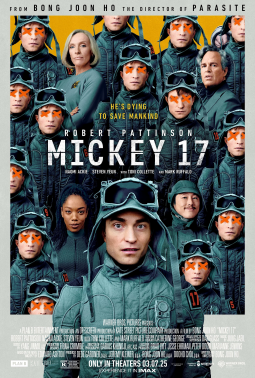
Mickey 17 (2025)

It was my pleasure to see Mickey 17 and it was because I was in the company of new friends. The film itself comes with complex feelings. 

Bong Joon Ho joins forces with Robert Pattinson for a story that defies easy categorization. It’s full of a myriad of ideas in line with the South Korean’s usual preoccupations including class and pervasive humor. There are some potentially cute creatures and, if not cute, then they are decidedly more sympathetic than many of the humans we come in contact with. 

While watching the film following Mickey Barnes, a schlub of a man who signs his life away for an excursion to outer space, I couldn’t help but return to two reference points. The first being Star Wars: The Empire Strikes Back and then Ridley Scott’s Blade Runner.

We meet Mickey as he is discarded in a snow cave on an icy planet — ostensibly left for dead. Given his costume and the circumstances, it’s difficult not to see echoes of a frozen Luke Skywalker facing imminent danger in a Wampa’s lair. Except we are dealing with a drastically different world.

Because this is actually the umpteenth iteration of Mickey, and he is part of a program that prints copies of human beings to do the morally dubious dirty work no one else is willing to undertake. 

After all, since he can just come back as a new version of himself every day, what’s it to him if he contracts a deadly virus or gets eaten alive by a snow creature all in the service of the greater good? Most of the early montage is made up of Pattinson being moved around like a ragdoll Frankenstein constantly being tested and incinerated when his utility is used up. 

As you might imagine the connection I see to Blade Runner are these fundamental questions of what it means to be human and who we give dignity to. In other words, is this an inalienable human right? Because although he was a nobody back on earth, on the run with a wily conspirator Timo (Steven Yeun), Mickey still is a human with thoughts and feelings even as he’s relegated to second-class citizenship. He doesn’t want to die any more than anyone else, but he resigns himself to the cycles of life. 

Pattinson channels an accent like you’ve never heard from him before that has a bit of a young Steve Buscemi in it. It’s a bold choice but then for the entire movie, Pattison just goes for it because there’s no vainglory in a part like this if you’re squeamish about taking it to bizarre ends. 

For me, Bong’s latest film works best as a cosmic character piece with Pattinson front and center. There could be a version following his existential arc in outer space as he comes to terms with his station in life while falling in love.

However, because it’s 2 hours and 15 minutes, Mickey 17 attempts to be about a lot more with an epic scale. The primary problem is there doesn’t seem to be a compelling narrative thrust even as Mickey is part of a vague expedition to colonize a distant planet. 

The film’s most obvious villain is the failed political figurehead Kenneth Marshall (Mark Ruffalo), who now has aspirations to colonize space with a superior race of human beings no doubt made in his image; he’s no Marcus Garvey, and I won’t even begin to guess if he’s a caricature of other political figures as Ruffalo hams it up with all the self-aggrandizing buffoonery he can muster.

Toni Colette plays his wife who is primary confidante and probably the brains behind the operation a la Angela Lansbury in the Manchurian Candidate. However, the deficiency here is that they do feel too much like cartoons. What are their genuine motivations besides being easy to tear down and be infuriated by?

On a positive note, Naomi Ackie plays a security officer on the ship who, for some inexplicable reason, falls for Mickey becoming his advocate and protector. It is an ongoing theme in the movie that the women are strong, but with Nasha we would like to believe she sees something genuine and unsullied in Mickey’s personhood.

However, when she’s on screen it feels like Nasha stands for something as both a romantic being and a person of principle who heroically champions good. In the fashionable parlance of the age, she speaks truth to power. Still, Ackie plays it in such a way that the performance feels modulated and not simply driven by a platform or plot mechanics but by her genuine affection for Mickey. 

Two other notable heroines are the timorous scientist Dorothy, who becomes an ally with her chosen expertise, and then Kai, a grieving security officer who comes to Mickey’s aid when he goes before Kenneth Marshall for an arranged dinner. Marshall wants her for her superior genes, perfect for colonizing his new planet, but she turns out to be a person of compassion too — something he couldn’t care less about. It feels like a turning point in the story even as she all but disappears from much of the final act. 

The great leader has deigned to have this expendable at his table where he feeds him raw meat, and they pray and sing hymns with a bombastic faux religiosity. He prays only to be heard by others thinking he will be heard because of his flowery words.  

It’s one of many moments where we see this state-sanctioned religion derided for what it is by Bong. There is an irreverence that is prototypical for Bong, but it seems as if it is directed at what we might call “Christendom” or in this case the accouterments of religious culture that feels disingenuous and more about propping up leaders to accrue power than any kind of piety or true virtue. 

However, much like Parasite, if we dig under the surface, the framework of the world still functions on logic that we all comprehend. There are the aforementioned questions about what it means to be a human and whether or not that should ascribe us a certain dignity. 

And in the same sense, while Marshall and his wife prove to be a pernicious, narcissistic tandem as they look to eradicate the endemic ‘creepers’ in a contentious standoff, they fall into the age-old fallacy.

Because their whole economy is predicated on showmanship and creating fear around the “other.” Mickey knows these creatures have more to them because he has come face-to-face with them. In a weird way he is an intercessor so even as the humans cause destruction and needless death, there is a requirement for a scapegoat. Someone to atone for the blood that has already been shed…

So while Bong’s latest film is not without merit and there’s plenty to quibble about, it feels like the film falls admittedly short in one primary department. It languishes in telling a focused story even as there are plenty of individual performances to single out.

As an Asian-American, it seems like Steven Yeun has currently cornered the market on these kinds of skeevy or despicable characters which feels like his well-won prerogative to upend a generation of model minority stereotypes. He’s played ceaselessly interesting characters of late. Even Steve Park gets a chance in the limelight as he continues to build a wonderful second act for himself thanks to Wes Anderson. 

Mickey 17 gets his happy ending and in a sense, it feels well-deserved. In this way Bong allows himself to be a romantic at heart even in a world beholden to his comically dark proclivities. I commend the movie more for its themes than its storytelling and given Bong’s track record it seems a shame because he’s one of the foremost genre smugglers working today. 

3/5 Stars
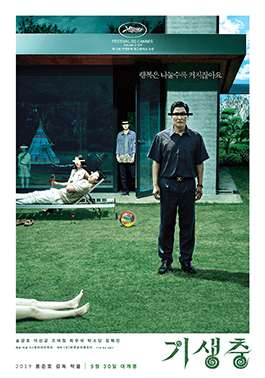
Parasite (2019): Bong Joon-ho’s Household Thriller

Parasite_(2019_film)

I heard in an interview director Bong Joon-ho had the idea for Parasite percolating in his mind for a long time, and it was born out of the most curious forms of inspiration. In college, he used to tutor English for the child of a rich family. From that point of disembarkation, he started asking “what if…” and all of a sudden his latest thriller was born.

Whether this story is completely true or not, it gets at what I relish about screenwriting and the inception of ideas in any form. Oftentimes they come straight out of real-life experiences only to be morphed and molded, burnished and extrapolated upon until they take on an existence entirely their own.

In some ways, Parasite feels very much related to the previous year’s Cannes darling Shoplifters, directed by Hirokazu Koreeda. In both cases, a story about an impoverished family becomes a handy jumping-off point for social commentary. But that’s just it. The premise provides a jumping-off point and there’s little else we can compare because the stories take drastically different turns simply adjudging from their creators.

Because the Kim family live crowded in a shoddy basement-dwelling leeching off the wi-fi of those who live around them, somewhat contented or at least resigned to their vagrant lifestyle. However, one day their teenage son, Ki-woo is enlisted by a friend to fill his position tutoring the daughter of a rich family.

His family helps him with the con using their skills of photoshop, composition, and dramaturgy to pull off the masquerade and ingratiate themselves. It helps that their mark is a simple-minded, trusting, and generally kind matriarch. There’s a touch of Luis Bunuel in the depiction of this rather naive and vacuous bourgeoisie family getting overrun by the lower classes.

And yet a distinction must be made here too because Bong does not altogether mock them. There is the inkling of affection for all his ensemble even as he teases them. This is one of the keys to the movie’s success. The message is not hammered home at the expense of the characters. 

One thing leads to another and the household vacancies begin filling up. First, an English tutor, then an art therapy instructor, next a new chauffeur, and finally a housekeeper. If the early dynamic is a tad like Shoplifters, as Parasite gears up, I couldn’t help but feel this same pervading unease experienced throughout Jordan Peele’s Get Out. While it might seem like a curious touchstone, what both films fashion are compelling thrillers carved out of the home.

The domicile and symbol of social capital, stability, even the family unit, is turned into this perturbing space that can be easily sabotaged and infested. It doesn’t matter if the main thematic element is race or class. They can both function in an insidious manner as a source of tension throughout the picture, seeping in through the cracks. Where you can live life from the heights of privilege or sunken in the subterranean void below. 

While the cat’s away the mice will play, and it’s at this point we ponder where we could possibly be headed. The Kims succeed in totally taking over the house and lounging in all its decadent luxuries. This could be the end of the story. Thankfully, we are in the hands of someone who knows full-well what they are looking to accomplish. 

Part of the ingenuity of the film comes in how form follows function in this very tangible way. Because the visual and environmental disparity trickles down through the story until it emphatically erupts. The metaphor takes on a very real and concrete form throughout the picture. But for the time being, it’s all about building the mounting suspense to a crescendo.

Bong is a disciple of Hitchcock, and thus he’s taken to heart the pervasive power of dramatic irony. He can both manipulate the audience while implicating us and making us totally invested in the charade at hand.

Though Parasite does have twists — one particularly harrowing in nature — it is built out of this maintained sense of dread and tension. It only works because the director has taken us into his confidence and we know something other characters do not.

The film is also built and developed out of not only its architecture but the sound design helping to create a distinct space and also a rhythm conducive to the action. A chaotic scramble to neutralize, not a gun, but a phone with social media capabilities is the centerpiece of one memorable scene full of struggling bodies, flailing arms, and the like, choreographed to perfection.

There are certain scenes like this one where they cease to be bits of exposition and dialogue, and they feel more and more like they’re verging on visual symphony as we watch images and actions flash by with a very particular cadence. They have the force to carry us away in the moment — cutting to the music — like many of the greats have done, from Hitchcock to Scorsese. 

When the Kim family is finally at their lowest point, sleeping on a gymnasium floor, their patriarch utters the film’s one line which feels like some kind of worldview tucked into a movie that otherwise functions only as a satire, if not an out-and-out black comedy. He says the best plan is no plan because nothing works out the way you mean for it to anyway. It doesn’t matter if you kill someone or commit treason. Nothing matters. Nihilism is alive and well.

Still, the beauty of this is even while Mr. Kim says these things, there is a director behind him — an artistic creator — who has more than a vision for where he will end up. There is a purpose to everything that is happening to him. 

If the majority of the movie is an exhibition in Hithcockian manipulation, then the ending is suitably macabre for someone totally versed in the Master of Suspense. Bong somehow manages to be playful, shocking, thrilling, and a tad somber all in the course of the final hour. The film is lengthy; we don’t always know where it will wind up, and yet it ends up in places that continually lead to further questions.  You cannot unsee it or quite forget about what we have witnessed. 

Parasite has an undisputed climax and still the story continues allowing itself to sink back into a newfound despondency and the original status quo. I still cannot decide if this suits everything we have been subjected too thus far.

Although another joy of screenwriting is narrative symmetry when we can take a movie back to where it began. Because so much has happened. We have weathered so much as an audience, watching and in some perverse way, rooting for this family, only for it to end up back the way it was, under very different circumstances.

All I know is that this is one of the most wickedly sharp and ingeniously pulse-pounding movies I’ve seen in quite some time. It irks me and yet in the same instance, I cannot quite turn away.

If there is any more fruit, broader still, it will come from the phenomenal press the film has received, and in an age where acclaim still guides public opinion, like Bong said himself, maybe this can be the film to help the general public conquer their fear of subtitles. Because if Parasite‘s any indication, it wields the power to open people up to expansive avenues of cinema. This is only the tip of the iceberg.

The joy of making the leap is the realization that you are not being pulled further away from what you know. More often than not, you’re getting closer — closer to the things that feel universal — the human predilections connecting us on an intimate scale. Both the parasitic and the hospitable, the good and the evil. 

Although they couldn’t be a more diverse company, you see it in Hitchcock (a Brit), Koreeda (a Japanese), Bunuel (a Spaniard), Bong (a South Korean), and many others. Go watch them if you have the chance. My hope is you will be glad you did. 

4.5/5 Stars