
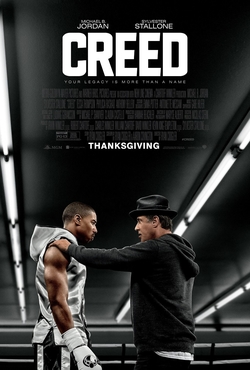
 There’s a very special place in my heart for Rocky (1976) and I choose those words very carefully. The reason being, subsequent films lost the appeal of the original and I simultaneously lost interest in the franchise. Perhaps it’s because, after Sylvester Stallone’s breakthrough film, the series lost much of its unassuming charm. It was no longer an underdog story. It no longer felt as personal and intimate.
It’s true that I cannot pass any kind of judgment on Rocky II, III, IV, V, and Rocky Balboa. But it’s so easy to lose your guiding light, for a franchise to drift away from what made it good by simply relying on blockbuster status, star power, and a robust fanbase. These very things kept me away and yet Creed made me extremely happy that I came back into the fold.
This is by no means a rehash of the original Rocky, that beloved classic in the pantheon of sports movies, but it knows its lineage and maintains the same spirit of that narrative. But when you have such a strong sense of your roots, that makes it all the easier to head out into new terrain.
Creed is, of course, about Apollo Creed’s son. Because whether you know it or not (I didn’t) Apollo Creed has passed away. He was (SPOILER) killed by Ivan Drago. All he left behind was his wife, an illustrious boxing career, and crucial to this story, an illegitimate son who has grown up much of his life in juvie. But his widow tracks down the boy and looks to rehabilitate him, like a prodigal son gone astray.
Over time, Adonis “Donnie” Creed (Michael B. Johnson) grows in knowledge and stature, landing a job in a company where he is rising up the ranks, but he’s discontent. He does some boxing on the side behind closed doors, in places that no one of any repute has heard of but he strives to be like his deceased father. He wants to be a boxer, ditching his job, leaving his step-mother’s lavish home behind to start on his own hero’s journey.
And unsurprisingly his dreams take him to that gem of a city — the City of Brotherly Love — Philadelphia, to seek out a man who now runs a humble Italian restaurant christened “Adrian’s.” Donnie walks into this establishment with a mission, to get to know the former rival of his father, to get this aging man to train him in his own boxing career.
Rocky Balboa (Stallone reprising his role) is not about that life anymore. Content with simplicity and the memories that are left from his many years in the ring. If his restaurant is any indication, it stands as a testament of the love he still holds for his wife, who passed away. He visits her every week at the local cemetery still sharing his life with her like his closest confidante.
It’s moments like these that suggest that director Ryan Coogler’s film is a cut above some of the previous offerings. It’s this fascinating idea of a transgenerational film — it’s Rocky for the millennial generation but it shows a certain deference and even wistful reverence for its past — even the music constantly hinting at Bill Conti’s iconic score. But that should not be mistaken for being stuck in the past because with Michael B. Jordan in the lead, he motors the story forward with his own Rocky-like resolve.
Yes, his daddy is Apollo Creed, but he’s looking to make a name for himself apart from that. He starts calling on the girl downstairs — the local singer-songwriter Bianca and his relationship with “Uncle” Rocky quickly grows. They’re family now. And for boxing fans, Creed has its fair share of training sequences, buildup, and such, as Creed himself becomes an underdog facing off against world champion Jack Conlon. But if that’s all that Creed was, I would have been content going back to the original Rocky.
However, Creed suggests something very powerful as noted by Rocky early on. Time takes everyone out, time’s undefeated. There are affectionate callbacks to Adrian (the restaurant) and Paulie (Adonis stays in his old bedroom), even Apollo. But all of them are gone now. All of them lost against time. And Rocky nearly does as well. It’s inevitable. However, with the story of young Adonis we are reminded that there’s still room for hope and dreams and love and caring about other people. Those are things to be treasured.
Here Ryan Coogler has proven once more that he is a rising director crafting compelling films. Teaming up again with Michael B. Jordan after the searing Fruitvale Station, he fills the blockbuster with the same ambiance of an independent film with hot dog vendors and little bits of everyday authenticity. There’s a certain amount of documentary realism that still manages to be cinematic and at the same time surprisingly personal. So if you love Rocky go see Creed. If you love boxing go see Creed. But beyond that, it’s a film with a great deal to offer and I was heartily impressed in how it balances the past and the present with so much poise.
4/5 Stars

 It’s hardly Charles Dickens, but still, Hard Times is a real tooth and claw street brawler. We have Charles Bronson as our token taciturn drifter, tough and down on his luck during the Depression. James Coburn is Speed, a fast-talking promoter looking for a quick buck. Walter Hill’s film may not be pretty to look at, but boy is it a lot of fun! Everyone’s favorite supporting scene stealer Strother Martin makes an appearance as a sometime doctor who dropped out of med school. These three men are at the center of an evolving partnership that comes into being on the streets of New Orleans, that hopping town of jazz, juke joints, and bare-knuckle boxing. The latter is the most important for the men aforementioned because, with Speed as his manager and Poe as his ringside doc, Chaney looks to rule the ocean front with his grit and tenacity.
 What it manages to bring together within the frame of a meager B-film plot is quite astounding, balancing the brutality and atmospheric visuals with the direction of Robert Wise to develop something quite memorable. Boxing movies have been bigger and better, but film-noir has a way of dredging up the grittiest pulp and the Set-Up is that kind of film.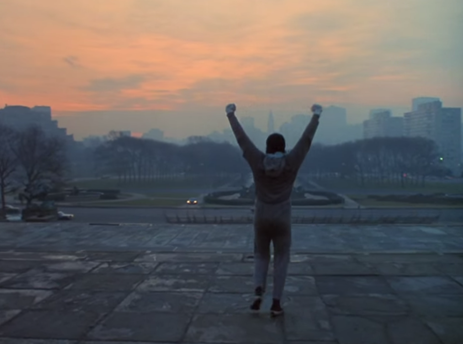

 “Now there are just two of us – young Aubrey Montague and myself – who can close our eyes and remember those few young men with hope in our hearts and wings on our heels.” ~ Lord Lindsay
 Back in the 1920s, a brash young Abrahams (Ben Cross) is about to enter university at Cambridge intent on becoming the greatest runner in the world, and taking on all the naysayers and discrimination head-on. He’s a Jew and faces the antisemitism thrown his way with defiance and a bit of arrogance. He’s a proud young man who loves to run, but more than that he loves to win. His best friend becomes Aubrey, a good-natured chap, who willingly lends a listening ear to all of Harold’s discontent. Soon enough Abraham’s makes a name for himself by breaking a longstanding record of 700 years, at the same time gaining a friend in the sprightly Lord Lindsay. Together the trio hopes to realize their dreams of running for their country in the Paris games of 1924. They are the generation after the Great War and with them rise the hopes and dreams of all those who came before them.
 Simultaneously we are introduced to Eric Liddell (Ian Charleston) a man from a very different walk of life. He’s a Scot through and through, although he grew up in China, the son of devout Christian missionaries. Everything in his life is for the glory of God, and he is a gifted runner, but in his eyes, it’s simply a gift from God (I believe God made me for a purpose, but he also made me fast. And when I run I feel His pleasure). His sister is worried about his preoccupation with this seemingly frivolous pastime, but Eric sees a chance at the Olympics as a bigger platform – a platform to use his God-given talent to glorify his maker while living out his faith. Abrahams is a disciplined competitor and he goes so far as to bring on respected coach Sam Mussabini (Ian Holm) to help his chances. Liddell is a pure thoroughbred with life pulsing through his veins, and of course, they must face off. It’s inevitable.

 4 Star Films