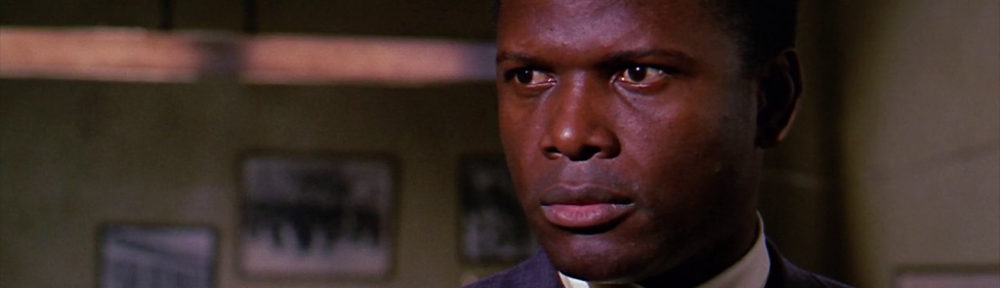

Dial M for Murder is talky and more dialogue-driven than a great many Hitchcock films but that’s partly because the environment is more conducive to that kind of storytelling as much as the fact that this murder story is adapted from a popular British stage production.
Like Rope (1948) or even Lifeboat (1944) before it, Dial M for Murder is for all intent and purposes a chamber piece that essentially takes place on one set: the drawing room of Tony and Margo Wendice.
But quite similar to its predecessors you also get the sense that Hitch approached this picture with a certain perspective and turned it into a technical puzzle to be solved. In typical Hitchcock fashion, he underlies even scenes that are seemingly stagnant with interesting accents. His frame is constantly filled in the foreground lending a certain depth to the picture that we can easily imagine as utilizing cutting-edge 3D technology.
Aside from his work with his frequent director of photography Robert Burks, he also put some obvious restrictions on himself in terms of location. Several of his decisions are fairly daring. Instead of having a whole courtroom sequence he elects to shoot it in a highly stylized fashion that while far from realism, still gets the essence of the story across in a matter of a few minutes.
However, he also has a sequence where two men are talking and the frame is broken up by a lamp and it takes the typical shot-reverse-shot paradigm and makes it more interesting. The same goes for the disconcerting high angles that he uses in multiple instances to depict the action unfolding as first the two accomplices plan out the ensuing events and then the police come onto the scene to investigate.
His preoccupation with the “Perfect Murder” crops up once more as a retired tennis player living off the fortunes of his beautiful young wife decides to murder her to maintain his lavish lifestyle. Her infidelities with an American mystery novelist and minor acquaintance are the pretenses for his actions — a perfect way to get all her money for himself.
But this isn’t a picture working on a moral level. As is often the case, Hitchcock seems far more invested in the mechanics of the actual murder and whether or not it can actually be pulled off and what it would all look like.
Tony (Ray Milland) soon has an old college chum embroiled in his plot with a healthy bit of blackmail and he has everything set up perfectly to get Margot (Grace Kelly) to stay at home while this phantom man will sneak into their flat and murder her. But it will come off as a freak accident and that will be the end of it. However, being a fighter, Grace Kelly doesn’t give up without a struggle and her husband now must cover all his tracks and events unfold much differently than he was expecting.
Milland plays the typically witty and rather sophisticated Hitchcock villain who is in one sense charming and extremely prone to moral turpitude. Grace Kelly is stunning as always and a sympathetic figure as the wife who finds herself the victim of a grisly attack and subsequently accused of a murder no thanks to her husband helping to dig her grave. Though it’s not her best performance next to such startling revelations as Rear Window (1954) and To Catch a Thief (1955), there’s no question that it helps to solidify her incomparable partnership with Alfred Hitchcock.
Robert Cummings role as a crime author is a necessity because it makes his spot-on guesswork certainly not plausible but more interesting. Because he’s simultaneously dreaming up a scenario and ironically convicting Milland with his cockamamie stories which are surprisingly close to the truth.
John Williams reprises his stage role and turns Dial M for Murder into a bit of a Columbo episode of ‘how is he going to catch him’ because this works best to Hitchcock’s advantage since he’s not necessarily interested in the shock but introducing the audience into the entire plot so they become invested and stringing them along with all the proceedings. In such a way, the suspense and the subsequent payoff can be as memorable as possible.
When Milland walks through the door at the end of the picture, it’s an unextraordinary, even everyday action, but Hitchcock has imbued that single event with so much meaning. As an audience, we are sitting with baited breath waiting to see if the key will turn in the lock. This is a film that ultimately is indebted to the rotary phone if only for its title. But it’s hard to beat Hitchcock and the future Princess Grace of Monaco.
4/5 Stars
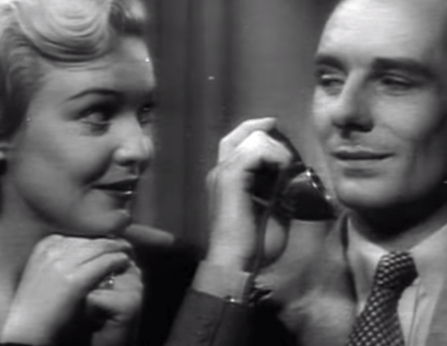
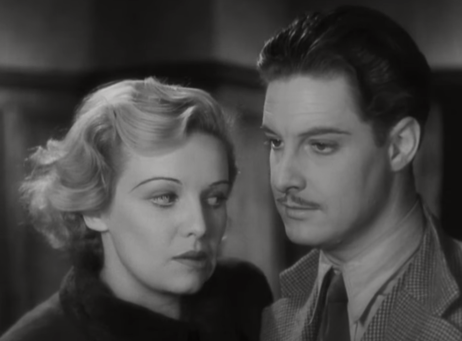
 Although Hitchcock did many riffs off the same themes, he very rarely tried to do the same film twice over. The Man Who Knew Too Much might be the one exception and even then if you place these two thrillers from 1934 and 1956 up next to each other, they’re similarities are fairly nominal.
 In the 1970s political paranoia involved issues in the realm of Watergate. Government conspiracy and that type of thing perfectly embodied by some of Alan Pakula’s best films. But it’s important to realize in order to better understand this particular thriller, the 1980s were a decade fraught with fears of Soviet infiltration compromising our national security. The Cold War was still a part of the public consciousness even after being a part of life for such a long time already. So No Way Out has a bit of Pakula’s apprehension in government and maybe even a bit of the showmanship of Psycho with some truly jarring twists.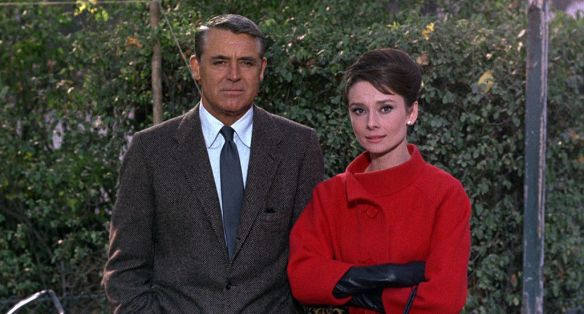

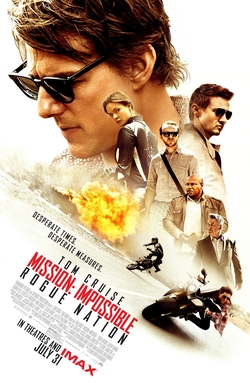 n the last decade or so arguably the greatest action/spy/thriller franchises have been Jason Bourne, James Bond, and Mission Impossible. To their credit, each series has crafted several passable films fortified by a few real stalwarts of the spy thriller genre. Although many of these series thrive on gadgetry, set pieces, and a cynical tone more at home in the modern millennium, one thing that set some of the better films apart were interesting female characters.
 Body Snatchers works seamlessly and efficiently on multiple fronts, both as science fiction and social commentary. Don Siegel helms this film with his typical dynamic ease putting every minute of running time to good use. The screenwriter, Daniel Manwaring, put together perhaps one of the greatest political allegories ever penned and, on the whole, it’s a taut thriller combining sci-fi and horror to a tee.
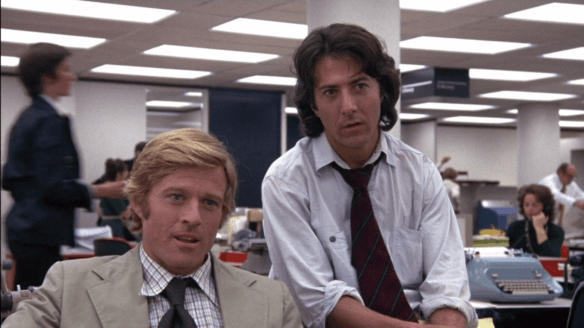 You couldn’t hope to come up with a better story than this. Pure movie fodder if there ever was and the most astounding thing is that it was essentially fact — spawned from a William Goldman script tirelessly culled from testimonials and the eponymous source material. All the President’s Men opens at the Watergate Hotel, where the most cataclysmic scandal of all time begins to split at the seams.
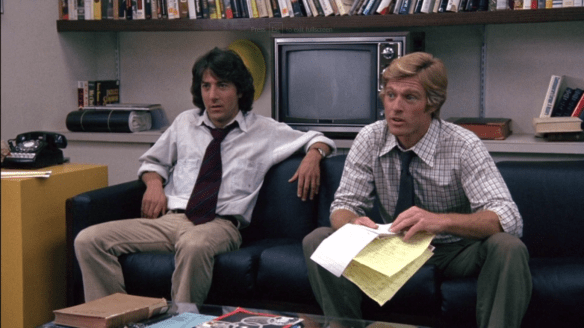 But it only takes a few breakthroughs to make the story stick. The first comes from a reticent bookkeeper (Jane Alexander) and like so many others she’s conflicted, but she’s finally willing to divulge a few valuable pieces of information. And as cryptic as everything is, Woodward and Bernstein use their investigative chops to pick up the pieces.
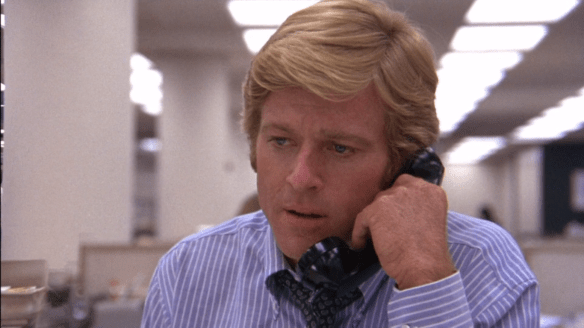 Gordon Willis’s work behind the camera adds a great amount of depth to crucial scenes most notably when Woodward enters his fateful phone conversation with Kenneth H. Dahlberg. All he’s doing is talking on the telephone, but in a shot rather like an inverse of his famed Godfather opening, Willis uses one long zoom shot — slow and methodical — to highlight the build-up of the sequence. It’s hardly noticeable, but it only helps to heighten the impact.
