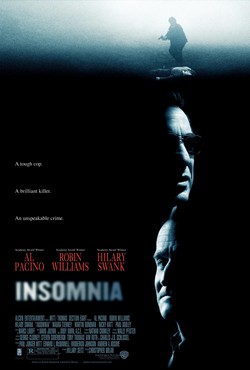
 “You and I share a secret. We know how easy it is to kill somebody.” – Robin Williams as Walter Finch
As I come to understand it, calling Christopher Nolan’s film a remake of the Norwegian thriller of the same name starring Stellan Skarsgaard is not exactly fair. As a director with a singular artistic vision of his own, it’s only fair to say his thriller set in the icy outskirts of an Alaskan fishing village is a re-imagining of the material.
His tale follows a jaded sage of an L.A. cop who comes with his partner on a reassignment, but Dormer (Al Pacino) is also running away from something — something that undoubtedly has major repercussions on not only his life but the case he is about to be met with.
Getting acclimated to Nightmute is no easy task. The town is quiet and the local police are nice enough, including Bill’s old buddy and the overly zealous but industrious rookie Ellie Burr (Hilary Swank). To her, the estimable Will Dormer is a legend, the man you only read about in case files, not actually witness in person. She holds that kind of awe for him, but he just takes it in stride as he and his partner Hap (Martin Donovan) go about their business
Worst of all is the perpetual daylight. It’s something we take for granted, but in this story, the sun never truly sets. It’s always there. There’s no relief and, in a sense, it haunts Dormer. He struggles to sleep, he struggles when he is awake, because he hasn’t been able to sleep, and then the title Insomnia begins to make so much sense. It’s perpetuated to the extent that we begin to feel its effects on us as an audience. The story wears us down, making us into jaded individuals like Dormer (strikingly close to Dormir) and the fact that Al Pacino half-whispers his dialogue with his methodical delivery only aggravates the situation. Our vision is clouded just as much as his.
Set pieces are relatively few, but they are used to great effect. The ones that come to mind are a chase that ensues in the thick Alaskan fog, where the pursuer all too quickly becomes the helpless victim, the paranoia leading to a lapse of judgment. Another equally gripping chase sequence takes place over floating logs and that’s the first time we actually catch a glimpse of Walter Finch (Robin Williams).
Otherwise, Insomnia is all about the mind games, as fatigue sets in and Dormer must reconcile all he knows and does. Maybe his lapse of judgment was really his innate desire, but the dividing lines are blurring.
Moral ambiguity becomes of great interest because in some ways our main players really are not all that different. Dormer has sidestepped protocol in order for his brand of justice can be enacted — the justice he thinks the people want. And he may be right, but there are consequences for any act and he quickly learns what that means for him.
By the end, we hardly know who is in the right and I think Dormer is as confused as us — or otherwise, he’s just too exhausted by this point to care either way. Robin Williams gives a surprisingly chilling and generally subdued performance. He is our villain in the general sense, but his villain looks suspiciously like a twisted, sick little man. Perhaps a far scarier reality.
Insomnia is the story of Will Dormer and Walter Finch getting twisted up in knots, and in both cases, each man loses a little more of their sanity. It’s in the film’s climactic moments that Ellie must make a choice, and Will implores her to make the right one. She’s the purest, most innocent character in this narrative, and if she falters then there is little hope. But Will succeeds in protecting the last shred of decency that still exists. A small victory, given his circumstances, but a victory nonetheless.
4/5 Stars
 Inspired directors oftentimes do not make themselves known in grandiose flourishes but in the smallest of touches, and in his debut, Polish newcomer Roman Polanski does something interesting with the opening of Knife in the Water. Perhaps it’s not that unusual, but it’s also hard to remember the last film where the camera was on the outside of a driving car, looking in. We see shadows of faces overlaid with credits and then finally the faces are revealed only to be shrouded by the reflections of overhanging trees glancing off the windshield.
 Thus, it becomes an exercise of technical skill, much like Hitchcock in Lifeboat or any other film that limits itself to a single plane of existence. Polanski’s framing of his shots with one figure right on the edge of the frame and others arranged behind is invariably interesting. Because although space is limited, it challenges him to think outside the box, and he gives us some beautiful overhead images as well which make for a generally dynamic composition. That is overlaid by a jazzy score of accompaniment courtesy of Krzysztof Komeda, a future collaborator on many of Polanski’s subsequent works during the ’60s.
 However, at this point, as a young director, he is simply sharpening his teeth and getting acclimated to the genre a little bit. Knife in the Water builds around the three sides of a love triangle, creating a dynamic of sexual tension because that’s what tight quarters and jealousy do to people. This is less of a spoiler and more of a general observation, but the film does not have a major dramatic twist. Instead, there are heightened tensions, a bit of underwater deception, and finally a fork in the road.
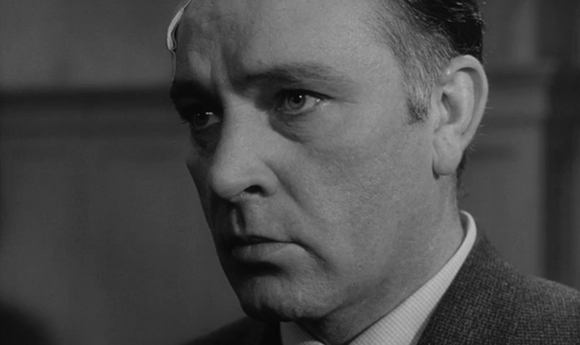 Adapted from the John le Carré novel, this is a black & white spy thriller that personifies cold war paranoia in ways that Bond never could. Richard Burton is an operative working in Berlin before being demoted to a librarian job. It looks like our narrative is heading in a direction hardly fit for a spy film. Its intentions are not so obvious at first, and it keeps its audience working for the rest of the film.
 Peter Lorre has a face that will forever live in cinematic infamy, and it started with M. In truth, Fritz Lang’s drama involving a serial killer feels fresh and engaging even after all these years, maybe because humanity hasn’t changed all that much. We still murder, we still kill, we still seek justice, we still give into our base desires, and there’s not a perfect person among of us. Each one of us has our faults — our own personal downfalls.
 It is well documented that Shadow of a Doubt was Hitchcock’s personal favorite of his own films. That’s quite a telling statement when you do a quick scroll through some of the titles up for contention. Vertigo, Psycho, Rear Window, North by Northwest, Notorious, even The Birds. And yet the famed “Master of Suspense” chose the often glossed over Shadow of a Doubt. If we take a slightly closer look it makes a great deal of sense as the film follows through with one of Hitch’s most prominent credos, “There is no terror in the bang, only in the anticipation of it.”
 His train comes barreling towards town with smoke spewing ominously. For now, his oblivious family is just happy to see his face, especially his oldest niece and namesake Charlie (
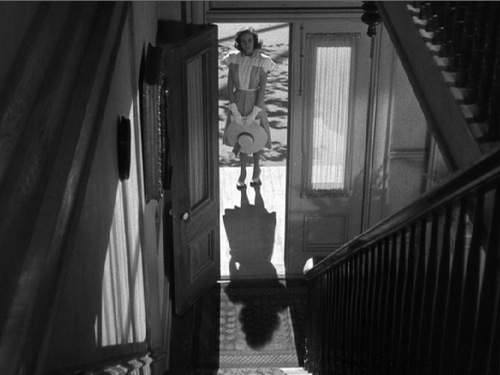 Unfortunately, the role of Detective Saunders feels rather shallow, but that’s hardly something to get stuck on. If that were the case, we could easily point to Charlie’s parents who seem way too old. But they are perfectly average, ordinary folks, as played by Henry Travers and Patricia Collinge. The script work of the preeminent Thorton Wilder (Our Town) and the on-location shooting in the Everytown of Santa Rosa lend a universality to this thriller’s impending dread.


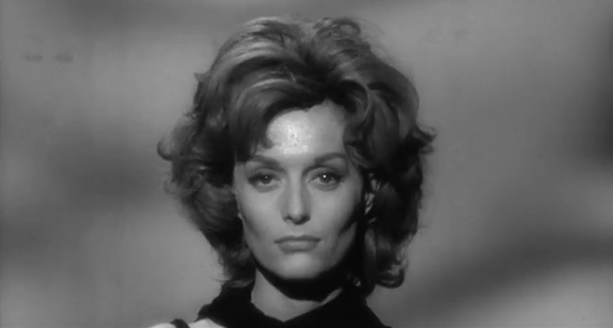
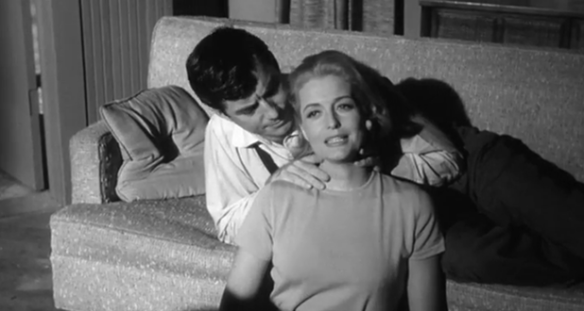 Of course, her first customer happens to be a police chief named Griff (Anthony Eisley), who advises her to skedaddle out of town as quick as possible. He gives her the details on a cozy joint across the border known for their Bonbon girls. He thinks he’s got her pegged, but Kelly goes and does something even he wouldn’t expect.
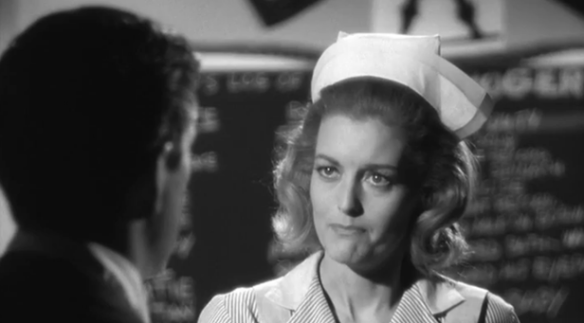 The social commentary is there. The characters are interesting. Meanwhile, Fuller slices and dices through taboo subjects that would have horrified censors and yet he brings them to the forefront in such a way that hardly glorifies them, but actually gets them out in the open. Every detail isn’t written out, but Fuller throws us into the narrative and allows us to track with him. He puts a little faith in his audience.
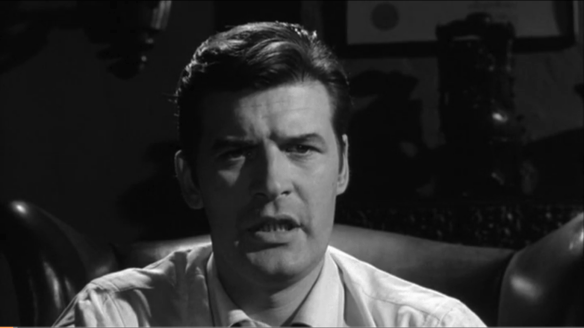 “This long corridor is the magic highway to the Pulitzer Prize” – Johnny Barrett
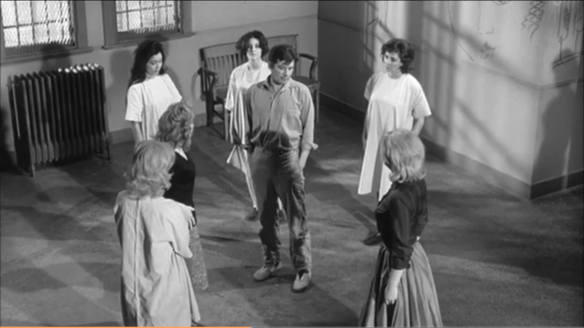 Behind the pearly gates, there are brawls galore and noisy neighbors riddled with all sorts of neurosis, quirks, and ticks. There are the good cop and bad cop who help care for the patients and keep them at bay. Johnny even begins to have hallucinations of his girlfriend drifting through his dreams. He gets introduced to hydrotherapy, dance therapy, and even faces a traumatizing experience at the hands of women in the female ward.
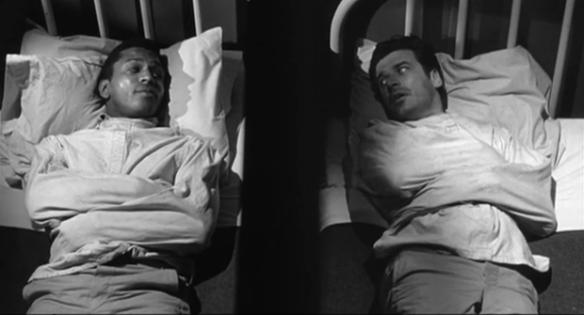 The boisterous, tumultuous chaos of the ward does almost become maddening, even to the viewer. Johnny has a few angry outbursts of his own as the strain of the facility gets to him more and more every day. Electric shock therapy among the other treatments leaves him mixed-up, confused, and overtly paranoid. He’s hardly the man we met in that office so many days ago and even if he got the scoop he was looking for, at what cost? Shock Corridor has a thunderously disconcerting ending worthy of a Fuller production.
