The Tall T (1957)

The_Tall_T_1957_PosterThe Tall T is a little different riff on the Budd Boetticher western, because it follows a former ranch hand named Pat Brennan who makes a stop at a local stagecoach way station to pay a visit to some locals before riding into the nearby town. Quickly we can see that Brennan is a little more jovial and still as tough as many of the other figures Scott has played.

He also is a first rate ranch hand, and yet after a bet with his old boss he loses his horse, because a bull throws him. Brennan attempts to catch a ride with a stagecoach with happens to be carrying two honeymooners, the timid Mrs. Mims and her stuffy husband. Reluctantly he is allowed to ride shotgun with the old time driver Rintoon (Arthur Hunnicutt) and it ends up being a regrettable decision. Mistaken for the regular stage, the four are hold up by three merciless outlaws looking for a big payoff.

They are led by Frank Usher (Richard Boone in a villainous turn), but the most deadly is Chink (Henry Silva), who seems eager to knockoff as many people as possible. And so a tense game of life and death ensues.  Rintoon attempts to fight back,  Mims agrees to go the cowardly route and ride off to try and attain ransom money. Brennan simply bides his time.

Unrest begins to build between the outlaws and Brennan takes his chance to save Mrs. Mims from the leering Billy Jack and bloodthirsty Chink. As the old story goes, the ringleader Usher is the only one left, but he has one last trick up his sleeve.

O’Sullivan’s role felt relatively minor, but it was quite fun to see Have Gun Will Travel’s Richard Boone opposite Randolph Scott. It made for a relatively interesting conflict.

3.5/5 Stars

Seven Men From Now (1956)

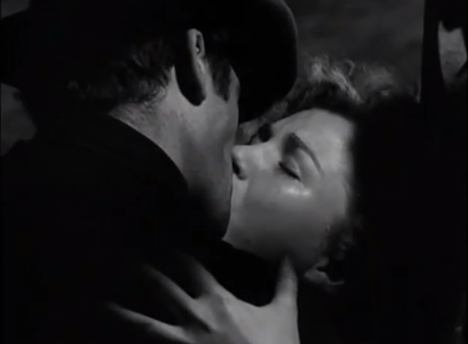
220px-Poster_of_the_movie_Seven_Men_from_NowAlong with Detour, Budd Boetticher’s Seven Men from Now is undoubtedly one of the greatest B-films I have seen to date. It rejuvenated the career of Randolph Scott who plays gruff sheriff Ben Stride. We are introduced to the often stoic man when he walks into a dimly lit cave during a torrential downpour. There he meets two strangers and demonstrates his skill with a gun for the first time.

For the rest of the film, he comes alongside a couple from the East, struggling to move westward with all their possessions carted on a wagon. The husband John Greer (Walter Reed), is a chipper man, but not a very adept pioneer. His kindly wife Annie (Gail Russell) loves him in spite of this ineptitude. He doesn’t say much, but Stride seems to like them both as well or at least, he knows they won’t make it very far without help. So after helping them get their wagon out of some thick mud, he sticks by their side.

They are eventually joined by Bill Masters (Lee Marvin) and his accomplice Clete, who look to make some money in the wake of Stride. He willfully explains to the Greers how Stride used to be the sheriff in the town of Silver Springs, before his wife was killed by a group of bandits when they were robbing a Wells Fargo shipment. He made it his mission to track down the seven men who took part in the act. And so as an opportunistic schemer Masters is content with riding along with Stride until the opportune moment to score a big payoff.

In this way, he helps the Greers and Stride fend off some Apache and even puts a bullet through a man before Stride gets it. If we didn’t know better, we might think that Lee Marvin has gone to the good side for once. But that’s not so. He’s full of insinuations, flirtations, and veiled threats that somehow feel more ominous than a Vince Stone or Liberty Valance. It’s not just physical brutality but he is playing perhaps an even deadlier game of mental warfare. Against not only Stride, but Mrs. Greer, and her husband.

It’s around this point that Masters and Clete make a move. They alert Stride’s nemesis to his plans and just like that two men go and ambush the veteran sheriff. He knocks them both off after receiving a wounded leg that leaves him unconscious out in the canyon. Luckily the Greers come across him and John decides to take responsibility for what he has unknowingly done. He goes into town to face the music for the role he has ignorantly taken in this whole deadly affair. After discounting Greer as weak and spineless, Masters is finally forced to recant his previous statement.

What’s left is Ben Stride out in the canyon with the Wells Fargo shipment, but with two new bandits and Masters and Clete, it looks to be a bloody finale. After a bit of backstabbing, Ben Stride stands alone in the aftermath. He has completed his odyssey and he says goodbye to Ms. Greer with a new resolve to take on the role of deputy sheriff in Silver Springs. But it’s doubtful if that is the end of his story.

4/5 Stars


The Bravados (1958)

The_Bravados_-_US_film_posterThe Bravados opens with an ominous stranger in black riding towards a town. He doesn’t say much, but his presence alone creates tension enough. He gets led into town by the local deputy and after a meeting with the sheriff, he is allowed to stick around. His only reason for coming to the city of Rio Arriba is to watch the hanging of four outlaws, at least that’s what he says. But when he asks to see the prisoners, he surveys them and there is nothing but anger in his eyes.

As they wait for the hangman from out of town to arrive, Jim Douglas (Gregory Peck) gets reacquainted with the beautiful Josefa (Joan Collins). And nothing is said about their backstory, but there is obviously something between them. He at first refuses her offer to go to church, but requests to walk her over before reluctantly joining her in the chapel.

However, back at the jail, the hangman is not who he appears and stabs the sheriff in the back with the four outlaws getting away taking a local’s daughter with them. So the town is in a fury sending a posse after the fugitives led by Douglas.

And one by one Douglas tracks down the culprits. First, ambushing Parral (Lee Van Cleef) who he shoots after the man begs for his life to be spared. Next, he takes down Taylor and hangs him from a tree after dragging him behind his horse. The posse does eventually get the kidnapped girl Emma, but Douglas is far from satisfied, crossing the border to Mexico to finish the job. He guns down Zachary in a bar and his only target left is Lujan (Henry Silva). But that’s when things change. Douglas is knocked out of his blind rage for a moment. Because this whole vendetta began after his wife was raped and murdered. He went on an obsessive quest to find the four culprits and although these four no-goods constantly denied seeing his wife, he just went after them anyway.

It is Lujan who finally makes Douglas realize he made a mistake. In this epiphany, Douglas realizes he is little different than these four outlaws, willing to kill mercilessly, even in the name of justice. He goes back to town a hero, but he heads straight for the church where he confesses his wrongs to the local priest. He is a man with a lot to wrestle with, but also a lot to live for thanks to his daughter and Josefa. Although not quite as iconic and memorable, The Bravados, in a sense, is Gregory Peck’s version of The Searchers. This Henry King western in CinemaScope is noteworthy for allowing Peck to play another morally ambiguous character. He is no Atticus Finch.

3.5/5 Stars

Yellow Sky (1948)

yellowsky2From William A. Wellman comes an unheralded western with an intriguing cast dynamic. Gregory Peck is the undisputed star as the boss of a group of outlaws who ride into town, pull a quick bank job, and are forced to flee from the Cavalry across the desert wasteland. It’s the prerogative of “Stretch” (Peck) to continue across the desolate terrain, despite the obvious drawbacks. But everyone else reluctantly follows although a few are opposed including his biggest rival Dude (Richard Widmark).

The story could end there with the band of fugitives dying of thirst in no man’s land and it nearly does happen, but like a mirage, they come upon a ghost town. It’s like a sick joke because it seems that all the people have picked up and left. All that is except an old prospector and his plucky Granddaughter (Anne Baxter). She is wary of these marauders, and she is extremely protective of her old grandpa. The men get a bit lustful since they have not seen a woman for some time and she catches the eye.

Again, the path of this story seems like it will be stagnant once more and yet that’s before we knew that the two relations are sitting on top of a gold mine. That catches the attention of the outlaws and the avarice grows in the hearts of the men. Not to mention their lustful desires.

yellowsky4That’s what makes “Stretch” such an interesting villain as portrayed by Gregory Peck. Certainly, he does wrong in the eyes of the law, but he has his morals in a sense. He vows to the old man that they will keep their agreement to split the gold. It’s the honorable thing to do and he is smitten with the attractive Mike. But Dude is not so excited about this act of charity and so he gets the boys to turn on “Stretch.” They try and pin him down and thus unfolds the necessary gunfight. The power struggle reaches its apex in the shrouded saloon where “Stretch”, “Dude”, and “Lengthy” face off for one final showdown. Shots are fired and a desperate Mike goes charging in to witness the outcome.

The bad boys get their comeuppance and the stooges including Walrus and Half-Pint (Harry Morgan) are okay. Most importantly “Stretch” is now a straight arrow for the girl he loves by pulling the world’s first reverse bank robbery.

Yellow Sky was a thoroughly enjoyable story because it felt surprisingly dynamic and even graphic for a 1940s western. Highlights include Anne Baxter slugging Gregory Peck and dishing out the ultimate insult that he smells bad.  Peck is such a commanding presence, and it’s fun to see him in a darker role. Baxter was also deadly in a very different way than her backstabbing Eve Harrington. Richard Widmark and John Russell were worthy adversaries while Charles Kemper was the token fat guy. And I still cannot get over how young and dare I say, scrawny Henry Morgan looks.

I must confess that I have never read The Tempest, but this story is supposedly based on that Shakespearean tale. Well, now I know.

4/5 Stars


Support Your Local Sheriff (1969)

2e4c1-localsheriff5Funeral sequences are a mainstay of the western genre because they give us a chance to peer inside of characters and examine the time and place that is the west. It can be tough, hard, and most certainly brutal. Support Your Local Sheriff is a barrel full of fun because it takes many of these set pieces and subverts them for the sake of humor.

It opens with one of these typical solemn wakes for a man that no one seems to know or care much about. All too soon everyone is distracted by a speck of gold and mayhem commences. It sets the tone for the entire film and the people we will soon become acquainted with. All the action is wonderfully exaggerated by a frantic harmonica-laden score with jaw harp included. It’s twangy madness that works to a tee. But enough of that.

The mining town of Calendar is a wild, untamed place built for the sole purpose of mining. The rough and tumble Danby Family seem to have a monopoly on the gold trade controlling the only road out of the town. It’s a big mess.

That’s the climate that Jason McCullogh walks into (James Garner) on his way to Australia. After seeing Joe Danby (Bruce Dern) kill a man, he decides to sign on as the town’s sheriff. Town “mayor” Olly Perkins and his entourage are surprised that any person would want to take the job, but after seeing Jason’s marksmanship they giddily agree. Quickly he astutely breaks up mud fights, puts Danby in jail and finds himself a deputy in Jake (Jack Elam).

Most of the rest of the film follows Pa Danby (Walter Brennan) and his two nitwit sons as they try and get their equally dumb baby brother out of prison. It’s followed by a long line of hired gunman who all fail out knocking the sheriff off.  Jason also has encounters with Perkins’ often ditsy daughter Prudy (Joan Hackett). It would be wrong to say that Prudy is the only whimsy one, because it feels like everyone in town has a screw loose, from the hero to the villains.

That’s what makes Support Your Local Sheriff so appealing. James Garner is as charming a wisecracker as ever, but on a whole, this film is full of comedic misunderstandings, caterwauling, and stupidity with an ignoramus around every corner. There’s a jail without bars, villains who are wimps, a girl who hides in a tree and lights herself on fire, even a protagonist who seems bent on heading off to the real frontier in Australia. What?

Thus, this rewriting of your typical western trope of a man taming the west works out quite well and in many ways feels like a precursor to Blazing Saddles. It was a lot of fun to have two personal favorites in James Garner (The Rockford Files) and Harry Morgan (MASH) in a film together. Joan Hackett was a lot of fun too. I really want to see more with her (ie. Will Penny, The Last Sheila).

3.5/5 Stars

Hondo (1953)

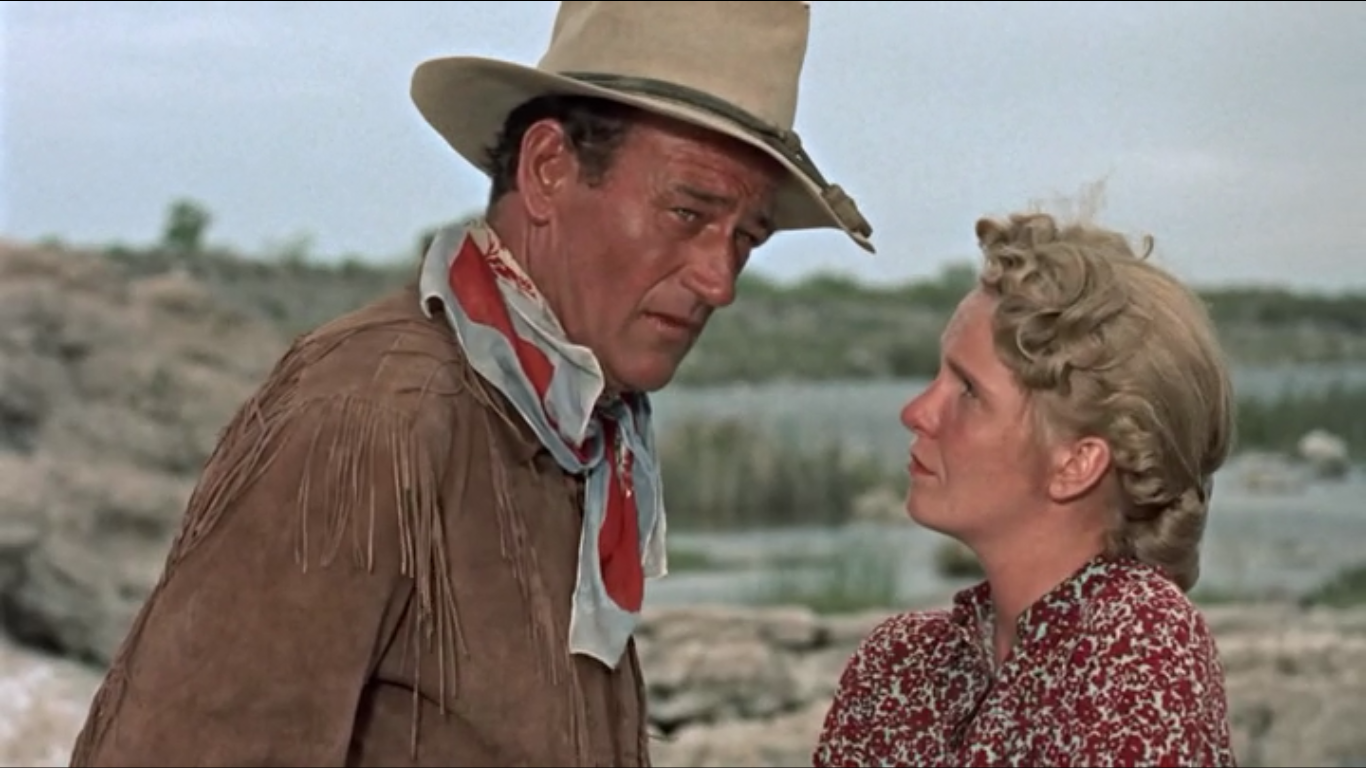
0a5df-hondo3In many ways Hondo feels a lot like Shane since it came out the same year and follows a wandering gunslinger who comes in contact with a frontier family. The story based off the novel by famed western writer Louis L’Amour is a lesser addition to the Western canon, but its hard to complain about a film with John Wayne. I was not a big fan of Geraldine Page (she seemed too needy) but I was happy to see some western mainstays in Ward Bond and a young James Arness.

The film opens with homesteader Angela Lowe and her 6 year old son Johnny spotting a man off in the distance. At first they are tense but as he gets closer and they interact with Hondo, it is clear he only has the best intentions and needs assistance since he lost his horse.

A great deal of the film revolves around the conflict between the native Apache and the U.S. Cavalry with Lowe and her son stuck in the middle of it all. Both sides seem to be at fault at times and in the right in others. Hondo used to be a scout for the Cavalry and he killed three men in the past year which raises the lady’s suspicions but she does not know the circumstances.
When Hondo’s not having run-ins with the Apache or on the brink of being killed, he gets in hot water with Lowe’s vagrant husband. Through it all he returns to the ranch and watches over Johnny who has been made a blood brother to the Apache.
His relationship with Angie deepens and when all seems to be lost during an Apache ambush, he breaks up their wagon circle and kills the enemies leader allowing them to flee. Hondo has a happy family life ahead of him, but it is pretty evident that the Apache existence will die out soon with the arrival of still more Cavalry forces.
3.5/5 Stars

Little Big Man (1970)

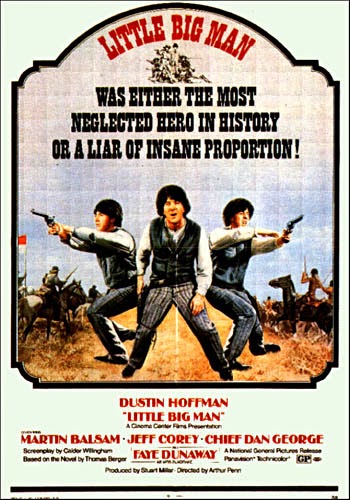
9a376-little_big_manAlthough the film certainly had so good parts for some reason it did not quite jell with me. Focusing on the positive first, this was a revisionist western that tried to depict an alternative picture of the American west from the eyes of Native Americans. Although not perfect it was trying. Dustin Hoffman also gave an impressive performance that found him drifting between the worlds of “the White man” and “the Indians.”

Here is where I get into the main problem that I had with the film. Most of it had to do with age and casting. It was brave and somewhat strange that Dustin Hoffman portrayed his character from his teen years up until he was over a century old. For the most part Hoffman pulled it off. I also was kind of uncomfortable with his sister Caroline who looked like she was 30 even though she was only supposed to be a child. Then, you have Faye Dunaway. That had to be the strangest thing in the film. Although younger in real life, she was Dustin Hoffman’s adopted mother for a time and she played it up.

In some ways this film reminded me a bit of The Butler because we have a main character who grows old in front of us and he ultimately has a role in many diverse bits of history. Like that film, Little Big Man is quite interesting and at times entertaining, but the implausibility of the plot can get to you.

In defense of this film, I really did not know what I was getting myself into and so it surprised me with its mix of violent drama and a sprinkling of comedy. I would have liked to have seen more of Faye Dunaway and Martin Balsam, but it is what it is. Chief Dan George was the breakout character for sure. He was very enjoyable to listen to as he mentored Little Big Man.

3.5/5 Stars

El Dorado (1966)

5a6c7-eldorado3 El Dorado is less of a remaking of Howard Hawk’s previous western production Rio Bravo and more of a reworking of it. This time the town drunk is sheriff J.P. Harrah (Robert Mitchum), who got his heart broke by a girl. The kid is Alan Bourdillion Traherne (James Caan) also known as Mississippi. He can be found with a shot up old hat on his head and a sawed off blunderbuss for a gun. It’s not his weapon of choice anyway. Then, there’s old reliable Bull Harris (Arthur Hunnicut), who holds down the fort and looks after the sheriff when he’s laid up. As the main love interest, there’s Maudie (Charlene Holt), a resident of El Dorado since her childhood days.
As always the man who calls the shots is Cole Thorton (John Wayne), an old war buddy of J.P.s. He has one of the fastest draws around but also has a surprisingly soft spot for doing good. He befriends the younger Mississippi and comes to the aid of J.P when he could have joined the other side.
Thorton rejects the offer of local villain Bart Jason (Ed Asner), but a threatened local ranch family wishes to take no chances. When it is all said and done Thorton receives a bullet in the back that causes him problems afterward.
Now lethal hired gun Nelson McLeod (Christopher George) has taken up Jason’s offer, and they ride into the town. One of their first meetings takes place in the old church and it ends in the arrest of Jason for his part in the whole affair. Another shootout takes place that night and now the formerly drunk sheriff also gets nicked in the leg.
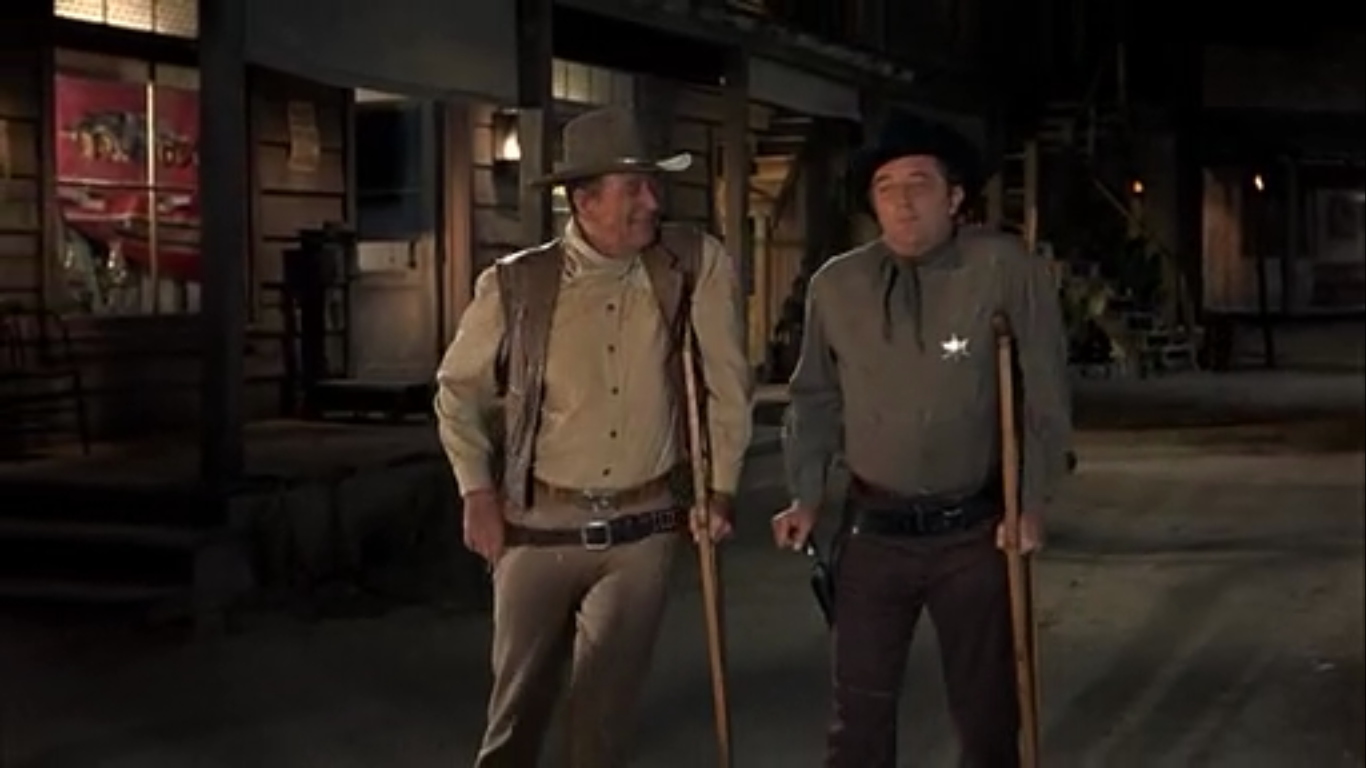
Maudie is fearful of the thugs milling around her place and when Thorton and Mississippi go over to investigate they get ambushed because Cole has physical ailments of his own. They get Cole back but not without giving up their own prisoner. With one of the McDonald’s kidnapped a quick plan is devised and the final showdown begins. Our ragtag crew gets the job done, but J.P. and Cole make quite the pair. They look more like crippled old men than hardened gunfighters, both hobbling down the street with a crutch.

I must admit I am partial to Hawk’s original Rio Bravo and I have yet to see Rio Lobo, but I did really enjoy these characters. Wayne and Mitchum seem to play against type because at times they are quite comical. Mitchum is not a tough P.I. or ruthless villain, but a town drunk! Wayne can hardly shoot a gun at times and he even gets taken. That’s unheard of. It’s as if they softened with old age, but I don’t mind, because the interactions between those two, Mississippi, Bull, and Maudie are a lot of fun. Even the antagonist McCleod is a man with a sense of honor and good fun. Some great moments include Mississippi’s miracle concoction and numerous bars of soap being brought to the dirty sheriff when he finally takes a bath! The initial introduction of the two leads is priceless too. They both were smitten with the same girl.

Howard Hawks really knew how to make westerns not simply about guns and shootouts, but colorful characters who oftentimes seem more content kicking it back in the jail than in smelling out trouble. He proved it again with El Dorado.

4/5 Stars
A gallant knight,
In sunshine and in shadow,
Had journeyed long
Singing a song, 
In search of El Dorado

Forty Guns (1957)

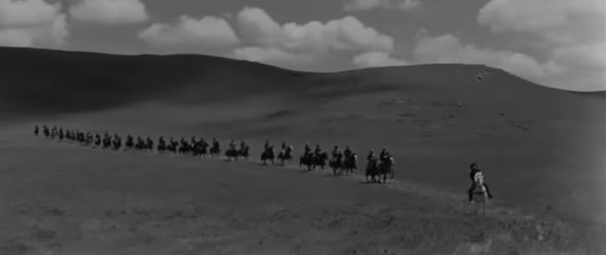
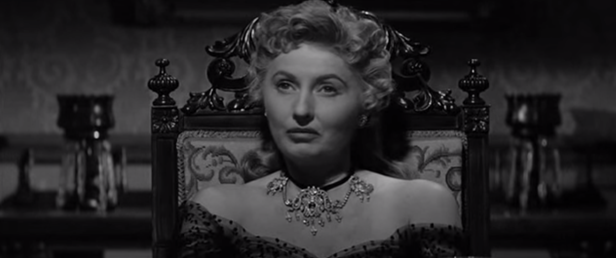
6fb70-fortyguns1Samuel Fuller has got an eye for style, cinematic scope, and at times, subversive mayhem. It’s no coincidence that Forty Guns was shot in Cinemascope, and it is one of the enjoyments of watching this film, which constantly bounces back and forth between long shots and close-ups. To start things off, Barbara Stanwyck is Jessica Drummond, the “High Ridin’ Woman with a Whip,” and she is the heiress of a self-made frontier empire.

It helps to tote forty guns around with her, but she is not as unethical as she would appear at first glance. On the other side are the Bonnell brothers, former gunslinger Griff (Barry Sullivan), number two man Wes (Gene Barry) and then the baby Chico. After they arrive in town, on behalf of the Attorney General, the nearsighted sheriff (Hank Worden) is gunned down by a drunken troublemaker who just happens to be Drummond’s kid brother. Then his buddies proceed to trash the town all in the name of good fun.

Soon Griff straightens Brockie out and Jessica comes into town to retrieve him. Next, Griff comes with a warrant to Jessica’s ranch and in a memorable scene, literally made for Cinemascope, the warrant gets passed down the table. Jessica wants no trouble but soon a crooked sheriff named Logan (Dean Jagger) want to finish off Griff. It doesn’t go so well and he gets more and more jealous of Jessica’s increasing love for the oldest Bonnell brother.

Ultimately, Brockie ends up in the clink, but he uses his sister as a shield in an attempt to escape. For once Griff loses his cool and sprays him with bullets and that’s not all. For good measure, Fuller has Griff ride solemnly off in his buckboard only to have Jessica scamper after him. The power dynamic see-sawing once again.

Yet again, Fuller never seems to do anything conventionally or demure. His film has a reformed gunfighter who calls his former profession that of a freak. The leading female character dominates most everyone else and has a ballad written about her. There are tornadoes that envelop the screen. Then, only Fuller would have the audacity to kill someone during their wedding ceremony, and he does it without skipping a beat.

Among other things, it is a film about guns, brothers and sisters, and love. Griff packs a gun on him. Jessica always has guns behind her. Griff has a younger brother who has much to learn. Jessica’s brother will never learn. That being said, the inventive visuals, typical brutality, and the memorable casting of Stanwyck were all in a day’s work for Samuel Fuller.

4/5 Stars

Once Upon a Time in the West (1968)

27ccb-once_upon_a_time_in_the_westStarring Charles Bronson, Henry Fonda, Claudia Cardinale, and Jason Robards with director Sergio Leone, this is another memorable Italian western. The film follows a recently widowed beauty (Cardinale), the villainous killer who is after her (Fonda), a anti-hero bandit (Robards), and of course the man with a harmonica who is looking for revenge (Bronson). The gunman Frank commits murders, turns on his employer the railroad tycoon, and forces the widow to auction off her land. However, “Harmonica” comes to her aid and then he is confronted by Frank several times since he wants to know the man’s purpose. After a flashback we know what “Harmonica” wants and another gunfight ensues. The ending is bittersweet but the town’s future looks bright thanks to the railroad and the radiant widow. The long opening sequence sets the tone nicely for this visually beautiful film. It moves at its own pace and it has a good score and great characters including an evil Henry Fonda!

5/5 Stars