It’s hard to grow tired of Bob Hope. In many ways, he’s a universal entertainer — transcending time — circumventing the decades with a brand of humor that is timeless. And the same goes for his iconic persona. He can quip with his lips like Groucho Marx but he’s more of a lovable dope. He likes to think he’s clever and when he lets his mouth run off Hope certainly is, in a cheeky sort of way. It’s just his characters who are always dumb.
Whether it was his own stellar ad-libbing or a careful premeditation of calculated gags, there’s no doubt that Bob Hope has staying power. The Road Pictures with Bing Crosby are a testament to that, but in my own personal estimation, Son of Paleface is arguably one of his best films. Ironically, it came as a sequel to the standout hit Paleface from 1948. But for many, the second go-around is markedly better.
Here Hope is reincarnated as a pompous Harvard man, Junior Potter, a young college magnum cum laude who is intent on heading out West to collect on his heralded father’s long-lost fortune. He expects the welcoming committee to be waiting for him, but there’s only a town of locals intent to settle long-standing debts.
There’s also someone else who is quite interested in Junior Potter and most specifically his supposed fortune — the wanted outlaw The Torch. Of course, no one knows that this brazen outlaw comes in the form of sultry saloon owner Mike (Jane Russell) the jewel of every man’s eye. Junior’s not the least among them, not knowing what her true intentions are. He doesn’t mind getting to know her a little better and she obliges, though it doesn’t help he has all the charm of a bad toothache.
Mike’s not the only one masquerading, however, a government agent is undercover as well, bent on catching the notorious outlaw in his/her tracks. Enter Roy Rogers with his trusty steed Trigger stage right. Thus, the stage is set for a classic western showdown dragged through the mud and riddled with jokes thanks in part to Hope. Rogers and Russell are mostly serious but once and a while they offer a quip or two because Hope prompts such a response every now and then.
Frank Tashlin who helped script Paleface a few years before, wanted more creative control and found himself helming the sequel much more to his liking. But this a film propelled by its leads. There’s also are surprisingly good musical numbers starting with the earlier hit “Buttons and Bows” and bolstered by the catchy additions of “Wingding Tonight,” “Four-Legged Friend,” and”Am I in Love?”
It’s true with the great parodies that they know when to go for gags and when to play it straight. There needs to be a clash of tones, a cacophony of the outlandish with the dramatic. Hope supplies the pratfalls and one-liners with his usual aptitude — just like another walk in the park or an Oscar ceremony (he did host 19 times after all). Because it’s exactly that type of material that’s built into his persona free of charge. It flows out so naturally, with extreme ease. Breaking up the action is exactly what we expect from him. There are madcap chase scenes, catcalls and pratfalls, fourth wall breaking, and numerous prattling asides that Hope fills with his usual wit. I used to watch Hope a lot as a kid and even after so many years it still feels fun.But that’s not to discount Roy Rogers and Jane Russell one bit. They make up a winning western trio indeed.
3.5/5 Stars
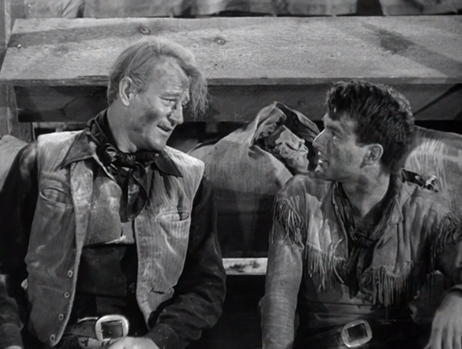
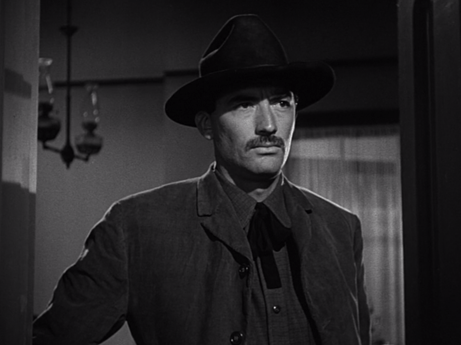 “Ringo don’t look so tough to me.”
 Of all men to understand Ringo, you would think that the local Marshall (Millard Mitchell) would be the last, but he happens to be an old friend of the gunman. They used to run in the same circles before Mark softened up. His life mellowed out, while Ringo’s reputation continued to build.
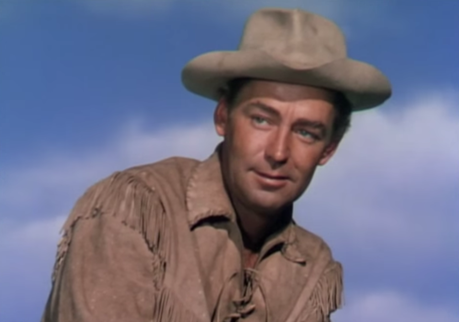
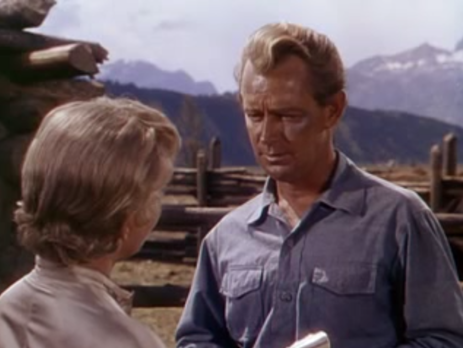
 The main reason Ringo stays in a town that doesn’t want him is all because of a girl (Helen Westcott). He waits and waits, biding his time, for any word from her, and finally, it comes. He gets his wish to see her and his son in private. These scenes behind closed doors are surprisingly intimate, casting the old gunman in an utterly different light.
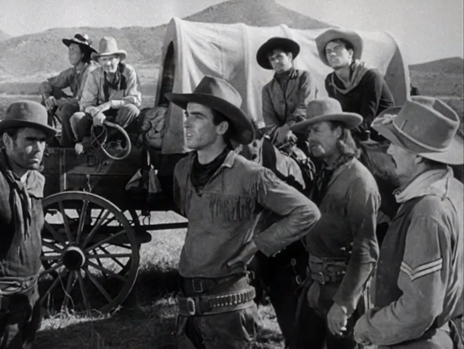
 My father has always maintained that two of his favorite films are The Magnificent Seven and True Grit. The first one makes sense with its stellar cast, resplendent score, and some top rate gunslinging. The second film, well, it makes sense too, but for completely different reasons.
 “Nobody throws me my own guns and says ride on. Nobody” ~ James Coburn as Britt
 Into the valley road the seven rather like the light brigade, at first simply preparing to train up and prepare their little village of farmers to fight back against the brutal outlaw Calvera (Eli Wallach). But there’s something that happens over time. When you spend time in close proximity with people, eating their food and sharing their shelter, it’s hard not to build a bond — a connection that holds you there. At first, it seems of little consequence when the enemy gets beaten back, but everyone knows they will return with a vengeance.
 And we get the final skirmish with guns blazing, bullets flying, and lives being put on the line. Here is a film where the final body count deeply matters. Not so much of the enemy, but of our heroes, because each one chisels out a little niche for themselves. Everyone has worth and importance even as they jockey for screen time and it pays off in the end. They fight with honor just as they die with honor. Perhaps it might seem futile, but not without significance. The little village is left in peace to live out their days in tranquility. Calvera’s final words echo in their ears: “You came back – for a place like this. Why? A man like you. Why?”