 Bridge to the Sun is one of those films that was ahead of its time. Its main actors are hardly remembered by modern audiences. The top-billed leading lady, Carroll Baker, was probably more notorious for her controversial persona in films like Tennessee’s Williams’ Baby Doll than she was famous. James Shigeta was a pioneering Japanese-American actor, who was once told, “If you were white, you’d be a hell of a big star” (The Slanted Screen). He aged gracefully but was slowly relegated from leading roles to bit parts. Belgium director Etienne Perier was only a slight blip on the Hollywood radar. When it came out in 1961, its narrative based on the memoir of Gwen Terasaki ended up being an abysmal flop. Honestly, it’s not all that surprising, because the public was not ready for such a film, and its candid depiction of interracial marriage. Now, with a fresh pair of eyes in the 21st century, Bridge to the Sun looks quite extraordinary. Certainly, this is a love story, but under very different circumstances, in a very different world. Although it was made in the classical Hollywood mode, it still manages to groundbreaking, not necessarily due to its form, but thanks to its content. Because Bridge to the Sun places an Asian man and a Caucasian woman together, as they navigate two starkly different cultures both tottering on the brink of war.
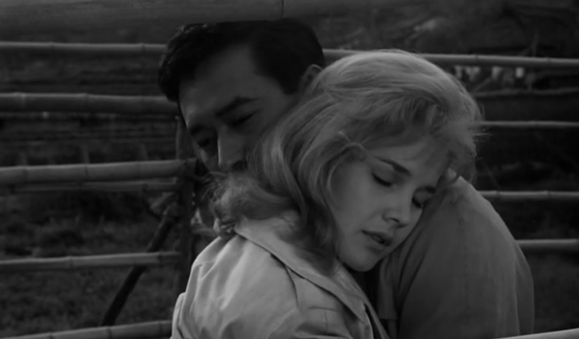
 In truth, this film does not shy away from showing their affection, even though it undoubtedly made some viewers squeamish at the time. More than once Gwen and Terry embrace in intimate moments that signify the deep-rooted love that holds them together. Sometimes it’s far from easy. For instance, when they first travel to Japan, Gwen finds it difficult living in a culture where women are meant to be wholly subservient to their husbands. She’s fine with the bowing and the taking off of shoes even, but not being allowed to speak her mind is about the limit.
This sentiment is reflected perfectly in a sequence right after some guests solemnly file out of Terry and Gwen’s home after a dinner party. Gwen is dressed in traditional garb with an annoyed look plastered on her face, and her husband silently glowers behind her. Their home is quiet and still, the light all but gone from the dark interiors. Finally, she turns around and breaks the silence by voicing her annoyance.
What follows is a single medium shot that frames both our protagonists and then a classic shot-reverse shot paradigm perfectly captures the ensuing quarrel between the married couple. It’s seamless, hardly extravagant, and it allows all the focus to fall on the verbal blows being dealt during their marital tiff. There is also great irony in how Gwen is dressed in a kimono and wig, while at the same time pushing back against the cultural expectations. The intonations of her voice are high-pitched and enraged while Terry’s retorts are low and authoritative in juxtaposition.
One of the most telling lines comes when Gwen positively erupts after Terry chides her to keep her mouth shut, “according to custom.” The major distinction is that this is his custom and not her own. A cultural gap has developed. One set of customs feels antiquated, the other modern. One set seems honorable, the other blunt. There is this obvious dissonance between them, and in many ways, these two individuals are a perfect embodiment of the chafing that is going on globally. Except the important difference is that Terasakis manage to compromise, while the world around them plunges ever deeper into conflict.
 Gwen and Terry cannot stay mad forever, especially with the birth of their little girl Mako. In fact, it is actually in a moment when their family is in danger of being pulled apart that Gwen shows her true resilience and loyalty as a wife. Pearl Harbor has just blown up and that means there is a freeze on all Japanese aliens. Terry is stuck at the embassy about to be deported, and an FBI agent advises Gwen that she would be much better off staying in the states. But as she converses with him you can see the determination in her eyes. She knows what it means to go to Japan. Her daughter as a child of mix race will be scorned, and Gwen herself will be looked down upon if not endangered by her status as an American citizen.
Her blubbering aunt implores her not to go, but in one of the film’s most impactful close-ups, Gwen tells Aunt Peggy off. She is not about to be split up from her husband – not after all they have gone through. It is in this other high intensity moment that we see her for who she truly is. She’s not about to be constrained by the cultural expectations placed upon her, and it goes both ways whether they are Japanese or American.
Mrs. Terasaki traverses the gauntlet of jeering crowds with all the other Japanese wives. She’s an easy target in the sea of Japanese, and the racist slurs are aimed just as scurrilously at her as anyone else, perhaps even more so. A noose hangs around the neck of a grotesque caricature of Tojo outside the fence, and still Gwen goes bravely on, covering her daughter’s ears, and comforting Mako the best she can in the hateful tumult. In this moment, we have yet another fascinating intersection of cultures. Gwen, a Caucasian woman from Tennessee is being transported along with alien immigrants back across the ocean like one of “the enemy.” She willingly gives up her status, her comfort, and even her very safety to hold her family together.
Of course, the situation in Japan is not ideal either, and the Terasaki’s have it rough. When they arrive abroad there is the same discrimination and the myriad of strange looks. Terry’s loyalty is questioned as he tries to mediate between the two warring nations. The ethnicity of his wife doesn’t help, and the fire bombs raining down from up above don’t exactly calm their nerves. But again and again, Terry and Gwen prove to be a resilient couple.
With the war in high gear, the Terasaki’s eke out an existence, while Terry does his best to avoid imprisonment from his own government. Meanwhile, the bullets and bombs continue to rain down, even in the countryside where the family now resides. On one such occasion, Mako is scampering through town with a friend and “the enemy” strikes. To his credit, Perier convincingly pieces together aerial footage with what is occurring down below. Airplane motors whirr menacingly. The Terasakis race towards town frantic to find their daughter. The planes begin their descent followed by waves of bullets as Japanese soldiers get in position to fight back. It’s utter chaos with smoke, fires, overturned vehicles, fleeing people, and finally dead bodies. The death toll includes soldiers and a little child. Mako lives, but her best friend perishes trying to salvage a doll. It’s in this climatic moment that all the Terasakis are huddled together after both parents rush to protect their girl and give aid to the dying friend. The fighting persists and both look up. First, Terry yells out something almost completely stifled by the noise, and then with Mako cradled in her arms, Gwen screams, “No More!” at the top of her lungs in exasperation.
Miracu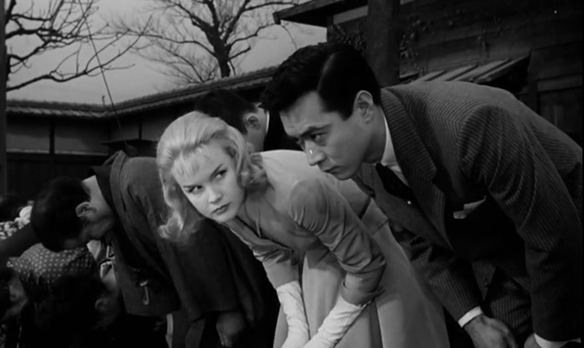 lously these individuals salvaged their marriage and preserved their family. Meanwhile, the world around them would not make the necessary concessions. It allowed cultural differences to define relationships, and ultimately increase the void between nations. The rubble of WWII was eventually cleared and new hope was built upon that foundation. In reality, the chronicles of the Terasakis was an emblem of that hope. Inherent in their story is the possibility that two people and two nations really, can be reconciled and even thrive together. Perhaps the United States was not ready for such a message to come out of Hollywood, even as late as the 1960s, but nevertheless, it seems like a message we can certainly take to heart today.

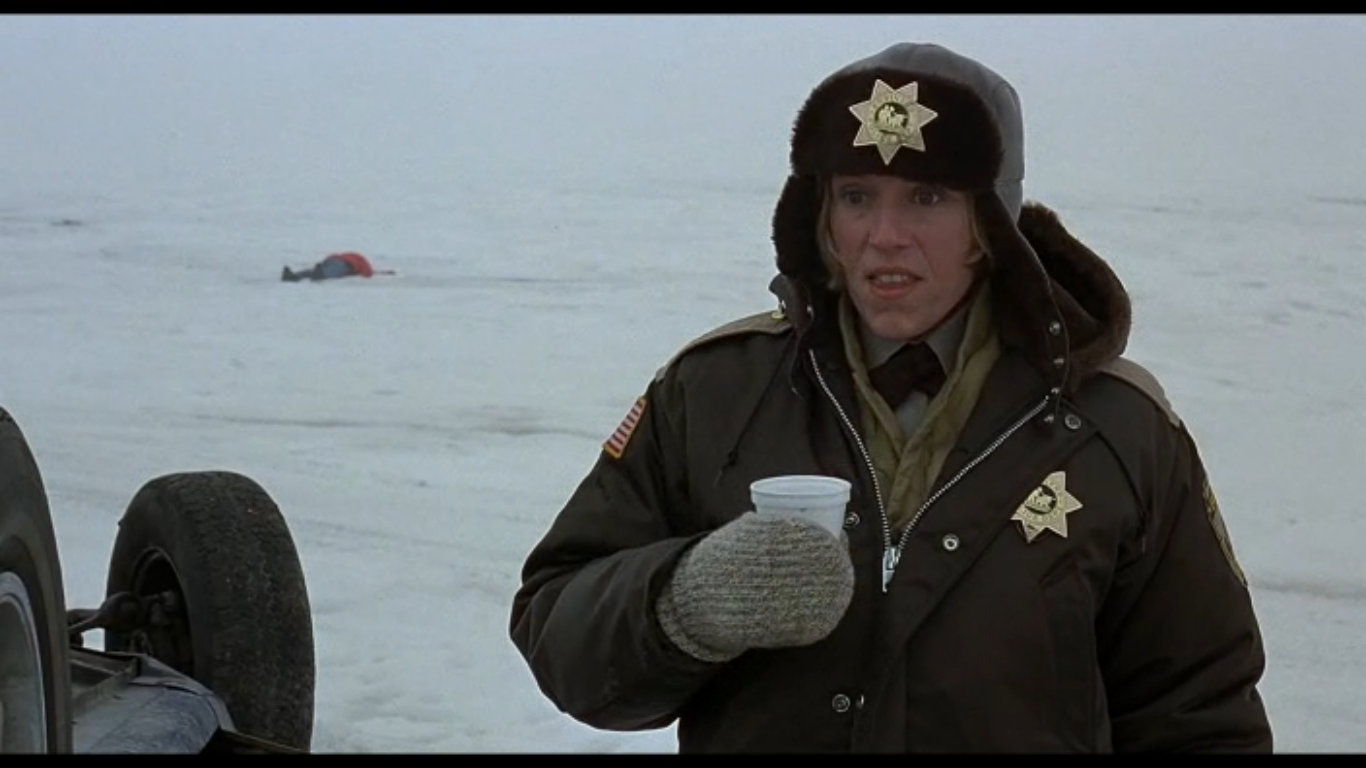 The Coen Brothers have always been an interesting case for me. I admit that there are still a lot of their films that I wish and need to see. Films like True Grit and Fargo I find thoroughly enjoyable or at least passable, but they do not completely resonate with me. However, I certainly respect them as writers, directors, and auteurs, because they know the lineage of film as a medium and they have their own unique way of approaching movies. It’s often clever, unique, and carries a wickedly funny tone no matter their subject matter.
 “I don’t like anybody pushing me around. I don’t like anybody pushing you around. I don’t like anybody getting pushed around.” Van Heflin as Sam Masterson
 17 or 18 years later a full-grown Sam Masterson (Van Heflin) decides to return to his old stomping grounds, Iverstown, on a whim. He’s surprised to learn that the “little scared boy on Sycamore street” is now District Attorney (Kirk Douglas). And he’s now married to Martha Ivers (Stanwyck). She and Sam had something going long ago, but he’s all but forgotten it by now. He’s made a living as a gambler who has a pretty handy dandy coin trick, but really Heflin’s character could be anything.
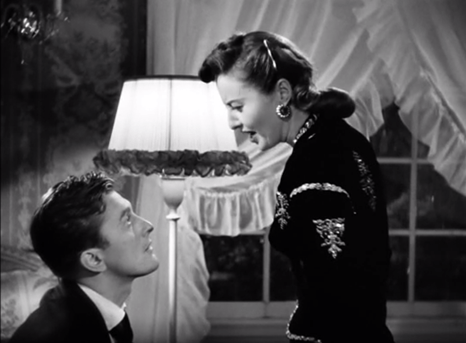 We don’t actually see Barbara Stanwyck’s face until 30 minutes into the film, but it doesn’t matter. She as well as
  Honestly, although Stanwyck is our leading lady, it’s quite difficult to decide whose film this really is. Van Heflin and Barbara Stanwyck are at its core, but then again, Scott and Douglas do a fine job trying to upstage them. There’s a polarity in the main players, meaning Stanwyck and Heflin have the power, and the other two are the subservient man and woman respectively. However, the film really becomes a constant tug-of-war. Douglas is not just a spineless alcoholic. There’s an edge to him. Scott seems like a softy and yet there’s an incongruity between her persona and that prison rap that hangs over her. Heflin seems like the one relatively straight arrow because as we find out, Stanwyck is fairly disturbed. She’s no Phyllis Dietrichson and that becomes evident in yet another climatic conflict involving a gun. But she’s still demented, just in a different way.


 Perhaps
 A quaint, unassuming film, especially up against other more lavish Ernst Lubitsch works like Trouble in Paradise and Heaven can Wait, Shop Around the Corner still manages to be in the upper crust of romantic comedies — even to this day.
 Robert Mulligan is an unassuming film director. Man in the Moon would be his last film in a career that was not so much illustrious as it was respectable. In truth, I’ve only had the pleasure of seeing one of his other films — his crowning achievement To Kill a Mockingbird.
 Arguably, the next most important character in Dani’s story is Court (Jason London). They have your typical terse meet-cute that signifies only one thing. They must fall in love. It turns out he’s the eldest son of an old friend of Mrs. Trant. Soon things change for young Dani because she’s never known someone like Court, much less liked a boy.
 The second half of the film enters melodramatic territory that first hits the Trant’s with familial turmoil, and then Court. Dani for the first time in her life is faced with the full brunt of tribulation. What makes matter worse is her feelings are all mixed up. She loves her sister. She hates her sister. She cannot bear to see Court. She cannot bear the suffering. It’s in these moments that uncomfortable feeling well up in the pit of your stomach.