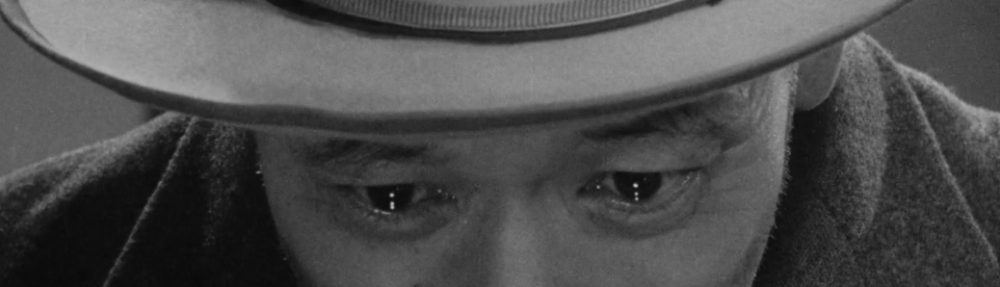
Review: Dr. Strangelove or: How I Learned to Stop Worrying and Love the Bomb (1964)

Dr._StrangeloveHow to speak of Dr. Strangelove? To clarify I mean the film and not the character. First and foremost, it’s one of those films that has so much significance, because of the era it came out of and for the way it represents that time and space. It’s the defining film about the Cold War, much in the same way All the President’s Men is identified with Watergate and the sentiments at the time.

This film is wickedly funny, and yet I never found myself laughing out loud. There was more often a smirk slowly forming on my face. This film is a landmark and an important piece of cinema and yet I could never say I have a passionate love for it. What sets it apart is the way that Kubrick is able to tackle the paranoia at the time.

His plot is utterly ridiculous and absurd and yet in anything, there is always a sliver of truth that seems all too real. A film throwing around talk of nuclear war and doomsday devices is rather bleak and so I suppose Dr. Strangelove is a type of morbid humor. Certainly a black, satirical comedy.

Kubrick’s story is split into three sections: There the B-52 bomber where the crew including Slim Pickens and a young James Earl Jones patrol the skies until they get the unmistakable order to proceed with “Plan R” which begins an attack on Russia. Slim Pickens is an inspired piece of casting with his iconic southern drawl because he plays everything straight, but you cannot help find it funny. He sticks out like a sore thumb in the cockpit and then there’s, of course, his mounting the bucking bomb, but that comes later…

The order was given on the command of a General Jack D. Ripper (Sterling Hayden) after he ordered his aide British officer Lionel Mandrake (Peter Sellers) to put their base on high alert. All this came about because of Ripper’s fears about fluoridation and bodily fluids. He’s sure the Commies have infiltrated and so he prepares to decimate them. He bypasses the president, all communication is cut off, and he locks himself and Mandrake up in his office. As far as he’s concerned the deed is done. He can just go on chomping on his cigar while comforting Mandrake. Because there’s no way that he would ever disclose the three-letter code so his aide can warn the Pentagon.

The final setting of the film takes place in the legendary war room which feels rather like a velodrome with a table in the center. There the highest officials of the nation gather round to try and figure out what to do about this national crisis. General Buck Turgidson (George C. Scott) advises the president on what to do about the situation while chewing away at a wad of gum. President Merkin Muffley (Sellers once more), is far from pleased and he even sends a call over “the hotline,” to the Russian Premier. He shares his deep regrets about the situation with Dimitri and it gives Sellers a stage on which to work his deadpan humor. Muffley also tries to maintain order after Turgidson and the Russian Ambassador get in a scuffle (Gentlemen, you can’t fight in here! This is the War Room!).

Meanwhile, a battle ensues at Ripper’s base as the apt billboard inscribed “Peace is our Program” sits in the background. This is an utterly ludicrous firefight and it ends with an appearance by Keenan Wynn ready to take Mandrake and Ripper captive. However, the general has already kicked the bucket and Mandrake attempts to use a payphone to reach the Pentagon.

But the best advice the president gets comes from Nazi defector Dr. Strangelove (Sellers number three), who is restricted to a wheelchair and still has trouble stifling his “Heil Hitler” and “Mein Fuhrer.” His final solution is to gather a few hundred people in mine shafts underground, away from the radiation, where they can procreate. The female to male ratio optimally would be 10:1 and that starts Turgidson salivating. We don’t quite know how it ends, but Kubrick ends with the iconic juxtaposition of nuclear bombs exploding as “We’ll Meet Again” wafts through the air. It’s the last brilliant piece of humor.

Dr. Strangelove is a great film in part because of its performances beginning with Sellers. We’re used to his lovable buffoon Inspector Clouseau and yet he’s quite different here. Each character is starkly different in fact, but each one is played straight with their assorted quirks laid out for us.  Slim Pickens, a man also known for his comedic sidekick roles is playing it straight, which is also funny in itself.

Finally, George C. Scott is one of the stars that we would label a dramatic actor, and yet this is probably the most over the top and odd performance of his career. It’s wonderfully vibrant in all respects from the gesticulation of his body to his facial expressions.

Everything’s an odd mix where hysteria with global consequence is matter-of-fact. There’s no fighting in war rooms. There are Cold Wars and Hotlines. Nazi Doctors advise the president and Russian ambassadors are tackled to the ground. It’s pointing to the inconsistencies in this world that we live in. It’s a satire about the absurdity of nuclear deterrence in an age where that was en vogue.

4.5/5 Stars

R.I.P. Maureen O’Hara (1920-2015)

Maureen_O'Hara_1942I came home this weekend to find that the great Maureen O’Hara had passed away at 95 years of age. It’s a bittersweet moment, because “The Queen of Technicolor” was a fiery heroine of some many great films and numerous personal favorites like Miracle on 34th Street and The Quiet Man. John Wayne arguably had no better costar than O’Hara and he would undoubtedly agree. She also has a handful of films I still want to see and will certainly make an effort to watch. The sad thing is that it seems we often only remember people when they’re gone. The irony is that when Joan Leslie passed away recently, I mentioned Maureen O’Hara as one of the great stars who was still with us. And now just like that she too is gone, but still leaving behind a tremendous legacy. That will allow her to live on in the hearts and minds of film audiences for generations to come.

Review: Short Term 12 (2013)

shortterm1In recent years Hollywood has been the land of superhero films, special effects extravaganzas, and star-studded drama. It all fits into the mold of this industry personified by sun-soaked beaches joined with excessive glitz and glam.Go down the California coast to San Diego and you find a slightly more humble, but still highly prevalent affluent beach culture. Look no further than La Jolla and that reality is extremely evident. That’s part of what makes Daniel Destin Cretton’s film so credible. It’s not like that. But it’s important to start from the beginning to understand why that is.

Cretton, who is originally from Hawaii, came to San Diego in order to attend Point Loma Nazarene, one of these pristine waterfront getaways that also doubles as a school. Afterwards, he went through film school at San Diego State. However, in between his two stints in school, he spent some time working as staff for a short-term home for teens. It proved to be a formative experience and the jumping off point for Short Term 12.

It began as a short film for Cretton’s Master’s thesis, but with the proper funding, he turned his modest work into a full-fledged feature project. However, this is far from your typical Hollywood production and it undercuts the typical San Diego persona. Instead, this story literally bleeds with humanity flooding out of its veins like no other.  In other words, it’s not your high-brow epic. It’s truthful, gritty, and inherently real. The facility pictured here feels like a more typical San Diego, depressed, humble, and full of people fighting against the currents of life.

shortterm4These characters are not caricatures, but reflections of people who could very easily be real. Headlining the modest cast is Brie Larson, who is on the rise with a few more mainstream roles on the horizon. With Grace, she channels a spirit that is so affecting in a raw, visceral way. She is the catalyst of the workers who are meant to be a stabilizing force on the kids in their care. Day in and day out they must deal with angry outbursts, insubordination, and sometimes worse. It’s a difficult job, to put it lightly, and yet Grace does the work dutifully with an unfaltering mix of tough love and compassion.

These kids often come from the worst of family background including abuse. Grace was one of those kids herself and now she helps others with a group of staff including her partner and best friend Mason. In essence, she is their friend and champion, but behind this facade lies a girl — timid and scared. Not ready to let others in after she so readily enters into the lives of others.

The kids are a big part of this story as they deal with their baggage, but first and foremost Short Term 12 is the story of Grace. The story of how she finally learns to open up her life, to confront the pain, and allow herself to be vulnerable with the one she loves.

In so many of these characters, there are a multitude of emotions that brew in isolation. So much is pent up inside and so much goes unspoken. It’s barely hidden under the surface but always written on faces and in averted gazes. This is not a pretty film and it should not be because life rarely is the perfect portrait that movies often seem to paint. Drama is not dazzling theatricality; it’s dirty and low, besmirching all that it touches.  There’s so much loneliness to be parsed through, in the adults and adolescents alike, before problems can be resolved. They are never made perfect, but the film leaves these people better than when they started.  Life goes on much as it had before, and a great deal of hope is unearthed beneath all the debris. So though it might not be pretty, it is unmistakably beautiful.

shortterm2The director’s unsteady handheld camera feels a little abrasive at times, but also brutally honest, spending a great deal of time on close-ups. Cretton’s script is relatively simple, still, it continually brims with harsh realities and little moments that feel terribly human. It might be Grace sitting solemnly in an abortion clinic, the brooding Marcus throwing down a heartfelt rap, or Jayden illustrating her pain through the story of an armless octopus. The minutiae work marvelously, collectively making these into people who we can truly feel for.

Many might vehemently disagree, but Short Term 12 seems to prove that all a film needs is a grain of truth mixed with some authentic humanity to be engaging. That is far more gratifying than any amount of special effects or explosions that Hollywood can manage to throw up on to the screen.  Unfortunately this is a criminally underseen film and hopefully, Netflix might help change that.  But if not it will take individuals championing lost clauses just like the workers in this story. They never gave up on these kids and they were willing to go the whole nine yards when everyone else had forgotten. Please do yourself a favor and do not forget Short Term 12. I certainly won’t be forgetting it anytime soon.

4/5 Stars

The Dark Corner (1946)

Dark_Corner_1946“I’m backed up into a dark corner and I don’t know who’s hitting me.”

It’s always satisfying to find another little gem of a film-noir, and I think this thriller from Henry Hathaway fits that bill. Our stars include a serious and quite beautiful Lucille Ball along with Mark Stevens as gumshoe Bradford Galt. He’s more of a Cornel Wilde type. A rather nondescript lead compared to Bogey or even Dick Powell, but he works well enough as the focal point of this story.

He served a stretch in prison after he was framed for a murder wrap and now he’s a P.I. trying to keep himself on the right side of the law. But nevertheless, it’s a dirty business that’s bound to catch up with him. He’s being shadowed by a man in a white suit and almost gets mowed down by a car that had his name on it. His secretary Ms. Kathleen Stewart genuinely worries for his safety and tries to help him, so he reluctantly lets her into his life.

Everything seems to point back to one man. Anthony Jardine was the attorney who set Galt up and sent him off to the clink. It only makes sense that he would want to silence the P.I. for good. After all, if not him who else could it be? Except things get especially dicey when Galt gets framed once more and this time he knows for sure his old nemesis cannot be involved.darkcorner1The race is on for the real murderer because Galt must also attempt to clear his name before he gets charged with another killing leading to a date with the electric chair. This is when a juicy piece of dramatic irony comes in since as the audience we know who has it out for the P.I. We just don’t know why… Some sleuthing leads Galt to another crime scene and finally to an art gallery where he follows a hunch. His suspicions were on point, and he finally fights his way out of the corner.

It should go without saying that The Dark Corner is beautifully shot with a lot of wonderful low lit sequences that are deliciously moody. Interestingly enough, the storyline is infused with a lot of Culture whether it is jazz music or pieces of fine art. It’s a weird juxtaposition of this noir world bleeding into these higher echelons of society. The people and places criss-cross and intertwine in a web of the urban and the urbane. It proves that treachery can rise up from any level of society.

3.5/5 Stars

The Professionals (1966)

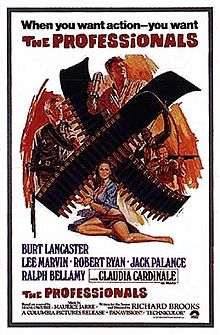
220px-Movie_poster_for_-The_Professionals-Who wouldn’t be enticed by a film entitled The Professionals? It feels a little like an amalgamation of The Magnificent Seven, The Dirty Dozen, with a  little sprinkling of Mission Impossible, and dare I say The Wild Bunch? We have a band of four big-time pros who are brought together to rescue the wife of a man named Grant (Ralph Bellamy). She is being held at ransom in the heart of Mexico. That’s no small task in the wake of Pancho Villa and the Mexican-American conflict, but these men are the best of the best.

The leader is none other than Lee Marvin (of The Dirty Dozen) with his prematurely white hair, leading the band as Rico Fardan, a skilled tactician, and former U.S. Army Officer. He is joined by Jake Sharp (Woody Strode), who is the best tracker around and also a crack shot with a bow and arrow. Next, comes skilled horseman and pack master Hans Ehrengard (Robert Ryan), who keeps mainly to himself. The most dynamic part is that of Bill Dolworth (Burt Lancaster), an unscrupulous scrounger who nevertheless is a good shot and an artist when it comes to using explosives. He’s not what you call a trustworthy type, but Rico would trust this man with his life and that says a lot.

Richard Brooks story is straightforward enough. This dream team goes in with their mission clear: The man who stands in there way is revolutionary turned outlaw Jesus Raza (Jack Palance), who is the one keeping Maria (Claudia Cardinale) captive.

As they push forward, they witness the brutality of Raza and his men as they raid a passing train and execute many of the occupants. Soon Fardan and his crew move in on Raza’s compound and wreak havoc one night so they can pull Maria out and take her to safety. But she seems like a very reluctant damsel in distress. She also seems very intimate with Raza. That’s the first sign that something’s up, but still, they follow the parameters of the assignment and pull her out.

Retribution follows and after a gunfight The Professionals flee through the mountains with Raza in hot pursuit. They use explosives to try and impede the progress of the rebels, and then Dolworth resolves to stay back to bide his partners time so they can get across the border. It’s at this point that he fights like one of the magnificent seven, in an impressive rearguard action that has his foes befuddled.

It’s when he actually comes face to face with his enemy that things become interesting. They know him and he knows them. Once upon a time, he fought with Raza and he was also acquainted with the lively female marksman Chiquita. When they finally get back to good ol’ Mr. Grant they find he’s not as straight-laced as they once thought, so they make a costly decision. They lose out on their big payoff but do the honorable thing by setting Maria free.

The Professionals gives us want we want. Honestly, we want cool characters and fun action sequences and that’s essentially what we get. There’s quite a bit of fairly graphic violence too for a ’60s western signaling a slow change in the genre. Lee Marvin is impeccable as the self-assured, tough as nails commanding type. Lancaster is, of course, the most interesting, and I can only imagine he had the most fun because playing a scoundrel would undoubtedly be a treat. Strode, Palance, and Cardinale were enjoyable to watch in their own rights as well since we did not necessarily need a whole lot of depth from them. It was only Robert Ryan’s role that felt rather like a throwaway part that did not have much to it. No matter, the Professionals was still an enjoyable all-star western.

J.W. Grant: You bastard.

Rico: Yes, sir. In my case an accident of birth. But you, sir, you’re a self-made man.

4/5 Stars

Libeled Lady (1936)

Poster_-_Libeled_Lady_01Libeled Lady has screwball comedy written all over it and that’s perfectly alright with such a glorious cast. Myrna Loy and William Powell reunite once again (for one of their 13 pairings), but we also get Jean Harlow and Spencer Tracy. Amazing!

The set-up is easy and pretty self-explanatory. Warren Haggerty (Tracy) is the managing editor of the New York Evening Star, but while he is reluctantly getting ready to walk down the aisle, he gets the horrific news that the paper sent out a misinformed scoop by mistake. Now Haggerty is faced with a $5,000,000 libel suit from wealthy socialite Connie Allenbury (Loy), and it brings his weddings proceedings to a halt, much to the chagrin of his peeved fiancee (Harlow). This isn’t the first time that their big day has been postponed after all.

Stuck between a rock and a hard place, he goes to one of his former reporters, Bill Chandler (Powell), who really rubs Haggerty the wrong way, but he also happens to be a whiz when it comes to libel. He’s the only man who can get the paper out of the major jam so he leverages his position. Things go down like this. Chandler will ingratiate himself to Ms. Allenby and soon afterward Gladys Benton (Harlow) posing as his wife, will rush in on them. Presto! The suit will be dropped. Simple, right?

It’s the consequences that get even dicier. At first, Gladys absolutely despises being cooped up in a hotel with Chandler and she’s still fed up with Warren. But over time, the close quarters cause Chandler to grow on her. Meanwhile, Chandler tries to learn everything he can about angling, to charm Allenby’s father (Walter Connolly), who is a fishing aficionado.

From the start, his daughter has Chandler pinned as a fake (which of course he is), but by some act of heaven his act actually works and he wins them both over. Worse, Connie is falling for him and he’s reciprocating, but Haggerty is still waiting for the plan to be executed. Gladys is waiting impatiently for her “husband” who she seems to genuinely miss. It’s all a big mess to be sure.

The finale involves the four leads together for one final climactic barrage of pandemonium and spouse swapping. As you would expect everyone ends up with the right partner, but it was sheer craziness to get there. It had been a while since I had seen a screwball, and Libeled Lady is a striking reminder why the genre is so fun. It had me laughing pretty hard whether it was the utter absurdity of the fishing sequence or any of the other madcap moments. It boasts quite the cast too. It’s crazy to think that in only a year Jean Harlow would be gone, a short but vibrant career behind her.

4/5 Stars

Scarface: The Shame of a Nation (1932)

Ga220px-Scar2ngsters, prohibition, Al Capone, the St. Valentine Day’s Massacre. It all sounds like some distant piece of folklore that by now is far removed from our modern day sensibilities. But when films like The Public Enemy, Little Caesar, and of course Scarface came out, these things were at the forefront of the national conscience. In fact, it seems like these films have seeped into our culture, making it hard to pull the legends and cinematic stereotypes away from the cold hard facts that have now dissipated with time.
Like the other gangster dramas, Howard Hawks‘ effort makes it blatantly obvious with its introductory title card that it is a story condemning the rise and fall of the gangsters. Much like many modern films, there is a great deal of screen time given to corrupt characters, but in this case, there is meant to be less ambiguity. The audience is directed to the fact that this is not a glorification, but an indictment. That didn’t mean controversy was not stirred up since Scarface’s immense amount of violence got it held up by the censors. But it did finally make it past in 1932.

What follows is what we would expect: The rise and fall of one ambitious mobster Tony “Scarface” Carmona. He starts out as an enforcer and tough guy who is ready to make his way up the ranks and he’s not going to allow any Tom, Dick, or Giuseppe get in his way. He often incurs the displeasure of his worried mother, and he is often distraught with his baby sister (Ann Dvorak) since she will not keep away from the boys.

Pretty soon Tony is made second in command, and his boss is looking into taking over the South Side after the previous big shot was knocked off. The little men cannot do much about Johnny and his crew moving in on the territory, but of course Tony’s not satisfied. Along with making a pass at the bosses girl, he starts taking it to rival mobsters on the North Side even when Johnny told him to lay off.

Retaliation follows with a vengeance and the cops are also taking an increasing interest in nailing Tony since he’s such a smug hotshot. But Scarface’s new best friend is the Tommy Gun. Tony only increases his ambitions by countering the rival mobsters, ambushing and gunning them down all across town. There’s no mercy and he even annihilates the rival boss Gaffney (Boris Karloff) at a bowling alley. Tony even manages to escape a hit put on him by Johnny and pretty soon old Scarface is running the show like he always wanted.

Every rise is always followed by a crushing fall, and Tony is no different. He is enraged to find his buddy and perpetual coin flipper Little Boy (George Raft) calling on his sister. Tony literally loses his mind gunning his friend down in cold blood and thus unwittingly setting himself up for an undisputed murder wrap. He deliriously holds himself up in his barricaded flat, but the hourglass is slowly running out. The game is up as quickly as it began.

Paul Muni is a fairly captivating lead who pulls off the gruff Italian tough guy pretty well. His supporting cast including the glowering George Raft and his hapless “secretary” (Vince Barnett). Although Ann Dvorak felt like a girl miscast. Otherwise, this pre-code film has its fair share of bullets flying and sirens blaring. It’s a film full of grit and shadowy avenues that are sometimes swimming with beer and sometimes blood. It is extraordinary to think of where Hawks went from this film, one of his earlier works because he really was one of the most adaptable and successful directors I can think of. His films do not always reflect his own personal style per se, but they are more often than not engaging, self-assured, and dynamic. Scarface is little different. An early classic from one of the great American visionaries of film.

4.5/5 Stars

Joan Leslie (1925-2015)

For Classic Film Aficionados most of our favorite stars have passed on and that makes any star or starlet we lose now that much more noteworthy. Joan Leslie is such a figure, not a major star by any means, but she certainly had some great films in her catalog. Without knowing who she was and barely knowing Gary Cooper, I saw her in Sergeant York at a young age. On subsequent viewings I realized she was the perfect girl for the role. The same goes fore Yankee Doodle Dandy, because there is not a malevolent bone in her body, and she exudes an innocence that cannot be discounted.

I’ve seen the less well known Repeat Performance, and although it is nothing to write home about, it was rewarding to see Leslie in a starring role. The names are getting fewer and far between: O’Hara, De Havilland, Douglas, Donen, Poitier, to name a few. But all the time they get more and more obscure as the years go by.

My hope is that  people will continue to discover the likes of Joan Leslie for years to come!

People Will Talk (1951)

peoplewill1People Will Talk is in this weird gray area between genres. It has humor but it’s not screwy enough to be a screwball. It has drama, but it’s not intense enough to be a full-fledged melodrama. And underlining all this are issues that reflect such areas as the medical industry, the Korean War, and most definitely the witch hunts that were going on in the nation — bleeding into the Hollywood industry.

Written and directed by Joseph L. Mankiewicz, this is a minor classic about a doctor named Noah Praetorius (Cary Grant), who is under investigation from one of his by-the-book colleagues Dr. Elwell (Hume Cronyn), who dislikes the good doctor’s unorthodox and thoroughly effective approach to his trade. Praetorius by now is a preeminent physician who started his own clinic and also teaches classes at a local med school.

One of these individuals happens to be Mrs. Deborah Higgins (Jeanne Crain). She is not a student but sits in the lecture because her former partner was a medic. A date with a cadaver proves to be too much for her and she faints. Seems normal enough right? Wrong. After examining her, the Dr. tells her she’s pregnant. The truth comes out that she’s not really married and the father is dead. Her own father would be greatly distressed to learn about her condition, since he cannot provide for her.

That’s where Dr. Praetorious comes into the picture, and he takes great concern in Ms. Higgins condition. He attempts to allay her anxiety by saying she’s not really pregnant, and she runs away from his clinic out of embarrassment, since she is falling in love with him. He goes with his stoic friend Mr. Shunderson to the farm owned by Deborah’s uncle.

Deborah turns out to have a strange mix of aloofness and lovesickness, but when she realizes the Doctor’s true motive for being there (before he even does) she is wholly relieved. They share a passionate kiss and leave the farm behind to get married. Of course, the Doctor still hasn’t told her about the pregnancy.

Meanwhile, the whole storyline culminates with a concert conducted by Praetorious himself, but it just so happens that the hearing to analyze his conduct is happening simultaneously. Some mysterious truths about Mr. Shunderson are given in his own words, and stale Mr. Elwell’s case is dumped. Everything wraps up nicely as you expect with a happy marriage and Grant free to direct the symphony in one last glorious crescendo.

So you see if you really look at this film, there are these two main story arcs. One is a response to McCarthy’s witch hunts, the other an equally subversive love story about a doctor marrying a woman who had a pregnancy out of wedlock. When you put it that way this film seems chock full of controversy, and yet it is all veiled in a palatable comedy-romance. Walter Slezak is a welcomed addition to the cast as the nutty colleague and Hume Cronyn has taken on better roles, but nonetheless, he is always an enjoyable character actor. Obviously, this is a lesser Grant performance, but his pairing with Jeanne Crain is still a fun one.

4/5 Stars

Donnie Brasco (1997)

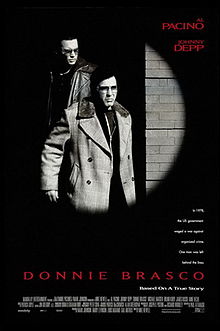
220px-Donnie_brasco_ver2In the tradition of such films as Serpico, Goodfellas, and even The Departed, Donnie Brasco is another worthy addition to the gangster canon. You have a necessary mainstay in Al Pacino, playing the veteran and streetwise hit man Lefty. He’s been around and is claimed to have 26 “whacks” to his name. One fateful day he took Donnie under his wing and the two became real pals. Better than that they were family and Lefty vouched for Donnie, bringing him into his life and his business. It’s just that his business revolves being a member of one of the mob families.

The story is twofold, however, because Donnie Brasco’s real name is Joe Pisone, and he is an undercover agent for the FBI. However, in order to do his job he has to be gone for months on end. He checks in and has a tape recorder on his person, but for all intent and purposes, he is a member of the mob. They think he’s one of them which Pistone’s superiors are delighted about, but he also begins to relate to them and see himself pulled into their reality.

Long months away from his wife and kids do not help their marriage or his family life. Whenever he drops in their life, he’s cold and detached. His wife expects something more. She wants her husband back, but all he has for her is a fiery temper courtesy of the crowd he hangs out with now.

He follows their crowd from New York, down to Florida trying to get a cut of the land there, but after getting ousted by the cops, they must head dejectedly back to New York. Several times Joe almost gets his cover blown, but even more perturbing he stops checking in with his superiors. His wife is bearing the toll of his absence and tries to content herself with thoughts of him being dead. It’s easier to take.

Meanwhile, young hopeful Sonny (Michael Madsen), with the help of his cronies, knocks off his rival and things are looking up for the whole lot of them. Donnie knows however that there will come a point where he will be pulled out and that will be the end of it. He tries to give his new found friend and confidante Lefty a way out. He offers money to his pal, in a last-ditch effort to get the vet to leave this life behind. Instead, they follow through with the hit that they’re supposed to.

The irony of this story is that Joe Pisone gets a medal and a $500 check for his services to his country. He spent however many months and years in this high tension, high-stress environment and that’s what he gets. You can see him scoffing at it. His marriage is essentially shot to hell. He lost one of the best friends he had and that’s the end of it.

It’s great having Al Pacino in this film because he along with Robert De Niro will always embody the gangster to me. Except instead of playing the steely Michael Corleone, he’s the more world wearied type. Bruno Kirby sounded so much like Joe Pesci that it was almost uncanny to me. And it was a pleasure to see Johnny Depp in such a role since he is so often remembered for his quirkier roles. Here he truly seems to show his dramatic acting chops, and the camaraderie between him and Pacino is palpable in their scenes.

4/5 Stars