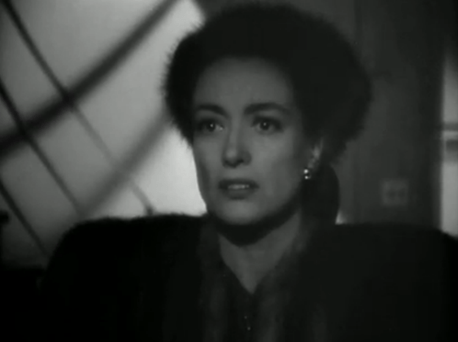
Review: Mildred Pierce (1945)

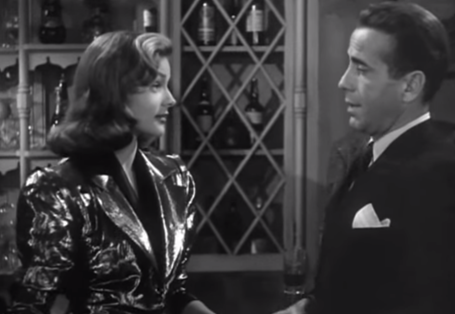
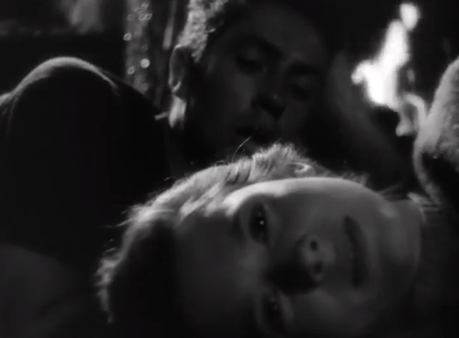
mildredpierce1Mildred Pierce is a hybrid between two genres in a way. It most certainly could be categorized as a weepie 1940s melodrama, a so-called “woman’s picture,” and yet it has the undeniable framing devices of a typical film-noir. It’s unique in other ways as well. It features a strong, independent woman as the lead, the eponymous Mildred Pierce and her aspirations and the struggles in her life become the focal point of this story.

Before any gun was fired or a dead body was found at a beach house or any of that happened, Mildred was a stay at home housewife with two daughters and a husband. It becomes all too clear that all is not right in the Pierce household as Bert becomes annoyed with Mildred, who spends so much time doting over eldest daughter Veda (Ann Blyth). It’s as if she needs to earn Veda’s love and Bert realizes the issue early on. They separate and soon after they watch their youngest daughter die of pneumonia suddenly.

What happens next is Mildred’s big break. She starts out all alone and discouraged before finding a job as a waitress, and ultimately, starting up her own restaurant with the help of the hapless Wally Fay (Jack Carson). She finds a loyal friend and employee in Ida (Eve Arden) and a rejuvenated love life thanks to the socialite Monte Beragon (Zachary Scott).

Veda on her part is ecstatic to finally have a life of nice things with the stream of income coming in from her mother, however, she still does not approve of her mother working in the restaurant business. Mother is so Philistine after all.

Thus, despite all the work and effort, she has put into holding onto her one remaining daughter, Veda begins to drift farther and farther away from Mildred until a fight causes Veda to leave home. Most people would say good riddance, but Mildred Pierce is not like that. She has an unhealthy, almost obsessive need for her daughter’s affection. She will do anything to get her back and most of it has to do with giving Veda stuff.

She is far from happy but finally marries Beragon, because she thinks it might bring Veda back to her home. It works but what she doesn’t know is that she is getting forced out of her own company by Bergaon. That evening she found her gun and then Beragon got murdered on the premises of his beach house.

Back in the station, the shadowy noir sensibilities are still present and Mildred abruptly finishes up her tale. Except for the police investigator and the audience know better. That was not the end of the story. There’s one last cruel twist.

In my mind, Joan Crawford is rivaled only by Bette Davis in giving me the shivers, except in this film her eyes are so expressive, giving off emotion without her even saying anything. Within this film, I find the character dynamics and gender conflict to be quite interesting and there are really 6 main characters we can look at:

Mildred: A strong woman who gains her independence the hard way by putting in work to earn her honest wage. She is not a bad person per se, but her weakness is an unhealthy love for her daughter, or rather, a need to have the affection of a girl who never can be satisfied. It leads to divorce, a loveless marriage and a lot of heartaches.

Veda is a little spoiled brat and most of the pain and problems in the film stem from her. She constantly plays on her mother’s emotions heartlessly and even goes so far as to steal her man. That is perhaps the ultimate slap in the face after all she has already done.

Ida: Along with Wally Fay, Ida is perhaps one of the more likable characters in the film, because she is a strong woman who also holds a lot of wit thanks to the performance of Eve Arden. She also utters the famous line that shines some light on the Veda situation (Alligators have the right idea. They eat their young).

Bert: Although he takes part in an affair and is not the perfect husband, I think Mildred and the audience realize how right he was. He saw all the drama with Veda coming, and he remained civil with Mildred through it all, continuing to look out for her.

Monte: He may not be a “villain,” but Beragon is ultimately another corrupt character who is driven by money and his social status. However, it is interesting to ponder whether it was his own avarice and playboy instincts that led him to do what he did, or was he wholly influenced by Veda?

Wally: Finally, we have Wally Fay played the always enjoyable Jack Carson. He too has his eye on Mildred, but although he can be forward and a little annoying, he ultimately looks out for her much like Bert. And yet to call him an angel would be an overstatement because he still has his own interests in mind.

That’s what makes these characters so fascinating since there are some obvious antagonists, but each character, at their core,  has faults. Thus, it makes sense that this film has melodrama brought on by familiar conflict and the like, only to descend down into the noirish world brought on by vice and greed. Whatever you label this film as, the fact of the matter is, it was a major hallmark for the fading Joan Crawford as well as the ever versatile director Michael Curtiz.

4.5/5 Stars

Review: The Postman Always Rings Twice (1946)

Lana_Turner_in_The_Postman_Always_Rings_TwiceThe first time I saw this gripping noir, my least favorite part of the film probably was the title, and it still is. That’s saying a lot, and the film is adapted from the James M. Cain crime novel anyways, with the title included free of charge. Otherwise, Postman is a wonderful example of the film noir canon, and yet it lacks the elements of your more typical private eye mystery.

It trades dark streets of crime for a small roadside burger joint owned by a shrewd man and his noticeably younger wife. Bring a drifter searching for a quick buck and you have everything set for the deadliest of love triangles. At the tips are John Garfield as the rambling man Frank who initially couldn’t care less for his boss’s pretty wife. Then there’s Cora, the alluring girl who seems out of place in her life. Then you have the money-grubbing Nick (Cecil Kellaway) who seems naively oblivious to the whole situation.

At first, nothing seems to be afoot, and Cora is adamant about not getting involved with the new hand. However, ultimately things evolve. That’s not necessarily the exciting part. We expect the rapid and lurid love affair that soon besets Frank and Cora.  We expect, more likely than not, that Nick will either catch them or they will knock him off first. They choose the latter and its far from preferable. Soon the district attorney is down their throats with his own suspicions about the forbidden couple. He’s pretty smart too.

Sackett plays Frank and Cora off of each other. They’re both scared. Neither one wants jail or worst the gas chamber. Nora ends up being the only one prosecuted, but her sly lawyer (Hume Cronyn) is able to call his opponents bluff and get Cora off with hardly a hitch. The only problem is that Frank and Cora hate each other guts now. They are positively poisoned to each other.

The story could end there and it would be ironic enough, but it doesn’t. It has yet another act where Frank and Cora make up following the illness of her mother, the flourishing of her establishment after the trial, and a bout with blackmail. All seems to be better than it ever was, but fate can have a cruel sense of humor.

On one out of the ordinary car ride, Frank crashes and in the aftermath, Cora is left dead with Frank on the fast track to the gas chamber. And that’s where the title comes in. The Postman Always Rings Twice. In other words, if you don’t pay for your crimes the first time around, you always end paying up one way or another. Cora was killed and Frank faced execution. Neither one got off in the end.

Putting aside the Hay’s Codes need for justice to be dealt, this is a wonderfully sardonic tale and ultimately sensual noir for the 1940s. Lana Turner was never better dancing with relative ease between amorous sweetness and acidic intentions. And the moment she first shows up on the screen is one of the most eye-catching entrances by a femme fatale period. Although not the greatest of leading men, John Garfield is surprisingly credible opposite, Turner. He plays the hard-working everyman incredibly well. Hume Cronyn, for his part, plays his wily prosecutor wonderfully with a sly smile all the while. I cannot quite put a finger on it, but I like him.

4.5/5 Stars

How to Steal a Million (1965)

220px-HowtostealamillionHonestly, the main attraction of this film is its leads in Audrey Hepburn and Peter O’Toole as well as its director, the great William Wyler. Otherwise, this film is a fluffy, silly caper comedy with a touch of drama. It falls somewhere in between a rom-com and an art heist film where everyone in Paris speaks English. Go figure.

Nicole Bonnet’s (Hepburn) father Charles is a master forger of all types of art which he supplements his own vast collection with. Many of his pieces have been sold for a pretty penny at auction, and he has yet to be found out.

He loans out a family heirloom, Cellini’s Venus, to a local Parisian museum for a large exhibition. Meanwhile, Nicole catches someone in the act of burglary and it ends up being a handsome young gentleman (Peter O’Toole).  She is given a fright but ultimately is taken by the man who hardly seems the thieving type. She lets him go without calling the police even giving him a ride home.

Eventually, they cross paths again and she recruits him to help her steal Cellini’s Venus from the museum. She doesn’t tell him why, but she has her reasons and he willingly obliges. It’s all good fun after all.

The caper scenes are no more harrowing than the rest of the film. In fact, it gives the perfect setting for more comedy as the two burglars get locked in a broom closet together after closing time, while also repeatedly setting off the alarm. But it’s all part of the man’s plan, because, after all, he’s a professional. And their plan works. They get away with the statue and the following day the news spreads like wildfire.

In the end, Nicole finds out that Simon Dermott is actually a private eye specializing in art and criminology. He’s no thief and so this was his first heist too. She thinks she’s in for it now, but they’re too in love for that to matter. He explains himself to Mr. Bonnet who reluctantly agrees to end his forgery career on top.

The two lovebirds drive off madcap down the streets of Paris with a beautiful life ahead of them. There’s not much else to say except Hepburn and O’Toole are fun together, while the score of a young John Williams has a recognizable bounciness. Hugh Griffin seems slightly miscast to be Hepburn’s father, and the film is far from pulse-pounding, but these small facts do not negate from its overall charm.

3.5/5 Stars

Move Over, Darling (1963)

Move_Over_Darling_-_PosterMove Over, Darling is a remake of My Favorite Wife (1940) and the unfinished Something’s Got to Give (1962). Thus, a Marilyn Monroe & Dean Martin vehicle ultimately turned into a Doris Day romantic comedy with James Garner and Polly Bergen. The dynamic feels so different and yet it ends up fitting nicely into the Doris Day canon. James Garner is always a fun actor and he plays an enjoyable role opposite Day.

The third time is still the charm with a plot involving a wife who is thought to be dead and returns after 5 years on a deserted island. Meanwhile her husband has moved on finally with a new wife who he has just recently married. One husband, two wives. That’s frowned upon in American society so he must figure out how to navigate these choppy marital waters. There are plenty of laughs in this screwball type plot line even if it is worn thin by this point.

The cast is full of great character players including Thelma Ritter, a very funny Edgar Buchannan, Don Knotts, John Astin and Chuck Connors. In this regard it is fun to compare and contrast the roles from the previous renditions such as Don Knotts versus Wally Cox as the shoe salesman, and so on.

It’s not a great film but certainly an enjoyable one full of marital mishaps and screwy situations. Not much more you can ask for so move over, darling and enjoy the show! Here’s to Doris Day who is still with us, James Garner who recently left us and a whole host of others.

3.5/5 Stars

Scott Pilgrim Vs. The World (2010)

Scott_Pilgrim_vs._the_World_teaserScott Pilgrim plays out like a live-action video game with sound effects, tokens, pee bar and all. It’s a great riff off the all too typical teen comedy. It has angst, attitude and quirkiness thanks to Edgar Wright and it still finds time to be utterly hilarious. Michael Cera plays his typical awkward young man which is no surprise. However,  Anna Kendrick, Kieran Culkin, Aubrey Plaza, Chris Evans, Brandon Routh, Brie Larson and Jason Schwartzman among others bring a lot of wit. So much sass to go around; it’s quite entertaining.

I will say it again that this film is an extremely absurd journey as we watch Scott battle Ramona’s (Mary Elizabeth Winstead) seven evil exes. He has a complicated former relationship of his own with Knives Chau (Ellen Wong) who never stopped loving him. Then there’s his doting younger sister Stacey (Kendrick) and his roommate Wallace (Culkin), who is always ready with some tough love or advice.

The destination seems obvious. Scott has to defeat the exes to get Ramona for his own, but it is not quite that easy. It never is and this film becomes about the path that these characters take. It’s not your typical formatted film, so leave your reservations outside. During its most enjoyable moments it becomes an utterly entertaining live-action-cartoon, musical mash-up adventure set in Canada. Don’t ask questions, just watch it for yourself. It’s certainly one of the more unique films in recent memory.

4/5 Stars

The Revenge of the Sith (2005)

Star_Wars_Episode_III_Revenge_of_the_Sith_posterRevenge of the Sith was the film that all Star Wars fans were looking forward to. For the younger generations, it meant the closure of the trilogy we had grown up with. For older fans, it meant that the Star Wars saga might finally be complete in some sense of the word. All movies linked together in this crucial last piece that smoothed out any last ambiguities about how Anakin Skywalker evolved into the feared Darth Vader.

It was a pretty big deal because it would either close the series on a controversially sour note or with the type of visceral storytelling George Lucas inundated us with in the 1970s. This certainly is no Empire Strikes Back (the darkest film of the original saga as many know), but it was probably the most enjoyable installment of the new trilogy and that is the most genuine of statements. As pure fans we liked it, and it was a worthy installment full of action as well as personal conflict.

Is it even necessary to go over the plot of Star Wars? Before anyone answers, I will give a recap more for my own sake than anything else. The Clone Wars are still being waged against the Separatists and the tides are slowly turning. Anakin is now even more renowned as he continues to team up with his Jedi Master and mentor Obi-Wan. But Revenge of the Sith quickly turns into a story of inner turmoil and political unrest with young Skywalker caught in the middle.

He is secretly married to Padme, taken under the wing of Chancellor Palpatine and then called on by the Jedi Council to spy on the Chancellor. It’s a web of confusion, anger, and fear going way back to his mother’s death, visions of his wife dying and perhaps his unfortunate nickname “Ani” leading to masculinity issues. Anyways, that is the situation that he finds himself and ultimately Palpatine (as we always guessed was Darth Sidious) poisons Anakin, who slowly turns against his friends and the Jedi Council.

Although we always knew this moment was coming, it is still so satisfying and painful to see it play out. It leads to some sad deaths (ie. Mace Windu) and some of the most epic lightsaber battles, going so far as to pit friend vs. friend against the backdrop of lava and John Williams’ score.

It is very hard not to appreciate this moment in the narrative where we finally see how the Empire came into being. How Anakin became Vader. How Luke and Leia were split up and how Obi-Wan became a hermit in order to protect the boy. As far as the films go, the original trilogy will undoubtedly remain the favorites, but that does not take away from the entertainment and emotional energy of this film.

Sith take Revenge and Jedi simply Return to put things right. Now I have to go back and watch the original films because I would not mind a happy ending about now. The beauty is that the bleak conclusion of this film is not the end of the story. Thank goodness we still have Yoda.

4/5 Stars

Jerry Maguire (1997)

Jerry_Maguire_movie_posterJerry Maguire is your typical feel-good sports story, but it has a different angle. The eponymous character, Jerry (Tom Cruise), is on top of the sports industry. Not as a player, executive, broadcaster, or anything like that, but as an agent. His job is to make his clients the big bucks and protect their interests while also thinking about his own. He’s constantly on the phone cajoling and soothing big time egos so they stick with him and do as he desires. A lot of it is a flattery game, and Jerry is the best of the best whether it’s face-to-face or over the phone. He knows how to play the game.

In a brief moment of so-called weakness, however, he writes an impassioned memo after he realizes he has gone away from his initial values of being a sports agent. The idealistic magnum opus he comes up with late one night is well received and yet it signals a real hitch in his career, even if he doesn’t know it yet.

He gets let go at his agency, and he struggles to hold on to any clients he can, but slowly, bit by bit, they leave him. First one, then two, and then on and on they went. When a top prospect leaves him it looks like Jerry is sunk. And then there was one. Loud-mouthed, prima donna Rod Tidwell (Cuba Gooding Jr.) known for famously uttering the phrase, “Show me the money!”

All the while, unassuming single mom Dorothy Boyd (Rene Zellweger) buys into his dream when no one else will and in the process, she begins falling in love. He’s not quite at the same place she is however.

Jerry Maguire is invariably sad, but it is an ultimately uplifting look at the sports drama told from the sidelines which are still chock full of drama, conflict, and romance in its own right. By consolidating and getting smaller, Jerry learns what is truly important. He finds who his true friends are in Rod and Dorothy. And he learns what it means to truly love someone, not only in a cheesy romantic sense (You had me at hello), but as a true blue friend.

So although not always a great film, Cameron Crowe’s story holds some of the same sensibility of Say Anything… and Almost Famous. It shows that something as big and blown up as professional sports can always be brought down to a more basic level of humanity. It falls somewhere in between films like The Blind Side and Moneyball and that’s not necessarily too bad a place to be.

3.5/5 Stars

“And I’m free, I’m free fallin'”

Act of Violence (1948)

ActofViolenceAct of Violence is an interesting post-war moral tale from director Fred Zinnemann. Frank (Van Heflin) returned home from war a hero. He now has a small child with his pretty young wife Edith (Janet Leigh) in the vibrant California town of Santa Lisa.

Little is known about his P.O.W. past and all his comrades were killed. Except one. His friend Joe (Robert Ryan) is still alive but he is plagued by a crippled leg now. He finds out about Frank’s whereabouts and it become his personal vendetta to straighten him out. The innocent Edith is in the dark about the whole ordeal and with the shadow of Joe constantly haunting him, Frank must family face the specter of his past.

He goes off on a business trip to escape and there out of desperation he winds up hiring a hit man to get Joe off his back. The two former buddies set up a meeting (which is really a trap), But as would be expected it does not work out as planned. Justice is dealt but there is still a strange sense of moral ambiguity. This is  certainly not Zinnemann’s best work, but it brings up some interesting questions about moral scruples and personal conflict.

3.5/5 Stars

Phantom Lady (1944)

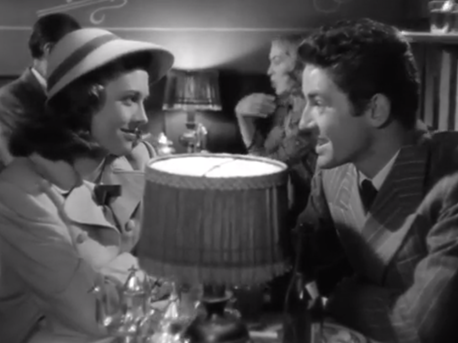
PhantomladyThe film uses the motif of a mysterious lady who cannot be found as the jumping off point for this Film-Noir. It is this so called phantom lady who Scott Henderson (Alan Curtis) meets at a bar after having a spat with his wife. They lift each others spirits and part ways. Returning home, he is met by the police inspector (Thomas Gomez), who found that Henderson’s wife was strangled to death. Scott is the prime suspect and now he needs his alibi which seemed so airtight before.

She truly has vanished and no one remembers her so Henderson is on the verge of the death penalty. It is his smitten secretary Carol (Ella Raines) who takes up his cause. She retraces his steps interrogating a bartender and wheedling information out of a puny drummer (Elisha Cook Jr.). Soon an old friend (Franchot Tone) of Scott’s returns from South America and everything gets a little more interesting.

Phantom Lady stars a cast of only a couple recognizable names, however Robert Siodmak does a decent job at making this noir interesting and it is certainly worth a watch.

3.5/5 Stars

Me & Earl & the Dying Girl (2015)

Me_&_Earl_&_the_Dying_Girl_(film)_POSTERI can say unflinchingly, without a single waver in my voice, that this is the best new release I’ve seen this year. Truth be told, I have not seen a whole lot of new films this year, but even if I had, Me and Earl and the Dying Girl would be the best by far.

The title in itself exudes a quirkiness that continues in a steady stream throughout the film. The same quirks can be found in our main protagonist, the self-proclaimed awkward, pale, rodent-faced high school senior Greg (Thomas Mann). He’s gone through high school with the mission of ingratiating himself to all and befriending no one. At this point in his high school career, the closest thing he has to a friend is Earl, who he simply considers his “co-worker,” since they develop homage short films together (ie. A Box of ‘Lips Wow). That’s another thing. Greg is obsessed with film: He eats up anything from Werner Herzog or The Archers thanks to the influence of his father (Nick Offerman). His other “friend” is the chill history teacher Mr. McCarty with an office that is the lunchtime oasis for Greg. But that’s about it.

That is until his doting mother (Connie Britton) forces him to go visit a girl who has been diagnosed with Leukemia. It’s a very forced scenario and both Greg and Rachel know it right from the get go. They haven’t even hardly talked since kindergarten. But, despite that, the two of them hit it off and Greg begins this doomed relationship with this dying girl.

The next 209 odd days or so Greg navigates this friendship and all that goes with it, while also developing a film for Rachel on the urging of the classmate that he is infatuated with. But do not get me wrong, this film does not fall into some contrived love triangle or sordid high school drama. It has a far broader more mature scope than that.

Yes, this is a high school teen film. Yes, it is a coming-of-age story, but it boasts so much more. It’s a film about films, a film about friendship, a film about regret, and most importantly a film about what it means to be alive. And yet, all the while, it tries to sidestep the normal tropes we expect.

Greg and Rachel have two very different perspectives. Two very different lots in life, but somewhere in between all of that, amidst the fear, laughter, and even anger, they find some special connections.

There is so much to appreciate about the film and for me, it starts with the character of Greg, because in some ways he was analogous to me in high school. I too was a nomad who traveled from group to group never being fully known. I found a passion for film and slowly began to learn about Kurosawa and Bergman among others. It was not until senior year where I finally began to feel comfortable in my own shoes and that was the perfect time for a new adventure in college. Thus, I resonate with Greg, because although he is certainly not me, he’s the most relevant high school character I have seen in a long while.

As for Connie Britton and Nick Offerman, both of them have some nice scenes that add a lot to this story. One as the over-involved mom who generally cares and the other as a free spirit of a dad who likes exotic food, bohemian garb, and art-house, not to mention the family feline Cat Stevens.

With great films, it is always difficult to pin them down, and the same can be said for this one. It has an awareness of film history that is unequivocally refreshing and unheard of for a genre potentially aimed at teenagers during the summer months. It has its own heartfelt crescendo that in some respects reminded me of Cinema Paradiso. In all other facets, it works beautifully as a teen dramedy and it does a better job in that niche than most. Miraculously, it couples humor and quirks with touching notes that are relevant to the here and now, while somehow still being universal. Also, do not get me started on the music, which is absolutely fantastic.

I look forward to seeing it again sometime soon!

4.5/5 Stars