The Women (1939)

 6d603-womenHere is a film full of personalities. In fact there is so much personality that it nearly bowls you over with its impact and frenetic force.

In the center of it all is Norma Shearer who is the respectable socialite who is losing her husband to another woman. Joan Crawford is the gold digging woman who is as detestable as ever. Rounding it out is the equally repulsive gossip played to a tee by Rosalind Russell. There is the ever innocent Joan Fontaine and a spunky divorcee played by Paulette Goddard. Throw in numerous other memorable women and you have a cast that completely overwhelms, but in a good way.

Husbands and lovers seem to being switching hands so easily and the whole film is focused on the women who are swapping them. It begins with Mary Haines’ husband only to continually get more complicated as more gossip is divulged and mud is thrown. Not to mention a few angry fists and slaps to go with the caustic words.

There is a lot to admire about this film, because it does what it set out to do very well. It creates some empathy, some laughs, and yes, a whole lot of loathing.

However, as I contemplated the film I realized although the Women is from 1939 and the clothes often seem laughable, the people and issues in the film often seem all too real. Divorce hits close to many homes literally and gossip certainly has not gone instinct. Thus, despite the passage of time, in many ways this film still feels fresh and relevant today.

4/5 Stars

The Passion of Joan of Arc (1928)

6d281-passionarcAs cliche as it will sound, this is one of those films that transcends the years for me. It is still that powerful after so many decades.

Using low angles and numerous close ups Carl Theodor Dreyer pulled me into this story early on. It was tense and claustrophobic causing the viewer to become emotionally involved in the trial and the plight that surrounded Joan.

The actors that he chose have wonderfully expressive visages that are so distinct even with out makeup of any kind. Then there is Falconetti who undoubtedly has a pair of the most expressive eyes ever shown on the silver screen.

I watched the film without any score so the complete silence was a new experience for me, but it forced me to pay particular attention to the images. Those were enough to keep my attention by  making me squirm and empathize the entire time.

By the end of the film there is an immense connection for Joan built because she seems an innocent victim. A martyr to be sure who reflects the sufferings of Christ. That is the story of The Passion of Joan of Arc. Certainly a simple tale but a master work of silent cinema nonetheless.

I am intrigued to see more from Carol Theodor Dreyer especially because his filmography is so sparse.

4.5/5 Stars

Pickup on South Street (1953)

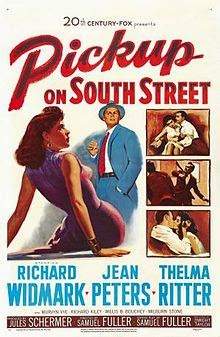
bf34b-pickuponsouthstreetFrom American cult film director Samuel Fuller comes a brief, yet potent film-noir laced with communism, pickpocketing, and a lot of shady business on the streets of New York.
Grifter Skip McCoy (Richard Widmark) is just recently out of the can, and he is back on the streets up to his old tricks again swiping wallets. His victim this time around is a pretty young dame named Candy (Jean Peters) who has a mission of her own to drop off a package. Neither of them knows quite what they have gotten into and to start off with, nothing happens. What exactly has Skip stumbled upon? The answer includes microfilm, spies, and the Commies. All of a sudden things are hot, as McCoy tries to cut a deal with the Reds, and Candy tries to recover the film she unknowingly lost. Candy gets caught in the middle of her boyfriend who is sided with Communists and Skip who wants to cash in on his good fortune. Between Skip and Candy begins a wild and passionate love affair that seems destined for disaster. Both have their own agendas, but it is ultimately Candy who drops hers because of her new found affection. McCoy is callous at first but he comes around, in the end, leaving this noir on a surprisingly positive note.
Thelma Ritter was usually colorful in her many screen appearances and she has another memorable turn as the wheeler-dealer Moe Williams in this film. However, Moe does not just deal ties and secrets; she is a woman with a conscience and a touch of good old-fashioned patriotism. In her own simple way, she is a hero whether people know it or not.
Widmark played a similar conman in Night and the City (1950), but this time around things worked out a little differently for his character. The pickpocket sequences were perhaps less elaborate but still similarly intricate to Robert Bresson’s Pickpocket (1959). It is possible that he got some of his inspiration from Fuller’s work here.
This is a real communist era thriller that Fuller injects with passion, grit, and some unadulterated violence. It is not a pretty film necessarily, but that is not what Fuller is going for, and he never does. Instead, as a former journalist, he reveals to his audience the nitty-gritty of South Street up close and personal. He succeeds with flying colors in delivering a first rate scoop of uncompromising pulp.
4/5 Stars

Ida (2013)

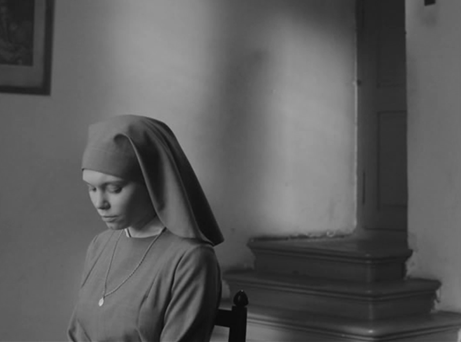
28ceb-ida1At hardly an hour and 20 minutes, you would think Ida has very little to offer, but that just is not the truth whatsoever. Polish director Pawel Pawlikowski blessed us with a nuanced film full of power and strangely pleasing visuals. It’s stark, yet crisp, black and white cinematography did not have to be that way, but it looks absolutely beautiful.

In the opening sequence, we see a young nun carving a statue and then carrying it to the grounds outside. We realize it depicts Christ and it feels rather reminiscent of La Dolce Vita and yet this film has a note of reverence.

We have been transposed to Poland during the 1960s where novice nun Ida lives a simple and disciplined lifestyle within a convent. The meager plot follows her pilgrimage to meet her only relative before taking her vows. It’s the aunt who refused to take her in after Ida’s parents passed. They have never met before now.

There doesn’t seem to be much to say. In fact, what can you say? Ida has taken up a religious calling and her aunt, a former judge named Wanda Gruz, lives life the way she pleases. Men, alcohol, and smoking are all a part of that lifestyle.

Thus, they have little in common until the moment when Gruz discloses the truth to Ida. Her real name is Ida Lebenstein. She is Jewish. Her parents were killed during the War, but the details are not too clear. They can probably guess how it happened.

Ida’s whole identity is rocked because she is now a Jew within a convent which seems like a gross incongruity. Ida’s resolve is to find her parents’ resting place and so the unlikely pair set off looking for answers.

That’s about all the film’s plot right there, and though it does not sound like much, it is far more engrossing than a lot of the other fair we come across. There are moments when it feels like we are watching something from Robert Bresson. It’s simple. There are not frills but it is chock full of humanity and seemingly real characters with real emotions.

Ida is very rarely in the center of the frame, more often than not her eyes are averted, looking away from the camera. Pawlikowski also has a curious habit of focusing on one character during a scene of dialogue. It seems to denote how isolated and confused many of these characters are. It’s one of those films that leaves us with more questions than answers and that lends itself to a truly insightful viewing experience.

4.5/5 Stars

This Jesus of yours adored people like me” ~ Wanda Gruz

Review: Murder, My Sweet (1944)

e30de-murdermysweet1Ann Grayle: You know, I think you’re nuts. You go barging around without a very clear idea of what you’re doing. Everybody bats you down, smacks you over the head, fills you full of stuff…and you keep right on hitting between tackle and end. I don’t think you even know which side you’re on.

Phillip Marlowe: I don’t know which side anybody’s on. I don’t even know who’s playing today.

Now after seeing the original Dick Powell as a crooner in light song and dance flicks, his re-imagined image as Chandler’s Phillip Marlowe is that much more surprising. This film quickly dropped being the potential musical Farewell my Lovely and ultimately became a hard-boiled Noir called Murder, My Sweet. To Powell’s credit, his new alter ego works and he brings his own spin to the role. Perhaps he has a little more humor than Bogart but there is still enough of the tough guy in his role to make it work. He’s also deliciously cheeky which is perfectly illustrated by a scene where he lights his match on the butt of a statue. It’s great.

Edward Dmytryk gave us a film that has often been credited with helping to define the film-noir style of the 1940s. It makes perfect sense since his film brims with many of the major hallmarks of the genre. The powder-burned Marlowe’s initial narration carried through a flashback lends a wry and cynical commentary to the entire story. The screen itself is cloaked in shadows, filled with billows of cigarette smoke, and is often superimposed with disorienting images.

Early on one man named Marriot is dead, Marlowe gets clocked over the head, roughed up several times, not to mention drugged up. He gets hired, used, thrown off, and seduced more than once. All because of an expensive jade necklace. As Anne (Anne Shirley) notes, Marlowe goes charging into his case not quite knowing what is going on or who he is dealing with. That ambiguity is one of the strengths of this film because we are never allowed the comfort of knowing who to side with.

By default, we begin the film from the point of view of Marlowe, and so he is our anti-hero who we track with the entire film. He gets the giant thug Moose (Mike Mazurki) tossed his way first. Marlowe meets the pretty Anne who hides her true intentions, introducing him to her wealthy father (Miles Mander) and seductive stepmother (Claire Trevor). Next up is quack doctor Jules Amthor (Otto Kruger) who appears to be our most clear cut villain and yet nothing is for sure.

It takes a late night confrontation at a beach house for things to straighten themselves out. Yet even up until that point, we do not know Marlowe’s true intentions, and he does not find out the resolution of the case until well after, thanks to the powder burns to the face.

Aside from Dick Powell’s anchoring performance, Claire Trevor is a tantalizing femme fatale, while Anne Shirley plays the guardian angel rather well. The juxtaposition of a morally questionable woman and an innocent girl develops the tension, not to mention that they are step-daughter and step-mother. When it’s all said and done, Marlowe got a sweet deal. He didn’t even need the jade necklace.

4/5 Stars

8 1/2 (1963)

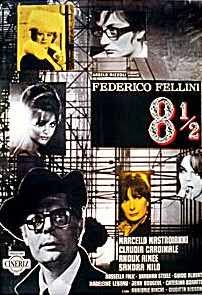
4b2c1-8mezzoDirected by Federico Fellinni and starring Marcello Mastroianni, the film follows the famous director Guido. After an opening sequence that reveals how he feels, we see Guido as he spends time at a spa trying to get healthy. However, he also must prepare for his next epic film production and he is constantly being bombarded by his writer, producer, actors, and all others involved. First his mistress arrives which he is unhappy about and then his wife comes and he is glad to see her. All these various things leave Guido confused since he does not have any answers. He wanted to make a genuine film full of truth and yet he cannot even be truthful in his own life. Even the ideal woman, the actress Claudia, has no real answers for him. Despite this, the film ends on a positive note with everyone holding hands in dance. What makes this film so fascinating is the interlocking dreams, reality, fantasy, and Guido’s childhood memories. Sometimes the viewer may get confused and yet often it is possible to decipher what is going on still. This is  a very personal film about film making itself and for Fellini it is also considered by many to be his greatest achievement.

5/5 Stars

The Big Combo (1955)

b456e-bigcombo1There is so much to the plot of The Big Combo, but the irony is that the story is not altogether extraordinary. Instead, highlights include David Raksin’s (Laura) jazzy score infused with brass which is somewhat unusual for the genre. Cinematographer John Alton also helped in making this film visually and stylistically engaging. There are some crazy, overstated shadows making this undeniably film-noir. There are very few better examples of so-called “dark” cinema with prototypical chiaroscuro and low key lighting.

Honestly, I have never been a huge fan of Cornel Wilde, and I can understand why he is not that popular or well known. He’s relatively beady-eyed, not particularly good looking, and his voice is not altogether memorable. Like Mr. Brown said in the film, “It’s personality. You haven’t got it. You’re a cop.” Even Dick Powell has some wit but Wilde’s character is straitlaced and steady. There’s nothing of much repute about him. But enough about Wilde.

The story is your somewhat typical procedural with a righteous cop facing off against a big time mobster. Mr. Brown is practically untouchable with a large pool of money at his disposal and a group of faithful thugs ready to do his bidding. He has a girl, Susan Lowell, who is about fed up with him, but she sticks around.

Lt. Diamond (Wilde) is totally fed up with the corruption but himself is also infatuated with Lowell. His only lead is the name “Alicia” which leads to trouble with Brown and his thugs who rough him up and leave him drunk. However, he learns from a man named Betini that “Alicia” was Brown’s wife who was supposedly murdered and thrown overboard with an anchor.

Next on the beat is a tight-lipped Swedish antique dealer, and ultimately, Diamond comes up with proof that Brown’s wife is still alive. He’s getting too close so Mr. Brown sends out his thugs Fante and Mingo to shut him up for good. They get the wrong person.

Alicia finally turns up, a few more figures get mowed down in Mr. Brown’s wake including Diamond’s trusty colleague Sam (Jay Adler). All that’s left is a showdown at the airport that is like Casablanca‘s atmosphere on steroids. It truly is a stunning achievement in visual storytelling for Alton and director Joseph H. Lewis.

There is not a great deal of sympathy to be had for a lot of the characters who got it, and though she seemed to have little bearing on the plot, Rita’s demise was surprisingly difficult to take. She was the girl with the heart of gold. Brown’s heartlessness finally came back to bite him but honestly, I could have cared less if Diamond was the one to catch him or not. He couldn’t have done it without Susan anyways.

3.5/5 Stars

The Fellowship of the Ring (2001)

fea8c-fellowship1Without the inventiveness and lore that J.R.R. Tolkien created in his books, there would never be something as visceral and grand in scope as The Lord of the Rings. However, it is a vibrant mythology that Peter Jackson breathed life into, and it becomes evident in the opening minutes of the Fellowship.

There is so much ground to cover as far as history and context go and Jackson sets it up beautifully with an epic prologue narrated by Galadriel (Cate Blanchett) which became synonymous with this trilogy.

“But something happened then that the Ring did not intend. It was picked up by the most unlikely creature imaginable: a hobbit, Bilbo Baggins, of the Shire. For the time will soon come when hobbits will shape the fortune of all.”

Thus, begins the Fellowship of the Ring. We find ourselves in the awesomely beautiful Shire (courtesy of New Zealand) backed by an exuberant score by Howard Shore. This is the home of a now elderly Bilbo (Ian Holm) and his relation Frodo Baggins (Elijah Wood). The backdrop is Bilbo’s Eleventy-First Birthday and Gandalf (Ian McKellen) is making an appearance for his old friends birthday.

There is a lot of merriment to be had complete with Gandalf’s world famous fireworks, however, Bilbo is also preparing to say adieu, and he must finally give up the Ring. It is at this time that Gandalf is reminded of its power as it gets handed off to the unknowing Frodo. It is now this little hobbit’s task to flee everything he has ever known because 9 Black Riders sent by the evil Sauron are heading to retrieve the Ring.

By his side is the loyal gardener Samwise Gamgee (Sean Astin) and his two jesting friends Merry and Pippin. As for Gandalf, he must deal with some business with the head of his order Saruman (Christopher Lee).

With the Riders in hot pursuit, the hobbits stop at the Prancing Pony. By this time Gandalf has yet to return but they cross paths with a ranger named Strider (Viggo Mortensen). He agrees to lead them to the Elvin city Rivendell but before they can get their Frodo is ambushed by the Ring-Wraiths and receives a fatal wound. He survives and is reunited with Bilbo as well as Gandalf who was forced to flee Saruman who has switched his allegiance.

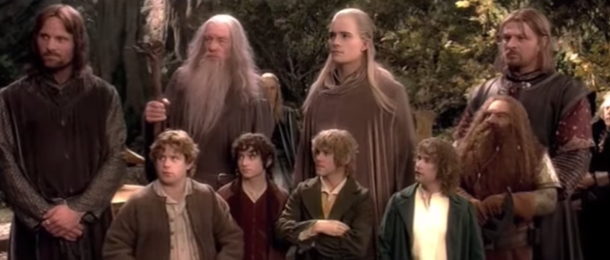
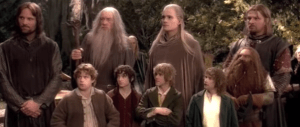
A decision is made to destroy the Ring in Mount Doom from whence it came and Frodo is joined by his friends, Gandalf, Aragorn, Legolas the elf (Orlando Bloom), Gimli the dwarf (John Rys-Davies) and Boromir (Sean Bean) the man.

They must take a treacherous path leading to the Mines of Moria which are in complete ruins. The area has been completely overrun by orcs and Gandalf must stave off an ancient demon called a Balrog so the others can escape.

They wind up in Lothlorien the home of more Elves including Galadriel who informs Frodo of what the future hold for him. Boromir is the next person to be tempted by the Ring and he tries to get it away from Frodo who starts to flee once more.

Aragorn, Gimli, and Legolas take on a legion orcs and Boromir attempts to redeem himself but is struck down. Merry and Pippin get kidnapped leading the enemy away from Frodo. Ever faithful Sam follows Frodo because of the promise he made. And the three other members of the Fellowship resolve to go after the press-ganged hobbits after they pay their respects to Boromir.

It’s a cliffhanger ending, but it is packed with enough epic drama and heart to make it a worthwhile ride. Just know that this is just the beginning of a long, hard journey.

Lord of the Rings is visually magnificent and it’s absolutely mind boggling that most of the scenery and extras in the film (ie. orcs) were actually real. Thus, it seems like The Lord of the Rings is one of the last great epics in a long line of epic films. It is sad to think that this kind of “real” epic is a dying breed with the use of CGI. Human actors and real life scenery is slowly, or actually quite rapidly, getting replaced by computers.

My criticism is that computers make the world and even characters look too perfect. You can tell that it is not real and it loses some of its allure in my mind. Furthermore, if characters are being created from scratch you lose the human interaction and thus a great deal of movie magic. My hope is that these type of epics will find a resurgence because they are usually well worth it.

Another observation has to do with Howard Shore’s magnificent score. If you removed it from this film we would have a completely different movie-going experience. It would be as if a piece of the puzzle is missing, because he seemed to so perfectly personify each locale and he accented each scene so wonderfully with music. Whether it was epic choral arrangements during dark moments or the flute for the gaiety of a sunny day in the Shire.

This certainly not my first romp in Middle Earth, but I was reminded why this world was so engaging. I am excited to revisit the other installments, because the story only gets better with time, even if we already know the ending. Thank you, Peter Jackson, and thank you, J.R.R. Tolkien.

5/5 Stars
The Best Films of Peter Sellers

1. Dr. Strangelove
2. Being There
3. A Shot in the Dark
4. The Pink Panther
5. I’m All Right Jack
6. Lolita
7. The Ladykillers
8. The Party
9. Murder by Death
10. The World of Henry Orient
11. The Mouse That Roared
12. The Return of the Pink Panther

“If you ask me to play myself, I will not know what to do. I do not know who or what I am.”

The Bests Films of Elizabeth Taylor (1932-2011)

“Some of my best leading men have been dogs and horses.”

1. Giant
2. Who’s Afraid of Virginia Woolf?
3. A Place in the Sun
4. Cat on a Hot Tin Roof
5. National Velvet
6. Father of the Bride
7. Life With Father
8. Lassie Come Home
9. The Taming of the Shrew
10. Jane Eyre
11. Father’s Little Dividend
12. Suddenly, Last Summer

Famous Collaborations: Richard Burton, George Stevens, Montgomery Clift