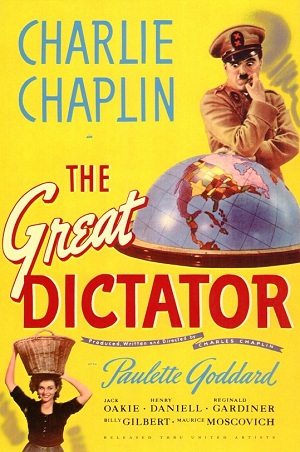
The Great Dictator (1940)

ac211-the_great_dictatorStarring Charlie Chaplin with Paulette Goddard, this satire blatantly critiques Hitler and the Nazis. The film opens during WWI where a little solider (Chaplin) saves an important military man. However, as a result he lands in a hospital with amnesia. All the while the power hungry dictator of Tomania, Adenoid Hynkel (also Chaplin) is on the rise. The man with amnesia returns to his barber shop in the Jewish ghetto and there he catches the eye of a beautiful girl Hannah. However, as Jews they are not safe, and even when things start improving, quickly Hynkel puts down his iron fist. The barber and another dissident are imprisoned, Hannah is in trouble, and Hynkel is ironing out his differences with Benzino Napaloni. However, after a gutsy escape, the barber poses as Hynkel and makes an impassioned plea to the people.

I see this film as a drama full of pathos. It is important to realize that is is not trying to make light of the situation but it is in fact condemning what Hitler was doing at the time. I think that is part of the brilliance and universality of Chaplin’s films. He could balance drama and comedy so aptly, making it possible for him to tackle this controversial topic head on. Furthermore, even though this was his first true talkie he still kept one foot in the silent age in his portrayal of the barber (very similar to the Tramp), and yet he also acknowledged the very present danger of Hitler. This film has some wonderful moments, but I think the two that really stick out are the opening speech by Hynkel which blatantly derides Hitler’s mannerisms and rhetoric. Then, in a complete 360, Chaplin gives his powerful speech aimed to rally mankind. Overall, it is a stellar duel performance from Chaplin and Goddard is as radiant as ever. That mustache certainly did not hurt the film either!

5/5 Stars

Lifeboat (1944) – Alfred Hitchcock

Directed by Alfred Hitchcock and starring Tallulah Bankhead, the film follows the passengers of a liner who escape in a lifeboat after the ship is sunk. Together they try and survive in order to make it back to civilization. Along the way they must make many difficult decisions. This includes saving the life of a German who sank their boat as well as amputating a man’s leg. Through it all there is ongoing conflict among the people who would normally be genial. However, their circumstances are by no means ordinary. By the end they are so desperate and crazed they seemingly turn against some and fall in love with others. This technical challenge of such a small setting did not disable Hitchcock’s storytelling ability. Written by John Steinbeck, the film’s story is an interesting view of humanity during World War II. This movie also includes Hitchcock’s most ingenious cameo of any of his films.

4/5 Stars

Shadow of a Doubt (1943) – Alfred Hitchcock

08054-original_movie_poster_for_the_film_shadow_of_a_doubtIn one of Hitchcock’s earlier American films starring Joseph Cotten and Teresa Wright, Uncle Charlie comes to visit his niece namesake “Charlie” and the rest of the family. Initially the whole family seems to be in a funk until they find Charlie (Cotten) is coming to visit them in Santa Rosa. However, what they do not know is that he is a wanted murderer. Over time “Charlie” (Wright) becomes suspicious of her uncle and finally comes across the truth. Her uncle figures out what she knows and decides he must get rid of her. Living in constant peril, “Charlie” finally is forced to face him. In the ensuing struggle she fights madly for her life. With the constant discomfort and suspense, Hitchcock proves how powerful thrillers can be even in the home. Cotten and Wright both do a very good job in this film. Supposedly this was Hitchcock’s favorite among his own films. I think it certainly one of the best of his lesser known movies.

5/5 Stars

The Virgin Spring (1960)

19cfc-jungfrukc3a4llanDirected by Ingmar Bergman and adapted from a Swedish ballad, this film revolves around a Christian Medieval family. Their only child is a beautiful, care free girl who they cherish. They sned her off to church with a maid servant. Along the way the two of them must pass through the forest. The girl leaves her servant behind to rest and then she goes on, meeting some herdsman on her way. She shows them hospitality by sharing her food, but the two men brutally rape and kill her. Ironically, that night they seek shelter with the girl’s family unknowingly. By accident the parents discover what became of their daughter and they must then decide what action to take. Bergman’s films certainly bring up questions about morals, religious faith, and evil. None of the characters were perfect but instead human, because they all make mistakes and must ask for God’s forgiveness

4/5 Stars

Wild Strawberries (1957)

Directed by Ingmar Bergman and starring Victor Sjostrom, the film follows an elderly doctor who travels by car to receive an honorary degree. Over the course of the day the old man has strange dreams and he also reminisces about his summers as a child with his family. He travels with his daughter in law and along the way they pick up energetic young people, deal with an unhappy married pair, stop at a gas station, and visit the old man’s lonely mother. The days events force him to face his past and realize his various faults. He also recognizes soon enough he will die. However, he finally comes to terms with it all and as a result he treats his daughter in law, son, and housekeeper differently. As with many Bergman films, this one is thought provoking. Some of the dream sequences were a bit odd but many of the characters and scenes were enjoyable.

 
5/5 Stars

Rebecca (1940) – Alfred Hitchcock

This film directed by Alfred Hitchcock and starring Laurence Olivier with Joan Fontaine, was adapted from the Daphne du Maurier novel of the same name. The story begins in Monte Carlo where Max De Winter (Olivier) and a young woman (Fontaine) have a chance meeting as she is working for an older lady. Soon she learns that his previous wife died the year before. Fairly soon the two of them are attracted to each other and Max has plans of marriage and returning to his Manderley. However, back home the fairy tale is over and the new Mrs. De Winter is constantly tormented by the housekeeper Mrs. Danvers. Pretty soon Max himself seems to have changed. Confused Mrs. De Winter must learn what happened to Rebecca, the lady who was so enchanting. When she actually finds out the truth it is almost too much to bear. Like many Hitchcock films this one is certainly worth watching and it was actually his first American film. Olivier, Fontaine, George Sanders, and Judith Anderson all have very good performances.

4.5/5 Stars

Foreign Correspondent (1940) – Alfred Hitchcock

Directed by Alfred Hitchcock, this film stars a cast including Joel McCrea, Laraine Day, Herbert Marshall, and George Sanders. Wanting a good scoop about events in Europe a newspaper editor sends a reporter off to dig something up. Joel McCrea’s character finds himself entangled in a complicated kidnapping scheme and assassination. On top of that he falls in love while on the job. With no one believing him at first, he must try and gather the facts that ultimately might lead to a war. Dodging two attempts on his own life, he knows he is getting close. However, little does he know how near he actually is. After more twists and turns McCrea finally gets his story and the girl but at a cost. From the scenes in the windmill until the tense moments on the plane, this movie does much to intrigue. It serves a double purpose, a decent piece of propaganda and a good thriller.

4/5 Stars

The Lady Vanishes (1938) – Alfred Hitchcock

Margaret Lockwood plays an American socialite in Europe in this Hitchcock mystery-thriller. The night before she is to leave, Lockwood meets a kindly middle-aged lady who is fascinated with European music. The next day the two ladies sit together on the train to talk. Being a bit disoriented, Lockwood takes a short nap however when she wakes up Ms. Froy is mysteriously gone. Seemingly no one remembers seeing the woman and no one will believe Lockwood. Finally, she teams up with a man who she had a run in with the night before (Michael Redgrave). Together they try to figure out what has happened to the lady. Finally discovering the truth, they come under great danger and must fight for their lives and those of the other passengers. Hitchcock does it again, bewildering the mind and making us intrigued at the same time.

4.5/5 Stars

39 Steps (1935) – Alfred Hitchcock

In one of Hitchcock’s great English films, he plays with the idea of a man on the run. Robert Donat is just an ordinary Englishman until a strangle woman tells him a deadly secret. Upon finding her murdered by a dangerous foe he flees. However, that puts him under suspicion and the hunt is on. He makes his way up to Scotland and gets some assistance however soon trouble brews. Somehow he finds himself cuffed to a woman he detests and he drags her away with him in order to escape. Due to their predicament, the unlikely pair soften to each other and try to discover the truth. After running for so long the answer finally comes to Donat  in the theater. He finally discovers what the 39 Steps are.

4.5/5 Stars

Walk the Line (2005)

Walk_the_lineStarring Joaquin Phoenix and Reese Witherspoon, this biopic opens with Johnny Cash recalling his past as he gets ready to perform at Folsom prison. JR is the son of an abusive share cropper and his brother Jack dies when he is just a boy. He goes off to Korea and comes back with a few songs under his belt. Cash marries his girlfriend and they move to Memphis where Cash tries to get work. On a whim he tries to form a gospel band to audition at Sun Records. Initially it goes poorly until Cash begins to Sing Folsom Prison Blues. Soon Johnny Cash and The Tennessee Two are signed and touring with many different artists. There Cash meets the likes of Jerry Lee Lewis, Elvis Presley and of course June Carter. Cash begins to fall for the recently divorced Carter but she rejects his initial advances leading Cash to go to drinking and drugs. They part ways but then later on they begin to tour again. His music is a success but his relationship with June causes his marriage to go down the tubes. He continues to takes more pills. This is the low point in his career but June gives him a second chance. They perform together at Folsom in 1968 and then after one rejection of marriage, June finally accepts while they are performing a duet. The two of them continue to perform and raise a family together. Phoenix was commendable as Cash and Witherspoon’s vivacious performance gave life to this film. One things is for sure, johnny Cash had a hard life that was full of mistakes. That’s what made his music so good. It was often personal and most importantly human. Because humans make mistakes. Thank you Man in Black for giving us what you did. 4/5 Stars