The Court Jester (1955): The Brew That Is True

the court jester 3.png

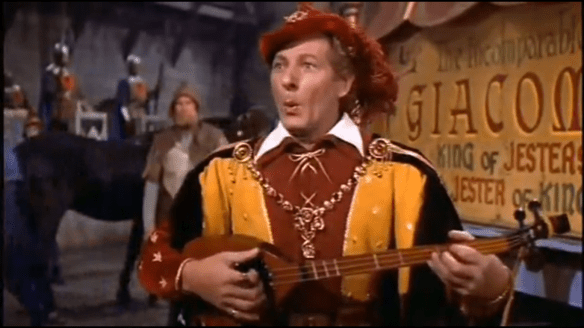
Maybe I’m simply partial to Medieval forms of entertainment but it’s hard to imagine a finer vehicle for Danny Kaye than The Court Jester. It needs to be lithe enough to accommodate his goofy even acrobatic brand of song-and-dance buffoonery. What better arena for Kaye than the king’s courts, that laughable domain of a man in a dunce cap and tights?

However, equally important is some form of plot for the actor to hang his routine on. The production is complemented exquisitely by a lavish setting replete with fine costuming, bejeweled individuals, and everything from knights and sword fights to magic incantations, backroom treachery, and romantic entanglements.

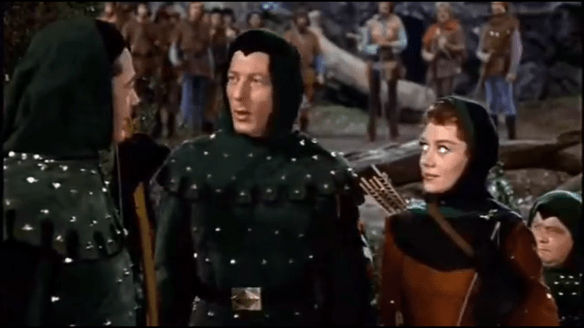
The humorous tongue-in-cheek opening diddy “Life Could Not Better Be” sets the tone nicely. We are inserted into a storyline that is a decidedly genial Robin Hood knockoff. In his place is our righteous outlaw The Black Fox who is looking to install the rightful king to the throne, the infant with the royal birthmark — the purple pimpernel.

The malevolent, power-hungry King Roderick has usurped the domain and set himself up as the supreme leader of the land, surrounding himself with an array of equally loutish characters, namely Lord Ravenhurst (Basil Rathbone). The King is hopeful an alliance with a knight named Griswold will help him to vanquish his mortal foe, the Fox, promising to betroth his reluctant daughter (Angela Lansbury) as a sign of goodwill.

Ravenhurst, fearful that his place of prominence might be undercut, calls on the services of a Court Jester named Giacomo (John Carradine) to do away with the king’s other consorts. However, on the surface, it seems the perfect disguise for the minstrel Hubert Hawkins (Kaye) to aid the Black Fox in his raid on the castle.
the court jester 1.png

If Kaye is for all intent in purposes our Allan a Dale thrust into our Robin Hoodish role, then Glynnis John is his fair companion Maid Jean (aka Maid Marian) who also happens to be a trusted captain of the Foxes men (aka his capable Little John).

After they overtake the real Giacomo, the carnival showman dons the robes of a jester for the masquerade. He thinks there is only one agenda. To meet a contact within the castle on behalf of The Black Fox. Little does he know, he’s also got to look after the well-being of a precious baby in a basket while unwittingly making a connection with Ravenhurst who assumes him to be an assassin (“Get it?” “Got it.” “Good!”).

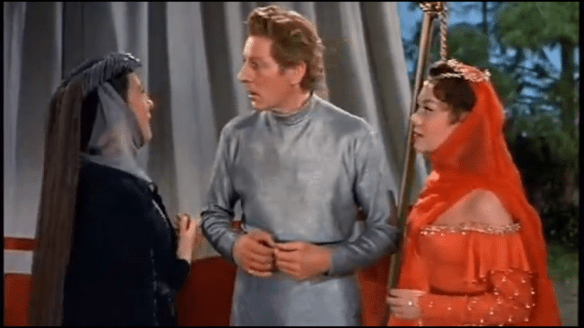
Meanwhile, the princess receives an oracle from her personal maid — a witch named Griselda (Mildred Natwick) — that a gallant man will soon arrive at the castle to have her hand. Little does the new Giacomo know he’s now caught up in a third complication as Griselda casts a spell on him turning him into a strapping and virtuous lover with the snap of her fingers — another one of the film’s recurring gags.

After his new entertainment arrives from Italy, the king also sends out an edict that all the fair wenches of the land be brought into his courts and, of course, the lovely countenance of Maid Jean gains the favor of the king, earning her a prestigious place in his company.

As he does his best not to bungle (by purposefully bungling) his floor show to earn the approbation of his master, Kaye must try and resolve the three plans of action put forward, though he’s conveniently forgotten them all.
the court jester 5.png

Soon our hero is ousted as an imposter and a cunning plan is enacted to red light him for knighthood so he will be eligible to face off against Griswold at the following day’s tournament for the hand of the princess. It’s all but inevitable. He’s a dead man without a chance at survival unless the Black Fox can come in time to take his place! Alas, it is not to be.

Their last-ditch effort is to try and poison Kaye’s formidable foe before they enter into combat. What it sets up is the film’s most beloved gag and one of the most heavily quoted routines there ever was: The Vessel with the Pestle and The Chalice from the Palace. In typical Kaye fashion, he struggles to remember which one holds the brew that is true or as he says it “the true that is brew.” Add the Flagon with the Dragon to the verbal shell game and he’s done for.

The extended hijinks is pure tongue-twisting, mind-boggling perfection, given an added exclamation point by his suit of armor becoming conveniently magnetized. This causes him to continually clunk into his adversary as they present themselves before the king. It couldn’t be funnier. And as a good belly laugh is often hard to come by these days, I was greatly delighted. The scene plays just as well as the first time I’d seen it.

But the antics in part give way to some genuine thrills as the jester leads a daring uprising against their would-be captors capped off by a counter-offensive by their friends. A merry band of little people sneaks in only to terrorize the courts and form a conveyor belt to fling their adversary away from the castle premises with a catapult. What follows is a storming of the castle by the rest of the rebels and a finale of the best comical homage to Technicolor Robin Hood there ever was.

A final duel with Ravenhurst showcases Kaye’s bipolar “dual” personalities. First, the frantic slap fighting of a craven coward, then the cocksure swordsmanship of a man with endless confidence, though it takes some support from his true love to send Ravehurst to his fitting demise.

There, in a nutshell, you have the impeccable concoction of the film reflected in Kaye. He’s a buffoon as much as he is a hero who nevertheless comes out on top thanks to another’s love. With a fairy tale ending such as this, life could not better be. Of course, The Court Jester is spruced up by the very fact it supplies a wagon-load of laughs to supplement a thoroughly agreeable adventure.

4.5/5 Stars
The Secret Life of Walter Mitty (1947): Danny Kaye Does Thurber

SecretLifeofwalter.jpg

In many ways, it seems short stories are the best sources for feature-length films because they allow the narrative to take the spark of an idea and extrapolate and mold it into something new and hopefully ingenious in its own right.

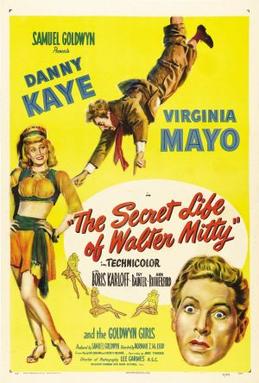
Author James Thurber didn’t seem to think that was the case with this adaptation of his short story plucked from the pages of The New Yorker in 1939 and turned into a vessel of lavish Hollywood entertainment by Samuel Goldwyn. Reading his story, in itself, gives a fascinating insight into the film version. For one thing, the “pocketa-pocketa-pocketa” onomatopoeia is translated from page to screen.

However, it’s also very apparent watching The Secret Life of Walter Mitty that Goldwyn, for obvious reasons, tailored the material to his star Danny Kaye. There’s certainly no point of contention there and the story probably is better for it.

In this version, Walter Mitty is a Pulp magazine editor and being unmarried, it’s his mother, not his wife, who is constantly nagging him to stop dawdling and do his best to not be so absent-minded. If you actually think about it, the fact this homely mama’s boy is brainstorming racy detective novels, exotic love stories, and horror romances is a bit ironic. Though given his flights of fancy, it’s not all too unbelievable.

Kaye’s spry verbal acrobatics are as limber as ever finding his voice contorting, shrieking, and hiccuping in all manner of ways through all manner of dialogue, monologues, and songs. He also progressively plays up his nervous shtick as he goes clunking around offices, with pigeons flying about, continually fearing for his life while also receiving the ire of his conceited boss.

These developments come with the acquisition of a little black book that very much resembles the one he uses to maintain his daily regimen. Except this one is very important to a beautiful woman named Rosalind van Hoorn (Virginia Mayo) as she attempts to acquire some priceless Dutch jewels.

The best elements of the narrative, plucked from the fanciful comic short story, have Mitty swimming in and out of daydreams. And of course, alluring Mayo plays the grateful damsel in every scenario, cast as his dream girl and later found in the flesh when they cross paths for the first time.

His imagination has him taking on all sorts of occupations from a captain on the high seas to a world-class surgeon in the operating room of a hospital. Then, it’s a daring Air Cadet in the RAF with impressive impersonation abilities. The persona of the Riverboat Gambler made me realize Snoopy has a bit of Walter Mitty’s whimsy in him. It’s not too far a stretch to surmise Charles M. Schultz was all too familiar with the picture. But onwards and upwards as Walter daydreams himself into being a women’s hat designer and finally a western hero. Each scenario conveniently brought to life in front of us. This is the film at its most inventive.

But the comedy of the original story, you soon realize, is that Walter Mitty really is a mundane individual. There’s nothing particularly special about him and yet he takes the banalities of daily life and turns them into something thrilling to ignite his hyperactive imagination. Maybe implicitly it’s about being stuck in the monotony but more overtly it’s simply a tale of a normal, average, everyday person who, when you pull back the curtain, has a deeply imaginative fantasy life. Perhaps there’s something neurotic about it but more so it’s simply goofy.

Although watching Danny Kaye run around with Virginia Mayo in what feels like an inept amalgamation of The Big Sleep and North by Northwest has its intrigue, you begin getting away from its true inspiration. Because the lovable peculiarity of Mitty is that he’s so very unextraordinary and his life is so menial. However, by inserting this cloak-and-dagger stuff, although the film gets more exciting, it loses something of its main conceit.

The best single scene by far finally comes at the tail-end where Mitty’s lives collide and he finally gains a backbone. Calling out all the small-minded, tiresome, annoying quibblers in his life. It’s Walter’s way of firmly sticking it to the insufferable doldrums he’s been subjected to.

But it is interesting how films or modes of media, in general, are very much indicative of their times. Take Joseph Conrad’s “Heart of Darkness” being turned into Apocalypse Now (1979) in the post-Vietnam years and most certainly the remake of The Secret Life of Walter Mitty (2013).  It reflected the escape from mid-life crises that many Americans no doubt crave at a certain age. Again, it’s part of the overarching narrative but not necessarily the true essence of Thurber’s original idea. Funny how that happens.

3/5 Stars

The Boatniks (1970): A Balboa Island Sit-Com

boatniks.png

I won’t make any pretense that The Boatniks is a great movie by any means but surely it speaks to some favorable quality when you enjoy something for its sheer goofiness, a certain sense of nostalgia, and the overall familiarity that pervades the material.

Yes, it’s a long sitcom episode but in this case, I have no qualms with such light and fluffy fare because so many good friends from my childhood came aboard for the ride. Norman Tokar, a prolific figure behind Leave it to Beaver directs with a script worked on by among other people Arthur Julian of Hogan’s Heroes, one of my dearest childhood favorites.

The cast has all sorts of sitcom mainstays of the 60s including Phil Silvers (Sgt. Bilko), Bob Hastings (McHale’s Navy), Joey Foreman (Get Smart guest star), Al Lewis (Car 54 Where Are You?, The Munster), Joe E. Ross (Car 54 Where are You?), Shaaron Claridge (Adam-12), and last but certainly not least Vitto Scotti, arguably the most prolific sitcom actor of all time. If you don’t know who he is, it’s all too obvious you haven’t seen enough of the classics.

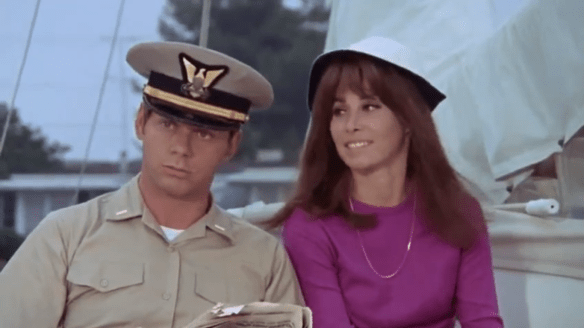
The Boatniks (a not so clever play on Beatniks) wears its goofball wonkiness on its sleeve. We have a hapless hero who must come out from under the shadow of his prestigious father to take over command of the local Coast Guard in Balboa Bay.

Ensign Garland (Robert Morse) doesn’t start off too successfully as he lands a plethora of citations and winds up instigating a traffic accident all on his way to the docks. Then, at the docks, he clumsily splatters a sun-soaked Boat Rental and Sailing Instructor (Stefanie Powers) with yellow paint much to her chagrin. Everything is going just dandy only to get better.

He subsequently bumbles his way through his duty, first getting beached on a rock and having to be towed by the smug instructor, followed by any number of issues from a husband locked in a cabin to a pretty girl whose skirt got caught in her boat’s controls. A Mayday goes out on both accounts. Despite handling some of these problems about as successfully as possible given the circumstances, Garland’s commanding officer (Don Ameche) is far from impressed by the compromising situations he always seems to be in but at least the girl starts to like him.

Simultaneously, three thieves led by, of all people, Phil Silvers, have absconded with a payload of priceless jewels. Their car is the one that gets rear-ended by the same awkward Ensign and with roadblocks dotting the coast, all the way from Orange County to San Diego, their only chance is to head for the sea which they do despite having no nautical knowledge whatsoever. For those who didn’t gather already, it does not bode well.

They lose their priceless picnic basket into the great wild blue yonder and in an attempt to recover their spoils the trio trawls for everything in the bay except what they’re looking for. First, they snag a gigantic sea bass that sends their boat reeling. Then, they go deep-sea diving. It’s all to no avail and flustered by a shark attack, the commodore picks up the phone and makes a long-distance call to his buddy in Tokyo for leads on pearl divers. A young Japanese woman arrives and the failure to communicate is used to great and awkward comic effect even as Phil Silvers tries to use Spanish to speak with a pretty diver (Midori). Of course, when it counts she knows how to speak the language.

The Bay is also inhabited by an assortment of other weirdos including Wally Cox and his floating harem La Dolce Vita; it’s a constant party at his place that never leaves the docks. One oddball sailor does his best to practice lashing himself to the mast in preparation for his trip around the world, conveniently leaving his wife and children behind. Another bungling seaman nervously huffs before he performs his daily ritual of bouncing his boat off the dock. It has no bearing on the plot but each is good for a few stray laughs of sheer corniness.

The scenery remains another point of interest for me because the fact is the film was all but shot in my backyard or at least quite close to where I grew up (albeit a few years before I lived there). We grew up hearing stories of John Wayne, Shirley Temple, Buddy Ebsen, and Joey Bishop only a few of the prominent figures who resided in the area at one time or another.

We have brief views of Balboa Island and seafront homes visible in the background as the buffoonery takes center stage. Boatniks would precede the Columbo episode “Dead Weight” starring Eddie Albert and Suzanne Pleshette with Peter Falk’s title character, making use of the same scenery. Except Boatniks is a great deal lighter.

In the modern age of Disney as a mega-conglomerate, these are the kind of family-friendly movies that I dearly miss. It feels like part It’s a Mad, Mad, Mad, Mad World (1963) and some of McHale’s Navy sprinkled in with dashes of so many other things. I enjoyed it far more than I probably had any right to but why shouldn’t I? It’s unabashed, quality fun for the whole family.

3/5 Stars

He Ran All The Way (1951): John Garfield’s Final Film

he ran all the way 1.png

We meet the belligerent two-bit criminal named Nick Robey (John Garfield) sleeping one off in the grungy apartment he shares with his acerbic mother (Gladys George). It’s not exactly the lap of luxury but it gives us some immediate insight into who he is. He’s an oafish, pitiful excuse for a human being and he’ll never amount to anything. One very visible reason comes from his open disdain for other people; he and his mother share no amount of affection whatsoever. It’s not a very promising portent.

Norman Lloyd, once again, plays some sidewalk sleaze, like he did in Scene of The Crime (1949), this time coaxing his pal Nick into helping him pull a job. It looks as easy as pie. And it is. The man parks, starts walking away with his briefcase full of dough, and they overtake him easily — without a hitch of any kind. But it’s inevitable; in order for there to be any movie at all, something must go wrong. A nosy policeman starts poking around and they scramble to get away before he nabs them.

The cop fatally wounds Lloyd but Garfield gets away, not before gunning down his pursuer. Just like that he winds up a cop killer. Except no one knows his identity definitively. So he’s got to go on the lamb keeping himself masked with the weekend crowds.

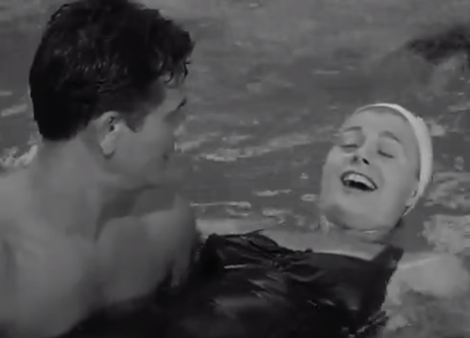
It’s a fascinating documentation of weekend diversions, in particular, community swimming pools. With his payload of money in toe, Nick nervously tiptoes around the pool eyeing the oblivious policemen milling about. There he also meets a girl. She’s not only a cover but a bit of a welcomed distraction from his continual paranoia.

he ran all the way 2.png

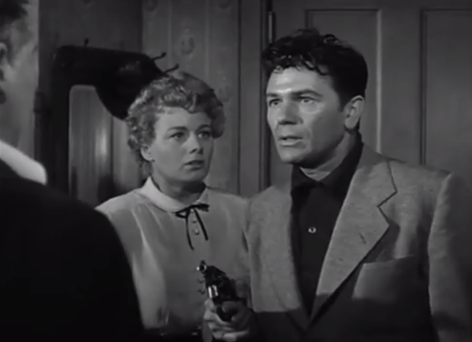
He Ran All The Way takes on a motif reused in Suddenly (1954) and other such pictures as Nick essentially becomes a live-in guest to Peg Dobbs (Shelley Winters), her parents (Wallace Ford and Selena Royle), and her kid brother (Bobby Hyatt). He lets them go about life partially unimpeded, keeping one of the family at home at all times as constant leverage. That way there’s no funny business.

While the picture is hardly Garfield’s best, it is imbued with tightly coiled tension that’s instigated in the opening minutes. The ticking clocks never end aided by confined spaces, oddly intimate relationships between captors and hostages, as well as a volatile showing by Garfield. He’s all turned upside down trying to deliberate on his future plans.

Then they have a clash of principles over the dining room table. The family with their stew and him with the turkey and the lavish meal he’s gotten together. They want no part of it but he’s going to get them to eat even if he has to provoke them at gunpoint. In another scene, he inquires gruffly, “What does that church stuff do for you?” Without skipping a beat, still working away on his model vessel, Mr. Dobbs succinctly replies, “it makes you understand the virtue of love.”

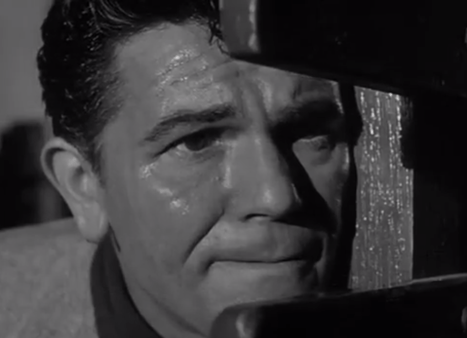
Thus, this dialogue aptly frames the story as a tale pitting family versus romance in such a way that only one can come out intact. Peg is the one forced to make a choice. James Wong Howe’s camera works in numerous close-ups and that continues even until the end of the film to underscore moments of isolated impact. Garfield’s face, in particular, is singled out. We see the fear, the anger, and the confusion breaking out across his features time and time again.

A stairwell finale perfectly epitomizes the dynamic between the two leads, see-sawing back and forth perilously. Until they make it to the ground level and things must come to their harrowing conclusion once and for all.

he ran all the way 3.png

For all the hell Garfield put his captors through, the look on his face is striking, when it all comes to an end. It’s betrayal and fright and forlornness all rolled into one. Even as he’s a hard-bitten, tormented man, there’s still a sliver of something inside of him that we cannot help feeling sorry for. That’s a testament to the earnestness of his talent.

The context of the picture becomes arguably just as important as the film’s condensed narrative. Like any movie, it was hardly conceived in a vacuum and the early 1950s were, of course, characterized by the paranoid finger-pointing culture of McCarthyism.

The emblematic figurehead that always gets brought up is The Hollywood Ten — who subsequently were some of John Garfield’s closest collaborators. Dalton Trumbo even worked under a pseudonym on this script while director John Berry, for all intent and purposes, might have been christened the 11th member of this targeted group. Following the production, he would enter a self-exile in Europe.

But this would also be John Garfield’s last film and it would primarily be his last film — most people agree — because his heart attack, brought on at the age of 39, was caused by undue stress from the allegations he was embroiled in.

Even though he went before the House Committee on UnAmerican Activities, his appearance did not completely absolve him and on top of that, a separation with his wife looked to be ending in divorce. He would die on May 21st, 1952, his funeral attended by masses of mourning friends and fans.

He was the apparent forerunner to such other tragic figures like James Dean and Montgomery Clift and the not-so-tragic decline of Marlon Brando. Without Garfield, those fellows would have come out of nowhere but from him, you trace the line of progression from hardboiled stars like Cagney and Bogart. Watch these films and you recognize that same pent-up alienation and angst. Most importantly there’s a newfound sense of vulnerability being awakened.

3.5/5 Stars

The Breaking Point (1950): Updating Hemingway and Hawks

the breaking point 1.png

Michael Curtiz, to all those who revere him, has far more than Casablanca (1942) on his resume. It’s stacked with classics including The Adventures of Robin Hood (1938), Mildred Pierce (1945), White Christmas (1954) and even a less-heralded picture like The Breaking Point.

Those familiar with the original source material, from Ernest Hemingway, might also realize an earlier version of the story was made starring Humphrey Bogart opposite his future wife, Lauren Bacall, in her crackling debut.

Director Howard Hawks helmed To Have and Have Not (1944), which proved to be very loosely based on the eponymous material indeed. About the only elements comparable between the two renditions are the oceanic atmospherics with salty seafaring types and other undesirables mixed together liberally. Though donning a new name and casting a new star in John Garfield, it’s easy to make the case that The Breaking Point is a lot more authentic.

To Have and Have Not is a delight because it is such a cinematic creation with indelible characters filling up a world, not unlike Casablanca, ironically. But its successor unfurls qualities that feel less done up and artificial in a still delightfully atmospheric Hollywood fashion.

the breaking point 3.png

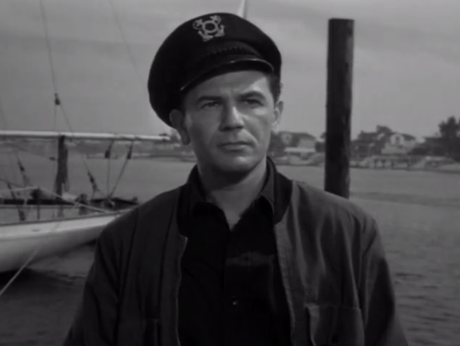
One could wager it begins with a location that’s very much a real place. In fact, it’s a place I have known quite well in my lifetime. I was first tipped off to its whereabouts when Garfield gives money to his daughters to go see a movie and tells them to be careful on Marine Ave.

As I only know one Marine Ave., I double checked the film’s shooting locations and looked ever more closely at the exteriors. All this confirmed the fact The Breaking Point was shot in and around Balboa Island in Newport Beach, California. I know the area well as I used to spend some summer days there as a kid. The exteriors are most obvious when our protagonist comes back from the bar, walking by the docks, and he’s already day drunk.

We have yet to describe any of the narrative but already we have something vastly different from its predecessor. The main character is a family man, a seaman, and simultaneously trying to drown his sorrows in alcohol. What adds insult to injury is the fact Harry Morgan (Garfield) was a highly commended Navy Seamen during the war. Except, ever since coming back from the war a hero, he’s never been a somebody and that’s hard to take for a proud human being.

All he knows is the sea and so he’s tried to make a go of it obdurately, working furiously to subsist off his boat but it seems like everyone is pushing his head underwater. Try as he might, he can never get ahead. He needs dough for the reasons we all do. To pay the bills. To put food on the table. To take care of his wife and daughters.

the breaking point 2.png

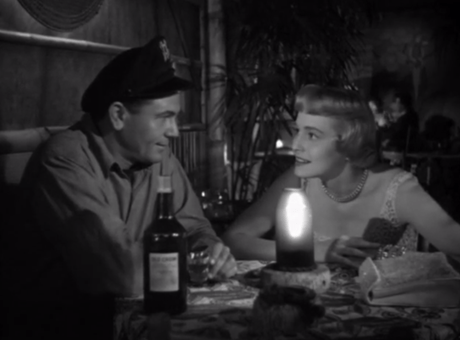
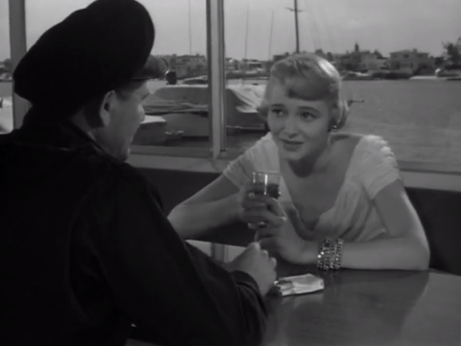
Soon Harry’s peddling a would-be fisherman and his gal pal (Patricia Neal) off the coast of Mexico. Of course, the shyster runs out without paying and leaves his girl behind. Harry’s been played for a sucker, stuck on the wrong side of the Mexican border, without any fare to get home. He’s kept his nose clean thus far but times are desperate. In a dive joint, he gets approached by a slimy undesirable, chomping on cigars and proposing a shady business proposition. Momentarily, our hero has been submerged back into the world of Bogart and Hawks.

He’s tasked with sneaking a group of Chinese passengers into American water illegally. However, following an altercation with his contractor (Victor Lee Seung), with Ms. Charles (Neal) and his mate Wesley (Juano Hernandez) aboard, he backs out leaving the Chinese behind. He’s escaped for now, his mores still intact.

But that doesn’t help him when he gets home. The Coast Guard soon confiscate his livelihood. His wife takes on work at home to try to compensate and he has one last chance to save his boat from being taken away from him in order to make ends meet. He feels compelled to take a second job bringing him back into cahoots with the same cruddy opportunist named Ducan, albeit reluctantly.

It’s in these dire straights where it becomes evident The Breaking Point is on the same moral plane as The Bicycle Thief (1946), where our protagonist is forced to make horrible decisions, all for the sake of his family. Should we blame him for the deadly finale that follows? It’s so difficult to enact decisive judgment.

Surely Patricia Neal has the flashy role because she’s the flirtatious blonde who’s never tied down and seems ready to get with anyone. But Phyllis Thaxter, even as she competes with the other woman, dying her hair in an attempt to win back her husband’s affection, has a softer more vulnerable tremor in her voice that feels so very transparent.

When we look into her eyes and see her get angry with her husband for not throwing in the towel and taking up a life on her father’s farm, the concern there is so very real. We understand it because it’s plaintive and deceptively unprepossessing. Because there are deep wells of beauty inside of her making the film’s romantic dynamics that much more intriguing.

John Garfield maintains the working-class persona he always seemed to flaunt so easily but here he’s surrounded by a family — two daughters and a loving wife, making his struggle all the more relatable.

He’s also a loving father bringing his daughters trinkets from his trips, cradling them in his arms affectionately, and slipping them change so they can go to the picture show again. The same goes for his wife. Even as they struggle and fight fairly regularly, over the kitchen table, there are other moments where he makes his love and faithfulness supremely evident. He compliments her looks and the new hairstyle she’s trying after the girls criticize it.

the breaking point 4.png

Because the one thing The Breaking Point is not is a story of infidelity. Sure, it comes close on multiple occasions with Neal playing the tantalizing siren but Garfield unreservedly loves his wife. He’s honest with her in that sense, even as he keeps other secrets on the side. He thinks it’s a way to protect his family and his friends. The waters of the film are undoubtedly choppy, even perilous; that’s partially what makes the solid rock of the marriage at its core all the more refreshing.

Any relationship with a firm foundation is predicated on transparency. There’s no other way if you don’t want to harm your spouse and push them further and further away. I admire The Breaking Point deeply for this unflinching portrayal of marriage that, while not always polished, feels inherently real.

4.5/5 Stars

Review: Network (1976)

network 1.png

“We’re not talking about eternal truth or absolute truth or ultimate truth! We’re talking about impermanent, transient, human truth! I don’t expect you people to be capable of truth! But, you’re at least capable of self-preservation! That’s good enough!” – Peter Finch as Howard Beale.

Throwing around the term auteur and you’ve already set yourself up for a grievous debate with some diehard cinephile. There are those ardent disciples as well as those who vehemently oppose what they deem a simplistic notion.

Because the main tenet is that the auteur or “author” who exacts his vision on a movie is namely the director. However, if there was ever a subject to cast in the role of “screenwriter as auteur,” Paddy Chayefsky just might be the perfect candidate. He came of age in the medium of television, an adamant humanist and purveyor of social realism. His most prominent work of those early years being the heart-warming classic Marty, which first starred Rod Steiger and then did great things for Ernest Borgnine in the film adaptation.

Network is conveyed by a veteran Chayefsky who has weathered the industry for a long spell now and looking at it presently, we observe his wry bit of commentary. Because the beast of a medium made him but he seems to derive some glee from confronting it head-on. He’s taken the systems in place and very conveniently added his own spin.

Along with the Big Three, CBS, NBC, ABC, he has created his own outlier, a dark horse, and the littlest giant UBS. The landscape is one familiar to anyone who lived through the 70s. Nixon got the can. There have been two recent attempts on President Ford’s life. It’s the wake of Watergate and Vietnam, with the throes of inflation and depression. America is looking for an escape valve for their dissatisfaction.

I’d like to think that the world of The Mary Tyler Moore Show has some semblance of truth to it with its camaraderie and the humanity of its comedy, but then we see Network and are provided another harsh alternative that bears the uneasy feeling of its own truth.

In this same world of civil unrest, television networks with their programming regimens and new shows are bloated with all sorts of agendas. You have the continually clashing horns between warring executives and self-serving angles in their neverending quest for higher ratings and a bigger share of the viewing public.

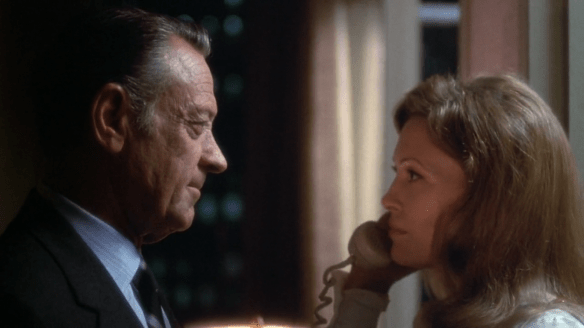
Max Schumacher (William Holden) is a remnant of television’s bygone era where men like Ed Murrow and Walter Cronkite were symbolic purveyors of truth in all facets of America. Maybe the nation was naive but at least they believed in something. Times have changed. Sensationalism and stories to stir up some form of controversy are of particular interest especially with Diana Christensen (Faye Dunaway) who aims to use such material to bolster the network’s abysmal ratings.

network 3.png

Meanwhile, abrasive big whig Frank Hackett (Robert Duvall) is tired of the news division’s lackluster performance, and he’s ready to instigate some new changes within the business conglomerate. Schumacher feels slighted as his former allies seem to crumble around him.

Now’s about a good time as any to introduce Howard Beale (Peter Finch). He’s one of Max’s best friends from the old days and due to plummeting ratings, he’s been given the axe. I never felt sorry for Howard Beale before because he’s so often lost in the shuffle of the movie. He’s used by not only the network but the film itself as a kind of diatribe. It seems like the man is all but forgotten.

Finch plays the role so pitifully at times and that becomes easily overshadowed by his attention-getting histrionics.  However, when he makes his initial announcement that he will take his life on air, in two weeks’ time, it’s very matter-of-fact. There’s little agenda to it. Here’s a man who’s lost his wife and now is losing his job after 11 years of service to the network. Soon he’ll have nothing.

The utter disinterest in his plight is what’s most striking when you look down the line of producers and behind-the-scenes employees who sit in the dark in front of the monitors chatting rather than actually paying attention to their anchor. Apathy seems to reign.

Simultaneously, Christensen is exploding with harebrained schemes of inspired lunacy that she seems all too serious about enacting, from a docudrama called The Mao Tse-Tung Hour to keeping Howard Beale on the airwaves. She’s the foremost proponent of angry shows to articulate the angst of the general public through counterculture and anti-establishment programming. That’s her agenda.

In this very way, Network is a film of bewildering disillusionment in the world full of crises and absent of reason and maybe even God. Howard is a voice to all those absurdities and when he calls B.S., he turns the heads of the entire country. It blows up but as any publicity is good publicity, Diana convinces her boss to keep the mad prophet on.

She positions Howard Beale as a prescient even messianic figure calling out the hypocrisies of the age. Her boss openly objects, “We’re talking about putting a manifestly irresponsible man on television,” which Dunaway promptly nods her head in response to. Maybe she’s a bit crazy in her own right.

Then, when the fad keeps on going and he’s now got people yelling out their windows or sending their grievances straight to the White House, Christensen is complaining that he’s too irascible, not apocalyptic enough, recommending some writers be brought on to pen some juicy jeremiads for him to spout off. In spite of the ludicrous nature of it all, the results speak. Soon Howard Beale’s antics have landed him 4th in the Nielsen ratings surpassed only by The Six Million Dollar Man, All in The Family, and Phyllis.

Hackett is deliriously happy about the success and becomes power-hungry. But as Beale’s sole friend still kicking, Schumacher can’t help but feel Howard’s being used, even as he himself gets involved with Diana (she harbored a girlish crush on him in college).

network 2.png

The film’s trajectory seems all but predestined. The fad of Howard Beale begins to wane and ratings go down with him. Max Schumacher’s job and then his marriage go down the tubes as well, all because of Diana. For her part, Diana is so completely consumed by her work that everything, even her personal life, works in scripts. However, the rendition of The Blue Angel that she’s unwittingly been playing with Max doesn’t end as she initially thought.

As a satire of the medium we know as television, Network certainly has few equals. Chayefsky spends a good spell of time orating off his soapbox as he does in many of his pictures. The ideas are there. The words are coming from voices and we’re taking them in, and they are spiced up with rhetoric and wit. If anything, one can marvel at his work even when it doesn’t take. It bears his mark.

The one thing about Network that is still harrowing today is the mere implications. Television was being considered an institution systematically destroying everything it touched through its manipulation and backstabbing industry practices. It only exasperates the situation by breeding a public that’s both vacuous and apathetic.

There is no call for human decency anymore. There are no true glory days. People are depressed, lonely, bitter, and helpless. If that all came to pass, theoretically, because of a box sitting in a family’s living room, 21 inches in size, that could be turned off, and had bad reception more often than not, what is the internet doing to us?

Now we’re in constant interface with our devices, warring for our attention and promising us comfort and convenience. Meanwhile, our ghost machines suck us dry. We’re shells of human beings. There are some figures in Network that I dislike, played most convincingly by Duvall and Ned Beatty. They seem opportunistic, crass, and merciless. But most everyone else of note I feel somewhat sorry for. The Max Schumachers, the Diana Christensens, and of course the Howard Beales. What did we do to deserve this madness?

4/5 Stars

Review: Bonnie and Clyde (1967)

bonnie and clyde.png

Fifty years on and Bonnie and Clyde remains a cultural landmark as the harbinger proclaiming a new American movie had arrived on the scene. As a cinematic artifact, it is indebted as much to the 60s themselves as it is the Depression Era where its mythical crime story finds its roots.

The spark of an idea came from screenwriter Robert Benton’s own knowledge of his father’s fascination in real crime novels, which even led the elder Benton to attend the actual funerals of Clyde Barrow and Bonnie Parker. It’s youth rebellion and a free love revolution by way of the 1930s mythology.

Formalistically, Bonnie and Clyde was an effort by producer Warren Beatty and director Arthur Penn, collaborating with their screenwriters, to channel the French New Wave. It’s true that at a time, two of the movements titans, Francois Truffaut and then Jean Luc Godard, were both attached to the project. Ultimately, it didn’t pan out but the spirit they’re pictures were imbued with remain even as this effort is undeniably American.

Bringing the exciting and at times challenging art pictures of Europe to the American mainstream with a jolt of new blood, squibs included free of charge. Even if everyone didn’t realize it at the time, it signaled a rebirth of a style and philosophy that was fully alive. It only took generations of new film school filmmakers to run with it and in subsequent generations eventually, kill it.

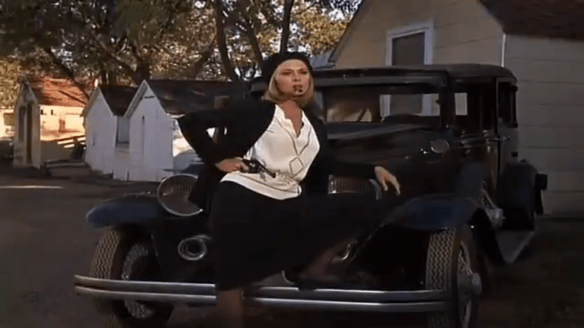
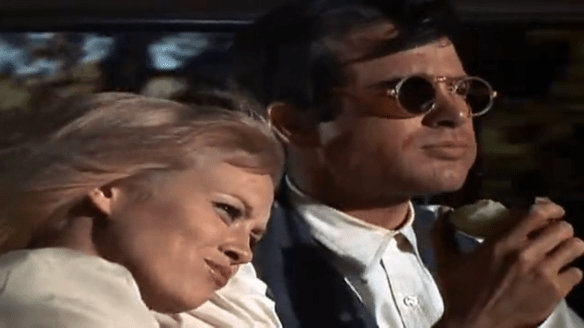
For now, we had the fateful meet-cute, Bonnie Parker (Faye Dunaway) scantily clad, bored out of her mind, and spying the boy trying to nab her mama’s car. She catcalls him and he welcomes her — nay, challenges her — to join him. He’s Clyde Barrow (Warren Beatty) a small-time criminal who did a stint in prison and has two missing toes to prove it (It was his gag to get off a work detail a few days before he was paroled). They share a drink over Coca-Cola in the noonday sun. He’s intent on being a big shot and she’s disillusioned by her waitressing gig.

In a moment, he brandishes a gun to exert his manhood and he’s further coaxed on by Bonnie to rob the cash register in her quaint town. She doesn’t believe he has the gumption. A minute later he rushes out with the wad of cash and they’re on their way to a giddy life of crime so thrilling, at first, with its bouncy jangle of banjo strings. This is only the beginning. They aren’t big name criminals yet. That notoriety is born out of three words: We Rob Banks!

Yes, they do. They bring on slow-witted but able mechanic C.W. Moss (Michael J. Pollard) to keep their gears constantly turning so they can handily outrun the police and dot their native Texas with bank job after bank job. Clyde kills his first man after Moss botches their getaway and the papers start to document their harrowing exploits on the wrong side of the law.

A family reunion follows for Barrow as his older brother Buck (Gene Hackman) and Buck’s quibbling wife Blanche (Estelle Parsons), the daughter of a preacher, join their merry company. It should be noted the ladies take an immediate disliking to each other. Bonnie’s not agreeable to the domesticated lifestyle and she’s wary of Blanche, a woman she deems has no guts. It’s a perceptive observation.

bonnie and clyde 2.png

As their reputation grows, so do the prices riding on all of their heads. First, the cops look to ambush them on their holiday in Missouri. Then it’s a lone Texas Ranger (Denver Pyle) who winds up getting his picture taken to be plastered all throughout the newspapers. He’s not one to forget the humiliation and he’s aiming to make them pay.

Each and every time they take to the road again, starting up their rampage across the countryside a new, casing bank after bank, while gaining a bit of mystique with the common folk. Along the way, they pick up some extra passengers (Gene Wilder and Evans Evans) to terrorize and then make a pilgrimage to the Parker home due to Bonnie’s homesickness.

But even this move is extremely dangerous and soon another police ambush follows on their latest residence that is deadlier still. It’s a downward spiral with an ever larger target being pinned on their backs. Soon they’re picked off like ducks in a shooting gallery with Buck being mortally wounded and Blanche subsequently goes hysterical and spills her guts to the authorities all but sealing the fate of our antiheroes. Bonnie was right about her.

The other three escape by the skin of their teeth though badly battered. With nowhere else to turn, they seek asylum with C.W.’s father who extends some southern hospitality. Although, behind closed doors, he isn’t too keen about his son’s new lifestyle with tattoos and all.

We know the story must end even as Bonnie has successfully canonized their legend nationwide with a poem she penned subsequently published around the country. And they are as in love as they ever were promising to get married and dreaming of a different life where they could settle down and be normal folks. They take what they can get and love each other while they can. Because justice is swift and it comes with a vengeance.

bonnie and clyde 3.png

The old mores are upheld but utilizing a new language that was aberrant and gratuitous in comparison to the traditions of the past. But that was just it. Bonnie and Clyde was somehow the perfect vehicle of antiestablishment both in form and function. It was like the perfect storm of a cultural revolution and a medium to reflect the angst of a generation.

There’s a madcap raggedness to their crime spree that’s almost comical and Penn plays it like a comedy at first. A bunch of hicks out on a road comedy caper, only it’s underscored by graphic blood-spattered violence like the industry had never witnessed before. It’s like putting the frenetic zaniness of the Keystone Kops with the violent gunplay out of the gangster tradition and it creates a disconcerting dissonance ripping apart the standards of Classical Hollywood. Because the industry had showcased degenerate criminals before — the Cagneys, Robinsons, and Bogarts — but they were always hard-bitten figures and, of course, they got their comeuppance.

Up to that point, there was arguably no characterization quite like this where our leads were young and desirable — a new kind of antihero who forged an anarchic path between Gun Crazy, Breathless, and Pierrot Le Fou.

Arthur Penn pointed out at a later date, and you could easily make the argument, for the first time film was being more accurate by showing the actual impact of a bullet on a human body. There was no cutaway. There was no inference or use of the wizardry of editing to imply the results. They were right there in from of us in all their gory reality. That was indeed groundbreaking.

Its final scene ranks right up there with Psycho‘s shower sequence for how it completely shatters everything we knew to be convention. At that point, there’s no going back. You cannot unsee it. It stays with you. Both instances brutal in their meshing of image, sound, editing, and the myriad pieces at the disposal of filmmakers to make us see something deeply manipulating.

Bonnie and Clyde would bear many of the progeny that have challenged me; films that brazenly dabble in violence, comedy, and the darkness of the human heart in almost inconceivable ways. Mixing tones, emotions, and content in a manner that is incompatible at best and deeply perturbing in their most volatile forms.

Surely, we cannot laugh at something and an instant later be subjected to the blackness of death? People cannot be villains and cast as heroes in the same breath. Everything passed down from our traditions tells us this is not the way it works. After Bonnie and Clyde, it was a whole new landscape. No question.

5/5 Stars

Bullitt (1968)

bullitt 1.png

There was never a better city for crime pictures than San Francisco. Much of this reputation comes from Bullitt and the enduring cool of its hero Steve McQueen. He had many great films and he was a part of some truly epic ensembles including The Magnificent Seven and The Great Escape, but Bullitt is unequivocally ruled by “The King of Cool.” There is no other focal point.

Frank (McQueen) and his partner Delgetti (Don Gordon) have an authentically antagonistic relationship running deep. Because they know, without saying anything, they have each other’s backs. However, the ensuing events lay out a premise that will test them incessantly. Self-aggrandizing political hopeful Walter Chalmers (Robert Vaughan) is intent on presenting his key witness Johnny Ross (Felice Orlandi) before the Senate to spearhead his clamp down on organized crime. He’s handpicked Bullitt to give his valuable asset around-the-clock protection until he’s called upon to testify. He knows the cops exploits are popular with the local press and for Chalmers, every decision is an attempt to vie for candidacy.

For Bullitt, it’s just his job and so he Delgetti and a family man named Stanton take on the assignment ready to sit it out with Ross in a two-bit hotel room feeling like sitting targets with the large windows inviting prying eyes. Even as a certain of apprehension is maintained, the police set up watch and tell Ross to get comfortable. But the status quo was not to be. Stanton’s shift gets disrupted by a brutally unsentimental hit on a hotel room.

Ross gets blown through with a shotgun by two fugitives and Stanton is left for dead as well. Things truly ignite as Bullitt looks to pursue the culprit and feels the residual heat from Chalmers who is ready to make Frank’s life a living hell. Buying time, he hides Ross’s body to keep it out of the news and goes after the men he knows will lead him to his elusive answer.

bullitt 2.png

Aside from his motorcycle riding in The Great Escape, Bullitt‘s car chase is McQueen’s finest hour as an action star. Though he shared stunt driving duties in both films with industry-pro Bud Ekins, there’s little doubt his persona was well-deserved and he plays the part well.

10 minutes bouncing and thudding through the streets of San Francisco. Epic panoramas of the chase, swerving through traffic and careening around street corners leading to a straightaway where we get to see The Dodge Charger and Mustang really fly.

The enigmatic nature is the key to the rhythms the story settles into. It’s this sense of uneasiness mixed with pavement and payphone realism as Bullitt does the heavy lifting involved with chasing leads.

The beats of the procedural feel methodical and genuinely authentic while never obscuring the fact this is a thriller with pulsating ebb and flow. Because the best action movies are exactly that: action. Not simply in the climactic moments but the mundane. They rarely get weighed down by exposition or dialogue that we have to slog through. And as a result, they are won and lost in the ambiguity.

Director Peter Yates was hand-picked for the project based on his work on Robbery from the year prior, complete with its own defining car chase. Then, screenwriter Alan R. Trustman works with Harry Kleiner to follow up The Thomas Crown Affair, his other vehicle for McQueen.

Bullitt became the standard neo-noir cop film to measure all others from William Friedkin’s French Connection, its East Coast rival, to Dirty Harry and many of the later works of David Fincher including Se7en and Zodiac.

The film is blessed with unprecedented access to San Francisco, which would be all but unheard of today. From streets being closed off, to shooting in full hospital wings, and taking over SFO airport for an evening. These authentic locations all throughout the city not only guarantee a certain degree of authenticity, they also meant Bullitt needed no sets.

Because at the time the picture was shot, S.F. was not necessarily a film mecca though films such as The Sniper, The Lineup, and of course Vertigo were shot there. But Bullitt and other equally atmospheric projects captured its shading for all posterity in the subsequent years. It became so much a part of the cultural consciousness Peter Bogdanovich would very purposely do a sendup of the chase in his neo-screwball What’s Up, Doc.

Handheld Arriflex cameras allow Yates a fluidity and a similar intimacy with the real world that all but plants us in the environment. Steve McQueen racing across the tarmac to nab his man, ducking and diving under oncoming planes taxiing out masks nothing. It feels real and fearless in a way that’s hardly for show. McQueen embodies this type of tenacity.

bullitt 3.png

In the end, it’s not much of a spoiler that we see another bloody body, this time with wounds inflicted by the police and we’re reminded how similar they look. Yes, one was committed as an act of crime, the other an attempt to maintain public safety but they both lay there horribly mangled.

If the film began with an unsentimental gut punch then it’s safe to assume it would not change and thankfully it does not. Bullitt is the quintessential police film with grit and violence, forged through by a cop who’s willing to go rogue and stand in the face of powerful men to uphold his responsibility. He’s not looking to make a name for himself. Even as he pushes back against the establishment, he’s reined in by his own moral compass. It’s what guides him.

Jacqueline Bisset is enchanting as his girlfriend though she isn’t given much of a purpose in the film except for providing him someone to go home to. She is a much-needed person to draw out the more sensitive side of his normally guarded self. But she’s also the one to put into question his line of work: “Do you let anything reach you? I mean, really reach you? Or are you so used to it by now that nothing really touches you? You’re living in a sewer, Frank.”

Here is the conflict I imagine within most any police officer. This internal tug-of-war between wading through the refuse to clean up the streets and becoming one with it. Of becoming so used to evil, you’re soon callous and cynical toward all good. When the only way to fight violence is with violence in an equal and opposite direction.

At the very least it spells a compromise of integrity and morals and of a belief system. If that’s getting a little too moralistic, know Bullitt is just about the best police procedural we ever had. It certainly holds a well-deserved place in the pantheon of crime genre archetypes. With or without morals.

4.5/5 Stars

The Thomas Crown Affair (1968)

thomas crown affair 2.png

To watch the original Thomas Crown Affair now is to see a film that is so completely and confidently of its time. It opens with a Bond-esque enigmatic title theme, “Windmills of The Mind,” playing against blocked split-screen images composing the credits. As such, it’s easily dated by its 60s suavity, which nevertheless serves the film handsomely as it progresses and sinks into its story.

A heist is in its latent stages, composed of the same stylized patchwork of images visually coordinating all the parties involved as Steve McQueen pulls all the switches from the comforts of his corporate office. The streamlining techniques being utilized effectively consolidate the footage and make us more overtly aware of Hal Ashby’s influence serving as the film’s editor. It’s at times discombobulating, particularly when used extensively later on during the polo match to multiply the frames. But it more than serves its purpose through the stylized manipulation of the individual images.

It’s only a heist film for what seems like a few solitary minutes but it’s immaculate in both conception and execution as all parties converge on their target, get in and get out with their prize and very few complications. In this regard, those familiar with Kansas City Confidential (1952) might notice some nominal similarities. The brilliance of the crime comes in using robbers who have never met and can never be tied back to each other again.

The money is dropped off at a checkpoint and all parties involved will get their money when things cool off. In these opening moments you’ll wonder if Steve McQueen is actually a bad guy and where Faye Dunaway is because, after all, she robs banks too. When things begin to unfold and we see where we are destined, it’s not at all what I imagined with McQueen and Dunaway batting for different teams much of the film.

Insurance Investigator Vicki Anderson (Dunaway) is brought on as a favor to her friend to help a harried detective gain some much-needed closure on the case. She makes a stunning entrance and never lets up with the wardrobe changes. Ms. Anderson has an immaculate outfit to coincide with each subsequent scene and an answer for every situation. In fact, she’s the one who intuitively pins Thomas Crown as her man. All she’s got to do is prove it and she certainly can be very persuasive.

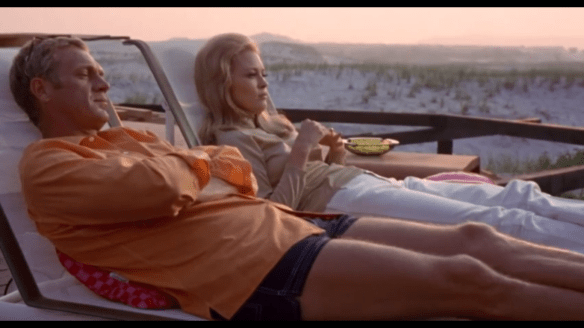
McQueen is the eponymous affluent playboy businessman who’s bored stiff by his day-to-day. It includes diversions like polo, dune buggy rides sliding across the sand and soaring through the skies in his custom-built sailplane. For a man like him, it’s not enough so he devotes himself to the perfect crime and it’s his lucky day when he meets a ravishing woman looking to trap him. It makes life a bit more exhilarating.

thomas crowne affair 1.png

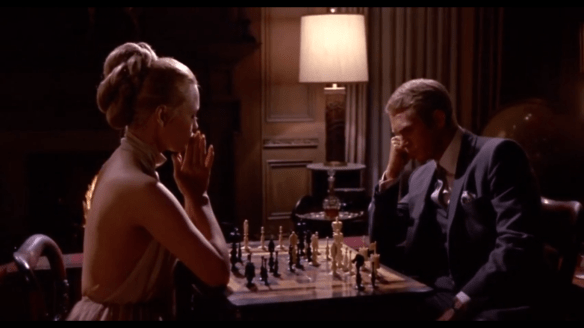
Among other rendezvous, they play a literal chess match in his parlor, which serves the dual purpose. Not only does it reflect the sparring going on between the two of them but it effectively accentuates the romantic chemistry pulsing through them with every headlong glance, every thoughtful thrumming of the fingers, or caress of a chess piece. It’s near-wordless with Michel Legrand’s score impeccably setting the quietly sultry mood in the low light.

On top of the title track, Legrand devised his score by composing against the uncut footage and in a generally unprecedented move, the movie was cut to his work. What we are met with within the same extended sequence are faces eventually framed in lingering close-ups. Eyes, mouths, nervous ticks denoting concentration. What’s more, it all culminates into a spiraling kissing extravaganza kaleidoscope of color.

As Vickie closes in on Thomas, he knows she cares about him and he must force her hand instigating a nearly identical heist to draw out her response. She can either work with the authorities or chase after him as he soars away in his jet decked out in his iconic blue-tinged Persol sunglasses. It’s her choice.

The Thomas Crown Affair is the most backward game of cat and mouse with the coolest rodent you ever did see crossing wits with an equally wily and lovely feline. But the stakes are minor in this sumptuous affair as it’s all style over substance in this second teaming of McQueen with director Norman Jewison. Of course, when you have two stars as scintillating as McQueen and Dunaway one could argue that you don’t need much else. Purportedly McQueen jokingly christened his unestablished costar “Done Fade-Away” as a little picture called Bonnie and Clyde (1967) hadn’t been released yet. Boy, was he wrong. She was here to stay.

3.5/5 Stars

The Cincinnati Kid (1965)

the cincinnati kid 4.png

The opening images of The Cincinnati Kid are nearly inexplicable but that doesn’t mean they can’t be fun. Steve McQueen brushes past a funeral procession of African-Americans complete with a groovin’ brass band. Then there’s a bit of a needless opening gambit where he’s tossing pennies with a precocious shoeshine boy. If the sequence serves a purpose it’s to indicate the world we find ourselves in — New Orleans during the Depression — and it also says something about our protagonist: He’s a winner.

This was Norman Jewison’s first promising picture to follow up a trio of frothy 60s comedies. As far as star power goes, he couldn’t do much better than Steve McQueen as the up-and-coming “Kid” even if the established star might be a bit old for the role. He’s got the prerequisites, confidence and an emotionless poker face, making him a believable big stakes stud. In fact, he’s one of the best around.

We get our first actual taste of the Kid’s talents when he walks off with the pot after challenging a smug nobody in his bluff and flying out a window before sauntering across the nearby railroad tracks after a washroom altercation. Steve McQueen takes it all in cool breezy stride like he does it every day. In truth, he had an action scene written into his contract for every picture and so the film gets the obligation out of the way early.

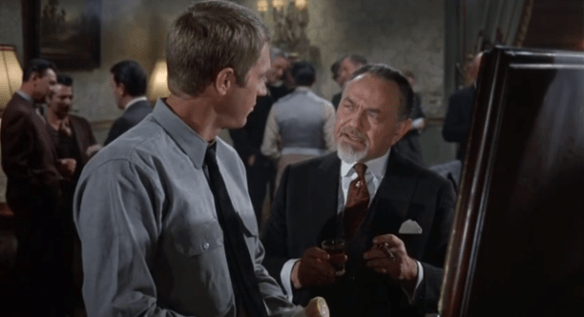
Afterward, it settles into its happy equilibrium. Edward G. Robinson is stately with beard and silver hair as Mr. Howard, the veteran of the poker-playing world who has seen a great deal and has remained the best of the best even after all these years. It’s all but inevitable The Kid will have to face him. There is no glory, no true ascension to the top of the pantheon of the greats if he cannot topple the old guard.

The Kid has a girl (Tuesday Weld) who he’s intent to keep around even as she goes back to her hometown for some space. He’s not much for talk and that serves McQueen as an actor just fine, but he does show her that she still means something to him.

the cincinnati kid 2.png

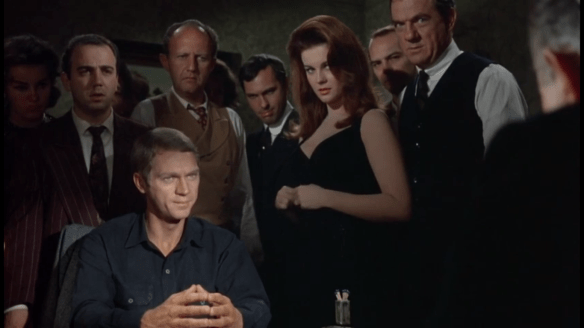
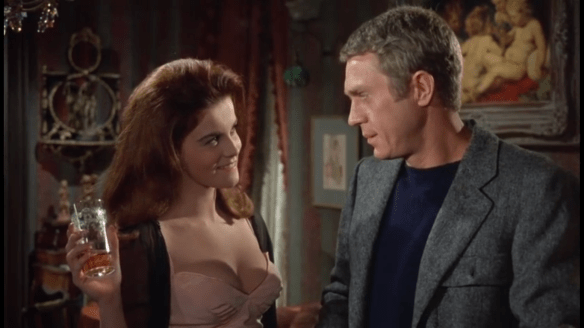
Meanwhile, his buddy Shooter (Karl Malden) lines up a date with The Man himself, Lancey Howard. Though I love Malden to death as an actor, he seems slightly miscast as the veteran card sharp. His wife is another story entirely. We meet Melda (Ann-Margret) as she cuts puzzle pieces to size when they don’t fit together. She cheats at everything. Ann-Margret proves as frisky as a calico cat and provocative as ever; the fire blazes between her and Steve McQueen and never stops burning. The camera seems to love them both. But Melda’s overt advances and The Kid’s passive acceptance do have repercussions. It never reaches the notes of melodrama but it’s no question that feelings are hurt and relations are strained.

What the Cincinnati Kid can’t put out as far as substance, it more than makes up for with an abundance of stylized cool instigated by McQueen. It is rendered through a Depression-era palette by way of the 60s, coquettish dames, and a stunning range of impressive personalities, including a boisterous Joan Blondell, who all help fill out the hazy backroom poker joints.

The steely, unblinking eyes of McQueen are made for the poker table. Then again, the same might be said of Robinson, his face never flinching or wavering, with an air of disinterest to match The Kid’s quiet confidence. They’re two sides of the same deck, both winners.

the cincinnati kid.png

The last 40 odd minutes or so are admittedly stagnant though having McQueen and Robinson around a table together actually does have the pretense of drama thanks to the stakes and the characters that have been brought to the fore.

It’s hardly an expositional movie but we know the archetypes. The young buck out to prove he can be the best. The old white wizard who’s looking to prove he’s not quite ready to call it quits as he attempts to go out on his own terms. Likewise, we have cocky card players who get taken to the cleaners and card dealers who’ve been around but that can’t always keep them out of a bind.

The film benefits by downplaying most of its dialogue-heavy scenes for the more cinematic moments, which essentially get carried by the faces of McQueen and Robinson alone with a room full of hushed onlookers. McQueen was by pedigree an action star and he reveled in those environments but there’s no question he has a certain mettle that makes his battle going toe-to-toe with Robinson equally compelling. And of course, the older man still carries his same self-assured confidence even if his days of being a Warner Bros. gangster have long since passed. It makes The Cincinnati Kid a cinch to be a winner no matter the outcome.

It’s true the picture went through substantial personnel changes including Spencer Tracy dropping out due to his failing health and Sam Peckinpah was also fired as director paving the way for Jewison. Tuesday Weld also ended up in the project instead of Sharon Tate. She’s a meeker performer but perhaps it works better in contrast with Margret’s character because even though they are friends, they also serve as obvious foils for the Kid’s affections.

Watching the beats the story goes through, one cannot help but think we already have The Hustler (1961) with Paul Newman playing much the same role facing off against Jackie Gleason in what proves to be a stellar black and white classic. While that doesn’t nullify The Cincinnati Kid, it does feel like a similar framework. Thankfully, it still manages to be delectable entertainment in its own right. The closing credits are sung by none other than Ray Charles and a relatively downbeat ending, ironically, provides a breath of fresh air.

3.5/5 Stars