The Adventures of Sherlock Holmes (1939)

adventures of sherlock holmes 1.png

“Elementary My Dear Watson” owes its indelible stature in the lexicon hall of fame to this second installment in 20th Century Fox’s Sherlock Holmes series. The studio obviously did not gather the phrase to have that much resonance as they gave up on the franchise only to have it be picked up by Universal Pictures for many, many more outings. This would be the last one set in its original historical context and it’s unquestionably the gem of the lot.

Though the analogy breaks down, it was easy to see the first installment of Rathbone’s outing as Holmes like Peter Sellers in the original Pink Panther (1963). You get a sense of a formidable character who is subsequently given greater fluidity and is, therefore, able to break into their own. A Shot in the Dark (1964) was far better than its predecessor because it gave Inspector Clouseau his own vehicle.

The Adventures of Sherlock Holmes proves to be a superior film for two such reasons. First, Rathbone and Bruce coming off their success are put front and center in this picture. But also while the first film was an adaptation of a Doyle story, this picture is an original narrative thus taking the characters from the page and extrapolating them onto the screen in new and intriguing ways.

In one sense, I’m glad for that change because whereas The Hound of the Baskervilles was much better as detailed by Doyle’s pen, this story is a creation blessed with an imagination. Taking all that is good about the original work and synthesizing it into something that never quite loses the spirit but on the contrary, builds on it all the better for distillation to the big screen.

The remarkable revelation is that the story does provide a true conundrum for Holmes as he battles it out with his arch nemesis Moriarty in a chess match of wits. While there are several moments that seem uncharacteristically on-the-nose for a man of his intellect, otherwise we relish the game and his astute observations.

It opens in a courtroom as Professor Moriarty is exonerated for a crime that everyone seems to agree that he committed. Only moments after the pronouncement Holmes rushes into the courtroom with the needed evidence. But it’s far too late. His rival has lived to scheme another day and what a scheme it is. He plans to pull off the crime of the century by distracting Holmes with two toys that he won’t be able to put down. He likens Holmes to a fickle little boy easily distracted and he plans to exploit his idle curiosity.

What unravels and what is articulated by the script is a lovely piece of intrigue that provides many distractions not only to Holmes but his audience as well. We know full-well that though they might appear completely unrelated, they’re indubitably tied together. It’s simply a matter of understanding how and for what purpose.

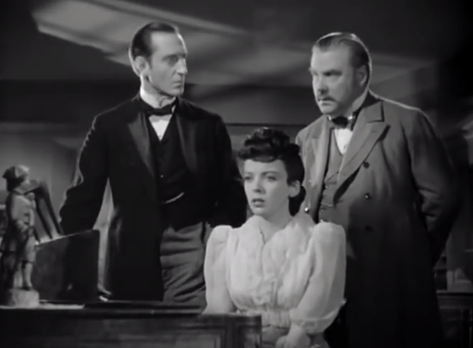
The first involves a young woman named Anne Bramdon (Ida Lupino). She comes to Mr. Holmes on the behalf of her older brother who has received an ominous note. The reason she’s worried is that her dear father received much the same message before he died under strange circumstances years before.

Although it ultimately takes a back seat to this more interesting case, Holmes is also counted on by his friend at the Tower of London to help with security in the transfer of a priceless diamond to be added to the Crown Jewels.

Holmes is caught up in this perplexing case in front of him as Bramdon’s frightened brother is attacked by a mysterious assailant and soon after the lady gets a note of her own telling her to attend a certain social gathering of a longtime friend. Holmes advises her to go as he will be there to protect her but of course, the date and time are the exact same as the jewel transfer. You see the point already.

Rathbone makes another stunning showing in disguise apprehending the killer and dashing off to thwart another crime as Moriarty cleverly infiltrates the Tower’s security, no thanks to Watson. George Zucco seamlessly embodies an intellectual yet sociopathic mind filled with disdain for human life. He asserts in one such scene to his harried valet that killing a plant should be a far greater offense than taking human life. He proves overwhelmingly that a superior villain with brazen intentions elevates any story.

Director Alfred L. Werker shoots the finale with some amount of artistry that heightens the climax to an agreeable apex. It goes down as it must on the top of the Tower of London and what is curious but rather refreshing is that there are no back and forth monologues of doom and heroism. Actions speak for both our hero and villain. While London fog now seems like free atmosphere and little else, the film is actually at its best in visual terms with well-lit Victorian interiors.

The finest success of this film was in projecting a certain image or reputation that extends far into the present age. Watson became an incorrigible bumbler. Holmes a cinematic detective both partially sanitized and still witty. Moriarty remains one of the standards for villains to this day. And with so many different iterations on these same characters, the influence on Robert Downey Jr. to the modernized Benedict Cumberbatch is equally evident. There are few qualms acknowledging the impact of such a sublime mystery adventure as this.

4/5 Star

Hound of the Baskervilles (1939)

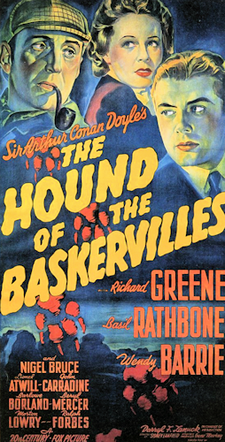
The_Hound_of_the_Baskervilles_-_1939-_Poster.pngThough there’s not a shred of doubt this picture was filmed on a Hollywood backlot, our story takes place in 1889 on the Moors of Dartmoor in Devonshire. It’s all very British and when you do a quick scan of the most British figures coming out of literature and pop culture, you would probably find few higher on the list than Sherlock Holmes.



For better or for worse, this is one of the films we must thank for countless Sherlock Holmes archetypes as established by Basil Rathbone’s characterization. Joined by his oafish, vacuous-minded friend Dr. Watson (Nigel Bruce), Holmes looks to investigate the mysterious death of one Sir Hugo Baskerville which supposedly came to pass due to the curse of a demonic curr labeled “The Hound of the Baskervilles.”

Right at this very moment, his nephew Sir Henry (Richard Greene) is coming to take up residence at the supposedly deadly manor deep in the heart of Devonshire. Holmes asks for Watson to accompany him as he has important business of a different nature to attend to. It unfolds as a stylized gothic murder mystery with typical studio melodramatics that are still somehow invariably delectable.

Some might be especially surprised to find out about Holmes’ absence for much of the film’s middle though Rathbone makes a stunning reemergence just in time to do a bit more sleuthing and confirm his numerous empirical suspicions. Bruce proves just how vital he is because there must be a stooge to make the hero look all the more preeminent.

The picture is hardly a whodunit. Deciphering the guilty party is quite simple to guess, working with the tropes that we have in our toolkit. But in the habit of Arthur Conan’s Doyle’s work, the enjoyment is in our hero’s highly-perceptive method of deduction.

While the short stories are probably more rich in this regard, what this film has in an iconic turn by Basil Rathbone — a man who was often made into a villain and yet was just as impeccably cast as a hero. However, to match the aesthetics at the time this picture has a broad menagerie of characters and the foggy atmosphere with the easily conjured shrouds of Gothic Hollywood.

We have shifty house servants, a deranged killer out on the loose, a husband and wife trained in the art of seances, and the crotchety old buffoon who is constantly threatening lawsuits. They are among the casts most colorful additions. Yes, we even get an appearance from the Hound, though, in fact, he’s actually a Great Dane.

It’s hardly an exercise to work your brain too strenuously but it’s a jolly fun piece of entertainment with several true moments of intrigue and menace. The pleasure is in its economy as well because the adventures of Sherlock Holmes as portrayed by Rathbone and Bruce proved so popular they were serialized on both radio and many more films to come.

Of course, when this effort came out, 20th Century Fox wasn’t so sure how their new hero would fare and so they conveniently cushioned his billing and his sidekick between the two love interests. I have nothing against Richard Greene or Wendy Barrie whatsoever but they are hardly the reason we turn out to see this picture.

Still, it seems necessary to at least acknowledge that one would do well to start with Arthur Conan Doyle’s work first and once you get a sense of them, enjoy this film without reservations. You can test the merits of Sherlock Holmes on this picture but you would do better not to. Because this is a Hollywood confection more than anything, proving to be a diverting adventure even as it helped usher in the accepted mythology of everyone’s favorite amateur detective for future generations.

3.5/5 Stars

Summer 1993 (2017)

summer 1993 2.png

Summer 1993 is a testament to subtleties which can make a film into something imbued with deeper meanings than what we might initially realize. It begins with the title immediately asserting this is a period piece and also implicitly we have the suggestion of the autobiographical. The postcript dedication is the final confirmation.

Otherwise, the film does not project a sense of self-awareness nor does it continually remind us what we are watching. Instead, it works in terms of intimacy and nuanced beats which lay out a world of the past that is piercing for the very transparency it projects. The personal becomes obvious in the ways it is handled with grace and an emotional candor.

This is a story of a small girl named Frida. She owns a pair of beautifully expressive brown eyes. Her hair is curled like a perfect little cherub and she is introduced in the midst of tragedy though we know very little about it. Being a child, she cannot quite understand the circumstances either. Much of the film occupies her head-space and point of view. Conversations waft over her. Things she cannot understand the gravity of. All we know is she has been affected. But even that rarely comes out of her.

She is defined mostly by pensive and measured actions. Her grandma teaches her the words necessary for her first communion. She repeats them obediently. Then, comes the move out of her family home with her new parents — an uncle and aunt — who have agreed to take her to live with their baby daughter.

They are caring and yet as with any change, there is a difficulty in adapting — a disconnect because she must become acclimated to a new life and even as the familiar has been replaced with something novel, we question how the transition will go.

Her doll collection is most important to her — and she plays house with her baby cousin — taking on the persona of the emotionally-detached mother even smoking a make-believe cigarette through her garish mascara. In town, she joins in a game of tag with the local kids and like it always goes — being the one new person — she gets shouldered with the task of being “It.”

She scrapes her knee scampering about and one mother becomes frantic that her child might be infected.  It’s an overreaction but it gives a hint to Frida’s past — the very reason her parents are no longer present in her life. Later there is a solemn conversation held over the kitchen table with all the extended family discussing her as she sits docilely by.

At night she’s lying in bed, saying her prayers and the barely audible notes of a marital argument can be heard between two people who nevertheless seem kind and in love. Life has a way of weighing on our hearts and minds. It is never an easy road to traverse.

When the baby daughter gets lost in the woods, injuring her hand, there is another change. Husband and wife, with prodding from the wife, in particular, agree limits must be put in place for Frida. She can hardly be trusted to look after her sister in this state.

summer 1993.png

Even against this backdrop, Summer 1993 is a reminder of the beauty and inquisitiveness of children. Their hands so meticulous, their eyes searching and innocent. In many ways, they are not jaded and troubled by many things as we often are as adults. Still, they are capable of selfish acts, defiance, and naughtiness. They do not understand how their actions affect others besides themselves. What ties us all together is the very fact we all have feelings and emotions. These do not change. They are the universal connector between us all.

The greatest pleasure is that the film very rarely — if ever — feels like artifice. There is such a measured and sensitive eye at work here to be able to capture a moment in childhood and do it without unheeded histrionics.

Better yet are the sweet refrains like the whole family snuggling up in bed together. Double-fisting ice cream as a reward for another successful doctor’s appointment after a whole slew of tests. I was there once as well except it was always Cheetos and strawberry kiwi Snapple.

The other moments are just as real. Frida watches her baby sister tumble into the water and watches wide-eyed as her father jumps in after her. She is scolded for her inaction in the face of the helpless cries for help. Then she drops her grandma’s gift nightdress in the dirt — ungrateful and jealous of her baby sister’s — even spilling milk on it. Her mother tells her to go wash it even as Grandma tries and make concessions.

She likens her plight to that of a Catalan Cinderella but then again for all kids childhood is a bit of a fairy tale even the bad parts. It feels like the whole world is against her. Of course, it couldn’t be farther from the truth but she is blinded by her own childish narcissism.

The fact her adopted parents are so loving, understanding, and have her best interest in mind makes it all the more striking. How can she view the world in that way? One evening she finally gathers her meager belongs, all but prepared to go off on her own, loading her bag with all the necessities including fruit from the kitchen table.

Her baby sister tells Frida she “loves” her and she reciprocates by leaving behind the doll she had packed. It’s undertaken with the sincerity of youth and that’s what makes it so sweetly affecting. There is this gravity to the proceedings even as this innocent girl does not understand all the intricacies of her situation.

summer 1993 4

A fitting final scene comes over the kitchen table again. Frida finally seems happier, at least she is getting used to life, but then out of the blue, she asks her new mother how her first mother died? Then, what follows are a row of very honest questions.

Her new mother fields them calmly in a reassuring way so her daughter can comprehend but you also sense there’s a touch of relief as Frida is opening up and willing to talk about the things she’s been aching to know. It’s a moment of deep personal connection. The impact is heady because it is hidden inside something seemingly so mundane in nature. But to those involved, it means the world. It is the beginning of greater understanding, moving them closer and closer to a whole family.

Getting ready for bed Frida spontaneously breaks into tears. For the whole film she has kept it in — remaining surprisingly unemotional — and yet now she can let her guard down. She doesn’t know why she is crying but we have some inclination. Could that be an eye getting misty? Not unlikely.

It recalls one lovely summer I spent living overseas because it is the one and only time in my life where I have lived on the edge of nature where you can hear and see the wildlife and walk around in it. It truly becomes your backyard. But it was in such a paradise where I had to rebound from personal grief as well.

It was not in the Catalan countryside but I was going through the same sense of isolation. Being a bit older I tried to cope in a different manner. What I realized is there is a need to gravitate more toward others opposed to falling away. But even as an adult it is difficult to do. It goes against our impulses in such moments where solitude is our greatest friend. Ultimately, Frida got there and I did too; it simply takes time. What a beautiful elegy to a childhood, to a mother, and, ultimately, the rebirth of a young life in the midst of tragedy.

4/5 Stars

The Only Son (1936)

the only son 1

Tragedy in life starts with the bondage of parents and children.

The film opens with a single extended scene with the title card reading: Shinshu, Central Japan 1923. Ozu guides us in with his pillow shots framing the story’s sequences with images of his locales which neither serve the narrative nor reveal anything about our characters at hand. But he more than many directors is well aware of his environment and basking in its very contours.

The opening premise has to do with a young middle school-aged boy and his mother. The problem is whether or not he will go onto high school. You see, his father is dead and his mother must eke by a living. They don’t have much money. School costs money.

There are two stories going around. The one he told his mother saying he would not continue his schooling and then the one he told his teacher. His mother only finds out when the man comes by to acknowledge how happy he is for the boy.

Though distraught at first, from that day forward the mother vows to pay for her son to have schooling, first high school and then college. Likewise, he vows dutifully to become a great man so her maternal sacrifice is not in vain.

Flashforward to the present and the now elderly mother decides to pay a visit to her son in the big city of Tokyo. He’s grown now and has a job. But it turns out that things are not as she might have hoped.

First off, he has a couple of surprises for her. He got married and already has a baby son. Also, their home is fairly run-down and humble because his salary as a night school teacher is meager at best. So much for being a great man. It turns out such aspirations are difficult, especially in a metropolis like Tokyo. Look no further than his old teacher who has turned to running a butcher shop just to provide for his family.

However, despite these circumstances, the son throws out all the stops to make a lavish showing of hospitality for his mother’s benefit. After all, he can’t possibly let on how things are actually going. Because that would break her heart. He would have failed her.

So he buys extra chicken, offers small trinkets, and they attend the picture show. Things he probably never would have done if she were not present. Slowly he’s sinking under the surface, borrowing money from everyone who might oblige.

But of course, the truth always finds its way out. She worked so hard to get him to college and the hope of his successes kept her going. The revelation of his current situation pains her heart and she’s forthright in telling him precisely that. She is utterly ashamed as he explains how difficult it is to become a big man in Tokyo. Hard work does not always cut it.

This could be the end of their relationship right there and yet there is another moment. After a horrible accident, he gives all the money they have left to help a single mother pay for her son’s medical bills. It’s a meaningful gesture and right before she leaves, the mother tells her son that she’s proud of his integrity.

All he can think about is how unsatisfied she must be and how much he didn’t want her to come to begin with. His wife concurs he’s lucky to have such a good mother, because by the standards of Japan, she made her child her all so that he might succeed.

Meanwhile, the mother regales her solitary friend back home about her son who has become a great man and his lovely wife and how she can die now without any regrets. All the while we know the full truth but she must save face and so she makes up the most satisfying story she can. Hidden away from view her head is downcast in grief and shame.

What’s striking to the very last frame of The Only Son is the conflicting feelings it provides. It constantly flits back and forth between this false sense of security and contentment to moments of deepest regret.

It never quite allows you to rest on a single one of these emotions but instead requires you to cope with them in equal measures as the scenes are layered one on top of another. First, the mother is happy, then the son is anxious, then the mother is ashamed, then proud. Her son is regretful and finally spurred on to make another go of being a great man. So there’s this lingering sweetness, this not uncertain hope, and yet his mother is in the backroom head bowed, saddened by where she left her boy.

There is no easy answer. There is no definite category. There’s no way to siphon off this person’s emotions from that person’s because they all remain interconnected. That’s what allows this film to make sense and have such an emotional impact as it quietly whiplashes us back and forth between mother and son. We feel for both of them even if their hopes and aspirations seem somewhat misplaced. It’s a film that pains the heart of anyone who hates to see lives in utter distress.

I must confess that I racked my brain for the reason Ozu might spend so much time cutting to shots of the hanging laundry — a recurring motif throughout the film. Surely, there’s some intricacy that I am missing or some subtle symbolism. While that is undoubtedly true, I realized even more clearly that Ozu did not require an overt reason for his shot choices.

Just as our eyes stray to observe the world around us so his camera turns its lens in such a way. It is attracted to faces, rooms, and maybe even the mundane qualities of hanging shirts as the wind softly swirls past. There need not be more than this.

Likewise, I kept on staring at the image of the glamorous movie star up on the wall of their humble home. I was trying to decide if it was Joan Crawford or some German actress I am not aware of. Someone else might be able to distill my ignorance but I realized, again, it did not matter as long as I enjoyed the overall experience.

Ozu can be cast much in the way of the famed woodblock printer Katsushika Hokusai most famous for his “36 views of Mount Fuji.” Likewise, the Japanese director took similar forms and topics and unearthed the intricacies of temperament and interrelations which he subsequently revisited again and again.

If you notice, he has simply reversed his normal dynamic of father with daughter and it has become mother and son. Relatively similar origins and yet the outcomes are no less enlightening. So it’s not necessarily about the novel. There can be just as much relish in taking something that we are so used to, like parent-children relations, and recasting them in such a way that we recognize the situations with greater lucidity. Therein lies a space for growth and understanding.

Surely Ozu takes some getting used to. However, eventually his style will age on you and you will come to find the same fascinations he does until your tastes meld and it becomes second nature to see the empathy and beauty in his subject matter just as he seems to. Pretty soon it feels as if you are looking alongside him. If you let him, it can become a thoroughly symbiotic relationship between filmmaker and audience.

4.5/5 Stars

Arigato-san (1936)

arigato san.png

The translated English title of Mr. Thank You somehow comes off insincere as if it’s making fun but there’s nothing of this kind of sentiment in this picture from director Hiroshi Shumizu. It proves to be a cordial exploration of human nature and human kindness played out in the most organic fashion possible. In turn, it’s blessed by extensive on location shooting as well as a wide-ranging cast of players.

What it promises is a charming road film like few I’ve ever seen; self-contained and yet freely spilling out over the roads with meandering ease guided by our eponymous hero. The driver of the bus traversing the road from the rural area of Iku to the big city in Tokyo is known to everyone as “Arigato-san” because when you hear a polite ‘Honk’ followed by an “Arigato,” he’s more than made his presence known.

People appreciate his continuous gratitude and also the courteous favors he does for them along his route. It might be picking up pop records for girls in the hills so they can have quality entertainment. Or for someone else promising to place water and flowers at a deceased father’s grave. He obliges graciously and constantly makes necessary pit stops to accommodate everyone.

The rhythm becomes second nature to us as an audience as well and we gladly follow any diversion the story takes. By the end, we’re so used to the film’s continual visual motif of point-of-view shots followed by an “Arigato” and a rear view of the pedestrians making way and waving our travelers on.

Peppy scoring right out of a Hollywood silent reel comedy does wonders to develop a certain mood on the road. In one respect it matches the jovial demeanor of our protagonist but at the same time, there are slight nuances of more solemn issues merely touched upon. Because it’s a bus that brings together quite the gathering of folks from all walks of life.

If our bus driver is a lovely character full of cheerfulness then his passengers are certainly just as colorful. He can be seen almost like a benevolent symbol of modernity and in some respects, his cohort is one too. She takes the seat right behind him and we gather at first that it’s simply to flirt. But as the story unfolds and we see more interactions those initial preconceptions give way to a more complex reading. She reflects a different sort of progressiveness. A woman who speaks her mind, drinks with the boys, and calls others out for their improprieties. You get the innate sense that she is worldly wise but generally kind-hearted.

The rest of the core group includes an impoverished mother and her daughter who is going to Tokyo for the sake of her family; it’s further implied that she will be forced to take on the ignominious life of a prostitute. Next, is a phony businessman with a handlebar mustache and a penchant for ogling pretty girls. The passengers are rounded out by earthy but nevertheless amiable folks and momentary travelers attending weddings and wakes. Each has a unique destination. Arigato-san transports them all.

For a director as prolific as he was — Shimizu had over 160 screen credits — it’s astounding that he has very little recognition among audiences now, at home or abroad. Yasujiro Ozu, one of his contemporaries and colleagues in their days at Shochiku Studio is of course revered the world over. Some might actually find Arigato-san more accessible in some respects and it’s definitely deserving of more acknowledgment.

Because what it offers up is not only a genial portrait of Japan and its humanity but also some of the inherent plight of the common man in rural Japan. In fact, the film is so affable that some of its undertones easily slip by. There’s a wide range of depth going from humor to surprisingly delicate commentary.

All the while we come to relish the time spent with each one of these individual passengers and especially Arigato-san. When they exit the bus upon arriving at their appointed destination it means something because in such a short time it does feel like we’ve built some sort of rapport with them. That’s one of the joys of travel felt most readily when you make the concerted effort to get to know those around you.

In this particular instance, the film provides deeper cross-cultural understanding and there is the realization that economic depressions were not centered solely around the U.S. Japan had similar if not worse conditions for its populous. And if anything, it makes you realize how the nationalistic movement in Germany or imperialistic ambitions in Japan took root. It comes from people who are weary from economic and social deprivation. They want something better.

For his part, I deeply admire the character of Arigato-san because his purpose is a noble one planted in humility. It seems like he genuinely cares for his neighbors and he readily goes out of his way to increase their joy. On a large scale, things might well seem hopeless but the micro-level shows that Japan was made up of many considerate people. While that cannot alleviate all the suffering of the impoverished it certainly is a jumping off point to instigate human flourishing.

4/5 Stars

The Burmese Harp (1956)

The_Burmese_Harp_Nikkatsu_1956_poster.jpgPut in juxtaposition with Kon Ichikawa’s later rumination on WWII, The Burmese Harp is a romanticized even simplistic account of the Japanese perspective of the war. However,  this is not to discount the mesmerizing nature of the story that is woven nor the overarching truth that seems to linger over its frames.

If anything, it humanizes the Japanese point of view and, rather remarkably, it does this so soon after the war’s conclusion. They were a nation deeply concerned with honor and the only way to get past such an egregious defeat was to frame it in such a way that empowered them for the future.

Because the men who came out of the war unscathed would be the shoulders on which to build a new democracy. You see that even in Ichikawa’s portrayal of the “enemy,” in this case, the English. There is no obvious ill-will. In fact, you could even consider it surprisingly laudatory. Because The Burmese Harp is not concerned with any types of residual politics or long-harbored injustices.

One could make the case it’s a far more universal and a far more moving portrait of the wartime landscape. The story, adapted from a Japanese children’s tale, plays out rather like a parable.

In the waning days of the Burma campaigns, a Japanese Captain named Inouye (Rentaro Mikuni), with a background in music teaches his group of men chorale arrangements which they sing to maintain their morale while they march and during their idle hours. One of their company, Private Mizushima (Shoji Yasui), quickly picks it up and becomes especially skilled at playing the harp to accompany their songs.

One evening they find their position in a local village surrounded by British soldiers in the night. The tense scene is diffused by music in a mutual connection reminiscent of the Christmas cheer in Joyeux Noel.

They learn that Japan has officially surrendered and so they lay down their arms peaceably. Although fearful and demoralized by months of struggle, they resolve to weather it all together. But one of their members is called upon to try and get some of their comrades to stand down before the British blast them to smithereens.

Mizushima volunteers to be the one to undertake this initial task as a liaison to try and avoid the needless loss of more countrymen. It is not to be. Even as the war is already over, it’s this event that proves to be galvanizing in the private’s new position as a missionary of mercy.  After being rehabilitated by a monk, he takes on their dress and shaves his head compelled to give a decent burial to all his fallen comrades.

Moved by the memorial hymn sung over the dead Japanese soldiers at the British Hospital, he realizes what his final calling must be. It’s easy to wager that the film’s most poignant moments occur in conjunction with song. In many of the best interludes, we hear the voices ringing out amid nature whether it’s the shade of the forest or the cleared terrain of a military encampment you can sense the notes rising up into the heavens with the strains of angelic melodiousness.

The same songs lift the spirits of our characters, comforts their souls,  and gives them the resolve to push onward for the greater good.  It has to do with an unswerving belief that each individual life holds dignity. Despite their many spiritual differences, there’s no doubt that this is a conclusion arrived at by both Buddhism and Christianity. Yes, the ugliness is unavoidable. But just as prevalent are immense reservoirs of beauty.

Mizushima is compelled in the inter most catacombs of his being to rescue the bodies of his brothers-in-arms that their spirits might rest in peace for posterity. It seems like such a small even insignificant act especially in response to such a cataclysmic war. But it’s one man’s calling. It is not for a mere man to know the answers to all the plaguing questions. All we can do is ease the suffering. For him, it is something. For him, it is enough.

What lends urgency to the story is the very fact that Mizushima’s entire company is frantically trying to obtain news of his whereabouts as they are getting ready to be shipped home. One of their most faithful messengers is a kindly old lady who learned some Japanese dialect. She can only give them small morsels but they cling to some hope. First, they think he’s been killed. Then, they think they’ve passed him on a bridge. Finally, they get their closure.

The candor is nearly startling especially put in relief with Ichikawa’s later work Fires on The Plain which paints a starkly different picture (or a very different side of the same picture). Likewise, this movie is aided by a script penned by his wife and close collaborator Natto Wada.

What we are left with are clear resounding strains of pacifism but by no means does it feel belligerent. What is conveyed is the sheer meaninglessness of war. However, it’s done through different avenues than his later work.

The film is bookended by the phrase, “The soil of Burma is red and so are its rocks.” The mind quickly flies to the pints of blood that were spilled across this terrain. It’s a grim reminder and yet The Burmese Harp, despite being a bittersweet tale, does boast hope. In the wake of war, such hopefulness is indispensable. You cannot progress without it.

4/5 Stars

Fires on the Plain (1959)

fires on the plain 1.png

The opening images of Fires on the Plain nearly catch you off guard. Not only are we thrown into a dialogue sequence that we have yet to grasp but much like Ozu would have a penchant for doing, director Kon Ichikawa photographs two Japanese soldiers head on so their conversation and reactions face the camera directly. It’s the first of numerous times where the film messes around with visual convention. But that’s not the half of it.

Fires on the Plain proves to be a repeatedly idiosyncratic war film while subsequently becoming one of the most appalling. As an audience, we are privy to one Japanese soldier’s listless pilgrimage across the bleak and generally decimated terrain. There’s no goal in sight. No reason even to stay alive. He is stricken with tuberculosis but the hospital, drowning in casualties already, won’t take him because he’s not fatal enough.

His commanding officer, who berated him in the opening minutes for returning to his starving unit, told him to try the hospital again or else use his grenade to kill himself and uphold his duty.

Ichikawa frames his pointless journey with unconventional camera setups that are considerably jarring if not completely detached. Private Tamura (Eiji Funakoshi) lumbers up each hill mechanically. Hacks his way through the underbrush. There’s little meaning to his movements. Any incoming threat seems inconsequential in spite of hikes in dramatic scoring. Still, he wanders through ghost towns and fresh graveyards. Rather haphazardly skewers a stray mutt with his bayonet. Guns down a local inside a hut as part of his constant search for food. Another villager gets away in a boat.

By this point, Tamura hardly cares anymore and proceeds to drop his useless firearm into a river; there are no bullets left. When he’s not alone he joins the most beleaguered band of squatters as they blindly wander toward their evacuation point together but no less pitiful.

It’s not a film to shie away from the stomach-churning, grotesque, forlorn, utterly hopeless realities of what war really is. Fields strewn with dead bodies. Heaps of skeletal remains. Hospitals with abhorrent conditions. Wild tales of men eating human flesh just to stay alive in New Guinea. Wading through mud. Playing dead with incoming enemy fighters. There’s little respite from this onslaught.

It becomes so absurdly hopeless it’s almost funny. What else is there to resort to? In the rain, trampling through the underbrush, first, one soldier sees a pair of discarded boots and switches his worn pair with these. This swapping continues with another man. The first man’s trash is his treasure. By the time our protagonist gets there, the boots left over are completely worn through but his boots have no soles either so he just tosses them on the ground and resigns himself to walking barefoot.

This is insanity. It’s cruddy. Absolutely dreadful imagery again and again and again. There’s a certain point where it simply becomes an act of survival — nearly monotonous in its never-ending, never ceasing plodding toward an ultimatum. We must begin to ask questions. Why do we do this to ourselves? Why must we go through this suffering and inflict pain and injury on our fellow man? We even resort to infighting just to survive.

If you came in with any idealized visions of warfare still intact, Ichikawa’s intent is to rip those preconceptions away limb from limb. There is no good in war. Only vile, putrid, horrible, unthinkable things that extinguish life and crush the human spirit.

Such moments prove to make Fires on the Plain a perfect counterpoint to Hollywood’s Bridge on the River Kwai (1957) going far beyond their choices in palette. Because Ichikawa’s film takes it’s black and white cinematography and carries it into all aspects of the production. It’s the nitty-gritty, the somber, the absolute disgusting side of war dolled out without much hesitation.

It fits nicely into the world developed in pictures such as The Steel Helmet (1951) and Red Badge of Courage (1951), except one can contend that Ichikawa takes it even further into the abyss. In fact, it would also serve as a fine companion piece for the provocative docu-drama The General’s Naked Army Marches On (1987).

However, not for a moment would I bash David Lean’s landmark epic nor the performances of such titans as Alec Guinness and William Holden. The pictures succeed in their portrayals in part because of their contrasting approaches to the same futility of war. That statement is made in both but the mode of expression is radically different.

If my recollections are correct we never hear explicitly where the action takes place though we can make many educated assumptions. Fittingly, in the last frame, we are told. The Philippine Front, 1945. Not that it matters. It could have been any war in any place.

There are anti-war statements and there are absolute anti-war immersions, arguably none more devastating than Kon Ichikawa’s effort here. Because to be trapped knee deep in this hell hole you know there is no way that such a world should exist. And yet we cannot be so naive to believe that such a shocking scenario is only of the imagination. It’s a troubling film to watch because we can’t help but be assaulted with the truth even as we would like nothing better than to bury it.

How can life get to such an intolerable point where death is perceived to be a greater gift than life? In not so flippant terms, maybe war is hell. Man turned against man. There is no harmony. There is no peace,  only chaos and destruction waiting for us around every corner.

The novel on which the film was based purportedly ends with our narrator taking on a Christian perspective and gaining a more optimistic outlook on Man and life after the war. However, I have few qualms with Ichikawa’s interpretation, though more downbeat, it makes the equally frank assertion that Man is prone to evil and violence. If Man was wholly good there would be no war. But something quakes within us that makes us belligerent. The age-old question remains what or who can save us from this world of death?

4/5 Stars

Shoplifters (2018)

Shoplifters_(film).jpgHirokazu Kore-eda has quickly become one of my favorite Japanese directors, and I consider it fortuitous that this affinity has cropped up in such a fertile period. Shoplifters is a high watermark in his already illustrious career.

Many folks are probably quick to label him the modern generation’s Ozu because it is an easy and harmless claim to make — a very complimentary one at that. Though, Kore-eda himself rightfully likens his work to Ken Loach or even Mikio Naruse. But if we conjure these names it seems equally apt to consider Vitorio De Sica, particularly The Bicycle Thieves, especially in the context of this film.

He’s shown it before but Kore-eda exposes us to a different stratum of Japan. It is more personal, humble, and if we can make the claim, more realistically transparent. You will not see his world in Lost in Translation (2003). Because he shows us something that many people probably would not want to acknowledge, much less those making the laws and running Japanese society.

His central characters are a husband and wife, Osamu (Lily Franky) and Nobuyo (Sakura Ando), who approach life as counter-cultural enigmas within the country at-large. He is a struggling day laborer, hampered by a sprained ankle, and she is ultimately laid off from her position at a local laundry firm. These are hardly spoilers and more so remarkable indications of just how extraordinary their relationships are. Because together they form a ragtag yet tight-nit nucleus of a family.

Living with them are Grandma (Kiki Kirin), a runaway hostess club worker named Aki (Mayu Matsuoka), and a taciturn son named Shota. The beauty is how we know these individuals as part of a symbiotic unit. We assume each one is a sister or a son until we realize just how unique this “family” really is.

It begins coming into focus when the “parents” take in a lost little girl named Yuri. There are signs of neglect and even abuse on the part of her parents that leave her seemingly detached from the world. But through constant nurturing and their own brand of endearment, she begins to come out of her shell and feel safe once more. It is through the lens of her situation we most distinctly view the discrepancies apparent in such an overtly unified society.

It is a movie that I must consider in the context of actually spending a great deal of time living in Tokyo. Because the city itself is wonderful, the streets are clean, everything has order and tranquility. But it all comes down to being perceptive. If you look around you begin to see the flaws, the skeletons in the closets, and the issues residing very near the surface.

You have this monumental epidemic of loneliness in this sea of humanity, the reality that many old people die alone without a network of community. Similarly, because they have little welfare or funds, the elderly often take up menial jobs just to survive in their old age. Fewer and fewer people are getting married. The population in Japan is slowly declining.

All types of folks fritter away their days (and money) in Pachinko parlors, or they seek out some kind of intimacy through tawdry forms of sensual pleasure. Even well-to-do families — those who represent what we might call “The Japanese Dream,” fathers with well-paying jobs, a beautiful wife with fine, intelligent kids — they can be dying a little bit every day on the inside too.

If the Shoplifters is capable of pointing us to anything meaningful, at the very least, it suggests how imperative personal relationships are. They must be built on affection and genuine concern. There must be space for feelings and love and closeness. Ironically, for a place with so many people, Tokyo is just about the most isolating place you can possibly exist in.

The film also creates this utterly riveting dichotomy that we might tie back to De Sica’s famed neo-realist picture. Because many people will see the film’s title and frame the entire narrative through that window of perception. Here is a family living in poverty and stealing produce and things to make ends meet. On a surface level, this is all true. In fact, we meet Osamu and Shota in the act of their very meticulous thievery of a grocery store. It begs that question, what would you do to provide for your family?

However, one could argue Shoplifters takes it a step or two further along this moral gradient. What really is right and wrong? Are the ways we monitor the differences in society really just or is there more nuance to the definitions than we normally give allowance for?

To another point, yes, this family is breaking the law. There is no doubt about it whatsoever, and yet you look at how they treat one another and live with such close-knit bonds and you wonder. Again, it is the so-called “honest citizens” who treat their children’s lives with such detachment or worst yet derelicting their duties as parents entirely. They substitute material things for true concern. There is no competition. One is utterly infectious and meaningful, brimming with life and authenticity. The other feels callous, shallow, and fake.

If it is a critique, then it works in the most benevolent commentary known to man. Kore-eda has such an elegant, non-confrontational approach to his material, you never feel like you’re are being preached to. Instead, he rightfully invests in onscreen relationships to make them feel genuine.

Because if shoplifting is in the title, this movie is, nevertheless, an exploration of so many vast and varied topics that are well worth our time and money to consider. Kore-eda makes each one more than worthwhile through his deft touch and handling of each character. His children feel real and genuine even as his adults have multi-faceted contours worth pulling back.

In Matsuoka’s scenes at her work, the few solitary moments we have there somehow evoked Paris, Texas (1984) for me. Because in one sense, we are provided certain expectations — this outer veneer with preconceived notions of what this place will be — only to have them be subverted in the most beautifully illuminating manner possible.

The most meaningful revelation comes when she finally comes face-to-face with one of her customers in a small, intimate space. The man, who barely utters a sound, does not even crave sexual intimacy but simply contact of the most basic nature. He’s lying in her lap docilely, just listening to her talk and sharing a moment for a couple of solitary minutes. They form a connection even in this short span — perhaps more affecting than anything else that has happened to either of them in recent memory.

Out of all the scenes in the movie, this one literally broke my heart. It’s difficult to describe but it is one of the best examples I can put to the debilitating loneliness often found in a place like Tokyo. You begin to understand how monumentally alone people might feel. These are not depraved folks seeking out sensual gratification; these are the isolated men and women looking for some human contact; any contact. You don’t hug in Japan. Even the physical touch in itself is life-giving. Our main family embodies this kind of affection to the core of their being.

While the final act takes us into new territory and for different reasons the makeshift family gets pulled apart at the seams, there is still this wistful sense of relationship. It was never discord that was going to break them apart. It always had to do with the outside stressors and rigid reinforcement of the world around them.

Even in this social structure they still find brief momentary nuggets of continual joy and familial warmth. These emotions are so powerful and so very difficult to hold onto but when you can they imbue life with so much meaning. One prime example is a family pilgrimage to the beach — getting them out of the hustle and bustle of Tokyo life — for a bit of freedom.

Kirin Kiki is phenomenal again in this picture and while not her actual swan song, it is a fitting final testament to her versatile and highly perceptive talents. Although I’ve become acquainted with her quite recently, she will be dearly missed on the cinematic landscape.

The ultimate beauty of this film, however, is the very fact it is not about one individual but the whole interwoven network of lives stitched together. It does feel like a humbling experience. It is a film that suggests revelation can come from the most unassuming of places. We can learn more from a lowly thief than we might ever learn from all the professors, salarymen, and bigwigs in Tokyo. It is a stirring reminder of where true worth and priorities need to come from.

4.5/5 Stars


Summer with Monika (1953)

summer with monika (1953).png

If I didn’t know any better I would say what the desires of the kids at the center of this early Bergman picture, sound like the American Dream. Except maybe it’s the Swedish Dream and maybe the main tenets are all but universal to many of the wide-eyed, angsty teens out there.

The lives of Harry (Lars Ekborg) and Monika (Harriet Andersson) have undoubtedly been witnessed countless times. They’re both in unfulfilling jobs. He’s an introverted laborer at a packing house where he’s not particularly happy and his constantly sub-par work ethnic receives the repeated wrath of his superiors. Meanwhile, the spirited Monika spends her days at a grocery store with a skirt chaser. Hardly the ideal environment.

But between Harry and Monika love blooms. He buys her a small trifle. They go to the movies together and she cries over the reveries on screen. This only serves to magnify how unpleasant real life feels, a far cry from the dreams they hold as working-class youth in Stockholm.

However, on a whim, Harry commandeers his father’s boat and Monika leaves behind her two annoying brother and nagging mother for adventure on the high seas (or rather the archipelago). The sun is bright. The water glimmers with personified delight. And it’s much the same for these two as they frolick and enjoy the novelty of this romanticized getaway. Even though the film famously features brief nudity, rather than being utterly sexualized, in more ways it evokes the imagery of Genesis 2 (Adam and his wife were both naked, and they felt no shame). The shame comes later.

Right now, they’re yet another iteration of the love-on-the-run narrative that proves you only need a mode of transport and passion does the rest — carrying lovers away on its gleeful wake.

Because at that age we’re all grasping at something intangible that floats above us tantalizing us every day of our lives. There’s not enough experience in life yet to know any better and so we go out and crave these pie and the sky ideals. Until it turns out were really grasping at straws. There’s nothing there for us. Only a harsh reality check.

As they often have a habit of doing, dreams so quickly turn themselves into nightmares and all the hopes that we clung to are dragged through the brush and the briar. So by the end, they’re muddied with dirt. That doesn’t have to be the end, however. Nor do you have to give in to your dreams being trampled.

As in the case of Harry and Monika, you can try and make a go of it the normal way. Grinding out an existence, poor and trying to eke by paycheck to paycheck. There’s a child now and he’s going to school to earn a better life, nagging like a conscientious adult about saving money and making their rent payments on time. There’s the constant bickering when he comes home tired from work and she’s discontent with this very mundane, sedentary lifestyle. There’s no allowance to go to the movies or buy some new clothes.

Soon she’s going to the arms of another man. Divorce is all but inevitable. How could all this happen in rapid succession you ask? Perhaps Summer With Monika is an exercise in heightened drama but Bergman, in essence, seems to be plotting the cycles of life and what hard-edged reality does to you.

It runs you up against the rocks, often destroys all your well-meaning aspirations, and leaves you disgruntled. Especially when we’re young we run that risk but any type of love, even those relationships founded in shallow soil, are rapturous when times are good. It’s a true test of stability when the bad times hit or further still the banality of the everyday. If you are still in love with a person even in those moments, perhaps that’s when you know you have a marriage with staying power.

It didn’t occur to me until well into the picture because I can be slow-witted with a thick skull but early on in the film, we have one of the old-timers observing that it’s springtime. The film is Summer with Monika and that embodies the happy times in the sun. But of course what must follow is Fall where everything begins to fall apart and then there are the bleakest depths of winter which are trying for any relationship to attempt to weather. All Harry can do is look back and yearn for those summer months. Although by wintertime it’s already far too late.

Bergman’s ultimately portentous parable is gorgeously rendered as usual. In fact, I’m not sure if I have ever seen a film by the Swedish maestro that wasn’t so. There’s a crispness to the black and white that while unadorned and unglamorous is nevertheless pure and blatantly arresting. In the moments of free, uninhibited youth it so exquisitely captures that mood while just as quickly shifting into the frigid moments as youthful innocence is forced to die.

4/5 Stars

Review: What’s Up, Doc? (1972)

whats up doc 1.png

I’ve always been fascinated with individuals who have blurred the line between the film critic and actual contributors to the industry. Notable examples, of course, being the boys at Cahiers du Cinema, Frank S. Nugent, James Agee, Paul Schrader, even Roger Ebert, and certainly Peter Bogdanovich.

It’s this bridge between the intellectual and the actual practicality of the craft that seems so crucial. Because Bogdanovich might come off as an erudite individual who would end up making stuffy philosophical pictures. But What’s Up Doc is nothing like that. He loves the cinema and it shows.

Yes, this movie becomes a tossed salad of cinematic references and yet in the midst of the chaos, there is the finest rejuvenation of the screwball genre we’ve probably ever received. If neo-screwball were to be readily adopted in academic circles, you just might have to start the conversation here. It’s crazy; it’s destructive; it goes careening out of control. Maybe it’s just me, but I find it genuinely uproarious like a sprawling sitcom episode. It’s what the genre was made to be.

“You’re The Tops” plays, as the credits roll, sung by Barbra Streisand in a very casual manner that hints at the enjoyable jaunt we are about to undertake. Using the most basic terminology to break down the picture, What’s Up Doc is essentially a comic shell game. Except the shells are replaced with four identical plaid overnight duffles and the con is simultaneously being pulled on everyone on the screen and in the audience alike.

One bag holds the prized rocks of a musicologist Howard Bannister (Ryan O’Neal) who is traveling to San Francisco from his conservatory in Ames, Iowa to vie for the prestigious Larabee Grant. If he is lucky enough to reel in the award, it will help fund his research on the musical properties of igneous rocks. Don’t ask me to explain.

The other case comprises the possessions of one Judy Maxwell (Streisand). It’s not the contents of her bag as much as her whirlwind personality that will wreak havoc on the picture. Then, a third bag holds one lady’s prized collection of jewelry and the fourth holds secret government documents. Again, don’t ask.

But everyone seems to have a shtick. That’s a product of a screenplay crafted by Buck Henry, David Newman, and Robert Benton. There’s a repetition to the script’s comedic cadence that puts an indelible stamp on the material. Coming from such people like Madeline Kahn it can almost drive you insane while O’Neal is playing a stereotypical sterile intellectual type that generally goes against his well-suited image.

Still, with some people playing the film straight, or at least as flat and square as they come, it makes other people pop even more. Is that Barbra Streisand I hear? She drives us crazy but in a different way — arguably a much better one.

whats up doc 2.png

She throws the anal Eunice (Madeline Kahn) off the scent and winds up accompanying Howard to his important dinner to schmooze Mr. Larabee (Austin Pendleton) and outfox the competition represented by the snobbish Hugh Simon (Kenneth Mars). Alone Howard wouldn’t stand a chance but taking on the name Burnsy and masquerading as his fiancee, this intolerable girl who accosted him in a gift shop essentially wins him the grant.

Pendleton is an utter dork but there’s also something personable about him. He finds Burnsy to be just delightful and soon they’re on a first name basis. Howard’s trying to explain all the mix up as the real Eunice attempts to claw her way into the affair putting on a hissy fit. Meanwhile, Howard doesn’t know what to do because Burnsy’s got him all turned around amid the ruckus.

Various side plots continue crisscrossing as people sneak around the periphery involving the aforementioned travel packs. A concierge and the house detective are in cahoots to abscond with the priceless treasure trove of glittering gems. Meanwhile, a mysterious man is tailed every which way by another man saddled with a golf bag as a measly attempt at a disguise. It would be astoundingly absurd if we weren’t already distracted by everything else going on in front of us. As it is, these diversions only succeed in adding to the cacophony of it all. A perfect visual articulation comes in the form of a hallway lined with doors, leading to rooms, and the people inside.

whats up doc 5.png

It comes to an abrupt end when they all wind up in Howard’s room with one girl out on a ledge, his outraged Fiancee asking him to turn the TV down, and everyone else making a cameo appearance. What follows is the total annihilation of a hotel room suite, a fitting foreshadowing of coming attractions.

Even if it can’t quite reach the same heights, What’s Up Doc is unabashedly homage to Bringing Up Baby (1938). We have a man’s coat being ripped, dinosaur bones being traded out for rocks, and the similar antagonizing relationship between our leads. However, I didn’t realize that we also have much of the character dynamic from The Lady Eve (1941) because Streisand like Barbara Stanwyck before her has an incredible aptitude for manipulating her male conquest. Katharine was the whizzing hurricane of constant disaster. Stanwyck was whip-smart. Streisand channels a decent dose of both legends.

The Larabee Gala hosted at Frederick’s estate proves to be the beginning of the floor show as the camera leaps into action and the final act kicks into a frenzy of slapstick, flying pies, and all sorts of comedic violence.

This might be blasphemy, but as much as I admire Bullitt (1968), Bogdanovich’s film might feature my favorite car chase through San Francisco. It involves a famed giant pane of glass, wet cement, offroading down stairs, a Chinese dragon, and a big splash in San Francisco Bay among other visual kerfuffles. We even have a courtroom drama on our hands!

The laundry list of other references is nearly endless from Cole Porter to nods to Bogart and “As Time Goes By” in Casablanca. Ryan O’Neal even drops a fairly inconspicuous “Judy, Judy, Judy” in the airport terminal, no doubt a nod to Cary Grant’s misattributed catchphrase.

His plane is leaving to return him to his life of everyday tedium. But between in-flight Bugs Bunny shorts and one lethally pointed barb aimed at Love Story (1970), there’s also one final smooch. And we’re done. This is a movie you’re lucky to survive. It’s certainly laced with references, and, more importantly,  it’s a successful giggle fest. The screwball comedy proves to be alive and well in San Francisco.

4/5 Stars