Review: Dial M for Murder (1954)

Dial_M_for_Murder1

Dial M for Murder is talky and more dialogue-driven than a great many Hitchcock films but that’s partly because the environment is more conducive to that kind of storytelling as much as the fact that this murder story is adapted from a popular British stage production.

Like Rope (1948) or even Lifeboat (1944) before it, Dial M for Murder is for all intent and purposes a chamber piece that essentially takes place on one set: the drawing room of Tony and Margo Wendice.

But quite similar to its predecessors you also get the sense that Hitch approached this picture with a certain perspective and turned it into a technical puzzle to be solved. In typical Hitchcock fashion, he underlies even scenes that are seemingly stagnant with interesting accents. His frame is constantly filled in the foreground lending a certain depth to the picture that we can easily imagine as utilizing cutting-edge 3D technology.

Aside from his work with his frequent director of photography Robert Burks, he also put some obvious restrictions on himself in terms of location. Several of his decisions are fairly daring. Instead of having a whole courtroom sequence he elects to shoot it in a highly stylized fashion that while far from realism, still gets the essence of the story across in a matter of a few minutes.

However, he also has a sequence where two men are talking and the frame is broken up by a lamp and it takes the typical shot-reverse-shot paradigm and makes it more interesting. The same goes for the disconcerting high angles that he uses in multiple instances to depict the action unfolding as first the two accomplices plan out the ensuing events and then the police come onto the scene to investigate.

His preoccupation with the “Perfect Murder” crops up once more as a retired tennis player living off the fortunes of his beautiful young wife decides to murder her to maintain his lavish lifestyle. Her infidelities with an American mystery novelist and minor acquaintance are the pretenses for his actions — a perfect way to get all her money for himself.

But this isn’t a picture working on a moral level. As is often the case, Hitchcock seems far more invested in the mechanics of the actual murder and whether or not it can actually be pulled off and what it would all look like.

Tony (Ray Milland) soon has an old college chum embroiled in his plot with a healthy bit of blackmail and he has everything set up perfectly to get Margot (Grace Kelly) to stay at home while this phantom man will sneak into their flat and murder her. But it will come off as a freak accident and that will be the end of it. However, being a fighter, Grace Kelly doesn’t give up without a struggle and her husband now must cover all his tracks and events unfold much differently than he was expecting.

Milland plays the typically witty and rather sophisticated Hitchcock villain who is in one sense charming and extremely prone to moral turpitude. Grace Kelly is stunning as always and a sympathetic figure as the wife who finds herself the victim of a grisly attack and subsequently accused of a murder no thanks to her husband helping to dig her grave. Though it’s not her best performance next to such startling revelations as Rear Window (1954) and To Catch a Thief (1955), there’s no question that it helps to solidify her incomparable partnership with Alfred Hitchcock.

Robert Cummings role as a crime author is a necessity because it makes his spot-on guesswork certainly not plausible but more interesting. Because he’s simultaneously dreaming up a scenario and ironically convicting Milland with his cockamamie stories which are surprisingly close to the truth.

John Williams reprises his stage role and turns Dial M for Murder into a bit of a Columbo episode of ‘how is he going to catch him’ because this works best to Hitchcock’s advantage since he’s not necessarily interested in the shock but introducing the audience into the entire plot so they become invested and stringing them along with all the proceedings. In such a way, the suspense and the subsequent payoff can be as memorable as possible.

When Milland walks through the door at the end of the picture, it’s an unextraordinary, even everyday action, but Hitchcock has imbued that single event with so much meaning. As an audience, we are sitting with baited breath waiting to see if the key will turn in the lock. This is a film that ultimately is indebted to the rotary phone if only for its title. But it’s hard to beat Hitchcock and the future Princess Grace of Monaco.

4/5 Stars
Secret Agent (1936)

secret agent 1.png

It’s so easy to quickly brush off early works of Hitchcock with admittedly bland titles like Blackmail (1929), Murder (1930), Secret Agent (1936), Sabotage (1936), etc. But if you actually dare to dust one of these films off for a viewing, you do see Hitchcock spinning his wizardry even if the edges are a bit worn, the stories barely developed, and the production values humble.

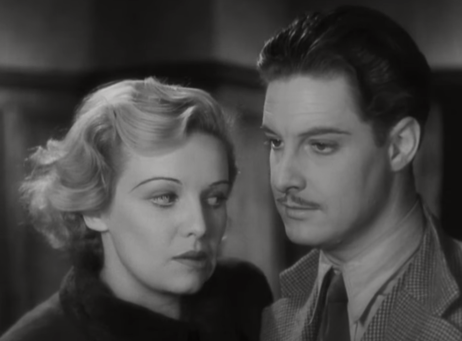
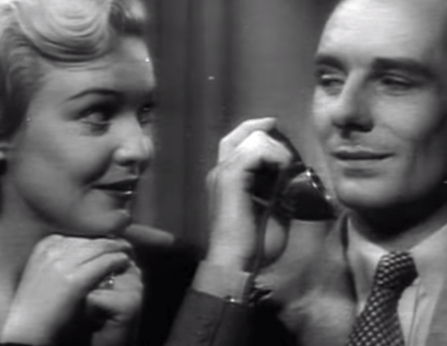
Among the ranks of Hitch’s thriller sextet, Secret Agent written by frequent collaborator Charles Bennett is a surprisingly lucid effort with a cast that is stacked quite nicely. John Gielgud is a bit bristly as our leading man and the chief secret agent in our loosely set WWI storyline while Madeleine Carroll (featured earlier in The 39 Steps) is decidedly more fun as the adventure-seeking gal by his side, augmented by a certain amount of ravishing vitality.  They have quite the connubial relationship posing as a married couple. Still, there’s enough chemistry within the film’s running time for some breezy comedic moments that predate later romantic thrillers like To Catch a Thief (1955) and North by Northwest (1959).

In fact, part of the reason Gielgud’s Shakespearian sensibilities come off rather stuffy at times is not so much his fault but a testament to Carroll and Gielgud’s other male counterparts. The future all-knowing television father Robert Young makes his mark as a quipping American wiseguy constantly making passes at his latest acquaintance Mrs. Ashenden.

We meet him for the first time lounging in the lady’s hotel room in an amorous mood and he never ceases flirting, for the majority of the film anyway. Equally memorable is the spastic performance of Peter Lorre though he can’t quite pull off the stereotypical portrayal of General, the Hispanic sidekick supposedly spouting off Spanish in rapid fire and still speaking in a cannibalized English dialect with a German influence. There’s no denying he is colorful given Lorre’s usual aptitude for playing wonderful supporting spots.

Like many of Hitchcock’s films sandwiched together during the 1930s, this one exhibits the same precision plotting that sets out the parameters of the narrative early on including our hero, his background, and his goals, in this case to rendezvous with a double agent so they might weed out an enemy counterspy.

The objectives seem simple enough as our man Broden alias Ashenden must masquerade with his “Wife” and the eccentric “General” in the deceptively glamorous world of spies, secrets, and international intrigue. Hitchcock does make it a riveting world at that. A foreboding church with pounding organs and clanging bells is the scene of a murder. There’s a lively setup at a casino beckoning the future delights of films like Casablanca (1942) and Gilda (1946).

But there’s always bedlam waiting somewhere and in this case, it’s staged in a German chocolate factory as our English spies try to evade capture ratted out by a faceless snitch. The final act rumbles along on a hurtling train still behind enemy lines with the British air force raining down a hail of bullets. It’s the prototypical spectacle for a Hitchcockian showdown with unconventional results.

One of the most impressive aspects of Secret Agent is how many people Hitchcock is able to crowd in the frame balancing medium shots with close-ups and maneuvering his camera this way and that around his character’s many interactions. It evokes that not so famous adage that film is both what is in the frame and what is left out. Here we have a film that makes us very aware of what we are looking at and that is a hallmark of this man. He very rarely allows his camera to be a passive observer unless he chooses for it to be.

4/5 Stars

Note: It’s only a small aside but I only realized moments after the movie ended that even a young Lilli Palmer made an appearance as General’s beau.


Review: The 39 Steps (1935)

39 steps 1.png

With The 39 Steps, it’s possible to witness Alfred Hitchcock coming into his own and one of the most obvious markers are numerous motifs, character archetypes, and techniques that would crop up in his work again and again. But it’s also conceivable to trace the influences of this film in most every spy-thriller-comedy-romance that has ever come in its stead.

Like The Man Who Knew Too Much the year before, this picture takes little time to get going and Hitchcock strings scenes together in such a way that the narrative is constantly on the move. Our modern sensibilities might tell us that his picture is rushed but it’s unquestionably interesting. It’s equally likely that we might believe other scenes are too slow. And yet he really does offer up a wonderful thriller that maintains a driving force of suspense. The key is balancing the more complacent moments with great jumps and leaps in story that both work to keep us simultaneously engaged and off balance.

He rather brilliantly cuts from scene to scene giving us just enough information to grow invested in his man-on-the-run spy thriller that looks vaguely familiar. In fact, it’s easy to see the groundwork for Cary Grant’s Roger Thornhill from North by Northwest (1959) in Robert Donat’s own credible characterization. In many ways, it’s a humbler version of the later cross-country epic trading the vast expanses of North America for the quaint and still majestic United Kingdom. We even are treated to one of Hitchcock’s original blondes in Madeleine Carroll and like all his greatest stories, he uses the seemingly useless plotting device, the so-called MacGuffin, as the motor to his narrative.

The action opens in a music hall where a lively performance is going on in front of a rowdy crowd and the festivities showcase the rather unbelievable phenomenon of Mr. Memory, among other acts. But in typical Hitchcock fashion a gunshot goes off and pandemonium breaks loose.

In a moment, we’re shown the outside of the venue and our hero Richard Hannay finds his hand being held by a frightened woman. Hitch moves the action forward on this coincidental meeting and never ceases from that point on. You see, this woman is connected with the international spy world. She gives a vague notion of her business but what isn’t vague are the men who are looking to kill her or the subsequent knife found in her back.

It’s yet another thrust forward in the film that sends Donat hurtling toward Scotland, the location where his female visitor noted her contact was located in. But equally telling is her warning to watch out for a man missing the tip of his finger. So, of course, in perfect Hitchcock fashion, in a completely ludicrous turn of events, the double chase is on. Both the authorities and the bad guys are after this innocent man. One for the murder attributed to him and the others for the knowledge that he now has.

From this point onward the almost picaresque plot is continuously streamlined and functions on a subsequent row of fascinating scenes and locales that all could work as separate entities entirely. First, he’s riding aboard the Flying Scotsman jumping free of the train to evade capture. Then, Hannay is holed up in the home of a gruff farmer and his sympathetic wife in the Scottish Highland. He meets the big man face to face and gets away with his life only through sheer coincidence. Next, he unwittingly ends up giving a stirring speech to the local electorate about their obligation to live a life of brotherly love before getting whisked away by the authorities.

Subsequently, he finds himself handcuffed with one of his earlier acquaintances from aboard the train (Madeleine Carroll). The fact that they despise each other perfectly highlights the best comedic elements of The 39 Steps as they bicker and struggle to keep their cuffs inconspicuous moonlighting as newlyweds.  This section of the film hearkens to some similar moments in the screwball comedy of the prior year It Happened One Night and it doesn’t hurt that Donat has a mild resemblance to Clark Gable. He happens to whistle a lot too.

Still, this is a Hitchcock thriller and it takes them through the moors of Scotland, their fleeing feet masked by bleating sheep and their mutual distaste finally traded for a general amount of concern. You might say they grow on each other. Yet that does not take away from the bottom line.

Government secrets of the utmost importance are about to be smuggled out of the country and they haven’t the faintest idea how it is to be done. Surprise, surprise, we end up in a packed London Palladium where everything must come to fruition. By this point, we hardly know how we got where we are as an audience and when it’s all over there’s more than a few questions — maybe even a few objections — but there’s no doubt that the 39 Steps is a clinical exhibition in the art of the spy thriller.

Although his actors would arguably become more prestigious (though Donat and Carroll are no slouches) and his whole productions more impressive, it’s decidedly difficult to deny the sublime vision that courses through the film. It could really function as several films all in under an hour and a half and yet ultimately it comes off unequivocally as one picture. It’s not simply one of Hitchcock’s finest British efforts, it’s a high watermark in any conversation of his oeuvre.

If you desire even a single moment of pure ingenuity look no further than the interlude when the maid comes into the murdered woman’s flat. We expect to hear her bloodcurdling screams as she turns toward the camera but instead, we are met with the high-pitched screeching of the train as Donat idly sits now miles away. In the hands of another director, this whole sequence might have slogged on. Hitchcock makes it positively gleam with possibility and that’s indicative of the whole picture.

4.5/5 Stars


Review: Strangers on the Train (1951)

Strangers_on_a_Train_-_In_the_dining_car.png

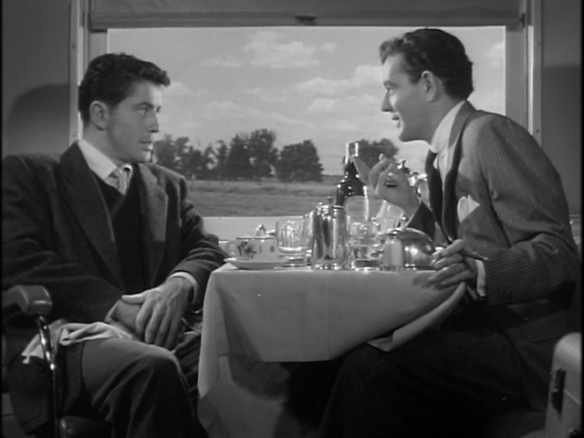
Strangers on the Train is conceived in its first few minutes of dialogue when the charismatic bon vivant Bruno (Robert Walker) ingratiates himself on tennis player Guy Haines (Farley Granger). Bruno is a big idea-man, constantly talking and thinking and wheedling his way into other people’s lives because he does have a way about him. He makes it easy for others to like him and then they let their guard down after a row of trivial jokes and he’s got them. That is until they begin to see something else entirely in him.

In this particular instance, he schmoozes Guy’s ego. He’s a big tennis star. Bruno has read up on him and knows all about him. At first, it’s mere flattery but as the conversation continues it gets more and more unnerving. Bruno seems to know a little too much almost to the point of obsession.

Still, he manages to keep the other man’s attention just long enough to share his greatest idea — imagine for a second that two men who meet quite by chance (on a train for instance) were to trade murders — leaving no motives or connections for the authorities to trace back to the culprit. Of course, the whole idea soon falls apart if not everyone is equally invested. It doesn’t work if only one individual takes such a ludicrous idea seriously.  That’s where uneasiness begins to set in.

Robert Walker’s performance might rightly be one of the greatest performances in a Hitchcock film in terms of the sheer chill factor. He’s a psychopath, somehow misguided and tortured by issues that never truly get resolved. A great talent with so much promise was lost far too young when he died tragically the same year this film was released.

But equally important is Farley Granger’s more subdued performance, that quiet sensibility that makes him an easy target for someone as magnetic as Bruno. With another actor such as William Holden (initially considered for the part), the dynamic falls apart for sheer implausibility and as a result, the film would not function so effectively. We soon believe that a relationship such as Guy’s and Bruno’s could actually exist and that shred of reality makes the tension all the more unnerving.

Due to its foreboding cinematography courtesy of longtime Hitchcock collaborator Robert Burks and Bruno hanging over Guy constantly like an expectant specter, it`s easy to trace the line of film noir sensibilities here as the darkness seeps into Guy’s picture-perfect life.

But what’s fascinating is that Bruno initially aids his newfound friend — he assists him in getting the life that he’s wanted for a long time, an existence that is respectable, complete with a beautiful woman. Anne Morton (Ruth Roman) is the daughter of a respected Senator (Leo G. Carroll) and her upbringing and general concern reflects a stark improvement in Guy’s social standing.

Is it safe to say that it’s fairly easy to harbor a crush for Roman who exudes a refined decency, even if she’s not quite Hitchcock’s icy blonde? Place her up against Guy’s opportunistic and cavorting wife and Bruno’s action could almost be considered a service. Almost… Still, Bruno spins his charisma into a deadly threat, ultimately evolving into Guy’s worst nightmare.

Meanwhile, Patricia Hitchcock sometimes feels like she is used as a plot device but nevertheless even in that aspect alone she is crucial to this story. She also doesn’t quite fit into the Morton family but her very characterization reinforces many of the themes her father is playing with often using visual language.

The most acclaimed shot for its sheer stylized perspective is the scene of Bruno’s act of murder. It’s done in only a moment, silently, and without much fanfare. The woman’s glasses fall to the ground cracked and we see the reflection of the events at hand. It’s pure Hitchcock but the entire sequence is a masterstroke in buildup.

Bruno is tracking his unsuspecting prey. He follows her into a carnival. Past the booths and the rides, by popcorn vendors, into the tunnel love and finally to a darkly lit meadow where the deed is done. But without the buildup, this continuous cutting between the man and the woman, the scene has little impact. Hitchcock gave it increased stakes bolstered by true suspense.

But what he does equally well is cross-cutting not only his two main characters but their very actions. The opening introduction showcases this contrast of personalities with Bruno and Guy. It never ceases. They’re constantly placed opposite each other intersecting and crossing each other. Yet Hitch emphasizes these conflicts visually on multiple occasions which completely justifies why his main hero was written as a tennis player.

The fact that Guy is in the thick of a match during one of the tensest segments is magnified in how the camera cuts between Guy and his opponent back and forth with the audience, line judges, and everyone else spliced in for good measure. It mirrors the very same conflict he’s still tied up in with Bruno just as the gradation of black and white reflects the good and evil that separates and at the same time connects the two men.

You can always count on Hitch to bring the goods and yet again Strangers on the Train ends with a whirling, whizzing, shrieking bit of pandemonium — a real slam-bang finish courtesy of the Master of Suspense. Over 65 years later it hasn’t lost much of its impact blending a sense of real-life spectacle with genuine thrills. And like Hitchcock’s greatest films this one works on multiple planes visually, psychologically, metaphorically, narratively, and that frees us up to enjoy it in whatever way we please. That’s the sign of a quality movie from the foremost of creators.

5/5 Stars

The Man Who Knew Too Much (1934)

The_man_who_knew_too_much_1934_poster.jpgAlthough Hitchcock did many riffs off the same themes, he very rarely tried to do the same film twice over. The Man Who Knew Too Much might be the one exception and even then if you place these two thrillers from 1934 and 1956 up next to each other, they’re similarities are fairly nominal.
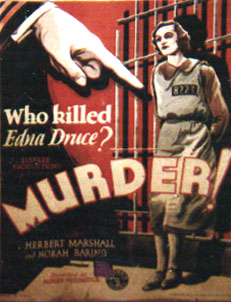
The bare-bones plot involving international espionage, a pair of unassuming parents, and the kidnapping of their child remains the same. But most everything else is drastically different.

Thus, it becomes an interesting exercise in juxtaposition. It really depends on what the viewer deems definitive in a quality film mixed with personal preference. Without question, this initial offering from a younger director is grittier and less made up but it’s subsequently a less technical sound achievement with also little score to speak of. We trade out James Stewart and Doris Day’s singing for the less remembered pair of Leslie Banks and Edna Best. But nevertheless, this version of The Man Who Knew Too Much is an enjoyable international adventure crossing the globe from the Swiss Alps to England.

The Lawrences are on a lively vacation complete with skiing and skeet shooting with their precocious daughter (Nova Pilbeam) but after an acquaintance winds up murdered, the family finds themselves embroiled in a treacherous world of espionage. The dead Frenchmen left them a message to pass on to his contact but that knowledge finds them deeply distressed when their daughter is kidnapped. From that point, the intentions of the story are fairly straightforward. It’s simply a matter of watching Hitchcock at work.

Peter Lorre fresh off his emigration from Nazi Germany in the wake of Hitler, ironically plays the quintessential international menace, cigarette curled between his lips. It was so recent in fact that the man who made a name for himself as slimy undesirables learned all his lines phonetically because he still had yet to gain full command of the English language. But thank goodness we had him for this film and many to come. He perennially made movies more interesting by his mere presence. That marvelous face of his is one in a million.

There are some wonderful sequences and typical touches of Hitchcockian style and subversion, namely a sun-worshipping cult hiding out in a cathedral but, overall, it’s not always a cohesive exhibition in suspense. His greatest achievements always seem to fit together seamlessly to the perfect crescendo like a thrilling piece of clockwork. Whereas sometimes it feels as if a few of these scenes are strung together.

But that does not take away from some of the better set pieces namely Hitchcock’s original Royal Albert Hall sequence and a different finale altogether with a final shootout that is still harrowing in its own right. And of course, the foreboding clangs of Peter Lorre’s pocket watch leave their mark on this film just as his eerie whistling became his foretoken in Lang’s M (1931). Hitch would only continue to fine tune his formula but there’s no question that The Man Who Knew Too Much is a diverting thriller and the first in a lineup of six consecutive successes from the director during the 1930s.

3.5/5 Stars

Murder! (1930)

Murder_hitch.jpgAlfred Hitchcock captures the pure bedlam that overtakes a neighborhood when their peaceful dreams are rudely disrupted by an awful din. As is customary everyone is in a foul mood, peers out their windows, bickers with everyone else, and moves into action.

Then in a split second, everything’s beastly still. The reason: The dead body lying on the floor discovered by the policeman making his rounds. The blunt instrument is at the feet of a disoriented young actress who looks to be the obvious culprit. But there has to be more to this story than what meets the eye. This cannot be as simple as we are led to believe. It’s a stellar environment to introduce a murder. Acting as one of Hitch’s few whodunits, Murder! involves itself with the rest of a stage acting troupe full of players.

Still, in the ensuing court hearing, the aspiring starlet, Diana finds her life on the line in the hands of a jury. Their deliberations feel a bit like 12 Angry Men (1957) as Sir John (Herbert Marshall) is hustled and hurried into coming to a guilty verdict by groupthink as the one remaining holdout.

In these sequences, there’s a sense that Hitchcock has a bit of frustration with the state of affairs with the legal system or if nothing else a great interest in its functions much like Fritz Lang did in pictures like M (1931), Fury (1936), and You Only Live Once (1937). But it’s truly a Hitchcock touch to have the pronouncement of death given as the camera continues to focus on a worker cleaning up the juror’s room. But it’s key that the story does not end here, rather like The Phantom Lady (over a decade later) there’s more to the story and only one man is interested in figuring it out. Because of his sheer fortitude, it’s understandable that he becomes our hero.

Sir John finds himself in a bit of a moral dilemma (as denoted with an early example of character voiceover) because he feels partially responsible for the problems assailing young Diana and he resolves to do something about it. Unfortunately, the film’s latter half slogs on a bit as Sir John calls upon the services of Ted Markum and his wife — two witnesses in the opening scene — to help close in on the real killer. The individual they suspect to be the culprit. However, the real trouble is not simply pinning the murder on this perpetrator but also figuring out how they did it.

A woman’s life hangs in the balance as the gallows sit menacingly in her future. Still, Hitchcock uses some cruel poetic justice to tie his story’s loose ends up. A trapeze act gets a lot more morbid than ever before and again Hitchcock returns to human tumult which livens up his picture moderately and makes Murder! truly worthy of its name. In such instances, there are obvious signs of the master at work. Otherwise, this is hardly Hitchcock’s most diverting offering in the genre.

3/5 Stars

Blackmail (1929)

Blackmail_1929_Poster.jpgIn one sense Blackmail proves to be a landmark in simple film history terms but it’s also a surprisingly frank picture that Hitchcock injects with his flourishing technical skills. It’s of the utmost importance to cinema itself because it literally stands at the crossroads of silent and talking pictures and holds the distinction of being one of Britain’s first talkies.

So close did it ride the lines, in fact, that two versions were released. It was initially supposed to be a full-fledged silent until it was requested that Hitchcock update the production to follow the tides of the times.

Far from being hampered by the transition, Hitch takes everything in stride and delivers a story that is pure cinema. It means simply that the film functions as a visual narrative. Still partially silent, yet using dialogue, and utilizing all the tools at his disposal to develop the greatest impact to reach his audience.

The story is simple really, about a young woman named Alice (Anny Ondra, future wife of German boxing icon Max Schmeling) who’s having a bit of a rough time with her boyfriend who’s on the police force. Still, she’s trying to make it work but another man has taken her fancy. He’s an artist and he uses the excuse of showing her his work as a pretense to get her up in his room. We all have an inclination of what might happen next. She’s taken advantage of and Alice has no recourse but to defend herself.

A conniving low-level conman is looking for an easy bit of blackmail and the policeman goes to great lengths to protect his girl but she herself is struggling with her guilt with what happened. Her nerves cannot take the constant strain because she was never meant for such circumstances. She’s hardly a bad person. In fact, she has no reason to feel remorse because, in the film’s candid portrayal of the artist’s less than honorable intentions, it’s easy to sympathize with Alice.

What makes the picture extraordinarily refreshing is that Hitch never relies too heavily on dialogue although it was the newest technology. He seems to already have an intuitive sense of how it can be used in cadence with the moving image. He can still make a film that for sequences is much like a silent picture and far from detracting from the story he is developing it further. It only serves to bring out more of the story whether it be the atmosphere or certain amounts of character development.

The local gossip chattering on and on about the murder and how she would never use a knife no matter the provocation but we are also privy to the young woman’s reaction shots as the word “knife” reverberates through her consciousness. Even in that moment, the dialogue underlines her inherent guilt and the further moral dilemma she has been put in.

Hitchcock’s already resorting to using memorable locales, in this case, The British Museum to make his chase sequences pop with character. You might say this is even an obvious precursor to Vertigo (1958) with a chase sequence that takes off across the rooftops of the museum.

But the ending comes with a bit of fateful luck that’s simultaneously darkly comic in quintessential Hitchcock fashion. It’s the perfect punctuation on a film that spun on an unfortunate split second altercation and it just as easily fell back on track with another such moment of good fortune. It’s the director’s way of teasing his audience in a sense and he’s very good at it — mingling murder with wit.

3.5/5 Stars

The Lodger: A Tale of the London Fog (1927)

The_Lodger_1927_Poster.jpgWhat’s striking about Alfred Hitchcock is the sheer breadth of his work and how his career managed to take him in so many directions as he continued to evolve and experiment with his craft from silent pictures, to talkies, then Hollywood, and all the way into the modern blockbuster age. And yet the very expansiveness of his oeuvre begs the question, where to begin with it all? Certainly, his lineup of masterpieces in the 1950s are a must.
But of his early silent pictures, The Lodger is the film that Hitchcock himself noted was really the beginning of his filmography as we know it and within its frames, there are some telling signs of an artist coming to grips with his craft.

His subject matter here is a bit of a Jack the Ripper-type tale set in London. A rash of murders has overtaken the town as coincidentally a new tenant with suspicious tendencies moves into the room of a local family. Their daughter does her best to make him feel welcome but her macho boyfriend, a member of the local police force, is skeptical of the competition. Especially since circumstance seems to point to the lodger’s guilt. So in this central conflict, we have a bit of the innocent man motif that Hitch would scrutinize and continue to tweak again and again.

Hitchcock already shows an immense aptitude for visual experimentation, utilizing his mise en scene in fascinating ways.  He makes great use of staircases whether he only shows a man’s hand as it slides along the banister or he sets up crucial moments along the expanses of the stairwell, characters slowly descending toward us being representative of innumerable tension.

We also unwittingly have one of Hitch’s first documented cameos and his assistant director on the picture is none other than his soon-to-be wife and lifelong collaborator, Alma Reville. That connection alone makes this production crucial to Hitchcock’s future career.

It’s easy to make the assertion that Hitchcock remained in the most basic sense a silent filmmaker his entire career and if we can count F.W. Murnau as one of his major influences from his time in Germany, you have that same sense of visuals over dialogue or even title cards. Some of his greatest scenes are in fact nearly silent. The crop dusting chase in North by Northwest (1959) or Norman Bates discarding the evidence in Psycho (1960) both spring to mind.

Though the parameters set up by the studio and expectations of his audience meant his leading man could not be found to be guilty, Hitch still manages to make the scenario as interesting as he possibly could — even if the degree of moral ambiguity wasn’t quite to his liking.

Consequently, in many ways, The Lodger also manages to be one of Hitchcock’s most tenderly romantic films. Because while his pictures have romance and passion they are more often than not subverted by the macabre, sensuality, or that notable dry wit. But here, the love story seems generally sincere.

Because there are tinges of true heartbreak here and the circumstances that bring the two lovers together are imbued with emotional consequence. Even the intricacies of a flashback and genuine interactions between two people who exude a certain chemistry make up for any overly theatrical moments courtesy of the tenderhearted heartthrob Ivor Novello.

But as he generally had a knack for doing Hitchcock also knows how to squeeze the most out of his ending sequences with the most satisfying spectacle. In this case, although the police have exonerated their suspect, the mob is after him and he flees them only to get caught on the iron works of a fence, his handcuffs leaving him dangling, vulnerable to the onslaught of humanity. He hangs there pitifully, at their mercy, a near Christ-like figure.

Perhaps the outcome was not quite what he wanted but the burgeoning master still manages a true Hitchcockian ending worthy of remembrance alongside some of his more championed pictures.

3.5/5 Stars


The Birds (1963)

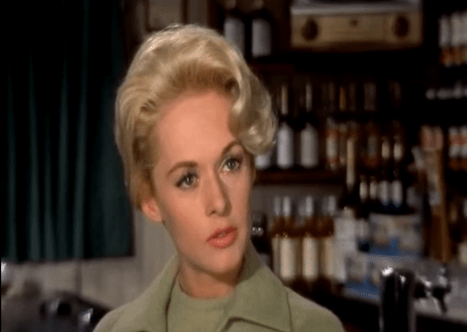
thebirds1The Birds is about all sort of birds. The ones we are acquainted with initially are actually a pair of humans. Lovebirds you might call them. Except they don’t know it quite yet, but the moment Melanie Daniels (Tippi Hedren) and Mitch Brenner (Rod Taylor) meet in a pet shop, the sparks are already flying — the birds too.
In this way, the film opens with a love story as you might expect between a grounded lawyer and a cultured woman who nevertheless has somewhat of a reputation. She matter of factly plays  “Deux Arabesques” by Claude Debussy on the piano (I had to look that up), but she’s also been involved in an unseemly ordeal at a Roman fountain. Her daddy’s a big shot newspaperman. She’s the kind of gal who elicits whistles from passersby and skeptical looks from protective mothers. The film has both types.

But if The Birds ended as a simple love story it would be a rather tepid affair altogether, not to mention faulty advertising. But Alfred Hitchcock the unequivocal master of suspense could never be accused of such a thing (other things possibly). He injects the storyline with an impending dread and a continual payoff that makes the Birds a tense horror classic even to this day putting the emphasis on his major assets. The first being his antagonistic ornithological forces cycling in and out of the narrative menacingly. The second strength is his impeccable use of panoramic locales.

Much like Douglas Sirk, Hitchcock knows how to use the glossy palette of Hollywood to the nth degree and it becomes one of his main attractions taking his favorite spots in Northern California once again — this time the idyllic Bodega Bay — and developing them into the perfect canvass for the drama he draws up.

A short story from Daphne du Maurier (author of Rebecca) provided the inspiration rather than true source material, however, Ed Mcbain, a reputable writer in his own right,  crafts something that’s still quite compelling. It proceeds like you might expect from a normal romantic drama. There’s the meet-cute, the flirtatious repartee, the woman pursuing the man who catches her fancy. Beautiful skies, sunshine, and love in the air. There’s a younger sister (Angela Cartwright), an old flame (Suzanne Pleshette), and a mother (Jessica Tandy). Each looks at this new woman with an entirely different perspective.

But upending the typical progressions The Birds becomes a grim thriller as the bird populations including crows, seagulls, and even sparrows become belligerent. Invading homes, causing havoc, and terrorizing the general population. Melanie and Mitch become our intrepid heroes but it’s almost easy to lose them amidst this churning force of nature.

In one particular scene inside the iconic Tides restaurant, all the locals trade talk about the current state of affairs. It becomes very obvious that there’s a great deal of fear and confusion. What’s at hand is almost apocalyptic as one drunkard wildly quotes the Bible out of context and a didactic bird expert tries to assuage any concerns. But none of that dialogue can possibly mitigate what happens next. A fire starts. The birds rain down in waves of fury. People are chased hither and thither. Melanie first looks on from the restaurant, fights her way to a telephone booth and somehow reaches safety. Others were not so lucky.

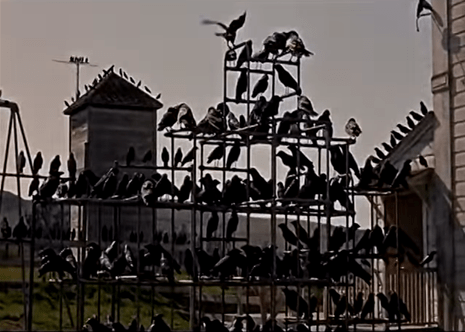
thebirds2Most assuredly, the film benefits from long stretches of wordless action. The most striking example involves a murder of crows gathering on a jungle gym near the schoolhouse. Never before was the name of their posse more applicable.  And while the narrative lacks a true score, the unnerving screeches from the birds is sound enough to send chills down the spine of any audience.

At different times both Cary Grant and Audrey Hepburn had the potential to be in this project, but perhaps it’s better that they were not. Although Hitchcock essentially tortured her and ultimately ruined her career, Tippi Hedren gives a sparkling performance here that is nevertheless overshadowed by her many adversaries. After all, it’s not her name in the title. The same goes for Rod Taylor a handsome and adequate actor but he’s not the main attraction either. However, to its credit, the script does at least devote time to several of its supporting characters to develop their contours, namely the schoolteacher Annie (Suzanne Pleshette) and Mitch’s skeptical mother Lydia (Jessica Tandy). But that’s not what keeps us watching or what keeps audiences coming back over 50 years later. No one knew that better than Hitchcock himself.

4.5/5 Stars

Topaz (1969)

topaz1While Hitchcock’s Topaz also finds its roots in the Cold War like its predecessor Torn Curtain (1966), it revolves around more intricate professional espionage which in this case pertains specifically to the Cuban Missile Crisis. The establishing shot of the film makes it clear that we are somewhere, once more, behind the Iron Curtain as we see a waving flag emblazoned with the faces of Lenin, Marx, and Engels. Interestingly enough, although the film begins with a high Russian official fleeing the country with his family and includes the deal he cuts with the Americans, Topaz really focuses on something else entirely. It plays off this idea of a man caught in the middle of the Cold War. Except this is not an everyman, but a specialized agent trained in espionage. Andre Devereaux (Frederick Stafford) is a Frenchmen who should seemingly be outside the fray of the opposing Superpowers.

But as anyone would probably try to explain, such issues of international relations and security are never so cut and dry. There is a lot more ambiguity involved and being an old friend with one of the American agents (John Forsythe), Devereux obliges to get involved with the whole affair in Cuba because he too is interested to see what the Russians are up to.

Agent Devereaux gets fully embroiled in Cold War espionage after making contact with Juanita (Karin Dor), the esteemed widow of a Cuban Revolutionary who now also happens to be a spy. Andre slips her aide a Geiger counter so that he can monitor the surrounding area to see if the Russians have nuclear warheads. And his results are conclusive. When by some lucky break Devereaux actually does get his evidence out of the country, Agent Nordstrom (Forsythe) confirms that the new information matches that from other sources including U2 plane surveillance. While the history stops there with Kennedy’s handling of the Cuban Mission Crisis, the film continues, following Devereaux back to France where he suspects a Russian mole. Since Hitchcock was always more of a showman than a political filmmaker, it makes sense that he grabs hold of the spy thriller thread in one final act. It channels paranoia very similar to The Spy Who Came in From the Cold although it is a glossier affair with intrigue crisscrossed with illicit romance.

topaz2Whereas the previous Torn Curtain was generally concerned with life behind the Iron Curtain, Topaz is decidedly more continental moving swiftly between Russia, France, America, Cuba, including a few pitstops at international embassies. However, the film does end up spending a lot of time focused on Cuba which can very easily be juxtaposed with the East German scenes in the former film. Hitchcock once more creates an illusion of reality using the Universal backlot and the adjoining area to craft Cuba, and he makes into a place of sunshine and romantic verandas, but it also runs rampant with totalitarian militia. It’s perhaps more exotic and welcoming than East Germany, but no less repressed. In both cases, they become a perilous locale for our protagonists. Still, rather unlike the previous film, Topaz lacks a truly A-list star like Paul Newman or Julie Andrews.

It’s as if Hitch has lost a number of things that made some of his best films, a stellar cast backed by a truly inspired script, carried out with his typical ingenuity. However, this film holds a special place in my heart as my first introduction to Claude Jade. That alone made it a worthy piece of viewing, but it also stands as a historical relic.

3/5 Stars