Remember the Night (1940)

remember_the_night_posterI find that many of the best Christmas movies aren’t really about Christmas at all — at least not in the conventional sense that we’re so used to. Not trees or presents or lights or even holiday sentiment although those might all be there.

The films that start to tease out the true meaning and impact of the Christmas season start by looking at people and their relationships with one another. Because, truth be told, we so often get distracted by the bright colors and shiny objects that get in our way.

That’s actually part of what Remember the Night is about. Lee Leander (Barbara Stanwyck) is a woman who has a penchant for stealing jewelry. She’s not a kleptomaniac or wrong in the head, she’s just a poor, unspectacular woman with nothing to show for in life. She lives in a hotel. And so the minute she’s apprehended and prosecuted in the courtroom you would assume that it’s nothing out of the ordinary.

Except this is a romantic film starring the likes of Fred MacMurray and Barbara Stanwyck working from a script from Preston Sturges and under the guidance of Mitchel Leisen. So obviously that tips us off that love is in the air. Especially during the Christmas season, love is all around us — peace on earth and goodwill towards men.

Except when Lee’s trial is postponed by the astute district attorney on the other side of the table, it looks like she’s in for an abysmal holiday. She has no money, no place to go, and she’ll be spending her time behind bars (with a Christmas dinner of course). But John Sargent goes through a change of heart and his heart is fairly big when you get to know him. He ends up getting Lee out of jail for Christmas dinner as recompense and goes a step further still by inviting to take her back to her family home. They both hail from rural Indiana.

In this leg of the film, on the road, they begin to warm to each other. A certain amount of empathy sets in as they must flee pell-mell from some small town law enforcement after unlawfully milking a cow on private property. However, John also stands by his new companion when she returns to her childhood home — a place she ran away from at an early age — she’s not welcomed back.

And while it doesn’t tell the story of Christmas overtly, it’s at this point that Remeber the Night begins to make sense. Hence the title. At least in my mind. Because what night would you remember? The logical progression of thought would be the first Christmas — the moment where the biblical narrative notes that there was no room for the child in the inn and so he was forced to be housed in a lowly manger on that silent night.

If you look at John’s mother and aunt played so lovingly and nurturing by Beulah Bondi and Elizabeth Patterson, you get the sense that they were probably aware of that event. However, how they act is also a natural outpouring of their hospitable natures. They welcome Lee into their home, they welcome her like family, they go so far out of their way to make her comfortable. Certainly, this is only a backdrop for the broader more sentimental focal point of the film which we were expecting. The accused and the prosecutor begin falling in love, but they still have to return to the courtroom when their holiday is over.

But that’s what wonderful films do. They work above and beyond their plotline being displayed at face value. Sturges was always a spectacular screenwriter even before becoming a director and here he develops a tale that comes off less frenetic than many of his later works, but it’s also imbued with a great amount of feeling. But credit also goes to Leisen for tailoring the script to his leads.

And as it’s set during the holidays, that makes it into a timely movie for the Christmas season (and New Years). Because the bottom line is that it’s about love, but not just in the romantic sense. Love of family. Love of your fellow man (and woman). Love of other people so much so that you are willing to sacrifice and take on the penalty for your actions, deserved or not. If we strip down the impact of Christmas to its core elements that’s essentially what it is about as well. So remember this movie during the holidays and remember that night if you’re so inclined.

Merry Christmas to all, and to all a good night!

4/5 Stars

The Strange Love of Martha Ivers (1946)

strangelove1“I don’t like anybody pushing me around. I don’t like anybody pushing you around. I don’t like anybody getting pushed around.”  Van Heflin as Sam Masterson

Lewis Milestone never quite eclipsed the heights of All Quiet on the Western Front. Still, The Strange Love of Martha Ivers is brimming with some engaging performances. Although it is, at times, more of a  melodrama than noir, there is still merit in Robert Rossen’s script. When it does not falter with didacticism, the film has a certain twisted, deep-seated emotion that runs through it. Barbara Stanwyck is the one at the center of it all, as the title suggests.

The film begins in 1928 with three children. The assumption is that these three individuals will become of greater importance later on. After that fateful evening, one would be left without any family, one would leave for good, and one would be left in the perfect position to rise up the ranks. These opening moments boasts spiraling staircases, thunder, the pounding orchestration of Miklos Rozsa, and a complete gothic set-up.

strangelove317 or 18  years later a full-grown Sam Masterson (Van Heflin) decides to return to his old stomping grounds, Iverstown, on a whim. He’s surprised to learn that the “little scared boy on Sycamore street” is now District Attorney (Kirk Douglas). And he’s now married to Martha Ivers (Stanwyck). She and Sam had something going long ago, but he’s all but forgotten it by now. He’s made a living as a gambler who has a pretty handy dandy coin trick, but really Heflin’s character could be anything.
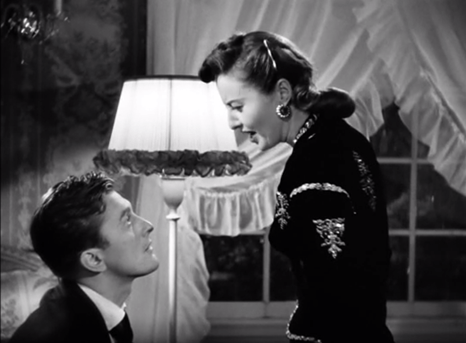
He meets a sultry, smoky-voiced Lizabeth Scott with the pouting face. For those unfamiliar, I would liken her to a Lauren Bacall-type, although she was less well-known and ultimately got typecast in noir roles. Here Scott’s “Toni” Marachek is an often despondent woman who just got out on probation.

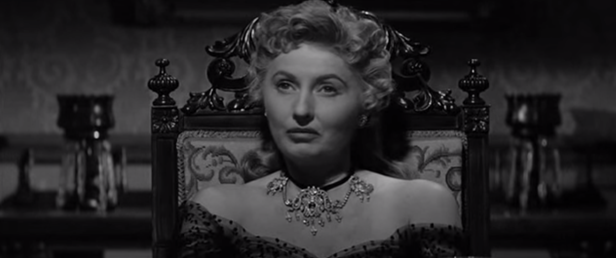
strangelove2We don’t actually see Barbara Stanwyck’s face until 30 minutes into the film, but it doesn’t matter. She as well as Kirk Douglas (in his screen debut), leave an impression right off the bat. They are a married couple alright, but she seems to hold the keys to the kingdom, so to speak. All her power is propping him up as he makes his political rise. Perhaps there’s more going on here, however.

From its outset, Martha Ivers looks to be a tale with two threads that slowly begin to intertwine, bringing together some old pals and acquainting some new ones. When Sam wanders into the lives of Martha and Walter O’Neil, it’s putting it lightly that they’re taken aback. The district attorney is good at putting on a face for an old boyhood chum. His wife, on the other hand, is not about to hide her excitement in seeing her old flame.

However, they both think he has an agenda, misreading the twinkle in his eye as intent to blackmail, for a payoff after what he saw all those years ago. But that’s just it. Only we know that he didn’t see anything. Martha Ivers slips up, caught between love, hate, and a suffocating life. She has so much power and yet so little. So much affection and yet so much bitterness.

strangelove5Honestly, although Stanwyck is our leading lady, it’s quite difficult to decide whose film this really is. Van Heflin and Barbara Stanwyck are at its core, but then again, Scott and Douglas do a fine job trying to upstage them. There’s a polarity in the main players, meaning Stanwyck and Heflin have the power, and the other two are the subservient man and woman respectively. However, the film really becomes a constant tug-of-war. Douglas is not just a spineless alcoholic. There’s an edge to him. Scott seems like a softy and yet there’s an incongruity between her persona and that prison rap that hangs over her. Heflin seems like the one relatively straight arrow because as we find out, Stanwyck is fairly disturbed. She’s no Phyllis Dietrichson and that becomes evident in yet another climatic conflict involving a gun. But she’s still demented, just in a different way.

3.5/5 Stars

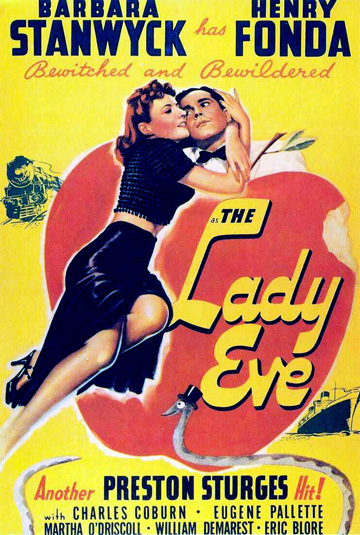
Review: The Lady Eve (1941)

theladyeve3“You have the darndest way of bouncing a fellow down and bumping him up again” ~ Henry Fonda as Charles Pike

The story goes that screenwriting wunderkind Preston Sturges penned The Lady Eve with Barabara Stanwyck in mind. He promised her a great picture and he most certainly delivered a stellar screwball like only he could. It plays off the archetypal biblical temptress with comic effect, and it finds the greatest of comic couples in Stanwyck and Henry Fonda. They both are iconic stars, but the narrative works so well, due to that, but also the fact that the film constantly undermines the typical plotting. As the title suggests the woman is really the focal point of the film — she’s the one in control.

In this instance, Stanwyck is shady trickster Jean Harrington, who joins forces with her equally conniving father (Charles Coburn) to take people to the cleaners in any way possible. They’re real smooth operators with cards and any other type of con you could think of. A luxury ocean liner seems like the perfect place to set up their business. Out of all the many high profile passengers, one man stands a head above the rest. His name is Charles Pike (Henry Fonda). He keeps his nose buried behind a book, tries to avoid the gazes of all the pretty girls, and has a penchant for reptilian wildlife after getting back from a long expedition. He also just happens to be the heir to a gargantuan Ale fortune. That’s what catches everyone eye, including the beautifully sly Stanwyck.

theladyeve2In fact, we have a brilliant introduction to her as she narrates the scene unfolding in front of her with the aid of her compact mirror. She trips up the bumbling bachelor and their introduction is the first exclamation point in a bumpy relationship. She’s ready to play him and marry rich and famous, because he’s a pretty naive fellow, and stiff around the ladies. Fonda’s nervous charm proves the perfect recipe for success as he is constantly being overwhelmed by Stanwyck’s frenetic barrage. His defenses are down and he hasn’t the foggiest what has hit him. Either he was really that uncomfortable or otherwise, he does a superb job of faking it since there’s never another moment where he’s not being fondled or manipulated.
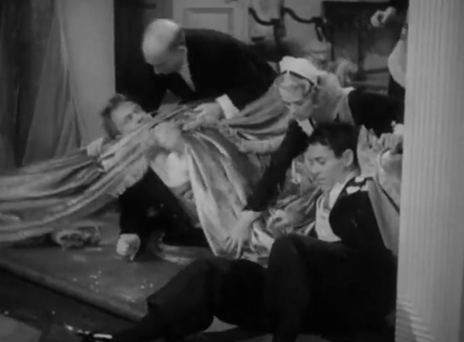
Jean is very quick to get cozy with “Hopsy” (after alcohol and not a rabbit), but something strange begins to happen. For some strange, ludicrous reason she begins to fall for her mark — this goofy guy with loads of cash. That certainly was not in her cards, yet she doesn’t seem to mind. What follows are some wonderful card playing antics between Charles Coburn and Barbara Stanwyck as she tries to stave off her father from pulling one over on her new beau. But of course, just as Pike is getting his sea legs he catches wind of the whole charade quite by chance, and he’s quick to turn off Harrington for the fraud he thinks she is.

theladyeve4The story could end there, but Sturges has set his story up perfectly for a killer second act. Jean plans a perfectly sneaky revenge plan to get back at “Hopsy” by posing as the British niece of another con man (Eric Blore). He uses his own wily charm and influence to get them an invitation to the Pike household for dinner. There we see several other great character actors in action including Horace Pike (Eugene Pallette), and the perennial sourpuss Muggsy (William Demarest). Jean shows up now as the Lady Eve and successfully convinces her “Hopsy” that she is a completely different individual. The film works wonderfully on this axle of ludicrousness because  young Pike is completely befuddled and awestruck again. He goes thudding, clanking, and crashing all evening long, a true victim of love. Pike thought he lost one girl for good and here’s another even better prospect. A whirlwind romance follows and everything is falling into place beautifully. There’s a frantic montage in preparation for the big day and then it happens. They get hitched. Afterwards, it’s all done and the two lovebirds are on a train barreling down the tracks interspersed with the long laundry list of all Eve’s beaus from Angus, to Herman, and Cecil and so on. It’s Charles’ worst nightmare, and he hopes to get out of it as quickly as possible.

But then by chance, he runs into the first girl, who is, of course, Stanwyck as well. He’s genuinely happy to see her, and they embrace like nobody’s business. Being the honorable man that he is, Pike acknowledges that he is, in fact, married now, but the joke’s on him. She is too! It’s an entirely irregular ending, but that’s screwball comedy for you.

theladyeve1What makes Sturges’ film so wonderful is all the parts making up the whole. His script is perfectly contrived mayhem. He sprinkles it with his typical slapstick, his loudmouthed stock company lends an added layer, and his typically lightning-quick repartee is brought to life by his leads. Stanwyck was the quintessential leading lady of the 1940s and in 1941 she was in fine form (Balls of Fire and Meet John Doe). She can dance so effortlessly between dynamic comedy to heartfelt drama that is positively palpable.  She overshadows Fonda in a sense, but they still work together, because he is her perfect foil, the precise innocent fool to fall into her web of feminine wiles. She can muss up his hair, manhandle him, and completely manipulate his feelings. Yet we still like both of them in spite of it. They are a hilarious match, and there’s space for some passionate canoodling as well. It’s probably one of the most perfectly wonderful, utterly dysfunctional relationships we could ever hope to see put on screen.  By continually whipping out punch line after punch line to the very last quip, Sturges makes this comedy look positively effortless.
4.5/5 Stars

Easy Living (1937)

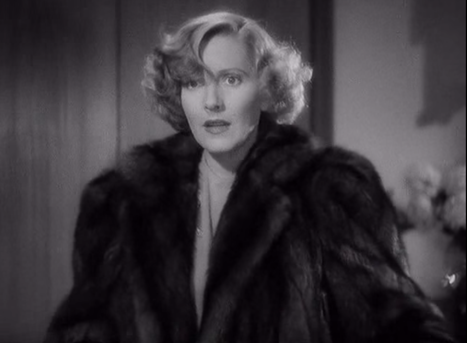
easyliving1Easy Living is a sizzling screwball comedy propelled by a Preston Sturges script and the direction of Mitchel Leisen (a former costume designer). It finds humor in the stratified 1930s society and the so-called easy livings of the affluent. But it also has it’s fair share of rip-roaring slapstick. Really the whole plot revolves around a rogue fur coat.

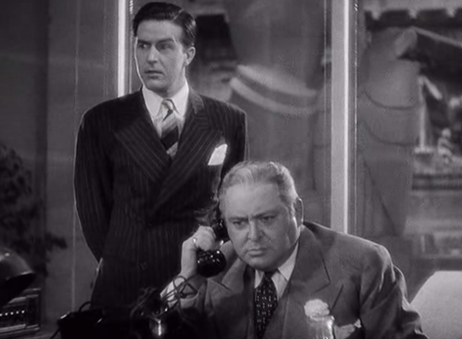
J.B. Ball (Edward Arnold) is the third most prominent banker in New York. His wife has a penchant for fur coats and his son John Jr. (Ray Milland) is fed up with his father’s constant criticism. He’s ready to leave the luxury and make a go of it on his own. Fed up with his wife and not all that pleased with his son, Mr. Ball tosses one of his wife’s sables off their balcony. Mary Smith (Jean Arthur) is the unsuspecting recipient of the coat as she rides by on a passing bus. By chance, she and Mr. Ball strike up a conversation and they hit it off after he resolves to buy her a new hat, in lieu of the one that was ruined. Of course, the clerk gets the wrong idea about their little friendship and it has major repercussions.

Many folks want to get on her good side since they’ve heard through the grapevine that she’s connected to Mr. Ball. This includes the befuddled hotel owner Louis Louis, who offers Mary one of his finest suites and she has no idea what she ever did to deserve it. Of course, Mary crosses paths with John Jr. who is smitten with her right off the bat. But she has no idea who his father is.

A joke from him, relayed by Mary, ends up having overwhelming consequences on the stock market and it ends up spelling major trouble for Mr. Ball. But of course, father and son and Mary all wind up in J.B.’s office together as the comedy of errors finally synchronizes. Son finally proves his acumen to father and gets the job he desperately needs.  Mary has her guy now and Mr. Ball’s marriage is all intact.

easyliving3Edward Arnold is an absolute riot and at his pushy best as the affluent banker. Jean Arthur has always been one of my favorite comediennes. She has such a great voice for delivering quips; there’s a certain lilt to it that is always invariably funny. She’s also the perfect independent working woman like a Barbara Stanwyck or Rosalind Russell. She’s no pushover. I knew Ray Milland for later films like The Lost Weekend or Dial M for Murder, but I saw here firsthand that he has some comedic chops. I also learned what an automat was and at the same time got treated with some top-notch slapstick. Thank you, Preston Sturges.

4/5 Stars

Angel Face (1953)

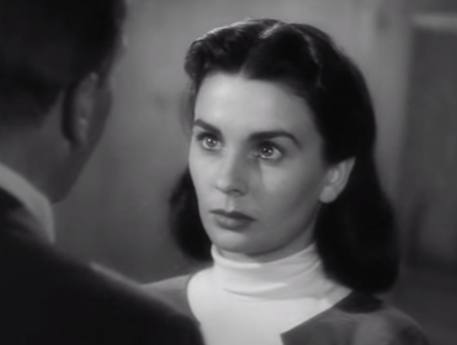
angelface1Rumor has it that Howard Hughes was angry at Jean Simmons who had cut her hair short prior to filming, as her contract was due to expire soon. But not to be outdone he told Otto Preminger that the director would get a bonus if he could shoot the picture before Simmons was released. That he did, and in the 20-day interim he gave us yet another stylish film-noir classic to follow in the footsteps of Laura and Where the Sidewalk Ends.

Robert Mitchum plays ambulance driver Frank Jessup who falls victim to the webs of young beauty Diane Treymayne who adores her superficial father, but nurses a lifelong grudge against her step-mother. She has it in for her arch nemesis and meanwhile strings Frank along, coaxing him to become her family’s chauffeur. He loses sight of her other side, and their budding romance means trouble for Frank’s longtime relationship with the sensible Mary. She sees a better fit in one of Frank’s ambulance coworkers, but he still wants her back.

Instead, Diane and Frank get caught up in a trial for their lives, after they are accused of a murder that Diane did indeed commit. But due to some wheeling and dealing, their shrewd attorney gets them off. It’s at this point that Angel Face takes an unsuspecting twist that ends up being intriguing. Could it be that the seductive Tremayne girl is actually remorseful for her actions? Is she a more nuanced femme fatale then would first be assumed? Frank was an unsuspecting lout, but then again maybe Diane is a sort of victim too.

angelface2

Her tryst with Frank is doomed and he is stuck because Mary no longer wants him, so of course, he can only end up going one place. The slow buildup to the finale makes these last moments all the more shocking. Angel Face seems to be less of a deadly poisoning than a slowly ticking time bomb just waiting to blow.

Jean Simmons is most often associated with civilized and demure beauties. A couple counterpoints or variations would be The Grass is Greener and this film. Playing against type proves to be as fruitful for her as it did for the likes of Barbara Stanwyck, Gene Tierney, Cary Grant, and Henry Fonda, just to name a few. However, in a way, Angel Face had a far more complex femme fatale than I was expecting and that’s to its credit. Still, I would never want to be trapped in her nightmarish world like Frank.

4/5 Stars

Review: Double Indemnity (1944)

Double_indemnity_screenshot_8It was a hot afternoon, and I can still remember the smell of honeysuckle all along that street. How could I have known murder can sometimes smell like honeysuckle?” – Walter Neff

I can’t say this enough. Double Indemnity is so deliciously enticing each and every time I see it. Maybe it’s the A-grade script from Billy Wilder and crime novelist Raymond Chandler with its noir cynicism and memorable phraseology. Maybe it’s the shadowy, low-key interiors or L.A. exteriors. The monotonous beating score of Miklos Rozsa, mourning impending doom. Maybe it’s the plain, laconic way of Walter Neff or his bloodhound buddy Keyes. Is it the innocent Lola who gives the film morality? Or the artificial wig and the silky smooth purring of Phyllis Dietrichson?

In fact, I named many, if not all, of the many facets of this film, because I want to attempt to acknowledge all of them before I forget. But the reality is I love Double Indemnity at its most basic level as a piece of prime American cinema. Yes, it is film-noir and yes, it came from a European director, but it is very much a product of 1940s sentiment as the war years waned.

The story is pulled right from some pulp fiction sleaze by James M. Cain and cemented itself as a noir classic in its own right with all the trappings that are called for.

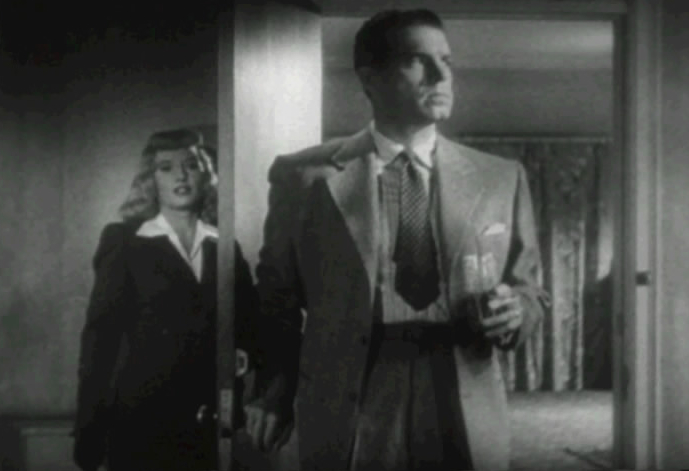
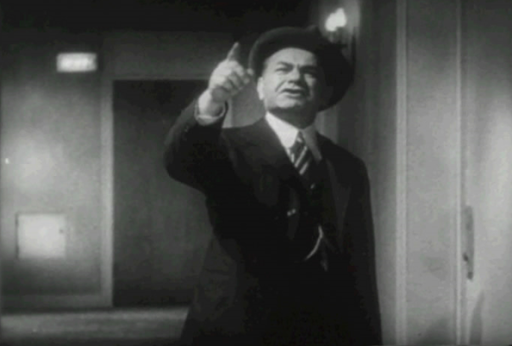
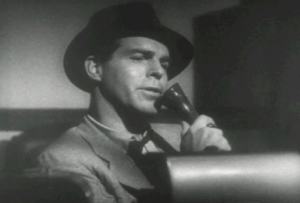
It opens with the beginnings of Rozsa’s score reverberating in our ears and it very rarely lets up. A car blazes wildly down the street and winds up in front of an insurance agency. Out stumbles our protagonist Walter Neff (Fred MacMurray) and for the rest of the film, he relates the recent happenings over the Dictaphone of his colleague Barton Keyes (Edward G. Robinson). It goes something like this:

During his first visit to the home of a Mr. Dietrichson, he instead has his first encounter with the man’s sensual wife, and his heart goes pitter-patter from then on. His motivation is no longer insurance. Now he just wants the chance to see her more. He gets his chance to advise her on a plan, and it all seems playful enough until she insinuates that she wants to knock off her ol’ hubby. At least that’s how Neff reads it. However, he cannot get her out of his head as he has fallen into her web. There’s no turning back.

They think of everything and Neff has everything figured out to a tee. As he suggests, it’s like having the perfect odds on the roulette wheel, you just need an accomplice to spin and Phyllis is just that person. From then it’s just straight down the line. They corroborate on all the details at local Jerry’s Market, Walter sets up his alibi, and he does the devilish deed as Phyllis stares with cool satisfaction at the road ahead.

They set it all up like an accident as the last touch, because as Neff knows all too well if it looks like Mr. Dietrichson was killed from riding a train the Double Indemnity clause of the insurance will mean double the payoff due to how unlikely the occurrence is.

 Double Indemnity (1944) - UpdatedHis only fear is the inquisitive nose of Keyes and the “little man” inside the claims investigator’s stomach, who warns him of the first sign of anything fishy. He gets close to the truth but not quite there. Neff is too close for him to see it. However, as things begin to heat up Phyllis and Neff must separate.

As Neff tries to console Lola Dietrichson over the death of her father, he quickly finds out what the naive girl has to say about her step-mother. It puts a little light on the subject, and Neff realizes what he’s been taken for. He wants to remedy things while he can, patching Lola up with her boyfriend, and going to confront Phyllis one last time.

It’s the perfect set-up. Darkened rooms with curtains drawn. Phyllis reclined in an armchair with evil intentions on her mind. In walks Walter and they have it out. Shots are fired, literally. Phyllis will never let up with her ploys until Walter gives her a little help for the final time. I’m sure the Hays Codes loved this one. I certainly did.

Back in the office Keyes finally overhears the end of Walter’s “confession” as his friend bleeds to death. In one last touching moment, Keyes returns the favor and lights the cigarette like Walter has been obliging to do the entire film.

Walter: “Know why you couldn’t figure this one, Keyes? I’ll tell ya. ‘Cause the guy you were looking for was too close. Right across the desk from ya.”
Keyes: “Closer than that, Walter.”
Walter: “I love you too”

Billy Wilder traded longtime partner Charles Brackett for Raymond Chandler, and despite a rocky partnership, they ended up with one of the greatest scripts, chock full of memorable bits of dialogue. You know you have an impressive cast when Edward G. Robinson is your third lead and each character is playing against type. It’s great casting, in a quintessential American drama solidified by great cinematography and storytelling.

It doesn’t get much better than this and it certainly does not need to. You know Double Indemnity is good when I’ve seen it multiple times and each time the bullets still keep me on the edge of my seat. Thank you, Billy Wilder, for teaching us murder sometimes smells like honeysuckle. That’s absolutely beautiful.

Phyllis: “No, I never loved you, Walter, not you or anybody else. I’m rotten to the heart. I used you just as you said. That’s all you ever meant to me. Until a minute ago, when I couldn’t fire that second shot. I never thought that could happen to me.”
Walter: “Sorry, baby, I’m not buying”
Phyllis: “I’m not asking you to buy. Just hold me close.
Walter: “Good-bye baby.”

5/5 Stars

Christmas in Connecticut (1945)

416cc-christmasinconnecticutElizabeth Lane  is the perfect cook, hostess, wife and mother who is the talk of the town thanks to her daily column in a reputable publication. Anecdotes from her quaint lifestyle out on a Connecticut farm have everyone from war vets (Dennis Morgan) and publishing magnates (Sydney Greenstreet) fawning over her cooking. She’s a chef extraordinaire. Except she doesn’t actually exist, or rather not in that incarnation. Instead the persona is the creation of New York columnist Elizabeth Lane who lives in an apartment with very little culinary ability of her own. That’s why things get complicated when a young sailor followed by the old publisher want to meet her and share Christmas on her farm. She knows Mr. Alexander Yardley is a stickler for the truth and so she rushes to pull off a masquerade to keep her job. It’s a harebrained scenario involving the farm of a beau and her kindly chef pal Felix (S.Z. Sakall) who covers for her lack of cooking ability. For a while it works and romance is in the air, but as you would expect things get a little complicated. Everything ends up hunky dunky in the end. If you’re feeling a Christmas comedy with screwball elements, you’ve come to the right place. Stanwyck is always great and Sakall invariably steals the show at times.

3.5/5 Stars


Forty Guns (1957)

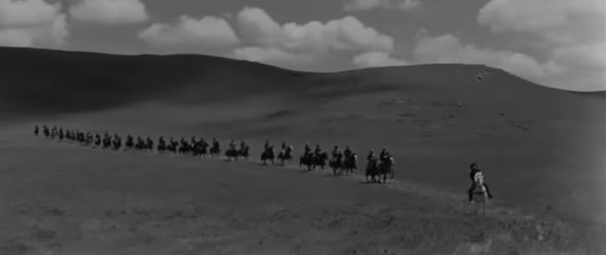
6fb70-fortyguns1Samuel Fuller has got an eye for style, cinematic scope, and at times, subversive mayhem. It’s no coincidence that Forty Guns was shot in Cinemascope, and it is one of the enjoyments of watching this film, which constantly bounces back and forth between long shots and close-ups. To start things off, Barbara Stanwyck is Jessica Drummond, the “High Ridin’ Woman with a Whip,” and she is the heiress of a self-made frontier empire.

It helps to tote forty guns around with her, but she is not as unethical as she would appear at first glance. On the other side are the Bonnell brothers, former gunslinger Griff (Barry Sullivan), number two man Wes (Gene Barry) and then the baby Chico. After they arrive in town, on behalf of the Attorney General, the nearsighted sheriff (Hank Worden) is gunned down by a drunken troublemaker who just happens to be Drummond’s kid brother. Then his buddies proceed to trash the town all in the name of good fun.

Soon Griff straightens Brockie out and Jessica comes into town to retrieve him. Next, Griff comes with a warrant to Jessica’s ranch and in a memorable scene, literally made for Cinemascope, the warrant gets passed down the table. Jessica wants no trouble but soon a crooked sheriff named Logan (Dean Jagger) want to finish off Griff. It doesn’t go so well and he gets more and more jealous of Jessica’s increasing love for the oldest Bonnell brother.

Ultimately, Brockie ends up in the clink, but he uses his sister as a shield in an attempt to escape. For once Griff loses his cool and sprays him with bullets and that’s not all. For good measure, Fuller has Griff ride solemnly off in his buckboard only to have Jessica scamper after him. The power dynamic see-sawing once again.

Yet again, Fuller never seems to do anything conventionally or demure. His film has a reformed gunfighter who calls his former profession that of a freak. The leading female character dominates most everyone else and has a ballad written about her. There are tornadoes that envelop the screen. Then, only Fuller would have the audacity to kill someone during their wedding ceremony, and he does it without skipping a beat.

Among other things, it is a film about guns, brothers and sisters, and love. Griff packs a gun on him. Jessica always has guns behind her. Griff has a younger brother who has much to learn. Jessica’s brother will never learn. That being said, the inventive visuals, typical brutality, and the memorable casting of Stanwyck were all in a day’s work for Samuel Fuller.

4/5 Stars

The Best Films of Barbara Stanwyck

1. Double Indemnity
2. The Lady Eve
3. Ball of Fire
4. Meet John Doe
5. Executive Suite
6. Titanic
7. Forty Guns
8. Remember the Night
9. Baby Face
10. Christmas in Connecticut
11. The Bitter Tea of General Yen
12. Stella Dallas
13. The Strange Love of Martha Ivers
14. Sorry Wrong Number
15. The Miracle Woman

The Lady Eve (1941)

Starring Henry Fonda and Barbara Stanwyck with director Preston Sturges, this screwball comedy is a good one. The supporting cast is rounded out wonderfully by Charles Coburn, Eugene Pallete, and William Demarest. The story begins on a big ocean liner where a beautiful young woman (Stanwyck) tries to pull a con on a naive, rich bachelor (Fonda). Slowly however they begin to fall in love and they plan to get married. He catches wind of her notoriety and becomes cold and that ends their relationship. In an act of revenge she poses as someone’s niece, a Lady Eve, so that she can be close to him. Through a series of events he thinks she is a different person who looks similar and over time they decide to get married. When Eve tells him about all her boyfriends he feels he has made a mistake. Back on the ship he is ecstatic to see the first girl and they embrace. Fonda’s character feels guilty because he is already married but then again she is too…to him. This film has a great combination of wit and slapstick which makes it an enjoyable classic.

4.5/5 Stars