Jaws (1975) at 50

I remember my dad telling a story about the first time he saw Jaws back in 1975, now 50 years ago. He was on a road trip visiting a childhood friend in the Midwest, and though he had spent all his life in California, he was grateful to be in a place that was landlocked when the movie came out. 

If my dad was representative of the general populous, this reaction was not unusual, and for any number of reasons, Jaws was a true cultural phenomenon. It changed the playbook of what a movie could be as a summer blockbuster, even as Steven Spielberg willfully built off the formula of Alfred Hitchcock while bringing his own youth and flair for storytelling to the fore.

It struck me watching the film this time how it is really split into two sections. There are the scenes in the island getaway town of Amity where Police Chief Martin Brody (Roy Scheider) is introduced as a New York City transplant (Coincidentally, it’s convenient to read The French Connection as a bit of backstory). We soon get a sense of his family life, his happy marriage with his better half (Lorraine Gary), and the small-time responsibilities that come with the incoming tourist trade. He also hates the water…

These are the throes of summer, on the verge of the July 4th weekend, and a town like this thrives and even relies on out-of-town business. The first inkling of a shark attack comes when the mangled body of a young woman is found washed up on the shore.

Then, there’s the moment for all time when Brody tries to relax in the arms of his wife on the seashore, only to see an ominous creature emerge from the water and confirm all his worst fears.

A friend pointed out how Spielberg pays homage to Hitchcock with the “Vertigo Effect” or dolly zoom, which gives us as an audience such a perturbing sensation as we are physically reeled into the moment. From then on, it’s not just a threat, but a battle that Brody must wage, dealing with the local repercussions, backroom politics, and general hysteria that gets dredged up in the face of such a news story. As the police chief, it feels like the weight of the whole fiasco falls on him, and what’s worse is that he has so little support.

It all comes to a head when a grieving mother (Lee Fierro) confronts him with a public slap to the face: She found out he knew about the shark threat, and he still kept the beaches open. We know what actually happened, but still, as a beacon of safety, it falls on him, and he internalizes the outrage. Because he has a conscience and a family, too. 

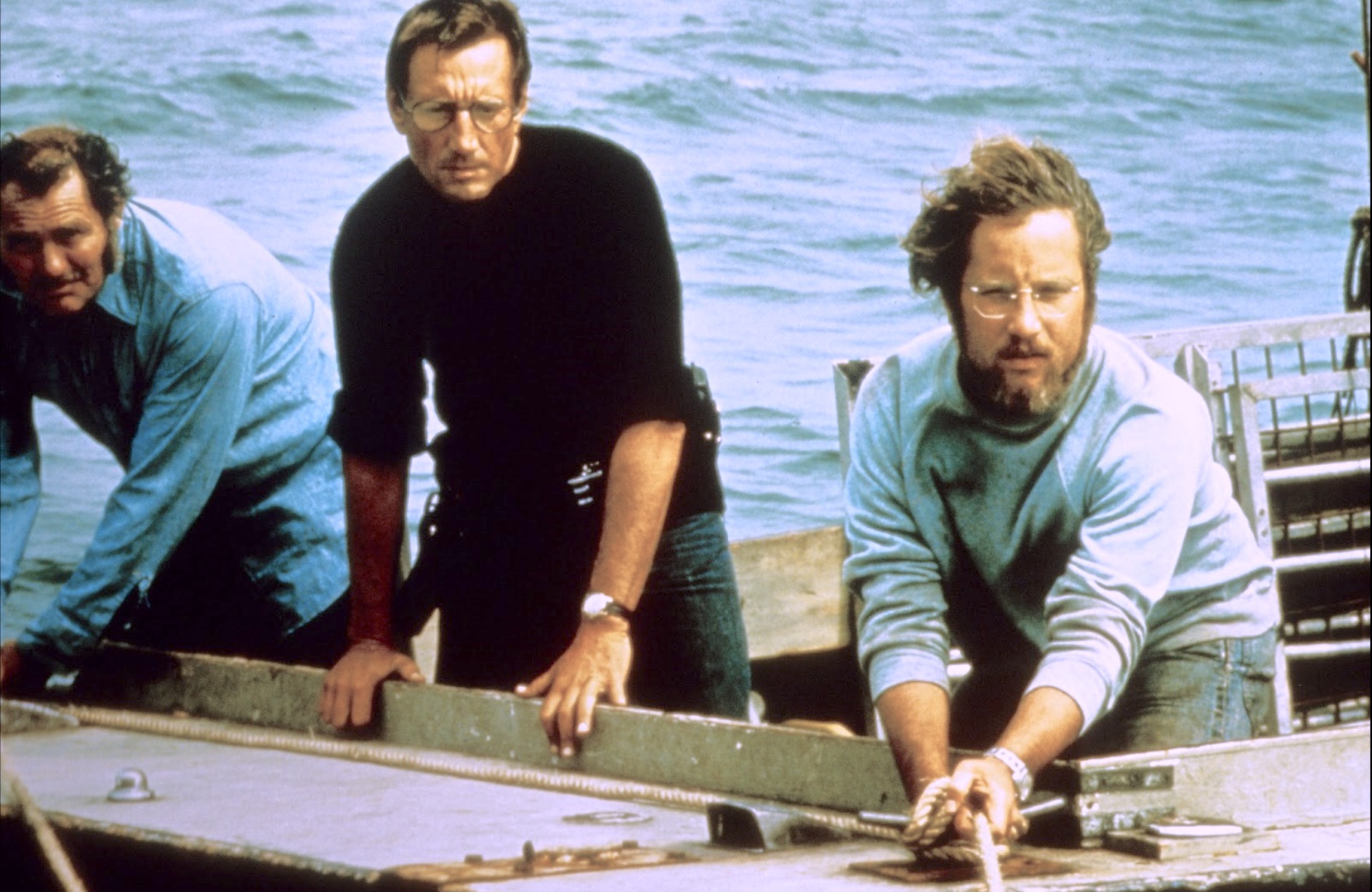
Then there are the later scenes where three men go out on a mission to hunt down the Great White terrorizing the town. It is an elemental story of man vs. nature. The cast thins out with the three primary stars and a big shark playing out a game of cat and mouse on a boat against a vast ocean. It’s an isolating, harrowing undertaking.

Put in these terms, and it feels like an entirely different movie, and yet there’s not a moment when they don’t feel anything but intimately related. A lesser film would have simply shot the second part — extended it — added some more sharks, guts, and explosions, and made it the movie (I haven’t seen the Jaws sequels, so I’m not sure if this formula applies). Although I’m sure this is what drew Spielberg to Peter Benchley’s source material. 

However, this movie is made better by how it builds out an entire world, and we see how it develops the context and creates the stakes and emotional resonance for the entire story.

Scheider is also the only one who can kill that shark in the end. He moved away from the urban jungle to have a quieter life. But the movie calls for him to face this threat head-on, and he does it in an extraordinary way, aided by Richard Dreyfuss and Robert Shaw’s characters.

They both provide two sides of an ethos appeal that lend credence to the evolutionary brutality of this underwater leviathan. Because one represents youthful intellect and scientific know-how of an oceanographer, while the other is a veteran of the sea, grizzled and tenacious. But we know intuitively that the trajectory of the story revolves around Scheider coming face to face with his own fears. It’s inevitable. No one else can save him. 

These words don’t always go together, but Jaws has some delightfully effective expositional scenes. I think of the opening hook where a bunch of young people are on the beach mingling together. The eyes of a young man and woman meet. Then, the camera pulls away as they have their meet-cute. We understand everything without hearing, and the next thing we know, they’re racing off toward the water to skinnydip… 

There’s also the scene where oceanographer Matt Hooper (Dreyfuss) pays a house call. It’s been a tumultuous day, and the police chief has grown introspective, jaded by the day’s events. Hooper awkwardly has two bottles of wine, and he’s wearing a tie. It becomes a scene with the wife talking to the young man, and we learn about both of our leads with this lovely sense of organic humor. 

Then there’s Quint’s moment on the boat one evening, recounting his harrowing experience on the U.S.S. Indianapolis in 1945 on a mission related to the atomic bomb. Ultimately, they were sunk, and many of the survivors were picked off by swarms of sharks in the ensuing hours. An event like that forms a man for life. 

Moments like these are chilling and give the moments of levity even more import. It’s like an escape valve for the tension. Spielberg does an admirable job of choreographing the hubbub of the town with frantic conversations and characters speaking over one another in a manner mirroring real life.

In another scene, Brody is deep in his thoughts, obviously distressed, then, right next to him at the dinner table, his little boy mimics his every move. It’s such an endearing moment of childlike warmth and affection. Or later, a drunken Shaw and Dreyfuss partake in some one-upmanship as they trade tattoo stories gaily after being at one another’s throats for most of the journey. 

Spielberg, at such a young age, already feels adept at creating a total immersive experience in film (You only have to look at his work on Columbo and Duel to see the work he put in before Jaws).

The underwater POV shots from below as human bodies tread above the waterline draw us in, and the notes of John Williams’ score never cease to cause my feet to tense up in my shoes. There are even jump scares I had forgotten about. The cumulative effect is still overwhelming. 

There’s an extraordinary blending of visual compositions that tell us the story succinctly, sprinkled with the kind of humor, exposition, and personal conflict that give the broader drama of Jaws a genuine meaning. Because we are not animals; we are not evolutionary machines. We are embodied creatures. We have hearts, limbs, eyes, voices, and feelings that make us who we are. It’s difficult to extricate ourselves from these realities, and what kind of unfeeling Social Darwinism would that leave us with? 

The Mayor (Murray Hamilton) is a character who is easy to dislike. He does come off as a kind of irrefutable sleaze, and yet when he visits the hospital to give his condolences and reluctantly sign off on Quint’s hunt, he finally makes an admission. His kids were on the beach too, where the attacks happened. For a moment, he is as human as anyone else. 

Because he’s emblematic of a story about locals trying to protect a way of life, and outsiders trying to maintain their own lives somewhere new. It’s a pleasure to watch Jaws and see it not simply as a historical lodestar in the blockbuster age, but 50 years on, it still remains a captivating saltwater thriller showing a young up-and-coming filmmaker on the ascendancy. 

I’ve rarely seen my dad set foot in the ocean during my lifetime. It’s probably coincidental, although Steven Spielberg (and John Williams) might have something to do with this, too. 

5/5 Stars
Rogue One (2016)

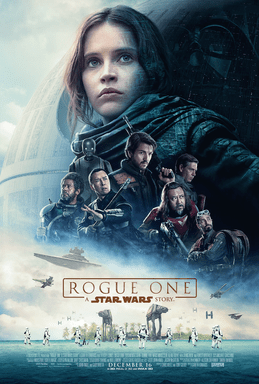
Rogue_One,_A_Star_Wars_Story_poster.pngFor so many, there is a deep connection to Star Wars that started at an early age. As I have alluded to on numerous occasions, I am no different. And if I feel that way about even the prequels, it’s exponentially greater for the original trilogy, as I can imagine it is for legions of others. Thus, when I watch Rogue One I do not linger on its shortcomings, though they most certainly exist, instead, I’m fixated on that very same suspension of disbelief that overtakes me every time I enter that world, a long time ago in a galaxy far, far away.
If Rogue One had been an unredeemable, thoroughly bad film I would have been the first to say so. Perhaps it sounds crazy (or to fans maybe not so much) but I am deeply protective of Star Wars. I only want fanservice if it’s logical, fits the parameters of the world, and so on. I’m not a voracious fact checker of every Star Wars Wookieepedia page known to man and yet I might as well be. I was one of those who was deeply defensive when Disney looked to shake up George Lucas’s original canon. Though I digress…

But even as it stands as a mediocre story with vague contours at times, Gareth Edward’s Rogue One is propelled by fun characters, space opera entertainment, and, of course, A New Hope nostalgia. For those very reasons, it’s invariably easy to lend a heavy dose of grace to this standalone entry. And that’s what I will do.

We are introduced to Jyn Erso at an early age which gives context to her later exploits. In fact, when the story flashes forward after traumatic beginnings she (Felicity Jones) is a prisoner — not on behalf of the Rebel cause — and she has no plan to help the Rebels anytime soon. But in this way, she becomes one of their unassuming champions receiving news from her father (Mads Mikkelson) that the Death Star must be destroyed and she must spread the word.

It leads her to join forces with Rebel scoundrel Cassian Andor (Diego Luna) and his sarcastic droid co-pilot K2SO (voiced by Alan Tudyk). The bottom line is that all the various trips to planets and skirmishes with the Empire lead to a final showdown on the planet of Scariff where the ragtag group of Rebels lands a sneak attack on their unsuspecting enemy led by Imperial Director Krennic (Ben Mendelson). Meanwhile, a space battle erupts in the skies above and Jyn looks to transmit the vital plans to the Death Star before it is too late — so that hope might live on in the galaxy — and she does.

Not surprisingly, Rogue One has its share of callbacks involving the likes of Ponda Baba, Mon Mothma, and Bail Organa all returning to the Star Wars cinematic universe. And unused footage from the original film of Gold Leader exchanging callsigns is repurposed in the final offensive sequence as well. Although Grand Moth Tarkin and Princess Leia (the late Peter Cushing and Carrie Fisher returning from 1976) somehow look like carbon copies of their prior selves, they nevertheless sound vaguely different, giving off this peculiar sensation that they are CGI constructions and not the real thing. Still, it’s a remarkably impressive piece of work.

Obviously, the main objective of Rogue One is simple from a narrative perspective. The Rebels must obtain the plans to the Empire’s Death Star because without those, A New Hope would not be possible. But in order to get there, there are other necessary outcomes that feel a touch more suspect. I can see the need for finding Jyn’s father since his work is so critical to the Rebellion’s objective. However, the idea of a main switch to open up communication, her father’s hologram, Jyn’s final push to broadcast the vital schematics by reaching an antenna, and yes, even Kyber crystals, all seem like easy fixes to explain away the need for certain plot outcomes. I am, however, still trying to come up with an explanation how that is any different than the Force, aside from the very fact that its balance is crucial to the entire galaxy. I’ll get back to you on that one…

Furthermore, the idea of hope comes center stage in Rogue One. In fact,  even despite the influences of eastern monism, Star Wars’ mythology reminds me of the Biblical text that reads like so, “We rejoice in our sufferings, knowing that suffering produces endurance, and endurance produces character, and character produces hope, and hope does not put us to shame.” The same could be said of the Rebels. And people might scoff but in its resolution, the film even takes a page out of Shakespeare’s Hamlet. That’s what makes this idea of hope so important because there could very easily be none at all with so much death and destruction.

My loyalty towards the franchise (more so than DC or Marvel or Star Trek) makes me also fear the continued mechanization of this world into a continuing box office cash cow. With film after film, story after story, it’s indubitable that Star Wars too will lose its allure. It will be run into the ground or become besmirched by some egregious plot hole, discontinuity, or for some far worse fates like the return of another Jar Jar Binks.

That is my major concern with Rogue One because with the absence of an opening crawl, what it really did was signal a changing of the times, a new seed has been planted as the extended Star Wars universe continues to germinate and grow. Time will indicate if it flourishes or sucks all the nutrients out of the vibrant creations that were given so much vigor by the likes of George Lucas, Mark Hamill, Carrie Fisher, Harrison Ford, John Williams, and so many others. Only then will we see if this franchise is one with the force and the force is in it. Because with so many films, it’s difficult not to falter. Being both critical and an avid fan, I care all the more deeply about its fate. But for the time being, enjoy Rogue One and afterward slip in A New Hope again to be reminded exactly why Star Wars remains a cultural landmark.

4/5 Stars

Captain America: Civil War (2016)

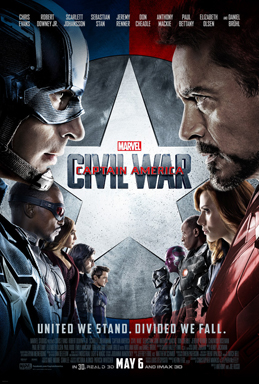
Captain_America_Civil_War_posterIn spite of being a jaded viewer at this point, the Russo Brothers (Arrested Development and Community) and the screenwriting duo of Christopher Markus and Stephen McFeely (The Narnia Franchise) proved still capable when it comes to keeping the Marvel Franchise afloat and, nay, helping it to flourish like few franchises ever have.  The pair of directing and writing duos who brought us Captain America: Winter Solider were able to add another link in the armor, and Marvel has remained stalwart. There are moments of misguided drama, times when the fight sequences become monotonous rather than momentous, but Marvel always does well to keep their funny bone intact.
As with any superhero movie Civil War calls for a suspension of disbelief, but it also becomes a balancing act, because for any movie to truly resonate with a mass audience its characters must feel human in some way shape or form. Where their powers and superhuman abilities must be on display for all those awaiting a popcorn thriller, but still restrained enough to keep them relatable.

In this case, Captain America (Chris Evans) is swayed by the love of a friend he’s known for over 70 years. Bucky Barnes is once more in the middle of a manhunt, and yet Cap has faith in his old friend. But it’s exactly that kind of loyalty that lands him on the wrong side of the law. Meanwhile, our other force of nature Tony Stark (Robert Downey Jr.) rehashes the tragic death of his parents and tough times with Pepper Potts leave him conflicted. He’s ready to concede to the United Nation’s demands to put the Avengers in check and that’s where he breaks with his former ally. When the two undisputed leaders of the Avengers become polarized that forms the dividing line between factions and the whole film becomes fascinating as the sides are slowly drawn up. As an audience, we are forced to make a choice. It’s either the true blue Steve Rogers or the wonderfully snarky Tony Stark or perhaps we watch as an impartial observer. But, nevertheless, a mental decision must be made.

And it’s not only a balancing act of super versus human qualities, but the sheer size and scope of the cast could easily be a hindrance. Equality of screen time or at least moments in the spotlight for everyone are key, and the film generally does that capably enough. Marvel revels in the callbacks and Civil War is no different. In this installment alone we have the pleasure of seeing numerous returning players sans Hulk. In fact, the most entertaining fight sequence involves everyone duking it out, and the fact that it feels almost like play fighting rather than full-fledged combat is of little consequence.

But the new additions are also noteworthy including the likes of  Black Panther (Chadwick Boseman) and yet another Spiderman. Credit due to Tom Holland for in some ways making Peter Parker into an invariably entertaining persona, who feels different than his predecessors. There are a few others in smaller roles of note including the likes of William Hurt, Martin Freeman, and even Jim Rash.

By this point, we have long grown tired of villains rising up from outer space harnessing some unfathomable amount of power. The antagonists that are truly compelling are those who are closer to home, more realistic, and sometimes even within our own ranks. Built into this film’s title is that type of conflict, between former friends, between people who used to be close or would be on the same side given any other circumstances. But Civil War ups the ante not by getting bigger and grander necessarily. It’s the fact that it gets more personal that makes it work surprisingly well.

Daniel Bruhl is a delightful actor, and he does well to play what some might call a villain and others might simply label a pained, vengeful man. That’s oftentimes far more interesting.

It’s overstuffed with players, many who are admittedly wonderful acting talents. Its editing and cinematography is at times overly frenetic and mind-numbing. While Civil War is the expected superhero extravaganza, there are dour, more mature interludes that are difficult not to appreciate. If Marvel has not completely kept me enraptured, due to so many subsequent films, they still have me coming back and if I’m any indication, there will be many far more ardent fans than me who will truly enjoy what this film has to offer.

4/5 Stars

Review: Jaws (1975)

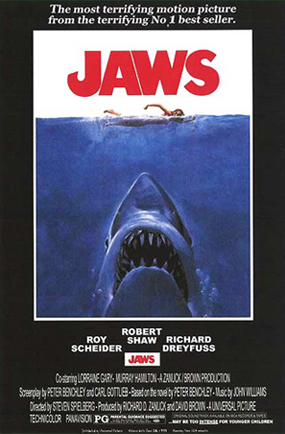
JAWS_Movie_posterAlfred Hitchcock once was quoted as saying, in typical Hitchcockian fashion, “There is no terror in the bang, only in the anticipation of it.” A young Steven Spielberg channeled this type of sentiment when he directed the smash hit and archetypal summer blockbuster Jaws in 1975. It’s still a cultural phenomenon and for good or for bad, it has forever instilled a fear of great white sharks in the general populous.

The film is a man-versus-beast type of story. It starts off on Fourth of July weekend on a New England resort town named Amity. After a girl is found the beach chewed up, it starts a frenzy. Well, not quite initially because although police chief and mainlander Martin Brody (Roy Scheider) wants to shut down the beaches, the local mayor will have nothing of it. Really, the first half of Jaws is very much political, as the mayor attempts to do anything he can to keep the masses flocking to his town because Amity gets all their revenue from the summer months. Meanwhile, Brody has the beaches monitored, but that does not stop a young boy from getting attacked. Up until now, we have only seen the handiwork of the beast, but in a brief instant we can catch a glimpse of him and it is shocking.

The vacationers flee the shoreline, and Brody is left to answer to the boy’s mother since he did not close down the beaches. She holds him responsible. However, Brody’s hands are still tied, especially when local fishermen catch another shark that they assume is the culprit that has terrorizing the town. He is met by a young marine biologist named Matt Hooper (Richard Dreyfuss), who also realizes the gravity of this shark problem. No one will take him seriously except Brody, and Hooper labels him the only other sane man on the island.

Because all the precautions that are taken cannot avoid still another shark attack from going down. And it is at this point that Brody and most certainly the Mayor, have to change things. At a tense news conference, they must walk a fine line in order to assuage the locals and the business owners. Ultimately, Brody convinces the mayor to let him go out with the salty veteran seaman named Quint (Robert Shaw) who agrees to take the shark down for a fee.

For most of us, the second half is what we all remember or at least equate with the film (probably for the iconic line, “We’re going to need a bigger boat.” It is this part of the story that breaks the adventure down to three men, our stars, going off on a mission to take on the terror of a great white (ie. “Bruce”). It feels very Captain Ahabesque, thanks to the addition of the grizzled fisherman Quint, but if he is a stabilizing force it soon becomes obvious that not even he is fully ready to take on this behemoth creature. It seems like no amount of barrels, harpoons, or even a “shark-proof” cage can humble it.

What we end with is utter destruction that spirals out of control. That’s what makes this shark such an intriguing foe because we certainly cannot really call it evil, but it certainly is an overpowering force of nature. Brody stands in for many of us who have an innate fear of the ocean and what lies underneath the surface. For all the plucky young adventurers they have a stand-in in Hooper. I am struck by how tense this film is even to this day, and Spielberg never seems to show is hand too early and he never gives us too much of the shark. Otherwise, it might look faker, and it would lose that heightened anticipation. Above all, John Williams lent a great deal of potency to Jaws, single-handedly, with his ominous score. Without his score, Jaws is nowhere as scary and certainly not as memorable.

5/5 Stars