
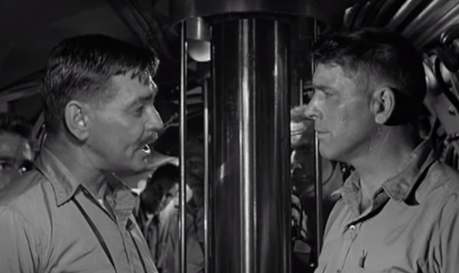
Run Silent, Run Deep features what amounts to a cold open, set in the Bungo Straits, near the coast of Japan in 1942. The foreboding sonar-infused score by Franz Waxman suggests this will be a no-nonsense war drama and sure enough, within the first 5 minutes, a submarine commanded by one P.J. Richardson (Clark Gable) has been sunk in its mission to destroy an enemy ship, leading to the capsizing of the entire crew.
As Richardson looks back at his receding enemy, we see the film’s objective right before us. He is bent on revenge. Given the situation, this is not a film so much about survival but returning to finish a job no matter the circumstances, dangers, or counter-orders standing in the way.
After a short leave of action, Richardson talks his way into another command, this time taking over from Jim Bledsoe (Burt Lancaster) who has already formed a close-knit rapport with his men. They don’t look too kindly on a new man taking over and Bledsoe broaches the subject bluntly with his new superior.
Richardson is hardly going to be dissuaded by a minor thorn in his side and his new crew begrudgingly take to the grueling regiment of drills he has them on. No one is looking to make any friends. This is hardly a film about buddy, buddy or camaraderie. There isn’t time. The one thing the commander does instill in them is discipline and well-oiled efficiency. It’s probably the greatest gift he can give them based on the circumstances.
The stakes are obvious as the death trap, Area 7, has led to the loss of four separate Allied subs, including Richardson’s previous command. What the story devolves into is a fairly straightforward WWII drama which is nevertheless riddled with tension as they knowingly enter perilous waters.
It’s true a submarine serves as an impeccable locale because its very form functions in constraining the action and ratcheting up emotions. There is no release valve and all these crewmen are literally submerged underwater for hours at a time. If that isn’t nerve-wracking I’m not sure what else qualifies.
Combine this environment with men who are already in tight quarters only to become more contentious over a major distaste in their commanding officer. It’s easy to envision him as a modern-day Captain Ahab. His white whale is the infamous Japanese Akikaze, Bungo Charlie, that he’s already has a deadly history with. The seafaring setting and power dynamics also hint at the traditions of The Mutiny on The Bounty though the story foregoes this exact demarcation.
While there are few flourishes or subsequent surprises from director Robert Wise’s film, there’s no question in labeling Run Silent, Run Deep an immersive experience, even for such a streamlined endeavor. In fact, that more than anything plays to its advantage. This allows it to be compact actioner extremely aware of its outcomes and not content until its mission has been accomplished. While it does not leave a great deal of leeway in the area of character development, our cast is a varied and compelling ensemble.
Obviously, the central figureheads are Gable and Lancaster, two hard-bitten battlers who are also consequently, far too old to be playing their parts. But this is Hollywood, after all, so it’s easy enough to make allowances when you’re getting top tier talent.
However, surround them with the likes of Jack Warden, Brad Dexter, Don Rickles (in his film debut), and Lancaster’s long-time collaborator Nick Cravat, and you have something quite engaging.
The key to the success of both the mission and the film is that it ends as quickly as it begins. It gets in and gets out with striking precision, taking little time to rest too long on its laurels. Between the flurry of malfunctioning torpedoes, the barrage of enemy depth charges, and bombs raining from up above, there is plenty of flack to provide antagonistic interference. By the end, it seems a miracle our men get through at all but of course, it’s not without a toll, both physically and mentally.
Because even when you cannot see the enemy in the flesh, the capability to do harm hardly slackens. In some cases, it proves even worse. What is easier to exterminate, an enemy who lacks any type of form or personage or one that is living and breathing? In this regard, Wise’s picture is sterile and impersonal. It’s not so much a flaw as it is a sobering reality.
3.5/5 Stars
 “Nobody throws me my own guns and says ride on. Nobody” ~ James Coburn as Britt
 Into the valley road the seven rather like the light brigade, at first simply preparing to train up and prepare their little village of farmers to fight back against the brutal outlaw Calvera (Eli Wallach). But there’s something that happens over time. When you spend time in close proximity with people, eating their food and sharing their shelter, it’s hard not to build a bond — a connection that holds you there. At first, it seems of little consequence when the enemy gets beaten back, but everyone knows they will return with a vengeance.
 And we get the final skirmish with guns blazing, bullets flying, and lives being put on the line. Here is a film where the final body count deeply matters. Not so much of the enemy, but of our heroes, because each one chisels out a little niche for themselves. Everyone has worth and importance even as they jockey for screen time and it pays off in the end. They fight with honor just as they die with honor. Perhaps it might seem futile, but not without significance. The little village is left in peace to live out their days in tranquility. Calvera’s final words echo in their ears: “You came back – for a place like this. Why? A man like you. Why?”

 4 Star Films