Gentlemen Prefer Blondes (1953)

Gentlemen_Prefer_Blondes_(1953)_film_poster“I can be smart when it’s important, but most men don’t like it.” ~ Marilyn Monroe as Lorelei

Marilyn Monroe and Jane Russell together. It’s a crackerjack combination and Howard Hawks milks it for all its worth. There’s streetwise Dorothy  (Jane Russell) wooing all the boys from here to kingdom come. She cares about more than just money, especially when it entails having fun. Her other half is the vivacious bubble-headed beauty Lorelei like only Monroe could pull off. She’s the girl looking to get hitched with her bookish millionaire and she’s not afraid to admit that his money sweetens the pot. It certainly doesn’t hurt (Don’t you know that a rich man is like a pretty girl? You don’t marry her just because she’s pretty. But, my goodness, doesn’t it help?).

Time and time again words and bits of dialogue leave her lips that are almost astonishing. She delivers them with such a fluid air of seriousness that they force a double take and each and every time she has the audience in the palm of her hand. We think she’s dumb, but whether it’s the just the persona she puts on or a bit of Marilyn Monroe herself, she is extremely intelligent. If nothing else she knows how to captivate an audience, not letting them soon forget her magnetic performance.

If she had been playing against anything else Jane Russell would have been the primary attraction and she’s always wry and lovely, but with Monroe in the equation, they develop into a dynamic duo, leaving a wake of hapless boys behind them. There’s the old playboy Piggy (Charles Coburn) with a tiara Lorelei has ambitions for, the hired private investigator Ernie Malone (Elliot Reid) who finds himself falling for Dorothy, the diminutive Mr. Spofford and, of course, the hapless Gus (Tommy Noonan).

It can be easy to write Gentlemen Prefer Blondes off as a superficial musical — a provocative color extravaganza aboard an ocean liner. After all, it’s a story complete with pools, water slides, romance and a whole squad of athletes with bulging biceps. But it is a genuinely enjoyable film with Howard Hawks once more showing his aptitude for skirting between genres, this case indulging in musical comedy.

The sparkling and most remembered number is, of course, Monroe’s sultry turn in “Diamonds are a Girl’s Best Friend,” clothed in velvety pink,  but really for the entire running time of the film, Monroe and her costar are continually strutting and snapping their way into the hearts of everyone they cross paths with. A final comedic twist of an ending, playing off the comedic dynamic of the film’s pair of heroines, gives Jane Russell an equal chance to show off her star power. This truly is a team effort, even if gentlemen circa the 1950s were discriminatory towards all non-blondes.  Obviously, this film and my commentary are not meant to be taken too seriously. Still, they can be enjoyable. At least in the case of this film. My commentary, not so much.

3.5/5 Stars

Monkey Business (1952)

monkeyb5I always was under the assumption that the screwball comedy died off in the 1940s with homages coming out years later. Is there such a thing as neo-screwball comedies? Anyways, after watching Monkey Business I feel it is necessary to reevaluate that general conclusion. Here is a film from Howard Hawks that channels a great deal of the madcap craziness that you see in his earlier works like Bringing up Baby (1938). For lack of a better term, it is very screwy indeed. Right from the opening credits, you have the voice of God (Hawks himself) breaking the fourth wall and calling Cary Grant by his real name.

Then the film actually opens, and we meet the quintessential absent-minded genius Barnaby (Grant) and his loving wife Edwina (Ginger Rogers). They are meant to go to a social gathering and yet he is so caught up in his work that they stay behind. You see he is trying to develop an elixir of youth. His experiments are of interest to the business-minded and much older Oliver Oxly (Charles Coburn), who only sees the positives of such a discovery. Barnaby tries to explain to him that it’s not so cut and dry. In fact, his work could have dire effects if careful precautions are not taken.

Little does Dr. Fulton know that one of his lab chimps got loose in his lab and tampered with some chemicals, dumping them in a water cooler. After this absurd moment, Barnaby unknowingly consumes the rejuvenating concoction and his whole demeanor takes a turn.

Soon he’s out buying flashy clothes, getting a flamboyant car, ice skating, and driving like a speed demon down the thoroughfares with an astonished secretary Ms. Laurel (Marilyn Monroe). Cary Grant even shows off his impressive acrobatic skills, performing a cartwheel and a few other tricks.monkeyb3Only when the concoction wears off does he figure out what happened, and he resolves to be more careful next time. Except next time turns out to come sooner than he was expecting when Edwina willingly drinks some of the substance so Barnaby can observe her. Just like that, she is a prank-pulling schoolgirl with insatiable energy.

Once more Barnaby takes the elixir while Edwina is sleeping off the effect. However, when she wakes up a misunderstanding leads to more mayhem as she tries to get help from Mr. Oxly. What develops is a spiral into more hilarity. Barnaby and Edwina are reunited, Edwina’s old flame is incensed, Ms. Laurel is petrified, and chimps and man alike are taking part in some Monkey Business. If none of this makes much sense then I did my job!

3.5/5 Stars

The More The Merrier (1943)

e0052-the_more_the_merrier_-_posterDirected by George Stevens and starring Jean Arthur, Joel McCrea, and Charles Coburn, this comedy makes light of the housing shortage in Washington D.C. during WWII. Retired millionaire Benjamin Dingle comes to D.C. as an adviser for the housing crisis. Unfortunately he cannot find a place to stay right away. By chance he happens upon an ad for a room the only thing is that the other tenant is a young woman. Mr. Dingle will not take no for an answer and despite her misgivings she agrees to let him stay. It soon proves to be a hilarious situation and it gets even more complicated when Dingle rents half of his half to a Sergeant Joe Carter who is about to ship out. Of course he doesn’t tell Connie. There is initial conflict however Dingle tries to play matchmaker. The only problem is that Connie is already engaged to a bureaucrat. Then Dingle oversteps his boundaries reading Ms. Milligan’s diary to Joe. Dingle accepts the responsibility and leaves but Connie allows Joe to stay since he will be gone soon. Through a series of events the newspaper gets a hold of the situation so Mr. Dingle advises them to get married to stop a scandal. As Joe gets ready to leave they realize they really do care for each other and Dingle was right Connie finally gave into her true feelings. All the main players were good and I think Charles Coburn was really the standout because he was the character who kept the whole story together. As is his motto, “Damn the torpedoes, full speed ahead.”
 
4.5/5 Stars

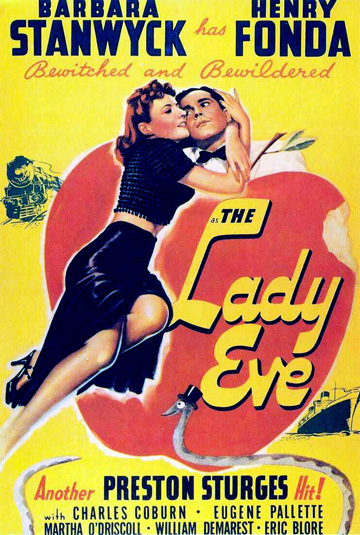
The Lady Eve (1941)

Starring Henry Fonda and Barbara Stanwyck with director Preston Sturges, this screwball comedy is a good one. The supporting cast is rounded out wonderfully by Charles Coburn, Eugene Pallete, and William Demarest. The story begins on a big ocean liner where a beautiful young woman (Stanwyck) tries to pull a con on a naive, rich bachelor (Fonda). Slowly however they begin to fall in love and they plan to get married. He catches wind of her notoriety and becomes cold and that ends their relationship. In an act of revenge she poses as someone’s niece, a Lady Eve, so that she can be close to him. Through a series of events he thinks she is a different person who looks similar and over time they decide to get married. When Eve tells him about all her boyfriends he feels he has made a mistake. Back on the ship he is ecstatic to see the first girl and they embrace. Fonda’s character feels guilty because he is already married but then again she is too…to him. This film has a great combination of wit and slapstick which makes it an enjoyable classic.

4.5/5 Stars