
 It feels necessary to begin with a prelude to The Gold Rush. I came to a realization I’ve only ever seen Charlie Chaplin’s updated version from 1942 with a new sound introduction and soundtrack. In some ways, watching the original feels like seeing a new film.
It was the first Chaplin feature I watched, and I’m pretty sure I liked every subsequent one more. I’m recognizing now, perhaps it was the Tramp character who grew on me. Because so much of his appeal is not only the audience identification, but also this sense of continuity over all his shorts and features. The more and more you watch, the more you love him.
Chaplin understood how powerful this could be, and it’s made his alter ego the most visible figure the cinema has ever known. Out of Chaplin’s films of the ’20s and ’30s, I think I still like his other ones more, but why does this matter? It’s all a collective body of work centered on the Little Tramp who could.
The movie itself opens during The Great Gold Rush of Alaska. The opening shot showcases a line of miners snaking their way through the desolate mountain landscape, and there’s a scope to it that has a definitive cinematic eye. Chaplin, as both actor and director, is on full display as he sets the stage for his protagonist.
The first act feels like a traditional Chaplin two-reeler. It’s scenario-based. The characters are larger than life, with a wanted fugitive (Tom Murray) and Big Jim McLain (Mack Swain), who strikes it rich only to be stricken with memory loss.
It’s also a comedy of errors involving snow flurries, gales of wind that would make Keaton proud, and surreal gags with an overgrown Chaplin chicken. They also go through the bizarre ordeal of systematically eating one of the Tramp’s shoes. Hunger will do that to you.
At the end of it all, the killer’s gone and the gold’s still hidden away; it’s sitting there for the rest of the movie just waiting to be dug up. We know intuitively we will return to the spot.
The Gold Rush truly hits its stride when introducing a romantic element, and it’s because of what it means to our lead character. There’s something transcendent in it that I can’t help but express. He’s so pure and honest in love. It’s comprehensible to anyone who’s admired, even loved, someone from afar.
Maybe a crush in high school, a Juliet who runs in different social circles than you, or a long shot who has someone else already that you could never compare to. It’s a tale as old as time, though so is The Gold Rush. The Tramp makes it universal.
The girl in question, Georgia (Georgia Hale), is a vivacious woman who frequents the local dance hall. She seems to wave to him, except there’s another man just behind him. In a subsequent moment, he thinks they might strike up a conversation as she comes near, only to look right through him. It discourages him, but he’s not daunted.
Later, he finds a discarded picture of her and picks it up, looking sheepishly at the old man standing nearby. He’s seen what the Tramp has done, and our bedraggled hero tries to play it off like he’ll throw it away. But of course he doesn’t.
We eventually find out that he keeps it under his pillow with his most prized possessions. The reason we find out is that Georgia pays him a visit with some of her friends; they think it will be a lark to see him. It’s nothing to them, and it’s everything to him just to speak with her and be in her presence.
At the hall, he finally gets the opportunity to dance with her, and it has nothing to do with him. It’s part of her scorning of another man, but in his little universe, it means something — it means the world to him — and our hearts beam and simultaneously break. She’s not going to want him, and yet in the same breath, we want the fairy tale for him, or at the very least, someone who would love him for who he is.
Chaplin’s character reaps the benefit of her coquettish game only to have his pants come loose, and he ties them back on with the leash of a nearby dog. It’s The Tramp’s inadvertent comedy on full display — comedy that just kind of happens to him out of his own wealth of eccentricity.
He rides the wave of the evening, however, with the elation at the prospects of guests for New Year’s. It’s so earnest watching him positively trashing his cabin with feathers out of pure jubilation, only to be left heartbroken.
The communal singing of “Auld Lang Syne” cross-cut with the Tramp all alone is an implicit reminder: every year, there are the lonely people who must make a go at life by themselves, forgotten again. The despondency spawns fitful dreams, including Chaplin’s iconic gag with dancing bread feet. If it sounds mystifying, then watch it for yourself.
For the final act, the Tramp is reunited with the prospector, who promises him a piece of his stake if they can track down the cabin. Instantly, the Little Man’s outlook changes, and he scales the balcony of the dance hall just to profess his love to Georgia and let her know he will come back a millionaire…
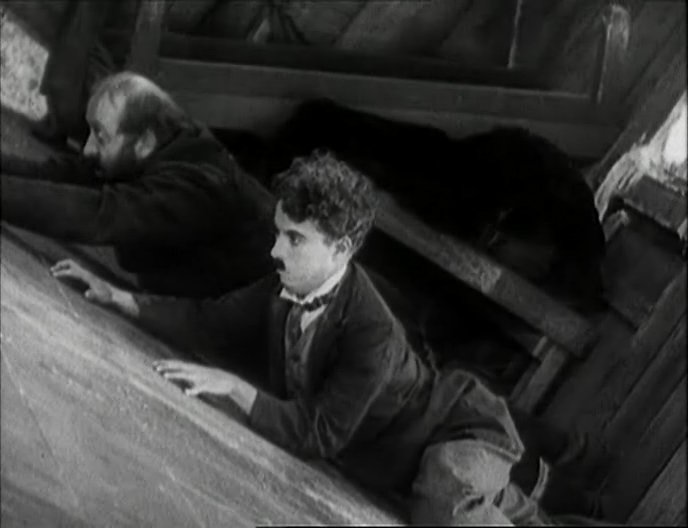
The best bit follows the two men as they hunker down for the night, only for the blizzard to displace their cabin to the cliffside so they’re jutting out on a perilous cantilever. “Flight of the Bumble Bee” perfectly captures the frantic nature of the moment without totally counteracting the comedy of it all as they slide this way and that, trying to escape to safety.
The two hapless prospectors succeed in their quest to get rich. The Tramp gets a lavish makeover so he looks like a Saks Fifth Avenue multimillionaire, catching an ocean liner home. Some photographers want some shots in his mining clothes, and somehow, all is right in the movie again when he’s back to looking like The Tramp. What would we call him otherwise? By this point, it feels like his proper uniform.
And yet there’s also a poetic reason for this development. It’s easy to read what will happen and what the film is building to. He must see Georgia again. Circumstances have changed, but for all intents and purposes, he looks like the same down-and-out Tramp, at least to her. It’s the exquisite irony underpinning their glorious reunion. Dreams really do come true.
In a cinematic sense, Chaplin effectively took a character who could easily be a bit part or a stereotype in any type of picture and proceeded to give him the level of depth and feeling that enraptured the world over.
I never said this out loud because I’m only formulating it now. Percolating under the surface, there is some dissonance within the Tramp persona because here you have this impoverished, chaste character played by a man who at least had the reputation of a womanizer and was wealthy the world over. This is only a perception. And yet I settled on this: The Tramp is a romantic and personal ideal for Chaplin and for all of us.
He bears all the difficulties of the world with heart, unassuming grace, and a healthy dose of laughter. As long as there is hardship, poverty, and romance in the world, The Tramp will be relevant because he makes us laugh, but most importantly, he makes us love him.
Because he is one of us, or maybe we are him as we traverse our own journeys. That’s what we’d like to believe anyway, and Chaplin allows us to. He also gives us a hopeful ending. It’s what makes him, even to this day, the fitting archetype of Classical Hollywood storytelling. He is the standard by which all others are judged.
4.5/5 Stars

 Well, here’s another fine mess you’ve gotten me into.
  “A picture with a smile — and perhaps, a tear…”
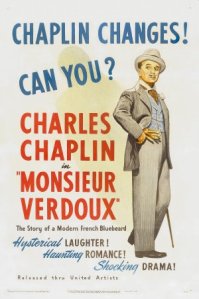 Prior to the making and release of Monsieur Verdoux Charlie Chaplin had undoubtedly hit the most turbulent patch in his historic career and not even he could come out of scandal and political upheaval unscathed. To put it lightly his stock in the United States plummeted.
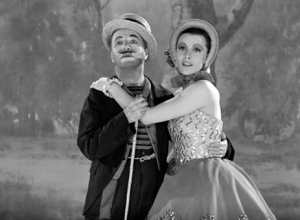
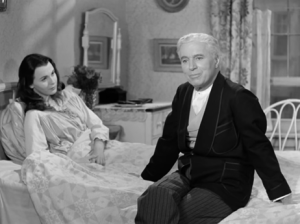 The glamour of limelight, from which age must pass as youth centers
  But now no one’s there. The seats are empty, the aisles quiet, and he sits with a dazed look in his flat the only recourse but to go back to bed. It’s as if the poster on the wall reading Calvero – Tramp Comedian is paying a bit of homage to his own legend but also the very reality of his waning, or at the very least, scandalized stardom. It adds insult to injury.
 It’s important to know that he writes off such an assertion as nonsense and one can question whether this is Chaplin’s chance at revisionist history or more so an affirmation of his life’s actual trajectory–working through his current reality that the world questions (IE. Marrying a woman much younger than himself in Oona O’Neil who he nevertheless dearly loved).


 4 Star Films