
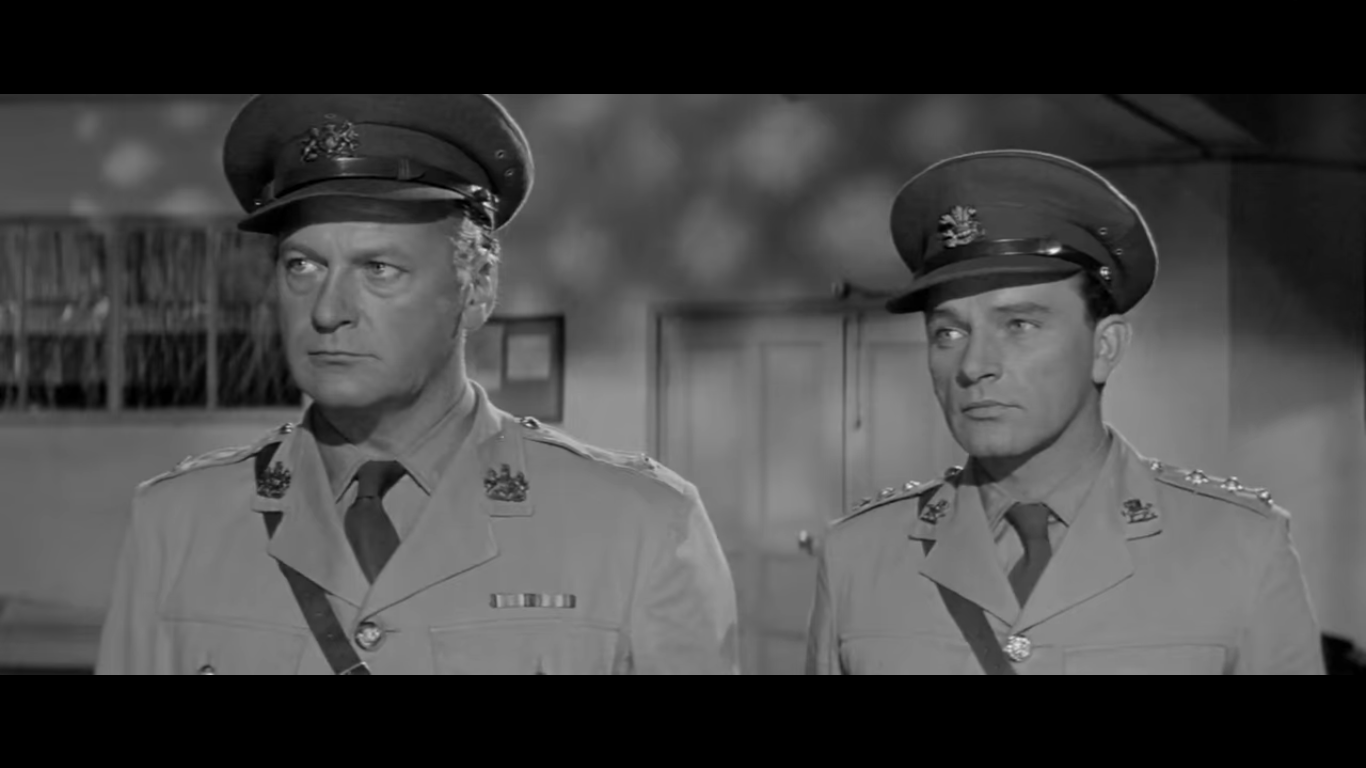
“He and you and I will become a part of history — of its futility” – Richard Burton as Jim Leith
Bitter Victory is a curious confluence of talents and material. Nicholas Ray was earmarked to helm this British war movie with French-American backing. Aside from the primary leads, the rest of the cast was purportedly decided by lottery.
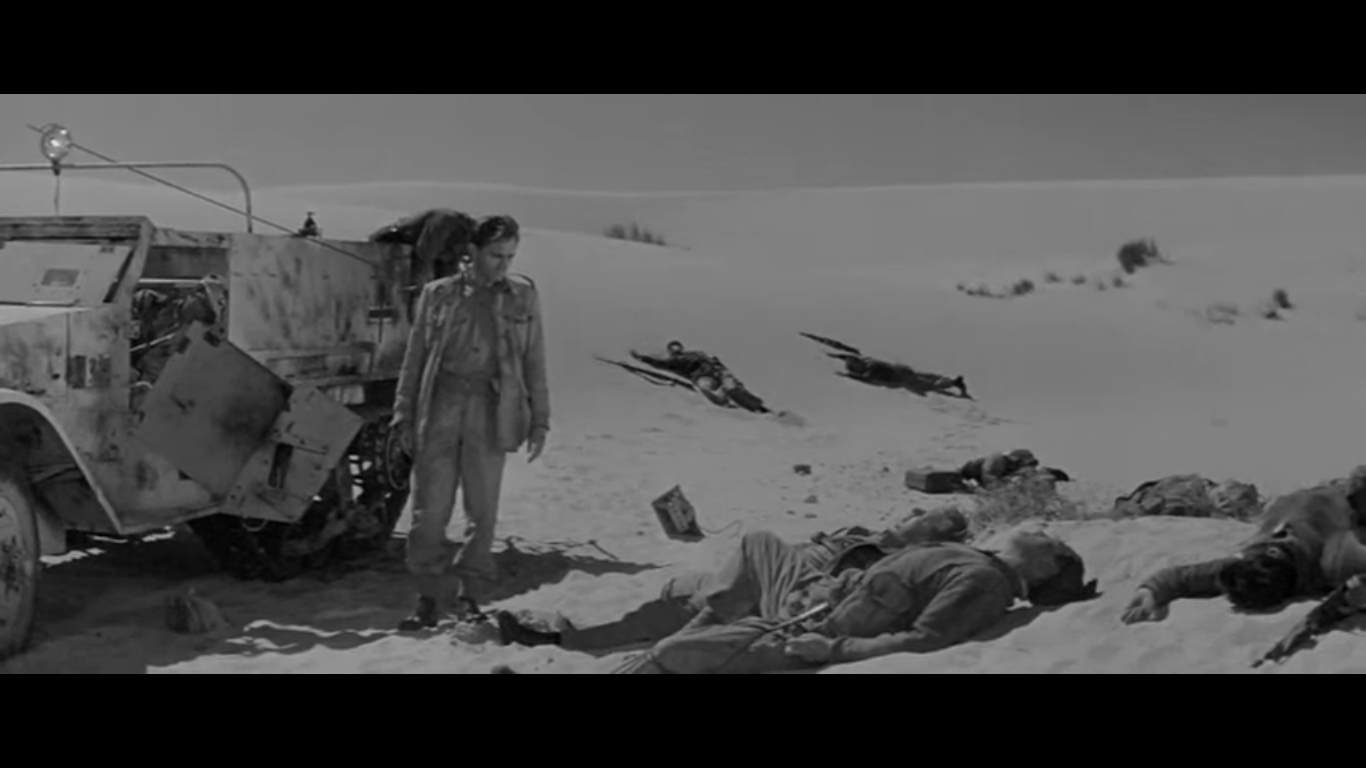
The film’s aesthetic is somehow impeccably represented by the wide array of combat dummies shot in black in white accentuating the muted tones of a rational military drama. It’s instigated by a secret mission behind enemy lines in Benghazi. This is North Africa during WWII.
There are two men being considered to lead the excursion: A curt, lifelong soldier Major Brand (Curd Jurgens). He’s by the book and adamant no one see his weakness. Then, a young, handsome fellow named Captain Leigh (Richard Burton) with a certain no-nonsense perspicuity and a background in ancient artifacts, not the mechanisms of war. He’s volunteered to serve his country. Whatever that means.
There are some pleasantries, and they take off to the club for the enlisted, a momentary calm before the work at hand. Thrown into the narrative as we are, it becomes apparent these are characters with some kind of overlapping history in a broad sense, and we become aware of their subtext involving a woman (Ruth Roman).
At first, it isn’t so engaging. The soldier with the sound effects and pyrotechnics at the bar seems to do more with his inebriated histrionics than them. Still, Ray ends the mounting sequence with a kiss in a carriage. Except before we see it in full, the carriage whisks away in this brilliant bit of kinetic energy playing out on the screen.
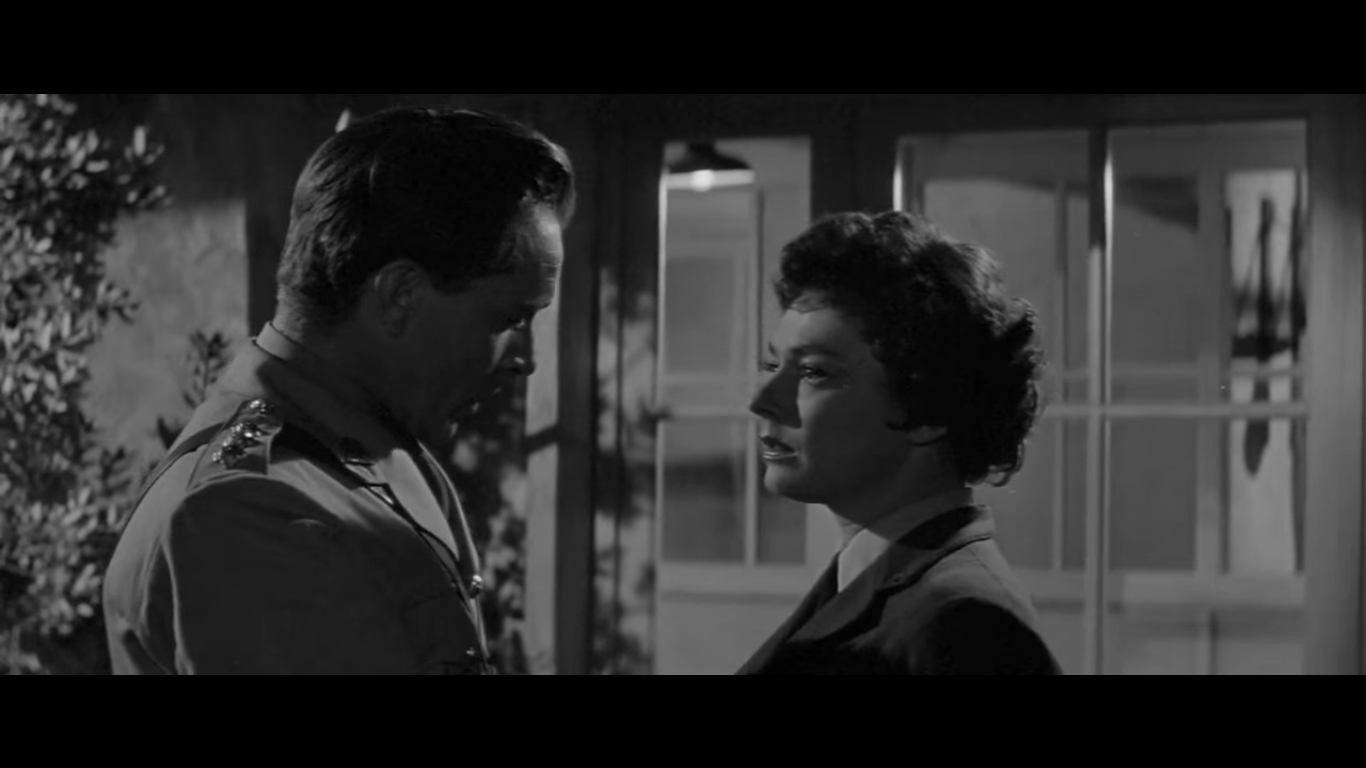
Roman is more mature and less delicate than we’ve ever seen her, partially thanks to the military garb but also due to the men she’s kept in her life. They’ve toughened her even as they grapple with romance.
It’s hardly a movie of jingoism as Burton represents a kind of jaundiced pessimism that would be his closest companion in The Spy Who Came in From The Cold as well. He’s hardly an adherent to wartime hero worship. And if Jurgens is beholden to the strictures of military protocol, he certainly doesn’t allow them to make him a joyful spirit. He’s constantly living life dictated by honor, fear, and his own inadequacies in command.
But we must remember there is a task at hand. They gather their company of recruits. Their plans are relayed through a model in a control room and curiously everyone seems to laugh off what might happen if their transportation a la humpback camel doesn’t make it to their rendezvous.
Soon they’ve become robed infiltrators cloaked by night loitering around the streets under Nazi occupation. Murder in the dark is silent though no less traumatic when it comes, even when it involves taking the life of an enemy in the line of duty.
These mission scenes have a clean and efficient luster, hardly dawdling when it comes to the action and as they disappear into the night and fight a skirmish over the sand dunes, it’s another perfect encapsulation of their clandestine task.
But the futility rushes back to Captain Leigh when it comes to the wounded. An enterprising soldier suggests getting a stretcher for a fallen comrade — but the pragmatist notes they would bleed to death in an hour — so the soldier goes down to offer a cigarette as a final consolation. He has an inherent human kindness and there’s something in Burton’s eyes as he watches. Is it regret or helplessness? Such decent showings of goodwill don’t come easily to him.
For some explicable reason, he stays behind as the others move forward. It might have been an order, but it might as well be to spite his superior. Whatever the reason, it’s hardly as baffling as Jurgens being cast as an Allied soldier. It feels like a gross mischaracterization no fault of his own.
Bitter Victory does continue to tease out a version of the love triangle involving David and Bathsheba where the man in the position of power is jealous for another man’s wife. Here the tables are turned. At the same time, the movie does feel like the antithesis of many “men on a mission” movies because it rarely feels bloated by pace, set pieces, and bits of narrative exposition and execution.
The character conflict becomes of greater interest than the actual task at hand. This is the movie’s wellspring because Burton and Jergens cultivate a mutual distaste throughout the entire movie. It continuously simmers and reaches the extremes of venomous vitriol. It’s more poisonous than the Germans, or even scorpions up a pant leg.
Burton bemusedly admits, “I kill the living and I save the dead,” and yet he still manages to scoff at his superior. “You have the Christian decency that forbids killing the dying man, but approves the work of a sharpshooter.” War so often seems to operate in baffling hypocrisies. It doesn’t make sense nor are the outcomes of war particularly equitable. They never have been.
When Roman clings to the arm of one of the barracks mannequins for support, her innate tenderness makes it feel like a totem for the man who didn’t come back. Again, it’s this dissonance of conflicting moods and emotions — what the military exonerates and exults in the service of duty and what the present company of soldiers standing by knows to be actually true.
The visual metaphor becomes even more overt when the same dummy is pinned with a medal. It comes to represent the core dilemma of the movie caught between duty, heroism, and the very manner in which we express and memorialize our sense of wartime. There are no easy answers. By the time Burton and Ray are done with us, they’ve blistered us to our core. You know a war picture has probably succeeded when it galls you and leaves you even momentarily disconsolate.
3.5/5 Stars
 4 Star Films