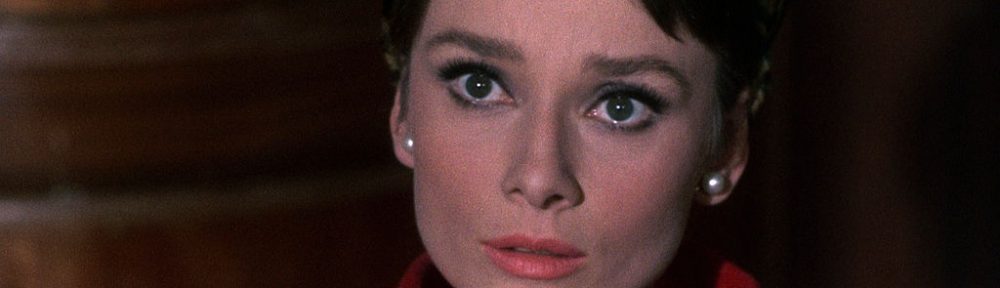
As often happens in the life of a classic movie aficionado, I became acquainted Claude Jade quite by accident and it happened at a random point in her filmography. In Hitchcock’s Cold War thriller Topaz (1969) she has a small part to play but the Master of Suspense was pointed to the actress by Francois Truffaut the French critic and director who had undertaken an immense interview with Hitch that has remained a treasure for cinema fanatics.
But still, that in itself has little bearing on Claude Jade. Jade came to the forefront of my mind after watching several entries in Truffaut’s famed Antoine Doinel saga starring Jean-Pierre Leaud, the first of these being Stolen Kisses (1968). And she immediately left an indelible mark on this viewer because she seemed the complete antithesis of our main character. Antoine was always a bit of a troublemaker, a vagrant, a malcontent, and whatever other negative descriptors you want to throw out. In some respect, it’s difficult to like him.
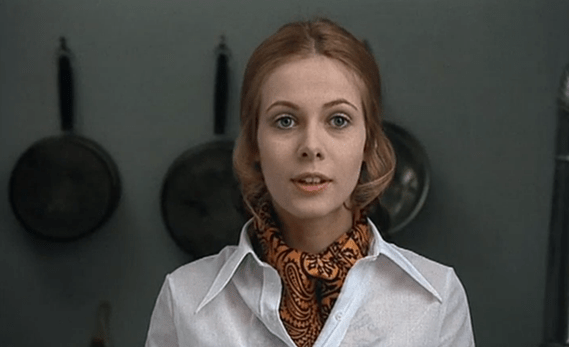
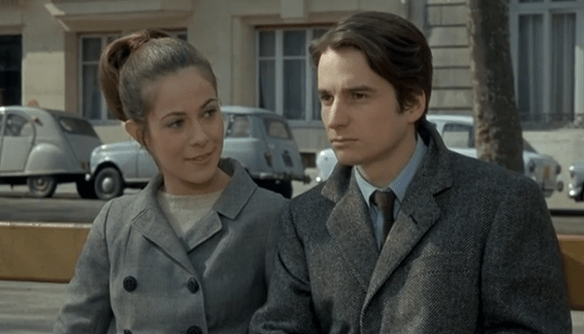
Yet from the first moment we see Christine Darbon, the wide-eyed ingenue, Antoine, and the audience are immediately taken with her for those very reasons. She’s so kind and sweet in ways that Antoine never manages to be. There’s an innocence and a playfulness behind her eyes that’s disarming. If we knew any better, we would say that he had no right in pursuing a relationship with a girl such as this. But to his credit, he does eventually get his life figured out just enough to begin to see her.
It’s these interludes of Stolen Kisses that we might say puppy love is bubbling up. There are furtive glances. Breakfast at the kitchen table. Walks through the neighborhood park together. It feels like a little slice of paradise and even in their utter differences, it seems that Antoine and Christine might make a life together. Perhaps they were even made for each other after all.
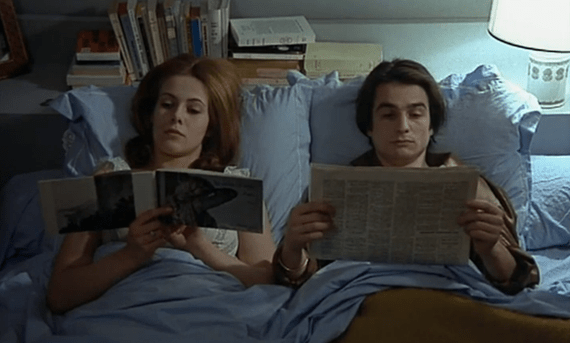
In Bed & Board (1970), the next installment in the series, the couple is now married and rather happily so. They have a baby and he has a flower shop and she teaches violin lessons. But they have each other and they are content. Reading in bed together after the day’s activities are over or eating a dinner of baby food because going to the store like adults is far too difficult. How could Antoine not be happy with a wife such as this?
However, he is always plagued by inner demons and infidelities. In this case, dismantling his marriage and all that is good with his life with another woman. But part of what makes Christine phenomenal is the immense grace in which she handles Antoine. Again and again, we are reminded of just how much he does not deserve her and yet she sees something in him that is worthwhile and worth staying with. If nothing else, she makes us appreciate Antoine as a protagonist, blessing him with a human side, and suggesting there are still some redeeming qualities left in him. So by the film’s end despite the turmoil and turbulence, they went through, they still have enough affection to stay together.
In Truffaut’s final installment Love on the Run (1979), the passage of time is not so kind to them as is often the case with life. But what stays the same is Christine (and unfortunately Antoine too). She remains a caring figure lighting up the screen with her charm, youthful exuberance, and quiet dignity even with she is slighted.
I will end by quoting the eminent critic Pauline Kael who noted in one of her reviews that Claude Jade was “a less ethereal, more practical Catherine Deneuve.” If I’d have to wager a guess on what she was getting at, it would probably be something along these lines. Deneuve was always this aloof beauty who exists in almost a different stratosphere and if we might be so bold to make the assumption, she feels almost unattainable. Maybe she doesn’t live in the same world that we do. Hers is a cinematic existence. But Jade in her playful winks and everyday interactions makes us feel like we know her well.
Because her life with Antoine is not unlike our own in some respects. That makes us appreciate her immensely and adore her even moreso because she feels like one of us. Deneuve is revered because she is beautiful in an elegant way. She would never be one to get her hands dirty. But with Jade, there’s that immediate connection. Rather than create a dichotomy however between “ethereal” and “practical” I’d much rather say that I appreciate them both and the impact that they both had on French cinema. Antoine Doinel, sometimes I think you’re an idiot. In fact, I know so. How could you not remain true to a woman with a face like that?

This is my entry in the Reel Infatuation Blogathon….
 “You can’t just do anything at all and then say ‘forgive me!’ You haven’t changed a bit.” ~ Colette
 Antoine Doinel is a character who thinks only in the cinematic and it is true that he often functions in a bit of a faux-reality. He seems normal but never quite is. He seems charismatic but we are never won over by him completely. Still, we watch the unfoldings of his story rather attentively.
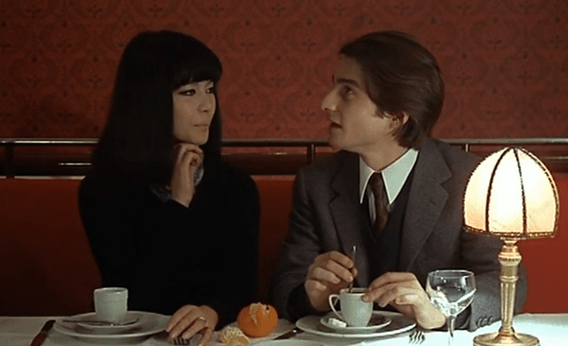 But as Truffaut usually does, he digs into his character’s flaws that suspiciously look like they might be his own. Antoine easily gets swayed by the demure attractiveness of a Japanese beauty (Hiroko Berghauer), and he begins spending more time with her. Thus the marital turbulence sets in thanks in part to Antoine’s needless infidelity –revealed to Christine through a troubling bouquet of flowers. It’s hard to keep up pretenses when the parent’s come over again and Doinel even ends up calling on a prostitute one more. It’s as if he always reverts back to the same self-destructive habits. He never quite learns.
 Charles Trenet’s airy melody “I Wish You Love” is our romantic introduction into this comedy-drama. However, amid the constant humorous touches of Truffaut’s film, he makes light of youthful visions of romance, while simultaneously reveling in them. Because there is something about being young that is truly extraordinary. The continued saga of Truffaut’s Antoine Doinel is a perfect place to examine this beautiful conundrum.
 In fact, all in all, if we look at Doinel he doesn’t seem like much. He’s out of the army, obsessed with sex, can’t do anything, and really is a jerk sometimes. Still, he manages to maintain an amicable relationship with the parents of the innocent, wide-eyed beauty Christine (Claude Jade in her spectacular debut). Theirs is an interesting relationship full of turbulence. We don’t know the whole story, but they’ve had a past, and it’s ambiguous whether or not they really are a couple. They’re in the “friend zone” most of the film and really never spend any significant scenes together. Doinel is either busy tailing some arbitrary individual or fleeing pell-mell from the bosses wife who he has a crush on.
 By the time he’s given up the shoe trade and taken up tv repair he’s already visited another hooker, but Christine isn’t done with him yet. She sets up the perfect meet-cute and the two young lovers finally have the type of connection that we have been expecting. When we look at them in this light, sitting at breakfast, or on a bench, or walking in the park they really do seem made for each other. Their height perfectly suited. Her face glowing with joy, his innately serious. Their steps in pleasant cadence with each other. The hesitant gazes of puppy love.
 While
While  Whereas the previous Torn Curtain was generally concerned with life behind the Iron Curtain, Topaz is decidedly more continental moving swiftly between Russia, France, America, Cuba, including a few pitstops at international embassies. However, the film does end up spending a lot of time focused on Cuba which can very easily be juxtaposed with the East German scenes in the former film. Hitchcock once more creates an illusion of reality using the Universal backlot and the adjoining area to craft Cuba, and he makes into a place of sunshine and romantic verandas, but it also runs rampant with totalitarian militia. It’s perhaps more exotic and welcoming than East Germany, but no less repressed. In both cases, they become a perilous locale for our protagonists. Still, rather unlike the previous film, Topaz lacks a truly A-list star like Paul Newman or Julie Andrews.
 4 Star Films